Justice and procedure

Books

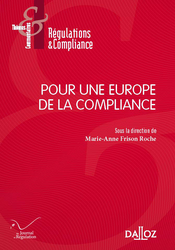
📕Pour une Europe de la Compliance (For the Europe of the Compliance)

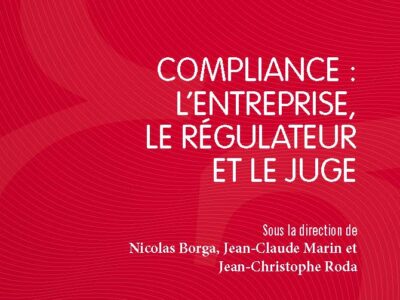
🌐 follow Marie-Anne Frison-Roche on LinkedIn 🌐 subscribe to the Newsletter MAFR Regulation, Compliance, Law - ► Full Reference: M.-A. Frison-Roche (ed.), Pour une Europe de la Compliance (For the Europe of the Compliance), series "Régulations & Compliance", Dalloz, 2019, 124 p.  - This volume is the continuation of the books dedicated to Compliance in this collection. 📚Read the other books' presentations of the collection about Compliance: 🕴️M.-A. Frison-Roche (ed.), 📕La juridictionnalisation de la Compliance, 2023 🕴️M.-A. Frison-Roche (ed.), 📕Les Buts Monumentaux de la Compliance, 2022 🕴️M.-A. Frison-Roche (ed.), 📕Les outils de la Compliance, 2021 🕴️N. Borga, 🕴️J.-Cl. Marin &🕴️J.-Ch. Roda (ed.), 📕Compliance : l'Entreprise, le Régulateur et le Juge, 2018 🕴️M.-A. Frison-Roche (ed.), 📕Régulation, Supervision, Compliance, 2017 🕴️M.-A. Frison-Roche (ed.),📕 Internet, espace d'interrégulation, 2016   📚Read the presentations of the other titles of the collection. - ► General presentation of the book: This book is written in French. The topic is : "For the Europe of the Compliance". See below its general presentation in English.  The political dimension is intrinsic to the Compliance Law. Indeed, compliance mechanisms consist of internalizing in certains companies the obligation to implement goals of general interest set by Public Authorities. These public bodies control the Ex Ante reorganization that implies for these companies and punish Ex Post the possible structural inadequacy of these compagnies, becoming transparent for this purpose.  This new mode of governance establishes a continuum between Regulation, Supervision, Compliance (book published in 2017) and renew the links between Companies, Regulators and Judges1Frison-Roche, M.-A., Compliance, see.  This political dimension must be increased: the Compliance Law of Compliance must today be used to build Europe. One can observe not only the construction of the  European Compliance Law, object-by-object, sector-by-sector, purpose-by-purpose, but also the construction of the European Compliance Law that transcends and unifies them. Becoming independent of American Law and ceasing to be in reaction, even on the defensive, the Compliance Law contributes to the European project, offering it a higher ambition, that Europe can carry and, by this way, can carry the Europe itself, not only to preserve the European economy from corruption or money laundering, but by claiming the protection of nature and human beings. This is why the book describes the "reasons and objectives" of the Europe of the Compliance, which makes it possible to describe, detect and even predict the ways and means. - ► Understand the book through the Table of Contents and the summaries of each article:  🕴️M.-A. Frison-Roche, 📝Avant propos  🕴️K. Lenaerts, 📝Le juge de l'Union européenne dans une Europe de la compliance 🕴️M.-A. Frison-Roche, 📝Un droit substantiel de la compliance, appuyé sur la tradition européenne humaniste   I. LES RAISONS ET LES OBJECTIFS D'UNE EUROPE DE LA COMPLIANCE (THE REASONS AND OBJECTIVES OF THE EUROPE OF THE COMPLIANCE)  🕴️X. Musca, 📝Construire une Europe de la compliance en donnant une meilleure place aux entreprises 🕴️P. Vimont, 📝La place de la diplomatie dans l'avancée d'une Europe de la compliance 🕴️P. Sellal, 📝Les vertus de la compliance : une réponse possible aux faiblesses de l'Union européenne ? 🕴️J.-J. Daigre, 📝Compliance, entreprise et Europe   II. LES VOIES ET MOYENS D'UNE EUROPE DE LA COMPLIANCE  (THE WAYS AND MEANS OF THE EUROPE OF THE COMPLIANCE) 🕴️J.-Cl. Marin, 📝Quels outils pour la construction du droit de la compliance en Europe ? 🕴️M. Canto-Sperber, 📝La compliance et les définitions traditionnelles de la vertu 🕴️T. Bonneau, 📝Compliance et secteur bancaire et financier en Europe 🕴️C. Duchaine, 📝L'Agence française anticorruption, à l'appui de l'Europe de la compliance 🕴️D. Martin, 📝Les contraintes et les vertus de la compliance 🕴️A. de La Cotardière, 📝Construire une Europe de la compliance lisible pour les entreprises -

Reports

📓 L’apport du Droit de la Compliance dans la Gouvernance d’Internet (The contribution of Compliance Law in the Governance of Internet))

► Full Reference: M.-A. Frison-Roche, L'apport du Droit de la Compliance dans la Gouvernance d'Internet  (The contribution of Compliance Law to the Internet Governance), Report asked by the French Government, published the 15th of July 2019, 139 p. - ► Report Summary. Governing the Internet? Compliance Law can help. Compliance Law is for the Policy Maker to aim for global goals that they require to be achieved by companies in a position to do so. In the digital space built on the sole principle of Liberty, the Politics must insert a second principle: the Person. The respect of this One, in balance with the Freedom, can be required by the Policy Maker via Compliance Law, which internalises this specific pretention in the digital companies. Liberalism and Humanism become the two pillars of Internet Governance. The humanism of European Compliance Law then enriches US Compliance law. The crucial digital operators thus forced, like Facebook, YouTube, Google, etc., must then exercise powers only to better achieve these goals to protect persons (against hatred, inadequate exploitation of data, terrorism, violation of intellectual property, etc.). They must guarantee the rights of individuals, including intellectual property rights. To do this, they must be recognized as "second level regulators", supervised by Public Authorities. This governance of the Internet by Compliance Law is ongoing. By the European Banking Union. By green finance. By the GDPR. We must force the line and give unity and simplicity that are still lacking, by infusing a political dimension to Compliance: the Person. The European Court of Justice has always done it. The European Commission through its DG Connect is ready.   ► 📓 Read the reporte (in French) 📝 Read the Report Summary in 3 pages (in English) 📝 Read the Report Summary in 6 pages (in English) -   ►  Plan of the Report (4 chapters): an ascertainment of the digitization of the world (1), the challenge of civilization that this constitutes (2), the relations of Compliance mechanisms as it should be conceived between Europe and the United States, not to mention that the world is not limited to them, with the concrete solutions that result from this (3) and concrete practical solutions to better organize an effective digital governance, inspired by what is particularly in the banking sector, and continuing what has already been done in Europe in the digital field, which has already made it exemplary and what it must continue, France can be force of proposal by the example (4). -   📝  Read the written presentation of the Report done by Minister Cédric O (in French). 🏛 Listen to the oral  presentation of the Report by Minister Cédric O durant the parliamentary discussion of the law against hate contente on the Internet (in French). -   💬 Read the interview published the 18 July 2019 : "Gouvernance d'Internet : un enjeu de civilisation" ( "Governing Internet: an Issue of Civilization"), given in French,  📻 Listen the Radio broadcast of July 21, 2019 during which its consequences are applied to the cryptocurrency "Libra" (given in French) 🏛 Presentation of the Report to the Conseil Supérieur de l'Audiovisuel- CSA (French Council of Audiovisual) on Septembre 5, by a discussion with its members presentation (in French) 💬 Read the  Interview published the 20 December 2019 : "Le droit de la compliance pour réguler l'Internet" ("Compliance Law for regulate Internet"), given in French -     read below the 54 propositions of the Report ⤵️ - 🌐 follow Marie-Anne Frison-Roche on LinkedIn 🌐follow Marie-Anne Frison-Roche on Instagram 🌐subscribe to the Newsletter MAFR Regulation, Compliance, Law 

Books

🏗️ direction of the collection: 📚Droit et Économie

L’ordre public économique (Economic Public Order)

Full reference : Laget-Annamayer, A. (ed.), L'ordre public économique ("Economic Public Order"), coll. "Droit et Économie", Lextenso – LGDJ éditions, 2018, 397p.   This collective book is published in French.    This is the 32nd volume published in this collection.   Often launched as an all-encompassing expression, both by the doctrine and by the judge, public economic order remains a mysterious concept whose substance and contours are difficult to know, simply because it is liable to fluctuate according to its apprehension and depending on the economic and social context. Yet the expression has become widely used, almost incantatory, like a label, and there is therefore undoubtedly a gap between its invocation and its meaning in Law. It is to this discrepancy, and in an attempt to reduce the mystery, that this work is devoted. Not stopping at the only vision of public economic order in internal Public Law, he tries to seek the meanings of it in Comparative Law, in European and International Law, without omitting the historical, privatist or economic vision. It is therefore to this rich overview treated by specialists from different legal fields and beyond that this book invites. It does not aim to put an end to the debate, but on the contrary to arouse it in the context of reflections on the relationship between Law and Economics of which everyone knows the importance. Authors are : Olivier Baillet, Jacques Caillosse, Aurélien Camus, Jacques Chevallier, Dominique Custos, Pierre Delvolvé, Samuel Ferey, Sébastien Hourson, Pascale Idoux, Jean-Philippe Kovar, Aurore Laget-Annamayer, Jérémy Martinez, Francesco Martucci, Jeanne Mesmin d’Estienne, Claire Mongouachon, Eric Naim-Gesbert, Guillaume Richard, Jean-Marc Sorel, Pascal de Vareilles-Sommières.   Read the forth of cover. Read the Table of Contents.   See the whole collection in which this book is published

Books

GPA : DIRE OUI OU DIRE NON

Working papers

Enterprise, Regulator, Judge: Thinking Compliance by these three characters

This working paper has served  as a basis for an article written in French in the book Compliance : Entreprise, Régulateur, Juge ("Compliance: Enterprise, Regulator, Judge"), published in May 2018 in the Regulations Series of Dalloz editions (Paris). See the other books published in this collection (presentation in French), directed by Marie-Anne Frison-Roche (presentation in English). ABSTRACT: The Company, the Regulator and the Judge are three key figures for the construction of an emerging Compliance Law. An important risk lies in a confusion of their respective roles, the company becoming a regulator, the regulator becoming a board of a place that goes to the conquest of others, the judge standing back. It is appropriate that each plays his role and that their respective function is not distorted. If this confusion is avoided, then the points of contact can multiply and one observes it. But as soon as everyone remains in its place, we can go further than these points of contact and if they agreed, the three characters can reach common goals. This is all the more legitimate since Compliance Law, as Regulation Law, is teleological in nature, which makes these branches of law profoundly political. These common goals are technical, such as risk prevention. They can be more political and higher, if there is a shared will, without ever one of the characters being captured by another: it is then to concern by the human being. The designation of this common goal to the Company, the Regulator and the Judge can be expressed in one word: Europe.

Working papers

🚧 To protect human beings, the ethical imperative of the legal concept of person

►   This working document was intended to serve as a support for a conference pronounced in French in the conference Droit et Ethique ( Law & Ethics) of May 31, 2018 in a symposium organized by the Court of Cassation and the Association Française de Philosophie du Droit.  French Association of Philosophy of Law on the general theme Law & Ethics. See a general presentation of this conference.  Rather, it has served as a support for the article to be published in the Archives de Philosophie du Droit (APD). This article is written in French.    ►   Summary: It is through the Law that the human being has acquired a unity in the West (I). What religion could have done, the Law also did by posing on each human being the indetachable notion of him of "person" (I.A). But this is what is challenged today, not the personality and the power that the human being has to express his freedom but the unity that implies in the disposition that we have of ourselves in repelling the desire that others have always had to dispose of us. Current law tends to "pulverize" human beings into data and transform into neutral legal services what was considered before as the devouring of others. The legal concept of "consent", ceasing to be proof of a free will but becoming an autonomous concept, would suffice (I.B.). To prevent the reigning of the "law of desires", which merely reflects the adjustment of forces, we must demand here and now the ethical sovereignty of Law, because Law can not be just just be just the interests adjustment (II). We can form this request if we do not want to live in an a-moral universe (II.A), if we see that the unity of the person is the legal invention that protects the weak human being (II.B.). If we admit this imperative, then we must finally ask who in the legal system will express and impose it, especially the legislator or the judge, because we seem to have lost the ability to recall this principle of the Person on which the West was so centered. But the principles that are no longer said disappear. There would then remain only the case-by-case adjustment of interests between human beings in the world field of particular forces. At this yardstick, Law would be more than a technique of securisation of particular adjustments. Law would be reduced at that and would have lost its link with Ethics. (II.C). .   

Articles

Bertrand Cantat revendique son “droit à la réinsertion” et le fait qu’il “a payé la dette à laquelle la justice l’a condamné” : en Droit, la justice pénale n’est pas une simple “facture” et c’est en terme de “libertés” et non de “droits” que les questions se posent