Justice and procedure

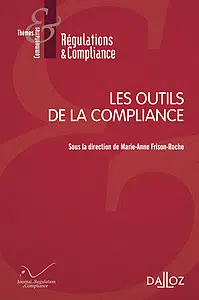
Couverture – Les outils de la Compliance

Books

Collection Régulations & Compliance Les outils de la Compliance (ed.)

General reference : Frison-Roche, M.-A. (ed.), Les outils  de la Compliance, series "Régulations & Compliance", Journal of Regulation & Compliance (JoRC) & Dalloz, 2021. In parallel, the book is published in an English version Compliance Tools, co-edited by the Journal of Regulation & Compliance (JoRC) and Bruylant.  This book follows a cycle of conferences organized by the Journal of Regulation & Compliance and by its partner universities.  -   See the collection Regulation & Compliance in which the book has been published.    - General presentation of the book : The political dimension of Compliance Law resides in the monumental goals that it aims for and which define it. These goals are internalized in "crucial operators", who willingly or by force must structure themselves and act to achieve "monumental goals", as set by public authorities and which may coincide with the interests of the enterprise. This one designs and controls the Ex Ante reorganization that this implies, under the public authorities supervision. Enterprises, even if their activities are not regulated, thus become transparent and must show the Compliance Tools effectively deployed to effectively achieve these goals. It is a major transformation of economic life in all countries because the Compliance Tools are adopted everywhere and have a global effect. These appear to be very diverse but their unity is profound and bringing it out has the practical benefit of producing a legal regime that is as unified as possible, while allowing their adaptation country by country, sector by sector, enterprise by enterprise.  This book aims to understand these Compliance Tools to better anticipate the assessment that will be made by Regulators, Supervisors and Courts, as well as the new conceptions of the authors of legal texts which impose new ones every day, while companies must also imagine the most appropriate Compliance Tools. This collective work specifically apprehends those on which we have few studies when we handle them on a daily basis, such as risk mapping or training or rights, letting more familiar tools shine through more transversal contributions, such as compliance programs, sanctions, whistleblowing or many sorts of settlements, agreements of public interest. A first chapter takes a legal and economic approach. A second chapter emphasizes the role of risk mapping. A third chapter draws the game of incentives. A fourth chapter identifies the expertise required. A fifth chapter insists on geographic significance. A sixth chapter details the measurement of effectiveness. A seventh chapter explores training. The eighth chapter examines technological tools. The concluding article leads to rights. -   Read the general presentation of the book, including the table of contents and the introduction (in French).   Read the presentations of the articles of the book :   Amico, Th., La Compliance ou le passage de l'ex post à l'ex ante: une révision copernicienne pour l'avocat pénaliste ?   Banck, A., La maturité de l’usager de l’outil de la Compliance, premier critère du choix de l’outil adéquat   Benzoni, L., and Deffains, B., Approche économique des outils de la Compliance: finalités, effectivité et mesure de la Compliance "subie" et "choisie"   Burlingame, R., Coppens, KK, Power, N. & Lee, D.H., Compliance : lutte internationale contre la corruption et gestion du risque   Calandri, L., Incitation(s) et autorégulation(s): quelle place pour le Droit de la Compliance dans le secteur audiovisuel?   Causse, H., La formation en Compliance, par et au-delà de la formation classique   Frison-Roche, M.-A., Décrire, concevoir et corréler les outils de la Compliance, pour en faire un usage adéquat   Frison-Roche, Construire juridiquement l'unité des outils de la Compliance à partir de la définition du droit de la Compliance par ses "buts monumentaux" ​ Frison-Roche, M.-A., Compliance et incitations, un couple à propulser   Frison-Roche, M.-A., Résoudre la contradiction entre incitations et sanctions sous le feu du Droit de la Compliance   Frison-Roche, M.-A., Dresser des cartographie des risques comme obligation et le paradoxe des "risques de conformité"   Frison-Roche, M.-A., Compliance : contenu et contenant du Droit de la Compliance    Frison-Roche, M.-A., Les droits subjectifs, outils premiers et naturels du Droit de la Compliance ​ Galland, M., Le contrôle par le Régulation de l'effectivité des instruments de compliance ​ ​Granier, C., L'originalité normative de la Compliance by design   Guillaume, N., Cartographie des risques de compliance : premiers aperçus des enjeux,des limites et des bonnes pratiques   Gutierriez-Crespin, A., L’audit du dispositif de compliance : un outil clé pour en vérifier la robustesse   Koenigsberg, S. et Barrière, Fr, La construction de l'expertise de l'avocat en matière de compliance   Larouer, M., Les manifestations des mécanismes incitatifs dans le Droit français de la Compliance   Merabet, S., La morale by design   Pailler, L., Les outils technologiques, la Compliance by Design et le RGPD: la protection des données personnelles dès la conception   Racine, J.-B., La prégnance géographique dans le choix et l'usage des outils de la Compliance   Rapp, L., Théorie des incitations et gouvernance des activités spatiales   ​Roda, J.-C., Compliance by Design en antitrust: entre innovation et illusion   Salah, M., Conception et application de la Compliance en Afrique   Tardieu, H., Souveraineté des données et Compliance   Thouret, T., Formation et Compliance, deux outils corrélés de transmission d'information   -

Videos

🎥 The Economic Attractiveness of Impartiality (“L’attractivité économique de l’impartialité”), in “”Economic Attractiveness, Judge Office and Impartiality. Thinking the judge Office” (“L’attractivité économique, l’office du juge et l’impartialité. Penser l’office du juge”)

►  Full Reference : Frison-Roche, M.-A., The Economic Attractiveness of Impartiality ("L'attractivité économique de l'impartialité"), in ""Economic Attractiveness, Judge Office and Impartiality. Thinking the judge Office" ("L'attractivité économique, l'office du juge et l'impartialité. Penser l'office du juge"),  -   🎥 watch the conference (in French with English subtitles) -   📝 read the colloquium program ( in French) 📝 see the general program of the cycle on the Judge Office. -   📝 read François Ancel's article of 14th of January 2021 in the Receuil Dalloz and which report this colloquium (in French)      📝 read the Working Paper, basis of this conference. This Working Paper is significantly different from the conference because it was conceived befor the colloquia cycle beginning. In addition, since this manifestation was a Round Table, the conference has taken more into account previous conferences and what said the other two speakers.   📊 see the slides, basis of the conference (in French) The slides could not be shown during the conference. Orally, it was appropriate to more develop the introductory remarks for emphasizing the human and unique dimension of the Judge Office, expected in economic matters. As a result, the second part of the conference was not given orally, so slides therefore remain the only media available. - ►  Summary of the conference : To fit into the ambition of this general colloquia cycle, which is to "Think the Judge Office" and in this round table which apprehends the imperative of economic attractiveness of this office, firstly emerges the seemingly contradictory relationship between this imperative and the distance that the judge must maintain. Thus it is often asserted that the judge should be internalized at this point in the "places", – an economic concept of great scope (to which the first part of the introduction is devoted, defining the "place" at the same time as a closed and porous space and as a "systemic litigant" -, that he/she should ipso facto lose his/her distance, that is to say his/her impartiality. As places are in competition, even if weighing on one hand the effectiveness of the place, and on the other hand the impartiality of a judge who is external to this place – Judge referring to the Law , Impartiality would necessarily emerge weakened. It would then be necessary on a case-by-case basis to get the judge to give the desired concessions… The conference aim is to take the opposite position and to state that the Place – in particular because they must be strongly distinguished from the Markets, of which they were the ancestors – require a Judge, who is at the same time "singular", that is to say with a personality, a face, opinions, and in distance so that his/her imagination does not surprise Place. Indeed, these require a human Justice, and a not mechanical one and singular judges, of whom the juge des référés or the arbitrator are the epigone, meets this need. But for reducing their "margins of discretion", how Economy qualifies the Impartiality of a person who can never be neutral, the singular Judge's Office must be inserted into mechanisms reducing these margins. In this way, the Place may reach a Judge who is always more impartial, and in doing so the Place becomes always more attractive. To achieve this in practice, the place expresses two legitimate expectations, as a "systemic litigant", whose satisfaction increases and the singular Judge's Impartiality and increases the Attractiveness of the Place as a space. This clearly shows that the Place's Attractiveness and the Judge's Impartiality, because judges are inserted into procedures, into institutions and into a "jurisdictional family", are not only not contradictory, but are on the contrary convergent, one fueling the other. Concretely, and judicial practice shows it, it is necessary to consolidate the particular Judge's Impartiality by inserting him/her into collective processes. As it is necessary to promote a radiance of Impartiality by strengthening the "jurisdictional family". To consolidate the singular Judge's Impartiality  by inserting him/her into collective processes, it is necessary to admit without hesitation the subjectivity of the judge, to seek it even. The reduction of the margins of discretion, definition of impartiality, being obtained by the inclusion of the judge in a procedure of which he /her alone is the master but in which he/her is not alone. This has the technical consequence that he/her is himself/herself in an adversarial debate, not only during the proceedings, but also before (in the media), inside the judgment (and the decision of the Criminal Chamber of 25 November 2020 is a model of that) and after the judgment. By that, the Judge shows that by his/her office he/she is in the future, as climate justice will show. In addition, to limit his/her margins of discretion, the singular judge must fit into a rational principle of coherence, vertical and horizontal. Vertical coherence, because he/she integrates what it is said and the technique of the "determining opinion" is to be encouraged, the singular judge having to avoid it only if he/she has "strong reasons" to do it. This is to follow  this general rule Comply or Explain (which is the very opposite of blind obedience). Horizontal coherence, because the singular judge either sticks to what he/she said, estoppel also being a rule of logic. But above all, the institution must extract as much as possible from " institutional doctrines", by all means, of which the annual reports are an example. To consolidate the singular Judge's Impartiality by strengthening the notion and reality of the "Jurisdictional Family", it is necessary to have of it a broader conception, which could lead to "guidelines" common to various jurisdictions, and a stronger one, by integrating those surrounding the judge to lead to judgment. In this, the procedure before the Court of Justice of the European Union, working on a common file, is a model. If this community were even stronger, the Judge Office would be even more useful than it is already in the digital space. Thus, Judges who are always human, always diverse, always singular, who listen, consider and adjust to the situation, who within a Jurisdictional Family fit into an Institutional Doctrine which transcends and supports them but which they transform if there is a strong reason to do so, a reason always expressed said: this is the embodied Impartiality that makes an economic and financial Place attractive.   -      

Articles

FRISON-ROCHE, Marie-Anne

💬 “Health Data Hub est un coup de maître du Conseil d’État” (“Health Data Hub is a stroke of genius of the Conseil d’État”)

Full reference: Frison-Roche, M.-A., "Health Data Hub est un coup de maître du Conseil d'État", interview realized by Olivia Dufour for Actu-juridiques, Lextenso, 22nd of October 2020 Read the news of 19th of October 2020 of the Newsletter MAFR – Law, Compliance, Regulation on which relies this interview: Conditions for the legality of a platform managed by an American company hosting European health data​: French Conseil d'État decision  To go further, on the question of Compliance Law concerning Health Data Protection, read the news of 25th of August 2020: The always in expansion "Right to be Forgotten"​: a legitimate Oxymore in Compliance Law built on Information. Example of​ Cancer Survivors Protection 

Articles

💬Et si le secret de l’avocat était l’allié de la lutte contre le blanchiment ? (Why would the attorney not be an ally in the fight against money laundering?)

Full reference: Frison-Roche, M.-A., Et si le secret de l’avocat était l’allié de la lutte contre le blanchiment ?, interview realized by Olivia Dufour for Actu-juridiques, Lextenso, 15th of October 2020 Read the interview (in French) To go deeper on the place of the attorney in Compliance Law, read Marie-Anne Frison-Roche's working paper: The Attorney, Vector of Conviction in the New Compliance System

Working papers

Rights, primary and natural Compliance Tools

Full Reference : Frison-Roche, M.-A., Rights, primary and natural Compliance Tools, Working Paper, July  2020. This Working paper is the basis for an article published in the collective book  Compliance Tools . - There was a time when Regulatory techniques  were above all only calculations of the best tarifications, taken up by monopolistic companies, while Compliance techniques were only obedience to all rules governing us. All this could therefore only be business of abacus and badine, used by engineers and consisted only of mechanical reflexes of "conformity" to all kinds of rules with the corset ensuring that everyone is bent in front of them1Contre cela, la critique radicale, savante et fondée d'Alain Supiot, dans l'ensemble de son oeuvre et plus particulièrement dans La gouvernance par les nombres, 2015. . In the perspective of a Regulation and Compliance thus conceived, that is to say effective, it would not be necessary to insert prerogatives for people, since these could only be sources of inefficiency, of cost. and protest, where the order would come from figures set in advance and controlled processes. Systems have since evolved to integrate these prerogatives of each person: rights. Is this evolution really acquired? Maybe more effectively in Regulation Law than in its extension which is Compliance Law. This may be surprising since Compliance Law, in that it extends Regulatory Law in enterprises should, on the contrary, promote rights by meeting the enterprise, which is a group of people ….2Sur la définition de l'entreprise comme un groupe de personnes qui se réunissent pour entreprise, v. le travail de référence d'Alain Supiot, par exemple son article d'introduction "L'entreprise...", dans l'ouvrage qu'il a dirigé L'entreprise dans la mondialisation ...., 2015 ... . But the modern reluctance to define the enterprise (and the company) as a group of people and the preference given to a definition of the company (and the enterprise) as an "asset", a "good" of which investors would be the owners, maybe explains the sidelining of rights not only in Regulatory Law but also in Compliance Law even though it is being deployed in the space of the enterprise3Si l'entreprise pouvait renaître comme idée de cristallisation d'une idée commune entre des personnes, naturellement titulaires de droits subjectifs, exerçant ensemble leur liberté d'entreprendre pour réaliser un projet commun, ce qui correspond à la définition classique du contrat d'entreprise donnée à l'article 1832 du Code civil, cela renforcerait considérablement la présence des droits subjectifs dans le Droit de la Compliance et conforterait la nature humaniste de celui-ci. En outre, dans une telle définition la loi de la majorité, qui n'est qu'une loi de fonctionnement d'une catégorie de sociétés que sont les sociétés de capitaux, deviendrait moins puissante, au profit des "droits propres" de tout associé (au-delà du cercle des sociétés de personnes), sans qu'il soit besoin d'aller chercher au-delà du cercle des associés ou titulaires de titres émis par la société ou l'entreprise (dit shareholders) et d'aller donner le "droit à la parole" à des personnes qui, parce qu'elles sont "concernées" (les "parties prenantes", les skateholders) ont désormais de plus en plus le "droit à la parole". . In addition, if Regulation has long been the subject of a branch of Law in which rights have full place, the presentation of Compliance as "conformity", that is to say the proven assurance of obedience to all the applicable rules, leaves no space for the prerogatives of people, which appear rather as resistance to the obedience that would be expected of them. There again, the expectation of what would be a good ratio of conformity between behaviors and prescriptions would be obtained by a "design", data processing being the new form of calculation, improved by precision tools where the being human is not required4La Compliance by Design reflète ces tensions. Elles sont particulièrement bien décrites par Cécile Granier. V. ..... His fallibility and the little confidence which one can place in him leads even to exclude the people and to conceive Compliance system between machines, not only to alert of the failures, but also to manufacture the "regulations" and to connect those. here, in a "regulatory fabric" without a jump stitch, entirely enveloping human beings5Contre cette conception de la légalité, qui prévoit tout et à laquelle il faudrait prouver par avance et que l'on se "conforme" entièrement, ce qui est contraire aux principes mêmes du libéralisme dont le principe est la liberté d'agir et non pas l'obéissance, Carbonnier affirme que les règles sont faites ne pas s'appliquer et qu'elles ne sont que le "mince vernis" des choses, qu'il convenait de se méfier de la "passion du Droit". V. not. son dernier ouvrage Droit et passion du droit sous la Vième République, 1995. Carbonnier est considéré comme le plus grand juriste français du XXième siècle. Il rédigea les lois qui réformèrent en profondeur le Code civil et publia des ouvrages sur "l'art législatif". . It would therefore be with regret, and probably because some constitutional jurisdictions still attach some value to fundamental rights that the systems of "conformity" of behavior to the rules make some room for the prerogatives of people, their more essential rights. It is sometimes said that this is part of the cost. It would therefore be as by "forcing" that rights would exist in Compliance systems, a kind of price that the effectiveness of Compliance must pay as a tribute to the Rule of Law principle6Au contraire, l'Etat de Droit n'est pas un coût extérieur au système de Compliance efficace, que celui-ci doit internaliser. Il est le fondement même du Droit de la Compliance. Voir dans ce sens la démonstration faite par le président de la Cour de Justice de l'Union européenne, Koen Laearnt, ..., in Pour une Europe de la Compliance, 2019. . If in a poor definition Compliance is conceived in this only "conformity", leading to a landscape in which the behaviors of the people adjust to the rules governing the situations, Compliance being only the most "effective way" to ensure the application of the rules, in a mechanical perspective of Law, then it would effectively be necessary to reduce the prerogatives of people to a minimal part, because any "additional cost" is intended to disappear, even if it is produced here by constitutional requirements. In the looming battle between the effectiveness of the application of rules and the concern for the legal prerogatives of people who should above all obey and not claim their rights, especially their right not to obey , or their right to keep secret in Compliance techniques which is based on the centralization of information, the effectiveness of efficiency could only, by the very power of this tautology, prevail7Sur la démonstration comme quoi la Constitution, en ce qu'elle contient de l'incalculable, est broyée dans cette façon de faire, v. Alain Supiot, Intervention 2019. …  The defeat would not be total, however, collaboration would still be possible and active between people availing themselves of their rights and Compliance Law. Indeed, in many respects, if rights have been recognized in Compliance systems, it is not only because Compliance Law, like any branch of Law, can only be deployed with respect for fundamental rights. kept by fundamental legal texts, but also because of the effectiveness of rights as " Compliance Tools". Indeed, because they constitute a very effective "tool" to ensure the entire functioning of a system whose goals are so difficult to achieve, because every effort must be made to achieve these goals, the public authorities not only rely on the power of crucial operators, but also distribute prerogatives to people who, thus encouraged, activate the Compliance system and participate in the achievement of the "monumental goals". Rights can prove to be the most effective tools to effectively achieve the goals set, to such an extent that they can be considered as "primary tools"  (I). But it is necessary to be more ambitious, even to reverse the perspective. Indeed because all the Monumental Goals by which Compliance Law is defined can be reduced to the protection of people, that is to say to the effectiveness of their prerogatives, by a mirror effect between rights. given by Law to persons and the rights which constitute the very purpose of all Compliance Law, in particular the protection of all human beings, even if they are in a situation of great weakness, rights become a "natural tool" of Compliance Law (II). Rights are the Compliance Law future. 

Organisation of events

Organization and scientific co-direction of the cycle of colloquia : “The juridictionnalization of Compliance”

Like the precedent cycles dedicated to the general topic of Compliance, aiming to build a “Compliance Law” and aiming also to be published in the series Regulation & Compliance, coedited by the Journal of Regulation & Compliance and Dalloz, this cycle continues to deepen a specific aspect of this emerging branch of Law which has been applied before being designed. The year 2020-2021 will give rise to two full and distinct cycles, the former deepening a key concept of Compliance Law, that are “monumental goals” and the later deepening a phenomenon with multiple roots and consequences: “the juridictionnalization of Compliance”. The juridictionnalization of Compliance is perhaps as ancient as Compliance mechanisms themselves. These various conferences will take place in different places, according to the role played by the very numerous universities which, this year once again, support the Journal of Regulation & Compliance for the realization of this cycle. This cycle will give rise to two books, one in French: La Juridictionnalisation de la Compliance, and the other in English : Juridictionnalization of Compliance.  This cycle of colloquia The juridictionnalization of Compliance will start in October 2020 and will take place until December 2021. Inaugural colloquium: Compliance juridictionnalization: why? Who? How? Where? and Toward What? , organized by the JoRC under the scientific direction of Marie-Anne Frison-Roche : read more information here   Second Colloquium: 31st of March 2021 : Arbitration and Compliance, co-organized by the JoRC and Paris II University, under the scientific direction of Marie-Anne Frison-Roche and Jean-Baptiste Racine : read more information here   Third colloquium : 23rd of June 2021 : The firm instituted as Court by Compliance Law, co-organized by the JoRC and the équipe de recherche Louis Josserand of Lyon 3 University, under the scientific direction of Marie-Anne Frison-Roche and Jean-Christophe Roda : read more information here   Fourth colloquium: September 2021 : Which judges for Compliance? , co-organized by the JoRC and the CR2D of Paris-Dauphine University, under the scientific direction of Marie-Anne Frison-Roche and Sophie Schiller : read more information here ​ Fifth colloquium: October 2021 : Compliance Law, crucible between American Procedure Law and Procedure Law, co-organized by the JoRC and the Brussels University, under the scientific direction of Marie-Anne Frison-Roche and Arnaud van Waeyenberge: read more information here   Sixth colloquium: Proportionnality, Compliance balance, co-organized by the JoRC and IDETCOM of Toulouse University, under the scientific direction of Marie-Anne Frison-Roche and Lucien Rapp: read more information here

Articles in a legal collective publication

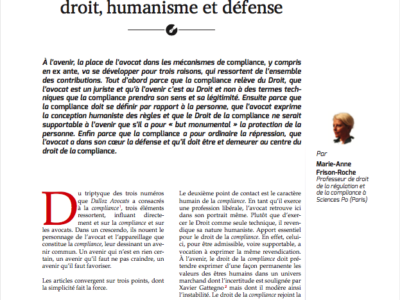
Attorney and Compliance – The future of the character and his tool: Law, Humanism and Defense

Full reference : Frison-Roche, M.-A., Avocat et Compliance – L'avenir du personnage et de son outil : Droit, Humanisme et Défense ("Attorney and Compliance – the future of the character and his tool: Law, Humanism and Defense),article of synthesis fo the collective publication "Compliance", Dalloz Avocat, March 2020, April 2020, June 2020, Dalloz Avocat, June 2020, pp. 321-324 Read the synthesis article (in French). Read the editorial of the March 2020 Issue, presenting the problematic : "The Attorney, Vector of Conviction in the New Compliance System".    -   Summary of the article: In the future, the place of lawyers in compliance mechanisms, including in Ex Ante, will develop for three reasons, which emerge from all of the contributions. First of all because Compliance is a matter of Law, a lawyer is a lawyer and in the future it is a matter of Law and not on technical terms that Compliance demands its meaning and legitimacy. Then because Conformity must be defined in relation to the person, the lawyer expresses the humanist conception of the rules and Compliance Law will only be tolerable in the future if it is for "monumental goal" of protection of the person. Finally, because Compliance with ordinary repression, that the lawyer in his heart defends and must be and remain at the center of Compliance Law. -

Articles in a legal collective publication

The attorney, vector of conviction in the new Compliance system (L’avocat, porteur de conviction dans le nouveau système de Compliance)

Référence générale : Frison-Roche, M.-A., L'avocat, porteur de conviction dans le nouveau système de Compliance, Dalloz Avocat, mars 2020. This editorial opens a thematic collective publication about Compliance. A synthetic article on all the contributions, published in May 2020, mirrors it: "Attorney and Compliance – The future of the character and his tool: Law, Humanism and Defense" - English Summary of the article (written in French) :  If we perceive Compliance Law as an aggression of the private company and a binding set of mechanisms that have no meaning and added value for it, then the attorney has a utility: to defend the business. It can do so not only during the sanctions phase, but also to prevent it. But this function is not central. He and she becomes so if we understand Compliance Law as being a body of substantial rules, pursuing a "monumental goal": the protection of the person, goal injected by political bodies and taken up by the operator. From this, the company must convince everyone to take it back, inside the company and outside. In a general and contradictory debate, the attorney carries this conviction, because he and shed is always convincing those who in the end judge (market, public opinion, etc.) that is their raison d'être.   Read the article   -     Read the Working Paper underlying this article, with the technical references and all the articles serving as the basis for all the assertions in this article          

Publication director

🏗️ direction of the collection: 📚Cours Dalloz – Série Droit privé

📚Publication of : 🕴️Anne-Marie LEROYER, 📕Droit des successions (Law of Succession), 4th ed.

► Full Reference : A.-M. Leroyer, Droit des successions (Law of Succession), 4th ed., 2020, Dalloz, “Cours Dalloz-Série Droit privé” Series, 526 p. - 📕Read the back cover (in French) - 📕Read the table of contents (in French) - 📚See the entire collection in which the book is published. -

Working papers

The attorney, vector of conviction in the new Compliance system

This Working Paper written in English is the basis for an article published in French in the French journal Dalloz Avocat , in March 2020.       Summary of the working Paper. If we perceive Compliance Law as an aggression of the private company and a binding set of mechanisms that have no meaning and added value for it, then the attorney has a utility: defending the business. It can do so not only during the sanctions phase, but also to prevent it. But this function is not central. It becomes so if we understand Compliance Law as a body of substantial rules, pursuing a "monumental goal": the protection of the person, goal injected by political bodies and taken up by the operator. From this, the company must convince everyone to take it back, inside the company and outside. In a general and contradictory debate, the attorney carries this conviction, because he and she is always convincing those who at the end judge (market, public opinion, etc.) that is their raison d'être.   (In this short document, the pop-ups refer to the different works that develop each of the points)

Articles

By Compliance, continental criminal justice mechanisms have come from inquisitorial procedure to adversarial system

Référence générale : Frison-Roche, M.-A., "La justice pénale est passée de l'inquisitoire à l'accusatoire" (By Compliance, Continental Criminal Justice Mechanisms have come from Inquisitorial Procedure to Adversarial System), Interview in French about the impact of the "conventions judiciaire d'intérêt public", the French equivalent of DPI, and Compliance Procedures in French Law, Lettre des juristes d'affaires, n°1416, October 14, 2019. Summary : In this interview and through the three questions asked, the answers show that we have gone from an inquisitorial system to an adversarial system, which is a  sort of Revolution especially in matter of proofw. The French legal system must be adapted, but also or, above all, this conception of Compliance efficiency is a mechanism without a judge. The expression of "deal of justice" is excessive, because precisely if there is a "deal", there is no a "judge" : the prosecutor was not a judge. These mechanisms are also handled by the administrative Independant Bodies of Regulation or Supervision, which act here as "prosecuting authorities", that is to say as prosecutor. They also "deal" the non-appearance of the judge, the opposite of "justice", in a classical conception which is the figure of the judge. It is true that in the case of the "convention judiciaire d'intérêt public" the French Law requires an approval by the judge of the CJIP: it is then that the stake moved. There is a change of culture: the prosecutor is in the center, the Regulator or the Supervisor are the "prosecuting authority" and it is as approval authority that the judge or the administrative Sanctions Committee intervenes. But later. When the essential are the proofs obtained in the first lapse of time. The firm or the person can be evaded by asserting his "right to the judge". This judge who seeks the truth while an authority to pursue wants something else: win. We must understand that.    Read the Interview (in French) and the answers to these three questions:  1. En quoi les mécanismes de justice négociée, relativement récents en France, bouleversent les concepts hexagonaux de l’ordre judiciaire ? /  How the negotiated justice mechanisms, relatively recent in France, upset the hexagonal concepts of the judiciary? 2. Les entreprises ont-elles véritablement le choix d’accepter ces « deals de justice » ? / Do companies really have the choice to accept these "deals of justice"? 3. En matière de lutte contre la corruption, les autorités de poursuite se comportent désormais comme des juges puisqu’ils exigent des engagements pour le futur. Quels sont les risques ? / In the fight against corruption, prosecution authorities now behave like judges since they demand commitments for the future. What are the risks ?