Economic Law, Regulation and Compliance

Organisation of events

Co-organization of the conference “The expertises required in the Ex Ante of Compliance”

The cycle of conferences Les outils de la Compliance (The Compliance tools) began in November 2019 and runs until June 2020. It is organized by The Journal of Regulation & Compliance (JoRC) and all of its partner universities. It includes a conference more particularly devoted to the theme of "Les expertises requises dans l'Ex Ante de la Compliance" ("The expertises required in the Ex Ante of Compliance"). See the other thematics, other dates and other particular manifestations,  building the complete cycle   Conference – Debate  Wednesday, January 29, 2020, 18h30-20h  in the amphitheater of the Paris Chamber of Commerce and Industry  Friedland Avenue, 27, 75008 Paris   General Presentation After examining various specific tools, such as Risk mapping or Incentives, these showing that the tools only have their efficiency through their use designed and carried out by human beings, endowed themselves with the required expertise. But it is often because it is very difficult to identify and define these "skills" that operators subject to the Ex Ante Compliance obligations end up entrusting this observance to machines, via Compliance by Design … The mass of what should actually be observed leads to favoring massification expertise, as the "Regtech" handle it. But the rules being a living thing, Company Law adjoins Governance and one must know both. In the same way as the mastery of Ex Ante supposes that one always thinks of Ex Post (sanction for failure in the Ex Ante), so that this Ex Post does not appear, under its unwelcome face of Repressive Law which therefore must be anticipated and therefore present in Ex Ante. In the same way, Tax Compliance presupposes that the State must be present in the good technical conception of Compliance. Compliance being the means by which States internalize their "monumental goals", or even confront each other under the mask of companies, it is then international policies in question, and this political expertise is required in Ex Ante. -   under the scientific direction of Marie-Anne Frison-Roche, professor fo Regulatory Law Compliance Law at Sciences Po.   with  : –  –  Antoinette Gutierrez-Crespin, partner, department  Forensic & Integrity Services EY France. – François Barrière and Sidne Koenigsberg, Skadden – Pierre Vimont, Senior Fellow, Carnegie Europe –  Benjamin Jean, president of Open Law –  Thomas Amico, Linklaters     - Read the registration procedure  for this conference. Consult the general calendar of upcoming events. Consult the presentation of the book to be published "Compliance Tools".   Go back to general presentation of the Conferences' cycle "Compliance Tools".   Inscription : anouk.leguillou@mafr.fr        

Working papers

The attorney, vector of conviction in the new Compliance system

This Working Paper written in English is the basis for an article published in French in the French journal Dalloz Avocat , in March 2020.       Summary of the working Paper. If we perceive Compliance Law as an aggression of the private company and a binding set of mechanisms that have no meaning and added value for it, then the attorney has a utility: defending the business. It can do so not only during the sanctions phase, but also to prevent it. But this function is not central. It becomes so if we understand Compliance Law as a body of substantial rules, pursuing a "monumental goal": the protection of the person, goal injected by political bodies and taken up by the operator. From this, the company must convince everyone to take it back, inside the company and outside. In a general and contradictory debate, the attorney carries this conviction, because he and she is always convincing those who at the end judge (market, public opinion, etc.) that is their raison d'être.   (In this short document, the pop-ups refer to the different works that develop each of the points)

Videos

French Financial Markets Authority decision of 11 December 2019 sanctioning the Bloomberg press organ for disseminating false information on the financial market: here, the ethical obligation converges with Financial Law

Watch the video commenting on the decision of the Commission des sanctions of the Autorité des marchés financiers – AMF (French Financial Market Authority Sanctions Commission). Read the decision. -   In 2015, a document supposedly emanating from the Vinci company reached the Bloomberg media announcing unexpected catastrophic results. The two journalists who received it immediately published it without checking anything, the Vinci listed shares losing more than 18%. It was a rude forgery, which a basic check would have established, a check which the journalists had not done. 4 years later, the Bloomerg company is punished for the breach to "disseminate false information" on the financial market, by a decision of the Sanctions Commission of the Autorité des Marchés Financiers (French Financial Markets Authority) of December 11, 2019. The company being sued argued that it was up to journalists to be accountable and not to itself, because on the contrary the firm had implemented both detection software and a code of conduct, even though there was no legal rule constraining it. In consequence, it would not possible to pursue it. But the AMF Sanctions Commission stresses that, independently of this, it is a general rule of ethics for journalists that obliges them to verify the authenticity of the documents they publish, which they did not, whereas an elementary check would have allowed them to measure that it is a rude forgery. In addition, the Sanctions Commission refers to the European Regulation on market abuses which in its article 21 targets the special status to be reserved for press freedom and the special status of journalists, but associates this ethical obligation to verify documents . However, the Sanctions Commission notes that this obligation, which was targeted by both the journalists' ethics and the reference text of Financial Law, was completely ignored by the two journalists. It is therefore up to the press agency to be accountable and to be punished. However, the media entreprise maintained that the balance between the principle of freedom of the press and the principle of freedom of opinion on the one hand and the principle of the protection of the financial market and of investors against false information disseminated requires an interpretation of the European Union Law, which must oblige the Sanctions Commission to ask a preliminary question to the Court of Justice of the European Union. The Sanctions Commission dismisses this request because it considers that the European texts are "clear", which allows the Sanctions Commission to interpret them itself. And precisely the European Regulation on market abuse in its article 21 provides for the exception in favor of the press and journalists but compels them to respect their ethics, in particular the verification of the authenticity of documents. In this case, they did nothing. They are clearly the authors of a breach attributable to the company. - In a less clear case, one could consider that this balance between two principles, both of public interest, is delicate and that an interpretation by the Court of Justice would always be useful. Indeed and more fundamentally, does Financial Law remain an autonomous Law, putting first the objective of the preservation of the integration of the financial market and the protection of investors or is it the advanced point of an Information Law protecting everyone against the action of any "influencer" (category to which Bloomberg belongs) consisting in disseminating inaccurate information (notion of "misinformation")? And that is not so "clear" ….   -

MAFR Chronicles Compliance Law

article published in French in the Chronicle MAFR Compliance Law (Recueil Dalloz)

📝La cartographie des risques, centre du Droit de la Compliance (Risk Mapping, center of Compliance Law)

► Full Reference : M.-A. Frison-Roche, "Théorie juridique de la cartographie des risques, centre du Droit de la Compliance (Legal Theory of Risk Mapping, center of Compliance Law)", D. 2019, chronique Compliance, p.  - ► English Summary of this article : The act of mapping risks is not currently defined by Law. It is only described in special laws. While risks mapping is central to preventing in Ex Ante the occurrence of crises or behaviors from which the occurrence is excluded, no legal regime is available, due to the lack of a legal definition available. This legal definition is proposed here in 5 stages, starting from special laws and specific cases to go towards a general conception. Risk mapping then appears as a concern for others taken care of willingly or by force by crucial operators, through a new subjective right: the “right to be alarmed”, the map being the structural counterpart of the character of the whistleblower. Two articulated systems of Compliance Law. - Read the article, published in French.   Read its translation in English.    Read the English Working Paper  on which this article is based, working paper with additional developpments, technical references and hypertext links.    -

Articles

Compliance Law to Regulate the Internet

Reference Frison-Roche, M.-A., Le droit de la compliance pour réguler l'internet  (Compliance Law to Regulate the Internet), Interview given in French to Sylvie Rozenfeld, Expertises, December 2019, pp. 385-390.   Summary. Law seems increasingly powerless to stem the social disorder generated by the Internet. For Marie-Anne Frison-Roche, Law professor and specialist in Regulatory Law, the solution is to be found in Law, and more particularly in Compliance Law. This specific Law is already applied in the banking and finance sector, or in the area of ​​personal data. As it has done for green finance and through the GDPR, Europe could impose a compliance system which internalizes concern for the individual in large digital operators. It is up to them to put in place the means and bear the cost, such as the right to be forgotten erected by the CJEU. Marie-Anne Frison-Roche does not offer anything revolutionary, she is content to take elements of positive law that already exist and to correlate them.   Read the interview (in French)   Read the presentation of the official Report for the French Government about which this interview is given:: The contribution of Compliance Law to the Governance of Internet. 

Articles in a legal collective publication

The use of Intellectual Property as Regulatory and Compliance Tool (Le maniement de la propriété intellectuelle comme outil de régulation et de compliance), in “Major cases in Intellectual Property” (“Les Grands Arrêts de la propriété intellectuelle”

Référence complète : Frison-Roche, M.-A., Le maniement de la propriété intellectuelle comme outil de régulation et de compliance, in Vivant, M. (dir.), Les Grands Arrêts de la propriété intellectuelle, 3ième éd., 2019, 9-11, pp. 43-53. This contribution is written in French. Summary:  Intellectual Property, which comes from the State and is incorporated into public policy, can be designed not to reward the creator a posteriori, but to encourage others to innovate. It is then an Ex Ante regulatory tool, an alternative to the subsidy. If private copying is an exception, it is not in relation to the principle of Competition but in an insertion into a system of incentives, starting from the costs borne by the creator of the first innovation: the rights holder is then protected , not only according to a balance of interests involved but in order not to discourage innovative potentials and the sector itself. (1st decision) ; The sectoral policy then permeates Intellectual Property, used to regulate a sector, for example that of the drug. While it is true that a laboratory wishing to market a generic drug did not wait for the expiration of the patent for the original drug to do so, it is however not relevant to sanction this anticipation by a few days because the investments made by the holder of the Intellectual Property right have been made profitable by this one and because the public authorities favor the generics in a concern of public health (2nd decision). Systemic interest prevails and therefore Internet service providers have to bear the costs of blocking access while they are irresponsible because of the texts. This obligation to pay is internalized by Compliance Law because they are in the digital system best able to put an end to the violation of Intellectual Property rights which the ecosystem requires to be effective. (3rd decision).   Read the contribution (in French).   Read the Working Paper written in English having served as a basis for this contribution and endowed with additional developments, technical references and hypertext links.  -

Videos

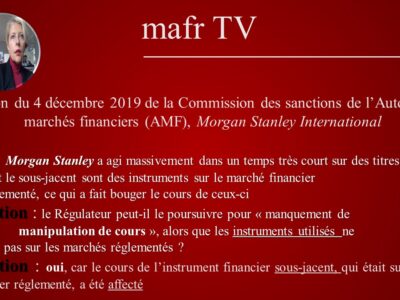
By its decision “Morgan Stanley International” of December 4, 2019, the French Financial Markets Authority Sanctions Committee specifies the interpretation of both restrictive but tacit texts and the system of evidence of breaches of breach of breach through that of price manipulation

Watch the video that presents, analyzes and measures the scope of the Commission des sanctions de l'Autorité des marchés financiers – AMF (French Financial Markets Authority Sanctions Committee) of December 4, 2019, Morgan Stanley International. - The bank, through its British subsidiary, had to answer before the Sanctions Committee of the Authority of the financial markets where it contested a notification of price manipulation grievances on financial instruments based on specific securities (OAT) issued by the Public Treasury French and put on  the regulated market, these first various financial instruments being themselves built elsewhere and offered on various national financial markets, for example for France FOAT, which are futures on these OAT not traded on a regulated market. The sentencing decision of 4 December 2019 is instructive. On the very principle of the competence of the administrative sanctioning authority (I) and on the evidentiary mechanism of the facts (II). This corresponded to the "3 elements of the infringement", which should in principle be found in the repressive administrative law, which is a "criminal matter." But as expressly stated in the decision, the intentional element is not required for market abuse. There remains therefore the legal element, which requires that the behavior be precisely targeted by a text, and the material element.   Let's see their fate.   I. LE PRINCIPE DE LEGALITE DES DELITS ET DES PEINES N'ENTRAVE PAS L'EFFET NATUREL DE LA DEFINITION "NATURELLE" DU COURS DU TITRE SOUS-JACENT AFFECTE PAR LA MANIPULATION En premier lieu la Banque contestait la compétence même du Régulateur à en connaître car ce n'est que postérieurement aux faits reprochés que les textes applicables ont dit qu'étaient sanctionnables les agissement sur des instruments financiers "liés" aux instruments financiers émis sur un marché réglementé. Au nom du principe d'analyse restrictive et de la non-rétroactivité des textes d'incrimination qui gouvernent la matière pénale, la Banque soutenait n'être pas apte à être poursuivie. La Commission des sanction écarte le moyen en affirmant qu'elle respecte ces principes inhérents à la matière pénale, mais qu'il faut regarder la finalité des textes. Or la manipulation de cours, manquement ici en cause, est un manquement parce que l'agissement a pour objet ou pour effet de perturber le cours du titre qui est sur le marché réglementé. En agissant sur un instrument financier, même situé sur un marché non-réglementé, dont le sous-jacent est sur un marché réglement, le cours de celui-ci est perturbé, alors la manipulation du premier ayant pour effet de perturbé le cours du second justifie la pourrsuite et la sanction. Sans qu'il y ait rétroactivité des textes.    II. LES PRESOMPTIONS SIMPLES D'AGISSEMENTS LEGITIMES OU ILLEGITIMES SUR LES TITRES ET LE "FAIT JUSTIFICATIF DE COMPLIANCE" En second lieu, la Banque soutient que son action sur les différents instruments financiers sur les différents marchés a été justifiée par son intérêt légitime démontré en raison de l'absence de liquidité du titre et pour dénouer une position déficitaire appelant une intervention massive dans un temps très court de sa part sur plusieurs marchés en même temps et que si le cours en a été modifié, il n'en est pas devenu pour autant "anormal", ce qui est un élément matériel du manquement.  La Commission des sanctions pose tout d'abord que l'opérateur peut à la fois avoir des motifs légitimes démontrés d'agir sur un titre et néanmoins opérer sur celui-ci une manipulation de cours.  Revenant sur la définition de la manipulation de cours, la Commission ne reprend pas la notion d'"anormalité" dans le sens où il faudrait que le cours ne soit pas conforme aux attentes, il faut mais il suffit qu'il soit inattendu : le "normal" est donc dans le sens de l'inhabituel. Si la Banque parvient à justifier son action, comme elle arrive à le faire pour un titre (le FGBL et FGBX), alors il n'y a pas de sanction (n°90 de la décision) mais dans les autres cas la Commission estime que les agissements ont eu pour effet de faire varier le cours des sous-jacents émis par le Trésor public français (OAT), ne s'expliquent pas autrement, les autres opérateurs agissant comme si la hause de la valeur des OAT avait une autre origine. Or, la Banque avant cet effet a revendu immédiatement les OAT. L'ensemble des agissements ayant duré moins d'un quart d'heure, la Commission considère que l'élément matériel de la manipulation de cours est constitué.  Pourtant la Banque se prévalait d'une sorte de fait justificatif : elle avait agi en "conformité" avec "une pratique de marché" (article 631-1 Réglement général de l'AMF).  La Commission récuse cela, car elle considère que ce texte ne vise que trois hypothèses : contrats de liquidité obligatoires, contrats de liquidité sur actions et acquisitions d'actions…. pour les opérations de croissance externe". C'est donc tout à fait une conception très restrictive que la Commission adopte pour ce qui vient en restriction des textes répressifs…. Quand à "l'intention manipulatoire", les choses sont encore plus claire. Pour sanctionner un manquement, il n'est besoin d'aucune démonstration d'une intention puisque les textes sur les abus de marché "ne font référence pas à un quelconque élément intentionnel"… Pour se protéger, la Commission estime que l'intention découle de toutes les façons du manquement…   QU'EN PENSER ? Il est probable que cette décision fera l'objet d'un recours.  L'on comprend bien le raisonnement du Régulateur. Il fait prévaloir l'efficacité, la sanction n'étant qu'un moyen de préservation l'intégrité du système financier dans son coeur même à savoir le caractère adéquat des prix des instruments qui y sont offerts. En cela la sanction n'est qu'un instrument au service du marché, n'est qu'un instrument de Compliance.  Il est assez savoureux, et amer, de lire comment la "conformité à une pratique de marché" est balayée d'un revers de main, le caractère général, de principe et téléologique n'étant tout à coup plus un raisonnement recevable…. Il est vrai que le Conseil d'État conçoit la sanction de la même façon. A propos du mécanisme de gel des avoirs, autre instrument du Droit de la Compliance, la sanction infligée à une banque par l'ACPR est maniée de la même façon. Mais que reste-t-il du Droit pénal, qui devait innerver dans son esprit et ses principes fondamentaux, repris dans la "matière pénale" le Droit administratif répressif ? Comment ne pas être inquiet quand il est désormais affirmé que d'élément intentionnel, il n'en est plus besoin ? L'on peut effectivement penser que le Droit retient la sanction, et l'accroît, mais met de côté la matière pénale : de la répression sans droit pénal… N'est-ce pas un oxymore ? Ne faut-il pas chercher au moins à le résoudre ?  -

Working papers

🚧 Compliance and Incentives: a couple to propel by the notion of “Incentive Compliance”

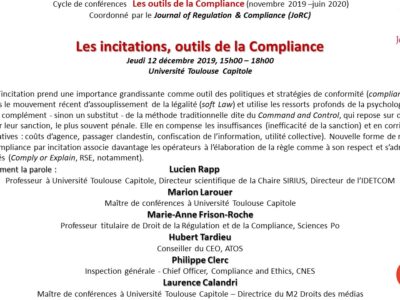
This working document serves as the basis for two conference given in the symposium made under the direction of Lucien Rapp, Les incitations, outils de la Compliance ("Incitations: Compliance Tools"). Référence : Frison-Roche, M.-A., Compliance et Incitations : un couple à propulser, in Faculté de droit de l'Université Toulouse-Capitole, et Journal of Regulation & Compliance (JoRC),Les incitations, outils de la Compliance, 12 décembre 2019, Toulouse.  This Working Paper has been the basis for two conferences in the colloquium in Toulouse (France) under the scientific direction of Lucien Rapp, about Les incitations, outils de la Compliance ("Incitations, as Compliance Tools"), on December 12, 2019, the first one about The sanction as incitation and the second one about Incitations and Compliance Law (synthesis of this colloquium). sur le thème de la sanction comme incitation, la seconde en synthèse de ce colloque sur  After it has been the basis for the article, to be published in the books Les outils de la Compliance and Compliance Tools in the Series Régulations & Compliance. Read a general presentation of this book.   - Summary of this Working Paper: Compliance and Incentives appear at first glance to be totally opposite. Not only because sanctions are at the heart of Compliance and that sanction is associated with constraint while incentive is associated with non-constrained1Voir cette question analysée d’une façon autonome, Frison-Roche, M.A., Résoudre la contradiction entre « sanction » et « incitation » sous le feu du Droit de la Compliance, 2020., but also because incentives are linked to self-regulation and that Compliance Law requires a strong presence of public authorities. Thus, one should choose: either Compliance or Incentives! Either the effectiveness of one or the effectiveness of the others; either the techniques of one, or the techniques of others; either the philosophy of one or the philosophy of the others. Resign yourself to the waste that such a necessary choice would involve. But putting the terms thus is thinking poorly about the situations and reducing the fields of the solutions which they call for. If we take a rich definition of Compliance Law, we can on the contrary articulate Compliance and Incentives. To do this, the concept of “incentive Compliance” should be developed. This concept is not only appropriate, but it is necessary in a new conception of Sovereignty. For example for the digital Europe. -   Read the developments below.