Economic Law, Regulation and Compliance

Working papers

🚧 Resolve the contradiction between “sanction” and “Incentive” under the fire of Compliance Law

This Working Paper has been the basis for the first conference of the two conferences in the colloquium in Toulouse (France) under the scientific direction of Lucien Rapp, about Les incitations, outils de la Compliance ("Incitations, as Compliance Tools"), on December 12, 2019, the first one about The sanction as incitation and the second one about Incitations and Compliance Law (synthesis of this colloquium).  Then, it has been the basis for the article, to be published in the books Les outils de la Compliance and Compliance Tools in the Series Régulations & Compliance. Read a general presentation of this book.     Summary and Introduction of this Working Paper: At first glance, Compliance and Incentives appear to be totally opposite. For two major reasons. In the first place, because the sanctions have a central place in the Law of Compliance and the incentives suppose an absence of constraint on the operators. Secondly, because the incentives are linked to self-regulation and that Compliance Law assumes a strong presence of public authorities. Taking the first reason, one should choose: either Compliance or Incentives! Either the effectiveness of one or the effectiveness of the others; either the techniques of one or the techniques of others; either the philosophy of one or the philosophy of the others. Resign oneself to the loss that such a necessary choice would involve. But to put the terms thus amounts to think poorly about the situations and reduce the fields of the solutions which they call for. If we take a rich definition of Compliance Law, it is possible on the contrary to articulate Compliance and Incentives. From this perspective, sanctions can no longer become what blocks the use of incentives but, on the contrary, what constitutes them. Even more, the coupling between Incentives and the requirements of Compliance Law must be strongly encouraged, as soon as the public authorities supervise in Ex Ante all the initiatives taken by the "crucial operators".  This working document deals with the first issue1La seconde problématique est analysée in "Compliance et Incitation : un couple à propulser", 2020.. Indeed, the so-called incentive theory targets mechanisms that do not directly use coercion. They would therefore have little place in Compliance Law. But Compliance seems saturated with sanction procedures. We can even say that it seems to put them at the center, the public authorities presenting the number of sanctions as a sign of success, while the companies seem obsessed with their prospects, the two concerns ending in such a strange convergence that are the D.P.O… An honest observer can only feel immediately uneasy. Indeed, he can only raise the definition of the sanction as a "constraint" triggered Ex Post, at the very heart of Compliance Law which is presented as a set of Ex Ante mechanisms. Based on this contradiction in terms, should we give up the association and think that it would be wrong against the spirit to think of the sanction as an incentive? It is undoubtedly in this connection that one perceives most clearly the clash of two cultures, which do not communicate, while technically they apply to the same situations. Indeed, because Compliance was firstly designed by Finance, everything is a tool for it. Therefore, the tendancy to think about the sanction only as an incentive is very strong in Compliance Law. It manifests itself continuously and will not stop (I). But whatever the reasons are to conceive it this way, the principles of the Rule of Law cannot disappear and if we do not want them to be erased, then they must be articulated (II). It’s an essential adjustment. This is why we can literally say that Compliance has set Criminal Law on fire by its conception, logical but closed in on itself, of sanctions as simple incentives. For Law to remain, however, it is necessary to hold a very firm definition of Compliance Law centered on its Monumental Goal, which is the protection of the person.

Working papers

🚧 Training, content and container of Compliance

This working document served as the basis for an article, contribution in the collective book Compliance Tools, 2020 - Summary of this working paper: Training is a specific Compliance tool and a dimension that each Compliance tool expresses.  Firstly, as a training it is a specific Compliance Tool, it is supervised by Regulators. It even becomes compulsory when it is contained in Compliance programs. Since the effectivity and the efficiency are legal requirements, what is therefore the margin of companies to design it and how can we measure its result? Secondly, as each Compliance Tool contains, more and more, an educational dimension, we can take back each of them to detect this perspective. Thus, even sanctions and prescriptions, are lessons: lessons given, lessons to follow. The question is then to know who, in this so pedagogic Compliance Law, are the "instructors"? -       Introduction: Training is akin to these things – and very precious – that we do, or even dream of doing, but so poorly expressed from the moment we take them as an object of technical writing. Just do it. It would be however unfortunate to publish a book on Compliance Tools without giving a particular place to training, the piece would miss in the puzzle. So much money spent by companies, by fair or foul means, especially when Compliance programs imposed as sanctions contain heavy training obligations leading people to retain word for word everything that is forbidden to them, in order to always abstain from now on. Training is thus the sharp point of such Hard Law appearing under the steel of Criminal Law's sword in amphitheaters and e-learnings.  But also so much speeches about the necessity of a "Compliance culture" which should be instilled to firms, Compliance spousing with joy in an harmony with their "raison d'être" and the historical identity of this group of people which is the company itself through trainings which tell Compliance as a link, an outstretched hand toward those with whom managers want to renew a moral contract in an ethic for which they give the good example. It is not Prohibition anymore but Communication and Community that set the tone of a human dialogue with employees, stakeholders, administration and judges.  It is possible to assume that the former does not exclude the latter, that Training should target all of this, the learning of mandatory prescriptions to follow without discussion but also the adhesion to guidelines, and this because everyone has understood that they are funded. Everything and its contrary, then. "Learning by heart" takes here its full sense: get everyone to remember mechanically in order for no one to misstep (with always more machines which massively teach us the regulatory corpus on our mobile screens) but also succeed in bringing our "heart" in Compliance, thanks to specific training methods (with always smaller groups, with always less public discussions in pleasant places). Everything and its contrary, then. It would be imperative but also sufficient to cumulate. Doing everything. Those who propose training softwares as those who organize conferences, meetings and travels and are favorable to this addition of face-to-face and distancing methods, of mechanic and of human relations. Concretely, at the end companies observe that since the first does not replace the second, costs add up. But, in Compliance, costs constitute a grave default of it, training taking a large part of this default. Managers end up finding the addition too heavy, especially if they thought that training of people is one of the public school's mission and not one of private companies' purpose. Moreover, training to Compliance is not outside Compliance Law, which makes it specific. Indeed, Compliance Law, corpus of Ex Ante mechanisms, targets to concretize "monumental goals". Set by public authorities, these monumental goals are internalized in companies in order for them to implement expected means in order for them to be reached in the future. These monumental goals can be negative (that corruption, money laundering, human rights violations, financial system crisis, etc. shall not occur), or positive (that ecological equilibrium shall be restored, that education shall be supplied, that healthcare shall be provided, etc.). Compliance Law takes as criteria of effectivity for implemented mechanisms, their reality, but also their efficiency, that is their ability to make sure their goal is achieved.Training must achieve its goal. Thus, in Compliance, the purpose is not only the one of every training, that is transmitting a knowledge in order to making the student more learned, but it is to contribute to the "monumental goal" of Compliance Law itself, which is a practical goal and not a scholar goal. For example, training about the applicable rules concerning corruption should have an effect to reduce corruption. And because corruption is itself a part of Compliance Law, in the same way the Regulation Authority can force to educate oneself or train others, the Supervision Authority should control not only the reality but also the effectivity and the efficiency of trainings.  However, the effectivity and the efficiency of Compliance training, because they are full part of Compliance Law, should be controlled by the Authority not only in their reality but also in their concrete ability to participate in the pursued goal. Thus, to keep the example of fight against corruption, training plays in it an essential role because the firm faces an alternative: either a mechanic solution consisting in setting literal interdictions, for example the interdiction to give up a value greater than a certain amount (according to the "anti-gift" rule) with the risk of getting around that every literal prescription offers, or a a solution by training consisting in explaining to everybody that it is wrong to corrupt but that it is acceptable to give samples. Training rather bets on spirit while the machine integrates the letter.  But this refers to the Regulation and Supervision Authority which will appreciate the company due diligences to reach the goals. One observes that, more and more, Authorities economize one step: rather than explain to the companies how educate people that work for them or with them, regulators educate directly.  Is on this point remarkable the "guide" published in 2012, whose second edition of 2019 has been updated in 2020, jointly by the Department of Justice (DoJ) and the financial regulator (Securities &Exchanges Commission – SEC) to know everything about the Foreign Corruption Practices Act (FCPA). Through the explanations offered to everyone of the principles, the reminded definitions, the told cases, they are behaviors prescriptions which are formulated especially for foreign companies by the prosecutor authority and the American sanction authority, allied in this handbook which has such weight that we can consider that it is as valuable as a guideline, soft law creator of Law and rights.  In the concentration of all powers which is often reproached to the Regulator, there is also the magisterium of the teacher, the one who educates stakeholders. After having assumed, on the American model, that the regulator should be the "advocate" of the rules for companies, proving to them the interest  that they have to respect them, it is logical that, in what some have called "Regulation, Act 2" this Regulator's pleading about the good news of Regulation for the firm justifying thus that this one integrates it in Ex Ante was prolonged in magistral lesson: the "regulator-institutor" explains to everybody how using rules for an always still in progress Law ("Better Regulation").  While training was before only peripheral, it is now at the heart. If it is so important, as every other "Compliance tool", it should take what we expect from it. The publications about training most often exhibit what it should be and a sorrowful spirit measures what sometimes appears as a huge gap between descriptions and realities sometimes reported.  Educating being without any doubt one of the most difficult actions, we should probably neither describe a paradise of maieutics nor write a hot paper against what already has  the merit to exist, but list what we can expect from Training mechanisms when they apply to Compliance, because here, rather more than for the other tools, it is a mean obligation. Which content should have a training ? (I). Because Compliance Law targets training as one of the mean to reach "monumental goals" which constitutes the substantial heart of this branch of Law, the training dimension is not limited to stamped training, finding back this pedagogical dimension in almost all the other tools (II). In that, Training appears as the alpha and the omega of Compliance.    

Working papers

🚧The dreamed Compliance Law

🌐follow Marie-Anne Frison-Roche on LinkedIn 🌐subscribe to the Newsletter MAFR Regulation, Compliance, Law  - ► Full Reference: M.-A. Frison-Roche, The dreamed Compliance Law, Working Paper, June 2020.  - This Working Paper, "The Dreamed Compliance Law", is the basis for an article, written in French, "La compliance" (Compliance), inserted in the collective work to be published under the direction of Jean-Baptiste Racine, Le Droit économique du XXIème siècle (The XXIe century Economic Law , in the Serie Droit & Economie,   Lextenso – LGDJ, 2020. -   No one can know what the Law of the 21st century will be. Pretending to know it is just not to realize its ignorance. Why then writing about it, since the future is always surprising? One can only write about the unknown part of the Law of tomorrow. If the future is then modeled on what was written, so much the better for the prophet, a tribute that can, for example, be paid to Pierre Godé1Mélanges Pierre Godé, off-trade book, 2019.  who described in 1999 what was going to be 10 years later "Law of the future" constituted by Environmental Law2Godé, P., Le Droit de l'avenir (Un Droit en devenir), 1999. . If the future denies the author or if its contours in no way follow the lines of the written word, this is not serious since the writing of the Law, even if it has the specificity of being partly prescriptive in that it has the power to write the future, a normative pen that rounds up letters3It is in particular the idea of the movement of analysis of Law & Literature which poses that by telling the past in one way or another, by thus inventing it, Law, and in particular the Judge, invents the future and being written, creates it. On this movement which was powerful in the United States, v. Cabrillac, R. et Frison-Roche, M.-A., Droit et Littérature, à paraître. , it participates in all writing: above all to be that of a dream. Lévi-Strauss argued that teaching is defined as dreaming out loud. Teaching and describing the Law of a century that we will never know gives even more freedom to dream about it. This freedom increases when the object is a branch of Law in the process of being born, state of the stammering "Compliance Law" of which some still maintain, as it was made for Regulation Law, that there is not existing. The hand can then, as it pleases, trace its beautiful or hideous features: what face will Compliance Law have, as soon as we assume that it will exist? It may as well be a nightmare (I) as a happy dream (II). It is up to us to choose in which category this branch of Law will flourish. Because what we can be sure of is this fulfillment. It is certainly already taking sides to presuppose the very existence of Compliance Law. Not only to consider it possibility with hostility because to be an enemy of something or someone is already to recognize their existence. Before that, two objections radically block the very existence of Compliance Law and their shadow remains in the future of it4See infra I. Compliance Law as nightmarish octopus. . Firstly, it is said that Compliance does not come under Law, but for example only ethics since it would consist in keeping well in companies which care about the interest of others or the planet, for example by spontaneous care of the environment; Compliance being a crystallization of social responsibility, the one for which we have our conscience, we express our "raison d'être" and we are not accountable5On the fact that "social responsibility" makes it possible not to be legally responsible, cf. Supiot, A., Du nouveau au self-service normatif: la responsabilité sociale des entreprises, 2004; this is not the subject of this article and this question will not be developed here.. Or it would consist in technologically putting in place tools for capturing technical information using data storage and processing methods. Compliance is then a sub-category of "Data Regulation"!6See, for instance, ..., Replace Regulation by norm by Regulation by Data, 2020. , a mechanical concept in which Law is no more present. In these two perspectives, Compliance Law cannot exist, no more tomorrow than it would exist today. These two radical conceptions, completely entrusting Compliance mechanisms to everyone except lawyers, do not make sense because it suffices to note the development of judgments and laws to measure the legal phenomenon already present7See, for instance, Frison-Roche, M.-A., Compliance Law (monography), 2016 ; Compliance Law, 2020. . Second, there would be many Compliance mechanisms but insufficient to constitute a branch of Law. Indeed we would find Compliance in Company Law, Labor Law, Financial Law, Banking Law, Criminal Law, Administrative Law, European Law, International Law, etc. These classic branches, which have been formed for so long, depending on the point of view adopted, would gain in modernity or be threatened with decay by this kind of extension which will be Compliance. There would thus be as many "little legal sectoral rules" as there are branches of law. These new internal developments would be like a new bud, on which care should be taken – if the tree regains its strength – or a weed to be eradicated – if the French garden loses its perspective. Thus the matter being scattered as many as specialist lawyers, often criminalists or specialists in banking and Financial Law, then tomorrow all specialists in all branches of Law, this could constitute the most radical obstacle to the constitution of Compliance Law. Indeed, we would come back to confuse Compliance and the "modernization" of Law itself as a whole, since it would only be a question of perfecting each of the classic branches of the legal system. If we keep in this half-sleep that is any projection in the future the hope of a constituted branch of Law, we must discard these two perspectives of annihilation, either in the total absence of Law or in recovery by all Law. To dismiss the sorrowful spirits who see no future in Compliance and keep only its enemies in the space of this article, let us assume that Compliance Law will exist in the 21st century. In what form and by what means, in the palm of which institutions, in the shadow of which legal system? Since it is a question of projecting ourselves onto the black screen of our nights of dreamy lawyers, let us take the current state only as a trailer. Like the one developed by the genius who by the contempt not only brought down into the flames of hell the cinema which has become a consumer industry with which producers force-feed us but offered us the vision of its future. What is what we see today the trailer? We let our imagination run wild since the trailer films are autonomous works compared to the film which follows them. We have no idea what will happen and what we are watching from the brief and violent current images of Compliance Law, the cinema of which rather makes a hero of the whistleblower8On what the cinema does with the whistleblower, with the availability of trailers and extracts from the films, see Frison-Roche, M.-A., introduction of the article The impossible unicity of the legal category of whistleblowers, 2019.  and a character of the narrow and ridiculous importance of the compliance officer9Frison-Roche, M.-A., ... (retrouver sur LinkedIn). , does little to help us. But if we force the features of the present lineaments, the alternative of this Law in childhood is therefore that of a nightmare (I) or an idyllic solution for difficulties that will increase (II). Everything will depend on the concept that we will retain of Compliance Law. Because the script is not written, because Compliance Law is a Law with a political dimension, that it is defined by the ambitions that we can claim to have by setting monumental goals that we are going to achieve, a claim that will make it one major branch of the Law of tomorrow, or we can abandon any claim, lower our heads and arms, and reject any claim. It is then that the power of Compliance Law, which will be no less great, will turn against us, human beings, as in a nightmare.  

Organisation of events

Organization and scientific co-direction of the cycle of colloquia : “Compliance Monumental Goals”

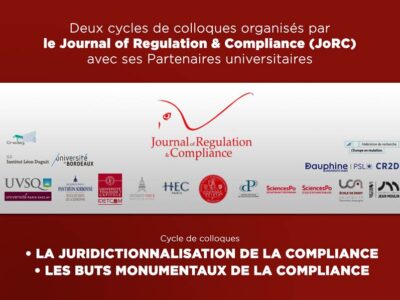
Like the precedent cycles dedicated to the general topic of Compliance, aiming to build a "Compliance Law" and aiming also to be published in the series Regulation & Compliance, coedited by the Journal of Regulation & Compliance and Dalloz, this cycle continues to deepen a specific aspect of this emerging branch of Law which has been applied before being designed.   The year 2020-2021 will give rise to two full and distinct cycles, the former deepening a key concept of Compliance Law, that are "monumental goals" and the later deepening a phenomenon with multiple roots and consequences: "the juridictionnalization of Compliance".  Compliance Monumental Goals has been proposed in 2016.   These various conferences will take place in different places, according to the role played by the very numerous universities which, this year once again, support the Journal of Regulation & Compliance for the realization of this cycle. This cycle will give rise to two books, one in French: Les Buts Monumentaux de la Compliance, and the other in English : Compliance Monumental Goals.  This cycle of colloquia Compliance Monumental Goals will start in October 2020 and will take place until December 2021.   First colloquium: 17th of May 2021: Public norms and Compliance in time of crisis: monumental goals put to a test, co-organized by the JoRC and the Montpellier University Law School, under the scientific direction of Marie-Anne Frison-Roche, Pascale Idoux and Adrien Tehrani: more information about this manifestation here   Second colloquium : 16th of September 2021, Compliance Monumental Goals: Radioscopy of a Notion, co-organised by the JoRC and Saclay University, under the scientific direction of Christophe André, Marie Malaurie and Benoît Petit  : more information about this manifestation here   Third colloquium: 4th of November 2021: Effectivity of Compliance and international competitiveness, co-organized by the JoRC and the Centre de recherches en Economie et Droit de l'Université Paris II, under the scientific direction of Laurent Benzoni, Bruno Deffains and Marie-Anne Frison-Roche: more information about this manifestation here

Organisation of events

Organization and scientific co-direction of the cycle of colloquia : “The juridictionnalization of Compliance”

Like the precedent cycles dedicated to the general topic of Compliance, aiming to build a "Compliance Law" and aiming also to be published in the series Regulation & Compliance, coedited by the Journal of Regulation & Compliance and Dalloz, this cycle continues to deepen a specific aspect of this emerging branch of Law which has been applied before being designed.   The year 2020-2021 will give rise to two full and distinct cycles, the former deepening a key concept of Compliance Law, that are "monumental goals" and the later deepening a phenomenon with multiple roots and consequences: "the juridictionnalization of Compliance".  The juridictionnalization of Compliance is perhaps as ancient as Compliance mechanisms themselves.   These various conferences will take place in different places, according to the role played by the very numerous universities which, this year once again, support the Journal of Regulation & Compliance for the realization of this cycle. This cycle will give rise to two books, one in French: La Juridictionnalisation de la Compliance, and the other in English : Juridictionnalization of Compliance.  This cycle of colloquia The juridictionnalization of Compliance will start in October 2020 and will take place until December 2021.   Inaugural colloquium:  Compliance juridictionnalization: why? Who? How? Where? and Toward What? , organized by the JoRC under the scientific direction of Marie-Anne Frison-Roche : read more information here   Second Colloquium: 31st of March 2021 :  Arbitration and Compliance, co-organized by the JoRC and Paris II University, under the scientific direction of Marie-Anne Frison-Roche and Jean-Baptiste Racine : read more information here   Third colloquium : 23rd of June 2021 : The firm instituted as Court by Compliance Law, co-organized by the JoRC and the équipe de recherche Louis Josserand of Lyon 3 University, under the scientific direction of Marie-Anne Frison-Roche and Jean-Christophe Roda : read more information here    Fourth colloquium: September 2021 :  Which judges for Compliance? , co-organized by the JoRC and the CR2D of Paris-Dauphine University, under the scientific direction of Marie-Anne Frison-Roche and  Sophie Schiller : read more information here ​ Fifth colloquium: October 2021 :  Compliance Law, crucible between American Procedure Law and Procedure Law, co-organized by the JoRC and the Brussels University, under the scientific direction of Marie-Anne Frison-Roche and Arnaud van Waeyenberge: read more information here   Sixth colloquium:  Proportionnality, Compliance balance, co-organized by the JoRC and IDETCOM of Toulouse University, under the scientific direction of Marie-Anne Frison-Roche and Lucien Rapp: read more information here

Articles in a legal collective publication

📝The impossible legal unicity of the category of “whistleblowers” (“L’impossible unicité juridique de la catégorie des “lanceurs d’alertes” “)

Full reference: Frison-Roche, M.-A., L'impossible unicité juridique de la catégorie des "lanceurs d'alertes" ("The impossible legal unicity of the category of "whistleblowers""), in Chacornac, J. (dir.), Lanceurs d'alertes, regards comparatistes, ("Whistleblowers, comparative perspectives"), Publications of the Centre français de droit comparé ("French Comparative Law Center"), May 2020, Volume 21, pp. 13-31.    Read the article (in French).    Read the general presentation of the collective book in which this article is published Read the bilingual working paper which had served of basis for this article.  Read the presentation of the conference "Les lanceurs d'alertes: glose" (Whistleblowers: glose") and especially the slides elabored for the colloquium organized by the Centre français de droit comparé ("French Comparative Law Center") on 23th of November 2018 under the direction of Jérôme Chacornac - Introduction of the article "Whistleblowers". This is a new expression. Which is a great success. Barely heard once, we hear it everywhere … A topic not of course or knowledge test, but rather a topic of daily conversation. Because it is spoken to us every day, in more or less gracious terms. For example President Donald Trump on October 1, 2019 declared to the press "want to question" the whistleblower who would have illegally denounced him and would not, according to him, have the right to conceal his identity, proof in this according to him of the lying character of his assertions against him, while his lawyer indicates on October 6, 2019 that he is not speaking on behalf of a single whistleblower thus taken to task but of a plurality of people who gave information against the President of the United States. Even the most imaginative screenwriters would not have written such brutal and rapid twists and turns. Spectators, we are waiting for the next episode, secretly hoping for the escalation. And precisely if we go to the cinema, it is still a whistleblower whose dedication and success, we are told about, even the drama, for the benefit of global society, and in particular democracy, since the secrets are fought for the benefit of the truth. The Secret Man designates Mark Felt as the first whistleblower. Returning to what we often present as being a more "serious" media1On the more general fact that cinema is undoubtedly the medium which most seriously restores the state of the Law, c. Frison-Roche, M.-A., Au coeur du Droit, du cinéma et de la famille : la vie, 2016., we listen to France-Culture and here is another story told by a historian who worked as an archivist on events that political power would have liked to keep hidden by possibly destroying their traces but which its trade led to preserve: here it is expressly presented to the studious listeners like a "whistleblower" …. While the same radio tries to find the one who could well be, as in a kind of contest the "first whistleblower"2L'histoire du premier lanceur d'alerte, France Culture, septembre 2019. ? …. This rewriting of History can be defended because ultimately what did other Voltaire do for Calas, or Zola for Dreyfus? It is also a subject of legislative discussion since in the United States the Dodd-Frank law of 2010 inserted in the law of 1934 which established the Securities & Exchanges Commission a complete device of remuneration and remuneration of the whistleblowers, whereas after having developed flexible but guiding lines in this regard in 20123European Commission, Guidelines on Whistleblowing, 6 of December 2012, SEC(2012) 679 final, updated on 23 of April 2018. , the European Commission published on November 20, 2018 the text of what will become a Directive intended to give a unified European status to the character, in the system gradually developed to protect the one who was presented in 2018 as that "cannot be punished for having done what is right". In Europe, the Directive first approved by a Resolution of the European Parliament on April 16, 2019 on the protection of persons denouncing breaches of Union Law and then adopted on October 7, 2019 (Directive of the European Parliament and of the Council of European Union on the Protection of Persons who Report Violations of European Union Law, different title, it should be noted, will have to be transposed into the laws of the Member States within the next two years. , since only "violations of Union Law" are targeted, but the character of the "whistleblower" is more generally targeted: he is "whole"4However, precisely the so common use of plurality ("whistleblowers") raises doubts about the uniqueness of the character. On this question, see. all the first part of the developments of this study, which leads to the conclusion rather than beyond the multitude of particular cases, there are rather two kinds of whistleblowers. V. infra I.. In short, the whistleblower is a star5The director of the film La fille de Brest says that she considers the whistleblower at the origin of the case of the Pick as a "movie character".. A sort of historical figure, covered in blows and glory, going from Voltaire to Snowden, both of whom find themselves embodied on the screens6Thus, the adventures of Snowden were brought to the screen by Oliver Stone in 2016, Snowden. On the question of knowing whether this film "faithfully reproduces" or not the case, Schetizer, P., Le film Snowden est-il à la hauteur de la réalité?, 2017. This article is favorable to the whistleblower, and to the film which tells us with emotion his case, in particular because (sic), it is easier than to read the Washington Post. …., Consecrated by law, which associates with it a legal regime of protection to such an extent that, like a Nessus tunic, it is this legal regime which will define the character and not the reverse. When we read the law of December 9, 2016 relating to transparency in the fight against corruption and the modernization of economic life, known as "Sapin 2", we notice that the Legislator makes much of this character, since 'he dedicates its chapter II to him7Underlined by us.: "From the protection of whistleblowers", and that it is by his very protection that he formally opens the door of Right to him. But why a plural? Admittedly when we read the recitals of the Community Directive of October 7, 2019 on the protection of whistleblowers8About this directive, v. the developments infra, it is only a list of all the subjects on which it is a good idea to protect them, which therefore prompts us to see in this plural only the index of this non-exhaustive list of subjects which it is good to tell us, a sign of the lack of definition of who should alert us. Reading the French law known as "Sapin 2" makes it less severe but more perplexing. Indeed, this plurality referred to by the title of the chapter devoted to "whistleblowers", there is no longer any question in the rest of the law, in the very definition which follows, article 6 which opens this chapter devoted to "whistleblowers" offering the reader immediately a singular since it begins as follows: "A9Underlined by us. whistleblower is a person …". No mention of diversity. The art of legislative writing would however have required that the qualifying article not only be singular but that it should not yet be undefined. Stendhal if he had still deigned to have the law for bedside book would have wanted to find at the beginning of chapter a sentence like: "The10Underlined by us. whistleblower is a person …". Thus seem to contradict themselves within the law "Sapin 2 the very title which presents the character, in that it uses a defined plural (the) while the defining article which presents it is in the undefined singular (one). … Here is a first reason not to advance any more but in a very careful way, in this "step by step" that constitutes a reading word for word: a gloss. This consists of taking the expression itself literally. The second reason for this technical choice is that the gloss is well suited to the introduction of a collective work, thus allowing more targeted developments to take place in other contributions, on the techniques, the difficulties and the limits of this protection, or on its history, or the reasons for the arrival in French law of these whistleblowers and the way they develop, or not, elsewhere. I am therefore going to content myself with taking this already legal expression to the letter: The (I) whistle (III). blowers (II).       

Articles in a legal collective publication

Attorney and Compliance – The future of the character and his tool: Law, Humanism and Defense

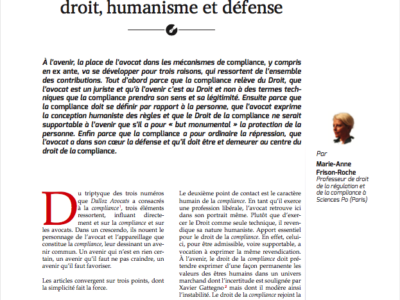
Full reference : Frison-Roche, M.-A., Avocat et Compliance – L'avenir du personnage et de son outil : Droit, Humanisme et Défense ("Attorney and Compliance – the future of the character and his tool: Law, Humanism and Defense),article of synthesis fo the collective publication "Compliance", Dalloz Avocat, March 2020, April 2020, June 2020, Dalloz Avocat, June 2020, pp. 321-324 Read the synthesis article (in French). Read the editorial of the March 2020 Issue, presenting the problematic : "The Attorney, Vector of Conviction in the New Compliance System".    -   Summary of the article: In the future, the place of lawyers in compliance mechanisms, including in Ex Ante, will develop for three reasons, which emerge from all of the contributions. First of all because Compliance is a matter of Law, a lawyer is a lawyer and in the future it is a matter of Law and not on technical terms that Compliance demands its meaning and legitimacy. Then because Conformity must be defined in relation to the person, the lawyer expresses the humanist conception of the rules and Compliance Law will only be tolerable in the future if it is for "monumental goal" of protection of the person. Finally, because Compliance with ordinary repression, that the lawyer in his heart defends and must be and remain at the center of Compliance Law. -

Working papers

Compliance Law, Health crisis and Future

This interview was conducted in French with Olivia Dufour, for an article published in French in the digital publication Actualité Juridique. Its subject is  the confrontation between the current health crisis situation and the Compliance Law.    Summary. After defining Compliance Law, distinguishing the procedural and poor definition and the substantial and rich definition, the starting point is to admit the aporia: the type of health crisis caused by Covid-19 will be renewed and it is imperative to prevent it, even to manage it, then to organize the crisis exit. Public Authorities are legitimate to do so, but because this type of crisis being global and the State being consubstantially linked to borders, States are hardly powerful. Their traditional International Law shows their  limits in this current crisis and one cannot hope that this configulration will improve radically. In contrast, some companies and markets, notably the financial markets, are global. But the markets are not legitimate to carry out such missions and counting on the generosity of certain large companies is far too fragile in front of the "monumental goal" that is the prevention of the next health crisis, crisis which must never happen. How to get out of this aporia? By Compliance Law, basis of, in a literal and strong sense, the "Law of the Future".  We need to be inspired by the Banking and Financial Compliance Law. Designed in the United States after the 1929 crisis to tend towards the "monumental goal" of the absence of a new devastating crisis in the country and the world,  this set of new legal mechanisms gave duty and power of supervision, regulation and compliance to market authorities and central bankers. These are independent of governments but in constant contact with them. Today, they claim to have as first priority the fight against climate change. Now and for the future, they must also be given the responsibility and the powers to prevent a global health disaster, similar to a global ecological disaster, similar to a global financial disaster. This does not require a modification of the texts because their mandate consists in fighting instability. Stability must become a primary legal principle, of which the fight against monetary instability was only a first example. By the new use that central banks must make of it by preventing and managing health crises, Compliance Law will ensure that the future will be not catastrophic.

Articles in The Journal of Regulation & Compliance « JoRC »

When Facebook “Invite” Each Internet User to Act Against COVID-19 by Redirecting Him or Her Towards Public Information Center, Is It by Legal Obligation (Compliance) or by Corporate Social Responsibility? With Which Consequences?

Without any request, on his or her newsfeed, those who surfs on the social network built by Facebook, has found on 23 of March 2020, in the morning, the following message : « X (prénom de l'internaute), agissez maintenant pour ralentir la propagation du coronavirus (COVID-19) Retrouvez les actualités des autorités sanitaires et institutions publiques, des conseils pour ralentir la propagation du coronavirus et des ressources pour vous et vos proches dans le Centre d’information sur le coronavirus (COVID-19)" ("X (user's name), act now to slow down the spread of the Coronavirus (COVID-19). Find the health authorities and public institutions' news, advices to slow down the spread of the Coronavirus for you and your entourage in the Information Center about Coronavirus (COVID-19) »). This corresponds to the more general declaration done the same day by Kang-Xing Jin, director of Health at Facebook, who declares : "In response to the coronavirus outbreak, Facebook is supporting the global public health community’s work to keep people safe and informed. Since the World Health Organization declared the coronavirus a public health emergency in January, we’ve taken steps to make sure everyone has access to accurate information, stop misinformation and harmful content, and support global health experts, local governments, businesses and communities.". Thanks, Facebook to indicate how to do ; by the way, thanks to having invited me to do it. By the way, is it really an « invitation » ? Since the expression is « act now ». Just miss the exclamation point, and the pointed finger of Uncle Sam for « war effort ». If in Law, we can consider « invitation », it would be not to the "invitation" that in the past Bank of France did to shareholders banks to refinance a bank which risks to be soon into difficulties that we could consider, invitation from which the invited cannot really escape. No, obviously no, it is just the same message that you and me can write on our Facebook pages to tell similar things about the same purpose ! But, Facebook would be, like you and me, editor of contents ? Questions and difficulties which encourage to proceed to the legal analysis to know under which title Facebook posted such a message. The first hypothesis is that this firm has acted spontaneously, following its « Corporate Social Responsibility » (I) If it is the right qualification, with regards to the content of the message, legal consequences are important because this firm, without generalizing to others, by the expression of its care of common good, shows, by transitivity, that it is an editor. The second hypothesis starts from the observation that Facebook is a « crucial digital operator ». In this perspective, the firm is constraint to Compliance Law (II). It is the reason why, it is constraint by specific obligations, that excludes the spontaneous message emission qualification. If it is the right qualification, with regards to the content of the message, legal consequences are also important and of a totally different nature. Indeed, the qualification leads to develop the relation between the obligation to fight against fake news and malicious websites towards those of redirecting towards public websites, benefiting for the operator of a reliability presumption. Read the developments below.

Working papers

Compliance and Extraterritoriality: a natural and effective couple for the future of Europe

This working paper is the basis for an article in the French Law Journal Le Clunet.   When we compare the terms "Compliance" and "Extraterritoriality", it is often with dissatisfaction, even anger and indignation. On the momentum, after having expressed a principle of disapproval of such a merger, attention is focused on how we can fight against it, to break the link between Compliance and Extraterritoriality. But do we have to go so fast? Is this negative initial assessment correct? Indeed, thus gone, it is frequently explained that the binding mechanisms of Compliance are suffered, that they come from abroad, that they apply with efficiency but in an illegitimate way, without agreement of the one who must submit to it, whose resistance is therefore certainly ineffective but nevertheless justified. In the same spirit, when we start to shell the cases, like so many scars, sort of rosary, even crown of thorns, BNPP case, Astom case, etc., the wounds not yet closed turn into reproaches made against the rules, public authorities, even reproaches made against named people. We are leaving this kind of complaint against X, which targets what would be this appalling "Compliance", this Law which would be both hostile and mechanical which would not have been able to stay within the limits of borders, Compliance being thus placed in contrast to sovereignty and protection, which presuppose staying within its limits and being able to protect companies from abroad. More concretely, this presentation targets more directly the United States, which uses "the legal weapon", slipped under what is then designated as "the artifice of the Law" with extraterritorial scope. But this effect would in reality be the very object of the whole: their hegemonic will to better organize at least a global racket, notably through the Foreign Corrupt Practices Act (FCPA) and at best a world government through notably the embargoes.Those who believed otherwise would be naive or foolish. This silences the opponents because who likes this costume? So the world would be put in a ruled cut; what the mafia could not have done, Compliance Law would have obtained, offering the whole world to the United States thanks to the extraterritoriality of its national Law. Compliance Law would thus become the very negation of Law, since it has the effect, even the purpose (barely concealed by strategic, powerful and shameless States), of counting borders for nothing, whereas Public International Law, in that it is built between the sovereign subjects of law that are the States presupposes the primary respect for borders to better exceed them while Private International Law takes the same postulate to better welcome foreign Law in situations presenting a foreign element. Jurists believed in the force of Law; by Compliance, we would return to the sad reality that only the powerful, here the United States, dominate and – ironically – it is under the pretext of Law that they do it. It would be necessary to be well duped, or accomplice, to see there still legal where there is only the balance of powers. When one is more intelligent or skilful than that, one understands that the "small" can only be "subject" to the Compliance Law, one would have to be powerful to be the normative source and its enforcement agent. It is then towards this mis-named Department of Justice (DoJ) that the fearful, hateful and resigned glances turn.  If you see it that way, what should you do then? The answer is obvious: react! It is necessary to save the sovereignty, France, companies, the Law itself. If that is how the question is posed, how can we disagree? It is therefore necessary to destroy the Compliance Law and the extra-territoriality of American Law which had found this "Trojan horse", an expression so frequently used. This is the basis for the administrative reports available, for example the Berger-Lellouche parliamentary reports and the Gauvainfootnote-1720 report. Both of them broadly develop the two preceding claims, namely that the extra-priority of compliance mechanisms is illegitimate and harmful, since it is a mechanism invented by the Americans and harming the Europeans, or even invented by the Americans to harm Europeans, the description being made in much more violent terms than those used here. The description seems acquired, the reflections therefore relate to the remedies. The reaction is most often to "block" the Compliance Law in its extraterritorial effect. But without discussing the effectiveness of the remedies proposed downstream, it is necessary to return to this description so widely shared made upstream. Because many elements on the contrary lead to affirm that ComplianceLaw first of all and by nature can only be extraterritorial and that it must be. Whether or not the State in which it was created has malicious intentions. The description which is made to us most often describes particular cases from which we draw generalities, but we cannot reduce Compliance Law to the already cooled cases, as BNPP case, or to the always hot case of the American embargo on Iran. Furthermore, one cannot take the issue of embargoes and draw conclusions, legitimate for it, but which would apply to the whole of Compliance Law. The fact that theCompliance Law is a branch of Law at the stage still of emergence can lead to this confusion which consists in taking the part for the whole, but it is very regrettable because what is justified for the embargoes does not is in no way relevant for all Compliance Law, of which precisely the Law of embargoes is only a small part, even an abusive use. This overlapping is not often perceived, because the definition of Compliance Law and its criterion are not clearly enough defined, namely the existence of a "monumental goal", which does not exist in an embargo decided unilaterally by an order decreed by the President of the United States, but which exists in all other cases and fully justifies extraterritoriality, extraterritoriality which is even consubstantial with Compliance Law (I). Once we have distinguished the embargoes, as an atypical, sometimes even illegitimate part, of Compliance Law, we should continue this work of distinction by emphasizing that the United States has certainly invented Compliance Law but only developed a mechanical concept for the prevention and management of systemic risks. Europe has taken up this systemic conception of the protection of systems, for example financial or banking, but superimposed another conception, drawing on its deep humanist tradition, whose protection of personal data is only an example and whose monumental goal is the protection of the human being. This primary concern then justifies the European use of Compliance mechanisms to interfere with global objects regardless of their location, especially the environment, and to block the entry onto the ground of objects that enter, which is contrary to Competition Law but builds a legitimate barrier under this Compliance Law, in the indifference of an extraterritorial origin (II). Indeed, this branch of the new Law which is Compliance Law is not reducible to Competition Law, any more than it is not reducible to a method. It is a substantial, extraterritorial Law because the "monumental goals" which give it substantial unity are extraterritorial. This can directly contribute to the future of a Europe which on the one hand will be able to pursue, in an extraterritorial manner, monumental humanist goals, in the field of the environment or the protection of personal information or access to the Law (in particular by the technique of compliance programs) and which, on the other hand, by the techniques of traceability of products, will have the means not to bring in products manufactured in an indecent manner, except in countries which do not grant value than in Competition Law to enter the WTO.     Read the developments below.  

Articles in a legal collective publication

The attorney, vector of conviction in the new Compliance system (L’avocat, porteur de conviction dans le nouveau système de Compliance)

Référence générale : Frison-Roche, M.-A., L'avocat, porteur de conviction dans le nouveau système de Compliance, Dalloz Avocat, mars 2020. This editorial opens a thematic collective publication about Compliance. A synthetic article on all the contributions, published in May 2020, mirrors it: "Attorney and Compliance – The future of the character and his tool: Law, Humanism and Defense" - English Summary of the article (written in French) :  If we perceive Compliance Law as an aggression of the private company and a binding set of mechanisms that have no meaning and added value for it, then the attorney has a utility: to defend the business. It can do so not only during the sanctions phase, but also to prevent it. But this function is not central. He and she becomes so if we understand Compliance Law as being a body of substantial rules, pursuing a "monumental goal": the protection of the person, goal injected by political bodies and taken up by the operator. From this, the company must convince everyone to take it back, inside the company and outside. In a general and contradictory debate, the attorney carries this conviction, because he and shed is always convincing those who in the end judge (market, public opinion, etc.) that is their raison d'être.   Read the article   -     Read the Working Paper underlying this article, with the technical references and all the articles serving as the basis for all the assertions in this article          

Conferences

THE TOOLS OF COMPLIANCE AND THE THEORY OF CLIMATES, IN “GEOGRAPHICAL PREGNANCE IN COMPLIANCE TOOLS “

Complete reference : Frison-Roche, M.-A., The tools of Compliance and the Theorie of Climates, in "Geographical pregance in Compliance Tools" (Les outils de la Compliance et la Théorie des climats, in La prégnance géographique dans les outils de la Compliance), February 4, 2020, Nice.    Conference Summary: Starting from Montesquieu's "climate theory", affirming that human beings would be of a different nature in different places of the world, which therefore requires different rules of government according to these places, a theory which echoes the geographical confinement that Pascal operated on the Laws, we can think that, as with any rule, Compliance legal rules, which ensure compliance of the behavior of human beings to the rules, this will vary depending on whether we are below or beyond the Pyrenees. But on this geographical dimension so natural one can on the contrary and at first doubt. Indeed, by presenting it as a simple process, which artificial intelligence based on algorithms could fully take care of, by its absence of substance this dimension loses all relevance. Except falling into the other excess consisting in posing that everything is only a question of "pure compliance culture" or that this is only the dressing of a pure balance of power, between geographical areas, for example the United States and Europe, and in this Law of palisade geo-politics is to such an extent that it would have devoured Law. It is necessary to keep the measure of things and on the contrary organize in a second time a kind of triptych and firstly find what comes from the accumulation of technical and immutable information, secondly what comes from local phenomena but requieres global standards of compliance which can be technically attached because of their "crucial nature" and thirdly also assume "political pretensions of monumental goals" which contest the borders and the branches of the Law which guard these.  If we manage to do this, then Compliance Law not only manages to get rid of what undermines it, that is, its mechanical temptation offered by technology and its disappearance by political power, keeping substance without being violent. . Indeed by respecting geography the West does not have to dictate "its" law. On the contrary, it must take concrete lying to the Kanak Law, which does not define the Law as what is stated and applied, but as a 'path'. Thus in the technique of responsible investments, because the Law of Compliance is teleological, the Subject of law, that is to say the company (which is in position, for example that invests) does not prohibit but organizes the transition so that the beneficiary of the device is not himself sanctioned, for example abandoned to corruption, but accompanied towards the exit of the system. The integration of time and the concept of 'duration', common to compliance law and regulation law (the Law of Compliance being the internalisation of Regulations in entities capable of implementing them) involving the articulation between the territory and duration (which is not permitted by Competition Law).     Read the presentation of this conference on the Geographical pregnance in Compliance Tools  See the other conferences of the complete cycle on Compliance Tools. Read the general presentation of the conferences cycle.   Read the working paper which is the basis of this conference.    Consult the slides on which the conference is based (in French).   Summary : Starting from Pascal's "climate theory", one might think, as with any rule, Compliance, which ensures that human behaviour conforms to the rules, it varies, depending on whether one is "below or beyond the Pyrenees". . But of this geographical dimension so natural, on the contrary and at first one can doubt. Indeed by presenting Compliance as a simple process, which artificial intelligence based on algorithms could fully support, by its absence of substance this geographical dimension loses all relevance. Except to fall into the other excess of asking that everything is only a matter of 'compliance culture' or that it is the dressing of a pure balance of power, between geographical political areas, for example the United States and Europe, and in this Law of façade the geo-politics is at this point all that it would have devoured Law. We need to keep Reason, instead organizing a kind of tryptic and find what is the accumulation of technical and immutable information, which is local phenomena but to which standards of global Compliance can be technically attached because of their "crucial nature" and also assume "political pretensions of monumental goals" that challenge the borders and branches of Law that guard them. If we manage to do this, then not only  Compliance Law manages to get rid of what undermines it, that is its mechanical temptation offered by technology and its disappearance by political power, keeping substance without being violent. . Indeed by respecting geography the West does not have to dictate "its" Law. On the contrary, it must take concrete conception, borrowing to Kanak Law, which does not define Law as what is stated and applied, but as a 'path'. Thus in the technique of responsible investments, because Compliance Law is teleological, the subject of law, that is to say the company (which is in position, for example to invests) does not prohibit but organizes the transition so that the beneficiary of the device is not himself sanctioned, for example abandoned to corruption, but accompanied towards the exit of the system of corruption. The integration of time and the concept of 'duration', common to Compliance Law and Regulation Law (the Law of Compliance being the internalisation of Regulations in entities capable of implementing them) involving the articulation between the territory and duration (which is not the rule of Competition Law). 

Organisation of events

Co-organization of the conference “Geographic significance in the choice and use of Compliance tools”

The cycle of conferences Les outils de la Compliance (The Compliance tools) began in November 2019 and runs until June 2020. It is organized by The Journal of Regulation & Compliance and all of its partner universities. It includes a conference more particularly devoted to the theme of "La prégnance géographique dans le choix et l'usage des outils de la Compliance" ("Geographic significance in the choice and use of Compliance tools"). See the other thematics, others dates and other particular manifestations,  builting the complete cycle   Conference and Debate  (in French)  Thuesday, February 4, 2020, 16h30– 19h30  Law & Political Sciences School Doyen Louis Trotabas Avenue, 06050 Nice Cedex. Amphithéâtre Bonnecarrère, Villa Passiflore,   General Presentation:  Compliance is a global phenomenon. In this, it illustrates the problematic of a Global Law. However, it should not be inferred that Compliance is applied in the same way everywhere in the world. Like any legal institution, it is integrated into a preexisting legal framework, shaped by culture and history. The aim of the conference is to explore geographic significance in Compliance Tools, that is to say the potentially different way in which these tools are chosen and used depending on the geographic area concerned. The three geographic areas studied will mainly be Europe, the United States and Africa. Opportunity will thus be given to highlight the convergences and divergences in the implementation of Compliance Tools in a geographic vision of the institution.   Under the scientific direction of Jean-Baptiste Racine, professor at the University Côté d'Azur (Law & Political Sciences School of Nice), GREDEG-CREDECO, CNRS UMR 7321 With the interventions of: – Jean-Baptiste Racine, professor at the University Côté d'Azur , Nice – Mahmoud Mohammed Salah, Law professor at the University of Nouakchott, Mauritany – Karen Coppens, Dechert LLP – Mads Andenas, Law professor at the University of Oslo, Norway – Marie-Anne Frison-Roche, Law professor at Sciences Po, Paris   -   -   Read the registration procedure  for this conference. Consult the gele calendar of upcoming events. Consult the presentation of the book to be published "Compliance Tools".   Go back to general presentation of the Conferences' cycle "Compliance Tools".   Inscription : anouk.leguillou@mafr.fr -