Economic Law, Regulation and Compliance

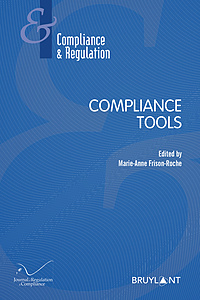
Couverture – Compliance Tools

Books

Compliance Tools

Full Reference: Frison-Roche, M.-A. (ed.), Compliance Tools, serie "Régulations & Compliance", Journal of Regulation & Compliance (JoRC) & Bruylant, 2021. This book in English is the first title of this collection integrally dedicated to Compliance Law, in that it is the extension of Regulation Law.  Read the titles of this series in English co-published by Bruylant. This collection in English is articulated with a collection co-published between the Journal of Regulation & Compliance and Dalloz. Thus, in parallel, a book in French, Les Outils de la Compliance is published.  Read the titles of the series in French co-published with Dalloz.  This book is published after a  cycle of colloquiums organised by the Journal of Regulation & Compliance (JoRC) and Partners Universities. - General Presentation of the collective book The political dimension of Compliance Law lies in the goals it aims to achieve. To achieve them, the concern for these goals is internalized in "crucial operators", which may be obliged to concretize "monumental goals" set by public authorities. These public bodies control the Ex Ante reorganization that this implies for these companies and sanction Ex Post the possible inadequacy of the companies, which have become transparent to this end. The effectiveness and efficiency of this internalization, without which the statement of these goals is worth nothing, is based on the Compliance tools that are deployed. These appear to be very diverse but their substantial unity (topic which will be the subject of a forthcoming book) makes it possible to study the tools put in place from a unique perspective, by not isolating them in a particular branch of Law, Criminal law or International Law for example, but by measuring what is common to them, notably Anticipation, Trust, Commitment, Responsibility, Incentive, and so on. If the Compliance tools vary, it is rather not only according to the sectors, finance and banking appearing then as the advanced point of the general Compliance Law, for example in environmental matters, but also according to the countries and the cultures. It is in fact about them that legal cultures seem to oppose. The book aims to understand these "tools" by going beyond the description of each instrument, for which we already have many monographs, for analyzing them through the issues of Risks, required Expertises, Training. Sovereignty claims, Incentives, mechanical aptitude of Technologies. It is through these themes that are analyzed by the authors, experts in the field, what we always want to understand better: Compliance Programs, Whistle blowing, Mapping, Sanctions, Extraterritoriality, etc.   -     Read the summary of the book.    Read the foreword, summarizing all the contributions.     Présentation of the book contributions:   Amico, Th., Compliance or the passage from ex post to ex ante: A Copernican revolution for the criminal lawyer? Banck, A., The maturity of the Compliance tool’s user, first criterion of the choice of the salient tool Burlingame, Coppens R., Power, N, Lee, D.H., Anti-Corruption Compliance: Global Dimension of Enforcement and Risk Management Calandri, L., Incentive(s) and Self-Regulation(s): which place for Compliance Law in the Audiovisual Sector?  Causse, H., Compliance Training: Through and Beyond Traditional Legal Training Frison-Roche, M.-A., Describing, designing and correlating Compliance Tools to have a better use of it Frison-Roche, M.-A., Building by Law the Unicity of Compliance Tools from the Definition of Compliance Law by its "Monumental Goals" Frison-Roche, M.-A., Drawing up Risk Maps as an obligation and the paradox of the "Compliance risks" ​ Frison-Roche, M.-A., Incentives and Compliance, a couple to propel Frison-Roche, M.-A., Resolving the contradiction between sanctions and incentives under the fire of Compliance Law Frison-Roche, M.-A., Rights, primary and natural Compliance tools Frison-Roche, M.-A., Training: content and container of Compliance Law​ Galland, M., The Regulator's Inspection of the Effectiveness of the Compliance Tools Implemented by the Company Granier, C., The Normative Originality of Compliance by Design Guillaume, N., Compliance risk mapping: first insights of challenges, limits and good practices Guttierez-Crespin, A., Audit of Compliance Systems​ Koenigsberg, S. and Barrière, F., The Development of Attorney's Compliance Expertise Larouer, M., The Manifestation of Incentives Mechanisms in French Compliance Law Merabet, S., Morality by Design Pailler, L., Technological Tools, Compliance by Design and GDPR: the Protection of Personal Data from Design Racine, J.-B., Geographical dominance in the choice and the use of Compliance Tools. Introductory remarks Rapp, L., Incentive Theory and Governance of Space Activities Roda, J.-C., Compliance by design in antitrust: between innovation and illusion Salah, M., Conception and Application of Compliance in Africa Tardieu, H., Data Sovereignty and Compliance Thouret, T., Training and Compliance, Two Correlated Information Transmission Tools  

Breaking news

📧 European Public Prosecutor’s Office comes on stage: the company having itself become a private prosecutor, are we going towards an alliance of all prosecutors ?

► The European Public Prosecutor's Office (EPPO), a major weapon for the Compliance Law.   The European Union's prosecutor comes out of its cradle : the "European Public Prosecutor's Office" starts its activities. Long to set up, this European judicial body is linked to delegated prosecutors in the Member States. It is not a simple emanation of national bodies networked; of autonomous competence, it is the organ in the name of which the action is carried out. In addition to this institutional revolution, there is a substantial revolution: this European Public Prosecutor's Office can prosecute any attack to the "financial interests of the European Union". These "attacks on financial interests" are conceived broadly, including in particular acts of corruption or embezzlement. First of all, Didier Reynders emphasizes that this puts the rule of Law at the center. It is no longer Europe supporting actions to be coordinated between States, the national prosecution having technical difficulties to cooperate effectively with each other, but the European Public Prosecutor's Office which will allow unified and effective European action between delegated prosecutors. Secondly, it continues the string of effectiveness between Compliance, located in Ex Ante, Compliance Law consisting in "preventing" and "detecting" such behavior, and the Ex Post, because a judge is sometimes necessary so that the disregard of these Ex Ante obligations is sometimes sanctioned (➡️📝Frison-Roche, M.-A., Compliance and International Public Order: the French conception preserved by the Paris Cour of Appeal, 2021) but also a prosecution: the prosecutor is a major figure in Compliance Law. Indeed, being able to prosecute, the prosecutor can also not prosecute and change its decision to close the file in returns for commitments (Ex Ante) from the company: the "public interest judicial agreements" – CJIP. In fact, through the opportunity to prosecute, will such powerful flexibility be found at European level? Thirdly, the prospect of prosecution by the European Public Prosecutor's Office will incent in Ex Ante companies to prevent, or to prosecute themselves (➡️🎤Frison-Roche, M.-A. et Roda, J.-C. (dir.), The firm instituted prosecutor and judge of itself by Compliance Law, Lyon, June 23, 2021) the perpetrators of fraud in the interests of the Union European. At a time when the Union is engaging in direct loans to lend still more, this role of the company, sometimes qualified as "private prosecutor", linked to a prosecutor, now European, is necessary. Are we moving towards the alliance of all prosecutors?

Organisation of events

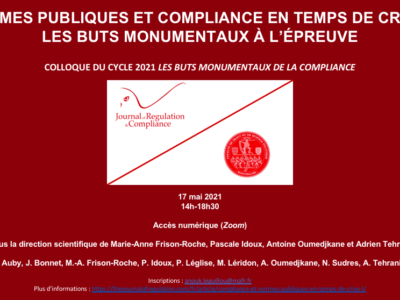
Co-organization of the colloquium “Public norms and Compliance in time of crisis : monumental goals put to a test” (“Normes publiques et Compliance en temps de crise : les buts monumentaux à l’épreuve”)

This scientific manifestation is placed under the scientific direction of Marie-Anne Frison-Roche, Pascale Idoux, Antoine Oumedjkane and Adrien Tehrani. It is organized by the Journal of Regulation & Compliance (JoRC) and by the Faculté de Droit et de Science Politique de l’Université de Montpellier (Centre de Recherches et d’Etudes Administratives de Montpellier and Centre du Droit de l’Entreprise). This manifestation is part of the cycle of colloquia organized in 2021 around the general topic of Compliance Monumental Goals.    The interventions will give rise to the production of articles which will be part of the books Les bus monumentaux de la Compliance and Compliance Monumental Goals which will be published in the Series Regulations & Compliance, coedited by the JoRC and Dalloz for the French version and by the JoRC and Bruylant for the English version. This manifestation will take place on Zoom on 17th of May 2021. Registrations: anouk.leguillou@mafr.fr Assistance to this event may be validated as part of the continuing education of lawyers. In addition, scientific videos will be extracted and disseminated later. Presentation of the topic: In the overall problematic of “Monumental goals”, this conference retains a particular case: that of the crisis and the emergency situation that it generates. First of all, in general, does the importance of public norms in the emergency context engendered by a crisis situation imply a marginalization of Compliance? Don’t private actors also have their place in these circumstances, at the service of the “monumental goals” that the public authorities want to maintain, or even which appear specifically? Secondly, more concretely, we have been living for many months in a health crisis. By taking it as a framework and, within it from particular cases, how public and private actors react, act, adjust? and how do the courts assess these movements? Going from the most general to the most specific, this conference aims to identify criteria, limits, of what could be specific rules when the emergency of a crisis meets Compliance, and will examine specific situations.   Working method: The conference is therefore built on a general issue, which was the subject of a “working paper”, written by Antoine Oumedjkane, Adrien Tehrani and Pascale Idoux, on which the speakers will have thought in advance and from which they are intended to study the question from their particular perspective. The conference, which is essentially interactive, therefore begins with an outline of the main lines of this general work. It is followed by the examination of concrete practical cases. They are as follows: 1️⃣ hydroalcoholic gel, its manufacture, price, availability, 2️⃣ information and regulation on all media in Covid period 3️⃣ the use of the bicycle during the state of health emergency A first conclusion, thematically limited, will relate to Revealed by the crisis situation, the place of private initiative in Compliance Law. A second, more general, undoubtedly open-ended conclusion is drawn from this confrontation between general reflection and concrete cases which must be resolved in a particular crisis.   Will speak:    Jean-Bernard Auby, Emeritus Professor of Sciences po (Paris)   Julien Bonnet, Professor at Montpellier University and member of the CERCOP   Guylain Clamour, Dean of Montpellier Law School   Marie-Anne Frison-Roche, agrégée des Facultés de droit, Professor of Regulation and Compliance Law at Sciences Po (Paris) and Director of the Journal of Regulation & Compliance (JoRC)   Pascale Idoux, Professor at Montpellier University   Pascale Léglise, adjointe au directeur des libertés publiques et des affaires juridiques (Deputy Director of Civil Liberties and Legal Affairs) of the Ministère de l’intérieur (Home Ministry)   Michèle Léridon, Member of the Conseil supérieur de l’audiovisuel (French Media Regulator), President of the working group Pluralisme, déontologie, supervision des plateformes en ligne (Pluralism, Deontology, Supervision of Online Platforms)   Antoine Oumedjkane, Researcher of the Centre de recherche et d’études administratives (Research and Administrative Studies Center) of Montpellier University   Nelly Sudres, Maître de conférences at Montpellier University and member of the Centre de Recherches et d’Etudes Administratives (Research and Administrative Studies Center) of Montpellier University   Adrien Tehrani, Professor at Montpellier University and member of the Centre du Droit de l’Entreprise (Company Law Center)   Xavier Vallad, Group Legal Director, Intermarché   ⤵️Read a more detailed presentation of the manifestation below:

Working papers

🚧 Place and Role of Companies in the Creation and Effectiveness of Compliance Law in Crisis

Full Reference: Frison-Roche, M.-A. Place and Role of Companies in the Creation and Effectiveness of Compliance Law in Crisis, Working Paper, May 2021.  -   This Working Paper has been elaborated as basis for a conference in the colloquium of Mai 17, 2021 (done in French: Normes publiques et Compliance en temps de crise : les buts monumentaux à l'épreuve. This video is made with English substitutes.  It is also the basis for an article in the book Compliance Monumental Goals, the English version of which is co-published by the Journal of Regulation & Compliance (JoRC) and Bruylant. Summary: This article has a very topic: the place of private Companies, with regard to the chapter's issue: "the ordeal of a crisis". The crisis constitutes a "test", that is to say, it brings evidence. Let us take it as such. Indeed, during the health crisis, it appears that Companies have helped the Public Authorities to resist the shock, to endure and to get out of the Crisis. They did so by force, but they also took initiatives in this direction. From this too, we must learn lessons for the next crisis that will come. It is possible that this has already started in the form of another global and systemic crisis: the environmental crisis. In view of what we have been able to observe and the evolution of the Law, of the standards adopted by the Authorities but also by the new case law, what can we expect from Companies in the face of this next Crisis, willingly and strength    Lire ci-dessous les développements.