Economic Law, Regulation and Compliance

Analyses

💬 “Faire du Droit pour qu’à l’avenir le monde soit moins injuste” – à propos du projet de directive européenne sur le devoir de vigilance. (“Making Compliance Law for a world less unfair in the future” – about the draft European directive on the corporate sustainability due diligence)

► Full Reference: Frison-Roche, M.A.,, "Faire du Droit pour qu'à l'avenir le monde soit moins injuste" – à propos du projet de directive européenne sur le devoir de vigilance ("Making Compliance Law for a world less unfair in the future" – about the draft European directive on the corporate sustainability due diligence), interview with Olivia Dufour, Actu-Juridique,  March 24, 2022.  - 💬 read the interview (in French)  - ► Interview English Summary: This interview comments on the draft directive presented by the European Commission aimed at unifying European Union Law about Corporate Sustainability Due diligence in global supply chains to protect environnement and human rights effectively, putting companies under same legal rules. including non-European companies. The interview emphasizes that this text and reinforces Compliance Law perspective in that the legal instruments are Ex Ante, aim at the functioning of groups, constitute incentives, and seek effectiveness to prevent violations of human rights and the environment, 80% of which taking place outside the European Union. The goal is both ethical, for example to fight against child labor and the endangerment of people, and systemic: the promoting of a sustainable economy, through the help of companies which have some power in value chains which are global.  This future directive clearly shows the difference between simple "conformity" (just obeying all applicable regulations…) and "compliance", illustrated here: aiming to achieve "monumental goals", here fighting against attacks on the climate balance and protect people, to obtain in the future these damages do not occur or are reduced.  -   
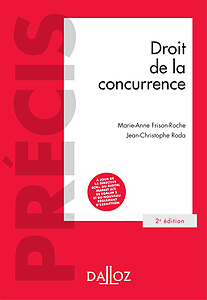
Couverture – Droit de la concurrence

Books

📕Droit de la concurrence (Competition Law)

► Full Reference: M.-A. Frison-Roche & J.-Ch. Roda, Droit de la concurrence (Competition Law), 2nd ed., Paris, Dalloz, "Précis" Serie, 2022, 842 p. - ► This second edition follows on from the first, written with Marie-Stéphane Payet. 📝read the foreword written in dedication to Marie-Stéphane (in French) - 📕read the 4th cover of the book (in French) - ► English Summary of the book: Even if reforms follow one another and upheavals are incessant, whether de facto (digital) or political (apprehension of foreign investment, controversies over objectives), the framework of Competition Law is stable, with French Law and European Law in harmony. Competition Law combines both the Law of competitive markets and the Law of relations between economic players. Its age and homogeneity increase its capacity to find solutions. This book restores the coherence and strength of Competition Law, which, once clarified, is easier to master and anticipate. The first part therefore sets out the blocks of rules that "protect competitive markets", through mechanisms that are increasingly ex ante, not only merger control but also the control of buyer power, leading to the governance of markets by authorities working together, while sanctions for anti-competitive behaviour restore markets that have been damaged by abuse. The second part sets out the blocks of rules that "rebalance economic relations". The tools used are often older, but their handling is no less innovative.   - 📕read the table of contents of the book (in French) - 📝read the review of the book made by the Professor Walid Chaiehloudj in the Concurrences review -

Monographs

📝La responsabilité Ex Ante (Ex Ante Responsibility), in Archives de Philosophie du Droit (APD), 📗La responsabilité

► Full Reference: M.-A. Frison-Roche, "La responsabilité Ex Ante" ("Ex Ante Responsibility"), in Archives de Philosophie du Droit (APD), La responsabilité, t. 63, Dalloz, 2022, pp. 105-115 - 📝read the article (in French) - 🚧read the bilingual Working Paper which is the basis of this article, with additional developments, technical references and hyperlinks - ► English Summary of the article: Today, Law is faced with a strategic imperative: to turn its strength towards the future, to deal with issues (digital and climate) over which law and contract do not have the required influence, because they are too local or too unsystemic, while ex post liability is not adequate to deal with the irreparable. Responsibility therefore takes hold of the future, with the judge becoming the central figure in the world through no fault of his own. This shift in time may continue to be anchored in the past, as a result of commitments made by States or firms. But this responsibility for the future, giving rise to an obligation not to make reparation but to do something about it, may come even more directly from the mere fact that the entity in question is ‘in a position’ to act to ensure that others are protected. Pre-constituted evidence, ex ante office of the judge, duty for others, but also powers of the firm and State to bear this ex ante responsibility, pillar of Compliance Law, Law of the future, are the new rules that are being put in place. - 🌐follow Marie-Anne Frison-Roche on LinkedIn 🌐follow Marie-Anne Frison-Roche on Instagram 🌐subscribe to the Newsletter MAFR Regulation, Compliance, Law

Lessons

Leçon n°4

Organisation of events

⚙️scienfica organisation of a public manifestation

🧱Scientific Organisation of the Conference 🧮L’office du juge et les causes systémiques (“The office of the judge and systemic causes”)

► Full Reference: Frison-Roche, M.-A., coordination and moderation of the conference L'office du juge et les causes systémiques (""The Office of the Judge and systemic causes"), in Cycle of Conferences, Penser l'office du juge ("Thinking the Office of the Judge"), Grand Chamber of the Cour de cassation, Paris, May 9, 2021, 17h-19h. The conference is held in French. - ► General presentation of the conference: the conference is based on the intervention of three judges, Christophe Soulard, Fabien Raynaud, and François Ancel, who think and debate among themselves on a hypothesis: the existence of "systemic causes". The hypothesis is that beyond and through the diversity of disputes and cases that are submitted to the most diverse judges, there is a category of cases that are systemic, which means containing in what is submitted to the judge for resolution a system.  If such a category exists, which also raises the question of the diversity of systems and the difficulty arising from their submission to rules that are not legal (for example economic, biological, financial "laws", etc.) , then the judge should take this into account, both in the procedure and in the judgment they make on the case and in the way they formulate et restitute this judgment. - 📝read the presentation of this conference by the Cour de cassation (in French) 📝read the program of the cycle of conferences 2022 (in French) -  🎥see the conference video (in French)  🎥 see the synthesis video of the conference, made in situ by Marie-Anne Frison-Roche (in French)   - ​✏️read the notes taken during the conference to make the synthesis (in French) 📝read the article of Marie-Anne Frison-Roche restituting this conference, published in the Recueil Dalloz (in French) - ►read the works, basis of the two interventions of Marie-Anne Frison-Roche 🚧 L'hypothèse de la "cause systémique (made before the conference to prepare it), available en English 📝Synthese of the conference (made during the conference) -