Economic Law, Regulation and Compliance

Articles in a legal collective publication

article in a collective publication

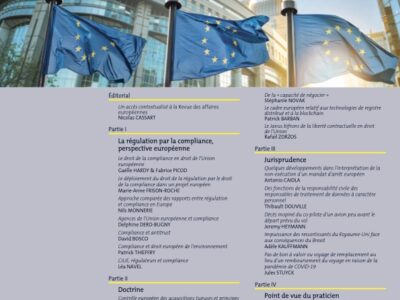
📝The deployment of Regulatory Law through Compliance Law in the European project

► Full Reference: M.-A. Frison-Roche, "The deployment of Regulatory Law through Compliance Law in the European project", in G. Hardy & F. Picod, Compliance Regulation from a European Perspective, Law and European Affairs (L.E.A.), 2023/2, pp. 345-352. - 🚧read the bilingual Working Paper which is the basis of this article, with additional developments, technical references and hyperlinks  - ► English Summary of the article: Compliance Law is neither a method of obeying regulations, nor a simple neutral method of ensuring the effectiveness of norms, nor a means of enforcement displaced from Ex Post to Ex Ante. It is an extension of Regulatory Law and goes beyond it. Like it, it aims to build spaces according to a political project specific to an area, such as Europe. Branch of Law looking to the future as Regulatory Law does, it constructs and maintains, in a systemic way, sustainable, albeit unstable, balances to achieve the ‘Monumental Goals’ in which its normativity resides: security, sustainability, probity, truth, and dignity. By internalising these Monumental Goals in the companies that are in a position to achieve them, the “crucial companies”, Compliance Law preserves the logic of Regulatory Law, offering it a prodigious expansion since it frees it from the condi- tion of a sector and territorial borders, which seemed tautological, by associating private powers and public will, which remains primary. In this way, Compliance can regulate the digital space and climate issue through political choices made by a sovereign Europe. - 🌐follow Marie-Anne Frison-Roche on LinkedIn 🌐follow Marie-Anne Frison-Roche on Instagram 🌐subscribe to the Newsletter MAFR Regulation, Compliance, Law

Articles in The Journal of Regulation & Compliance « JoRC »

📝Reinforce the Judge and the Lawyer to impose Compliance Law as a characteristic of the Rule of Law, in🕴️M.-A. Frison-Roche (ed.) 📘Compliance Jurisdictionalisation

► Full Reference: M.-A. Frison-Roche, "Reinforce the Judge and the Lawyer to impose Compliance Law as a characteristic of the Rule of Law", in M.-A. Frison-Roche (ed.), Compliance Jurisdictionalisation, Journal of Regulation & Compliance (JoRC) and Bruylant, "Compliance & Regulation" Serie, 2024, pp. 39-65 - 📝read the article - 🚧read the bilingual Working Paper which is the basis of this article, with additional developments, technical references and hyperlinks - 📘read a general presentation of the book, Compliance Jurisdictionalisation, in which this article is published - ► This article is the introduction of the book.   ► Summary of the article (done by the Journal of Regulation & Compliance): One can understand that the compliance mechanisms are presented with hostility because they seem designed to keep the judge away, whereas there is no Rule of Law without a judge. Solid arguments present compliance techniques as converging towards the uselessness of the judge (I). Certainly, we come across magistrates, and of all kinds, and powerful ones, but that would be a sign of imperfection: its ex-ante logic has been deployed in all its effectiveness, the judge would no longer be required… And the lawyer would disappear so with him… This perspective of a world without a judge, without a lawyer and ultimately without Law, where algorithms could organize through multiple processes in Ex Ante the obedience of everyone, the "conformity" of all our behaviors with all the regulatory mass that is applicable to us, supposes that this new branch of Law would be defined as the concentration of processes which gives full effectiveness to all the rules, regardless of their content. But supposing that this engineer's dream is even achievable, it is not possible in a democratic and free world to do without judges and lawyers. Therefore, it is imperative to recognize their contributions to Compliance Law, related and invaluable contributions (II). First of all, because a pure Ex Ante never existed and even in the time of the Chinese legists1 L’empire chinois n’a semble-t-il jamais apprécié les juges, ne leur faisant place que sous la forme de serviteurs purs de l’Etat, qu’ils soient des enquêteurs, des punisseurs et de gardiens de l’ordre public. Sur cet aspect du Droit chinois, v. … ; sur cette période particulièrement sanglante des légistes, où le principe de « certitude » de la législation a été portée à ses nues, v. …, people were still needed to interpret the regulations because a legal order must always be interpreted Ex Post by who must in any case answer the questions posed by the subjects of law, as soon as the political system admits to attributing to them the right to make claims before the Judge. Secondly the Attorney, whose office, although articulated with the Judge's office, is distinct from the latter, both more restricted and broader since he must appear in all cases where the judicial figure puts himself in square, outside the courts. However, Compliance Law has multiplied this since not only, extending Regulatory Law, it entrusts numerous powers to the administrative authorities, but it also transforms companies into judges, in respect of which the attorneys must deal with. Even more so, Compliance Law only takes its sense from its Monumental Goals2🕴️Frison-Roche, M.-A. (ed.), 📘​Compliance Monumental Goals, 2022.. It is in this that this branch of the Law preserves the freedom of human beings, in the digital space where the techniques of compliance protect them from the power of companies by the way that the Compliance Law forces these companies to use their power to protect people. However, firstly, it is the Judges who, in their diversity3The topic of this study is general. For a more analytical perspective, s.. 🕴️Frison-Roche, M.-A., « The function of the Judge in Compliance Law », in 🕴️Frison-Roche, M.A. (ed.), 📘Compliance Jurisdictionalisation, 2023. , impose as a reference the protection of human beings, either as a limit to the power of compliance tools4🕴️Frison-Roche, M.-A. (ed.), 📘Compliance Tools, 2021.  or as their very purpose. Secondly, the Attorney, again distinguishing himself from the Judge, if necessary, reminds us that all the parties whose interests are involved must be taken into consideration. In an ever more flexible, soft and dialogical Law, everyone presenting himself as the "advocate" of such and such a monumental goal: the Attorney is legitimate to be the first to occupy this place. - 🌐follow Marie-Anne Frison-Roche on LinkedIn 🌐follow Marie-Anne Frison-Roche on Instagram 🌐subscribe to the Newsletter MAFR Regulation, Compliance, Law

Monographs

📝La compliance, socle de la confidentialité nécessaire des avis juridiques élaborés en entreprise

► Full Reference: M.-A. Frison-Roche, "La compliance, socle de la confidentialité nécessaire des avis juridiques élaborés en entreprise" ("Compliance, the cornerstone of the confidentiality required for in-house legal opinions"), D. 2023, p. - 📝read the article (in French) - ► English Summary of the article: The French Law about the Ministry of Justice's 2023-2027 Orientation and Programming  ("loi d'orientation et de programmation du ministère de la justice 2023-2027") had introduced into the French legal system the confidentiality of in-house lawyers' opinions (before the  French Constitutional Council, on a question of parliamentary procedure, annulled this disposition, thus leaving the question still open).  This development is necessary in order to respond to the injunction for companies to comply more and more with the regulations, which is itself only one of the tools of a wider movement: Compliance Law. This branch of the law, notably through the French so-called Sapin 2 Act of 2016, the French Vigilance Act of 2017 and the European Digital Services Act (DSA), requires companies to implement the necessary means to satisfy the Monumental Goals contained in the laws or regulations. This presupposes, firstly, that companies have information (via alerts, risk mapping, vigilance, sustainability reports, etc.), enabling them to identify their conformity and non-conformity, so that they can, secondly, take effective action to put an end to current breaches, prevent future breaches and achieve the goals set by the Legislator. This Compliance System requires that the information made available to managers is reliable and honest. However, if non-conformity is not analysed and communicated in a way that is protected by confidentiality, the company will prefer not to know about it and will therefore be unable to take appropriate action, which will deprive the social community of its power to act in the future. This is why the confidentiality of in-house lawyers' opinions is based on the very definition of Compliance Law itself. - 🌐follow Marie-Anne Frison-Roche on LinkedIn 🌐follow Marie-Anne Frison-Roche on Instagram 🌐subscribe to the Newsletter MAFR Regulation, Compliance, Law

Videos

🎥L’avenir du Droit de la compliance (The futur of Compliance Law), in🧮 Nuit du Droit

► Full Reference: M.-A. Frison-Roche, "L'avenir du Droit de la compliance" (The futur of Compliance Law), in Cour de cassation (French Court of cassation), La Nuit du Droit 2023, October 4, 2023.  - 🎥 Watch the video (in French) - 🧮read the full programme of this event The Cour de cassation (French Court of cassation) had presented 4 successive themes insofar as they affect the future of Law: filiation, artificial intelligence, the environment and compliance. The President of the Chambre sociale de la Cour de cassation (Social Chamber of the Court of Cassation) gave a presentation on Compliance and the essential role played by the Judge. Then, the Parquet général (Prosecutor General's Office) then asked Fabien Raynaud, Conseiller d'État, about the importance of 'systemic cases' in Compliance Law and the dialogue between judges that it implies, using the Youporn case currently being examined by the judges. - ► General presentation of the speech: As my work has been seminal for Compliance Law, I was asked about the future of Compliance Law. - 🌐follow Marie-Anne Frison-Roche on LinkedIn 🌐follow Marie-Anne Frison-Roche on Instagram 🌐subscribe to the Newsletter MAFR Regulation, Compliance, Law

Conferences

conference

🎤Participation in the🏛️Law Day🧮Normes de Responsabilité Sociale des Entreprises /RSE & Devoir de Vigilance (Corporate Social Responsibility Standards /CSR & Duty of Vigilance)

🌐follow Marie-Anne Frison-Roche on LinkedIn 🌐subscribe to the Newsletter MAFR Regulation, Compliance, Law - ► Full Reference: M.-A. Frison-Roche, Participation à la Table ronde "Normes de Responsabilité Sociale des Entreprises (RSE & Devoir de Vigilance)" (Participation in the Round Table "Corporate Social Responsibility Standards (CSR & Duty of Vigilance)"), in Fribourg University, Journée du Droit, Fribourg University, Pérolles site, room C230, October 2, 2023. - 🧮see the full programme of this event 🎥​watch the video of this event (in French) - 🌐read the report written in French with photos, tags and links on LinkedIn and also with links to each the speech - ► General presentation of the event : This conference, build around 4 presentations and a debate between the speakers and then with the audience, aimed at explaining and understanding this fundamental movement and the new texts that express it in Switzerland, even if it is French law, such as the so-called 'Vigilance' law of 2017 and the draft European CS3D directive, because on the one hand it is a movement that begins with legal technique and on the other hand the texts in question are extraterritorial in scope, if only because of the notion of 'value chain'. In the first part of this round table, and to set the scene, I will outline the origin and content of the French 'Vigilance' law, the way in which the draft directive draws heavily on it, its relationship with Compliance Law, of which it constitutes the 'advanced point', and the decisive role it gives to the courts, in the general movement of the jurisdictionalisation of compliance. The purpose of this is to allow the discussion to get underway. 🕴️Idris Abdelkhalek, PhD candidate and lawyer, introduced the speakers and led the debate between them and the audience. He took questions from the audience on the intensity of the obligation weighing on companies, in particular between civil liability and criminal liability, between the obligation of means and the obligation of result, and on the way in which the duty of vigilance is applied to specific sectors such as defence. - ► Presentation of my speech : the subject of which was Presentation of French Vigilance law, European perspective and European Compliance System. My presentation was divided into four points. Firstly, I outlined the state of Law in France, in the novelty represented by the 2017 law known as the "Vigilance" law, whose principles are simple and strong, principles that are situated in the aims pursued, and the way in which this law inspires what is currently being negotiated: the CS3D Directive. Secondly, I stressed the need for companies to master these often technically complicated corpus, especially if we take into account the link between Vigilance and the CSRD directive on sustainability reporting and extra-financial information.  Thirdly, I have shown that an overall understanding can nevertheless be achieved, and that the technical nature of the 'tools' is better mastered if we place the duty of vigilance within Compliance Law, of which it constitutes the 'advanced point'. All of this anchors its legal normativity in the 'Monumental Goals' it serves, which in Europe are humanistic, since the aim is to protect, now but above all in the future because it is a branch of ex ante Law, the human beings involved in the systems (banking, finance, energy, digital, climate, etc.). Fourthly, I emphasised that this understanding enables everyone to play their part: political and public authorities, businesses and stakeholders. Even more, and at the heart of the matter, the judge plays an essential role, even in countries with so-called 'continental' Law. I have used current cases as examples. This is just the beginning, and judges need to train, specialise and work in dialogue to achieve this. - ► Presentation of the other speakers contributions : 🕴️Marion Paradas, Ambassador of France to Switzerland and Liechtenstein, opened the conference and gave a general presentation of the theme. Ambassador Marion Paradas presented the international challenge represented by Law, illustrated here by the duty of vigilance. She emphasised that this is a major issue, both now and in the future, for Swiss companies and French companies based in Switzerland, particularly as this duty extends throughout the "value chain" and in view of the CS3D directive, which will also have consequences for both. 🕴️Isabelle Chabloz Waidacher, Professor at the Faculty of Law in Fribourg and holder of the Chair of Economic Law at the University of Fribourg, gave a Presentation of Swiss Law. In particular, she emphasised the state of Swiss Law, which could have gone further than the 2017 French law known as the "Vigilance" law if the popular initiative reference had led to the adoption of a law, and which currently focuses more on information and transparency obligations, with CSR taking over from there. But she stresses that the reality of value chains will force Swiss companies to take into account the requirements of the European directive currently being adopted. 🕴️Renaud Roussel, Managing Director of Colas Switzerland, presented an entrepreneurial view of the subject. He began by outlining the concrete steps taken by his industrial group in Switzerland and around the world to implement its commitments to protect the environment, for example by ensuring the proper use of materials used in road construction. He also stressed the importance of human rights, particularly in labour relations, in the context of CSR and vigilance. He went on to point out that it was not always easy for a large company to meet its own requirements, or the requirements imposed on it by the law, because in the construction and public works sector in particular it is often small companies that are competing, competitors who do not bear the costs of such obligations. -
Conferences

🎤Conclusion, in 🧮L’eau : entre protection de la ressource et conflits d’usage

🌐follow Marie-Anne Frison-Roche on LinkedIn 🌐subscribe to the Newsletter MAFR Regulation, Compliance, Law - ► Full Reference: M.-A. Frison-Roche, "Conclusion", in Club des avocats environnementalistes, L’eau : entre protection de la ressource et conflits d’usage, Maison des Avocats, Auditorium, September 28, 2023. - 🧮see the full programme of this event -

Monographs

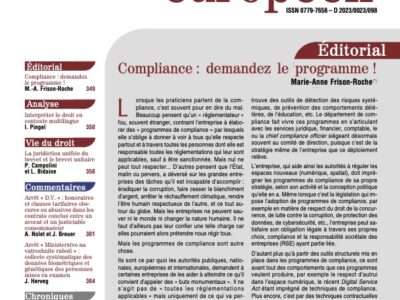
📝Compliance : demandez le programme ! (Compliance: ask for the programme!)

► Full Reference: M.-A. Frison-Roche, "Compliance : demandez le programme !" ("Compliance: ask for the programme!), J.D.E., 2023/7, No. 301, p. 349. - 📝read the article (in French) - 🌐see the LinkedIn post presenting this article - ► Summary of the article: Compliance programmes are neither constraints imposed by a 'mad regulator' forcing companies to show in advance that they comply with all the regulations applicable to them, nor are they a delegation by the State of tasks it is incapable of accomplishing, such as eradicating corruption or stopping global warming. On the contrary, they are a tool in the service of the alliance between public authorities and companies in the pursuit of the Monumental Goals of Compliance Law. Through them, the company implements actions to prevent the systemic risks associated with its activity. It thus assists the authorities in regulating new areas (digital, space) while adopting a sustainable strategy. As a result, it does not suffer from regulations, but participates in shaping the future. In this future, the judge plays a central role in shaping the compliance programmes that will be raised or challenged in 'systemic cases'. - 🌐follow Marie-Anne Frison-Roche on LinkedIn 🌐follow Marie-Anne Frison-Roche on Instagram 🌐subscribe to the Newsletter MAFR Regulation, Compliance, Law

Articles in a legal collective publication

📝Droit de la compliance et climat. Pour prévenir le risque et construire l’équilibre climatiques, in 🕴️M. Torre Schaub, 🕴️A. Stevignon et 🕴️B. Lormeteau (ed.), 📗Les risques climatiques à l’épreuve du droit

► Full Reference: M.-A. Frison-Roche, "Droit de la compliance et climat. Pour prévenir le risque et construire l'équilibre climatiques" ("Compliance Law and climate. Prevent the climate risk and build the climate balance"), in M. Torre Schaub, A. Stevignon and B. Lormeteau (ed.), Les risques climatiques à l'épreuve du droit, Mare & Martin, coll. "Collection de l'Institut des sciences juridique et philosophique de la Sorbonne", 2023, pp. 73-83 - 📝read the article (in French) - 🚧read the bilingual Working Paper which is the basis of this article, with additional developments, technical references and hyperlinks - ► Summary of the article: Compliance Law is beginning to emerge in climate topic, through the expression  "Climate Compliance Law", but the climate issue itself is the most perfect example of why General Compliance Law is made for.  It is indeed a new branch of Law, a global Law claiming to provide Ex Ante solutions here and now for global issues, so that in the future systemic catastrophies will not occur, will not happen: it is these "Monumental Goals" that give meaning, coherence, and simplicity to Compliance Law. Compliance Law, linked to the Rule of Law principle, makes it possible to go beyond the choice often presented between the effectiveness of the protection of the planet and the renunciation of freedoms, in particular the freedom to do business and the freedom of individuals, especially the protection of their data. Climate is thus exemplary of the object of Monumental Goals of Compliance Law (I). The systemic risk that it now constitutes is analogous to Banking or Digital Systemic Risks and therefore calls for the application of identical legal Compliance Tools, formerly put in place for Banking Regulatory and Compliance Law, recently invented for Digital. Compliance Law, extending Regulation Law, itself from the precondition of the Sector and the Territory, is therefore the branch which makes it possible to put in place new legal solutions, either by force (judicial agreements, compliance programs, etc.), or by will (commitments, global charters, etc.). Therefore, an alliance can exist between political and public authorities, and crucial economic operators (II), that the rise in power of the "raison d'être" is the sight and whose technical challenge is the collection of information that must be put in correlation. Scientists pooling Information, this public good, provided by public and private entities. The courts are at the center of this articulation between Compliance Law and Climate, which object is the Future. - 🌐follow Marie-Anne Frison-Roche on LinkedIn 🌐follow Marie-Anne Frison-Roche on Instagram 🌐subscribe to the Newsletter MAFR Regulation, Compliance, Law

Monographs

📝Le cas Petrobras, une juste adéquation de la responsabilité pour protéger les personnes impliquées dans des systèmes globaux (The Petrobras case: the right balance of responsibility to protect those involved in global systems)

► Full Reference: M.-A. Frison-Roche & Arnoldo Wald, "Le cas Petrobras, une juste adéquation de la responsabilité pour protéger les personnes impliquées dans des systèmes globaux" ("The Petrobras case: the right balance of responsibility to protect those involved in global systems"), RIDC, July-September 2023, No. 3, pp. 563-582. - ► Summary of the article: This article briefly outlines the main aspects of corporate liability in the capital market under Brazilian law, arising from the company’s duty to inform shareholders and investors, followed by a commentary on the recent partial award in an arbitration brought by minority shareholders against Petrobras, which underlines the legitimacy of the minority shareholders to engage the company’s liability. - 🌐follow Marie-Anne Frison-Roche on LinkedIn 🌐follow Marie-Anne Frison-Roche on Instagram 🌐subscribe to the Newsletter MAFR Regulation, Compliance, Law

Working papers

Working Paper

🚧Moving through Time to align Compliance with the rights of the defence

► Full Reference: M.-A. Frison-Roche, Moving through Time to align Compliance with the rights of the defence, Working Paper, September 2023. - 📕This working paper has been drawn up as the second part of the book Compliance et droits de la défense (Compliance and the rights of the defence), a first section summarising this book. - 📝This Working Paper was drawn up to serve as a basis for this second section, which sets out the general way in which the rights of the defence and the compliance system can be articulated, thank to this movement of moving back in time. - ► Summary of this Working Paper: The subject of Compliance & rights of the defence is difficult to pin down because it often gives rise to totally opposing presentations, which express the initial confrontation between Compliance and rights of the defence, which seems irreducible. This initial confrontation must be acknowledged, and this is even more necessary to prevent it from becoming definitive(I) But in a society governed by the Rule of Law, the rights of the defence are central, and the hierarchy of norms dictates that they remain the privilege of all those who risk being punished in the future. Admittedly, if we look at the course of events in a linear way, the Compliance mechanisms come in Ex Ante, whereas the rights of the defence would only be activated when the repressive procedures would later come to bear on the moral or natural person. The question would therefore not even arise, or not in a central way. But this reasoning creates a false compatibility between Compliance and the rights of the defence (II. Indeed, it is the perspective of punishment in the future that forms the basis for the attribution of rights of the defence in the present. This consideration of the future not only allows but obliges the Law to "move in time", to always think in advance about what might happen tomorrow: this is how we must think about the Compliance methods of Internal Investigation, the DPA (or in the French legal system the Convention judiciaire d'intérêt public and the French Guilty plea procedure (CRPC) (III). As soon as these Compliance Tools are being used in practice, at the time they are being used, we must already think about how their results will be used, results which they have often been used for, because the Internal Investigation is a formidable piece of Evidence for obtaining a conviction and/or a DPA, etc. : therefore, the rights of the defence must shift over time, from the future to the present of the Information collect. Two ambiguities that affect Compliance Law itself, ambiguities which the rights of the defence help to clarify, now appear more clearly.  The first concerns the place occupied by the consent of the person who could have been protected by the rights of defence but //who exercises his/her will to renounce them (IV). Consent, in relation to the will of which it is the expression, is also linked with the future and allows Compliance once again to take precedence over the prerogatives of the individual who chooses not to benefit from it. The omnipresence of 'consent' in Compliance is enlightening here… The second ambiguity concerns the place of secrecy (V). Secrecy seems to be the prerogative of the rights of the defence. But it can also be an effective Compliance Tool when Confidentiality enables the company to detect and prevent breaches. It may even constitute the very Monumental Goal of Compliance Law. This happens when the Goal of Compliance Law, in which legal normativity is placed, becomes the protection of the individual, as is the case for personal information. That guides the European Judge, in line with the humanism that underpins European Compliance Law, in finding the right balance, this protection and effectiveness, depending on whether the information must be given or must be not. - 🔓read the Working Paper developments below ⤵️ - 🌐follow Marie-Anne Frison-Roche on LinkedIn 🌐follow Marie-Anne Frison-Roche on Instagram 🌐subscribe to the Newsletter MAFR Regulation, Compliance, Law 

Articles in a legal collective publication

📝Penser et manier la vigilance par ses buts monumentaux de compliance (Thinking and using Vigilance through its Compliance Monumental Goals), in 📙La société vigilante

🌐follow Marie-Anne Frison-Roche on LinkedIn 🌐subscribe to the Newsletter MAFR Regulation, Compliance, Law - ► Full Reference: M.-A. Frison-Roche, "Penser et manier la vigilance par ses buts monumentaux de compliance" ("Thinking and using Vigilance through its Compliance Monumental Goals"), in I.Grossi (ed.), La société vigilante, JCP E, No. 31-35, 3 August 2023, pp. 16-20. - 📙this article is the introduction of this special issue. It is linked to the concluding article of this special issue: 📝La vigilance, pièce d'un puzzle européen (Vigilance, a piece of the European puzzle) - 🧮the 2 articles follow on from the introductory and concluding speeches in the colloquium La Société vigilante, held at the University of Aix Marseille on 24 March 2023 - 🚧read the bilingual Working Paper which is the basis of this article, with additional developments, technical references and hyperlinks - ► Summary of the article: The concept of "Vigilance" is difficult to define. Probably because even as it is becoming a standard, it has just entered the legal systems. And what a splash it is! To understand it, it must not be isolated. Neither in the only French law attracting all the attention, all the fears, all the hopes, the so-called Loi Vigilance ("Vigilance Law"), nor in the only technical mechanisms that make Vigilance a reality. Vigilance is itself only a part of a deeper movement, of which it is the advanced point, allowing us to anticipate the evolution of the whole: Compliance Law. In this light and for not getting lost in it, because the stakes are so high that one quickly loses the measure of things, with each party lashing out at the others, so Vigilance, the key element of Compliance, requires above all alliances,  that we can first examine the entry of Vigilance into the legal system and then understand it through the Monumental Goals which give the measure of it, i.e. both the scope and the limit, each one having to act within the margins that are theirs, States, companies, stakeholders, and judges. A Will for tomorrow can then emerge today, carried by Europe. - 📝read the article (in French) -

Articles in a legal collective publication

📝La vigilance, pièce d’un puzzle européen (Vigilance, a piece of the European puzzle), in 📙La société vigilante

🌐follow Marie-Anne Frison-Roche on LinkedIn 🌐subscribe to the Newsletter MAFR Regulation, Compliance, Law - ► Full Reference: M.-A. Frison-Roche, "La vigilance, pièce d'un puzzle européen" ("Vigilance, a piece of the European puzzle"), in I.Grossi (ed.), La société vigilante, JCP E, No. 31-35, 3 août 2023, pp. 57-58. - 📙this article is the conclusion of this special issue. It is linked to the introductory article of this special issue: 📝Penser et manier la vigilance par ses buts monumentaux de compliance (Thinking and using Vigilance through its Compliance Monumental Goals) - 🧮the 2 articles follow on from the introductory and concluding speeches in the colloquium La Société vigilante, held at the University of Aix Marseille on 24 March 2023 - 🚧read the bilingual Working Paper which is the basis of this article, with additional developments, technical references and hyperlinks - ► Summary of the article: The contributions form a contrasted whole. It should not be concluded that some of them are correct and others false: through the reading that each one makes of the so-called French 2017 "Vigilance law," it is a vision of the world as it should be that each author proposes. Because Compliance Law, which Vigilance is a part, claims to draw the future, it is normal that each author should draw the present Law with a hand that bends in one direction or the other, following their conception of the future world. The whole contributions must be seen as a dialogue. A lively dialogue, with this French 2017 law receiving a lot of "glory" and a lot of "indignity" on both sides, from which it is necessary to emerge in order to find solutions, because it is a fundamental movement of which this law is only a gateway (I).  Whatever one thinks of it, it is all the branches of law that are used, affected, and transformed by Vigilance (II). To master this profound transformation, we must turn to Europe, to the great puzzle of texts recently adopted or in the process of being adopted in the European Union, of which Vigilance is the hallmark (III). - 📝read the article (in French) -

Breaking news

💬La profession investit le Droit de la compliance et détermine sa Raison d’être

🌐follow Marie-Anne Frison-Roche on LinkedIn 🌐subscribe to the Newsletter MAFR Regulation, Compliance, Law - ► Full Reference: M.-A. Frison-Roche & S. Vernet, "La profession investit le Droit de la compliance et détermine sa Raison d’être" ("The profession invests Compliance Law and determines its Raison d'être"), Actualités, Ordre des Géomètres-Experts, July 28, 2023 - 💬read the interview (in French) - ► Presentation of the interview by the Ordre des Géomètres-Experts: "Pour mieux répondre aux défis d’une société en pleine mutation, ainsi qu’aux attentes de ses clients et concitoyens, la profession détermine sa Raison d’être. Séverine Vernet, première Vice-présidente de l’Ordre des géomètres-experts et Marie-Anne Frison-Roche, professeur de droit économique et spécialiste du droit de la régulation et de la compliance, nous expliquent cette démarche innovante." ("To better meet the challenges of a rapidly changing society and the expectations of its customers and fellow citizens, the profession is defining its raison d'être. Séverine Vernet, First Vice-President of the Ordre des géomètres-experts, and Marie-Anne Frison-Roche, Professor of Economic Law and specialist in Regulatory and Compliance Law, explain this innovative approach."). - ► Questions asked (in French):  Séverine Vernet, vous êtes la première Vice-présidente de l’OGE et présidente de la nouvelle commission compliance. Permettez-moi tout d’abord de vous féliciter pour votre réélection. Quels seront les prochains chantiers du mandat qui démarre ? Et votre ambition pour ce nouveau mandat ?​ Marie-Anne Frison-Roche (mafr), vous êtes professeur d’université, spécialiste de droit économique et plus particulièrement du droit de la régulation et de la compliance, vous accompagnez l’Ordre dans la mise en place de cette démarche. Séverine Vernet parle de compliance. Pourriez-vous nous en proposer une définition ?   L’OGE a créé une commission compliance spécifique que vous présidez. Pouvez-vous nous en dire un peu plus ?   Comment passe-t-on d’un organisme de régulation à un acteur de la compliance ? En quoi est-ce innovant pour un Ordre professionnel ?   Comment allez-vous vous y prendre pour engager la profession ?   Quelles seront les étapes pour passer de la régulation à la compliance ? -

Working papers

🚧The deployment of Regulatory Law through Compliance Law in the European project

🌐follow Marie-Anne Frison-Roche on LinkedIn 🌐subscribe to the  Newsletter MAFR Regulation, Compliance, Law - ► Full Reference: M.-A. Frison-Roche, The deployment of Regulatory Law through Compliance Law in the European project, Working Paper, July 2023. - 📝this Working Paper is the basis for the article "Le déploiement du Droit de la Régulation par le Droit de la Compliance dans le projet européen" ("The deployment of Regulatory Law through Compliance Law in the European project"), which is part of the special issue La régulation par la compliance, perspective européenne, published in French by the Revue des affaires européennes (Law and European Affairs). - ► Summary of this Working Paper: Compliance Law is neither a method of obeying regulations, nor a simple neutral method of ensuring the effectiveness of norms, nor a means of enforcement displaced from Ex Post to Ex Ante.  It is an extension of Regulatory Law and goes beyond it. Like it, it aims to build spaces according to a political project specific to an area, such as Europe. Branch of Law looking to the future as Regulatory Law does, it constructs and maintains, in a systemic way, sustainable, albeit unstable, balances to achieve the 'Monumental Goals' in which its normativity resides: : security, sustainability, probity, truth, and dignity. By internalising these Monumental Goals in the companies in a position to achieve them, the "crucial companies", Compliance Law preserves the logic of Regulatory Law, offering it a prodigious expansion since it frees it from the condition of a sector and territorial borders, which seemed tautological, by associating private powers and public will, which remains primary. In this way, Compliance can regulate the digital space and climate issue through political choices made by a sovereign Europe. -   🔓read the developments below⤵️

Breaking news

💬Compliance : les cours suprêmes s’emparent de la question de ses enjeux juridictionnels (Compliance : the Supreme Courts take up the issue of its jurisdictional implications)

🌐follow Marie-Anne Frison-Roche on LinkedIn 🌐subscribe to the Newsletter MAFR Regulation, Compliance, Law  - ► Full Reference:  M.-A. Frison-Roche et A. Seban, "Compliance : les cours suprêmes s’emparent de la question de ses enjeux juridictionnels" ("Compliance : the Supreme Courts take up the issue of its jurisdictional implications"), interview with Olivia Dufour, Actu-Juridique, 5 July 2023. - 💬read the interview (in French) - ► Presentation of the interview by the journal (in French): "Le 2 juin dernier s’est tenu au Conseil d’État un colloque fondateur sur le rôle du juge dans la compliance. Le professeur Marie-Anne Frison-Roche et le conseiller d’État Alain Seban, qui ont tout deux contribué aux débats, ont accepté de commenter les principaux enseignements des travaux de cette journée." - ► Questions asked (in French):  Le colloque « De la régulation à la compliance, quel rôle pour les juges » qui s’est tenu au Conseil d’État le 2 juin dernier a rassemblé juges civils et administratifs. En quoi le juge administratif est-il concerné par la compliance qui semble plutôt une affaire d’entreprises et donc de justice civile et commerciale ?  ​Vincent Vigneau, président de la chambre commerciale de la Cour de cassation rappelle que la compliance a plutôt vocation à éviter le juge en se situant ex ante, pourtant on découvre que le juge lui-même accepte de plus en plus de se prononcer en ex ante… qu’en est-il ?  Quel peut donc être le rôle du juge dans la compliance ? Peut-il contribuer à faire émerger un droit de la compliance et à l’harmoniser ?  ​ ​François Ancel semble considérer que le rôle juge va devoir adapter son office à la compliance, il évoque trois concepts : téléologique, soutenabilité et efficacité… Le juge dispose-t-il en l’état de tous les outils nécessaires ? Si tel n’est pas le cas, que faut-il créer ? En quoi le dialogue des juges, civil/administratif, national/européen, national/international, est-il important ? Que veut dire F. Ancel quand il déclare que le juge doit évoluer du constat à la trajectoire ? Existe-t-il des domaines où la compliance entre en conflit avec des principes processuels, par exemple le principe de légalité des peines ? En quoi la notion de « buts monumentaux », que vous avez créée en 2016, a-t-elle trouvé sa place dans le droit ? -

Working papers

Working Paper

🚧Conditions required to promote the “contractualisation” of the Law

🌐follow Marie-Anne Frison-Roche on LinkedIn 🌐subscribe to the Newsletter MAFR Regulation, Compliance, Law - ► Full Reference: M.-A. Frison-Roche, Conditions required to promote the "contractualisation" of the Law, Working Paper, June 2023. - 🎤This Working Paper has been done as a basis for the closing conference of the colloquia La contractualisation du droit. Acte II, organised by the Société de législation comparée (SLC) and the Procuradoria Geral do Estado do Rio de Janeiro (PGE-RJ), on 19, 20 and 21 June 2023. - 📝It is also the basis of the article "Les conditions requises pour favoriser la "contractualisation" du droit" ("Conditions required to promote the "contractualisation" of Law"), published in the book 📗La contractualisation du droit. Approches françaises et brésiliennes (Contractualisation of Law. French and Brazilian approaches). - ► English Summary of the Working Paper :  - 🔓read the Working Paper⤵️