►Full Reference: Frison-Roche, M.-A., Competition Law & Compliance Law , Working Paper, October 2018. - ►this Working Paper has served as basis for an Article published later in French in the Review Concurrences ; read the presentation in English of this Article. - ►Summary and introduction :Compliance Law is a new branch of Law, still under construction. One can have a "narrow definition" of seeing it as the obligation of businesses to show that they are constantly and actively complying with the law. One can have a richer definition, of a substantive nature, defining it as the obligation or the own will of certain companies to achieve "monumental goals" that go beyond economic and financial performance.The Competition Law partly integrates its two conceptions of Compliance: Precursor, the Competition Law concretizes dynamically the first conception of the Compliance Law (I) It is with more difficulties but also much more future that the Competition Law can express in dialectic the second conception of the Compliance Law as internationalization of these "monumental goals", especially in the digital space (II).
Read more
Competition lawMarketPersonEthicsCompliancedigitalBranch of LawCompliance Program
Complete reference : Arens, Ch., La cour d'appel de Paris, au coeur des droits de la concurrence, Revue Concurrences, n°3-2018, pp. 1-4. Sciences Po Students can consult the article via the drive in the folder "MAFR-Regulation & Compliance"
Read more
CompetitionCourt of Appeal of ParisInternational Chamber of the Paris Court of AppealConcurrence
Référence générale : Frison-Roche, M.-A., Game of Thrones: a so classical Law. For the moment. Working paper, 2018, http://mafr.fr/en/article/game-of-thrones-un-droit-si-classique/ This working paper has been written to be the base for an article published in French, "Game of Thrones : un Droit si classique. Pour le moment", for a collective book Game of Thrones et le Droit. Summary. In this series filled with grandiose surprises, epic characters, reversals, and all the more so as it began to run faster than the book it was born, we would find only what we know already of Law: it would be enough to raise the disguises, as one does in a fable. We then find the classic legal rules (I), the reproduction in decal of the feudal legal organization (II), sometimes contested in the name of exogenous principles (III). But it is remarkable that the series is not over yet. But what will happen does not refer to legal issues that we do not control ourselves? Unknown season in the full sense of the term, frozen legal terrain and uncertain soil of a Law that would take the form of "faceless" and "walking dead"? (IV).
►Complete reference: Frison-Roche, M.-A., Yes to the principle of the will, No to the pure consents, working document for an article written in French Oui au principe de volonté, Non aux consentements purs, to Mélanges dedicated to Pierre Godé, 2018, available at #lien192 en / article / yes-in-principle-of-the-desire-not in the consent / ►Summary: Pierre Godé devoted his thesis to defend the freedom of the human being, freedom that the person exercises by showing his will. This will manifests itself, even tacitly, by this trace of "consent". In a liberal society, politically and economically, that is to say a society based on the principle of the will of the person, consent must always be defined as the manifestation of the will, this link between consent and will being indivisible ( I). But by a perversion of liberalism, "consent" has become an autonomous object of the freedom of the person, mechanical consent that has made it possible to transform human beings into machines, machines to desire and machines to be desired, in a world of " pure consents","where we keep clicking, consenting to all without ever wanting. This consent, which has been split from the free will of the person, is the basis of the markets of the Human and the illiberal democracies, threats against human beings (II). The future of Law, in which Pierre Godé believed, is to continue to aspire to protect the human being and, without countering the free will of the human being as the movement of the law of the consumption had been tempted to, to renew with a liberal movement of Law and to fight against these systems of pure consents (III). 🔻read the article below (in French).
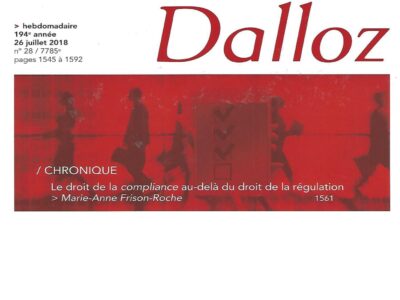
Full reference : Frison-Roche, M.-A., Le Droit de la Compliance au-delà du Droit de la Régulation, Recueil Dalloz, 2018, chronique, pp. 1561-1563. Summary : A movement started from precise legal requirements linked to identified actors, as the financial or banking sector, to transform itself in legal norms of Compliance. Compliance Law is thus the extension of Regulation Law. But Compliance Law is taking its full autonomy with regards with Regulation Law, while retaining its violence, its radicalisé, and even its archaism, even though it concerns companies which do not act on regulated sectors, putting down, for instance, notions linked to territoriality (I). How companies should react face to this unequaled news (II)? Read the article (in French)Read the table of contents of the Review (in French).This document is based on a working paper with footnotes, technical references and hypertext links.
Read more
LawFinancial Services IndustryRegulatory lawComplianceCompliance Law