All news

Books

VERGNOLLE, Suzanne

L’effectivité de la protection des personnes par le droit des données à caractère personnel (The effectiveness of the protection of people by personal data Law)

Full reference: Vergnolle, S., L'effectivité de la protection des personnes par le droit des données à caractère personnel (The effectiveness of the protection of people by personal data Law (our translation)), Passa, J. (dir.), thesis, Law, Panthéon-Assas University (Paris II), 2020, 531 p.   Read the thesis (in French) Read directly and only the table of contents (in French)     To go further about regulation of personal data, read:  Frison-Roche, M.-A., Rethinking the world from the notion of data, 2016 Frison-Roche, M.-A., The regulatory conséquences of a world redesigned from the concept of data, 2016. 

Publication director

🏗️ direction of the collection: 📚Droit et Économie

📕Le droit économique au XXIe siècle. Notions et enjeux

Full reference: Racine, J.-B. (ed.), Le droit économique au XXIe siècle. Notions et enjeux, Coll. Droit & Economie, Lextenso – LGDJ, 2020, 726 p. -   Summary of the book : Economic Law has not been so important than today, at a time of phenomenal changes in our societies. Economics are everywhere and Law is directly requested, to accompany, frame and finalize economics. Economic Law, which remain without definition, must be perceived now as a fundamental understanding tool of the realities of our time. This book proposes both to take stock of what Economic Law is at the start of the XXIst century and to give prospective analysis of what it could be in the years to come. It has been designed as a collective research based on  30 key-words (like the firm, the market, globalization, artificial intelligence). Each author has taken a notion by placing it in a logic of Economic Law. It is therefore on a transversal and thematic analysis that the book is based. Economic Law is an open house. While it seeks diverse schools of thought, it gives pride of place to diversity. The book has been realized in this spirit. If it gather many authors from Nice's school, it is also open to other perspectives and opinions. Economic Law, through its research topics and analysis methods is in constant change. This research shows that economics is a topic which crosses every legal branches, beyond business Law.  The book is aimed at students wishing to familiarize themselves with Economic Law process, researchers intending to explore Economic Law themes in depth, and also practitioners who are looking for keys to understanding the current issues raised by the relationship between Law and Economics.    List of authors: Jean-Baptiste Racine Éric Balate Jennifer Bardy Jean-Sylvestre Bergé Walid Chaiehloudj Jacques Chevallier Bruno Deffains Catherine Del Cont Pascale Deumier Isabelle Doussan Aude-Solveig Epstein Marie-Anne Frison-Roche Giulio Cesare Giorgini Lemy Godefroy Marie-Angèle Hermitte Clotilde Jourdain-Fortier Gilles J. Martin Frédéric Marty Séverine Menétrey Mehdi Mezaguer Eva Mouial Bassilana Irina Parachkévova-Racine Thomas Perroud Valérie Pironon Patrice Reis Fabrice Riem Jean-Christophe Roda Mahmoud Mohamed Salah Fabrice Siiriainen Katja Sontag Marina Teller Anne Trescases   Read the table of contents (in French) Read Jean-Baptiste Racine's introductive article (in French) Read Marie-Anne Frison-Roche's article (in French) and read the bilingual working paper on which this article is based. 

Articles

New SEC Report to Congress about Whistleblower Program: what is common between American and European conception

Full reference: Frison-Roche, M.-A., New SEC Report to Congress about Whistleblower Program: what is common between American and European conception, Newsletter MAFR – Law, Compliance, Regulation, 1st of December 2020 Read by freely subscribing other news of the Newsletter MAFR – Law, Compliance, Regulation   Summary of the news Like every year since the adoption of the Dodd-Frank Act, the Securities and Exchanges Commission (SEC) and especially its Office of the Whistleblowers (OWB) handed to the Congress of the United-States a report about the success of its program concerning whistleblowers, especially estimated with the amount of financial rewards granted to them during the year. This report especially presents the amount granted to whistleblowers, the quality of the collected information and the efficacy of SEC's whistleblowers' protection process. If Americans condition the effectiveness of whistleblowing to the remuneration of whistleblowers, Europeans oppose the "ethical whistleblower" who shares information for the love of Law to the "bounty hunter" uniquely motivated by financial reward and favor the former to the later, as it is proven in the French Law Sapin II of 2016 (which do not propose financial reward to whistleblowers) or the British Public Interest Disclosure of 1998 (which just propose a financial compensation of the whistleblower's losses linked to whistleblowing).  However, American and European conceptions are not so far from each other. As United-States, Europe has a real care for legal effectivity, even if, because of their different legal traditions, Americans favor effectivity of rights while European favor effectivity of Law. If it places effectivity at the center of its preoccupations, Europe should conceive with less aversion the possibility to financially incite whistleblowers. Moreover, United-States and Europe share the same common willingness to protect whistleblowers and if rewarding would enable a better protection, then Europe should not reject it, as shows the recent declarations of the French Defenders of Rights. It is not excluded that both systems converges in a close future. 

Reports

CHAPRON, Jean-Paul, DUBOST, Coralie and IMALHAYENE, Fella

Labels RSE. Accompagner les entreprises et donner confiance à leurs parties prenantes (CSR labels. Support companies and give confidence to their stakeholders)

Full reference: Chapron, J.-P., Dubost, C. and  Imalhayene, F., Labels RSE. Accompagner les entreprises et donner confiance à leurs parties prenantes (CSR labels. Support companies and give confidence to their stakeholders), Report submitted to the French Minister of Economy and Finances, 30th of November 2020, 81p.   Read the report (in French) Read the synthesis of the observations and recommendations of this report by the Secretary to social, solidarity and responsible economy (in French)

Articles in The Journal of Regulation & Compliance « JoRC »

LAGARDE, Paul

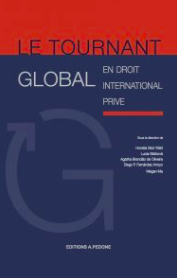
Preface of the book “Le tournant global en droit international privé”

Full reference: Lagarde, P., Preface of Le tournant global en droit international privé, Muir-Watt, H., Biziková, L., Brandão de Oliveira, A., Fernández Arroyo, D. P., Ma, M. (ed.), Editions Pedone, 2020, pp. 9-14 Read Paul Lagarde's preface (in French)

Articles in a legal collective publication

Pour une conception humaniste du Droit des affaires et de son enseignement (For a humanist conception of Business Law and of its teaching), in “Un juriste pluriel. Mélanges en l’honneur d’Alain Couret”

Full reference : Frison-Roche, M.A., Pour une conception humaniste du Droit des affaires et de son enseignement (For a humanist conception of Business Law and of its teaching), in Un juriste pluriel. Mélanges en l'honneur d'Alain Couret, Editions Francis Lefebvre and Dalloz, 2020, pp. 985-990.   Read the article   Read the working paper, with additional developments, technical references and hyperlinks on which this article is based   Read the general presentation of the book in which this article has been published

Jurisprudence

Cour de Cassation (French Judicial Supreme Court)

Decision of 25th of November 2020, Société Iron mountain France SAS

Full reference: Cour de Cassation, Chambre criminelle, 25th of November 2020 (18-86.955), Decision n°2333, société Iron mountain France SAS Read the decision (in French) Read the press release from the Cour de Cassation (in French) ​Read the explication note from the Cour de Cassation (in French) Read Julie Gallois' comment   Summary of the decision In this decision constituting a case law reversal, the Chambre criminelle of the Cour de Cassation decides that the firm which absorbs the one to which are imputable facts which can receive a penal qualification leading to penalties of fines has the aptitude to answer penally. The decision precises that this reversal is applicable only to future cases, to respect the principle of predicability, except if this merging was operated only to escape from criminal responsibility of moral persons.  This case is an example of the use of Criminal Liability Law as an incentive.     

Texts

European Parliament and European Council

Directive 2020/1818 on representative actions for the protection of the collective interests of consumers

Full reference: Directive (EU) 2020/1828 of the European Parliament and of the Council of 25 November 2020 on representative actions for the protection of the collective interests of consumers and repealing Directive 2009/22/EC Read the directive

Articles

💬Facebook: Quand le Droit de la Compliance démontre sa capacité à protéger les personnes (Facebook: When Compliance Law proves its ability to protect people)

Full reference: Frison-Roche, M.-A., Facebook: Quand le Droit de la Compliance démontre sa capacité à protéger les personnes (Facebook: When Compliance Law proves its ability to protect people), interview with Olivia Dufour, Actu-juridiques Lextenso, 23rd of November 2020 Read the interview (in French) Read the news of the Newsletter MAFR – Law, Compliance, Regulation about this question

Videos

🎥Compliance Law, an adequate legal framework for GAIA-X, in 🧮GaiaX Summit2020, The World with GAIA-X

► Full Reference: M.-A. Frison-Roche, "Compliance Law, an adequate legal framework for GAIA-X", in Pan-European GAIA – X Summit, The World with GAIA-X, November18, 2020. - 🧮See the general presentation of the Summit - 📈​See the slides, basis of this intervention. - ► Summary of the intervention: Europe may offer an adequate legal framework for the GAIA-X project through Compliance Law. Compliance Law is a new form for Regulatory Law, driven by "Monumental Goals", negative Monumental Goals, for instance prevention of systemic failures, and positive Monumental Goals, for instance innovation or stability. This very new branch of Law works on these Monumental Goals, which must be explicit and internalized in Crucial Enterprises. These Crucial Enterprises concretize these Goals, supervised by public Authorities.  European Compliance Law already works, for instance about Personal Data protection (case law and GDPR) or prevention banking systemic failures (Banking Union), Compliance Tools being in balance with Competition principle. European Union Law is moving from the Ex-Post Competition Law to the Ex-Ante Compliance Law, internalizing Monumental Goals in Crucial Enterprises.  There is a perfect adequacy between European Compliance Law and GAIA-X. This project built by Crucial Enterprises must be supervised by public authority, maybe a specific or the European Commission. The governance of GAIA-X must be transparent and accountable. This private organization must use it powers in respect of the proportionality principle, controlled by the public supervisory body. The legal framework is required but it is sufficient.  - 📈see the slides, basis of this intervention. - 🎥watch the video of this intervention.  -