ENGLISH
The role of fibre is very important towards connecting to ultra-fast broadband, one of the key action areas of the Digital Agenda. But, Europe is late in its fibre deployment, especially when compared to other advanced economies such as the United States or Japan. At the same time, however, there is still no standard for a European fibre strategy: public as well as private stakeholders are having very different approaches in local FTTx deployment sometimes leading to a waste in private and public funds and being mainly focused on dense areas. This article aims to propose an efficient model for fibre network deployment that can be applied to all European Member States. The model provides high-margin incentives for operators to install fibre network across the whole country, while maximising households’ fibre connection rate through an automatic migration scheme. In a period of weak growth and budget restrictions, the catch-up in ultra-fast broadband internet requires more than ever an efficient policy to maximise the deployment of FTTH at the lowest cost possible to the public. The proposed model serves as an ideal choice given this context.
Alternative operator – Budget – Connexion – Copper network – Cost – Digital agenda – Duplication – Effeciency – Essential facility – Europe – Fiber optic – France – Incentive – Incumbent operator – Infrastructure – Internet – Natural economic monopoly – Network – Price – Provider – Regulatory policy *
* In The Journal of Regulation, these keywords are done by the Editor and not by the Author.
PORTUGUESE
Artigo: Do cobre à fibra: uma política de regulação ótima.
O papel da fibra é muito importante em conexões de banda larga de alta velocidade, uma das principais ações na área da Agenda Digital. No entanto, a Europa está atrasada no desenvolvimento da fibra, especialmente quando comparada com outras economias avançadas como Estados Unidos ou Japão. Ao mesmo tempo, porém, ainda não há um patamar para uma estratégia europeia para a fibra: detentores de haveres públicos e privados têm tido diferentes posturas no desenvolvimento de FTTx local, o que leva às vezes a um desperdício de fundos públicos e privados e sendo sobretudo registrado em áreas de densidade. Este artigo objetiva propor um modelo eficiente para o desenvolvimento da rede de fibra que possa ser aplicado para todos os Estados Membros Europeus. O modelo prevê incentivos altos para operadores para instalar redes de fibra por todo o país, enquanto maximiza a taxa de conexões domésticas de fibra através de um esquema de migração automática. Em um período de crescimento desacelerado e restrições orçamentárias, um novo impulso em banda larga de alta velocidade requer mais do que nunca uma política eficiente para maximizar o desenvolvimento de FTTH ao menor custo possível para o público. O modelo proposto serve como uma escolha ideal dado este contexto.
Operador alternativo – Orçamento – Conexão – Rede de cobre – Custo – Agenda digital – Duplicação – Eficiência – Facilidades essenciais – Europa – Fibra ótica – França – Incentivo – Operador – Infra-estrutura – Internet – Monopólio natural econômico – Rede – Preço – Provedor – Política de regulação*.
* No Journal of Regulation, as palavras-chave são fornecidas pelo Diretor, e não pelo Autor.
ITALIAN
Articolo: Dal rame alla fibra: un’ottima politica di regolazione
Il ruolo della fibra è molto importante per la connessione ad alta velocità, una delle azioni centrali dell’agenda digitale. Tuttavia l’Europa è in netto ritardo per quando riguarda lo sviluppo della fibra, in particolare rispetto all’economia di altri paesi come gli Stati Uniti o il Giappone. Questo si capisce, però, in quanto non esiste uno standard per la strategia dell’Europa in materia di fibra: gli attori privati e pubblici del settore della fibra stanno avendo degli approcci differenti nei confronti della realizzazione dei FTTx, e tali approcci spesso si concludono in uno spreco di investimenti e si concentrano spesso su aree ad alta densità. Questo articolo si propone di trovare un modello efficace per la realizzazione di una rete a fibra in tutti gli Stati membri. Questo modello prevede degli incentivi elevati per gli operatori che installano delle reti a fibra ottica nei loro paesi, e massimizza la percentuale di connessioni a fibra ottica per nucleo familiare con un sistema di migrazione automatico. In un periodo di crescita ridotta e restrizioni di budget, lo sviluppo di connessioni a fibra ottica richiede una politica quanto mai efficace per massimizzare lo sviluppo del FTTH ai minimi costi possibili per i conti pubblici. Il modello proposto costituisce una scelta essenziale, in considerazione del contesto esistente.
Agenda digitale – Budget – Connessione – Connessioni su rame – Costi – Duplicazione – Efficienza – Europa – Fibra ottica – Fornitore – Francia – Incentivi – Infrastruttura – Infrastruttura essenziale – Internet – Monopolio economico naturale – Operatore alternativo – Operatore storico – Prezzo – Politica di regolazione – Rete *
* In The Journal of Regulation, le parole chiave sono responsabilità dell’Editore e non dall’Autore.
SPANISH
Artículos: Del cobre a la fibra : una política regulatoria óptima
El rol de la fibra óptica es de gran importancia en lo que concierne la conexión al ancho de banda ultrarrápida, una de las áreas claves de acción en la Agenda Digital. Sin embargo, Europa se encuentra atrasada en cuanto a su desarrollo, especialmente en comparación con otras economías avanzadas, como la de los EEUU o Japón. No obstante, todavía no existe un estándar para una estrategia europea para la red de fibra óptica; accionistas, tanto privados como públicos, han estado adoptando diferentes acercamientos a la implementación de los FTTx, lo cual suele llevar a un enfoque sobre áreas demasiado densas y al desperdicio de fondos privados y públicos. Este artículo tiene como objetivo proponer un modelo eficiente para el desarrollo de la red de fibras ópticas que podría aplicarse a todos los miembros de la Unión Europea. El modelo provee incentivos de gran margen de ganancias para operadores para la instalación de estas redes de fibras a través del país entero y al mismo tiempo maximiza la conexión rápida de fibras en todas las viviendas facilitado por el uso de un esquema de migración automática. En un periodo de crecimiento débil y restricciones presupuestarias, el “catch-up” en el Internet de banda ancha ultrarrápida requiere ahora más que nunca una política eficaz para maximizar el desarrollo del FFTH y minimizar el coste incurrido por el público.
Other translations forthcoming.
The role of fibre is very important towards connecting to ultra-fast broadband, one of the key action areas of the Digital Agenda. But, Europe is late in its fibre deployment, especially when compared to other advanced economies such as the United States or Japan. At the same time, however, there is still no standard for a European fibre strategy: public as well as private stakeholders are having very different approaches in local FTTx deployment sometimes leading to a waste in private and public funds and being mainly focused on dense areas. This article aims to propose an efficient model for fibre network deployment that can be applied to all European Member States. The model provides high-margin incentives for operators to install fibre network across the whole country, while maximising households’ fibre connection rate through an automatic migration scheme. In a period of weak growth and budget restrictions, the catch-up in ultra-fast broadband internet requires more than ever an efficient policy to maximise the deployment of FTTH at the lowest cost possible to the public. The proposed model serves as an ideal choice given this context.
In February 2009, Commissioner Neelie Kroes, Vice-President of the European Commission responsible for the Digital Agenda, talking about the fibre deployment situation in Europe, admitted that “The current rate of new connections – now down to 25,000 a day – is simply not enough to meet our 2020 targets”[#_ftnref1<-]. Indeed, Europe is late in its fibre rollout: the penetration rate of FTTH/B in Europe, at 17.4%, is quite low compared to that of Japan or the US, at 39% and 33% respectively[#_ftnref2<-]. However, it is very important for the European society and economy to have all households connected to the new technology. In a period of weak growth and budget restrictions, the catch-up in ultra-fast broadband internet requires more than ever an efficient policy to maximise the deployment of FTTH at the lowest cost possible to the public. The choice of an appropriate regulatory model is therefore essential. This article describes such an optimal model by taking the French experience as a case study for numerical illustration. Lessons from this French experience remain obviously true for other European countries.
The historical model for the copper network
What is the starting point? In Europe in general, a copper network deployed by the incumbent operator makes telephone service available across the whole country. This network has supported the development of the low-speed and then high-speed internet. Internet service providers (ISPs) pay an access price to the copper network that is mostly regulated and fixed by National Regulatory Authority (NRA). The price is currently at €8.55/line/month in Europe[#_ftnref3<-]. This unique access price in each European country conceals a reality of very different costs depending on the geographical situation of all the lines the countries. Indeed, the lower the population density, the higher the cost of the line.
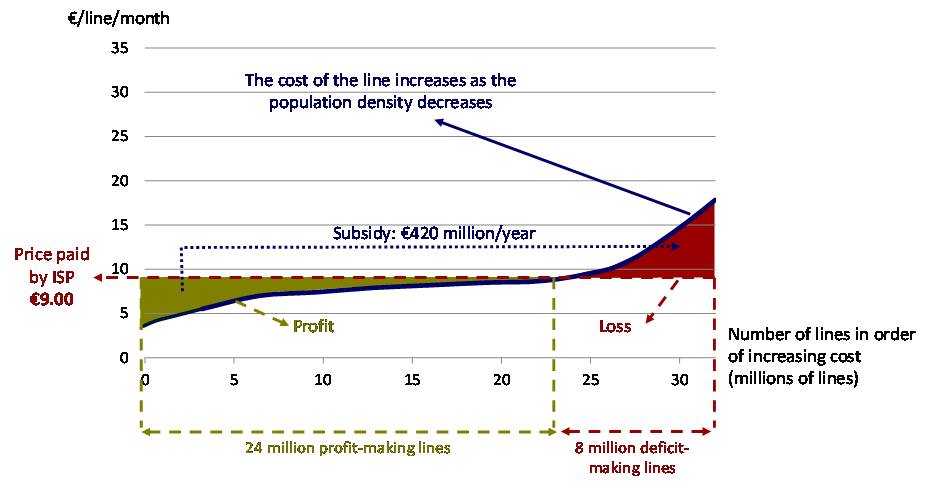
In France, for example, where the access price to the copper network of France Telecom is at €9.00/line/month, a geographical averaging of costs by which 24 million lines finance 8 million lines is in place. These 24 million lines, whose cost is less than €9.00/line/month, incur a profit of €420 million/year and thus subsidise the 8 million lines whose cost is higher than its price[#_ftnref4<-]. This is an internal transfer within France Telecom. It allows an overall economic balance that leaves France Telecom with, among others, a comfortable margin[#_ftnref5<-] (see figure 1 below). The situation is similar for other incumbents in Europe.
Figure 1: Geographical averaging of costs between lines in the copper network in France
Source: Tera Consultants.
This system allows French ISPs to buy an access to the copper network that let them sell ultra-fast broadband internet at around €32/line/month including tax[#_ftnref6<-], where competition is feasible. It should be noted that 6 million lines or 20% of total lines in France cannot access these offers due to the copper network structure and the viability of local loop unbundling (LLU). Similar situation arises in other European countries, for example, in the UK only 85% of total lines are enabled by at least one LLU operator.
A transition from copper to FTTH: the efficient regulatory model
Let us consider the total replacement of the copper network by the FTTH network. This new network is based, like the copper network, on a point-to-point architecture which facilitates fibre unbundling. This network also links the optical distribution frame (ODF) with a minimum capacity of 2000 lines, which is an essential element that allows for a full-fledged competition among all the ISPs across the whole country, including the lines that currently do not enjoy the best of broadband internet. The same profit as the copper network (same WACC) could be applied. The access price to the fibre network paid by ISPs would be the national average cost of all the lines. In this system, with the same geographic averaging as for the copper network, there will be profit-making lines, whose cost is lower than the average price, and loss-making lines, whose cost is higher than the average price. A fund with contributions from profit-making areas should assure the subsidy of loss-making areas. The operating principles of such a fund have already been tested as in the universal telecommunications service.
The FTTH connection rate under this system is automatically 100% since the switch off of the copper network is planned through a mandatory migration similar to that currently in place for the Digital Terrestrial Television for example, or to the successful change from 110 to 220 volts in electrical networks. This further guarantees the profitability of FTTH by maximising economies of scale. The system can also allow residential subscribers who opt for the telephone service only on their fibre access to keep their current price plan, which is €15/line/month VAT included for the European average[#_ftnref7<-], by introducing a subsidy for non-internet subscribers by ultra-fast broadband internet subscribers. On the other hand, all internet subscribers would be migrated over ultra-fast broadband internet based on fibre.
In order to ensure that the FTTH is deployed in the most efficient manner, a competition for the market could be introduced to choose the most efficient FTTH network operator at the local level.
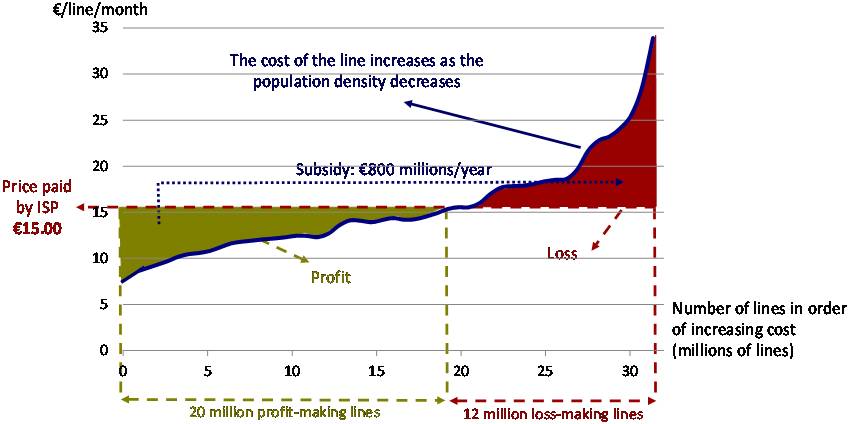
When this model is applied in France, total investment needed including connection to each accommodation is estimated at €36 billion that is supposed to pay off within 35 years with the same level of profitability as the copper network at 10.4%[#_ftnref8<-]. The access price to the fibre line paid by ISPs would be at €15.00/line/month excluding tax vs. €9.00/line/month for the copper network. Given geographic averaging, 20 million lines, or 60% of the total, would cost lower than their average price and thus incur a profit of €800 million/year that would compensate the loss arising from the 12 million loss-making lines (see figure 2 below).
For ISPs’ consumers, the retail fibre monthly rental charge would then stand between €38 and €39/line/month, equivalent to a 20% price increase compared to the standard broadband over copper monthly rental charge. In return, these consumers would enjoy symmetric internet access at a higher speed of up to 50 times and the possibility to choose any ISP and to have access to any internet service regardless of where they live.
Figure 2: The cost, average price and subsidy for an efficient national FTTH deployment
Source: Tera Consultants.
The errors of the model chosen nowadays
The efficient model above can be applied to any other country, in Europe as well as elsewhere. However, this has not been chosen as a European standard. In fact, there is currently no European standard at all. A host of different initiatives has sprung up: in Switzerland, the incumbent Swisscom and the utility operator EWZ work together to construct the fibre network in largest cities, in Italy, alternative operators have teamed up for the deployment, in Sweden, the Netherlands or Germany, the municipalities and the incumbents have led the way, in France, on the other hand, both the incumbent and alternative operators have built their own infrastructure, thus leading to a duplication of fibre networks, etc. As a result of these “unorganised” and diverse initiatives, market players and NRAs must now think about how to encourage investment in fibre deployment and migration from copper to fibre. For example, the European Commission issued an NGA Recommendation in 2010 that requires regulator to take into account an investment risk premium to allow for an increase in wholesale access price to the new fibre network[#_ftnref9<-]. Also, the European Telecommunications Network Operators’ Association (ETNO) and the European Competitive Telecommunications Associations (ECTA), two imminent trade associations in telecoms, have proposed contradicting measures. While ETNO recommended the same pricing method for both the fibre and copper network, ECTA indicated that access price to copper should be cut substantially to create enough incentive for incumbents to invest in fibre[#_ftnref10<-]. But, if the efficient model presented above had been chosen, these questions would be irrelevant since migration would be automatic for all households, plus profitability of FTTH network would be guaranteed with a comfortable margin.
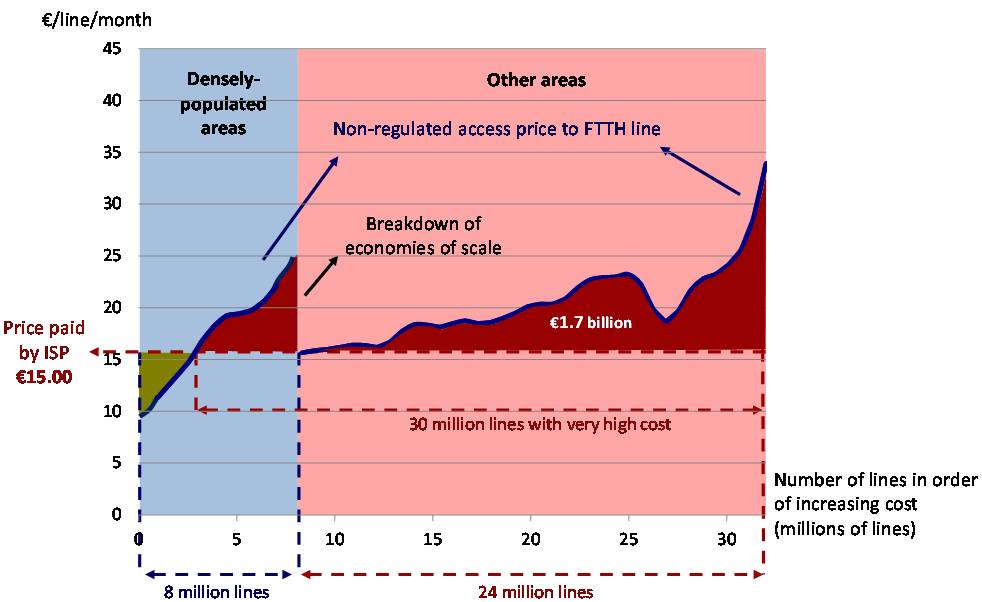
An example of inefficient model is the case in France, where the duplication of FTTH networks takes place in areas classified as “very dense” (148 municipalities and 5.5 million households according to ARCEP). This duplication disrupts economies of scale and leads to an average price of access to FTTH twice as high in very dense areas: it will amount to around €20/line/month vs. €10/line/month if the network had not been replicated. Outside very dense areas, economic rationality reasserts itself: only one operator can reasonably be expected to deploy the FTTH network, France Telcom[#_ftnref11<-]. The current model entails an increase of access prices by about 35% in total at the national level compared to the efficient model. 30 million lines, or 94% in total, and the corresponding number of French households will have to pay higher prices compared to the efficient model, equivalent to an additional expenditure of nearly €1.7 billion per year[#_ftnref12<-].
Figure 3: Cost, disruption and “digital divide” in the current system, the example of France
Source: TERA Consultants.
In addition, several incumbents in Europe deploy nowadays a FTTH network with the Passive Optical Network (PON) architecture such as France Telecom, Telenor of Norway, Telecom Italia, and A1 Telekom of Austria. This is a technical choice that makes it expensive and difficult to open their network to competing ISPs in the future. In Europe, since no constraint is imposed on the minimum size of the ODF, the incumbent will be free to completely close the market by creating small ODF that the alternative operators will not be able to serve due to low economies of scale. Service-based competition will be all the more weakened since ex ante regulation of offers enabling access to FTTH networks is still at a hypothetical stage in many European countries. Instead, it should be decided a priori and not a late remedy to address certain malfunctions.
Obviously, in the current models in Europe, there is no longer any guarantee of a deployment of FTTH to all households, especially since the deployment cost in non-urban areas could be very high. For instance, in France, outside very dense areas, FTTH access prices vary depending on the municipalities, from €12 to €34/line/month. This risk is increasing the digital divide whereas in fact, people living in rural areas would benefit more from FTTH than city dwellers because internet connection speed on fibre does not decrease with distance, contrary to the copper case. On top of this, even if fibre deployment would perhaps be extended to rural areas, there would be no guarantee of homogenous price in all areas of the country. This is already the case in the Netherlands –one of the most dense and homogeneous country from a geographic point of view in Europe-, where fibre deployment is in an advanced stage compared to other European countries but where access price to fully unbundled ODF varies between €12.14/month and € 17.71/month[#_ftnref13<-]. The efficient model presented above will not only prevent these effects (no fibre in rural areas and/or geographically de-averaged prices) but will also ensure a very profitable the investment in FTTH (cost of capital at around 10%, like for copper). It is to be noted that, outside Europe, the Australian government is choosing a similar approach by organising the deployment of a nationwide FTTH network with a uniform wholesale access price whereby national solidarity is preserved[#_ftnref14<-].
Conclusion: an absolute necessity to revise the models adopted in Europe
There exist circumstances where competition cannot work. Lawyers call that “essential facility”, economists “natural monopoly”. In these circumstances, regulation is needed. The situation of the local loop of wired telecommunications networks falls within this issue: the duplication of infrastructure increases the costs to such an extent that no gain in competitive efficiency is able to offset the cost of this duplication. The replacement of copper by fibre does not change the technical and economic fundamentals of wired local loop. Why? This is due to the fact that most of the fixed costs of this local loop consist of civil work, construction, engineering and labour, items not subjected to the digital technology progress.
It is therefore indispensable to have a comprehensive review of current regulatory model in order to overcome the digital divide, to ensure the maximum FTTH deployment in Europe with the lowest cost possible by introducing effective competition everywhere and to promote the dissemination of innovations in the digital economy of the future. The digital divide must be resolved and must not be turned into an economic abyss.
[#_ftn1<-] The Commissioner’s speech at the Fibre to the Home Council Europe Conference, Milan, 10 February 2011.
[#_ftn2<-] Source: IDATE, FTTx 2011 Market & Trends, Facts & Figures.
[#_ftn3<-] Source: Communication from the Commission to the European Parliament, the Council, the European Economic and Social Committee and the Committee of the Regions - Progress Report on the Single European Electronic Communications Market (15th report). The prices are of October 2009 and excluding tax.
[#_ftn4<-] These figures are TERA Consultants’ calculations based on ARCEP’s data published in 2005 (see ARCEP’s decision no. 2005-0834). ARCEP is the French telecoms regulator.
[#_ftn5<-] Cost of capital at 10.4% determined by ARCEP on the basis of assets evaluated using the current cost with economic depreciation approach.
[#_ftn6<-] Price charged by alternative operators Bouygues Telecom and SFR in May 2011 (2€ more for France Telecom, the incumbent, and Free, another alternative operator, includes unlimited calls to mobile for 38€).
[#_ftn7<-] European Commission 15th report, figures of September 2009.
[#_ftn8<-] Tera Consultants’ calculations. These costs include investments of vertical and horizontal deployments, cost of connecting to apartments in building as well as to one-off houses. Other costs that were taken into account are : operational costs (cable maintenance), the lease costs of civil engineering of France Telecom or sewers, municipality costs (5.78% according to ARCEP’s decision 2005-0834), the client connection costs and the costs of vertical deployment, shared between operators with an investment depreciated in 35 years (source: ARCEP’s decision 2005-0834), with a cost of capital at 10.4% (ARCEP: 2005-0834) and 32 million lines (source: Notice explicative de l’outil de simulation de la tarification du génie civil de boucle locale en conduite de France Télécom – May 2010).
[#_ftn9<-] Commission Recommendation of 20 September 2010 on regulated access to Next Generation Access Networks (NGA) [2010/572/EU]
[#_ftn10<-] ETNO’s position is based on a study by Plum Consulting available at http://www.etno.eu/Default.aspx?tabid=2381; ECTA’s proposal is based on the WIK’s study available at http://www.ectaportal.com/en/REPORTS/WIK-Studies/WIK-Study-Apr-2011/
[#_ftn11<-] For more on this subject read opinion 10-A-07 of 17 March 2010 of the French Competition Authority relative to the opinion requested by the Minister for the economy, industry and employment and by the Minister for industry relative to the national “ultrafast broadband” programme, available online at http://www.autoritedelaconcurrence.fr/user/standard.php?id_rub=368&id_article=1417
[#_ftn12<-] Segmentation between the very dense areas and others will then create absurd local disruptions. Municipalities with FTTH network duplication will experience an access cost of up to €21/line/month, 40% higher than that in the municipalities where FTTH network is not duplicated and yet where population density is lower (see Figure 3). Obviously, these two types of municipalities can be next-door neighbours: imagine the source of misunderstanding for the families and the consequences for the politicians under such a system.
[#_ftn13<-] Source: for the Netherlands: KPN 4th quarter results 2010, page 73, available at http://www.kpn.com/corporate/aboutkpn/investor-relations/presentations/analyst-presentations.htm.
[#_ftn14<-] Source : NBN co limited, Corporate Plan 2011 – 2013, 17 December 2010, page 13