All news

Articles in The Journal of Regulation & Compliance « JoRC »

📝L’arbitre, juge, superviseur, accompagnateur ? (The arbitrator, judge, supervisor, coach?),, in 🕴️M.-A. Frison-Roche (dir.), 📕L’obligation de Compliance

► Full Reference: J.-B. Racine, "L’arbitre, juge, superviseur, accompagnateur ?" (The arbitrator, judge, supervisor, coach?), in M.-A. Frison-Roche (dir.), L'Obligation de Compliance, Journal of Regulation & Compliance (JoRC) and Dalloz, coll. "Régulations & Compliance", 2025, pp. 489-502. - 📕read the general presentation of the book, L'Obligation de Compliance, in which this article is published - ► English Summary of this article (done by the Journal of Regulation & Compliance – JoRC) : From the outset, the author sets out what is at stake in these terms:  "Quel rôle peut ou pourrait jouer l’arbitre dans les dispositifs de compliance ? Selon le rôle qu’il est amené à jouer, il peut ou pourrait venir en renfort de l’obligation de compliance. Poser cette question, c’est poser la question des pouvoirs de l’arbitre et de son office. C’est aussi, d’une certaine manière, renvoyer à la notion même d’arbitrage." (What role can or could the arbitrator play in compliance systems? Depending on the role he/she is called upon to play, he/she can or could reinforce the compliance obligation. Asking this question raises the question of the powers of the arbitrator and his/her office. In a way, it also goes back to the very notion of arbitration).  In practice, arbitrators deal with compliance issues in their office as judges. This is illustrated by disputes involving allegations of corruption, where the arbitrators' ruling obviously cannot give effect to a corrupt practice unless they violate themselves international public order. But in this, the arbitrator is only applying a legal standard, the main issue being then the question of evidence, with compliance tools often serving as indicators of the corruption itself. Leaving behind the strict legal source and coming to the standards issued by the ICC about the fight against corruption, we really enter into the "compliance obligation", in the strict sense, when a contract appears. International business practices standards are emerging, not only in the area of probity but also in the protection of human rights, for which arbitrators can now act as guarantors. Arbitrators can do this, in particular, through the emerging litigation relating to vigilance obligation, either directly when vigilance plans are at issue,, even if a legal rule gives a specific competence to a State court (as the French 2017 law does) or if we imagine that a plan itself includes a system for recourse to arbitration, which would imply a change in culture, or if we consider that soft law is in the process of emerging from the practices of international trade laying down a duty of vigilance that arbitrators could take up. In the second part of his contribution, the author takes a second, bolder approach, namely that of an arbitrator who understands Compliance Law in that he/she would be more than a Judge, i.e. he/she would do more than settle a dispute by applying the law. This would be conceivable given the tendency to consider that the arbitrator could modify contracts and if example is taken from the technique of arbitration practised for concentration disputes in merger law. To give arbitration the required regulatory dimension, this third party would have to be able to exercise a supervisory function, which the notion of "dispute" hardly lends itself to, especially as an arbitrator is only set up to be a judge, and if he/she ceases to be one it is difficult for him/her to remain an arbitrator…. However, it is conceivable that in Ex Post the arbitrator could perform the monitoring function often required in Compliance Law. The technique of disputes boards is inspiring in this respect. The two fields, Arbitration and Compliance, are thus destined to move closer together, as the two traditional limits, arbitrability and litigation, are in the process of evolving so that they no longer stand in the way of such rapprochements. The author can therefore conclude: "C’est aux différents acteurs de la compliance de penser à l’arbitrage, et à la souplesse, la plasticité et la liberté qu’il offre, pour éventuellement le configurer spécialement au service des buts de la compliance." (It is up to the various players in Compliance to think about Arbitration, and the flexibility, plasticity and freedom it offers, in order to configure it specifically to serve the goals of Compliance Law). -

Articles in The Journal of Regulation & Compliance « JoRC »

RAPP, Lucien🕴️

📝L’obligation de Compliance dans les chaînes de valeur, in 🕴️M.-A. Frison-Roche (dir.), 📕L’obligation de Compliance

► Full Reference: L. Rapp, "Compliance, Chaines de valeur et Économie servicielle",  ", in M.-A. Frison-Roche (dir.), L'obligation de Compliance, Journal of Regulation & Compliance (JoRC) and Dalloz, coll. "Régulations & Compliance", 2025, pp. 153-172. - 📕read the general contribution of the book, L'Obligation de Compliance, in which this contribution is published - ► English summary of this contribution  (done par its author) :  Based on an analysis of the value chains of companies in the space sector and their recent evolution, this contribution examine the role, place and current transformations of compliance policies and strategies in the context of an industrial transformation that has become essential: the transition from an industrial economy to a service economy. - 🦉This article is available in full text to those registered for Professor Marie-Anne Frison-Roche's courses -

Articles in The Journal of Regulation & Compliance « JoRC »

📝À quoi engagent les engagements (In Compliance Law, the legal consequences for Entreprises of their commitments and undertakings), in 🕴️M.-A. Frison-Roche (dir.), 📕L’Obligation de Compliance

► Full Reference: M.-A. Frison-Roche, "À quoi engagent les engagements" (In Compliance Law, the legal consequences for Entreprises of their commitments and undertakings), in M.-A. Frison-Roche (dir.), L'Obligation de Compliance, Journal of Regulation & Compliance (JoRC) and Lefebvre-Dalloz, coll. "Régulations & Compliance", 2025, pp. 419-447. - 📝read the article (in French) - 🚧read the bilingual Working Paper on which this article is based, with additional developments, technical references and hyperlinks - 📕read the general presentation of the book, L'Obligation de Compliance, in which this article is published 📚see the general presentation of the series "Régulations & Compliance" in which this book is published - ► English summary of this article: The innocents might believe, taking the Law and its words literally, that "commitments" are binding on those who make them. Shouldn't they be afraid of falling into the trap of the 'false friend', which is what the Law wants to protect them from (as stated in the prolegomena)? Indeed, the innocent persons think that those who make commitments ask what they must do and say what they will do. Yet, strangely enough, the 'commitments' that are so frequent and common in compliance behaviours are often considered by those who adopt them to have no binding value! Doubtless because they come under disciplines other than Law, such as the art of Management or Ethics. It is both very important and sometimes difficult to distinguish between these different Orders – Management, Moral Norms and Law – because they are intertwined, but because their respective standards do not have the same scope, it is important to untangle this tangle. This potentially creates a great deal of insecurity for companies (I). The legal certainty comes back when commitments take the form of contracts (II), which is becoming more common as companies contractualise their legal Compliance Obligations, thereby changing the nature of the resulting liability, with the contract retaining the imprint of the legal order or not having the same scope if this prerequisite is not present. But the contours and distinctions are not so uncontested. In fact, the qualification of unilateral undertaking of will is proposed to apprehend the various documents issued by the companies, with the consequences which are attached to that, in particular the transformation of the company into a 'debtor', which would change the position of the stakeholders with regard to it (III). It remains that the undertakings expressed by companies on so many important subjects cannot be ignored: they are facts (IV). It is as such that they must be legally considered. In this case, Civil Liability will have to deal with them if the company, in implementing what it says, what it writes and in the way it behaves, commits a fault or negligence that causes damage, not only the sole existence of an undertaking.  - 🌐follow Marie-Anne Frison-Roche on LinkedIn 🌐follow Marie-Anne Frison-Roche on Instagram 🌐subscribe to the Newsletter MAFR Regulation, Compliance, Law 🌐subscribe to the Video Newsletter MAFR Surplomb 🌐subscribe to the Newsletter MaFR Droit & Art

Articles in The Journal of Regulation & Compliance « JoRC »

📝Les enjeux présents et à venir de l’articulation des principes de procédure civile et commerciale avec la logique de compliance (Current and future challenges for articulating civil and commercial procedural principles with Compliance Logic), in 🕴️M.-A. Frison-Roche (dir.), 📕L’Obligation de Compliance

► Full reference : Th. Goujon-Bethan, "Les enjeux présents à venir de l’articulation des principes de procédure civile et commerciale avec la logique de compliance (Current and future challenges for articulating civil and commercial procedural principles with Compliance Logic)", in  M.-A. Frison-Roche (ed.), L'Obligation de Compliance, Journal of Regulation & Compliance (JoRC) and Dalloz, coll. "Régulations & Compliance", 2025, pp. 693-719. - 📕Read a general presentation of the book, L'Obligation de Compliance, in which this article is published. - ► Summary of this article (by the Journal of Regulation & Compliance – JoRC): The author shows that the French Code of Civil Procedure, because it is exceptionally well designed and managed, can respond to the scale of transformation brought about by Compliance Law. Compliance Law is normatively anchored in its Monumental Goals: these are brought as such before the judge in 'Systemic Cases'. However, the French Code of Civil Procedure distinguishes between litigation and conflict, as demonstrated by the work of the academic authors of the Code, who were very famous legal scholars. Indeed, in a "Systemic Case" such as Compliance Law, which necessarily takes precedence (climate, protection of internet users, effective equality of human beings, sustainability of banking systems, etc.), it is the parties who are in dispute, while the conflict encompasses the systems themselves and other entities. The procedure must incorporate not only the dispute but also the conflict. This means, in particular, that we must deal not only with the dispute, but also with the conflict, which does not necessarily end with the dispute and does not find the same solutions as those sought by the dispute. It is particularly in this latter perspective, essentially in a "Systemic Compliance Case" procedure, that the techniques of mediation, amicus curiae, with a judge who takes an ex ante position, etc., are required. They are available through legal dispositions of this French Code of Civil Procedure: judges who understand what "Systemic Compliance Cases" are need only apply them. - 🦉this  article is available in full text for people who follow the professor Marie-Anne Frison-Roche's teaching  -

Articles in The Journal of Regulation & Compliance « JoRC »

Article in the Journal of Regulation & Compliance (JoRC)

📝Le juge adéquat pour l’effectivité de l’Obligation de Compliance (The Adequate Judge for the Effectiveness of the Compliance Obligation), in 🕴️M.-A. Frison-Roche (ed.), 📕L’Obligation de Compliance

► Full Reference: M.-A. Frison-Roche, "Le juge adéquat pour l'effectivité de l'Obligation de Compliance" ("The Adequate Judge for the Effectiveness of the Compliance Obligation"), in M.-A. Frison-Roche (ed.), L'Obligation de Compliance, Journal of Regulation & Compliance (JoRC) and Dalloz, coll. "Régulations & Compliance" 2025, pp. 741-775. - 📝read the article (in French) - 🚧read the bilingual Working Paper on the basis this contribution has been built, with  more developments, technical references and hyperlinks.  - 📕read the general presentation of the book, L'Obligation de Compliance, in which this article is published 📚see the general presentation of the series "Régulations & Compliance" in which this book is published - ► English summary of this contribution : The Judge is a character who seems weak in a Compliance Law that seems so powerful in a world where Technology is developing even a more impressive power. But present and future cases show, on the contrary, that he or she has a central role to play and that his/her role must be to use his/her own strength to remain what he/she is: the guardian of the Rule of Law, which is not so obvious because many Compliance tools, which are technological in nature, are in a way 'insensitive' to what we hold dear, the protection of human beings, which is based on the diligence of companies (I).  The second role that we can expect of the Judge is that not only does he/she help to ensure the permanence of this Rule of Law, which relies to a large extent on him:Her in the face of a future world that is unknown to us, mainly in its digital and climatic dimensions, perspectives that Compliance Law seeks to grasp, by renewing Regulation Law, by acting in relation to companies whose role is active, which leads the Judge to control them and to be aware of the claims that can be made against them, without taking the place of their management powers (II). This presupposes a new method (III), and all the judges, however diverse, will converge in an active dialogue between the judges, which will enable, firstly, the traditional role of the judge, linked to the Rule of Law, to endure in a rapidly changing world and, secondly, each judge to take on this new role implied by Compliance Law (IV). The perfect triangle will then be established, the strength and simplicity of which allows the use of the singular and the retention of capital letters for each of these three terms: Regulation Compliance Judge. - 🌐follow Marie-Anne Frison-Roche on LinkedIn 🌐follow Marie-Anne Frison-Roche on Instagram 🌐subscribe to the Newsletter MAFR Regulation, Compliance, Law 🌐subscribe to the Video Newsletter MAFR Surplomb

Articles in The Journal of Regulation & Compliance « JoRC »

BARBIÈRI, Jean-Baptiste🕴️

📝Les juges du droit des entreprises en difficulté et les obligations de compliance (Judges of Insolvency Law and Compliance Obligations), in 🕴️M.-A. Frison-Roche (ed.), 📕L’Obligation de Compliance

► Full Reference: , J.-B. Barbièri, "Les juges du droit des entreprises en difficulté et les obligations de compliance (Judges of Insolvency Law and Compliance Obligations), in M.-A. Frison-Roche (ed.), L'Obligation de Compliance, Journal of Regulation & Compliance (JoRC) and Éditions Lefebvre – Dalloz, coll. "Régulations & Compliance", 2025, pp. 313-323. - 📕read a general presentation of the book, L'Obligation de Compliance, in which this contribution is published  - ► English summary of this contribution (done by the Journal of Regulation & Compliance – JoRC): Describing at first sight the intersection of Compliance and Insolvency procedures as the "marriage of the carp and the rabbit", the Author shows that the logic is in many ways the same, particularly in terms of the role played by the Judge, since it is always a question of the State delegating Monumental Goals, with Insolvency procedures giving concrete expression to the desire to save a company, jobs, an industry, a region, etc., in what is always a "public interest".  In his/her office, the insolvency judge is confronted with compliance clauses, relating to commitments, or information, or organising monitoring. The author begins by examining the cases in which the insolvency judge is confronted with the principle of primacy of the insolvency proceedings over this compliance contractual organisation, either under current contracts, which may contain compliance obligations, in particular because audits and controls will have been strengthened or automatic termination will be provided for (which would then be deactivated?), or because the nullity of the suspect period comes into play, because the compliance clauses are often unbalanced. The second part examines the hypothesis that compliance techniques will support insolvency proceedings themselves and the purpose they serve. Indeed, because they are preventive in nature, contractual compliance mechanisms can also prevent failures, by means of audit and monitoring clauses and the introduction of reporting, if necessary under the supervision of the Judge, associated with conciliation mechanisms. What is more, they should be used to restructure companies in difficulty. The plan, which can be imposed on creditors, must open up the range of instruments, and could perhaps be articulated at this class of parties, which would only be made up of creditors benefiting from compliance clauses, if we consider that they constitute a "sufficient community of economic interest". They could then also be delegated the task of monitoring the survival of the company, which is the main goal served by the plan. In the case of a disposal plan, an offer including compliance undertakings should not be favoured, since the law expressly states that the sole purpose of such a plan is to ensure the maintenance of activities and to clear the past. But time will tell whether the judge will go beyond this. - 🦉This article is available for people who follow the Professor Marie-Anne Frison-Roche teaching

Articles in The Journal of Regulation & Compliance « JoRC »

LAPP, Christophe🕴️

📝L’usage de l’arbitrage international pour renforcer l’obligation de Compliance : l’exemple du secteur de la construction (The use of International Arbitration to strengthen Compliance oObligations: the example of the construction sector), in 🕴️M.-A. Frison-Roche (dir.), 📕L’Obligation de Compliance

► Full reference : Ch. Lapp, "L’usage de l’arbitrage international pour renforcer l’obligation de Compliance : l’exemple du secteur de la construction" (The use of International Arbitration to strengthen Compliance oObligations: the example of the construction sector)", in  M.-A. Frison-Roche (ed.), L'Obligation de Compliance, Journal of Regulation & Compliance (JoRC) and Dalloz, coll. "Regulations & Compliance", 2025, pp. 471-487. - 📕Read a general presentation of the book, L'Obligation de Compliance, in which this contribution is published. - ► English summary of this article (by the Journal of Regulation & Compliance – JoRC): The author emphasises that Arbitration is a particularly significant method of dispute resolution in the construction sector, not only because operators make extensive use of it, but also because this activity gives rise to difficulties that lend themselves to arbitration and at the same time concern compliance issues. In order to provide the necessary legal security and focusing on the Vigilance Plan especially in French and European Law, the author examines how disputes may arise in relation to it and what they may concern. In light of this, the author examines, on the one hand, the cases in which arbitration may be organised alongside the jurisdiction legally assigned to the Paris Court of Appel and, on the other hand, how Arbitrators will resolve the issues submitted to them. - 🦉This article is available in full text for those following the Professor Marie-Anne Frison-Roche's courses. -

Articles in The Journal of Regulation & Compliance « JoRC »

contribution dans a collective legal publication

📝Compliance et Responsabilité civile : comprendre et raison garder (Compliance, Vigilance and Civil Liability: put in Order and keep the sense of Reason), in 🕴️M.-A. Frison-Roche (dir.), 📕L’Obligation de Compliance

► Full Reference: M.-A. Frison-Roche, "Compliance, Vigilance et Responsabilité civile : mettre en ordre et raison garder" (Compliance, Vigilance and Civil Liability: put in Order and keep the sense of Reason), in M.-A. Frison-Roche (dir.), L'Obligation de Compliance, Journal of Regulation & Compliance (JoRC) and Lefebvre-Dalloz, coll. "Régulations & Compliance", 2025, pp. 635-659. - 📝read the article (in French) - 🚧read the bilingual Working Paper on which this article is based, with additional developments, technical references and hyperlinks - 📕read the general presentation of the book, L'Obligation de Compliance, in which this article is published 📚see the general presentation of the series "Régulations & Compliance" in which this book is published - ► English summary of this article: The descriptions of the Liability incurred by large companies as a result of their compliance obligations are very diverse, even contradictory, going beyond the wishes that may be expressed as to what this liability should be. The first part of this study therefore sets out the various liabilities incurred by companies, which differ in the conditions under which they are implemented and in their scope, so as not to confuse them. Indeed, as the various laws establish specific legal compliance obligations, they give rise to liabilities of varying conditions and scope, and it is not possible to avail of the regime of one in a situation that falls within the scope of another. It is therefore necessary to review the various bodies of compliance legislation, the GDPR, the ALM-FT regulations, the French so-called Sapin 2 law, the French so-called Vigilance law , the European IA Act , the European European DGA Act, etc., to recall the inflexion that each of these bodies of legislation has made to the liability rules applied to the companies subject to them. Nevertheless, the unicity of the Compliance Obligation, overcoming this necessary diversity of situations, regulations and liability regimes,  can provide grouping lines to indicate beyond this diversity the extent of the liability incurred by companies. Once this classification has been made, the second part of the study develops the observation that none of this can create any principle of general liability on large companies in terms of compliance, and in particular not in terms of vigilance. It is not possible to deduce a general principle of specific obligations of liability or specific obligations to reparation, for example in the area of vigilance, as the texts creating specific vigilance obligation refer to the conditions of commun Tort Law (proof damage and causality), and International Public Law does not have the force to generate a general principle binding companies in this respect. The third part stresses that it is nevertheless always possible to invoke Tort Law, and companies cannot claim to escape this. This may involve contractual liability, a situation  becoming increasingly frequent as companies contractualise their legal compliance obligations, reproducing them but also modifying them, and as Vigilance duty is an obligation that goes beyond the specific situations covered by the regulations.  But it is essential, and this is the subject of the fourth part, not to make companies pure and simple guarantors of the state of the world, present and future. Indeed, if we were to transform sectoral compliances into illustrations of what would then be a new general principle, but one that applied only to them, they would consequently exercise the other side of this coin, namely power over others. - 🌐follow Marie-Anne Frison-Roche on LinkedIn 🌐follow Marie-Anne Frison-Roche on Instagram 🌐subscribe to the Newsletter MAFR Regulation, Compliance, Law 🌐subscribe to the Video Newsletter MAFR Surplomb 🌐subscribe to the Newsletter MaFR Droit & Art

Articles in The Journal of Regulation & Compliance « JoRC »

📝Concevoir l’Obligation de Compliance : faire usage de sa position pour participer à la réalisation des Buts Monumentaux de la Compliance (Conceiving the Compliance Obligation: Using its Position to take part in achieving the Compliance Monumental Goals), in 🕴️M.-A. Frison-Roche (ed.), 📕L’Obligation de Compliance

► Full Reference: M.-A. Frison-Roche, "Concevoir l'Obligation de Compliance : faire usage de sa position pour participer à la réalisation des Buts Monumentaux de la Compliance" ("Conceiving the Compliance Obligation: Using its Position to take part in achieving the Compliance Monumental Goals"), in M.-A. Frison-Roche (ed.), L'Obligation de Compliance, Journal of Regulation & Compliance (JoRC) and Dalloz, "Régulations & Compliance" Serie, 2025, pp. 3-44. - 📝read the article (in French) - 🚧read the bilingual Working Paper on the basis this contribution has been built, with  more developments, technical references and hyperlinks.  - 📕read a general presentation of the book, L'Obligation de Compliance, in which this article is published  - ► English summary of this contribution: Rather than getting bogged down in definitional disputes, given that Compliance Law is itself a incipient branch of Law, the idea of this contribution is to take as a starting point the different regimes of so many different compliance obligations to which laws and regulations subject large companies: sometimes they must apply them to the letter and sometimes they are only penalised in the event of fault or negligence. This brings us back to the distinction between obligations of result and obligations of means. Although it might be risky to transpose the expression and regime of contractual obligations to legal obligations, starting from this observation in the Compliance Evidentiary System of a plurality of obligations of means and of result, depending on whether we are dealing with this or that technical compliance obligation, we must first classify them. It would appear that this plurality does not constitute a definitive obstacle to the creation of a single definition of the Compliance Obligation. On the contrary, it makes it possible to clarify the situation, to trace the paths through what is so often described as a legal jumble, an unmanageable mass of regulations. Indeed, insofar as the company obliged under Compliance Law participates in the achievement of the Monumental Goals on which this branch of Law is normatively based, a legal obligation which may be relayed by contract or even by ethics, it can only be an obligation of means, by virtue of this very teleological nature and the scale of the goals targeted, for example the happy outcome of the climate crisis which is beginning or the desired effective equality between human beings. This established principle leaves room for the fact that the behaviour required is marked out by processes put in place by structured tools, most often legally described, for example the establishment of a vigilance plan or regularly organised training courses (effectiveness), are obligations of result, while the positive effects produced by this plan or these training courses (efficacy) are obligations of means. This is even more the case when the aim is to transform the system as a whole, i.e. to ensure that the system is solidly based, that there is a culture of equality, and that everyone respects everyone else – all of which come under the heading of efficiency. The Compliance Obligation thus appears unified because, gradually, and whatever the various compliance obligations in question, their intensity or their sector, its structural process prerequisites are first and foremost structures to be established which the Law, through the Judge in particular, will require to be put in place but will not require anything more, whereas striving towards the achievement of the aforementioned Monumental Goals will be an obligation of means, which may seem lighter, but corresponds to an immeasurable ambition, linked with these Goals. Moreover, because these structures (warning platforms, training, audits, contracts and clauses, etc.) only have meaning in order to produce effects and behaviour leading to changes converging towards the Monumental Goals, it is the obligations of means that are most important and not the obligations of result. The judge must also take this into account. Finally, the Compliance Obligation, which therefore consists of this interweaving of multiple compliance obligations of result and means of using the Entreprise's position, ultimately aims at system efficiency, in Europe at system civilisation, for which companies must show not so much that they have followed the processes correctly (result) but that this has produced effects that converge with the Goals sought by the legislator (effects produced according to a credible trajectory). This is how a crucial economic operator, responsible Ex Ante, should organise itself and behave.           - 🌐follow Marie-Anne Frison-Roche on LinkedIn 🌐follow Marie-Anne Frison-Roche on Instagram 🌐subscribe to the Newsletter MAFR Regulation, Compliance, Law

Articles in The Journal of Regulation & Compliance « JoRC »

GAUVAIN, Raphaël🕴️ & BALIAN, Blanche🕴️

📝Opposition et convergence des systèmes juridiques américains et européens dans les règles et cultures de compliance (Opposition and Convergence of American and European Legal Systems in Compliance Rules and Cultures), in 🕴️M.-A. Frison-Roche (dir.), 📕L’Obligation de Compliance

► Full Reference: R. Gauvain & B. Balian, "Opposition et convergence des systèmes juridiques américains et européens dans les règles et cultures de compliance" ("Opposition and Convergence of American and European Legal Systems in Compliance Rules and Cultures"), in M.-A. Frison-Roche (ed.), L'Obligation de Compliance, Journal of Regulation & Compliance (JoRC) and Editions Lefebvre – Dalloz, "Régulations & Compliance" Serie, 2025, pp. 401-417. - 📕read the general presentation of the book, L'Obligation de Compliance, in which this article is published - ► English Summary of this contribution (done by the Journal of Regulation & Compliance – JoRC) : The authors approach Compliance Law through its tools, mainly compliance programmes through which companies comply with regulations and investigations conducted by companies at the request of public authorities to identify risks and new modes of defence consisting of entering into agreements with prosecuting authorities.  The article highlights the American inspiration behind this movement, whereby the State, primarily for the sake of efficiency, transfers the responsibility for pursuing "Monumental Goals" to businesses. Based on this, the article first shows how American mechanisms have been imported into Europe, particularly France, with the Convention judiciaire d'intérêt public, taking on many of the characteristics of the DPA, even if some specific features remain, for example in the alert mechanisms.   Secondly, the convergence between the two systems is shown, because through the compliance obligations that form the core of these compliance tools, it is always Western values that are expressed, values that are common to American Law and European Law and European countries. It has enabled this importation, and we can now see that these values are more strongly upheld by Europe, particularly through the Vigilance duty and the DSA.  - 🦉This article is available in full text  (in French) to those registered for Professor Marie-Anne Frison-Roche's courses -

Articles in The Journal of Regulation & Compliance « JoRC »

BLANC, Jean-Baptiste🕴️

📝La loi, source de l’Obligation de Compliance (The Law, source of the Compliance Obligation), in 🕴️M.-A. Frison-Roche (ed.), 📕L’Obligation de Compliance

► Full Reference: J.-B. Blanc, "La loi, source de l’Obligation de Compliance" ("The Law, source of the Compliance Obligation"), in M.-A. Frison-Roche (ed.), L'Obligation de Compliance, Journal of Regulation & Compliance (JoRC) and Dalloz, "Régulations & Compliance" Serie, 2025, pp. 393-400. - 📕read the general presentation of the book, L'Obligation de Compliance, in which this article is publish - ► Summary of this contribution  (done by the Journal of Regulation & Compliance) : - 🦉This article is available in full text to those registered for Professor Marie-Anne Frison-Roche's courses -

Articles in The Journal of Regulation & Compliance « JoRC »

📝La définition de l’obligation de compliance confrontée au droit de la cybersécurité (The definition of the Compliance Obligation in Cybersecurity Law)

► Full Reference: M. Séjean, "La définition de l’obligation de compliance confrontée au droit de la cybersécurité (The definition of the Compliance Obligation in Cybersecurity Law)", in M.-A. Frison-Roche (ed.), L'obligation de Compliance, Journal of Regulation & Compliance (JoRC) and Dalloz, coll. "Régulations & Compliance", 2025, pp. 109-117. - 📕read the general presentation of the book, L'obligation de Compliance, in which this article is published. - ► English Summary of this contribution (done by the Journal of Regulation & Compliance – JoRC) : The contribution compares the general definition given by Marie-Anne Frison-Roche with the specific nature of the world of cybersecurity, its legal organisation and the principles that govern it.  Taking up all the elements of this general definition, according to which the Compliance Obligation consists in "building a compliance structure producing credible effects in the perspective of the Monumental Goals targeted by the Legislator", the author shows that beyond the specificities of cybersecurity rules,  this corresponds in practice and in each of the elements of this definition, confronted with the various elements that constitute what is required in terms of cybersecurity, to what is technically required of the entities and persons concerned in terms of cybersecurity, which is actually thought out in these terms. - 🦉This article is available for people who follow the Professor Marie-Anne Frison-Roche teaching

Articles in The Journal of Regulation & Compliance « JoRC »

ANCEL, François🕴️

📝Devoir de vigilance et litiges commerciaux : une compétence à partager ? (Duty of Vigilance and commercial disputes: a jurisdictional competence shared ?), in 🕴️M.-A. Frison-Roche (dir.), 📕L’Obligation de Compliance

► Full Reference: Fr. Ancel, "Devoir de vigilance et litiges commerciaux : une compétence à partager ?" (Duty of Vigilance  and commercial disputes: a jurisdictional competence shared ?), in M.-A. Frison-Roche (dir.), L'Obligation de Compliance, Journal of Regulation & Compliance (JoRC) and Lefebvre-Dalloz, coll. "Régulations & Compliance", 2025, 727-740. - 📕read the general presentation of the book, L'Obligation de Compliance, in which this contribution is published - ► English summary of this contribution (done by the Journal of Regulation & Compliance – JoRC) : The author considers the procedural issues raised by the duty of vigilance as the "cutting edge" of Compliance Law.  After recalling the obligations imposed by the French 2017 law  so-called "Vigilance Law" with regard to the Vigilance Plan, he emphasises the 2 types of action instituted by the law to ensure compliance with the duty of vigilance: the preventive action to put an end to the unlawful act, initiated after the formal notice has been served, and the civil liability action that can be brought under the conditions of general tort law, once the damage has occurred. It is the French 2021 law so-called "Confidence Law" that has targeted the Paris Judicial Court of First Instance, in a jurisdiction that can be described as 'special' rather than exclusive. The author looks in detail at the disputes that this law both puts an end to and yet triggers in its turn, going back over the case law of the French Cour de cassation, which referred to the very nature of the Vigilance Plan and the subject matter of the dispute. It is therefore clear that the dispute may concern only the validity of the plan, in which case the Paris Court of first instance has jurisdiction, or it may concern a dispute, for example, between the company that drew up the plan and one of its partners, in which case jurisdiction is shared. The article details all the procedural situations involving disputes in which the Vigilance Plan is more or less at the centre, which more or less implies either a lack of jurisdiction, or a stay of proceedings, or knowledge of the entire dispute by a court other than the Paris Court àf first instance, with the author proposing methods each time to develop case law so that the Duty of Vigilance does not emerge fragmented, at the same time as other jurisdictions, for example the commercial courts, will be dealing with the duty of vigilance insofar as it interferes with actions relating to commercial companies, the Plan having a direct link with the management of these companies, with the new definition of the corporate purpose of companies and with the exercise of the power of management of companies. According to the author, this "judicial syncretism", expressed in the case law of the Cour de cassation, is part of Compliance Law, which goes beyond the distinction between the traditional branches of law. To give concrete form to this general view, the author states that when the subject of the action is the legality or validity of the plan, it therefore falls within the jurisdiction specially conferred by law on the Paris Court of First Instance. However, when the plan is only mentioned in an ancillary manner, and/or the duty of vigilance is mentioned in another capacity, the natural jurisdiction of the case law remains, for example if the nullity of a contractual stipulation is alleged. It is possible that this type of dispute is more frequent and more important than actions based primarily on the illegality of the Vigilance Plan. This contractual dispute could also arise from the fact that the company contractually imposes compliance with its own Vigilance Obligation on its employees and partners as part of the "adapted actions". Judges, for example commercial judges, are then justified in interpreting and applying Vigilance  obligations in the spirit of the law, particularly with regard to the aims pursued. It will be important for a common approach to emerge.         - 🦉this article is fully available  for people enrolled in courses taught by Professor Marie-Anne Frison-Roche  -

Books

📕L’Obligation de Compliance (dir.)

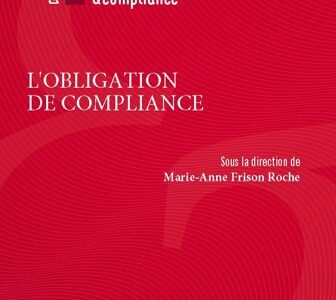
► Full Reference: M.-A. Frison-Roche (dir.), L'Obligation de Compliance, coll."Régulations & Compliance", Journal of Regulation & Compliance (JoRC) and Dalloz, 2025, 816 p. - 📘 At the same time, a book in English, Compliance Obligation, is published in the collection copublished by the Journal of Regulation & Compliance (JoRC) and the Éditions Bruylant. - 📚This volume is one of a series of books devoted to Compliance in the series edited by Marie-Anne Frison-Roche. - ► General presentation of this book: Compliance is sometimes presented as something that cannot be avoided, which is tantamount to seeing it as the legal obligation par excellence, Criminal Law being its most appropriate mode of expression. It is sometimes presented as something that the company does out of ethical concern, self-regulation which is the opposite of legal obligation. For the moment, therefore, there is no single vision of the Compliance Obligation. This is all the less the case because of the multitude of texts, themselves constantly evolving and changing, which inject such a wide range of compliance obligations that we give up trying to establish any unity, thinking that, on a case-by-case basis, we will define a regime and a legal constraint of greater or lesser strength, aimed at one subject or debtor or another, for the benefit of one or other. This lack of unity, due to the absence of a definition of the Compliance Obligation, makes the application of the texts difficult to foresee and therefore makes the Judge fearful, even though he/she is going to take on more and more importance. This book asks the practical questions: What is Compliance obliging? Who is obliged to comply? and How far are we obliged to comply? and provides answers, Compliance practices, constraints and innovations will be better mastered and anticipated by all those they affect: companies, stakeholders, technicians, lawyers, consultants, institutions and courts. - 🏗️general construction of this Book: The book opens with a double Introduction.  The first, which is freely accessible, consists of a summary of the book, while the second, which is substantial, deals with the unified conception that we can, and indeed should, have, of the "Compliance Obligation", without losing the concrete and active character that characterises this branch of law. The first Part of the book aims to define the Compliance Obligation. To this end, Chapter I deals with the Nature of this obligation. Chapter II deals with the Spaces of the Compliance Obligation. The Part II aims to articulate the Compliance Obligation with other branches of Law.  The Part III of the book looks at the way in which the possibility of obliging and the means of obliging are provided.  To this end, Chapter I deals with the Convergence of the Sources of the Compliance Obligation. Chapter II considers International Arbitration as a reinforcement of the Compliance Obligation. To this end, Chapter I deals with the Convergence of the Sources of the Compliance Obligation. Chapter II considers International Arbitration as a reinforcement of the Compliance Obligation.  The last Part of the book is devoted to Vigilance, the leading edge of the Compliance Obligation. Chapter I is devoted to a study of the various sectors, and analyses the Intensities of the Vigilance Obligation. Chapter II deals with the Variations in Tension generated by the Vigilance Obligation. Finally, Chapter III deals with the New Modalities of the Compliance Obligation, highlighted by the Vigilance Imperative. - TABLE OF CONTENTS    ANCRER LES OBLIGATIONS DE COMPLIANCE SI DIVERSES    DANS LEUR NATURE, LEURS REGIMES ET LEUR FORCE  POUR DEGAGER  L'UNITE DE L'OBLIGATION DE COMPLIANCE LA RENDANT COMPREHENSIBLE ET PRATIQUABLE  (ANCHOR COMPLIANCE OBLIGATIONS, SO DIVERSE  IN THEIR NATURE, THEIR REGIMES AND THEIR FORCE, TO BRING OUT THE UNITY OF THE COMPLIANCE OBLIGATION MAKING IT COMPREHENSIBLE AND PRACTICABLE) ♦️ Obligation de Compliance : construire une structure de compliance produisant des effets crédibles au regard des Buts Monumentaux visés par le Législateur (Compliance Obligation: building a compliance structure that produces credible results with regard to the Monumental Goals targeted by the Legislator), by 🕴️Marie-Anne Frison-Roche   TITRE I. CERNER L’OBLIGATION DE COMPLIANCE  (IDENTIFYING THE COMPLIANCE OBLIGATION)   CHAPITRE I : LA NATURE DE L’OBLIGATION DE COMPLIANCE (THE NATURE OF THE COMPLIANCE OBLIGATION) Section 1 ♦️ La volonté, le cœur et le calcul, les trois traits cernant l'Obligation de Compliance  (Will, Heart and Calculation, the three traits encercling the Compliance Obligation), by 🕴️Marie-Anne Frison-Roche Section 2 ♦️ De la dette à l’obligation de compliance (From the Debt to the Compliance Obligation), by 🕴️Bruno Deffains Section 3 ♦️ Obligation de Compliance et droits humains (Compliance Obligation and Human Rights), by 🕴️Jean-Baptiste Racine Section 4 ♦️ L'Obligation de Compliance et les mutations de la souveraineté et de la citoyenneté (Compliance Obligation and changes in Sovereignty and Citizenship), by 🕴️René Sève Section 5 ♦️ La définition de l''obligation de compliance confrontée au droit de la cybersécurité (The definition of the Compliance Obligation in Cybersecurity Law) by🕴️Michel Séjean   CHAPITRE II : LES ESPACES DE L’OBLIGATION DE COMPLIANCE (SPACES OF THE COMPLIANCE OBLIGATION) Section 1 ♦️ Entités industrielles et Obligation de compliance (Industrial entities and Compliance Obligation), by 🕴️Etienne Maclouf Section 2 ♦️ L'Obligation de Compliance dans les chaînes de valeur (The Compliance Obligation in Value Chains), by 🕴️Lucien Rapp Section 3 ♦️ Compliance et conflits de lois. Le droit international de la vigilance-conformité à partir de quelques applications récentes sur le continent européen (Compliance and conflict of laws. International Law of Vigilance-Conformity, based on recent applications in Europe), by 🕴️Louis d'Avout    TITRE II. ARTICULER L’OBLIGATION DE COMPLIANCE AVEC DES BRANCHES DU DROIT (ARTICULATING THE COMPLIANCE OBLIGATION WITH BRANCHES OF LAW)   Section 2 ♦️ Droit fiscal et obligation de compliance (Tax Law and Compliance Obligation), by 🕴️Daniel Gutmann Section 3 ♦️ Le droit processuel, prototype de l'Obligation de Compliance (General Procedural Law, prototype of the Compliance Obligation), by 🕴️Marie-Anne Frison-Roche Section 4 ♦️ Le droit des sociétés et des marchés financiers face à l'Obligation de Compliance (Corporate and Financial Markets Law facing the Compliance Obligation), by 🕴️Anne-Valérie Le Fur Section 5 ♦️ Le rapport entre le Droit de la responsabilité civile et l'Obligation de Compliance (The link between Tort Law and Compliance Obligation), by 🕴️Jean-Sébastien Borghetti Section 6 ♦️ Dimensions environnementales et climatiques de l'Obligation de Compliance (Environmental and Climatic Dimensions of the Compliance Obligation), by 🕴️Marta Torre-Schaub Section 7 ♦️ Droit de la concurrence et Droit de la Compliance (Competition Law and Compliance Law), by 🕴️Jean-Christophe Roda Section 8 ♦️ L'Obligation de Compliance en Droit global (The Compliance Obligation in Global Law), by 🕴️Benoît Frydman & 🕴️Alice Briegleb Section 9 ♦️ Les juges du droit des entreprises en difficulté et les obligations de compliance (Judges of Insolvency Law and Compliance Obligations), by 🕴️Jean-Baptiste Barbièri   TITRE III. COMPLIANCE : DONNER ET SE DONNER LES MOYENS D’OBLIGER (COMPLIANCE : GIVE AND TAKE THE MEANS TO OBLIGE)   CHAPITRE I : LA CONVERGENCE DES SOURCES (CONVERGENCE OF SOURCES) Section 1 ♦️ Obligation sur obligation vaut (Compliance Obligation on Obligation works), by 🕴️Marie-Anne Frison-Roche Section 2 ♦️ Les technologies disponibles, prescrites ou proscrites pour satisfaire Compliance et Vigilance (Technologies available, prescribed or prohibited to meet Compliance and Vigilance requirements), by 🕴️Emmanuel Netter Section 3 ♦️ Contrainte légale et stratégie des entreprises en matière de Compliance (Legal Constraint and Company Strategies in Compliance matters), by 🕴️Jean-Philippe Denis & Nathalie Fabbe-Costes Section 4 ♦️ La loi, source de l’Obligation de Compliance (The Law, source of the Compliance Obligation), by 🕴️Jean-Baptiste Blanc Section 5 ♦️ Opposition et convergence des systèmes juridiques américains et européens dans les règles et cultures de compliance (Opposition and Convergence of American and European Legal Systems in Compliance Rules and Cultures), by 🕴️Raphaël Gauvain & 🕴️Blanche Balian Section 6 ♦️ Ce à quoi les engagements engagent qu'est un engagement (What a ), by 🕴️Marie-Anne Frison-Roche   CHAPITRE II : L’ARBITRAGE INTERNATIONAL EN RENFORT DE L’OBLIGATION DE COMPLIANCE (INTERNATIONAL ARBITRATION IN SUPPORT OF THE COMPLIANCE OBLIGATION) Section 1 ♦️ Comment l'arbitrage international peut être un renfort de l'Obligation de Compliance (How International Arbitration can reinforce the Compliance Obligation), by 🕴️Laurent Aynès Section 2 ♦️ La considération par l'Arbitrage de l'Obligation de Compliance pour une place d'arbitrage durable (Arbitration' consideration of Compliance Obligation for a Sustainable Arbitration Place),  by 🕴️Marie-Anne Frison-Roche  Section 3 ♦️ L’usage de l’arbitrage international pour renforcer l’obligation de Compliance : l’exemple du secteur de la construction (The use of International Arbitration to reinforce the Compliance Obligation: the example of the construction sector), by 🕴️Christophe Lapp Section 4 ♦️ L’arbitre, juge, superviseur, accompagnateur  ? (The Arbitrator, Judge, Supervisor, Support) , by 🕴️Jean-Baptiste Racine   TITRE IV. LA VIGILANCE, POINTE AVANCÉE DE L’OBLIGATION DE COMPLIANCE (VIGILANCE, SPEARHEAD OF THE COMPLIANCE OBLIGATION) Section 1 ♦️ La Vigilance, pointe avancée et part totale de l'Obligation de Compliance (….), by 🕴️Marie-Anne Frison-Roche CHAPITRE I : LES INTENSITÉS DE L’OBLIGATION DE VIGILANCE, POINTE AVANCÉE DU SYSTÈME DE COMPLIANCE (INTENSITIES OF THE VIGILANCE OBLIGATION, SPEARHEAD OF THE COMPLIANCE SYSTEM) Section 2 ♦️ L’intensité de l’Obligation de Vigilance selon les secteurs : le cas des opérateurs financiers (Intensity of the Vigilance Obligation by Sectors: the case of Financial Operators), by 🕴️Anne-Claire Rouaud Section 3 ♦️ L’intensité de l’Obligation de Vigilance selon les secteurs : le cas des opérateurs bancaires et d’assurance (Intensity of the Vigilance Obligation by Sectors: the case of Banking and Insurance Operators), by 🕴️Mathieu Françon Section 4 ♦️ L’intensité de l’obligation de vigilance selon les secteurs : le cas des opérateurs numériques (Intensity of the Vigilance Obligation by Sectors: the case of Digital Operators), by 🕴️Grégoire Loiseau Section 5 ♦️ L’Obligation de vigilance des opérateurs énergétiques (The Vigilance obligation of Energy Operators), by 🕴️Marie Lamoureux Section 2 ♦️ Transformation de la gouvernance et obligation de Vigilance (Transformation of Governance and Vigilance Obligation), by 🕴️Véronique Magniermag   CHAPITRE II : LES DISPUTES AUTOUR DE L'OBLIGATION DE VIGILANCE, POINTE AVANCÉE DU SYSTÈME DE COMPLIANCE, DANS SON RAPPORT AVEC LA RESPONSABILITÉ Section 1 ♦️ Le rapport entre le droit de la responsabilité civile et l'obligation de compliance, by 🕴️Jean-Sébastien Borghetti Section 2 ♦️ Repenser le concept de responsabilité civile à l’aune du devoir de vigilance, pointe avancée de la compliance (Rethinking the Concept of Civil Liability in the light of the Duty of Vigilance, Spearhead of Compliance), by 🕴️Mustapha Mekki Section 3 ♦️ Tensions et contradictions entre les instruments relatifs à la vigilance raisonnable des entreprises, by 🕴️Laurence Dubin Section 4 ♦️ Compliance, Vigilance et Responsabilité civile : mettre en ordre et raison garde (Compliance, Vigilance  and Civil Liability: put in order and keep the Reason), by 🕴️Marie-Anne Frison-Roche   CHAPITRE III : LES MODALITÉS NOUVELLES DE L'OBLIGATION DE COMPLIANCE, MISES EN LUMIÈRE PAR L'IMPÉRATIF DE VIGILANCE (NEW MODALITIES OF THE COMPLIANCE OBLIGATION, HIGHLIGHTED BY THE VIGILANCE IMPERATIVE) Section 1 ♦️ Clauses et contrats, modalités de l’obligation de vigilance (Clauses and Contracts, terms and conditions of implementation of the Vigilance Obligation), by 🕴️Gilles J. Martin Section 2 ♦️ La preuve de la bonne exécution de la Vigilance au regard du système probatoire de Compliance (Proof that Vigilance has been properly carried out with regard to the Compliance Evidence System), by 🕴️Jean-Christophe Roda   TITRE V. LE JUGE ET L'OBLIGATION DE COMPLIANCE (THE JUDGE AND THE COMPLIANCE OBLIGATION) Section 1 Section 1 ♦️ Devoir de vigilance et litiges commerciaux : une compétence à partager ?, par 🕴️François Ancel Section 2 ♦️ Les enjeux présents à venir de l’articulation des principes de procédure civile et commerciale avec la logique de compliance (Present and Future Challenges of Articulating Principles of Civil and Commercial Procedure with the Logic of Compliance), by 🕴️Thibault Goujon-Bethan Section 3 ♦️ Le juge de l’amiable et la compliance (The amicable settlement judge and compliance), by 🕴️Malik Chapuis Section 4 ♦️ Le Juge requis pour une Obligation de Compliance effective (The Judge required for an Effective Compliance Obligation), by 🕴️Marie-Anne Frison-Roche     L’OBLIGATION DE COMPLIANCE : VISION D’ENSEMBLE (COMPLIANCE OBLIGATION : OVERVIEW) ♦️ L'obligation de compliance, charge portée par les entreprises systémiques donnant vie au Droit de la Compliance. – lignes de force de l'ouvrage (The Compliance Obligation, a burden borne by Systemic Companies giving life to Compliance Law –  key points of the book (free access) by 🕴️Marie-Anne Frison-Roche - 🌐follow Marie-Anne Frison-Roche on LinkedIn 🌐follow Marie-Anne Frison-Roche on Instagram 🌐subscribe to the Newsletter MAFR Regulation, Compliance, Law 🌐subscribe to the VideoNews  MAFR Surplomb 🌐subscribe to the Newsletter MaFR Law & Art
Articles

Law by Illustrations 🗿 Law and Sculpture

🗿La Justice en marbre. Dans l’église San Carlo de Noto, si on lève les yeux, la Justice est là, regardant la Prudence, la Force et la Tempérance (Justice in Marble. In the Church of San Carlo in Noto, if you look up, Justice is there, gazing at Prudence, Fortitude and Temperance)

► Full reference: M.-A. Frison-Roche, « La Justice en marbre. Dans l’église San Carlo de Noto, si on lève les yeux, la Justice est là, regardant la Prudence, la Force et la Tempérance » (Justice in Marble. In the Church of San Carlo in Noto, if you look up, Justice is there, gazing at Prudence, Fortitude and Temperance), article in the Newsletter Droit & Art, October 2025 (written in French). - 🌐Read the publication of this article in the Newsletter MaFR Droit & Art (in French): click here - 🗺️read a general presentation of the Sicilian town of Noto - ► Summary of the article: In the Church of San Carlo in the town of Noto, in Sicily, a group of statues brings together Justice, holding the scales, her eyes unbandaged, who looks straight ahead at the statue of Prudence, bending towards a child who looks up at her. On either side of Justice stand Fortitude, with an eagle at her feet, and Temperance, carrying a very heavy bag. To contemplate the four virtues, which support one another, one must first climb the many steps leading to the building and then, once inside, take the time to look up, for they have been placed high above, far from the noise of passers-by. - 🔓read the article (in French) on the French page of this presentation - 🌐follow Marie-Anne Frison-Roche on LinkedIn 🌐follow Marie-Anne Frison-Roche on Instagram 🌐subscribe to the Newsletter MAFR Regulation, Compliance, Law 🌐subscribe to the Video Newsletter MAFR Surplomb 🌐subscribe to the Newsletter MaFR Droit & Art