All news

Conferences

conference

🎤Le Droit de la Compliance, voie de la transition vers une égalité effective, efficace et efficiente entre les êtres humains (Compliance Law, for the transition towards the effectiveness, efficacy and efficiency of the equality between human beings), in 🧮Les banques coopératives et les transitions

► Full reference : M.-A. Frison-Roche, "Le Droit de la Compliance, voie de la transition vers une égalité effective, efficace et efficiente entre les êtres humains (Compliance Law, for the transition towards the effectiveness, efficacy and efficiency of the equality between human beings)", in Chair "Mutualist and cooperative banking at the service of the economy", ESCP, Les banques coopératives et les transitions​ (Cooperative Banks and Transitions), 29 January 2026. - 🧮view the general programme for the conference Cooperative banks and transitions (in French) - 📶see the slides (in French) - ► Presentation of this conference: The conference is not specifically aimed at lawyers, and even less so at specialists in Compliance Law. That is why it is divided into three parts, in order to show how Compliance Law is relevant in practice for creating effective, efficace and efficient equality between human beings. The first part of the lecture sets out the ambition of equality between human beings. As this is a political principle and not a natural one. As it is an ambition, it justifies being placed first and after that this ambition must be concretised, in a sort of second place. This second place is built bay a tro : that of effectiveness (real application of the norm), efficacy (that the goal for which the norm was established is achieved) and efficiency (that the system is transformed so that, having become robust, it endures through sustainabily). The second part of the conference will present the new branch of law known as Compliance Law. This should be distinguished from simple conformity, which consists of mechanically obeying a body of regulations that are constantly growing and becoming more complex. Compliance Law's Goal is to protect systems from risks that could cause them to disappear (all systems). "Sustainability" is the key principle, which is not limited to the climatic system (also digital system, banking system, and so on) and imposes the future as its object and the long term as its relevant time frame (unlike the market and Competition Law). "Transition" is also a key concept, as it involves moving from one state to another, from an expressed ambition to its realisation, through collaboration with others. These Goals are "Monumental" and are the normative legal basis of Compliance Law. In Europe, the Compliance Monumental Goal is to preserve systems for that the human beings who are involved in them, willingly or unwillingly, are not crushed by them, but rather benefit from them (for instance in banking sector). This is a "Monumental Negative Goal", to which is added a "Monumental Positive Goal", which a new conception of the "Ex Ante Responsability" (not liabily). Dialectically, the third part of the conference explains how Compliance Law internalises the political ambition of equality between human beings, which develops in the three concentric circles of effectiveness, efficacy and efficiency, among the operators best placed to contribute to it. Mutual banks belong to these circles more than the others. Firstly, because they are structured around the principle of taking human beings into consideration. Secondly, because they are rooted in their local areas. Thirdly, because they are driven by the long term, duration and sustainable. The transition est easer. The dificulty is the necessity to proof the effective and efficient will to do this transition. - ⛏️Go further  : 🕴🏻M.-A. Frison-Roche, 📝Drawing the circles of Compliance Law, 2017 🕴🏻M.-A. Frison-Roche, 📝Monumental goals, the beating heart of compliance law, 2021 🕴🏻C. Peicuti and 🕴🏻J. Beyssade, 📝The feminisation of management positions in companies as a compliance objective. The example of the banking sector, in 🕴🏻M. -A. Frison-Roche, 📘The Monumental Goals of Compliance, 2022  🕴🏻M.-A. Frison-Roche, 📝Births of a New Branch of Law: Compliance Law, 2024

Articles

Article in a Newsletter MAFR

📝Asset freezing in the legal saga between American power and Venezuelan wealt

► Full reference: M.-A. Frison-Roche, "Asset freezing in the legal saga between American power and Venezuelan wealth", MAFR Law, Compliance, Regulation Newsletter, 23 January 2026 - read this article published on LinkedIn the 23 January 2026  - 📧Read other articles from the MAFR Newsletter – Law, Compliance, Regulation for free with a subscription. - ► Summary of this article  : It is often emphasised that the  law is merely a masquerade in the series of events we are witnessing. This is not entirely true. For three reasons. 1. Much will depend on the judge who will rule on the Madura couple's case. The energy sector has always similarly mixed regulation, public policies of states and businesses, both articulated by States and companies, both articulated by  international contracts, always organising international arbitration 3. If ExxonMobil now refuses to make the investments desired by Trump, it is also because this enterprise remembers that many years ago the freeze  of assets granted by the arbitrators was not very successful, and now the company manager believes that investment in  Venezuala's infrastructure is therefore "impossible". And given the current state of the law in the US, there is little Trump can do about it.. - 📝⤵Read the complete article below⤵

Conferences

MasterClass

🎤Saisir les principes du Droit de la Compliance à travers l’actualité (Understanding the principles of compliance law through current current legal cases and events)

► Full reference : M.-A. Frison-Roche, Saisir les principes du Droit de la Compliance à travers l'actualité (Understanding the principles of compliance law through current current legal cases and events), Jean Moulin  – Lyon 3 University Law Faculty, 10 December 2025. - ► Methodological presentation of this 4-hour MasterClass : It is difficult to teach a branch of law that is still being developed, to find a way to open its doors, because if by explaining its principles ex abrupto, the risk exists of remaining at the door, even though the aim is to open it. This door is all the more blocked by the accumulation of multiple regulatory corpus, which are now perceived as being linked to Compliance Law: GDPR, Sapin 2, Vigilance, Nis2, Dora, FCPA, etc.; These are highly technical and complicated, and tend to be studied in silos, with little connection between them and little articulation with the traditional branches of Law. Therefore, the principles that form the backbone of Compliance Law as an autonomous branch of Law are all the less apparent, even though they would make these "compliance blocks" more intelligible and manageable. However, setting out these principles, which shed light not only on the current positive law but also on how it will evolve, seems "theoretical". In order to open the door to this new branch of Law, which already occupies a significant place in practice and is set to expand, so that it can be handled by lawyers who understand its spirit and is not entirely dominated by those from other disciplines who will master its tools (risk mapping, assessment, internal investigation, etc.), most often through algorithms and platforms (compliance by design), it is relevant to start with a few cases, a few decisions, a few texts, and a few comments, to gauge what they reveal. Because the principles are already there. They are gradually emerging. The challenge is that they often emerge quickly, in a manner that is sufficiently consistent with other branches of Law, and that the legal aspect takes precedence. That is what is at stake today. Each hour is devoted to a different case, based on a document of a different legal genre. - read a post on LinkedIn (in French) - - ⛏️Find out more  : 🕴🏻M.-A. Frison-Roche, 📝Compliance Law, 2016 🕴🏻M.-A. Frison-Roche, 📝Monumental Goals, the beating heart of Compliance Law, 2023 🕴🏻M.-A. Frison-Roche, 📝In Compliance Law, the legal consequences for Entreprises of their commitments and undertakings, 2025 🕴🏻M.-A. Frison-Roche, 📝Compliance Law and Systemic Litigation, 2025

Articles

Illustrated Law🎬Law & Cinema

🎭𝐅𝐢𝐜𝐭𝐢𝐨𝐧🎬The talks in the Town: what can a law professor do about it?”

  ► Full reference : M.-A. Frison-Roche, "Fiction🎬The talks in the Town  : what can a law professor do about it?", article from the Newsletter Law & Art, December 2025. - 🎬Watch the trailer - ► Summary of this article : This 1942 film seems to have left little trace. However, the main character, an innocent man whom the villain manipulates into being designated as the culprit by the small town's population, leading him to behave like a guilty person, is played by Cary Grant. This film inspired lawyers even more. And even more so law professors, because it was a law professor, the dean of Harvard Law School, who saved the innocent man who had been caught in the trap. And even more so today, since it was by playing on rumours, by creating them from the outset, in what we would call disinformation, that the powerful villain intended to win and, in the process, become mayor of the town, after escaping bankruptcy by setting fire to his own factory, a crime he blames on the innocent man thrown to the wolves of public opinion as citizens gather in the square. It's almost as if we were there… - 🔓read the article below⤵️

Articles

Interview

💬”Géomètres-experts : une profession qui assume concrètement sa responsabilité territoriale” (Chartered Surveyors: a Profession that takes its territorial responsibility seriously)

► Full reference : M.-A. Frison-Roche, ""Géomètres-experts : une profession qui assume concrètement sa responsabilité territoriale Géomètres-experts : une profession qui assume concrètement sa responsabilité territoriale (Chartered Surveyors: a Profession that takes its territorial responsibility seriously)", interview for JurisHebdo, 27 November 2025 - ► Read the interview  (in French) in which the questions (translated below in English) were answered⤵ - Q.You helped define the raison d'être of the profession of chartered surveyors and its Professional Order. In your opinion, what is its true consequences?   Q. Can the raison d'être become a tool for Compliance or Governance?   Q. What conflicts arise around the source of compliance norms and their implementation?    Q. Is this initiative part of a broader move towards social responsibility?   Q. How can the raison d'être influence the mission of the chartered surveyor, particularly in relation to land and environmental matters?  - ⛏️Further reading on the subject: 🕴🏻M.-A. Frison-Roche, 🎤Designing a raison d'être and explaining it, 2025 🕴🏻M.-A. Frison-Roche, 📝The Monumental Goals of Compliance, the beating heart of Compliance Law, 2023

Articles in a legal collective publication

contribution in a collective legal publication

📝L’invention du “droit à l’enfant”. Les conséquences de la pratique contractuelle comme source d’engendrement de l’enfant (The invention of the “right to a child”. The consequences of the contractual practice as a source of childbearing), in 📗Nouvelles filiations (New Filiations)

► Full Reference: M.-A. Frison-Roche,  « L'invention du "droit à l'enfant". Les conséquences de la pratique contractuelle comme source d'engendrement de l'enfant (The invention of the "right to a child". The consequences of the contractual practice as a source of childbearing)", in Special Issue Nouvelles filiations (New Filiations), AJ Famille, Lefebvre Dalloz, Nov. 2025, pp. 568-571.    - 📗read the table of content of the special issue in which this article is published (in French) - 📝read this article (in French) - 🚧Read the underlying bilingual working document, which includes additional technical developments, technical references and hyperlinks. - ► English summary of this article: Every legal system is built on concepts that form its pillars. Filiation is one such concept. A cas-law solution, presented as pragmatic and casuistic, can overturn this concept. Whether one agrees with it or not, it must first be acknowledged and assessed. Through a series of rulings on surrogacy, notably a ruling by its First Civil Chamber granting exequatur to a judgment recognising the filiation established by surrogacy between a child and persons with no biological link to the child and without recourse to adoption, the French Cour de Cassation has introduced the possibility of creating parentage by contract. This not only changes the concept of filiation but also changes the very structure of the French legal system, which is based on the distinction between persons and things. One may agree or disagree with this, but it must be said. Since the judge gives force to such a contract establishing filiation, with the foreign judge simply recognising it and the French judge ensuring only that the contract is balanced, the prospect opens up of a society in which individuals will be able to contractually create institutions at their disposal, within the private normative space of the contract, with the State's only function being to give effect to their right to legal recognition of their unique "project". Parentage is only a first example. Thus constructed on what was "inconceivable", i.e. a "right to a child", thanks to the contractual power to which the State should lend its force a posteriori, the judge makes parentage resulting .the judge technically declares a parentage arising from a contract to be "admissible". Is opening a society in institutions were contractually governed. 

Articles

💬”Ordonner la Compliance : pourquoi le faire et comment le faire ? (Organising Compliance: why do it and how to do it?)”

► Full reference : M.-A. Frison-Roche,  ""Ordonner la Compliance : pourquoi le faire et comment le faire ? (Organising Compliance: why do it and how to do it?)", interview Focus on… conducted for Dalloz Actu Étudiants, 13 November 2025 - ► read the interview : 💬 Read the interview (in French) - read the interview presentation on LinkedIn (in French) read the interview presentation through the MAFR Newsletter Law, Compliance, Regulation, (in English) - ► presentation  of the interview by Dalloz Actu-Étudiants  : Compliance can be defined as a new branch of law that mobilises major economic players and their stakeholders to ensure that the large systems in which we live do not collapse, but remain solid and sustainable. Sanctions, contracts, ethical principles, court decisions and corporate cultures all converge to achieve this. The ambition is great, some contest it, many want to escape it. It is still difficult to define compliance, which seems to be going in all directions. Who? What? Why? How? These are all questions addressed by Marie-Anne Frison-Roche, professor of law and editor-in-chief of the Journal of Regulation & Compliance (JoRC), together with the contributors to the collective works in the Régulations & Compliance series under her scientific direction. Compliance (JoRC), together with the contributors to the collective works in the "Regulations & Compliance" collection under her scientific direction, sheds light on with her imaginative power combined with her legal precision. - Q.Why do the fundamental objectives of compliance unify all legal compliance techniques? Summary of MAFR's response: because all these regulatory frameworks, which large companies are required to enforce effectively and which appear disparate, creating as many specific requirements as there are regulatory compliance blocks, find their unity when we consider the following reality: whatever the body of regulations in question (Sapin 2, Vigilance, Nis2, Dora, IAA, etc.), the aim is always to identify and prevent systemic risks so that these systems do not collapse.   Q. How can we define the obligation of compliance? Summary of MAFR response: the company concerned is therefore obliged to put in place "compliance structures", such as mapping, plans, alert structures and programmes (obligation of result), but of course, and this is the key point, to achieve this goal, namely to ensure that the system in question (banking, financial, climate, digital, algorithmic, etc.) does not collapse. This is an obligation of means. This is the exact, simple definition that unifies all the regulations of the Compliance Obligation for which subject companies are responsible.   Q. What conflicts arise around the source of compliance standards and their implementation?  Summary of MAFR's response: It must remain a matter of law. However, many argue that because it is only a matter of "compliance" and "ticking all the boxes", algorithms (which do not think or know anything) will do this, eliminating the need for lawyers and the law. This must be avoided. Furthermore, given the immense ambition of safeguarding systems, political and public authorities, businesses and stakeholders must join forces. They must not fight to bring each other down.   Q. What are the complexities of compliance law?  Summary of MAFR's response: I would not say "complexity", because although the regulations are complicated, compliance law is fairly simple and unified around its monumental goals of safeguarding systems, ensuring their future sustainability and protecting the people involved in them. However, it is a new branch of law that is still poorly understood and therefore sometimes poorly mastered. It therefore needs to be organised.   Q. What is your proposal for ordering it?  Summary of MAFR's response: Teaching more about compliance law will facilitate its organisation. The courts, to which all regulations converge through litigation, will participate in this organisation, which is necessary to ensure that regulations do not remain in silos and do not contradict each other when they have the same purpose, which constitutes their legal normativity. This new branch of law must also be articulated with all other branches of law. This is notably what the recently published book, L'obligation de compliance (The Obligation of Compliance), does.

Conferences

🎤Concevoir une raison d’être et l’expliciter (Conceiving a raison d’être and explaining it), in🪑🪑🪑Dire sa raison d’être (Expressing your Raison d’être)

► Full reference : M.-A. Frison-Roche, "Concevoir une Raison d'être et l'explicitre (Conceiving a Raison d'être and explaining it)", speech at the round table discussion "Dire sa Raison d'être (Expressing your Raison d'être)", National Conference of the Géomètres Expert (French Chartered Surveyors), 6 November 2025, Paris. - ► Presentation of the Round Table : This round table opens two days of work bringing together all the leaders, members of the Council of the Order of Chartered Surveyors and Regional Councils of Chartered Surveyors, in the presence of the relevant Ministry, in specific sessions during which the two Raison d'être that have been developed over several years of work and adopted, the Raison d'être of the profession and the Raison d'être of the Order, are presented. 🪑🪑🪑Other participants in the round table discussion, moderated by Hervé Grélard, General Deputy of the French Order of Chartered Surveyors: 🕴🏻Thomas Bonnel, chartered surveyor 🕴🏻Luc Lanoy, chartered surveyor, 🕴🏻Séverine Vernet, Chairwoman of the French Order of Chartered Surveyors - ► Summary of my presentation : Firstly, I spoke to remind everyone what a "raison d'être" is, in itself, and why it is particularly important when the entity that embodies it also constitutes a "profession", the raison d'être expressing this hybrid nature that is destined to endure in today's societies. It moves those who uphold the raison d'être – the professional, the profession, the umbrella organisation that is the Order – from the past to the future. To effectively carry this raison d'être, its bearer cannot remain isolated. Unlike the agent who operates in a market and whose strategy is solitary dynamism against others, the bearer of the raison d'être must find allies who share similar or compatible ideas and develop points of contact to carry out a collective project (the "Monumental Goals"). This is why it is just as important to communicate, explain and share the raison d'être with the outside world. Secondly, as the discussion surrounding the statement of purpose of the French Order of Surveyors and the profession progressed, I was led to point out that the raison d'être is not, or not only, ethical in nature, but also legal in nature, constituting at the very least a legal fact that can become enforceable against those who recognise themselves in it and claim it. This kind of reward, which is the "ex ante responsibility" expressed by the raison d'être and relayed by Compliance Law, anchored in its monumental goals of sustainability and responsibility, justifies that the profession that embraces its raison d'être is not simply an efficient profession in a supply and demand market, but establishes the Order as a regulator. This places both in the long term. - ⛏️Further reading on the subject: (with English Summaries) 🕴🏻M.-A. Frison-Roche, 💬"Géomètres-experts : une profession qui assume concrètement sa responsabilité territoriale", 2025 🕴🏻M.-A. Frison-Roche, 📝A quoi engagent les engagements, 2025 🕴🏻M.-A. Frison-Roche et 🕴🏻S. Vernet, 📝La profession investit le Droit de la compliance et détermine sa Raison d'être, 2023 🕴🏻M.-A. Frison-Roche, 📧Quels sont les points de contact entre la Raison d'être des entreprises et le Droit de la Compliance ?, 2022   -

MAFR Chronicles Compliance Law

article forming part of a thematic column

📝Droit de la compliance et Contentieux systémique (Compliance Law and Systemic Litigation)

►Full Reference: M.-A. Frison-Roche, "Droit de la compliance et Contentieux systémique" (Compliance Law and Systemic Litigation), in Chroniques Droit de la Compliance (Compliance Law Chronicles), Recueil Dalloz, 30 October 2025, No. 38, p. 1849 - 🚧read the bilingual Working Paper on which this article is based, with additional developments, technical references and hyperlinks -   ►read the English presentation of the previous chronicles: "Compliance and conformity: Distinguish them in order to articulate them", 2024 "Regulations, Compliance, Contracts, and Judges: places and alliances", 2023 "Contract of compliance, stipulations fo compliance", 2022 "The Adventure of the Compliance", 2020 "Compliance and Legal Personality", 2019 "TLegal Theory of Risk Mapping", 2019 ►read the English presentation of the whole chroniques - ►English summary of this article: Legal systems have changed, and Compliance Law, in its uniqueness, reflects this change and plays a powerful role in it. Through new sets of compliance rules, particularly at European level, in areas such as data protection (GDPR), anti-money laundering (AMLA), climate balance protection (CS3D) and banking and financial system sustainability (Banking Union), techniques (always the same) have been developed and imposed on large companies, which must implement them: alerts, mapping, assessment, sanctions, etc. These new regulatory frameworks only make sense in relation to their ‘Monumental Goals’: to detect systemic risks Ex Ante and prevent crises so that the systems in question do not collapse, but ‘sustain". All the legal instruments in the corpus are normatively rooted in these Monumental Goals, which are the core that unifies Compliance Law (I). Judges are the guardians (II) of this new and highly ambiguous normative framework, which relies on the practical ability of companies to do just that. They ensure that the technical provisions are applied teleologically in each of these compliance blocks, and that the regulatory frameworks are mutually supportive, for it is always the same systemic goal that all compliance regulations serve: to ensure that systems (banking, financial, climate, digital, energy, etc.) do not collapse, that they are sustainable, and that present and future human beings are not crushed by them but, on the contrary, benefit from them. This unity is still little perceived, as regulations pulverize this profound unity of compliance law in the myriad of changing provisions. Entrusting the "regulatory mass" to algorithms increases this pulverization, making the whole increasingly incomprehensible and therefore impossible to handle.  Acknowledging the judge's rightful place, i.e. at the heart of the matter, will enable us to master this new branch of law. But it's not the judge's job alone to restore clarity to a whole covered in the dust of his own technicality. The systemic object of Compliance Law is transferred to Litigation. Indeed, the Litigation that emerges from the new Compliance Law is also fundamentally new, by transitivity. Indeed, the aim of Compliance Law is to make systems sustainable (or sustainable, or resilient, the vocabulary varies). The result is litigation which is itself "systemic litigation" (III), most often initiated by an organization against a systemic operator. The place and role of each are transformed (IV).   -

Organisation of events

🧱⚙️Scientific coordination and co-hosting of the colloquia series 🧮Compliance and Contract

► Full reference : M.-A. Frison-Roche, Scientific coprdination and co-hosting of the colloquia series Compliance and Contract, organised on the initiative of the Journal of Regulation & Compliance (JoRC) and its academic partners - - ► The Symposium Series in a nutshell : As a direct continuation of the previous symposium series co-organised by the Journal of Regulation & Compliance and its partner universities on “Compliance Obligation”, which served as the basis for the publication of the book 📘Compliance Obligation,  The series, some elements of which began in 2024 and others are already present in this book, explored in depth the specific theme of the links between compliance law and contracts. Indeed, compliance law is often analysed as the construction of laws and regulations to achieve “📘 Monumental Goals ” of a political nature desired by States and public authorities, to the achievement of which systemic economic operations contribute through 📘Compliance Tools that are now well documented. Contracts are still relatively little studied, or even developed, in compliance systems that are often perceived through the orders issued, the technologies put in place and the 📘sanctions to be avoided or endured. On the contrary, the future of compliance law, particularly in its European conception, which places human beings at the centre of concerns for the sustainability of systems and the use of contracts, is the new conception that we must adopt. Contracts then appear to be both the means by which the subject company fulfils its legal obligations, forges relationships with other actors and deploys the necessary innovations. Contract law is both used and renewed as a result. The series of symposiums will examine various aspects of this general issue. It will result in the publication of a 📘book Compliance and Contrat. - ► Presentation of symposiums in development : 29 May 2026🧮THE JUDGE CONFRONTED WITH CONTRACTS OF COMPLIANCE AND COMPLIANCE CLAUSES: read the presentation 12 June 2026🧮THE “CONTRACT OF COMPLIANCE” : read the presentation 25 Septembre 2026🧮COMPLIANCE: CLAUSE BY CLAUSE: read the presentation 2 October 2026🧮COMPLIANCE AND COMMON CONTRACT LAW : read the presentation September 2026🧮COMPLIANCE, VALUE CHAINS AND CONTRACT: read the presentation 2 November 2026 🧮COMPLIANCE AND THE STRATEGIC CONTRACTUAL ORGANISATION OF CHAINS VALUE BY ENTERPRISES: read the presentation  -

Articles in a legal collective publication

Article in a collective book dedicated to an Amicorum

📝Trio, in 📗Mélanges en l’honneur du Professeur Denis Mazeaud

► Full Reference: M.-A. Frison-Roche, "Trio", in Mélanges en l'honneur du Professeur  Denis Mazeaud, Lextenso – LGDJ, 2025. - 📝read the article (in French) - 🚧read the text written on the morning when Rémy called me to talk about building this collective book Denis. Since then, due to editorial deadlines, this text has been modified, since this article deals with the so specific French Concours d'Agrégation de Droit, and François Terré, who prepared me for it, joined Pierre Catala before the overall typescript became final. At Pierre Catala's funeral, where Rémy recounted their last meeting, I was seated at the back next to Yves Lequette, and at François Terré's funeral I was again seated at the back next to Jacques-Henri Robert. Yves Lequette and Jacques-Henri Robert, with whom I worked long and hard to prepare the Mélanges in honour of François Terré. Yes, it is indeed the Mélanges that, in a great chain, honour the masters. It doesn't matter that this is incomprehensible to those outside the Alma Mater. When I read Denis's bibliography, which opens his Mélanges, I discover that Denis, who contributed to so many Mélanges, had his first contribution to this sort of books for the Mélanges conceived for François.   - ► English Summary of this contribution : The contribution pays tribute to Denis Mazeaud as a candidate in the Concours d'Agrégation des Facultés de Droit that we took together. As long as the University benefits from professors instituted in this way, i.e. in a non-competitive relationship with their peers and in a non-financially valued relationship with their knowledge and talent, Alma Mater will remain. - 📗Read the general presentation of these Mélanges.

Articles

article published in the MAFR Law, Compliance, Regulation Newsletter

Preuve est donnée, il n’y a pas de “compliance globale” : il faut donc continuer à construire une Compliance Européenne

► Full Reference: M.-A. Frison-Roche, ""Juge modeste" ou "check and balance" :alternative aux Etats-Unis, alternative en France" ("modest judge" or "check and balance": alternative in the United States, alternative in France), Newsletter MAFR Law, Compliance, Regulation, 21 October 2025.. - 📧Read by free subscription other news from the MAFR Newsletter – Law, Compliance, Regulation - ► Summary of this article: Recent, - 📧read below the article published the 6 October dans the Newsletter MAFR – Law, Compliance, Regulation ⤵️

Articles in a legal collective publication

contribution in a Round Table

📝De l’obligation de compliance à l’obligation de vigilance : le rôle du juge

► Full reference : M.-A. Frison-Roche, "De l'obligation de compliance à l'obligation de vigilance : le rôle du juge (From the obligation of compliance to the obligation of vigilance: the role of the judge)", in Round table De la compliance au devoir de vigilance. Une nouvelle responsabilité des entreprises (From Compliance to the Vigilance duty. A new responsibility for businesses," Lettre des juristes d'affaires, Oct. 2025. - 📝read the article reproducing the entire discussion (in French) - ► Summary of my contribution:  In this debate, the terms of which have been reproduced in the journal, I was asked to explain how the legal system had evolved, first by establishing Compliance Law, built on systemic ambitions to prevent sectoral disasters (banking, finance, energy), ambitions that constitute "Monumental Negative Goals", and then evolving on the one hand "Monumental Positive Goals", namely the protection of human beings involved willingly or unwillingly in these systems, on the other hand, outside even sectors with clearly defined boundaries, such as environmental or digital ambitions. The duty of vigilance extends this regulatory law and gives concrete form to the "compliance obligation" to which companies are subject. It is important to maintain a sense of proportion in the conception of the responsibility attached to it so as not to lose everything. Companies are bound by the goals but must remain free in their choice of means, and in particular be encouraged to use contractual techniques. This measure is entrusted to the judge because, due to the Compliance Jurisdictionalisation, it is at the heart of this new branch of Law, which is developing independently of fluctuations in the regulations. During the discussion, I was asked for my opinion on the ruling handed down by the Paris Court of Appeal on 17 June 2025, known as La Poste case. I pointed out that the comments had often focused only on the developments regarding risk mapping, whereas this ruling first establishes the principle that the vigilance plan is the work of the company's decision-making bodies and is not co-constructed, as consultation is a process of discussion and taking in consideration, which is not the same thing, with the judge himself pointing out that they must not interfere in management. In the discussion, I emphasised that if we were to highlight the essence of what would be a "new responsibility", it would primarily concern a new probative dimension that the company must implement in Ex Ante. The implementation of the CSRD, even if it has been excessively standardised, is in line with this, and this probative culture must be developed. - ⛏️Further reading on the subject : 🕴️M.-A. Frison-Roche (ed.), 📘Compliance Obligation, 2026 🕴️M.-A. Frison-Roche, 📝Vigilance, the front line and integral part of the compliance obligation, 2025 🕴️M.-A. Frison-Roche, 📝Compliance, Vigilance and Civil Liability: put in Order and keep the sense of Reason, 2025 🕴️M.-A. Frison-Roche (ed.), 📘Compliance Jurisdictionalisation, 2024 -   -   - ► Article summary : The 

Conferences

participation in a Round-Table

🎥Adéquation et inadéquation de la sanction comme outil de régulation financière et sa transformation par la Compliance (Adequacy and inadequacy of sanctions as a tool of Financial Regulation and its transformation through Compliance), in🧮Quel rôle pour la sanction dans la Régulation ? (what role for the Sanction in the Financial Regulatory System?)

► Full reference: M.-A. Frison-Roche, "Adéquation et inadéquation de la sanction comme outil de régulation financière et sa transformation par la Compliance" (Adequacy and inadequacy of sanctions as a tool of Financial Regulation and its transformation through Compliance)", contribution to the round-table discussion on"Quel rôle pour la sanction dans la Régulation ? (What role for sanctions in Regulatory System)", Annual conference of the Commission des sanctions (Enforcement Committee) of the Autorité des marchés financiers – AMF (French Financial Markets Authority), Paris,  14 October 2025. - ► see the general programme of this manifestation (in French) The event comprises two round tables. The theme of the first round table is: La preuve des abus de marché entre l’AMF et le juge pénal : vers une convergence ? (Proof of market abuse between the AMF and the criminal courts: towards convergence?) 🪑🪑🪑AutresOther participants in this 2nd round table, moderated by Sophie Schiller, member of the Enforcement Committe on the topic: Quel rôle pour la sanction dans la Régulation ? (What role for sanctions in Regulatory System?) 🕴🏻Sébastien Raspiller, Secretary General of the AMF 🕴🏻Martine Samuelian, Partner, Jeantet Law Firm 🕴🏻Vincent Villette, Secretary General of the CNIL (French Personal Data Regulatory Body) - ► Summary of this intervention : In the round-table discussion on the role of sanctions, a number of contributions will be made, depending on the nature of the discussion itself. They will be brief in nature and will be aimed at an audience with a good knowledge of financial regulation. It is the occasion for me to insist on 2 things, the first naturely and probably for ever attached to the role of sanctions in all Regulatory Systems, the secund very new. The first is the indissociability between Criminal Law and Sanction, even if sanctions is defined as a regulatory tools. The secund is the conception and the use of sanctions through Compliance Law. Therefore, in the first idea, my first intervention, aimed more at establishing the subject and describing the Intangible, is on the very idea that sanctions have a role to play in financial regulation. By its very nature. But this does not make it any less difficult. It is not obvious, because if penalties are seen as a 'regulatory tool', then it is the regulatory perspective that predominates and 'colours' the tool that is the penalty. Regulation, of which the texts on the basis which sanctions are issued are only one tool and which is not the set of applicable rules, Regulation which is an apparatus of institutions, rules and decisions aimed at establishing the equilibrium of a sector and maintaining this equilibrium, which is by nature unstable, over time, which the sector could not do by its own efforts alone (Regulatory Law, which is Ex Ante Law, thus distinguishing itself from Competition Law, which is Ex Post Law). From the perspective of Financial Regulatory System, as in other sectoral regulatory systems, and in the general Regulatory Law, sanctions are a tool (and a tool like any other, simply more powerful than the others. This is the pragmatic perspective adopted by the State and the Regulatory body itself, which will use it in conjunction with other tools, such as an Information, Education and Incentive mechanism. Moreover, it shall use sanction as informative tool, as educational tool, as incentive tool. However, the principle of the autonomy of Criminal Law, and the European concept of "Criminal Matters" mean that the sanction can be seen in terms of the autonomous criteria of the seriousness of the act imputed and the sanction imposed on the legal person. In this respect, the penalty is inseparable from the way in which it is imposed (Criminal Law is constitutionally inseparable from Criminal Procedure). In this respect, the sanction is not a tool coloured by the overall objective served by the Financial Markets Regulatory Body: the sustainability of the financial system. The Enforcement Committee is not the AMF's "armed wing"; it is a "court", as the Oury ruling reminded us. Therefore, the question is and I would like to ask it directly to the Enforcement Committed: Can you be both?   As they say, could you be both carp and rabbit? Depending on whether you are viewed from one angle or another, you will be seen as the body that makes financial markets effective (a tool among the tools) or as the body that punishes misconduct (a court among the courts). It is possible, and in practice it is often true. But if we are honest, we will admit that regulation feeds on information and that the procedure before a criminal court is built on secrecy and the weapons of those who, innocent or guilty, are at risk because they are, or will be, prosecuted. We've never got out of this difficulty. We always try to strike a balance between the fact that it is in itself a repressive sanction for a person who will suffer and the fact that it is also a systemic tool: there is a 'balance' between the search for systemic benefit (which reduces the protection of individuals for the benefit of the system) and the concern for the people involved (which reduces the present and future protection of the system). The balance goes more or less in one direction. It is often public opinion, the place, the legislator and, even above all,  the civil appeal judge (vertical dialogue) and those in dialogue, between the regulator and the criminal judge (horizontal dialogue) which cause the scales of diverse technical solutions. It is also the way in which the Enforcement Committee, in defining itself as the armed wing of the AMF (carp) or as a repressive court (rabbit), chooses in its procedural behaviour the role of sanctions in Financial Regulatory System, more or less instrumentalised (carp) or jurisdictionalised (rabbit). - The second point, if there is to be one, concerns the development of the role of sanctions in Financial Regulatory System . On the basis of these fundamentals, an evolution in the role of sanctions in financial regulatory system (an evolution that can be observed in all sectoral regulatory systems) consists of internalising sanctions (in their conception by the texts, their elaboration by the Sanctions Committees, their application) in the economic operators sanctioned, in the economic sectors concerned, in the opinion concerned (the figure of Peelmanian circles of the audiences applying). This internalisation transforms Regulatory mission of the administrative body (which deals with market structures) into Rupervision (which deals directly with market operators) since the sanction penetrates the operator, the operator adopting commitments. This concept corresponds to the new branch of Law known as Compliance Law.  Compliance Law uses sanctions as an "incentive like any other", and (we must be careful on this point), because it is systemic in nature, the concern for the system being internalised in the operator, it is relatively insensitive to procedural rights. With the emphasis on information, it is the principle of adversarial debate (which provides information) rather than the rights of the defence that is valued. The cooperation of the person being prosecuted is highly valued, and non-cooperation becomes incomprehensible. The internalisation of sanctions by operators has led to two major changes. Firstly, these economic operators themselves must sanction, detect and prevent market abuse. The number of special obligations of vigilance is increasing. The obligation of vigilance of operators themselves is becoming a pillar of Regulation, transformed in Supervision.  The other development is the liberalisation of regulatory system in relation to territory, thank to Compliance Law. As operators are less dependent on borders than are regulators and authors of legal texts (but soft law is spreading, including repression), market abuses can be apprehended in several jurisdictions at the same time, notably through global compliance programmes.


Articles

article published in the MAFR Law, Compliance, Regulation Newsletter

📝”juge modeste” ou “check and balance” : alternative aux Etats-Unis, alternative en France (“modest judge” or “check and balance”: alternative in the United States, alternative in France)

► Full Reference: M.-A. Frison-Roche, ""Juge modeste" ou "check and balance" :alternative aux Etats-Unis, alternative en France" ("modest judge" or "check and balance": alternative in the United States, alternative in France), Newsletter MAFR Law, Compliance, Regulation, 6 October 2025.. - 📧Read by free subscription other news from the MAFR Newsletter – Law, Compliance, Regulation - ► Summary of this article: Recent, if not forthcoming, decisions by the US Supreme Court show that the American political system that was based on the unwritten principle of Check and Balance, requiring the Justices to constitute one Power facing the other two could be replaced by a political system based on the principle of a "modest Justice" enforcing decisions made by the Federal Executive. They would then have a new Constitution. In Western Europe and especially in France, it is possible that the letter of the Constitution, which states that judges are not an autonomous power vis-à-vis the other two powers, will be abandoned and that, in the name of an unwritten principle, the Rule of Law, its transformation into an autonomous Power facing the executive in its own right will be adopted. The path would be exactly the opposite. We would then have changed the Constitution. That's conceivable, and there are many arguments in favour of it. We have to say so. And draw all the consequences. - 📧read below the article published the 6 October dans the Newsletter MAFR – Law, Compliance, Regulation ⤵️
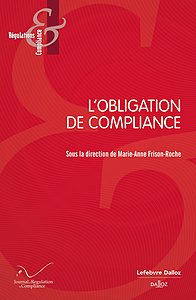
Couverture – L’Obligation de Compliance

Articles in a JoRC book

Contribution to a collective legal work

📝Obligation de Compliance : construire une structure de compliance produisant des effets crédibles au regard des Buts Monumentaux visés par le Législateur (Compliance Obligation: build a compliance structure producing credible effects in the perspective of the Monumental Goals targeted by the Legislator), in 🕴️M.-A. Frison-Roche (dir.), 📕L’obligation de Compliance

► Full Reference: M.-A. Frison-Roche, “Obligation de Compliance : construire une structure de compliance produisant des effets crédibles au regard des Buts Monumentaux visés par le Législateur” (Compliance Obligation: build a compliance structure producing credible effects in the perspective of the Monumental Goals targeted by the Legislator), in M.-A. Frison-Roche (dir.), L’Obligation de Compliance, Journal of Regulation & Compliance (JoRC) and Lefebvre-Dalloz, coll. “Régulations & Compliance“, 2025, pp. 3-44. - ► This article is the introduction to the book - 📝read the article (in French) - 🚧read the bilingual Working Paper on the basis this article has been written, with more developments, technical references and hyperlinks - 📕read the general presentation of the book, L’Obligation de Compliance, in which this article is published 📚see the general presentation of the series “Régulations & Compliance” in which this book is published - ► This article is written in French. English summary of this contribution (done by the Journal of Regulation & Compliance – JoRC): This article explains what companies’ Compliance Obligation” is. Delving into the mass of compliance obligations, it uses the method of classification of those that are subject to an obligation of result and those that are subject to an obligation of means. It justifies the choice of this essential criterion, which changes the objects and the burden of proof of companies that are subject to an obligation of result when it comes to setting up “compliance structures” and are subject to an obligation of means when it comes to the effects produced by these compliance structures. Indeed, rather than getting bogged down in definitional disputes, given that Compliance Law is itself a nascent branch of Law, the idea of this contribution is to take as a starting point the different legal regimes of so many different compliance obligations to which laws and regulations subject large companies: sometimes they have to apply them to the letter and sometimes they are only sanctioned in the event of fault or negligence. This brings us back to the distinction between obligations of result and obligations of means. Although it would be risky to transpose the expression and regime of contractual obligations to legal obligations put by legislation, starting from this observation in the evidentiary system of compliance of a plurality of obligations of means and of result, depending on whether it is a question of this or that technical compliance obligation, we must first classify them. It would then appear that this plurality will not constitute a definitive obstacle to the constitution of a single definition of the Compliance Obligation. On the contrary, it makes it possible to clarify the situation, to trace the paths through what is so often described as a legal jumble, an unmanageable “mass of regulations”. Indeed, insofar as the company obliged under Compliance Law participates in the achievement of the Monumental Goals on which this is normatively based, a legal obligation which may be relayed by contract or even by ethics, it can only be an obligation of means, by virtue of this very teleological nature and the scale of the goals targeted, for example the happy outcome of the climate crisis which is beginning or the desired effective equality between human beings. This established principle leaves room for the fact that the behaviour required is marked out by processes put in place by structured tools, most often legally described, for example the establishment of a vigilance plan or regularly organised training courses (effectiveness), are obligations of result, while the positive effects produced by this plan or these training courses (effaciety) are obligations of means. This is even more the case when the Goal is to transform the system as a whole, i.e. to ensure that the system is solidly based, that there is a culture of equality, and that everyone respects everyone else, all of which come under the heading of efficiency. The Compliance Obligation thus appears unified because, gradually, and whatever the various compliance obligations in question, their intensity or their sector, its structural process prerequisites are first and foremost structures to be established which the Law, through the Judge in particular, will require to be put in place but will not require anything more, whereas striving towards the achievement of the aforementioned Monumental Goals will be an obligation of means, which may seem lighter, but corresponds to an immeasurable ambition, commensurate with these Goals. In addition, because these structures (alert mechanisms, training, audits, contracts and clauses, etc.) have real meaning if they are to produce effects and behaviours that lead to changes converging towards the Monumental Goals, it is the obligations of means that are most important and not the obligations of result. The judge must also take this into account. Finally, the Compliance Obligation, which therefore consists of this interweaving of multiple compliance obligations of result and means of using the entreprise’s position, ultimately Goals at system efficiency, in Europe at system civilisation, for which companies must show not so much that they have followed the processes correctly (result) but that this has produced effects that converge with the Goals sought by the legislator (effects produced according to a credible trajectory). This is how a crucial company, responsible Ex Ante, should organise itself and behave.
Couverture – L’Obligation de Compliance

Articles in a JoRC book

article in a legal collective book

📝La volonté, le cœur et le calcul, les trois traits cernant l’Obligation de Compliance (Will, Heart and Calculation, the three marks surrounding the Compliance Obligation), in 🕴️M.-A. Frison-Roche (ed.), 📕L’Obligation de Compliance

► Full Reference: M.-A. Frison-Roche, "La volonté, le cœur et le calcul, les trois traits cernant l'Obligation de Compliance" ("Will, Heart and Calculation, the three marks surrounding the Compliance Obligation"), in M.-A. Frison-Roche (ed.), L'Obligation de Compliance, Journal of Regulation & Compliance (JoRC) and Lefebvre-Dalloz, coll. "Régulations & Compliance" 2025, pp. 49-65. - 📝read the article (in French) - 🚧read the bilingual Working Paper on the basis this contribution has been built, with  more developments, technical references and hyperlinks.  - 📕read the general presentation of the book, L'Obligation de Compliance, in which this article is published 📚see the general presentation of the series "Régulations & Compliance" in which this book is published - ► This article is written in French. English summary of this contribution (done by the Journal of Regulation & Compliance – JoRC): There is often a dispute over the pertinent definition of Compliance Law, but the scale and force of the resulting obligation for the companies subject to it is clear.  It remains difficult to define. First, we must not to be overwhelmed by the many obligations through which the Compliance Obligation takes shape, such as the obligation to map, to investigate, to be vigilant, to sanction, to educate, to collaborate, and so on. Not only this obligations list is very long, it is also open-ended, with companies themselves and judges adding to it as and when companies, sectors and cases require.  Nor should we be led astray by the distance that can be drawn between the contours of this Compliance Obligation, which can be as much a matter of will, a generous feeling for a close or distant other in space or time, or the result of a calculation. This plurality does not pose a problem if we do not concentrate all our efforts on distinguishing these secondary obligations from one another but on measuring what they are the implementation of, this Compliance Obligation which ensures that entities, companies, stakeholders and public authorities, contribute to achieving the Goals targeted by Compliance Law, Monumental Goals which give unity to the Compliance Obligation.  Thus unified by the same spirit, the implementation of all these secondary obligations, which seem at once disparate, innumerable and often mechanical, find unity in their regime and the way in which Regulators and Judges must control, sanction and extend them, since the Compliance Obligation breathes a common spirit into them.  In the same way that the multiplicity of compliance techniques must not mask the uniqueness of the Compliance Obligation, the multiplicity of sources must not produce a similar screen. Indeed, the Legislator has often issued a prescription, an order with which companies must comply, Compliance then often being perceived as required obedience. But the company itself expresses a will that is autonomous from that of the Legislator, the vocabulary of self-regulation and/or ethics being used in this perspective, because it affirms that it devotes forces to taking into consideration the situation of others when it would not be compelled to do so, but that it does so nonetheless because it cares about them. However, the management of reputational risks and the value of bonds of trust, or a suspicious reading of managerial choices, lead us to say that all this is merely a calculation. Thus, the contribution sets out to identify the Compliance Obligation by recognising the role of all these different sources. It emphasises that, in monitoring the proper performance of technical compliance obligations by Managers, Regulators and Judges, insofar as they implement the Compliance Obligation, it is pointless to limit oneself to a single source or to rank them abruptly in order of importance. The Compliance Obligation is part of the very definition of Compliance Law, built on the political ambition to achieve these Monumental Goals of preserving systems – banking, financial, energy, digital, etc. – in the future, so that human beings who cannot but depend on them are not crushed by them, or even benefit from them. This is the teleological yardstick by which the Compliance Obligation is measured, and with it all the secondary obligations that give it concrete form, whatever their source and whatever the reason why the initial standard was adopted. In order to define Compliance's Obligation, the study endeavours to recognise the contribution of all these three sources: Will, Heart and Calculation.