All news

Organisation of events

Co-organization of the colloquium “Compliance and Arbitration” (“Compliance et arbitrage”)

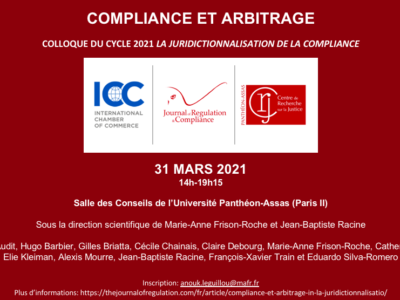
This scientific event is placed under the scientific responsibility of Marie-Anne Frison-Roche and Jean-Baptiste Racine. It is organized by the Journal of Regulation & Compliance (JoRC) and by the Centre de recherche sur la Justice et le Règlement des Conflits (CRJ)  of the  Panthéon-Assas (Paris II) University, with the active support of the International Chamber of Commerce ICC. This event is the third colloquium of the 2021 colloquia cycle around the general theme of Compliance Juridictionnalization.      The different interventions will be then transformed into contributions in the books La juridictionnalisation de la Compliance  and Compliance Juridictionnalization  which will be published in the Regulation & Compliance serie, jointly published by the JoRC and Dalloz for the book in French and by JoRC and Bruylant for the book in English.  This colloquium will take place the 31st of March 2021. The manifestation will be live broadcasted on Zoom. To register: https://u-paris2-fr.zoom.us/webinar/register/WN_sPSB4aUUQTWDWDnNcYt3sA   Presentation of the theme:  The arbitrator is the ordinary judge of international trade. It was natural that he or she encountered Compliance: by definition Compliance Law takes hold of the whole world and follows the paths of international trade while it can only be deployed with the help of institutions which, by nature are spreading around the world and need authorities like the Courts. The conference is based on the already perceptible connection points between Compliance and Arbitration to better identify what is emerging for tomorrow: contradiction or convergence between the two; weakening or consolidation. We are already seeing the impact that Compliance can have on the arbitrator's treatment of corruption or the consideration of money laundering. More generally, where do we stand with the arbitrator's knowledge of the many technical issues related to compliance? Beyond these, will the courts and arbitrators be able to achieve the goals, themselves new, sometimes monumental, pursued by Compliance Law? Through this joint exploration of these avenues, the fate of compliance clauses inserted in contracts, the relevance in the matter of private codes of conduct, etc. will be examined. Tomorrow, as of today, is the arbitrator a full and complete judge of Compliance Law? How, with what specificities and what controls?   Notably will speak: Mathias Audit, professeur à l'Université Panthéon-Sorbonne – Paris I (full professor at Sorbonne – University – Paris)   Dominique Bourrinet, General Counsel of Société générale group  ​ Cécile Chainais, director of the Centre de Recherche sur la Justice et le Règlement des Conflits (CRJ) and professeur à l'Université Panthéon-Assas (Paris II) (Full professor at Panthéon-Assas (Paris II) University)    Claire Debourg, professeure à l'Université Paris X- Nanterre (Full professor at Paris X – Nanterre)    Marie-Anne Frison-Roche, professeur à Sciences Po – Paris (Full Professor at Sciences Po – Paris)) and Director of the Journal of Regulation & Compliance (JoRC)   Catherine Kessedjian, professeur émérite de l'Université Panthéon-Assas (professor emeritus of Panthéon-Assas – Paris II University)   Elie Kleiman, partner, Jones Day Law Firm   Alexis Mourre, president of the ICC International Court of Arbitration   Jean-Baptiste Racine, professeur à l'Université Panthéon-Assas – Paris II (Full Professor at Panthéon-Assas – Paris II University)   François-Xavier Train, professeur à l'Université Paris X-Nanterre (Full Professor at Paris X-Nanterre University)   Eduardo Silva-Romero, Dechert Law Firm      Read a detailed presentation of the colloquium below:     

Conferences

Cycle JoRC of colloquia 2021 : Compliance Juridictionnalization

Compliance and Arbitration (Compliance et arbitrage)

This scientific event is placed under the scientific responsibility of Marie-Anne Frison-Roche and Jean-Baptiste Racine. It is organized by the Journal of Regulation & Compliance (JoRC) and by the Centre de recherche sur la Justice et le Règlement des Conflits (CRJ)  of the  Panthéon-Assas (Paris II) University, with the active support of the International Chamber of Commerce ICC. This event is the third colloquium of the 2021 colloquia cycle around the general theme of Compliance Jurisdictionalisation.       ►The interventions will be then transformed into a chapter in the books: contributions in the 📕 La Juridictionnalisation de la Compliance  , to be published the Regulation & Compliance series ries, jointly published by the Journal of Regulation & Compliance (JoR)C and Dalloz  📘Compliance Jurisdictionalisation,    to be published in the Compliance & Regulation Series , co published by the Journal of Regulation & Compliance (JoRC) and  Bruylant. -   This colloquium took  place the 31st of March 2021. The manifestation was live broadcasted on Zoom.   Presentation of the theme:  The arbitrator is the ordinary judge of international trade. It was natural that he or she encountered Compliance: by definition Compliance Law takes hold of the whole world and follows the paths of international trade while it can only be deployed with the help of institutions which, by nature are spreading around the world and need authorities like the Courts. The conference is based on the already perceptible connection points between Compliance and Arbitration to better identify what is emerging for tomorrow: contradiction or convergence between the two; weakening or consolidation. We are already seeing the impact that Compliance can have on the arbitrator's treatment of corruption or the consideration of money laundering. More generally, where do we stand with the arbitrator's knowledge of the many technical issues related to compliance? Beyond these, will the courts and arbitrators be able to achieve the goals, themselves new, sometimes monumental, pursued by Compliance Law? Through this joint exploration of these avenues, the fate of compliance clauses inserted in contracts, the relevance in the matter of private codes of conduct, etc. will be examined. Tomorrow, as of today, is the arbitrator a full and complete judge of Compliance Law? How, with what specificities and what controls?   Notably will speak: Mathias Audit, professeur à l'Université Panthéon-Sorbonne – Paris I (full professor at Sorbonne – University – Paris)   Dominique Bourrinet, General Counsel of Société générale group  ​ Cécile Chainais, director of the Centre de Recherche sur la Justice et le Règlement des Conflits (CRJ) and professeur à l'Université Panthéon-Assas (Paris II) (Full professor at Panthéon-Assas (Paris II) University)    Claire Debourg, professeure à l'Université Paris X- Nanterre (Full professor at Paris X – Nanterre)    Marie-Anne Frison-Roche, professeur à Sciences Po – Paris (Full Professor at Sciences Po – Paris)) and Director of the Journal of Regulation & Compliance (JoRC)   Catherine Kessedjian, professeur émérite de l'Université Panthéon-Assas (professor emeritus of Panthéon-Assas – Paris II University)   Elie Kleiman, partner, Jones Day Law Firm   Alexis Mourre, president of the ICC International Court of Arbitration   Jean-Baptiste Racine, professeur à l'Université Panthéon-Assas – Paris II (Full Professor at Panthéon-Assas – Paris II University)   François-Xavier Train, professeur à l'Université Paris X-Nanterre (Full Professor at Paris X-Nanterre University)   Eduardo Silva-Romero, Dechert Law Firm      Read a detailed presentation of the colloquium below:     
Articles

Why do we regulate? If it is to prevent systemic risks, systemic “family offices” must be subject to it (Archegos case) (Pourquoi régule-t-on? Si c’est pour prévenir les risques systémiques, les “family offices” systémiques doivent y être soumis (cas Archegos))

Full reference: Frison-Roche, M.-A., Why do we regulate? If it is to prevent systemic risks, systemic "family offices" must be subject to it (Archegos case) (Pourquoi régule-t-on? Si c'est pour prévenir les risques systémiques, les "family offices" systémiques doivent y être soumis (cas Archegos)), Newsletter MAFR – Law, Compliance, Regulation, 30th of March 2021 Read by freely subscribing other news of the Newsletter MAFR – Law, Compliance, Regulation   Summary of the news:  Archegos was a wealth management company whose activity consisted mainly in managing funds that were not themselves from the financial markets (hence its title of "family office"). Obviously, Archegos was proving to be too fragile financially in view of the highly speculative commitments it made on the financial markets and systemic banks were particularly deeply affected by the liquidation of large amounts by Archegos to be able to respond to margin calls. As the mandate of the financial regulatory authorities is aimed almost exclusively at the protection of public savings, Archegos completely escaped the regulation and supervision of the Securities and Exchange Commission (SEC). However, Regulation Law also aims to prevent and manage systemic risks, which are often multi-sectoral and even trans-sectoral, and this in a teleological way. In view of this and the increasingly important place taken by speculative behavior in the financial markets, the financial regulatory authorities must give up the condition of using public savings in their consideration of operators which should be regulated because even an operator not handling public savings can threaten the existence of financial markets. From this perspective, "family offices", not handling public savings but having a systemic dimension, must come under the regulation and supervision of financial regulatory authorities.

Articles

LUGURI, Jamie and STRAHILEVITZ, Lior Jacob

Shining a Light on Dark Patterns

Full reference: Luguri, J. and Strahilevitz, L. J., Shining a Light on Dark Patterns, Journal of Legal Analysis, Vol. 13, Issue 1, 2021, 67p.  Sciences Po's students can read this article via Sciences Po's Drive in the folder MAFR – Regulation & Compliance. 

Reports

BAYROU, François

Électricité: le devoir de lucidité (Electricity: the duty of lucidity)

Full reference: Bayrou, F., Electricité: le devoir de lucidité (Electricity: the duty of lucidity), note n°4 from the Haut-Commissariat au Plan (French government planification agency), 23rd of March 2021, 37 p.   Read the note (in French) Read the summary of the note done by the Haut-Commissariat au Plan on is official website (in French)