Activities

Conferences

🖥️L’usage des puissances privées par le droit de la compliance pour servir les droits de l’homme, in 🧮Puissances privées et droits de l’homme

🌐 follow Marie-Anne Frison-Roche on LinkedIn 🌐 subscribe to the Newsletter MAFR Regulation, Compliance, Law - ► Full Reference: M.-A. Frison-Roche, "L'usage des puissances privées par le droit de la compliance pour servir les droits de l’homme" ("The use of private forces by Compliance Law to serve human rights"), in Joel Andriantsimbazovina (dir.), Puissances privées et droits de l'homme, University of Toulouse, 16 June 2023. - 🧮Read the full programme of this event -

Conferences

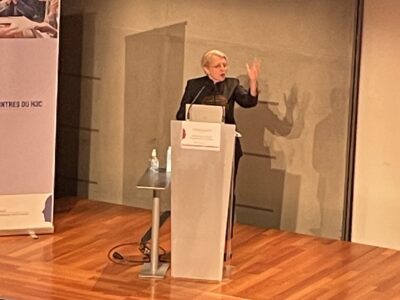
🎥L’esprit des Lois en matière de vigilance (“Spirit of Law in Vigilance (Due Diligences) matters”), in 🧮Réalités et défis de la CSRD – Perspectives du devoir de vigilance

► Full Reference: M.-A. Frison-Roche, "L'esprit des Lois en matière de vigilance" ("Spirit of Law in Vigilance (Due Diligences) matters"), in Haut Conseil du Commissariat aux Comptes (H3C), Réalités et défis de la CSRD – Perspectives du devoir de vigilance, Paris, 14 June 2023. - 🎥watch the video of a part of the speech (in French) - 🧱read the description of the speeches of other speakers of this panel (in French) -   The speech took place during the third-round table devoted to the Perspectives du devoir de vigilance (Perspectives of the duty of vigilance), the first round table having been devoted to the lessons that the DPEF can provide for the CSRD, and the second to the transposition work of the CSRD. 🧮See the full programme of this annual event (in French) - ► English summary of the speech: In consideration of and in addition to what has been said, explained and even affirmed by other speakers, I have emphasised that 'vigilance" laws is not a 'regulation' like any other, but the leading edge of a very vast movement, Compliance Law, in which the 2017 French law is the driving force. For its application, the Judge, who is at the centre because of the will of the Legislator, is already taking into consideration the CS3D, the twin text of the CSRD. The texts must not be seen in isolation. If we isolate them from each other, they become almost incomprehensible, their meaning appearing uncertain, even threatening: we need to understand the spirit of these texts, which are indeed new, because they aim to provide answers to the new world we have entered. We must all rejoice in this political ambition, which is taking a legal form, and work to make it efficient: Legislators, companies, auditors, Regulators and Judges. If we do not stop at the letter, which would be to reduce Compliance to conformity, whereas Compliance Law, particularly Vigilance, is the extension of Regulation, finds its meaning in the Goals, we see that the French law of 2017, known as the "Vigilance law", which copies all the techniques of the French law known as "Sapin 2", gives goals simple to understand to the companies subject to the Legislator's will: detect and prevent environmental and human rights abuses in the value chains. The logic is therefore Ex-Ante. This Ex-Ante logic is retained by the CS3D directive. The Judge is central to it. But the responsibility which the NGOs will ask him to trigger is itself an "Ex Ante responsibility", the Compliance trials being like "accountability" trials, to ensure that companies act in accordance with the Goals set by the Legislator. This is transforming the role of the Judge, who must find effective solutions for the future. The discussion and the adversarial principle will become more important. Mediation will be encouraged. Stakeholders and the company will have to work together, and this method, which was intended by the Legislator for drawing up the vigilance plan, will be continued in the supporting legal proceedings. This will also transform the company, and the role played by those who accredit the information on the company's actions and long-term strategies: auditors therefore have a central role to play. - 🌐follow Marie-Anne Frison-Roche on LinkedIn 🌐follow Marie-Anne Frison-Roche on Instagram 🌐subscribe to the Newsletter MAFR Regulation, Compliance, Law

Conferences

🎤Compliance et droit processuel (Compliance and Procedural Law), in🧮Compliance : Obligation, devoir, pouvoir, culture

🌐follow Marie-Anne Frison-Roche on LinkedIn 🌐subscribe to the Newsletter MAFR Regulation, Compliance, Law - ► Full Reference: M.-A. Frison-Roche, "Compliance et droit processuel" ("Compliance and Procedural Law"), in B. Deffains, M.-A. Frison-Roche and J.-B. Racine (dir.), Journal of Regulation & Compliance (JoRC) and University Panthéon-Assas (Paris II), Compliance : Obligation, devoir, pouvoir, culture (Compliance : obligation, duty, power, culture), University Panthéon-Assas, Salle des Conseils, 14 June 2023. - 🧮See the full programme of this event - 🎤see the other speech made during the first day of this symposium : "L'obligation de compliance, entre volonté et consentement : obligation sur obligation vaut" ("Compliance Obligation, between will and consent: obligation on obligation works")   - ► Summary of the conference: After referring to the chapter in the book Compliance Jurisdictionalisation, which deals more specifically with Procedural Law1See the articles that are part of the Second chapter of the book 🕴️M.-A. Frison-Roche (ed.), 📘Compliance jurisdictionalisation, 2023 : 🕴️N. Cayrol, 📝General Procedural Law in Compliance Law,, the conference is built around 5 developments, each of which represents a progression. The first development relates to the fact that the relationship between Compliance Law and Procedural Law is very difficult because it is often said that they simply have nothing to do with each other, or that they have everything to dislike each other. This is because Compliance is often reduced to processes, and to the mechanical place that algorithms could take in it, in taking care of everything. Compliance would even have the purpose and effect of ensuring that the company and its managers never come into contact with a judge, the public prosecutor being their best ally in this respect. Secondly, I recalled the very common idea that Procedural Law is a kind of 'tribute' that the rule of Law demands, which certainly weighs down companies when compared with companies living in systems in which there's not not such a price. But many stress that Procedural Law could become a model. This can be justified and technically anticipated because it has already happened in Regulation Law, and Compliance Law is the deployment of it2🕴️M.-A. Frison-Roche, 🚧From Regulation Law to Compliance Law, 2017. 🕴️M.-A. Frison-Roche, 🎤Le rôle du Juge dans le déploiement du Droit de la Régulation en Droit de la Compliance (The role of the Judge in the deployment of Regulatory Law in Compliance Law), in 🧮De la Régulation à la Compliance : quel rôle pour le Juge ?, 2023.. In the third stage, I worked on the alliance between the two, with the procedure (rather than the process) modifying compliance and thereby reinforcing it, evoking the way in which this can manifest itself technically3Notably in this perspective, 🕴️M.-A. Frison-Roche and 🕴️M. Boissavy, 📕Compliance et droits de la défense. Enquête interne - CJIP - CRPC (Compliance and Due Process. Internal Investigation - DPA), 2024.. In the fourth step, I looked for what would be the "naturally appropriate procedure" for Compliance: one that takes into account the duration and the development of "solutions", to which the notion of "sustainability", which is central in the substantive Law of Compliance, refers. In a fifth stage, and devoting more time to this, I have pointed out where innovation should be the strongest: the proof, the probatory obligation being the "part totale" ("total part") of the compliance obligation. This major issue will be the subject of a series of symposiums held in 2024. -

Conferences

🎥Le rôle du Juge dans le déploiement du Droit de la Régulation en Droit de la Compliance (The role of the Judge in the deployment of Regulatory Law in Compliance Law), in 🧮De la Régulation à la Compliance : le rôle du juge ?

► Full Reference: M.-A. Frison-Roche, Le rôle du Juge dans le déploiement du Droit de la Régulation en Droit de la Compliance (The role of the Judge in the deployment of Regulatory Law in Compliance Law), in Conseil d'État (French Administrative Supreme Court) and Cour de cassation (French Judiciaire Supreme Court of cassation), De la Régulation à la Compliance : quel rôle pour le Juge ? ("From Regulatory to Compliance : what role for the judge?"), speech constituting the "closing session" of the bi-annual joint symposium of the two High Courts, held at the Conseil d'État, Salle d'Assemblée générale, 2 June 2023. The event was held in French. - 🧮See the full programme of this event (in French) - 🎥watch the interview given about the conclusion, done after the speech (in French) - 🧮read the general programme of the manifestation (in French) - 📚read the bibliographical dossier du participant. (participant's file made in French) - 🎥watch the general introductory speechs of Didier-Roland Tabuteau, Vice-Président du Conseil d'État, de Christophe Soulard, Premier Président de la Cour de cassation, and of François Molins, Procureur général près la Cour de cassation ;  and the interventions in the first session devoted to the path from the Regulatory to the Compliance with Marie-Anne Barbat-Layani, présidente de l'AMF, Jean-Yves Ollier, conseiller d'Etat, Daniel Calleja-Crespo, directeur général du service juridique de la Commission européenne andChristine Guegen, , première avocate générale de la chambre commerciale de la Cour de cassation - 🎥watch the speechs in the second session devoted to the office of the judge with  Vincent Vigneau, président de la chambre commerciale de la Cour de cassation, François Ancel, conseiller à la première chambre civile de la Cour de cassatin, Astrid Mignon-Colombet, avocate à la Cour, Lucien Rapp, professeur à Toulouse-Capitol and Alain Seban, conseiller d'Etat ; the speechs of the third session dedicated to the Compliance new frontiers, with Christophe Chantepy, président de la section du contentieux du Conseil d'État, Roch-Olivier Maistre, président de l'Arcom, Paul Nihoul, juge au Tribunal de l'Union européenne, Jean-François Bohnert, procureur de la République financier, Joëlle Tolédano, professeure émérite à Dauphine ; the final session with Marie-Anne Frison-Roche - 🎥watch this final speech by Marie-Anne Frison-Roche, which formed the closing session of the event - 🚧read the bilingual Working Paper used as basis for the article to be published later - 💬read the interview given by Marie-Anne Frison-Roche and Alain Seban after the colloquia and entitled "Compliance : les cours suprêmes s’emparent de la question de ses enjeux juridictionnels" ("Compliance : the Supreme Courts take up the issue of its jurisdictional implications") - ► English presentation of this general conclusion: Having a definition of Compliance Law in mind, a definition around which there still seems to be so much dispute, is not required to understand that this Law is what will enable us to enter and deal with a new world and if this subject is so fascinating to young people who want to become lawyers, prosecutors, regulators or judges, even though they are not taught this subject, it is because they have understood that with Compliance Law they will be able to actively participate in this new world and build it. This is the way we want it to take it, with force and courage in a sort of collective adventure. In this way, the Judges have a monumental role to play, which is at the very heart of Compliance Law. They will necessarily be so because demands and claims will converge on them from all sides, from Internet users, consumers, investors, associations and companies, and the Judge will have to respond. This has already started and is only just beginning. Judges must be prepared. Four expectations are emerging as to what their role should be. Firstly, judges must persist in their role as guardians of the Rule of Law, in a Compliance Law impregnated with technologies (algorithms) that could be described as insensitive. Secondly, beyond this vital role as guardian of the Rule of Law, the Judge has a new role in the extraordinary deployment of Compliance Law, which is measured in terms of the novelty of the normative control it exercises, the commitments it supports, the remedies it finds and the sustainability it reinforces. Thirdly, in the natural space of justice, the judge responds to parties who make claims of compliance, both as plaintiff and defendant, because the causes of compliance are systemic causes that deserve a new jurisdictional treatment. Fourthly, given the novelty and scope of this innovative approach, all judges must converge in terms of content, qualifications, and methods if they are both to continue their traditional role as guardians of the Rule of Law and to be able to endure their new role, a dialogue in which they have so much to contribute to each other. - 🌐follow Marie-Anne Frison-Roche on LinkedIn 🌐follow Marie-Anne Frison-Roche on Instagram 🌐subscribe to the Newsletter MAFR Regulation, Compliance, Law 

Conferences

conference

🎤Conclusions, in 🧮le devoir de vigilance des entreprises : l’âge de la maturité ?

🌐 flollow Marie-Anne Frison-Roche on LinkedIn 🌐subscribe to the Newsletter MAFR Regulation, Compliance, Law  - ► Full Reference: M.-A. Frison-Roche, "Conclusions", in Ch. Maubernard et A. Brès (dir.), Institut de droit européen des droits de l'homme et Centre de droit de l'entreprise, Université de Montpellier, Le devoir de vigilance des entreprises : l'âge de la maturité?("The Entreprises duty of vigilance: the maturity age?") , Montpellier, May 25, 2023. The conference is held in French. - 🧮see the manifestation programme (in French) - 🌐 read the report done on LinkedIn (in French) - ► English summary of this final speech of the manifestation: It is rather difficult to draw a conclusion after listening so many contributions. For three reasons: firstly, because of their richness and extreme diversity; secondly, because of the fact that we do not know whether the duty of vigilance is under the French law of 2017 (known as the Vigilance Law) or in other national, European and international texts or beyond or below the legal rules; thirdly, because we do not know what is meant by the "maturity" of a legal concept. But in the end, since the question posed by the title itself of the colloquium is Duty of Vigilance: the age of maturity? the answer is clearly: no. But this is regrettable. It is therefore essential to explore the ways in which the duty of vigilance can mature.  If we find merit in this duty which has now entered the legal system, there are eight intersecting avenues, which must be exploited. The first path is progression through the passage of time, rediscovering what in the past was already vigilance and what in the future will be its deployment. The second way is to progress by fixing the vocabulary, because we are witnessing a great battle of words, overtly or covertly, in French or English. The third path is progression through the emergence of principles, or even a principle, rediscovered or invented. The fourth path is progression through coherence brought to the legal system(s), which at present suffer from gaps and inconsistencies, which could be remedied by methods such as centralising litigation or, more radically, ignoring borders. The fifth path is progression through the fact that it works, because vigilance techniques are those of Compliance, of which vigilance is the leading edge, and the challenge is to find solutions. The sixth path is progression through using power of the legal system not only to create new areas of relevance – starting with the notion of vigilance, but also that of the value chain – but also to impose new indifferences, namely indifference to the figure of the market (to which laws prefer the company and the value chain) and indifference to borders. The seventh path is progression through bringing perspectives closer together, in order to find solutions even when interests are opposed. This is where the two techniques of contract and mediation are very welcome. The eighth path is progression through culture, because the culture of vigilance, like the culture of compliance, must be developed within companies and supply chains, and must become common to them and their stakeholders. - 🚧read the Working Paper written just after this oral conclusion in preparation for the article to be published. -  
Breaking news

💬Enquêtes internes : une activité en plein développement pour les avocats (“Internal investigations: a growing business for attorneys”)

🌐follow Marie-Anne Frison-Roche on LinkedIn 🌐subscribe to the Newsletter MAFR Regulation, Compliance, Law - ► Full Reference: M.-A. Frison-Roche & M. Boissavy, "Enquêtes internes : une activité en plein développement pour les avocats" ("Internal investigations: a growing business for attorneys"), interview with Miren Lartigue, Gazette du Palais, 25 April 2023. - 💬read the interview (in French) - ► Presentation of the interview by the journal (in French): "Inspirées des Anglo-saxons et boostées par la loi Sapin II du 9 décembre 2016, les enquêtes internes sont de plus en plus utilisées par les entreprises françaises pour vérifier la réalité de pratiques douteuses en leur sein, découvertes ou alléguées. Parce qu’il s’agit d’un nouveau champ d’activité pour les avocats, le Conseil national des barreaux (CNB) y a consacré une journée lors de son colloque organisé les 20 et 21 avril 2023 sur le thème « Avocat et droits de la défense dans les enquêtes internes et la justice négociée », qui a réuni 750 participants sur deux jours. Matthieu Boissavy et Marie-Anne Frison-Roche, qui ont participé à l’organisation de cet évènement, nous expliquent les contours de ce nouveau métier." - ► Questions asked (in French):  Quels sont la place et le rôle de l’avocat dans les enquêtes internes et pourquoi le CNB a-t-il souhaité organiser une journée consacrée à ce sujet ?   ​​​Quel est leur rôle dans la réception des alertes ?   Et dans l’enquête interne proprement dite ?   Quelle est la complémentarité de l’avocat avec le juriste interne ?   Quels sont outils utilisés pour le calcul des préjudices, la collecte et le traitement des données ?   Comment s’applique la déontologie de l’avocat ?   Et qu’en est-il des droits de la défense ?   Quelle est l’étendue du secret professionnel de l’avocat ? -

Breaking news

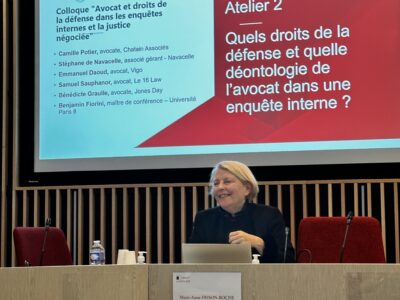
💬Avocat et droits de la défense dans les enquêtes internes et la justice négociée

🌐follow Marie-Anne Frison-Roche on LinkedIn 🌐subscribe to the Newsletter MAFR Regulation, Compliance, Law  - ► Full Reference: M.-A. Frison-Roche & M. Boissavy, "Avocat et droits de la défense dans les enquêtes internes et la justice négociée" ("Attorneys and rights of the defence in internal investigations and negociated justice"), interview with Marina Brillié-Champaux, Dalloz Actu Étudiant, 6 April 2023. - 💬read the interview (in French) - ► Presentation of the interview by the journal (in French): "Futurs avocats, c’est à vous que s’adresse cette interview de Marie-Anne Frison-Roche, agrégée des Facultés de Droit, directrice du Journal of Regulation & Compliance (JoRC) et de Matthieu Boissavy, avocat aux barreaux de Paris et de New York, médiateur, membre du Conseil National des Barreaux, vice-président de la commission Libertés et droits de l’Homme. Les 20 et 21 avril 2023 le Conseil national des barreaux, sous l’impulsion de ses commissions Libertés et droits de l’Homme et Droit et Entreprise, organise un colloque sur le thème « Avocat et droits de la défense dans les enquêtes internes et la justice négociée ». Si vous êtes déjà dans la profession, il se peut que leurs réponses vous intéressent pour le respect du droit à la justice !" - ► Questions asked (in French):  En quoi consistent les enquêtes internes ?   Qu’appelle-t-on la justice négociée ?   Qu’attendez-vous de ce colloque ?   Le questionnaire de Désiré Dalloz Quel est votre meilleur souvenir d’étudiant ? Quels sont votre héros et votre héroïne de fiction préférés ? Quel est votre droit de l’Homme préféré ? -

Breaking news

💬Colloque : « Avocat et droits de la défense dans les enquêtes internes et la justice négociée »

🌐follow Marie-Anne Frison-Roche on LinkedIn 🌐subscribe to the Newsletter MAFR Regulation, Compliance, Law  - ► Full Reference: M.-A. Frison-Roche & M. Boissavy, "Colloque : « Avocat et droits de la défense dans les enquêtes internes et la justice négociée »" ("Symposium: "Lawyers and rights of the defence in internal investigations""), interview with Olivia Dufour, Actu-Juridique, 3rd April 2023. - 💬read the interview (in French) - ► Presentation of the interview by the journal (in French): "Le Conseil national des barreaux (CNB) organise les 20 et 21 avril prochains un colloque intitulé « Avocat et droits de la défense dans les enquêtes internes et la justice négociée ». Matthieu Boissavy, avocat aux barreaux de Paris et de New York, médiateur et vice-président de la commission Libertés et droits de l’Homme du Conseil national des barreaux et Marie-Anne Frison-Roche, professeure de droit, directrice du Journal of Regulation and Compliance nous expliquent les enjeux de ces nouvelles pratiques judiciaires qui bousculent le rôle traditionnel des acteurs de la justice, qu’il s’agisse des avocats ou des magistrats." - ► Questions asked (in French):  Le CNB organise les 20 et 21 avril prochains un colloque sur le thème : Avocats et droits de la défense dans les enquêtes internes et la justice négociée. Pourquoi ce choix ?​ La compliance n’est-elle pas en train de bouleverser le métier d’avocat ? ​​​ Comment cela se traduit-il en pratique ?​ Quelles sont les implications déontologiques, ne faut-il pas inventer de nouvelles règles ? Qu’est-ce que la CJIP a changé dans le métier d’avocat ? Quels sont les nouveaux risques pour l’avocat ? Cela modifie-t-il les relations entre avocats, parquet et juges du siège ? -

Conferences

🖥️Propos introductifs : Les buts monumentaux de la vigilance, in🧮La société vigilante

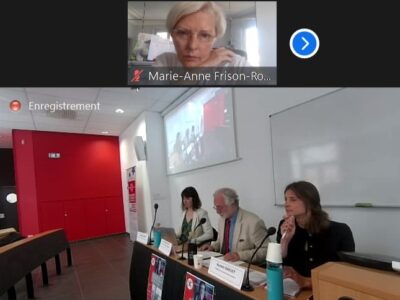
🌐 follow Marie-Anne Frison-Roche on LinkedIn 🌐subscribe Newsletter MAFR Regulation, Compliance, Law  - ► Full Reference: M.-A. Frison-Roche, "Propos introductifs : Les buts monumentaux de la vigilance" (Introductory remarks: The Monumental Goals of Vigilance), in La société vigilante ("The Vigilant Company"), Aix-Marseille University, Institut de Droit des Affaires, March 24, 2023. - This conference is done in French; read its English Summary below⤵️ 🧮see the complete program of the manifestation (in French) - ► English Summary of the conference: "Vigilance" is intriguing because, although it occurs in many branches of Law and is familiar in "banking compliance", in a form that is moreover reinforced since it is an obligation of vigilance on the part of the banker about a client whom he/she should "know", it is the "duty of vigilance" that made this notion famous. One could almost say scandalously famous because of a French law of 2017 that now bears its name, called the "Vigilance Law", whereas other laws bear the name of the minister who thought of it, which due diligence (vocabulary used for the European directive) does not erase.   The current challenge is to take the right measure of what "vigilance" is. Vigilance goes beyond the French Loi Vigilance, which is not enough to express what it is in its few dispositions. To say what it is in the legal system, to use it in practice, to propose the intellectuel legal exercice of qualification, Vigilance must be thought of in Compliance Law, of which it is both a "Tool" and the most advanced point, as shown by the European Directive, whose discussions during its elaboration show these design issues. Thus, like the whole of Compliance Law, Vigilance is understood, deployed, analysed and exercised through what underpins and gives meaning to all these constantly changing regulations, powers, and obligations, through Compliance Monumental Goals which give it stability and simplicity. This is the least that can be done in a mechanism that has the ambition to organise the "sustainability" of economic relations. But while Vigilance expresses and concretizes Compliance Monumental Goals, it must not go beyond measure. In fact, to set up structures, use tools and behave in such a way that human rights and nature are effectively and extraterritorially protected, both negatively and positively, these obligations of the company, which is the natural subject of the "duty", more generally the natural subject of Compliance Law, see its legal powers increased, these means being required for the company to fulfil its new obligations, first legal, then contractual, soon to be unilaterally formulated. Perhaps we should conceive of a "vigilant company" and not just a company that, beyond and through its economic activity, cares for others and the world, but a company that "watches over" everything and on everything would be to go beyond the measure, to make companies the "regents" of the world and the people who live in it. Faced with this perspective to be excluded, the construction of a Europe of Compliance, which does not be reduced to corruption fighting or environment protection, and draws on its humanist tradition, distinguishing itself in this respect from the American and Chinese compliance systems, is the major challenge.  Companies are not the alpha and omega, but they are one of the elements of an Alliance between the political Authorities and the population, its link, the one that allows us to escape from the limit of the territory, in what we call by this inadequate term of "extraterritoriality". It is rather a question of going beyond territories, required by the Compliance Monumental Goals of Compliance, of which Vigilance is the advanced point. - 🚧read the English Working Paper, basis of this conference: "Vigilance, Compliance Monumental Goals, and "Vigilant Company"" - 📈see the slides created for this conference (in French) - 📝read the article published after this conference -

Conferences

🎤Pourquoi le Droit de la Compliance (Why Compliance Law is needed)

► Full reference: M.-A. Frison-Roche, "Pourquoi le Droit de la Compliance ?" ("Why Compliance Law?"), in Roman Aydogdu et Hans De Wulf (dir.), Bruxelles, 15 march 2023.  - 🧮Read the full programme of this event -

Publication director

🏗️ copublishing and direction of the collection: 📚Compliance & Regulation

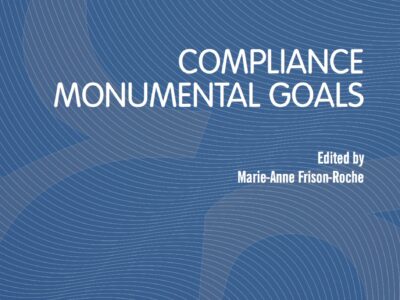
Publication of :🕴️ M.-A. Frison-Roche (ed.),📘 Compliance Monumental Goals

🌐 follow Marie-Anne Frison-Roche on LinkedIn 🌐subscribe to the Newsletter MAFR Regulation, Compliance, Law  - ► Full Reference: M.-A. Frison-Roche (ed.), Compliance Monumental Goals, coll. "Compliance & Regulation", Journal of Regulation & Compliance (JoRC) and Bruylant, 2023, 528 p. - ► This book in a few words: Seize Compliance by its mind: its Monumental Goals. The notion of "monumental goals" of Compliance was proposed in 2016 by Marie-Anne Frison-Roche1🕴️M.A. Frison-Roche, 📝Compliance Law, 2016.. It has become explicit in the texts and the resolution of cases, for example to fight against climate change, make human beings effectively equal, force to be extraterritorially vigilant about suppliers.  Compliance Monumental Goals are targeted ex ante by regulations, contracts, CSR, and international treaties. Creating an alliance between business and political authorities, aiming for a new form of sovereignty. The presence in litigation of these Monumental Goals of global dimension renews the responsibilities and the Judge office. Describing and conceiving these Monumental Goals makes it possible to anticipate Compliance Law, which is more powerful every day. - 📕 In parallel, a book in French Les Buts Monumentaux de la Compliance, is published in the collection "Régulations & Compliance" co-published by the Journal of Regulation & Compliance (JoRC) and Dalloz.  - 📅 This book follows a cycle of colloquia 2021 organized by the Journal of Regulation & Compliance (JoRC) and its universities partners.  - 📚   This book is inserted in this series created by Marie-Anne Frison-Roche for developing Compliance Law. 📚   read the presentations of the other books of this Compliance Series:  📘M.-A. Frison-Roche (ed), Compliance Juridictionnalisation, 2022 📘M.-A. Frison-Roche (ed.), Compliance Tools, 2020 - ► go to the general presentation of this 📚Series ​Compliance & Regulation, conceived, founded et managed by Marie-Anne Frison-Roche, co-published par the Journal of Regulation & Compliance (JoRC) and Bruylant.  - ► General construction of the book:  The book opens with an Introduction, ​which proposes the Monumental Goals as definition of Compliance Law putting them at its "beating heart", giving this new branch of law its originality and specificity, explaining what, in the History of the United States and Europe, gave birth to this singular corpus and justifies a substantial definition of Compliance Law. The concept of Monumental Goals is explained, justifying both systemic and political nature of Compliance Law, the practical consequences of which legal specific rules are thus better identified and limited, since Compliance Law does not lead to all-obedience. We can then determine what we can expect from this Law of the Future that is Compliance Law. From there, the book unfolds in 5 chapters. A first chapter is devoted to the "radioscopy" of this notion, in itself and branch of Law by branch of Law. A second chapter aims to measure how the Monumental Goals are questioned by a crisis situation, for example in a health situation, but not in that example, if they aggravate it and must be discarded, or if, on the contrary, they are exactly conceived for this hypothesis. of crisis, risks, catastrophes and that it is advisable to exploit them, in particular in order, in this "test", to benefit from the alliance between the political authorities, public powers and crucial operators. Once made explicit and tested, the Monumental Goals must find a sure way to be taken into account. This is why a third chapter aims to measure in principle and in practice how the Proportionality method can help the integration of Compliance, thus giving a new dimension to the Law without dragging it into insecurity and illegitimate grabbing of powers. But because Compliance Monumental Goals express a very great ambition, the question of a bearable, even beneficial relationship with the international competitiveness of companies, standards and systems must be opened. This is the object of the fourth chapter.   Finally, because the Monumental Goals express by nature a new ambition of the Law in a world which must not give up in what could be the prospect of its abyss, the fifth chapter has for object the relationship between the Monumental Goals of Compliance and Sovereignty. - ► Table of Content : INTRODUCTION 🕴️M.-A. Frison-Roche, 📝Main Aspects of the Book. The Monumental Goals of Compliance Law 🕴️M.-A. Frison-Roche, 📝Compliance Monumental Goals, Beating Heart of Compliance Law   CHAPTER I. THE VERY IDEA OF MONUMENTAL GOALS, THE BEATING HEART OF COMPLIANCE LAW 🕴️R.-O. Maistre, 📝What are the Monumental Goals for the Regulator in a Rapidly Changing Audiovisual and Digital Landscape? 🕴️A.-V. Le Fur, 📝Interest and “raison d’être” of the Company: How Does It Fit Together with the Compliance Monumental Goals? 🕴️A. Le Goff, 📝Monumental Goals Perceived by the Firm: Serene Business or Business under Pressure? 🕴️J.-F. Vaquieri, 📝The “Monumental Goals of Compliance” from the Company’s Perspective – the Case of Enedis 🕴️M. Malaurie-Vignal, 📝Monumental Goals of Market Law – Reflection on the Method 🕴️C. Peicuti et 🕴️J. Beyssade,📝Feminisation of Positions of Responsibility in the Workplace as a Goal of Compliance. Example of the Banking Sector 🕴️I. Gavanon, 📝Data Protection Law in the Digital Economy Confronted to Monumental Goals 🕴️B. Petit, 📝The Monumental Goals of (European) Labour Law: a Changing System with Balances to be Consolidated 🕴️G. Beaussonie, 📝Do Criminal Law and Compliance Form a System? 🕴️Ch. Huglo,📝Under what Conditions could Climate Law Constitute a Priority Monumental Goal?   CHAPTER II. IMPLEMENTATION OF COMPLIANCE MONUMENTAL GOALS IN ARTICULATION WITH THE MAJOR PRINCIPLE OF PROPORTIONALITY 🕴️L. Rapp, 📝Compliance, Proportionality and Normativity 🕴️B. Bär-Bouyssière, 📝Proportionality and Compliance 🕴️A. Mendoza-Caminade, 📝Proportionality and Evaluation. The Example of Intellectual Property Law 🕴️L. Meziani, 📝Proportionality in Compliance, the Guarantee of Public Order in Companies 🕴️M. Segonds, 📝Compliance, Proportionality and Sanction. A French Perspective 🕴️M.-A. Frison-Roche, 📝Definition of Proportionality and Definition of Compliance Law   CHAPTER III. COMPLIANCE MONUMENTAL GOALS TESTED BY CRISIS SITUATIONS 🕴️A. Oumedjkane, A. Tehrani et P. Idoux, 📝Public Norms and Compliance in Crisis Periods: Testing Monumental Goals. A Few Thoughts 🕴️J. Bonnet, 📝The Crisis, an Opportunity to Seize Compliance as a Mode of Communication for Public Authorities 🕴️M.-A. Frison-Roche, 📝Place and Role of Companies in the Creation and Effectiveness of Compliance Law in Crisis   CHAPTER IV. EFFECTIVENESS OF COMPLIANCE MONUMENTAL GOALS AND INTERNATIONAL COMPETITIVENESS 🕴️B. Deffains, 📝Compliance and International Competitiveness 🕴️J.-Ch. Roda, 📝Compliance, Internal Investigations and International Competitiveness: What are Risks for the French Companies (in the Light of Antitrust Law)? 🕴️F. Marty, 📝The Case for Compliance Programs in International Competitiveness: A Competition Law and Economics Perspective 🕴️S. Lochmann, 📝ESG Rating Agencies and Compliance as an Effective Way of Increasing International Competitiveness 🕴️M.-A. Frison-Roche, 📝Assessment of Whistleblowing and Vigilance Obligation with regard to International Competitiveness   CHAPTER V. COMPLIANCE SUPPORTED BY MONUMENTAL GOALS, A NEW WAY FOR SOVEREIGNTY 🕴️R. Bismuth, 📝The Ambiguous Relations between Corporate Compliance and Sovereignty 🕴️L. Benzoni, 📝International Trade, Competitivity and Sovereignty: Towards a Political Economy of Compliance 🕴️S. Pottier, 📝In Favour of European Compliance, a Vehicle of Economic and Political Assertion 🕴️Ch. André, 📝State Sovereingty, Sovereingty of the People: What Social Contract for Compliance? 🕴️M.-A. Frison-Roche, 📝The Principle of Active Systemic Proximity: Corollary of the Renewal of the Principle of Sovereignty by Compliance Law -

Articles

💬Les juges vont être de plus en plus présents dans le droit de la compliance

🌐follow Marie-Anne Frison-Roche on LinkedIn 🌐subscribe to the Newsletter MAFR Regulation, Compliance, Law  - ► Full reference: M.-A. Frison-Roche, , F. Ancel, N. Roret, "Les juges vont être de plus en plus présents dans le droit de la compliance" ("Judges will be more and more involved in Compliance Law"), interview with Olivia Dufour, Actu-Juridique, 1st March 2023. - 💬read the interview (in French) - ► Presentation of the interview by the journal (in French) : "À l’instigation du professeur Marie-Anne Frison-Roche, l’École nationale de la magistrature (ENM) a proposé pour la première fois début février une formation en compliance à destination des magistrats et des avocats. François Ancel, conseiller la Cour de cassation, Nathalie Roret, avocate et directrice de l’ENM et Marie-Anne Frison-Roche plaident d’une seule voix pour le renforcement du rôle des acteurs judiciaires dans la compliance." - ► Questions asked (in French):  D’où est venue l’idée d’aborder ce droit en cours d’émergence qui semble encore très confidentiel ? En effet, on croit souvent savoir ce qu’est la compliance, en la confondant avec la conformité, pouvez-vous expliquer ce qui les distingue ?​​ On constate, en lisant le programme de la formation, que toutes les branches du droit sont concernées par la compliance depuis le droit des sociétés jusqu’au pénal en passant par les contrats et la responsabilité. Pouvez-vous nous donner des exemples ?​ Comment se redistribuent les rôles entre les avocats, les juges et les entreprises dans cette nouvelle configuration qu’est la compliance ?​ En quoi est-ce important pour les magistrats d’appréhender ce nouvel univers ?​ Ces transformations sont-elles cantonnées à la compliance ou peuvent-elles sortir de son champ ?​ Par exemple qu’en est-il de la question très controversée du rôle de l’avocat à l’égard du juge ?​ Avez-vous constaté lors de cette formation une amélioration du dialogue entre les différents acteurs ?​ Cette formation va-t-elle être instituée de manière permanente dans la formation des magistrats et des avocats ? Une autre manifestation est-elle prévue ? -