Activities

Conferences

🎤 Conclusion (“Rapport de synthèse”), in “La concurrence dans tous ses états”

 ►Full reference : Frison-Roche, M.-A., Conclusion ("Rapport de synthèse"), in Droit et Commerce, La concurrence dans tous ses états, Deauville, 25th and 26th of June 2021. -   📅 This event was initially scheduled for June 22 and 23, 2020, then due to the health crisis, it was postponed to March 27 and 28, 2020; it finally takes place a year later.   📝  Read the general presentation of the colloquium and the program.  (in French)   -  

Conferences

🎤 The judge-judged / Articulate words and things face to the stressful conflict of interests, in “The Firm established as Prosecutor and Judge of itself by Compliance Law

Full reference: Frison-Roche, M.-A., The judge-judged: Articulate words and things face to the difficult conflicts of interest, in L'entreprise instituée Procureur et Juge d'elle-même par le Droit de la Compliance, colloquium co-organized by the Journal of Regulation & Compliance (JoRC) and Lyon 3 Law School, 23rd of June 2021. -   This conference was in French ; the Working Paper on which this conference was based is in French and in English: The judge-judged: Articulate words and things face to the stressful conflicts of interest  📅  June 23, 2021, 9h30 – 18h30  🧭 Lyon,  Lyon 3 Law School, "Salle de la Rotonde" and online -   📊 Read the slides on which this conference is based (in French) 🎥 See the video of this conference.    📝 Read the general program of this colloquium (in French) 📝 Read the working paper on which this conference is based  (in English) - 📅 This colloquium is part of the cycle of colloquia in 2021 organized by the Journal of Regulation & Compliance (JoRC) and its partners about Compliance Juridictionnalization.  📕 📘 The conference is the first basis for the writing of an article, forthcoming in a book whose the French version is La juridictionnalisation de la Compliance,  co-published by the Journal of Regulation & Compliance (JoRC and Dalloz, and whose the English version Compliance Juridictionnalisation, is co-published by the Journal of Regulation & Compliance (JoRC) and Bruylant.     The book in French will be published in the collection "Régulation & Compliance " while the book in English will be published in the same collection "Compliance & Regulation".  - 🔻 Summary of the conference: read below.

Organisation of events

Co-organization of the colloquium “The Firm instituted as prosecutor and judge of itself by Compliance Law (L’entreprise instituée Tribunal par le Droit de la Compliance)”

This scientific manifestation is placed under the scientific responsibility of Marie-Anne Frison-Roche and Jean-Christophe Roda. It is organized by the Journal of Regulation & Compliance (JoRC) and the Centre de Droit de l'Entreprise of Lyon 3 University.   It is the fourth colloquium of the cycle of colloquia organized in 2021 around the general topic of Juridictionnalization of Compliance.         The different interventions will be then transformed into contributions in the books La juridictionnalisation de la Compliance and Compliance Juridictionnalization  which will be published in the Regulation & Compliance serie, jointly published by the JoRC and Dalloz for the book in French and by JoRC and Bruylant for the book in English.  This colloquium will take place in Lyon 3 on 23rd of June 2021 with a limited audience. It will also be broadcasted in live on Zoom.  To register: https://zoom.us/webinar/register/8516215084724/WN_GoQ25I7pRoKhHuGomVMxYw    Presentation of the topic: Initially, it was through Criminal Law, inseparable from the trial, which forced companies to take charge of monitoring within themselves behavior likely to be deviant, the requirement of Ex Ante to be designed by the 'Ex Post of the jurisdictional. From this reversal of things, there has always remained this presence of the judge and the prosecution bodies in a Compliance Law which is nevertheless defined by its concern for the future and the Ex Ante tools within the company. In doing so, the company becoming on the one hand a judge of itself, on the other hand a prosecutor of itself, it splits up, taking in reverse the most established procedural principles. Moreover, because of the monumental goals which constitute Compliance Law, companies become attorneys and judges of the others, or for the others, the cutting machines and the "supreme courts" being by name instituted to regulate in Ex Ante all different before that it does not become litigation. The Ex Ante of Compliance would then make the Ex Post disappear. Method:  The colloquium which had to take place initially on 8th of April has been postponed to 23rd of June to enable speakers to meet and talk in face to face, with a limited audience.  These exchanges will be captured so that third parties can benefit from them, even before the publication of the works, La Juridictionnalisation de la Compliance and Compliance Juridictionalization, within which this work constitutes the basis for the development of a specific chapter. Five practical cases will first be examined in five specific sectors, where this institution of the firm as prosecutor and judge of itself is particularly observable before both specific and more cross-sectoral themes are examined and discussed.   Will speak : 🎤Luc-Marie Augagneur, attorney before Lyon Court of Appeal, CVS Law Firm 🎤Alexis Bavitot, senior lecturer at Lyon 3 University  🎤Alain Bruneau, chief compliance officer at Natixis 🎤Jean-Marc Coulon, Head of Legal Infrastructure at Bouygues Construction 🎤Marie-Anne Frison-Roche, director of the Journal of Regulation & Compliance (JoRC) 🎤Cécile Granier, senior lecturer at Lyon 3 University  🎤Xavier Hubert, director of Compliance at Engie 🎤Jérémie Jourdan-Marques,  professor at Lyon 2 University 🎤Jérémy Heymann, professor at Lyon 3 University 🎤Daphnée Latour, attorney before Paris Court of Appeal  🎤Christophe Lapp, founding partner of Altana law firm 🎤Samir Merabet, senior lecturer at Lyon 3 University  🎤Béatrice Oeuvrard, Public Policy Manager at Facebook France 🎤Jean du Parc, Bâtonnier  🎤Jean-Christophe Roda, professor at Lyon 3 University and director of the Centre de droit de l'entreprise (Center of Company Law) 🎤Jean-Baptiste Siproudhis, director Ethics, Integrity and CSR at Thalès

Publication director

🏗️ copublishing and direction of the collection: 📚Compliance & Regulation

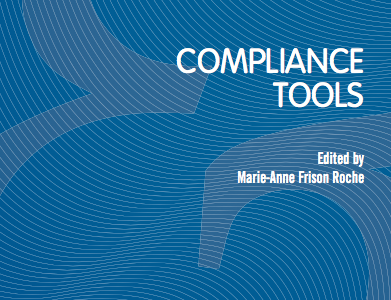
📘Compliance Tools

► Full Reference: Frison-Roche, M.-A. (ed.), Compliance Tools, series "Régulations & Compliance", Journal of Regulation & Compliance (JoRC) & Bruylant, 2021. This book in English is the first title of this collection integrally dedicated to Compliance Law, in that it is the extension of Regulation Law.  - 📚  Read the titles of this series in English co-published by Bruylant.  📚   This collection in English is articulated with a collection co-published between the Journal of Regulation & Compliance and Dalloz. 📕Thus, in parallel, a book in French, Les Outils de la Compliance is published.  - 📅   This book is published after a  cycle of colloquiums organised by the Journal of Regulation & Compliance (JoRC) and Partners Universities. -   ► General Presentation of the collective book: The political dimension of Compliance Law lies in the goals it aims to achieve. To achieve them, the concern for these goals is internalized in "crucial operators", which may be obliged to concretize "monumental goals" set by public authorities. These public bodies control the Ex Ante reorganization that this implies for these companies and sanction Ex Post the possible inadequacy of the companies, which have become transparent to this end. The effectiveness and efficiency of this internalization, without which the statement of these goals is worth nothing, is based on the Compliance tools that are deployed. These appear to be very diverse but their substantial unity (topic which will be the subject of a forthcoming book) makes it possible to study the tools put in place from a unique perspective, by not isolating them in a particular branch of Law, Criminal law or International Law for example, but by measuring what is common to them, notably Anticipation, Trust, Commitment, Responsibility, Incentive, and so on. If the Compliance tools vary, it is rather not only according to the sectors, finance and banking appearing then as the advanced point of the general Compliance Law, for example in environmental matters, but also according to the countries and the cultures. It is in fact about them that legal cultures seem to oppose. The book aims to understand these "tools" by going beyond the description of each instrument, for which we already have many monographs, for analyzing them through the issues of Risks, required Expertises, Training. Sovereignty claims, Incentives, mechanical aptitude of Technologies. It is through these themes that are analyzed by the authors, experts in the field, what we always want to understand better: Compliance Programs, Whistle blowing, Mapping, Sanctions, Extraterritoriality, etc.   -     Read the summary of the book.    Read the foreword, summarizing all the contributions.     Présentation of the book contributions: 📝Amico, Th., Compliance or the passage from ex post to ex ante: A Copernican revolution for the criminal lawyer? 📝Banck, A., The maturity of the Compliance tool’s user, first criterion of the choice of the salient tool 📝Burlingame, Coppens R., Power, N, Lee, D.H., Anti-Corruption Compliance: Global Dimension of Enforcement and Risk Management 📝Calandri, L., Incentive(s) and Self-Regulation(s): which place for Compliance Law in the Audiovisual Sector?  📝Causse, H., Compliance Training: Through and Beyond Traditional Legal Training 📝Frison-Roche, M.-A., Describing, designing and correlating Compliance Tools to have a better use of it 📝Frison-Roche, M.-A., Building by Law the Unicity of Compliance Tools from the Definition of Compliance Law by its "Monumental Goals" 📝Frison-Roche, M.-A., Drawing up Risk Maps as an obligation and the paradox of the "Compliance risks" ​ 📝 Frison-Roche, M.-A., Incentives and Compliance, a couple to propel 📝 Frison-Roche, M.-A., Resolving the contradiction between sanctions and incentives under the fire of Compliance Law 📝 Frison-Roche, M.-A., Rights, primary and natural Compliance tools 📝 Frison-Roche, M.-A., Training: content and container of Compliance Law​ 📝 Galland, M., The Regulator's Inspection of the Effectiveness of the Compliance Tools Implemented by the Company 📝 Granier, C., The Normative Originality of Compliance by Design 📝 Guillaume, N., Compliance risk mapping: first insights of challenges, limits and good practices 📝Guttierez-Crespin, A., Audit of Compliance Systems​ 📝 Koenigsberg, S. and Barrière, F., The Development of Attorney's Compliance Expertise 📝 Larouer, M., The Manifestation of Incentives Mechanisms in French Compliance Law 📝 Merabet, S., Morality by Design 📝 Pailler, L., Technological Tools, Compliance by Design and GDPR: the Protection of Personal Data from Design 📝 Racine, J.-B., Geographical dominance in the choice and the use of Compliance Tools. Introductory remarks 📝Rapp, L., Incentive Theory and Governance of Space Activities 📝 Roda, J.-C., Compliance by design in antitrust: between innovation and illusion 📝 Salah, M., Conception and Application of Compliance in Africa 📝 Tardieu, H., Data Sovereignty and Compliance 📝 Thouret, T., Training and Compliance, Two Correlated Information Transmission Tools  

Organisation of events

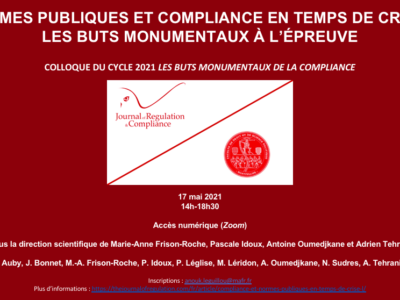
Co-organization of the colloquium “Public norms and Compliance in time of crisis : monumental goals put to a test” (“Normes publiques et Compliance en temps de crise : les buts monumentaux à l’épreuve”)

This scientific manifestation is placed under the scientific direction of Marie-Anne Frison-Roche, Pascale Idoux, Antoine Oumedjkane and Adrien Tehrani. It is organized by the Journal of Regulation & Compliance (JoRC) and by the Faculté de Droit et de Science Politique de l'Université de Montpellier (Centre de Recherches et d'Etudes Administratives de Montpellier and Centre du Droit de l'Entreprise). This manifestation is part of the cycle of colloquia organized in 2021 around the general topic of Compliance Monumental Goals.        The interventions will give rise to the production of articles which will be part of the books Les bus monumentaux de la Compliance and Compliance Monumental Goals which will be published in the Series Regulations & Compliance, coedited by the JoRC and Dalloz for the French version and by the JoRC and Bruylant for the English version.  This manifestation will take place on Zoom on 17th of May 2021.  Registrations: anouk.leguillou@mafr.fr  Assistance to this event may be validated as part of the continuing education of lawyers. In addition, scientific videos will be extracted and disseminated later.   Presentation of the topic: In the overall problematic of "Monumental goals", this conference retains a particular case: that of the crisis and the emergency situation that it generates. First of all, in general, does the importance of public norms in the emergency context engendered by a crisis situation imply a marginalization of Compliance? Don't private actors also have their place in these circumstances, at the service of the "monumental goals" that the public authorities want to maintain, or even which appear specifically? Secondly, more concretely, we have been living for many months in a health crisis. By taking it as a framework and, within it from particular cases, how public and private actors react, act, adjust? and how do the courts assess these movements? Going from the most general to the most specific, this conference aims to identify criteria, limits, of what could be specific rules when the emergency of a crisis meets Compliance, and will examine specific situations.   Working method: The conference is therefore built on a general issue, which was the subject of a "working paper", written by Antoine Oumedjkane, Adrien Tehrani and Pascale Idoux, on which the speakers will have thought in advance and from which they are intended to study the question from their particular perspective. The conference, which is essentially interactive, therefore begins with an outline of the main lines of this general work. It is followed by the examination of concrete practical cases. They are as follows: 1️⃣ hydroalcoholic gel, its manufacture, price, availability, 2️⃣ information and regulation on all media in Covid period 3️⃣ the use of the bicycle during the state of health emergency A first conclusion, thematically limited, will relate to Revealed by the crisis situation, the place of private initiative in Compliance Law. A second, more general, undoubtedly open-ended conclusion is drawn from this confrontation between general reflection and concrete cases which must be resolved in a particular crisis.   Will speak:    Jean-Bernard Auby, Emeritus Professor of Sciences po (Paris)   Julien Bonnet, Professor at Montpellier University and member of the CERCOP   Guylain Clamour, Dean of Montpellier Law School   Marie-Anne Frison-Roche, agrégée des Facultés de droit, Professor of Regulation and Compliance Law at Sciences Po (Paris) and Director of the Journal of Regulation & Compliance (JoRC)   Pascale Idoux, Professor at Montpellier University    Pascale Léglise, adjointe au directeur des libertés publiques et des affaires juridiques (Deputy Director of Civil Liberties and Legal Affairs) of the Ministère de l'intérieur (Home Ministry)   Michèle Léridon, Member of the Conseil supérieur de l'audiovisuel (French Media Regulator), President of the working group Pluralisme, déontologie, supervision des plateformes en ligne (Pluralism, Deontology, Supervision of Online Platforms)   Antoine Oumedjkane, Researcher of the Centre de recherche et d'études administratives (Research and Administrative Studies Center) of Montpellier University   Nelly Sudres, Maître de conférences at Montpellier University and member of the Centre de Recherches et d'Etudes Administratives (Research and Administrative Studies Center) of Montpellier University   Adrien Tehrani, Professor at Montpellier University and member of the Centre du Droit de l'Entreprise (Company Law Center)   Xavier Vallad, Group Legal Director, Intermarché   ⤵️Read a more detailed presentation of the manifestation below:

Publication director

🏗️ copublishing and direction of the collection: 📚Régulations & Compliance

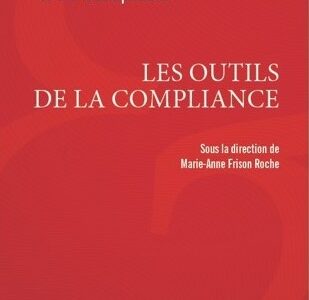
Publication of🕴️M.-A. Frison-Roche (ed.), 📕Les outils de la Compliance (2021)

► Full Reference: M.-A. Frison-Roche (ed.), Les outils de la Compliance, coll. “Régulations & Compliance“, Journal of Regulation & Compliance (JoRC) & Dalloz, 2021, 323 p. - 📘In parallel, the English version of this book, Compliance Tools, is published in the collection co-published by the Journal of Regulation & Compliance (JoRC)  and Bruylant.  - 📅This book comes after a cycle of colloquia organised by the Journal of Regulation & Compliance (JoRC) and its Academic Partners.  - This volume is the continuation of the books dedicated to Compliance in this collection.   ► Read the presentations of the other books in the series: the following books: 🕴️M.-A. Frison-Roche (ed.), 📕Les Buts Monumentaux de la Compliance, 2022 🕴️M.-A. Frison-Roche (ed.), 📕La juridictionnalisation de la Compliance, 2023 🕴️M.-A. Frison-Roche and M. Boissavy (eds.), 📕Compliance et droits de la défense. Enquête interne – CJIP – CRPC, 2024 🕴️M.-A. Frison-Roche (ed.), 📕L’Obligation de Compliance, 2025 🕴️M.-A. Frison-Roche (ed.), 📕Compliance et Contrat, forthcoming 🕴️L. Laref (ed.), 📕Compliance et vigilance bancaire, forthcoming 🕴️M.-A. Frison-Roche, 📕Le système juridique de l’adressage de l’Internet. Une structure multi-acteurs, gage de durabilité (The Legal System of Internet Addressing. A Multi-Stakeholder Structure, the Pledge of its Sustainability), forthcoming 🕴️M.-A. Frison-Roche (ed.), 📕Le système probatoire de la Compliance, forthcoming   the previous books: 🕴️M.-A. Frison-Roche (ed.), 📕Pour une Europe de la Compliance, 2019 🕴️N. Borga, J.-Cl. Marin and J.-Ch. Roda (eds.), 📕Compliance : l’entreprise, le régulateur et le juge, 2018 🕴️M.-A. Frison-Roche (ed.), 📕Régulation, Supervision, Compliance, 2017 🕴️M.-A. Frison-Roche (ed.), 📕Internet, espace d’interrégulation, 2016 📚Read the presentations of the other titles of the collection. - ► General presentation of the book: The political dimension of Compliance Law resides in the monumental goals that it aims for and which define it. These goals are internalized in “crucial operators”, who willingly or by force must structure themselves and act to achieve “monumental goals”, as set by public authorities and which may coincide with the interests of the enterprise. This one designs and controls the Ex Ante reorganization that this implies, under the public authorities supervision. Enterprises, even if their activities are not regulated, thus become transparent and must show the Compliance Tools effectively deployed to effectively achieve these goals. It is a major transformation of economic life in all countries because the Compliance Tools are adopted everywhere and have a global effect. These appear to be very diverse but their unity is profound and bringing it out has the practical benefit of producing a legal regime that is as unified as possible, while allowing their adaptation country by country, sector by sector, enterprise by enterprise.  This book aims to understand these Compliance Tools to better anticipate the assessment that will be made by Regulators, Supervisors and Courts, as well as the new conceptions of the authors of legal texts which impose new ones every day, while companies must also imagine the most appropriate Compliance Tools. This collective work specifically apprehends those on which we have few studies when we handle them on a daily basis, such as risk mapping or training or rights, letting more familiar tools shine through more transversal contributions, such as compliance programs, sanctions, whistleblowing or many sorts of settlements, agreements of public interest. A first chapter takes a legal and economic approach. A second chapter emphasizes the role of risk mapping. A third chapter draws the game of incentives. A fourth chapter identifies the expertise required. A fifth chapter insists on geographic significance. A sixth chapter details the measurement of effectiveness. A seventh chapter explores training. The eighth chapter examines technological tools. The concluding article leads to rights. - ► Read the general introduction of the book (in French). - ► Understand the book through the Table of Contents and the summaries of each article:   INTRODUCTION  🕴️M.-A. Frison-Roche, 📝Décrire, concevoir et corréler les outils de la compliance, pour en faire un usage adéquat   I. APPROCHES JURIDIQUE ET ÉCONOMIQUE DES OUTILS DE LA COMPLIANCE (LEGAL AND ECONOMIC APPROACHES TO COMPLIANCE TOOLS) 🕴️M.-A. Frison-Roche, 📝Approche juridique des outils de la compliance. Construire juridiquement l’unité des outils de la compliance à partir de la définition du Droit de la compliance par ses “buts monumentaux” 🕴️L. Benzoni et 🕴️B. Deffains, 📝Approche économique des outils de la compliance : finalité, mesure, effectivité de la compliance “subie” et “choisie”   II. LA CARTOGRAPHIE DES RISQUES, OUTIL CENTRAL DE LA COMPLIANCE (RISK MAPPING, CENTRAL COMPLIANCE TOOL) 🕴️M.-A. Frison-Roche, 📝Dresser des cartographies des risques comme obligation et le paradoxe des “risques de conformité” 🕴️N. Guillaume, 📝Cartographie des risques de compliance. Premiers aperçus des enjeux, des limites et des bonnes pratiques   III. PLACE ET MANIEMENT DES INCITATIONS DANS LES SYSTÈMES DE COMPLIANCE (PLACE AND USE OF INCENTIVES IN COMPLIANCE SYSTEMS) 🕴️L. Rapp, 📝Théorie des incitations et gouvernance des activités spatiales 🕴️M.-A. Frison-Roche, 📝Résoudre la contradiction entre “sanction” et “incitation” sous le feu du Droit de la compliance 🕴️M. Larouer, 📝La manifestation des mécanismes incitatifs dans le droit français de la compliance 🕴️H. Tardieu, 📝Souveraineté des données et compliance 🕴️L. Calandri, 📝Incitation(s) et autorégulation(s) : quelle place pour le droit de la compliance dans le secteur audiovisuel? 🕴️M.-A. Frison-Roche, 📝Compliance et incitations : un couple à propulser   IV. LES EXPERTISES REQUISES EN MATIÈRE DE COMPLIANCE (THE REQUIRED EXPERTISES IN TERMS OF COMPLIANCE) 🕴️A. Gutierrez-Crespin, 📝L’audit du dispositif de compliance : un outil clé pour en vérifier la robustesse 🕴️S. Koenigsberg et 🕴️Fr. Barrière, 📝La construction de l’expertise de l’avocat en matière de compliance 🕴️Th. Amico, 📝La Compliance ou le passage de l’ex post à l’ex ante. Une révolution copernicienne pour l’avocat pénaliste ?   V. LA PRÉGNANCE GÉOGRAPHIQUE DES OUTILS DE LA COMPLIANCE (THE GEOGRAPHICAL DOMINANCE OF COMPLIANCE TOOLS) 🕴️J.-B. Racine, 📝Propos introductifs. La prégnance géographique dans le choix et l’usage des outils de la compliance 🕴️M. M. Salah, 📝Conception et application de la compliance en Afrique 🕴️R. Burlingame, 🕴️K. Coppens, N. Power et 🕴️D.H. Lee, 📝Compliance : lutte internationale contre la corruption et gestion des risques   VI. LA MESURE DE L’EFFECTIVITÉ DES OUTILS DE LA COMPLIANCE (THE MEASURE OF COMPLIANCE TOOLS EFFECTIVITY) 🕴️M. Galland, 📝Le contrôle par le régulateur de l’effectivité des instruments de compliance mis en place par l’entreprise 🕴️A. Banck, 📝La maturité de l’utilisateur d’un outil de compliance, premier critère du choix de l’outil adéquat   VII. LA FORMATION, ALPHA ET OMÉGA DE LA COMPLIANCE (TRAINING, ALPHA AND OMEGA OF COMPLIANCE) 🕴️H. Causse, 📝La compliance : par et au-delà de la formation juridique classique 🕴️M.-A. Frison-Roche, 📝La formation : contenu et contenant de la compliance 🕴️Th. Thouret, 📝Formation et compliance : deux outils corrélés de transmission d’information   VIII. LES OUTILS TECHNOLOGIQUES ET LA COMPLIANCE BY DESIGN (TECHNOLOGICAL TOOLS AND COMPLIANCE BY DESIGN) 🕴️J.-Ch. ​Roda, 📝La compliance by design en antitrust : entre innovation et illusion 🕴️C. Granier, 📝L’originalité normative de la compliance by design 🕴️L. Pailler, 📝Les outils technologiques, la compliance by design et le RGPD : la protection des données dès la conception 🕴️S. Merabet, 📝La morale by design   CONCLUSION 🕴️M.-A. Frison-Roche, 📝Les droits subjectifs, outils premiers et naturels du Droit de la compliance - 🌐 follow Marie-Anne Frison-Roche on LinkedIn 🌐follow Marie-Anne Frison-Roche on Instagram 🌐 subscribe to the Newsletter MAFR Regulation, Compliance, Law 

Conferences

🎤 Note taken during the colloquium “Compliance and Arbitration” for doing its conclusion: a backing (Conclusion, in “Compliance and Arbitration))

Full reference: Frison-Roche, M.-A., Compliance et arbitrage. Rapport de synthèse: un adossement (Compliance and Arbitration: a Backing. Conclusion), in Frison-Roche, M.-A. & Racine, J.-B., Compliance et Arbitrage (Compliance and Arbitration), Colloquium co-organised by the Journal of Regulation & Compliance (JoRC) and the Centre de recherches sur la Justice et le Règlement des Conflits (CRJ) of Panthéon-Assas University (Paris II), with the support avec the International Court of Arbitration, Paris, 31st of March 2021 -   Read the program of this colloquium See Marie-Anne Frison-Roche's conclusion in video (in French, with English subtitles) These notes of the conclusion have been written as the colloquium took place.  See the video of the entire colloquium (in French, with English subtitles) - This colloquium is part of the Cycle of colloquium 2021 organized by the Journal of Regulation & Compliance (JoRC) and its partners around the topic Compliance Juridictionnalization.   This manifestation is in French but the interventions will be the basis for a specific chapter of the English collective book directed by Marie-Anne Frison-Roche, Compliance Juridictionnalization, co-published by the JoRC and Bruylant. An equivalent book in French, La Juridictionnalisation de la Compliance, directed by Marie-Anne Frison-Roche, will be co-published by the JoRC and Dalloz.    Read the notes established for the conclusion below ⤵️

Organisation of events

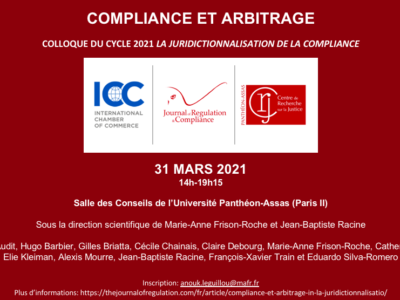
Co-organization of the colloquium “Compliance and Arbitration” (“Compliance et arbitrage”)

This scientific event is placed under the scientific responsibility of Marie-Anne Frison-Roche and Jean-Baptiste Racine. It is organized by the Journal of Regulation & Compliance (JoRC) and by the Centre de recherche sur la Justice et le Règlement des Conflits (CRJ)  of the  Panthéon-Assas (Paris II) University, with the active support of the International Chamber of Commerce ICC. This event is the third colloquium of the 2021 colloquia cycle around the general theme of Compliance Juridictionnalization.      The different interventions will be then transformed into contributions in the books La juridictionnalisation de la Compliance  and Compliance Juridictionnalization  which will be published in the Regulation & Compliance serie, jointly published by the JoRC and Dalloz for the book in French and by JoRC and Bruylant for the book in English.  This colloquium will take place the 31st of March 2021. The manifestation will be live broadcasted on Zoom. To register: https://u-paris2-fr.zoom.us/webinar/register/WN_sPSB4aUUQTWDWDnNcYt3sA   Presentation of the theme:  The arbitrator is the ordinary judge of international trade. It was natural that he or she encountered Compliance: by definition Compliance Law takes hold of the whole world and follows the paths of international trade while it can only be deployed with the help of institutions which, by nature are spreading around the world and need authorities like the Courts. The conference is based on the already perceptible connection points between Compliance and Arbitration to better identify what is emerging for tomorrow: contradiction or convergence between the two; weakening or consolidation. We are already seeing the impact that Compliance can have on the arbitrator's treatment of corruption or the consideration of money laundering. More generally, where do we stand with the arbitrator's knowledge of the many technical issues related to compliance? Beyond these, will the courts and arbitrators be able to achieve the goals, themselves new, sometimes monumental, pursued by Compliance Law? Through this joint exploration of these avenues, the fate of compliance clauses inserted in contracts, the relevance in the matter of private codes of conduct, etc. will be examined. Tomorrow, as of today, is the arbitrator a full and complete judge of Compliance Law? How, with what specificities and what controls?   Notably will speak: Mathias Audit, professeur à l'Université Panthéon-Sorbonne – Paris I (full professor at Sorbonne – University – Paris)   Dominique Bourrinet, General Counsel of Société générale group  ​ Cécile Chainais, director of the Centre de Recherche sur la Justice et le Règlement des Conflits (CRJ) and professeur à l'Université Panthéon-Assas (Paris II) (Full professor at Panthéon-Assas (Paris II) University)    Claire Debourg, professeure à l'Université Paris X- Nanterre (Full professor at Paris X – Nanterre)    Marie-Anne Frison-Roche, professeur à Sciences Po – Paris (Full Professor at Sciences Po – Paris)) and Director of the Journal of Regulation & Compliance (JoRC)   Catherine Kessedjian, professeur émérite de l'Université Panthéon-Assas (professor emeritus of Panthéon-Assas – Paris II University)   Elie Kleiman, partner, Jones Day Law Firm   Alexis Mourre, president of the ICC International Court of Arbitration   Jean-Baptiste Racine, professeur à l'Université Panthéon-Assas – Paris II (Full Professor at Panthéon-Assas – Paris II University)   François-Xavier Train, professeur à l'Université Paris X-Nanterre (Full Professor at Paris X-Nanterre University)   Eduardo Silva-Romero, Dechert Law Firm      Read a detailed presentation of the colloquium below:     

Videos

🎤 The Potential of Compliance Law (Les potentialités du Droit de la Compliance)

Full reference : Frison-Roche, M.-A., The Potential of Compliance Law (Les potentialités du Droit de la Compliance), conference given to Muriel Fabre-Magnan's students, Paris I, 17th of March 2021. -   This conference has been designed for Paris I's students following a Law cursus, specialized in Law of obligations and especially in Tort Law.  It therefore aims to show the technical content of Compliance Law and what it can become.  It has been followed by a debate with students.  Summary: Compliance Law is a branch of Law in the process of being born. We can be sure of its existence in the French positive Law, through the technical examination of laws called "Sapin 2" (2016) and "Vigilance" (2017). It appears at radically new. It is the reason why it is perceived as an attack, especially from United-States and we rather use legal knowledge to counter it. But if we study the historical reasons of its adoption in the United-States and the "monumental goals", whether they are negative (what should not appear in the future) or positive (what should appear in the future), we can measure that this Law, which is essentially Ex Ante could be the means through which scattered but legitimate public authorities and powerful but illegitimate big firms could ally. Therefore potentially Compliance Law could be the worst, simple tool of obedience (mechanical "conformité") or the best: what through which we could do something face to global problems, like global warming, or what we would accept to look in the face: the care for others.  Read the slides on which this conference was based (in French)

Videos

🎤 Devoir de vigilance pour les entreprises: vers un droit de la responsabilité ex ante? (Duty of vigilance for companies: towards an ex ante liability law?)

Full reference : Frison-Roche, M.-A., Devoir de vigilance des entreprises : vers un Droit de la responsabilité ex ante ? (Duty of vigilance for companies: towards an ex ante liability law?), conference-debate, The Faculty of Law, University of Oslo, Norway, 9th of February 2021.  The conference-debate is moderated by Catherine Banet, Associate Professor, Scandinavian Insitute of Maritime Law, Department of Energy and Resources Law, University of Oslo