Activities

Lessons

Leçon n°4

Organisation of events

⚙️scienfica organisation of a public manifestation

🧱Scientific Organisation of the Conference 🧮L’office du juge et les causes systémiques (“The office of the judge and systemic causes”)

► Full Reference: Frison-Roche, M.-A., coordination and moderation of the conference L'office du juge et les causes systémiques (""The Office of the Judge and systemic causes"), in Cycle of Conferences, Penser l'office du juge ("Thinking the Office of the Judge"), Grand Chamber of the Cour de cassation, Paris, May 9, 2021, 17h-19h. The conference is held in French. - ► General presentation of the conference: the conference is based on the intervention of three judges, Christophe Soulard, Fabien Raynaud, and François Ancel, who think and debate among themselves on a hypothesis: the existence of "systemic causes". The hypothesis is that beyond and through the diversity of disputes and cases that are submitted to the most diverse judges, there is a category of cases that are systemic, which means containing in what is submitted to the judge for resolution a system.  If such a category exists, which also raises the question of the diversity of systems and the difficulty arising from their submission to rules that are not legal (for example economic, biological, financial "laws", etc.) , then the judge should take this into account, both in the procedure and in the judgment they make on the case and in the way they formulate et restitute this judgment. - 📝read the presentation of this conference by the Cour de cassation (in French) 📝read the program of the cycle of conferences 2022 (in French) -  🎥see the conference video (in French)  🎥 see the synthesis video of the conference, made in situ by Marie-Anne Frison-Roche (in French)   - ​✏️read the notes taken during the conference to make the synthesis (in French) 📝read the article of Marie-Anne Frison-Roche restituting this conference, published in the Recueil Dalloz (in French) - ►read the works, basis of the two interventions of Marie-Anne Frison-Roche 🚧 L'hypothèse de la "cause systémique (made before the conference to prepare it), available en English 📝Synthese of the conference (made during the conference) -

Conferences

🎤Legal Focus : Compliance Ex Ante, in 📅Toward Automated Compliance in the Data Economy

► Full Reference: Frison-Roche, M.-A., Legal Focus: Compliance Ex Ante, in GAIA-X, Toward Automated Compliance in the Data Economy , November 30,  2021, online -   Read the program. Listen to the intervention.   Intervention Summary: Compliance Law has two senses and GAIA-X is a perfect illustration. Firstly, to respect rules and show in Ex Ante permanently this respect (procedural definition) ; secondly, to pretend certain specific "Monumental Goals" (substantial definition). In this second sens, Compliance Law is very different from Competition Law: it required in Ex Ante collaboration, transparency, stability to reach these Monumental Goals around the respect and protection of Humans, while Competition Law is based on fighting,  mobility and trade without obligation Ex Ante, just sanction Ex Post if a prohibitive behavior occurs.  GAIA-X is based on Compliance Law, established for the purpose of a European Data Industry, a Monumental Goal linked to the Sovereignty and people's protection: it must structurally oblige its members to collabore for this goals, notably through its policy rules (first sens).  It is also a part and subject of the European Union Law. In the sense, its members must obey European Regulatory system (second sens). The both are narrowly linked because the European legal system has the same purpose of sovereignty, internalization of goals in enterprises and individuals' protection: GDPR, Cybersecurity, Digital Services Regulation, etc. : members must show permanently they do it actively. Because the purposes of GAIA-X and the purpose of the European Union Law are now the same in the Compliance Law the respect of letter's Law but also the respect of spirit's Law matters. Both are Ex Ante. Therefore, Compliance by design, which is also Ex Ante, is adequate.   Automated Compliance (and automated Certification) are tools to obey and reach the Monumental Goal. GDPR has specific dispositions (articles 24 and 42) about them, but more generally the efficiency these tools are validated by Regulatory Body, and Courts notably through the design of Smart Contrats.  It could be prudent to put in adition some human Compliance control because, by definition, an Automated Compliance is just the technological transposition (second level) of legal norme (first level) and cannot create new normes.  This is why the more important in this conception in Ex Ante of Compliance by this marriage between Law and Technology is to keep in mind not only the letters put in the algorithms but only the spirit of Compliance Law. -   Go back to the previous intervention about Compliance Law as an adequate branch of Law for GAIA-X (November 2020)

Conferences

🎤The temporal dimension: imminence and intertemporally, in 📅Climate Change Cases before National and International Courts Cross-fertilization and Convergence”

► Full Reference: Frison-Roche, M.-A., Chair for "The temporal dimension: Imminence and Intertemporally", in Climate Change Cases before National and International Courts Cross-fertilization and Convergence", November 27, 2021, Paris.  -   read the program   Summary of the panel presentation: The specific topic of our panel is the “temporal dimension” of the judicial cases of Climate change. We shall listen to two great experts on this topic, which is Time. Listening the other previous speakers, I understand how this topic is important, because Climate Change requires an immediate action and it create a political issue, because everyone comes before courts. A basis and fundamental problem, because the times are not adjusted.  let's come back to basic notions, to have three times : “past, present, future”.   The issue of Climate Change is in the Future, the necessity of Action is in the Present and the basis temporal question is to know if Courts are the bodies adequate to responde ; maybe it is inevitable that Judge must be recreate their office because the time of the classical judicial office is the Past. Immediately, this simple et huge problem appears : in a classical repartition, the judge is the legal character to intervenir for the Past, the present (maybe is for you and me), and the future is the time for the State, and more precisely for the Parliament. But the climate change is a huge topic, not in the past, not in the present, but in the future. Therefore a gap exists between the time of the topic and the time of the court before the case is explained for obtaining a solution : how to give a good answer ? Judge maybe must travel in time, from past to future …. Maybe, he must, but might he? Classically, the judge can anticipate a very next future, but not the more distant and systemic future. Climate change belongs to the second one. This is why the title of this panel is non only about the necessity to take in consideration the “imminence” but also the “intertemporally” : maybe court are the sole able to create this intertemporality between Past and Future, and by this way to obtain from States and companies to do something immediately !   By two legal ways.    Courts can stay in Past, supervising States, if they dispose of effective legal decisions taken by States in the past about Climate Change (essentially Paris Agreement, for instance transposed in the French legal system by a formal law). This is why an efficient judicial solution would be the possibility for the courts to oblige State to implement their more or less committment they had taken in the past for the future (as the Conseil d’État did in the Commune de Grande-Synthe Cas Law). Even for that, the courts must adopt a creative notion of what is a commitment from a State through a Law… ; as they must do about private companies comitment (in their codes of conduct or soft law of corporate social responsability).    But what to do if States didn’t take such commitment ? Some can allege Courts are not Parliaments and are not legitimate to rule for the future … It is a political issue, a very classical one but very accurate for Climate change (where States and companies are face to courts…) and maybe  And as our colleague said, judicial system is quite technically weak to concretize human rights.   Therefore, the second way, more innovative, est the new use of Tort Law : no more a liability Ex Post, but a responsibility Ex Ante. In every legal system, even in Civil Law systems, Tort Law is conceived by courts (for instance in French Law).  If the new reasoning is conveived in Ex Ante, Tort Law must be a set of legal tools to reach the monumental tools to reach the "Monumental Goal" (being by nature future) which is the Climate Change stopping.  In this teleological reasoning, the admissibility and the choice remedies, must be adapted to obtain what is central : the effectivity and the efficiencicy.  In this sens, the judgement between two parties (which was an Ex Post act) may be conceived as an systemic efficient action (which was an Ex Ante act), because it must be.  -        

Conferences

🎤Appréciation du lancement d’alerte et de l’obligation de vigilance au regard de la compétitivité internationale (” (“Assessment of Whistleblowing and Vigilance Duty with regard to international competitiveness”)in 📅 “Effectivité de la Compliance et Compétitivité internationale”

  ► Référence complète: Frison-Roche, M.A., Appréciation du lancement d'alerte et de l'obligation de vigilance au regard de la  compétitivité internationale (" ("Assessment of Whistleblowing and Vigilance Duty with regard to international competitiveness"),  in Benzoni, L., Deffains, B. et Frison-Roche, M.-A.(dir.) , Effectivité de la Compliance et Compétitivité internationale("Compliance Effectivity and International Competitiveness"), seminar co-organised by the  Journal of Regulation & Compliance (JoRC) and the Centre de recherche sur l'Économie et le Droit (CRED)  of the Panthéon-Assas University, November 4, 2021.  -   ►This intervention is thematic ; it is articulated with those more general carried out in introduction by Bruno Deffains particularly focused on the necessarily global scope of Compliance and in conclusion by Laurent Benzoni on Compliance as a potential new pillar of industrial policy, the whole of the colloquium having been conceived by the three of us. - 📅 read the semirar program    📅 this scientific event is part of the 2021 colloquia cycle, organized by the Journal of Regulation & Compliance (JoRC) and its Universities partners, on the general theme of Compliance Monumental Goals. -   🚧  read the bilingual Working Paper, basis of this conference -   ►see the slides used during the conference -   ► Conference Summary: First of all and independently of the technical topic itself which, as the slides show, is focused on these two techniques based on Information which are the Whistleblowing and the Vigilance duty, it is essentiel to pose that the techniques themselves are conceived totally  differently depending on whether Compliance Law is conceived as a mechanical process and totally binding to fully comply with all applicable regulations and to demonstrate it in advance, under the threat of terrible fines, this definition being the both completely frightening and meaningless since what these applicable regulations contains is irrelevant, in which case the prospect of competitiveness boils down to notions of costs and also procedural considerations of foreseeability and legal certainty; or if Compliance Law is conceived as a new and substantial branch of Law Ex Ante developed to detect and prevent the systemic crises being before us, of which the climate crisis is unfortunately the epigone and which requires above all Action, an action of such magnitude which requires the alliance of all forces, that of States, companies, courts and people, in a renewal of concepts, particularly legal ones, and in the indifference of territories, which puts Compliance immediately at its right level: the world, because the scientifically emerging crisis is global, the so-called "extraterritoriality" theme now being misnamed. From this new general conception, the Vigilance obligation, about which so much was said when it was imposed in France in 2017, is the advanced point, soon taken up in Europe and whose scope must be naturally global, because that Compliance Law is consubstantially global. Taking up more technically the legal techniques of Compliance and confronting them with the Competitiveness of firms, it is necessary that these Compliance Tools do not harm this Competitiveness because Compliance Law , supporting immense ambitions, can only function through an alliance between political  wills (with great pretensions, i.e. save the planet) and the entities which are able to concretize them (the crucial economic operators): the Compliance tools designed by legal systems must preserve the companies which put them in place and never favor their competitors. On the basis of this principle, it is possible to assess these two legal techniques,  namely the whistleblowing and the Vigilance duty,  which both capture Information, which, as such, gives them a uniqueness and places them in the global Competition for Information. Taking the whistleblowing first, it appears that its first beneficiary is the company itself since it discovers a weakness and can therefore remedy it. This is why, beyond the principle of protection of the whistleblower by the access of somebody to the legal statute conceived in France by the law known as "Sapin 2", it is criticized that all the incentives are not used for that the holder of such information transmits it to the manager and that the same law continues to require the absence of financial counterpart, the "heroic figure of the whistleblower and the refusal of his remuneration depriving the company of a means information and improvement. The American solution is better and tt is regrettable that the law transposing the European Directive maintains this ineffective conception. But French legislation has on the contrary developed the right incentive as to the person whom the information must be transmitted to is the manager, then externally if the latter does nothing. The solution is better that the American solution because the incentive is thus made to push the internal manager to act and put an remedy to the internal dysfunction, which increases the competitiveness of the company. Even more, even if it seems counter-intuitive, the French Vigilance Duty greatly increases the competitiveness of the companies which are subject to it. Indeed, the 2017 Law by obliging them to prevent and fight against  human rights and environment violations has tacitly given them all the necessary powers to do so, in particular the power to capture Information on third-party companies, including ( and even above all) those which are not subject to transparency obligations. In this, companies, insofar as they are personally responsible, hold a supervisory power over others, a power which allows Compliance Law to globalize and which, in the process, increases their own power. This is why the obligation of vigilance is in many respects a boon for the companies which are subject to it. The resumption of the mechanism by the next European Directive, itself indifferent to the territory, will only strengthen this global power on other firms, even foreign ones. - ► This  conférence et le document de travail servent de base à un article dans un ouvrage : 📝This conference and the Working Paper constitute the basis for an article:  📕  in its French version in the book  Les buts monumentaux de la Compliance, in the Series    Régulations & Compliance  📘  in its English version in the book Compliance Monumental Goals, in the Series    Compliance & Regulation -  

Videos

🎤 Definition of Principle of Proportionality and Definition of Compliance Law (“Définition du Principe de Proportionnalité et Définition du Droit de la Compliance”), in 📅Compliance and Proportionality. From the control of Proportionality to the proportionality of the Control (“Compliance et proportionnalité. Du contrôle de proportionnalité à la proportionnalité du contrôle”)

► Full Reference: Frison-Roche, M.A., Definition of Principle of Proportionality and Definition of Compliance Law ("Définition du Principe de Proportionnalité et Définition du Droit de la Compliance"),  in Frison-Roche, M.-A. et Rapp, L. (dir.), Compliance and Proportionality. From the control of Proportionality to the proportionality of the Control ("Compliance et proportionnalité. Du contrôle de proportionnalité à la proportionnalité du contrôle") Compliance et Proportionnalité. Du contrôle de proportionnalité à la proportionnalité du contrôle, juges pour la Compliance, Colloque coorganisé par le Journal of Regulation & Compliance (JoRC) et la Chaire SIRIUS (IDETCOM),  14 octobre 2021.  -   📅 read the conference program  📅 this colloquium is part of the cycle of colloquia 2021 organised by the Journal of Regulation & Compliance (JoRC) and its partners on the Compliance Monumental Goals topic.  -   🚧  read the Working Paper on the basis of which the conference was done and from which the reactions took place.  -   ►see the slides supporting the conference (in French)   ► Conference Summary: The use of Proportionality t always limit powers is only justified when it is about sanctions, but sanctions are only one tool among others in Compliance Law, intended moreover to have little place in this Ex Ante branch of Law. And returning to the very nature of Compliance Law, which relies on operators, private or public, because they are powerful, then using proportionality to limite powers is detrimental to Compliance Law.  However, nothing requires that. Compliance Law is not an exception that should be limited. On the contrary, it is a branch of Law which carries the greatest principles, aimed at protecting human beings and whose Normativity lies in its "Monumental Goals": detecting and preventing future major systemic crisis (financial, health and climate ones). However, literally  the principle of Proportionality is: "no more powers than necessary, as many powers as necessary". The second part of the sentence is independent of the first: this must be used. Politics having fixed these Monumental Goals, the entity, in particular the company, must have, even tacitly, "all the necessary powers" to achieve them. For example the power of vigilance, the power of audit, the power over third parties. Because they are necessary to fulfill the obligations that these "crucial operators" have to perform as they are "in a position" to do so. So instead of limiting the powers, the Principe of Proportionality comes to support  the powers, to legitimize them and to increase them, so that we have a chance that our future is not catastrophic, perhaps better. In this respect, Compliance Law, in its rich Definition, will itself have enriched the Principle of Proportionality. -   ► the conference and the Working Paper are the basis for an article in the book⤵ ►  in its French version 📕 Les Buts Monumentaux de la Compliance, in the Series  Régulations & Compliance ► in its English version 📘Compliance Monumental Goals , dans  la collection    Compliance & Regulation   -  

Conferences

🎤Never exclude Judges and Lawyers in Compliance Law (“Ne jamais se passer des juges et des avocats dans le Droit de la Compliance”), in 📅 “Which Judges for Compliance?” (“”Quels juges pour la Compliance ?”)

Full  Reference: Frison-Roche, M.A., Ne jamais se passer des juges et des avocats dans le Droit de la Compliance ("Never exclude Judges and Lawyers in Compliance Law" ,  in Frison-Roche, M.-A., Morel-Maroger, J. et Schiller, S. (dir.), Quels juges pour la Compliance ("Which Judges for Compliance), Colloquium co-organised by the Journal of Regulation & Compliance (JoRC) and the CR2D of Dauphine University PSL, Raymond Aron Amphy, 23rd September  2021.  - 📅 Read the Colloquium programme 📅 This colloquium  is a part in the colloquia cycle organized in 2021 by the Journal of Regulation & Compliance (JoRC) and it partners on the  Compliance Juridictionalisation. - ✏️A bilingual Working Paper  on the topic  "The  role of the Judge in Compliance Law has been prepared to serve a basis for this conference : read this Working Paper  But for the reason detailed below, I preferred to use the time allotted to the introduction of the colloquium to develop rather what should had be an opening element for making it the entire topic of my intervention. : "Never do without judges and lawyers in Compliance Law". Because before analyzing the role of judges, they still need to be in the Compliance system; this seems to us to be taken for granted, but it is not.   ► Conference Summary: Due in particular to the large number of students and the fact that a long time ago when I arrived at Dauphine University I had created a Master in Economic Law with Martine Lombard in which I had included a course of "Economic Procedural Law" that I was teaching, since it was the moment to make this Colloquium "general introductory report", I therefore preferred to go further and focus the subject on something other than "The role of the judge in Compliance Law" , namely the very question of "the presence of judges and lawyers in Compliance Law". This question of their presence or their absence, because they would be useless, even harmful to the Compliance effectiveness, either judges, or lawyers, or both together, is indeed the prerequisite for the reflection of " Which judges for Compliance? " because if we think of Compliance exclusively through the Ex Ante and efficiency, as it is often done in the West through artificial intelligence or in China in a system of surveillance and economic, technological and political efficiency , there is neither judge nor lawyer. It is therefore to this prerequisite that I devoted my speaking time, deferring to publication all the analyzes that I had prepared on "The role of the judge in Compliance Law", to which everyone can refer by consulting the preparatory work. It is indeed imperative to always keep in mind the need to never exclude Judges from Compliance systems, although this can be conceivable since they are Ex Ante mechanisms, which often aim by nature to avoid the trial. (example of the Deffered Prosecution Agreement), because when there is a judge, the procedural mechanisms and Due Process principle are associated with it: the power of Compliance Law does not go wrong. However, Compliance Law is the Law of the future, that which will seize the immense challenges to be resolved today for tomorrow and it is not from the specific laws against corruption, such as FCPA or the French law known as "Sapin 2 law", which are only  examples, but from two enormous "monumental" subjects that are on the one hand Data and on the other hand Climate that Compliance Law is building, with the means that are required. But so that the rule "all the means necessary for the ends", which already tended to govern Regulatory Law of which Compliance Law is the exponential extension, does not carry all, one needs lawyers. Because the lawyers contradict. And ask. Ask judges and carry the actions of ordinary people for their subjective rights to be shaped. As Motulsky affirmed it in its thesis, written during the Second World War, before after this enormous systemic disaster inventing the "general procedural law". - The Working Paper which had not be exploited during the conference will be the bais for the article in the book : 📕 in its French version La juridictionnalisation de la Compliance, in the Series    Régulations & Compliance  📘  in its English version  Compliance Jurisdictionalisation, in the Series    Compliance & Regulation -   📅 Ce colloque s'insère dans le cycle de colloques 2021 organisé par le Journal of Regulation & Compliance (JoRC) et ses partenaires autour de la Juridictionnalisation de la Compliance.   -  

Conferences

🎤 Conclusion in 📅Compliance Monumental Goals: radioscopy of a notion “(“Rapport de synthèse in “Les buts monumentaux: radioscopie d’une notion” “)

Full reference: Frison-Roche, M.-A., Rapport de synthèse (Conclusion) in André C., Frison-Roche, M.-A., Malaurie, M. and Petit, B., Les Buts monumentaux de la Compliance (Compliance Monumental Goals), Colloquium co-organised by the Journal of Regulation & Compliance (JoRC) and the Laboratoire Dante of Paris-Saclay University, -     📅  September 16, 2021. 🧭 Maison du Barreau, 12 place Dauphine 75004 Paris - ► Conclusions' Summary: Based on the multiple contributions of the day, the first part of this synthesis focuses on the practical interest of having Monumental Goals attached to compliance techniques.Conceptually defining these Monumental Goals as normative legal rules of Compliance Law has the first practical advantage of making clear this scattered and almost incomprehensible material, allowing us to better understand it.  The second practical advantage is to bring together the various branches of law in that they all contain compliance mechanisms, the points of contact thus discerned leading to a unification of technical legal rules.  The third practical advantage is to provide the various sources of law concerned with a means of applying and interpreting the law. The fourth practical advantage is to give meaning to all these technical provisions. In the second part of this synthesis, it appeared that these practical considerations therefore justify undertaking the "conceptual adventure". This one can take three pillars, in this "cathedral" that Dominique de la Garanderie designed, this "monument" corresponding well to the adjective Monumental which is better suited to these Goals than does the adjective "Fundamental", because it is a question of building, of building for a future which is not fatal. The first conceptual pillar consists in conceptualizing the Monumental Goals so that the Compliance Law finding a substantial meaning thus gives in a normative way a meaning to all the technical provisions which serve it in an instrumental way. The second conceptual pillar consists of giving everyone their place, that of public authority, that of the company and that of the population, each concerned and each not having to take the place of the other in the determination of the monumental goals, the company being in particular free in the design of the means while the political authority being in charge of drawing the Goals, the company being able to copy them on its own account. This conception does not depend on legal systems but on goals and legitimacy, in particular on the definition chosen for what is a company. The third conceptual pillar derives precisely from the humanist conception that one can claim to have of the Compliance Monumental Goal, risk management being only a means to achieve it. Humanism effectively carried by Compliance, taken on their own account by the companies alone capable of making them concrete, is what makes it possible to distinguish texts that are nevertheless technically similar, depending on whether they apply in  Rule of Law systems or in systems which are note governed by the Rule of Law Principle. This is why the technical future of Compliance Law lies in this conceptual adventure that it is necessary to lead. -   📝 read the program of this colloquium  🎥 see Marie-Anne Frison-Roche's conclusion in video (in French, with English subtitles) ✏️ read the notes translated in English on which this conclusion is based  - 📅 This colloquium is part of the Cycle of colloquium 2021 organized by the Journal of Regulation & Compliance (JoRC) and its partners around Compliance Monumental Goals.   📘 This manifestation is in French but the interventions will be part of an English collective book directed by Marie-Anne Frison-Roche, Compliance Monumental Goals, co-edited by the JoRC and Bruylant. 📕 An equivalent book in French, Les Buts Monumentaux de la Compliance, directed by Marie-Anne Frison-Roche, will be co-published by the JoRC and Dalloz. 

Organisation of events

📅 Scientific Co-organization of the colloquium “Radioscopie d’une notion : les “buts monumentaux” de la Compliance (“Radioscopy of a notion: the Compliance “monumental goals””), in “Les buts monumentaux de la Compliance” (“Compliance Monumental Goals”)”

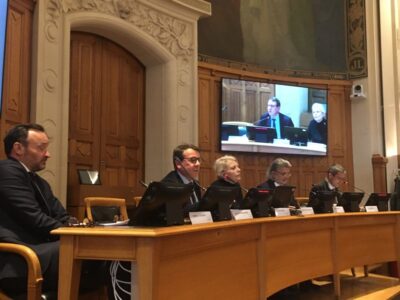
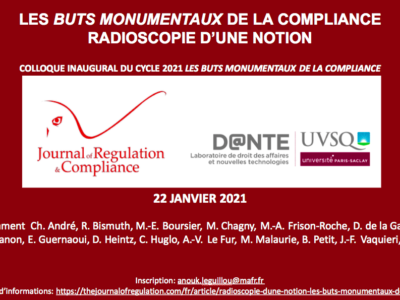
► co-organized between Laboratoire DANTE and the Journal of Regulation & Compliance (JoRC), this colloquium) is the core manifestation of the 2021 series of colloquia devoted to the general theme of Compliance Monumental Goals. It will take place on 16th of September 2021, at the Maison du Barreau, in Paris. This first work is in French but  will be the basis of the book in English : Compliance Monumental Goals,    This book will be published in the Compliance & Regulation Series, co-published by the JoRC and Bruylant. ► Presentation of the colloquium Thematic: To understand the notion of "Monumental Goals", it is firstly necessary to take crossed perspectives on them, particularly through the prism of Labor Law, Environmental Law and Enterprise Law. Many questions appear. Does the notion of “Monumental Goals” present any substance in Law? Is it uniformly understood, or do specificities appear, forged by specific cultures and disciplinary practices? What are the sources and implicit references or echoes? Because even if we admit the part of novelty, there is undoubtedly an anchoring in traditional legal concepts, like the general interest or sovereignty. How does the shift from meta-legal (prima facie introduced by the concept) to legal take place, and where do any operational difficulties lie when legal actors are called upon to act? The question of a possible categorization of "Monumental Goals" will thus be explored, through these three legal disciplines whose historicity, goals and implications for firms differ.   These reflections allow to ask why and how these "Monumental Goals" are developed. Indeed, what is the relevance of the association of "Monumental Goals" and Compliance? Beyond theoretical considerations relating to the meaning of Law, is this really an effective alloy encouraging companies to behave differently? By what ways? These questions arise in particular with regard to the imperatives of legal certainty and the operative nature of the concept. The question of "Monumental Goals" will thus be explored by the operational actors of compliance, both those who act within companies and those who act from the lato sensu State sphere, for understanding whether this notion is a pure rhetoric figure or constitutes a particularly promising lever for the evolution of market behavior.   ► with :  🎤 Christophe André, maître de conférences à l'Université Paris – Saclay (lecturer at the Paris-Saclay University) 🎤 Guillaume Beaussonie, professeur à l'Université Toulouse-1-Capitole (law professor at Toulouse-1-Capitole University) 🎤 Regis Bismuth, professeur de droit à Sciences po, Paris (law professor at Sciences po Paris) 🎤 Marie-Emma Boursier, doyen  de l'Université Paris – Saclay (dean of the Paris-Saclay University) 🎤 Muriel Chagny, professeur l'Université Paris – Saclay, directrice du Laboratoire Dante (Professor at the Paris-Saclay University, director of the Laboratory Dante) 🎤 Marie-Anne Frison-Roche, professeur à Sciences po (Paris) (Professor at Sciences Po Paris) 🎤 Isabelle Gavanon, avocate à la Cour d'Appel de Paris (attorney before the Paris Court of Appeal) 🎤 Emma Guernaoui, ATER à l'Université Paris II Panthéon-Assas (ATER at Paris II Panthéon-Assas University) 🎤 Dominique Heintz, avocat à la Cour d' appel de Paris (attorney before the Paris Court of Appeal) 🎤 Christian Huglo, avocat à la Cour d' appel de Paris (attorney before the Paris Court of Appeal) 🎤Dominique de La Garanderie, avocat à la Cour d'appel de Paris (attorney before the Paris Court of Appeal)  🎤 Anne-Valérie Le Fur, professeur à l'Université Paris – Saclay (Professor at Paris-Saclay University) 🎤 Anne Le Goff, secrétaire générale déléguée d'Arkéa (Deputy Secretary general at Arkéa) 🎤 Roch-Olivier Maistre, président du Conseil supérieur de l'audiovisuel (President of the French audiovisual regulation authority) 🎤 Marie Malaurie, professeur à l'Université Paris-Saclay (professor at the Paris-Saclay University) 🎤 Jérôme Marilly, avocat général à la Cour d'Appel de Paris (General attorney before the Paris Court of Appeal) 🎤 Benoît Petit, maître de conférences (HDR) à l'Université Paris-Saclay (lecturer at the Paris-Saclay University)  🎤 Jean-François Vaquieri, Secrétaire Général d'Enedis (Secretary General of Enedis) - Read a detailed presentation below:  

Videos

🎥 Compliance law: a strategic tool for a sovereign Europe (” Le droit de la compliance : un outil stratégique pour une Europe souveraine”)

► Full Reference: Frison-Roche, M.-A., Le droit de la Compliance : un outil stratégique pour une Europe souveraine (Compliance law: a strategic tool for a sovereign Europe), interview with Jean-Philippe Denis, recorded on July 3, 2021 and broadcast on September 17, 2021 -   🎥 Watch the interview, as broadcast on Xerfi Canal channels.    🎥Watch the interview enhanced with French subtitles - ►Summary: Compliance Law powerfully and clearly helps to build a sovereign Europe.  Compliance Law is not the annex of Competition Law; it is another branch of Law, which aims instead to rely on the de facto power of companies, when they are in a position to achieve the "Monumental Goals" that the Political Authorities have decided to achieve, which requires an alliance between them and those companies in a position to achieve these "Monumental Goals". Companies can do this because they are in a position to do so, in that they are well located to act, have the information, the technology and the adequate financial means.) Compliance is a construction tool, and not, as it is still sometimes presented, a means to limit the ability of those who are concretely able to build, i.e. the companies. The architect remains and must remain the Politics. But the company remains the master of the means to achieve these goals, and free to duplicate them in its own care, via CSR, "raison d'être" and ethics.