Activities

Conferences

🎥 Regulatory Law and Compliance, expression of the Professional Order missions, in🧮Une profession face aux défis de la société

  ► Full Reference: Frison-Roche, M.A., Régulation et Compliance, expression des missions d'un Ordre, in📅 Ordre des Géomètres-experts, Une profession face aux défis de la société, Le Havre, September 15, 2022.  - 📅 read the general of the manifestation de la manifestation (in French) - 🎥watch the one-minute video summarizing the twenty-minutes intervention (in French) - 🚧 read English Presentation of the Working Paper which has been the basis of this conference   ► English Summary of this intervention: Professional orders should not present themselves as exceptions, however legitimate they may be, in relation to a principle, which would be the competitive system, but as the expression of a principle. This principle is expressed by two branches of Law whose importance is constantly growing in European Law, liberal branches which are based on the conception of economic life and the definition of company, turned towards the future: the Regulatory Law and Compliance Law, two branches of Law both related and distinct. Indeed, and this is the topic of the first part, Competition Law conceives professional orders as exceptions since these "corporations" constitute structural agreements. French domestic legal system both consolidates the professional orders by backing them up to the State, which would sub-delegate its powers to them, but involves them in the questioning by the European Union of the States and their tools. Most often the temptation is then to recall with a kind of nostalgia the times when the professional orders were the principle but, except to ask for a restoration, the time would be no more. A more dynamic approach is possible, in accordance with the more general evolution of Economic Law. Indeed, the Professional Order is the expression of a profession, a little-exploited concept in Economic Law, over which the Order exercises the function of "Second-level Regulator", the public authorities exercising the function of "First-level Regulator". The Banking and Financial Regulatory Law is built in this way and operates thank to that, at national, European, and global level. This is what should be linked. The Professional Orders therefore have the primary function of spreading a "Culture of Compliance" among the professionals they supervise and beyond them (clients and stakeholders). This culture of Compliance is developed regarding the missions which are concretized by the professionals themselves. Therefore, the second part of the Working Paper deals with the legal evolution of the notion of "Mission" which has become central in Economic and General Law, through the technique of the mission-based company. However, there are multiple points of contact between the raison d'être, the company with a mission and Compliance Law as soon as the latter is defined by the concrete and overly ambitious goals that it pursues. : the Monumental Goals. Each structure, for example the French Ordre des Géomètres-Experts, is legitimate to set the Monumental Goal that it pursues and that it inculcates, in particular the conception of territory and the living environment, joining what unites all the Monumental Goals of Compliance: concern for others. The French Ordre des Géomètres-Experts, is adequate because it has a more flexible relationship, both tighter and broader, with the territory than the State itself. By instilling this in professionals, the Professional Order develops in the practitioner an "ex ante responsibility", which is a pillar of Compliance Law, constituting both a charge and a power that the practitioner exercises, and of which the Professional Order must be the supervisor. - ► to go further ⤵️  Frison-Roche, M.-A., 📘Compliance Monumental Goals, 2021 Frison-Roche, M.-A., 💻Appliquer la notion de "Raison d'être" à la profession du Notariat, 2021 -

Publication director

🏗️ copublishing and direction of the collection: 📚Régulations & Compliance

📚Publication of🕴️M.-A. Frison-Roche (ed.), 📕Les Buts Monumentaux de la Compliance (2022)

► Full Reference: M.-A. Frison-Roche (ed.), Les Buts Monumentaux de la Compliance (Compliance Monumental Goals), coll. “Régulations & Compliance“, Journal of Regulation & Compliance (JoRC) and Dalloz, 2022, 520 p. - 📘In parallel, the English version of this book, Compliance Monumental Goals, is published in the collection co-published by the Journal of Regulation & Compliance (JoRC) and Bruylant.  - 📅This book comes after a cycle of colloquia 2021 organised by the Journal of Regulation & Compliance (JoRC)and its Universities partners.  - This volume is the continuation of the books dedicated to Compliance in this collection. ► Read the presentations of the other books in the series: the following books: 🕴️M.-A. Frison-Roche (ed.), 📕La juridictionnalisation de la Compliance, 2023 🕴️M.-A. Frison-Roche and M. Boissavy (eds.), 📕Compliance et droits de la défense. Enquête interne – CJIP – CRPC, 2024 🕴️M.-A. Frison-Roche (ed.), 📕L’Obligation de Compliance, 2025 🕴️M.-A. Frison-Roche (ed.), 📕Compliance et Contrat, forthcoming 🕴️L. Laref (ed.), 📕Compliance et vigilance bancaire, forthcoming 🕴️M.-A. Frison-Roche, 📕Le système juridique de l’adressage de l’Internet. Une structure multi-acteurs, gage de durabilité (The Legal System of Internet Addressing. A Multi-Stakeholder Structure, the Pledge of its Sustainability), forthcoming 🕴️M.-A. Frison-Roche (ed.), 📕Le système probatoire de la Compliance, forthcoming   the previous books: 🕴️M.-A. Frison-Roche (ed.), 📕Les outils de la Compliance, 2021 🕴️M.-A. Frison-Roche (ed.), 📕Pour une Europe de la Compliance, 2019 🕴️N. Borga, J.-Cl. Marin and J.-Ch. Roda (eds.), 📕Compliance : l’entreprise, le régulateur et le juge, 2018 🕴️M.-A. Frison-Roche (ed.), 📕Régulation, Supervision, Compliance, 2017 🕴️M.-A. Frison-Roche (ed.), 📕Internet, espace d’interrégulation, 2016 📚Read the presentations of the other titles of the collection. - ► General presentation of the book: Seize Compliance by its mind: its Monumental Goals. The notion of “monumental goals” of Compliance was proposed in 2016 by Marie-Anne Frison-Roche1M.-A. Frison-Roche, "Le droit de la compliance", 2016. It has become explicit in the texts and the resolution of cases, for example to fight against climate change, make human beings effectively equal, force to be extraterritorially vigilant about suppliers.  Compliance Monumental Goals are targeted ex ante by regulations, contracts, CSR, and international treaties. Creating an alliance between business and political authorities, aiming for a new form of sovereignty. The presence in litigation of these Monumental Goals of global dimension renews the responsibilities and the Judge office. Describing and conceiving these Monumental Goals makes it possible to anticipate Compliance Law, which is more powerful every day. - 🏗️General construction of the book : The book opens with a double Introduction, the first summarizing the book (in free access) ​and the second, more substantial, proposing  the Monumental Goals as definition of Compliance Law putting them at its “beating heart”, giving this new branch of law its originality and specificity, explaining what, in the History of the United States and Europe, gave birth to this singular corpus and justifies a substantial definition of Compliance Law. The concept of Monumental Goals is explained, justifying both systemic and political nature of Compliance Law, the practical consequences of which legal specific rules are thus better identified and limited, since Compliance Law does not lead to all-obedience. We can then determine what we can expect from this Law of the Future that is Compliance Law. From there, the book unfolds in 5 titles. A first Title is devoted to the “radioscopy” of this notion, in itself and branch of Law by branch of Law. A second Title aims to measure how the Monumental Goals are questioned by a crisis, for example in a health situation, but not in that example, if they aggravate it and must be discarded, or if, on the contrary, they are exactly conceived for this hypothesis. of crisis, risks, catastrophes and that it is advisable to exploit them, in order, in this “test”, to benefit from the alliance between the political authorities, public powers and crucial operators. Once made explicit and tested, the Monumental Goals must find a sure way to be considered. Therefore a third Title aims to measure in principle and in practice how the Proportionality method can help the integration of Compliance, thus giving a new dimension to the Law without dragging it into insecurity and illegitimate grabbing of powers. But because Compliance Monumental Goals express a very great ambition, the question of a bearable, even beneficial relationship with the international competitiveness of companies, standards and systems must be opened. This is the object of the fourth Title.   Finally, because the Monumental Goals express by nature a new ambition of the Law in a world which must not give up in what could be the prospect of its abyss, the fifth Title has for object the relationship between the Monumental Goals of Compliance and Sovereignty. - ► Understand the book through the Table of Contents and the summaries of each article:   DOUBLE INTRODUCTION 🕴️M.-A. Frison-Roche, 📝Résumé de l’ouvrage Les buts monumentaux du droit de la compliance (free access : click here to read this article (in French))  🕴️M.-A. Frison-Roche, 📝Les Buts Monumentaux, cœur battant du Droit de la Compliance   I. LA NOTION DE BUTS MONUMENTAUX DE LA COMPLIANCE (“THE IDEA OF COMPLIANCE MONUMENTAL GOALS”)  🕴️R.-O. Maistre, 📝Quels buts fondamentaux pour le régulateur dans un paysage audiovisuel et numérique en pleine mutation ? 🕴️A.V. Le Fur, 📝Intérêt et raison d’être de l’entreprise : quelle articulation avec les Buts Monumentaux de la Compliance ?   🕴️A. Le Goff, 📝La part des banques dans la concrétisation des Buts Monumentaux de la Compliance 🕴️J.-F. Vaquieri,📝Les “Buts Monumentaux” perçus par l’entreprise. L’exemple d’Enedis 🕴️M. Malaurie-Vignal, 📝Les Buts Monumentaux du droit du marché. Réflexion sur la méthode 🕴️D. de La Garanderie, 📝Sur les Buts Monumentaux de la Compliance sociale  🕴️C. Peicuti & 🕴️J. Beyssade, 📝La féminisation des postes à responsabilité dans les entreprises comme But de la Compliance. Exemple du secteur bancaire 🕴️I. Gavanon, 📝Le droit des données personnelles dans l’économie numérique à l’épreuve des Buts Monumentaux 🕴️B. Petit, 📝Les Buts Monumentaux du droit (européen) des relations de travail : un système mouvant aux équilibres à consolider    🕴️G. Beaussonie, 📝Droit pénal et Compliance font-ils système ? 🕴️Ch. Huglo, 📝À quelles conditions le Droit climatique pourrait-il constituer un But Monumental prioritaire ?   II. MISE EN OEUVRE DES BUTS MONUMENTAUX DE LA COMPLIANCE EN ARTICULATION DU PRINCIPE MAJEUR DE LA PROPORTIONNALITÉ (“IMPLEMENTATION OF COMPLIANCE MONUMENTAL GOALS IN ARTICULATION OF THE MAJOR PRINCIPLE OF PROPORTIONALITY”)  🕴️L. Rapp, 📝Conformité, proportionnalité et normativité   🕴️B. Bär-Bouyssière, 📝Les obstacles pratiques à la place effective de la proportionnalité dans la Compliance 🕴️A. Mendoza-Caminade, 📝Compliance, proportionnalité et évaluation 🕴️L. Meziani, 📝Proportionnalité en Compliance, garant de l’ordre public en entreprise 🕴️M. Segonds, 📝Compliance, proportionnalité et sanction   🕴️M.-A. Frison-Roche, 📝Définition du principe de proportionnalité et définition du Droit de la Compliance     III. LES BUTS MONUMENTAUX DE LA COMPLIANCE ÉPROUVÉS PAR LES SITUATIONS DE CRISES (“THE COMPLIANCE MONUMENTAL GOALS TESTED BY CRISIS SITUATIONS”) 🕴️A. Oumedjkane, A. Tehrani et P. Idoux, 📝Normes publiques et Compliance en temps de crise : les Buts Monumentaux à l’épreuve. Éléments pour une problématique 🕴️J. Bonnet, 📝La crise, occasion de saisir la Compliance comme mode de communication des autorités publiques   🕴️N. Sudres, 📝Gel hydroalcoolique, Covid-19 et Compliance. Des insuffisances de la démarche de conformité à l’émergence d’îlots de Compliance 🕴️M.-A. Frison-Roche, 📝Place et rôle des entreprises dans la création et l’effectivité du Droit de la Compliance en cas de crise    IV. EFFECTIVITÉ DES BUTS MONUMENTAUX DE LA COMPLIANCE ET COMPÉTITIVITÉ INTERNATIONALE (“EFFECTIVENESS OF COMPLIANCE MONUMENTAL GOALS AND INTERNATIONAL COMPETITIVENESS”)  🕴️B. Deffains, 📝L’enjeu économique de compétitivité internationale de la Compliance 🕴️J.-Ch. Roda, 📝Compliance, enquêtes internes et compétitivité internationale : quels risques pour les entreprises françaises (à la lumière du droit antitrust) ? 🕴️F. Marty, 📝L’apport des programmes de conformité à la compétitivité internationale : une perspective concurrentielle 🕴️S. Lochmann, 📝Les agences de notation ESG et l’effectivité de la Compliance face à la compétitivité internationale 🕴️M.-A. Frison-Roche, 📝Appréciation du lancement d’alerte et de l’obligation de vigilance au regard de la compétitivité internationale     V. LA COMPLIANCE PORTÉE PAR LES BUTS MONUMENTAUX, NOUVELLE VOIE DE SOUVERAINETÉ (“COMPLIANCE SUPPORTED BY MONUMENTAL GOALS AND NEW WAY OF SOVEREIGNTY”)  🕴️R. Bismuth, 📝Compliance et souveraineté : relations ambigües 🕴️L. Benzoni, 📝Commerce international, compétitivité des entreprises et souveraineté : vers une économie politique de la Compliance 🕴️M.-A. Boursier, 📝Les Buts Monumentaux de la Compliance : mode d’expression des États 🕴️S. Pottier, 📝Pour une Compliance européenne, vecteur d’affirmation économique et politique 🕴️Ch. André, 📝Souveraineté étatique, souveraineté populaire : quel contrat social pour la Compliance ? 🕴️M.-A. Frison-Roche, 📝Le principe de proximité systémique active, corollaire du renouvellement du principe de souveraineté par le Droit de la Compliance - 🌐follow Marie-Anne Frison-Roche on LinkedIn 🌐follow Marie-Anne Frison-Roche on Instagram 🌐subscribe to the Newsletter MAFR Regulation, Compliance, Law  🌐s’abonner à la Newsletter MAFR Surplomb

Publication director

🏗️ direction of the collection: 📚Cours Dalloz – Série Droit privé

📚Publication of : 🕴️Stéphane PIÉDELIÈVRE, 📕Instruments de crédit et de paiement (Credit and Payment Instruments), 12th ed.

► Full Reference : S. Piédelièvre, Instruments de crédit et de paiement (Credit and Payment Instruments), 12th ed., 2022, Dalloz, “Cours Dalloz-Série Droit privé” Series, 453 p. - ► General presentation of the book (written in French) : The book first sets out the theory of accounts. Then the credit instruments, namely commercial paper and the new credit instruments. In the second part of the book, payment instruments are explained, namely the cheque and the new means of payment. This textbook thus makes it possible to understand the legal instruments through which companies obtain credit and pay the claims that third parties hold against them: the bill of exchange, the promissory note or the cheque, the whole most often operating through a bank account. In this tradition, which remains rooted in civil law whose guiding principles continue to govern the subject, the modernity of certain instruments renews it, such as the Dailly assignment or electronic money, which is upsetting the law of payment. This clear and above all pedagogical textbook explains this dialectic between classic law and the modernity of techniques. - 📚See the entire collection in which the book is published. -

Conferences

🎥La place de l’Intelligence artificielle dans le respect de la Compliance dans l’entreprise : la juste mesure (“Compliance, Artificial Intelligence and Business Management: the right measure”), in M. Mekki (coord.), 🧮L’intelligence artificielle et la gestion des entreprises (“Artificial Intelligence and Business Management”)

🌐follow Marie-Anne Frison-Roche on LinkedIn 🌐subscribe to the  Newsletter MAFR Regulation, Compliance, Law - ► Full Reference: M.-A. Frison-Roche, "Compliance, Artificial Intelligence and Business Management: the right measure" ("Compliance, Intelligence artificielle et gestion des entreprises : la juste mesure"), participation to the Conference coordinated by Mustapha Mekki, L'intelligence artificielle et la gestion des entreprises. July 1st, 2022.  - 🎥 see the conference (in French) -  consult the slides having been used as brief notes for deliver the lecture (inf French) - 🚧read the bilingual Working Paper having been used as basis for this conference - 📝This work will be the basis for an article. - ► Summary of the Lecture: Of the next European Regulation on artificial intelligence, the European Commission has a quite neutral conception of AI for obtaining a consensus between the Member States, while the Regulators and certain States have a more substantial conception of technology, wanting its power to be used to protect people, firstly from these new tools themselves, secondly from what is an amplification of the evils of the classic world, such as hate or misinformation. This is the reflection of two conceptions of Compliance. Firstly, Compliance can be defined as neutral processes that increase the effectiveness of what would be the obligation for companies or their desire for efficient risk management (in particular the consideration of "legal risks") to prove being "conform" to all regulations that are applicable to itself and all persons to whom the firm is accountable. This is often referred to as the "compliance obligation" or "obligation of conformity". This conception implies considerable practical consequences for the company which, in order to succeed in this "total exploit", would then have to resort to artificial intelligence tools constituting a "total and infallible solution", which mechanically generate for it the obligation to "know " all the "regulatory mass", to detect all "non-compliances", to conceive its relationship to the Law in terms of "risk of non-compliance", fully supported by Compliance by Design which could, without human intervention , eliminate legal risk and ensure "compliance total efficiency" in Ex Ante. The "legal price" of this technological dream is extremely high because all the "regulatory" requirements will then be transformed into obligations of result, any failure generating liability. The Compliance probationary system will become overwhelming for the company, both in terms of burden of proof, means of proof, and transfers, without exemption from proof. Objective responsibilities for others will multiply. The "law of conformity" will multiply Ex Ante systemic penalties, the border with criminal law being less and less preserved. It is essential to avoid this, both for businesses and for the Rule of Law. For this, we must use Artificial Intelligence to its proper extent: it may constitute a "massive aid", without ever claiming to be a total and infallible solution, because it is the human who must be at the center of the compliance system functioning thank to the firms and not the machinery. For this, it is necessary to adopt a substantial conception of Compliance Law (and not a sort of Conformity Law or Obedience Law). It does not at all cover all the applicable regulations and it is not at all "neutral", being in no way a series of processes. This new branch of Law is substantially built on Monumental Goals. These are either of a negative nature (preventing a systemic crisis from happening, in many but specific perspectives: banking, financial, health, climate, etc.), or of a positive nature (building a better balance, in particular between human beings, in the company and beyond). In this conception which appears more and more strongly, artificial intelligence finds its place, more modest. As Compliance Law is based on information, Artificial Intelligence is essential to capture it and make first connections, first stages for successive analyses, done by human beings, making what is essential: the commitment of the company, both by the leaders and by all those who are "embarked" by a "culture of Compliance" which is at both built and common. This restores the required seal between Criminal Law and what can be asked of the mechanical use of Artificial Intelligence; this puts the obligation of means back as a principle. This restores the principal place to the lawyer and the compliance officer, so that the culture of compliance is articulated with the specificities of a sector and the identity of the company itself. Indeed, the culture of compliance being inseparable from a culture of values, Compliance by design requires a dual technique, both mathematical and legal culture. It is why European Compliance Law, because it is rooted in the European humanist tradition, is a model. - For further: 📘Frison-Roche, M.-A. (ed.), Compliance Monumental Goals, 2022 📘Frison-Roche, M.-A. (ed.), Compliance Jurisdictionalisation, 2022 📘Frison-Roche, M.-A. (ed.), Compliance Tools, 2021 📓Frison-Roche, M.-A., L'apport du Droit de la Compliance à la Gouvernance d'Internet, 2019  📕Frison-Roche, M.-A. (ed.), Pour une Europe de la Compliance, 2019 📕Frison-Roche, M.-A. (ed.), Régulation, Supervision, Compliance, 2017 📕 Frison-Roche, M.-A. (ed.), Internet, espace d'interrégulation, 2016 📝 Frison-Roche, M.-A., Compliance Monumental Goals, beating heart of Compliance law,  2022, 📝 Frison-Roche, M.-A., Role and Place of Companies in the Creation and Effectiveness of Compliance Law in Crisis, 2022 📝 Frison-Roche, M.-A., Assessment of Whistleblowing, and the duty of Vigilance, 2022 📝Frison-Roche, M.-A., Drawing up Risk Maps as an obligation and the paradox of he "compliance risks", 2021 -

Publication director

🏗️ direction of the collection: 📚Cours Dalloz – Série Droit privé

📚Publication of : 🕴️Jean-Baptiste SEUBE, 📕Droit des sûretés (Law of Security Interests), 11th ed.

► Full Reference : J.-B. Seube, Droit des sûretés (Law of Security Interests), 11th ed., 2022, Dalloz, “Cours Dalloz-Série Droit privé” Series, 569 p. - ► General presentation of the book (written in French) : A security interest gives the creditor an additional chance of being paid. Steeped in property law and the law of obligations, the law of security interests strikes a balance between the protection of creditors’ interests and the interest of debtors. The textbook gives the characteristic features of personal securities and real securities. The book is intended mainly for undergraduate and Master students. It sets out the rules on suretyship, the mechanisms that produce an exclusive security effect as well as those that produce only an occasional security effect. As for real securities, the author distinguishes the classic real securities from those that operate « indirectly ». - 📕Read the table of contents (in French) - 📚See the entire collection in which the book is published. -

Conferences

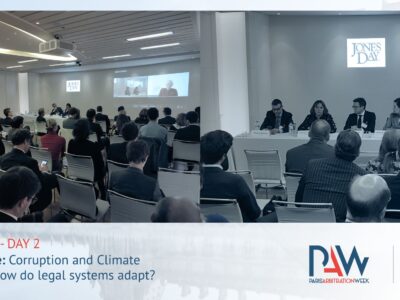
🎤The part of Compliance Law in the fight against Corruption and Climate Change, in

  ► Full reference: Frison-Roche, M.A., The part of Compliance Law in the fight against Corruption and Climate Change, in Paris Arbitration Week (PAW), Compliance: Corruption and Climate Change – how legal systems adapt?, Jones Day, March 29, 2022. Debate with Mathias Audit coordinated by Claire Pauly, Vice-President of the Paris Arbitration Week.  - ► Presentation of the intervention: After the presentation made by Mathias Audit of the consideration of facts of corruption, notably by the red flags method, in an arbitration trial, it seems a low-performing system of proof in compliance: the more diligent a party is in showing that it tried to meet its compliance obligations, the more it is exposed to demonstrating its own failure to doing so.  It seems a perversity … Therefore, I can understand why companies often so dislike Compliance Law because more they make efforts, more they put money and more they are punished… But this representation is not totally exact. My first observation is about the definitions themselves. It is particularly important to have a precise definition of “compliance obligations”, to not confuse them with obligations coming from Criminal Law. The confusion between Criminal Law and Compliance Law is frequent, maybe because what Compliance Law want to eradicate is also prohibited by Criminal Law, for instance corruption. Indeed, technically criminal legal rules and compliance legal rules have many points of contacts, but they are not the same: the obligations are different, the legal persons obliged are different, the reasoning are different the purposes are different. Because the general definition of Criminal Law and Compliance Law are different. Criminal Law, very old branch of Law, which prohibits and sanctions corruption, does it for everyone because the singular behavior is wrong (to corrupt; to be corrupted). Compliance Law is a very new branch of Law, is a systemic branch of economic Law, which wants to eradicate in the future mechanisms because they destroy economic systems, such as corruption does. Its wants that not to protect moral values but to protect economic systems. Therefore, Compliance Law asks some entities, large companies, to do something only because they are in position to do so: to detect and to prevent this corruption, in order to obtain in the future, the protection against this systemic risk threating the economic systems. The compliance legal tools are more in Ex Ante than in Ex Post: risk mapping, audit, code of conduct, training, obtention of information through the chains of suppliers. The proof to give is not the non-corruption everywhere from everyone but this concrete action of prevention and education, companies being entities helping public authorities in this global fight. More precisely, in this definition Compliance Law is not the general obligation to obey the regulations applicable (because this is simply the definition of Law itself, applicable to everybody). Compliance Law is a very new branch of Law which exists only for some systemic “global policies” (as the title of your manifestation says) applicable only on systemic entities (large companies) in a global perspective: for instance, fighting corruption, fighting money laundering, fighting climate change, fighting discrimination between human beings. In your example, for fighting corruption, specific legal obligations are taken, such as FCPA (with extraterritorial effects) or in French legal system the so-called the 2016 “Sapin 2” Law. These obligations don’t concern everybody: they concern entities in position to do so: large companies. My second remark is about the burden of proof. These compliance obligation or compliance duties are obligations of means. Companies are obliged to adopt Compliance plans, organize risk mapping, and so on. A lot of them organize them through code of compliance, or code of ethic, or code of corporate social responsibility, because Compliance Law is in an intimacy with Corporate Law. Because Compliance Law is a very concrete branch of law, these disposals are adopted at the level of the group and replicated in the contracts with suppliers. But he success of these compliance tools is only an obligation of means. For instance the supervisory authority does not require the company to have seen all the risks, in their existence or their exact quantification. In this sense, about money laundering, the French Financial Markets Authority said that the setup of these compliance tools must be “effective”, but after that the company must only do its “best efforts” to aim an “efficient” result (obligation de moyens). The French Regulatory Authority for the digital space says the same about the eradication of speeches of hate that Compliance Law oblige digital companies to fight (using the term of obligation de moyens). Moreover, about corruption, the Commission of sanction of the French Anticorruption Agency said in a decision of July 2019 that the firm is free to choose the technics to detect and to prevent the corruption (confirming that Compliance is not just following what the Regulator says), but offered a legal certainty:  if the company just follows what the Regulators had said in its guideline (rule based compliance behavior), it is no more possible to punish it. My third remarks could be a proposal for a more efficient system of proof. It is true that the burden of proof is on the company’s shoulders. But the object of proof is not the absence of corruption (it would not be possible…). The object of proof is the existence of due diligence to detect and prevent corruption. Companies must prepare that, must constitute these proofs by advance.  “Due diligence” is a legal concept frequently used in Compliance Law. Regulators, supervisors, and courts ask companies to show the reality of these diligences. It would not be sufficient to present the cost of Compliance… It will be sufficient to show the effectivity of Compliance programs freely adopted, taking in consideration the guidelines released by public authorities. Public authorities say they want to help companies to diffuse an effective “culture of compliance” : a dialogue with civil and corporate courts, not only with criminal courts would be efficient, for instance for the protection of human rights.    In a second part of this debate, on Climate change and Compliance, Claire Pauly asked the question: "My question is two-fold: do you consider that climate change issues should be treated in the same way as corruption issues? And do you think that arbitrators are well suited to tackle those issues, by upholding the method applied to determine and demonstrate corruption issues?". The response has been: Firstly, on the technical similarity between fighting Corruption and fighting Climate Change in Compliance Law, it is the same perspective effectively. If we come back to the definition of Compliance Law, the Compliance tools are organized to obtain in the future systemics results, such as no more corruption, no more money laundering, what we can name “Monumental goals”. This is a political decision: to design the future for excluding some systemic catastrophes. Corruption is an example of systemic risk; but climate change is another one. Fighting against Climate Change is a Monumental Goal, of the same nature than fighting Corruption. As everyone knows, we suffer of a lack of tools to address one of this fundamental challenge of our times which is climate change (more difficult than corruption…). But we are lucky to have some Compliance legal tools: we need to use them, because we have so few techniques about this Climate issue… And Compliance Law is the more adequate branch of Law because it is an Ex-Ante branch of Law : generally, its obligations are on the future, and the Climate change drama is in the future also. We can already see that Compliance Law is applicable to Climate Change issue It is easy to see it through the legal techniques.  In the French legal system, the Sapin 2 law invented in 2016 some new compliance techniques, such as risk mapping, audit, due diligence, to detect and prevent corruption. One year after, in 2017, the so-called Loi Vigilance took the same techniques, copying exactly the legal dispositions of Sapin 2 in this law to oblige large companies to detect and to prevent violation of human rights and environmental obligation, not only inside the corporate group but also through the supply chains. The manager will be accountable for that. On February 23, 2022, the European Commission adopted a proposal for a European Directive in the same direction of a “global policy” to impose a “corporate sustainability due diligence” on large companies, notably for fighting climate change. This new text will be effective in two years in the Internal legal systems. By a rules-based analysis and a principle-based analysis, we can see this is the same reasoning. Of course, this “corporate sustainability due diligence” is only an obligation of means. But it is extremely ambitious, linked to the direct consideration of the Corporate Social Responsibility. And I guess it will be efficient because all these tools are not only Ex Post but also Ex Ante: when the issue is to exclude the catastrophic perspective of the disappearance of the humankind on our planet, having Compliance Law, this Ex-Ante branch of law, is so precious!   Secondly, about the role of Arbitration in this issue, I am tempted to say: everyone is required in this global crucial policy! It is quite difficult for a national court to decide on this sort of issue because Climate change is a global issue, while arbitrators are global judges. Technically it is necessary and technically possible that Arbitration takes its place, because these due diligences about detection, prevention, action for a better Climate balance are organized non only in corporate mechanisms, such as code of conduct, corporate commitments, or manager remuneration calculation, but also a lot of contractual dispositions. We will see a lot of new legal techniques: a lot of international public global policies will be adopted. The obligation to give information about that not only to investor but also to stakeholders will be adopted worldwide. The technique of “compliance by design” will be used on the corporate policy of fighting against Climate change. Meanwhile, the classical branch of law, were Compliance Law steps in, will remain active, such as International Law, Corporate Law, Tort Law Contract Law, where Arbitration is so central. So, in short, your question was: are Arbitrators able to deal with climate change issue? my response is: “oh, yes!” - ► Read the repport made by the  fait par la Paris Week of Arbitration ( on the distinction between Compliance Law and Criminal Law, and their articulation) -   Pour aller plus loin⤵️ 📘Frison-Roche, M.-A. (ed), Compliance Monumental Goals, 2022. 📘Frison-Roche, M.-A. (ed), Compliance Jurisdictionalisation, 2022. -  

Analyses

💬 “Faire du Droit pour qu’à l’avenir le monde soit moins injuste” – à propos du projet de directive européenne sur le devoir de vigilance. (“Making Compliance Law for a world less unfair in the future” – about the draft European directive on the corporate sustainability due diligence)

► Full Reference: Frison-Roche, M.A.,, "Faire du Droit pour qu'à l'avenir le monde soit moins injuste" – à propos du projet de directive européenne sur le devoir de vigilance ("Making Compliance Law for a world less unfair in the future" – about the draft European directive on the corporate sustainability due diligence), interview with Olivia Dufour, Actu-Juridique,  March 24, 2022.  - 💬 read the interview (in French)  - ► Interview English Summary: This interview comments on the draft directive presented by the European Commission aimed at unifying European Union Law about Corporate Sustainability Due diligence in global supply chains to protect environnement and human rights effectively, putting companies under same legal rules. including non-European companies. The interview emphasizes that this text and reinforces Compliance Law perspective in that the legal instruments are Ex Ante, aim at the functioning of groups, constitute incentives, and seek effectiveness to prevent violations of human rights and the environment, 80% of which taking place outside the European Union. The goal is both ethical, for example to fight against child labor and the endangerment of people, and systemic: the promoting of a sustainable economy, through the help of companies which have some power in value chains which are global.  This future directive clearly shows the difference between simple "conformity" (just obeying all applicable regulations…) and "compliance", illustrated here: aiming to achieve "monumental goals", here fighting against attacks on the climate balance and protect people, to obtain in the future these damages do not occur or are reduced.  -