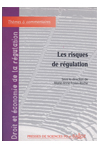
Full Reference : Frison-Roche, M.-A., "L’hypothèse de l’interrégulation", in Frison-Roche, M.-A. (ed.)Les risques de régulation, coll. « Droit et Économie de la Régulation », t.3, Dalloz / Presses de Sciences-Po, 2005, pp. 69-80. The topic of of this article is to propose a new notion, already presented in 2001 in the article "Regulation Law": "Interregulation". This mechanism will makes more easier a unified decision when several autonomous, even contradictory, regulations are legitimate to rule a situation. This creation therefore responds to a gap in the general system, of which the antimony is a variant. Political power no longer has the means to unify these disparate sources because it is "overtaken by the globalization of sectors and markets. Likewise, the hierarchical mode of traditional law cannot be suitable for autonomous sectorial regulations. There is therefore a need for interregulation between regulators, for the creation of a common "doctrine", or by procedural means, such as "authorized advice". Read the article. (written in French) Read the general presentation, written in English, of the collective book,Les risques de régulation, in which this article has been published. Below, read the article Summary.
After defining what may be a "crisis of Regulation" and stressing that the crisis is a political phenomenon, the book devotes its first part of "systemic risk," which refers to the assumption of the general crisis. This hypothesis is exposed to prospectively or from cases in different sectors, e.g. financial, energy and health, before wondering how to organize post-crisis. The regulation itself including risk, the book chooses to study especially the inconsistency because it is the higher legal risk for an economic system. Therefore, it is proposed to organize inter-regulation mechanisms. Finally, the specific risks Regulator is able to address are conflicts, through the dispute settlement mechanism, derived from judicial system. It is examined in each of the regulated sectors.
Read more
Systemic Risk
Publication director
🏗️ direction of the collection: 📚Droit et Économie de la Régulation
Economic Regulation renews the legislative art because the law can no longer impose hierarchically to people: it must convince operators who accept the relevance of the demonstration is made. Thus the authority by rationality has replaced classical notion of sovereignty. These new qualities of legislative discourse allow the authors of the standards, norms and decisions, including the regulator, to participate in the "concert of regulation." This new legislative art must also tend to increase the internal consistency of regulation and we can think of a framework law in this direction, especially regarding regulatory authorities.
Read more
A SUPPRIMER : Collection Droit et Economie (rubrique suffit)
► Full Reference: J.-M. Chevalier, I. Ekeland, M.-A. Frison-Roche & M. Kalika, Internet et nos fondamentaux ("Internet and our Fondamentals"), PUF, 2000, 128 p. - ► English general presentation of this book and its summary: The Internet creates an impression of extreme novelty. Indeed, the fundamentals, have changed, as much in economics, management as in law. e-management, e-commerce, e-finance: all disciplines must rebuild their rules, so that the behaviours of actors are in a new way framed. The Internet is not just a new way of communicating. It introduces new behaviours, new rules, some say a new world, perhaps a new life for pioneers of a new kind. This impression of extreme newness is the sign of a revolution, because the facts about the Internet do not seem to be explainable by any previously established rule: the principles to which we must refer have changed, the fundamentals that enable us to translate the world into abstractions, to understand it and to dominate it, are in mutation. How can we understand the Internet? Not necessarily by delving into its technical and everyday aspects, but by confronting it with the fundamentals of the various disciplines in order to measure which key notions the Internet is abusing, which it is destroying and which it is imposing. What remains of our ways of thinking and practising science, law, economics and management? What are these disciplines built on? How can we understand them and bring them together again, under the impact of the Internet? The ambition of this book is to shed light on these new fundamentals, to tackle the conceptual revolution that Internet technology is bringing with it. - Content : Introduction, p. 7 Internet et la recherche en sciences exactes et naturelles ("The Internet and research in the natural sciences"), p. 19 Les bouleversements du droit par Internet ("The upheaval of law caused by the Internet"), p. 37 Les fondements des sciences économiques interpellés par Internent ("The foundations of economics challenged by the Internet"), p. 77 Internet et les sciences de gestion : l’émergence du e-management ("The Internet and management sciences: the emergence of e-management"), p. 103 -
► Full Reference: M.-A. Frison-Roche, "Le critère de l’efficacité dans le traitement des difficultés des entreprises" ("The criterion of effectiveness in dealing with business difficulties"), inColloque des experts judiciaires en matière commerciale, 29 mars 1996, Moulins. -
►Full Reference: M.-A. Frison-Roche, "Remarques sur la distinction entre la volonté et le consentement en droit des contrats" ("Remarks on the distinction between will and consent in Contract Law"), Revue trimestrielle de droit civil, 1995, p. 573 s. - 📝read the article (in French) -
► Full Reference: M.-A. Frison-Roche, in collaboration with Serge Bories, "La jurisprudence massive" ("The Massive Jurisprudence"), D. 1993, chron., pp. 287-330 - 📝read the article (in French) - ► English Summary of the article: The term "jurisprudence" is likely to have several meanings: on the one hand, jurisprudence stricto sensu, that emanating from the High Courts; on the other hand, "massive jurisprudence", designating all legal decisions rendered by the courts. This study of "mass case law" is divided into two parts: the first sets out the advantages of analysing mass judgments (I.), and the second develops the method that should be used to study these judgments (II.). The analysis of massive jurisprudence is of threefold interest: educational, scientific and practical. Educational, in that it provides a more concrete, comprehensive and detailed view of the subject being taught. Scientific, in that it provides a global perspective, making it possible to take a closer look at reality and thus analyse the phenomena of pluralism in case law and anticipate 'elite case law' or legislative developments. And lastly, it is practical, in that it enables legislators to learn as quickly as possible about the practical application of the law and its consequences, so that they can potentially react to counter any perverse effects and/or use this information to adapt their legal policy decisions. The analysis method involves 3 stages. Firstly, a prior qualitative analysis of the banal judgment must be carried out, based on the extraction of key words and concepts contained in the decision, in order to transform the raw information into data. Next, categories of analysis need to be established, based on the structure of the data collected and the research hypotheses, in order to process the mass of refined data collected. It is also essential to have access to all the data used to adopt the decision. In the final stage, complementary methods, such as studying the case file or interviewing magistrates, should be added to the textual analysis. - 🌐follow Marie-Anne Frison-Roche on LinkedIn🌐follow Marie-Anne Frison-Roche on Instagram🌐subscribe to the Newsletter MAFR Regulation, Compliance, Law