About

Breaking news

In France, a decree of 1st August 2014 finally reorganizes the sanction procedure before the French telecommunication Regulator (ARCEP), after the condemnation by the French Constitutional Council for partiality

Political power has often difficulties, or takes a long time to admit the principles of law, such as express the judges. So it was quite certain that the penalty proceedings held before the Autorité de Régulation des Communications Electroniques et de la Poste -ARCEP  (French Regulatory Authority for Electronic Communications and Post, as the investigation body and the judgment body were not sufficiently distinct crumpled the constitutional principle of impartiality. It was acquired about 15 years. Yet the organization has continued. It has been enough that an operator has been sanctioned. He used the procedure of Question Prioritairre de Constitutionnalité -Q.P.C.  Priority Question of Constitutionality) and Numéricable July 5, 2013 decision by the Constitutional Council came to declare that any sanction proceedings before ARCEP unconstitutional, because of objective procedural partialité, thus causing difficulty to the regulator. It took until the 0rdonnance of March 12, 2014 and finally the decree of 1st August 2014 to organize an efficient sanctions procedure, making this time an intern wall within the ARCEP between the services responsible for the instruction and those which are responsible for judging. The great judge Pierre Drai used to say: "Ne pas respecter le droit coûte cher (Do not respect the law is expensive)". We see here that this is true also for the Government which writes laws and regulations. So, for months, the regulator has been without power, to the delight of the operators, who often are tacticians or turbulent.


Working papers

Home made Family

The family is built on one basic idea which is so powerful that legal rules are organised around it as spontanely. But if the paradigm is changing, then all the rules change with the strength of the evidence. However, in the 1970s, we changed paradigm. Previously, for millennia, the basic idea was the family as a group. Depending on the time or period, the group has varied in its contours, squares and powers granted to individual members, but the idea of group was acquired. Family was a group which was a part of the social group, kept by the State. From the 1970s, the family becomes the developed project done by a free and independent person. This project designed by a person wishing to build family that suits him or her will result in the fact that the individual meets other individuals whose family project crosses his or her. Contract becomes the perfect tool for these home-made families This desires adjustment corresponds to the market model. Concretely, market of ideal family provides services for satisfaction of various projects, all legitimate as expression of desir. The sufficient link between individuals  is affection and will, the center is the child. The market offers new perspectives, such as ideal partner and even more perfect child, becoming jewel. The idea of ​​Market has triumphed.

II.B.2. Previous scientific responsibilities

21. Member of the Réseau Français des Instituts d’Études Avancées (RFIEA) (French Network of Institutes for Advanced Study), 2013-2016; 20. […]

Monographs

71. Regulate ” critical firms” (Réguler les entreprises cruciales)

At first glance, only areas are regulated and the State doesn't enter private enterprises. But the imperative is reversed when a company absorbs the entire area, or when a firm has the project to absorb the area, such as Google has. The firm becomes "crucial" and the State must enter the company and intervene.  It is necessary to give the definition of a "crucial firm". A firm is "crucial", in a negative sense, when its failures could cause the collapse of the system; a firm is positively "crucial" if through it the industry is facing the purpose to serve the future of the social group. The State is then legitimate to enter the company to make its voice heard, sometimes to exercise its decision-making powers. The competitive dynamism and power of property don't exclude the superimposition of the common concern for the future, which some call the general interest.

Questions

LAW AND HISTORY: In British Law, Is the obligation to drive on the left an arbitrary rule?

One of the reasons why the law has a bad reputation is that it would be "arbitrary". It would be composed of rules, imposing to do this or not to to do that, without strong reasons. Ultimately, what we do does not matter, as long as we all behave in a similar way. No matter the substance in the legal rule which is adopted, the law, is primarily question of order. And a frequent example is the rule to drive on the left or to drive on the right on the roads.. Because it is a legal rule. It is often said that the law is "like that" and it is made just for the sole purpose of ensuring that everyone does the same, so there is no accident . But is that such an arbitrary rule ? Do the British, driving on the left, have no more reason to do so  that French who drive on the right ? If we can show that British legal rule has a more rational basis, then we must end up suspecting that no rule of law is established "without reason."

Working papers

Working Paper.

The “crucial companies” and their regulation

The expression "regulated company" may appear as an oxymoron : the State  regulates areas (markets, networks, etc.) because of their structural failures, but the State doesn't enter a company that develops its activities autonomously. But on reflection, it is sometimes necessary to "regulate a company" and this necessity is increasingly imposed. This is imperative if a company absorbs the entire area, because it is a monopoly or because it wants to become the heart of a crucial area, such as Google which has the project to become the future global brain. In a more general way, it is a necessity to  locate businesses which are "crucial", banks are only one example, and organize, beyond supervision, providing direct regulation of such firms. This regulatory power on critical firms must take the form of attendance of public power and policy within the company itself, so that the state interfere in decisions which social group suffers the consequences. The control can go beyond this "public presence" to take the form of "public authority", the state ruling as operator. Under such conditions of "cruciality", the neutralization of "public enterprise" by the competition law must cease, the public company must be better recognized as a regulatory instrument in distance with the simple game of competition.

Working papers

Working Paper

The promethean nature of the future banking and financial regulatory law

This working paper was prepared as a basis for a contribution to a forthcoming volume of the collection Le rapport moral de l'Argent dans le Monde ( The Moral Report of Money in the World). It develops the idea that everyone has the impression that the law is more powerful than ever in banking and financial regulation: Law invades everything and appears in its most terrible form that is criminal and repressive administrative law. It seems that the beginning of everything is Law ! But in reality, we must consider that the law is weaker than ever. Indeed, if the law of banking and financial regulation has become primarily repressive, it is because it is weak. It took the form of a multitude of microscopic rules and  punishment is only lending its force to any prescription. Repression has lost its autonomy, and has become a sort of simple enforcement of civil multiple rules. Moreover, the legislation degenereted into regulations. The Regulation goes into a random pile of incomprehensible and complexe requirements. On the contrary, the operators would need a law that fixed in advance and clearly a few strong lines of conduct. So it is a weak and shoddy law which the banking and financial regulators are building for the future. It will be severe only because it will be weak and  poorly done. The lawyer will be be as chagrined as the financier is.

Articles in a legal collective publication

📝Les décisions des juges et des régulateurs favorisent-elles la compétitivité des entreprises françaises ?

📝Les décisions des juges et des régulateurs favorisent-elles la compétitivité des entreprises françaises ?, in 📗La compétitivité de la règle de droit

Documents decisions_des_juges.pdf 4em_de_couv.pdf programme_22_11_2013.pdf

Articles in a legal collective publication

📝Experts et procédure : l’amicus curiae (Experts and procedure: the amicus curiae)

► Référence complète : M.-A. Frison-Roche, "Experts et procédure : l'amicus curiae" ("Experts and procedure: the amicus curiae"), Revue de droit d'Assas, october 2012, pp. 91-94 - 📝read the article (in French) - ► English Summary of the article: A recent thesis has argued that amicus curiae is becoming a common principle of Procedural Law. This shows its importance. The fact that the mechanism, the character, is designated by a Latin formula leads us to suspect that something is being concealed that legal technique ordinarily forbids: it is the legal expert and the party's expert, which is what the amicus curiae most often is, either one or the other, or both at the same time. Therefore, removing the prudish cloak of Latin, it is these two difficulties that must be addressed. If we exclude the legal expert, it is because "jura novit curia" ("the court knows Law". But this rule, which recalls the principle that "no one is supposed to be ignorant of the law", merely indicates a sharing of the burden of evoking facts and Law between the parties and the judge (Motulsky) and not a presumption of knowledge. Consequently, the modest, and therefore self-confident, judge has no reason, either psychological or legal, to shy away from a legal expertise. As for the party's expert, or the judge's expert who is highly influenced by a party, a profession, a social group, in short, a judge's expert who is in fact an expert held by a party, this can only be a problem if the judge cannot keep his distance from this expert whose opinion is biased by the weight of the party. But first of all, any opinion is biased. Whether it is given in bad faith or good faith, it is biased, and in rhetoric we know that an opinion biased in good faith is more dangerous than a bought opinion, because the latter is known to be twisted by self-interest. In this respect, the person who listens to it, the judge, knows the difference. Indeed, the legal system that recognises the party's expert and the amicus curiae, i.e. North American Law or European Union Law, draws the necessary procedural consequence: they include the party's expert opinion in the adversarial debate. It is the principle of adversarial debate, the principle of principles in the conduct of proceedings, that makes amicus curiae acceptable and welcome, since it provides the judge with a scientific input that the latter does not have. -

Reports

📓Le transfert de la compétence normative d’édiction des lois et réglements en matière de droit civil, de la métropole aux institutions propres à la Nouvelle-Calédonie

► Full Reference: M.-A. Frison-Roche, Le transfert de la compétence normative d'édiction des lois et règlements en matière de droit civil, de la métropole aux institutions propres à la Nouvelle-Calédonie. Étude pour le Congrès de Nouvelle-Calédonie (The transfer of the normative power to enact laws and decrees in the field of civil law from metropolitan France to institutions specific to New Caledonia. Study for the Congress of New Caledonia), 2012, 88 p. - La confection de ce rapport a été faite à partir des travaux sur les textes, des lectures et des réflexions, mais aussi de nombreuses rencontres avec les parties prenantes sur place. Le séjour et la remise du rapport ont donné lieu à de nombreuses interventions publiques. L'on peut notamment se référer à la conférence Le transfert du droit civil, une opportunité pour la Nouvelle-Calédonie, donnée au Congrès de Nouvelle-Calédonie. En outre, de nombreuses interviewes ont été données à la télévision, dans le presse écrite et à la radio.   Lire la table des matière du rapport. Lire le rapport dans son intégralité. Lire un interview dans la presse à propos de ce travail. Voir la conférence donnée en métropole à ce propos.   Lire le résumé du rapport ci-dessous.

Publication director

🏗️ direction of the collection: 📚Cours Dalloz – Série Droit privé

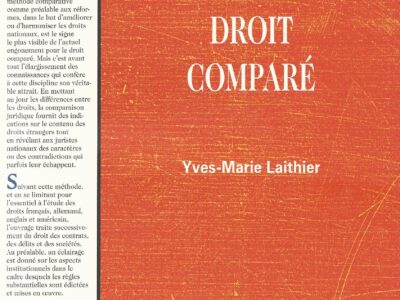
📚Publication of : 🕴️Yves-Marie LAITHIER, 📕Droit comparé (Comparative Law), 1st ed.

► Full Reference : Y.-M. Laithier, Droit comparé (Comparative Law), 1st ed., 2009, Dalloz, “Cours Dalloz-Série Droit privé” Series, 241 p. - 📕Read the back cover (in French) - 📕Read the table of contents (in French) - 📚See the entire collection in which the book is published. -

Publication director

🏗️ direction of the collection: 📚Cours Dalloz – Série Droit privé

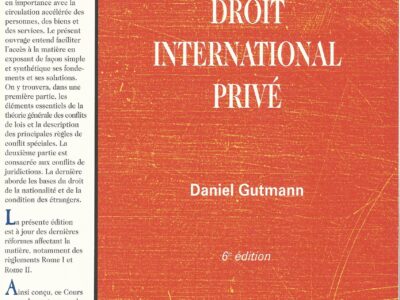
📚Publication of : 🕴️Daniel GUTMANN, 📕Droit international privé (Private International Law), 6th ed.

► Full Reference : D. Gutmann, Droit international privé (Private International Law), 1st ed. 1999 – 6th and last ed., 2009, Dalloz, “Cours Dalloz-Série Droit privé” Series. The subject was subsequently covered by a book entrusted to Bernard Haftel. - 📕Read the back cover (in French) - 📕Read the table of contents (in French) - 📚See the entire collection in which the book is published. -

CV

Current positions

Professor (Professeur des Universités) at the Institut d’Études Politiques de Paris (Sciences Po) Publisher, Director and Editor-in-Chief of The Journal […]

Monographs

📝Proposition for a notion: the “crucial operator” (“Proposition pour une notion : l’opérateur crucial”)

► Full Reference: Frison-Roche, M.-A., "Proposition pour une notion : l’opérateur crucial" (Proposal for a notion: the "Crucial Operator"), D. 2006, pp. 1895-p. 1900. - ► Article English Summary: The market is conceived as having two kinds of actors: operators and regulators. But we can suggest a third term: the crucial operator. This notion, proposed here, assumes that the sector cannot function without it. It could be a network manager or a systemic company, the failure of which produces a domino effect, or a structure that maintains a system like the financial market companies. These kinds of "second-tier regulators" then have more rights and more obligations. They are either holders of essential infrastructure, or bearer of capital innovation, or centralize system risks. The regulatory systems should be rethought by integrating these "crucial operators". - 📝read the article. - ► More developed Article English Summary: Competition Law neutralizes economic agents who act on the markets, by the rule of capital neutrality. Thus, the company is a transparent legal concept, which erases the specificities of organizations. Public enterprises are therefore only considered as an enterprise and the notion of "national champion" is rejected. To escape this neutrality, without falling into the arbitrariness of the States against which Competition Law rightly fights, there is great interest and relevance in developing the concept of crucial operator. The idea of ​​a crucial operator is to no longer think of it in a neutral way, not in relation to its capital or those who govern it, but in relation to its market behavior. In fact, cruciality can be defined as the quality of an organization which puts in its dependence the efficiency and the good functioning of other organizations. In this, cruciality is the opposite of competition, which postulates that the company not only does not depend on others but also will seek by nature to harm it by appropriating demand to the detriment of its competitors. But it may happen that the market cannot be satisfied with the aggressive mobility that is competition and supposes the stability and support of others operated by the crucial operator. This is so when the operator is the manager of an essential infrastructure since the other operators depend on it. This is also the case when the operator is the bearer of market innovation, which justifies access rights under essential facilities or agreements to produce research. The third case is when the operator carries the risks of the system, which explains why banks and financial institutions are most often crucial operators in that they carry the systemic risks of the banking and financial system. It is thus measured that the public or private character does not interfere in the qualification of crucial operator any more than the monopolistic character or not of the operator considered. The consequences of such a qualification as a crucial operator is that the operator must have more obligations than an ordinary operator. Thus, the infrastructure manager has the obligation to open it to third parties, even though control usually generates a power of exclusion. Similarly, financial or insurance institutions, because they must prevent risks, will be obliged by specific prudential standards. But the crucial nature of the operator gives him rights but also powers. This is how market companies, operators of private law who hold the places, have a disciplinary power of exclusion that some have compared to the power of the State. What is more, the crucial operator then appears to be a "second tier" regulator. Indeed, according to a pyramid figure, ordinary operators are subject to the disciplinary power of crucial operators who themselves are governed by public regulators, who are the first rank regulators. This quality of second-level regulator obliges the operator to behave towards his competitors with the same virtue as that which characterizes the regulator and first of all impartiality. This is the case with non-discrimination in accessing the network from its own competitors. In addition, a regulator must be accountable and behave in a transparent manner, while the ordinary operator is not subject to this principle, since competition law does not require transparency of structures and behavior. This link between regulation and governance clearly applies to financial operators, but it is also observed with regard to network operators. We thus measure that if positive law, giving form by a last effort of vocabulary to established rules, recognized the existence of the notion of crucial operator, it would better identify this intermediate category between the ordinary operator and the regulator, because the crucial operator is a company, entering into the game of supply and demand but it also supports the stable structure of the market and the stability of this market, which is not the usual aim of companies. -