About

Working papers

🚧Compliance, Artificial Intelligence and Business Management: the right measure

🌐 follow Marie-Anne Frison-Roche on LinkedIn 🌐subscribe to the Newsletter MAFR Regulation, Compliance, Law  - ► Full Reference: Frison-Roche, M.-A. Compliance, Artificial Intelligence and Business Management: the right measure, Working Paper, June 2022.  - ► Summary of the Working Paper: Of the next European Regulation on artificial intelligence, the European Commission has a quite neutral conception of AI for obtaining a consensus between the Member States, while the Regulators and certain States have a more substantial conception of technology, wanting its power to be used to protect people, firstly from these new tools themselves, secondly from what is an amplification of the evils of the classic world, such as hate or misinformation. This is the reflection of two conceptions of Compliance. Firstly, Compliance can be defined as neutral processes that increase the effectiveness of what would be the obligation for companies or their desire for efficient risk management (in particular the consideration of "legal risks") to prove being "conform" to all regulations that are applicable to itself and all persons to whom the firm is accountable. This is often referred to as the "compliance obligation" or "obligation of conformity". This conception implies considerable practical consequences for the company which, in order to succeed in this "total exploit", would then have to resort to artificial intelligence tools constituting a "total and infallible solution", which mechanically generate for it the obligation to "know " all the "regulatory mass", to detect all "non-compliances", to conceive its relationship to the Law in terms of "risk of non-compliance", fully supported by Compliance by Design which could, without human intervention , eliminate legal risk and ensure "compliance total efficiency" in Ex Ante. The "legal price" of this technological dream is extremely high because all the "regulatory" requirements will then be transformed into obligations of result, any failure generating liability. The Compliance probationary system will become overwhelming for the company, both in terms of burden of proof, means of proof, and transfers, without exemption from proof. Objective responsibilities for others will multiply. The "law of conformity" will multiply Ex Ante systemic penalties, the border with criminal law being less and less preserved. It is essential to avoid this, both for businesses and for the Rule of Law. For this, we must use Artificial Intelligence to its proper extent: it may constitute a "massive aid", without ever claiming to be a total and infallible solution, because it is the human who must be at the center of the compliance system functioning thank to the firms and not the machinery. For this, it is necessary to adopt a substantial conception of Compliance Law (and not a sort of Conformity Law or Obedience Law). It does not at all cover all the applicable regulations and it is not at all "neutral", being in no way a series of processes. This new branch of Law is substantially built on Monumental Goals. These are either of a negative nature (preventing a systemic crisis from happening, in many but specific perspectives: banking, financial, health, climate, etc.), or of a positive nature (building a better balance, in particular between human beings, in the company and beyond). In this conception which appears increasingly strongly, artificial intelligence finds its place, more modest. As Compliance Law is based on information, Artificial Intelligence is essential to capture it and make first connections, first stages for successive analyses, done by human beings, making what is essential: the commitment of the company, both by the leaders and by all those who are "embarked" by a "culture of Compliance" which is at both built and common. This restores the required seal between Criminal Law and what can be asked of the mechanical use of Artificial Intelligence; this puts the obligation of means back as a principle. This restores the principal place to the lawyer and the compliance officer, so that the culture of compliance is articulated with the specificities of a sector and the identity of the company itself. Indeed, the culture of compliance being inseparable from a culture of values, Compliance by design requires a dual technique, both mathematical and legal culture. It is why European Compliance Law, because it is rooted in the European humanist tradition, is a model. -

Articles in The Journal of Regulation & Compliance « JoRC »

📝La dynamique des Buts Monumentaux du Droit de la Compliance (“The Dynamics of the “Compliance Law Monumental Goals”), in Frison-Roche, M.-A., 📕Les Buts Monumentaux de la Compliance

► Full Reference: Frison-Roche, M.-A.., La dynamique des Buts Monumentaux du Droit de la Compliance (("The Dynamics of the "Compliance Law Monumental Goals"), in Frison-Roche, M.-A. (dir.), Les buts monumentaux de la Compliance, series "Régulations & Compliance", Journal of Regulation & Compliance (JoRC) and Dalloz, to be published. - ► English Summary of this Article:  This article constitutes the afterword of the book Les buts monumentaux de la Compliance. Its purpose is to show the consistency of the book, in that the Monumental Goals themselves, by their normativity, give Uniqueness to Compliance Law, giving it simplicity and strength. Restituting each of the contributions and articulating them all in an overall demonstration, this article highlights this consistency of the Compliance mechanisms which join the primary function of the Law: the protection of human beings, now and in the future. - ► read the presentations of the other Marie-Anne Frison-Roche's contributions in this book: 📝 Les Buts Monumentaux, cœur battant du Droit de la Compliance 📝 Définition du Principe de Proportionnalité et Définition du Droit de la Compliance  📝 Rôle et place des entreprises dans la création et l'effectivité du Droit de la Compliance en cas de crise  📝 Appréciation du lancement d'alerte et de l'obligation de vigilance au regard de la compétitivité internationale 📝Le principe de proximité systémique active, corolaire du renouvellement du Principe de Souveraineté par le Droit de la Compliance - This article is free access.  Read the article in English⤵️

Publication director

🏗️ direction of the collection: 📚Cours Dalloz – Série Droit privé

📚Publication of : 🕴️Jean-Baptiste SEUBE, 📕Droit des sûretés (Law of Security Interests), 11th ed.

► Full Reference : J.-B. Seube, Droit des sûretés (Law of Security Interests), 11th ed., 2022, Dalloz, “Cours Dalloz-Série Droit privé” Series, 569 p. - ► General presentation of the book (written in French) : A security interest gives the creditor an additional chance of being paid. Steeped in property law and the law of obligations, the law of security interests strikes a balance between the protection of creditors’ interests and the interest of debtors. The textbook gives the characteristic features of personal securities and real securities. The book is intended mainly for undergraduate and Master students. It sets out the rules on suretyship, the mechanisms that produce an exclusive security effect as well as those that produce only an occasional security effect. As for real securities, the author distinguishes the classic real securities from those that operate « indirectly ». - 📕Read the table of contents (in French) - 📚See the entire collection in which the book is published. -

MAFR Chronicles Compliance Law

📝 La responsabilité ex ante, pilier du droit de la compliance (“Ex-Ante Responsibility, Compliance Law Pillar”)

🌐 follow Marie-Anne Frison-Roche on LinkedIn 🌐 subscribe to the Newsletter MAFR Regulation, Compliance, Law  - ► Full Reference: FM.-A. Frison-Roche, La responsabilité ex ante, pilier du droit de la compliance ("Ex-Ante Responsibility, Compliance Law Pillar"), D. 2022, chronique MAFR – Droit de la Compliance, Recueil Dalloz, March 31, 2022. - ► Article English Summary: The Law must help to face the future, which can be totally catastrophic in terms of climate and digital issues. Courts are s best placed for this, without “governing”, only relying on the commitments made by companies, governments, and legislators.  On the ordinary Tort Law, court decisions oblige these different entities to be consistent in the commitments they have made, obliging them to act in the future, formal “compliance” with the regulations cannot be sufficient. This ex-ante responsibility, founding the powers, thus constitutes a pillar of a substantial Compliance Law, showing the part that CSR and the companies with a raison d'être play in it. -   📝 read the article. (written in French) - 📚go to the presentation of the other articles published in this Chronique Droit de la Compliance made in the Recueil Dalloz.  -

Conferences

🎤The part of Compliance Law in the fight against Corruption and Climate Change, in

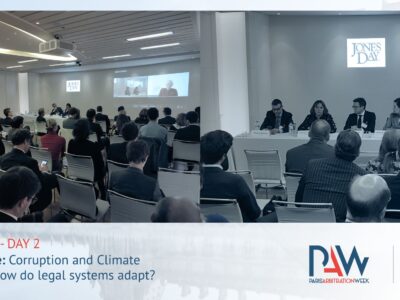
  ► Full reference: Frison-Roche, M.A., The part of Compliance Law in the fight against Corruption and Climate Change, in Paris Arbitration Week (PAW), Compliance: Corruption and Climate Change – how legal systems adapt?, Jones Day, March 29, 2022. Debate with Mathias Audit coordinated by Claire Pauly, Vice-President of the Paris Arbitration Week.  - ► Presentation of the intervention: After the presentation made by Mathias Audit of the consideration of facts of corruption, notably by the red flags method, in an arbitration trial, it seems a low-performing system of proof in compliance: the more diligent a party is in showing that it tried to meet its compliance obligations, the more it is exposed to demonstrating its own failure to doing so.  It seems a perversity … Therefore, I can understand why companies often so dislike Compliance Law because more they make efforts, more they put money and more they are punished… But this representation is not totally exact. My first observation is about the definitions themselves. It is particularly important to have a precise definition of “compliance obligations”, to not confuse them with obligations coming from Criminal Law. The confusion between Criminal Law and Compliance Law is frequent, maybe because what Compliance Law want to eradicate is also prohibited by Criminal Law, for instance corruption. Indeed, technically criminal legal rules and compliance legal rules have many points of contacts, but they are not the same: the obligations are different, the legal persons obliged are different, the reasoning are different the purposes are different. Because the general definition of Criminal Law and Compliance Law are different. Criminal Law, very old branch of Law, which prohibits and sanctions corruption, does it for everyone because the singular behavior is wrong (to corrupt; to be corrupted). Compliance Law is a very new branch of Law, is a systemic branch of economic Law, which wants to eradicate in the future mechanisms because they destroy economic systems, such as corruption does. Its wants that not to protect moral values but to protect economic systems. Therefore, Compliance Law asks some entities, large companies, to do something only because they are in position to do so: to detect and to prevent this corruption, in order to obtain in the future, the protection against this systemic risk threating the economic systems. The compliance legal tools are more in Ex Ante than in Ex Post: risk mapping, audit, code of conduct, training, obtention of information through the chains of suppliers. The proof to give is not the non-corruption everywhere from everyone but this concrete action of prevention and education, companies being entities helping public authorities in this global fight. More precisely, in this definition Compliance Law is not the general obligation to obey the regulations applicable (because this is simply the definition of Law itself, applicable to everybody). Compliance Law is a very new branch of Law which exists only for some systemic “global policies” (as the title of your manifestation says) applicable only on systemic entities (large companies) in a global perspective: for instance, fighting corruption, fighting money laundering, fighting climate change, fighting discrimination between human beings. In your example, for fighting corruption, specific legal obligations are taken, such as FCPA (with extraterritorial effects) or in French legal system the so-called the 2016 “Sapin 2” Law. These obligations don’t concern everybody: they concern entities in position to do so: large companies. My second remark is about the burden of proof. These compliance obligation or compliance duties are obligations of means. Companies are obliged to adopt Compliance plans, organize risk mapping, and so on. A lot of them organize them through code of compliance, or code of ethic, or code of corporate social responsibility, because Compliance Law is in an intimacy with Corporate Law. Because Compliance Law is a very concrete branch of law, these disposals are adopted at the level of the group and replicated in the contracts with suppliers. But he success of these compliance tools is only an obligation of means. For instance the supervisory authority does not require the company to have seen all the risks, in their existence or their exact quantification. In this sense, about money laundering, the French Financial Markets Authority said that the setup of these compliance tools must be “effective”, but after that the company must only do its “best efforts” to aim an “efficient” result (obligation de moyens). The French Regulatory Authority for the digital space says the same about the eradication of speeches of hate that Compliance Law oblige digital companies to fight (using the term of obligation de moyens). Moreover, about corruption, the Commission of sanction of the French Anticorruption Agency said in a decision of July 2019 that the firm is free to choose the technics to detect and to prevent the corruption (confirming that Compliance is not just following what the Regulator says), but offered a legal certainty:  if the company just follows what the Regulators had said in its guideline (rule based compliance behavior), it is no more possible to punish it. My third remarks could be a proposal for a more efficient system of proof. It is true that the burden of proof is on the company’s shoulders. But the object of proof is not the absence of corruption (it would not be possible…). The object of proof is the existence of due diligence to detect and prevent corruption. Companies must prepare that, must constitute these proofs by advance.  “Due diligence” is a legal concept frequently used in Compliance Law. Regulators, supervisors, and courts ask companies to show the reality of these diligences. It would not be sufficient to present the cost of Compliance… It will be sufficient to show the effectivity of Compliance programs freely adopted, taking in consideration the guidelines released by public authorities. Public authorities say they want to help companies to diffuse an effective “culture of compliance” : a dialogue with civil and corporate courts, not only with criminal courts would be efficient, for instance for the protection of human rights.    In a second part of this debate, on Climate change and Compliance, Claire Pauly asked the question: "My question is two-fold: do you consider that climate change issues should be treated in the same way as corruption issues? And do you think that arbitrators are well suited to tackle those issues, by upholding the method applied to determine and demonstrate corruption issues?". The response has been: Firstly, on the technical similarity between fighting Corruption and fighting Climate Change in Compliance Law, it is the same perspective effectively. If we come back to the definition of Compliance Law, the Compliance tools are organized to obtain in the future systemics results, such as no more corruption, no more money laundering, what we can name “Monumental goals”. This is a political decision: to design the future for excluding some systemic catastrophes. Corruption is an example of systemic risk; but climate change is another one. Fighting against Climate Change is a Monumental Goal, of the same nature than fighting Corruption. As everyone knows, we suffer of a lack of tools to address one of this fundamental challenge of our times which is climate change (more difficult than corruption…). But we are lucky to have some Compliance legal tools: we need to use them, because we have so few techniques about this Climate issue… And Compliance Law is the more adequate branch of Law because it is an Ex-Ante branch of Law : generally, its obligations are on the future, and the Climate change drama is in the future also. We can already see that Compliance Law is applicable to Climate Change issue It is easy to see it through the legal techniques.  In the French legal system, the Sapin 2 law invented in 2016 some new compliance techniques, such as risk mapping, audit, due diligence, to detect and prevent corruption. One year after, in 2017, the so-called Loi Vigilance took the same techniques, copying exactly the legal dispositions of Sapin 2 in this law to oblige large companies to detect and to prevent violation of human rights and environmental obligation, not only inside the corporate group but also through the supply chains. The manager will be accountable for that. On February 23, 2022, the European Commission adopted a proposal for a European Directive in the same direction of a “global policy” to impose a “corporate sustainability due diligence” on large companies, notably for fighting climate change. This new text will be effective in two years in the Internal legal systems. By a rules-based analysis and a principle-based analysis, we can see this is the same reasoning. Of course, this “corporate sustainability due diligence” is only an obligation of means. But it is extremely ambitious, linked to the direct consideration of the Corporate Social Responsibility. And I guess it will be efficient because all these tools are not only Ex Post but also Ex Ante: when the issue is to exclude the catastrophic perspective of the disappearance of the humankind on our planet, having Compliance Law, this Ex-Ante branch of law, is so precious!   Secondly, about the role of Arbitration in this issue, I am tempted to say: everyone is required in this global crucial policy! It is quite difficult for a national court to decide on this sort of issue because Climate change is a global issue, while arbitrators are global judges. Technically it is necessary and technically possible that Arbitration takes its place, because these due diligences about detection, prevention, action for a better Climate balance are organized non only in corporate mechanisms, such as code of conduct, corporate commitments, or manager remuneration calculation, but also a lot of contractual dispositions. We will see a lot of new legal techniques: a lot of international public global policies will be adopted. The obligation to give information about that not only to investor but also to stakeholders will be adopted worldwide. The technique of “compliance by design” will be used on the corporate policy of fighting against Climate change. Meanwhile, the classical branch of law, were Compliance Law steps in, will remain active, such as International Law, Corporate Law, Tort Law Contract Law, where Arbitration is so central. So, in short, your question was: are Arbitrators able to deal with climate change issue? my response is: “oh, yes!” - ► Read the repport made by the  fait par la Paris Week of Arbitration ( on the distinction between Compliance Law and Criminal Law, and their articulation) -   Pour aller plus loin⤵️ 📘Frison-Roche, M.-A. (ed), Compliance Monumental Goals, 2022. 📘Frison-Roche, M.-A. (ed), Compliance Jurisdictionalisation, 2022. -  

Analyses

💬 “Faire du Droit pour qu’à l’avenir le monde soit moins injuste” – à propos du projet de directive européenne sur le devoir de vigilance. (“Making Compliance Law for a world less unfair in the future” – about the draft European directive on the corporate sustainability due diligence)

► Full Reference: Frison-Roche, M.A.,, "Faire du Droit pour qu'à l'avenir le monde soit moins injuste" – à propos du projet de directive européenne sur le devoir de vigilance ("Making Compliance Law for a world less unfair in the future" – about the draft European directive on the corporate sustainability due diligence), interview with Olivia Dufour, Actu-Juridique,  March 24, 2022.  - 💬 read the interview (in French)  - ► Interview English Summary: This interview comments on the draft directive presented by the European Commission aimed at unifying European Union Law about Corporate Sustainability Due diligence in global supply chains to protect environnement and human rights effectively, putting companies under same legal rules. including non-European companies. The interview emphasizes that this text and reinforces Compliance Law perspective in that the legal instruments are Ex Ante, aim at the functioning of groups, constitute incentives, and seek effectiveness to prevent violations of human rights and the environment, 80% of which taking place outside the European Union. The goal is both ethical, for example to fight against child labor and the endangerment of people, and systemic: the promoting of a sustainable economy, through the help of companies which have some power in value chains which are global.  This future directive clearly shows the difference between simple "conformity" (just obeying all applicable regulations…) and "compliance", illustrated here: aiming to achieve "monumental goals", here fighting against attacks on the climate balance and protect people, to obtain in the future these damages do not occur or are reduced.  -   

Books

📕Droit de la concurrence (Competition Law)

► Full Reference: M.-A. Frison-Roche & J.-Ch. Roda, Droit de la concurrence (Competition Law), 2nd ed., Paris, Dalloz, "Précis" Serie, 2022, 842 p. - ► This second edition follows on from the first, written with Marie-Stéphane Payet. 📝read the foreword written in dedication to Marie-Stéphane (in French) - 📕read the 4th cover of the book (in French) - ► English Summary of the book: Even if reforms follow one another and upheavals are incessant, whether de facto (digital) or political (apprehension of foreign investment, controversies over objectives), the framework of Competition Law is stable, with French Law and European Law in harmony. Competition Law combines both the Law of competitive markets and the Law of relations between economic players. Its age and homogeneity increase its capacity to find solutions. This book restores the coherence and strength of Competition Law, which, once clarified, is easier to master and anticipate. The first part therefore sets out the blocks of rules that "protect competitive markets", through mechanisms that are increasingly ex ante, not only merger control but also the control of buyer power, leading to the governance of markets by authorities working together, while sanctions for anti-competitive behaviour restore markets that have been damaged by abuse. The second part sets out the blocks of rules that "rebalance economic relations". The tools used are often older, but their handling is no less innovative.   - 📕read the table of contents of the book (in French) - 📝read the review of the book made by the Professor Walid Chaiehloudj in the Concurrences review -

Monographs

📝La responsabilité Ex Ante (Ex Ante Responsibility), in Archives de Philosophie du Droit (APD), 📗La responsabilité

► Full Reference: M.-A. Frison-Roche, "La responsabilité Ex Ante" ("Ex Ante Responsibility"), in Archives de Philosophie du Droit (APD), La responsabilité, t. 63, Dalloz, 2022, pp. 105-115 - 📝read the article (in French) - 🚧read the bilingual Working Paper which is the basis of this article, with additional developments, technical references and hyperlinks - ► English Summary of the article: Today, Law is faced with a strategic imperative: to turn its strength towards the future, to deal with issues (digital and climate) over which law and contract do not have the required influence, because they are too local or too unsystemic, while ex post liability is not adequate to deal with the irreparable. Responsibility therefore takes hold of the future, with the judge becoming the central figure in the world through no fault of his own. This shift in time may continue to be anchored in the past, as a result of commitments made by States or firms. But this responsibility for the future, giving rise to an obligation not to make reparation but to do something about it, may come even more directly from the mere fact that the entity in question is ‘in a position’ to act to ensure that others are protected. Pre-constituted evidence, ex ante office of the judge, duty for others, but also powers of the firm and State to bear this ex ante responsibility, pillar of Compliance Law, Law of the future, are the new rules that are being put in place. - 🌐follow Marie-Anne Frison-Roche on LinkedIn 🌐follow Marie-Anne Frison-Roche on Instagram 🌐subscribe to the Newsletter MAFR Regulation, Compliance, Law