About

Organisation of events

🧱⚙️Coordination of the cycle of conference-debates 🧮Contentieux Systémique Émergent – CSE (Emerging Systemic Litigation – ESL)

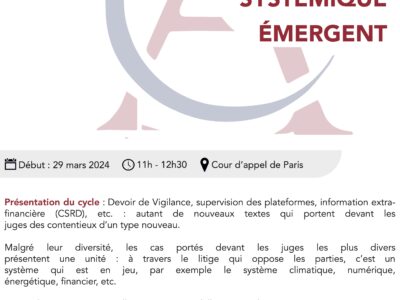
► Full Reference: M.-A. Frison-Roche, Coordination of the cycle of conference-debates Contentieux Systémique Émergent (Emerging Systemic Litigation), organised on the initiative of the Cour d'appel de Paris (Paris Cour of Appeal), with the Cour de cassation (French Court of cassation), the Cour d'appel de Versailles (Versailles Court of Appeal), the École nationale de la magistrature – ENM (French National School for the Judiciary) and the École de formation des barreaux du ressort de la Cour d'appel de Paris – EFB (Paris Bar School), under the scientific direction of Marie-Anne Frison-Roche - ► This Cycle in few words: Duty of vigilance, supervision of platforms, non-financial information (CSRD), etc.: as many new texts that bring new types of disputes before the courts. Despite their diversity, the cases brought before the most diverse judges present a unity: through the dispute that pits the parties against each other, it is a system that is at stake, for example the climate system, digital system, energy system, financial system, etc. New regulations are just the illustration of this "Emerging Systemic Litigation"; the conference-debates aiming at showing the new fields, new techniques, new standards, etc., in relation to the scale and diversity of stakeholders' expectations. This cycle is designed to encourage cross-fertilisation, so as to provide judges with food for thought ahead of the litigation they will be called upon to deal with. Les réglementations nouvelles ne sont que l’illustration de ce « contentieux systémique émergent » dont la formation a pour objet de montrer les nouveaux champs, les nouvelles techniques, les nouvelles normes, etc., en lien avec l’ampleur et la diversité des attentes des parties prenantes. Le cycle vise à favoriser les échanges croisés, afin d’alimenter la réflexion des magistrats en amont des litiges qui leurs seront soumis. - 🔴Registrations and information requests can be sent to: inscriptionscse@gmail.com 🔴For the attorneys, registrations have to be sent to the following address: https://evenium.events/cycle-de-conferences-contentieux-systemique-emergent/  ⚠️The conference-debates are held in person only, in the Cour d’appel de Paris (Paris Court of Appeal). - ► General Presentation of the Cycle: In 2024, the Cour d’appel de Paris (Paris Court of Appeal) created a new specialised chamber: chamber 5-12 Contentieux émergent – Devoir de vigilance et responsabilité écologique (Emerging litigation – Duty of vigilance and environmental liability). Vigilance litigation is an example of what is emerging more generally: Systemic Litigation, often linked to technologies. This calls for a new way of judging, organising procedures and relations between professionals. A series of conference-debates on Emerging Systemic Litigation (ESL) is being organised jointly by the Paris Court of Appeal, the Versailles Court of Appeal, the Cour de cassation (French Court of cassation), the École nationale de la magistrature – ENM (French National School for the Judiciary) and the École de formation des barreaux du ressort de la Cour d'appel de Paris – EFB (Paris Bar School), under the scientific responsibility of Professor Marie-Anne Frison-Roche. In this context, a series of conference-debates involving professionals from a wide range of backgrounds is being proposed on the following themes: 🧮the very notion of "Emerging Systemic Litigation" and the role of the judiciary in it (29 March 2024): read the report of this event   🧮vigilance, insofar as it gives rise to Systemic Litigation, notably because it takes legal form in numerous contracts, for example in employment relationships (26 April 2024): read the report of this event   🧮the inclusion in Emerging Systemic Litigation of information reliability techniques, particularly with regard to content available on platforms (27 May 2024): read the report of this event   🧮the way in which artificial intelligence is generating Systemic Litigation and the influence of new specific texts (24 June 2024): read the report of this event   🧮sustainability, a principle of systems found in reports and transitively in disputes concerning their development, their standards and even their control (9 September 2024): read the programme of this event   🧮new evidentiary techniques required by Emerging Systemic Litigation, to account for systemic needs, e.g. climate and digital systems, and how firms respond to them (14 October 2024): read the programme of this event   🧮Vigilance General Procedural Law, in that it incorporates the Systemic dimension of Vigilance Litigation (18 November 2024): read the programme of this event   🧮institutional and case law feedback from courts on Emerging Systemic Litigation (16 December 2024): read the programme of this event - 🧮read below the full programme of this cycle of conference-debates⤵️

Working papers

Working Paper

🚧Duty of vigilance: the way forward

► Full Reference: M.-A. Frison-Roche, Duty of vigilance: the way forward, Working Paper, December 2023/July 2024. - 🎤 This working paper has been drawn up to serve as a basis for the conclusions of the colloquium Le devoir de vigilance: l'âge de la maturité? ("The duty of vigilance: the age of maturity?") organised by the University of Montpellier on 25 May 2023. - 📝 Updated and developed, it serves as the basis for the article that concludes the book Le devoir de vigilance des entreprises : l'âge de la maturité? ("The duty of vigilance: the age of maturity?"), Editions Bruylant, 2024.   - ► Working Paper summary: In 2017 in France the so-called Vigilance law expressed great ambition. So did the draft directive. But in 2024 the European institutions moderated this ambition by refusing to increase either the type of companies subject and the constraints to which the duty of vigilance is associated. The directive has essentially halted what was for some the "march of progress". Does the ambition no longer exist? Does the future lie in an extension of the philosophy of the duty of vigilance, i.e. companies that should always be more concerned about others? This would undoubtedly be reaching the "age of maturity", where others see the age of madness, because it would be a contradiction in terms to ask a company to be concerned about anything other than its own development. It is therefore appropriate to consider this very hypothesis of an "age of maturity" as being an ambition maintained despite a European directive which, in its adopted version, is weakened and while the oppositions are intact (I). First of all, it must be admitted that the notion of "maturity" most often conceals a value judgment when applied to a legal concept (I.A.) and that this is blatantly obvious with regard to the duty of vigilance, which is considered by some and by nature by some as a good and by others as an evil (I.B). In order not to remain in what appears to be trench warfare, we must not get too bogged down in the reference French legislation of 2017 and what appears to be a European stutter in 2024, arguing so loudly that we can hear them reasoning in print, by paying attention to less visible and now more promising avenues of progress (II). In fact, the duty of vigilance can progress simply by the passage of time (II.A), by a better definition of the vocabulary (II.B), by the consolidation of the principles of Responsibility and Dialogue (II.C), by the uniqueness of the jurisdictional route (II.D). This last perspective of the progress that will be made possible in France by the uniqueness of the judicial route leads to a final avenue of progress. By their very nature, laws are jolts, all the more violent for being disputed. At the moment, if we want to make progress, these two other sources – the contract and the judge – must be favoured (III). The European directive is rightly concerned with access to the courts and takes a measured view of the effectiveness of contracts as a means of making the duty of vigilance effective, with the courts having to ensure that the contract does not destroy the spirit of the system. This is what the law already organises about the relationship between the contract, the judge and the duty of compliance (III.A). What is new in Europe in 2024 is the introduction of a Supervisor (III.B). Here again, vigilance is the "cutting edge" of Compliance Law, as it is an extension of Regulatory Law.  The result is that, through interpretation and the handling of principles, and to formulate a more general conclusion, it is the judge who holds and will hold the balance of the duty of vigilance.     - 🔓read the Working Paper below⤵️ - 🌐follow Marie-Anne Frison-Roche on LinkedIn 🌐follow Marie-Anne Frison-Roche on Instagram 🌐subscribe to the Newsletter MAFR Regulation, Compliance, Law

Articles in The Journal of Regulation & Compliance « JoRC »

📝The “Judge-Judged”. Articulating Words and Things in the face of Conflicts of Interest, in 🕴️M.-A. Frison-Roche (ed.), 📘Compliance Jurisdictionalisation

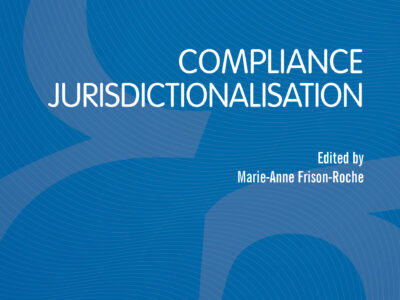
► Full Reference: M.-A. Frison-Roche, "The "Judge-Judged". Articulating Words and Things in the face of Conflicts of Interest", in M.-A. Frison-Roche (ed.), Compliance Jurisdictionalisation, Journal of Regulation & Compliance (JoRC) and Bruylant, "Compliance & Regulation" Serie, 2024, pp. 69-93 - 📝read the article - 🚧read the bilingual Working Paper which is the basis of this article, with additional developments, technical references and hyperlinks - 📘read a general presentation of the book, Compliance Jurisdictionalisation, in which this article is published - ► Summary of the article (done by the Journal of Regulation & Compliance – JoRC): Since the topic of this article is part of a chapter devoted to the Company established as Prosecutor and Judge of itself by Compliance Law, chapter aiming to use the relevant qualifications, it is appropriate therefore to worry about the adjustment of words and things, of the way in which the relationship between ones and the others evolve, and of the more particular question of knowing if this evolution is radical or not when one speaks of "judge ". because "judging" is a word that the Law has disputed with other disciplines, but that it has appropriated not so much to confer more powers on those who act in its name, for example that who supervise and punish, but on the contrary to impose limits, since to the one who judges it has put the chains of the procedure under foot, thus making bearable for the other the exercise of such a power. This is why those who want the power to judge would often want to not have the title, because having de jure the title of judge is being subject to the correlated regime, it is to be submitted to procedural correctness. It is therefore to better limit that the Law sees who judges, for obliging this so-powerful character to the procedure. But the Law also has the power to appoint a judge and to fix the contours of all the characters in the trial. He usually does it with clarity, distinguishing the ones of the others, not confusing them. This art of distinction has constitutional value. Thus, not only the one who judges must be named "judge" but the procedural apparatus which goes with this character and which constitutes a way of doing things and fundamental rights, are not "granted" by kindness or in a second step: it is a block. If you didn't want to have to endure procedural rights, you didn't have to want to be a judge. Admittedly, one could conclude that the procedure would therefore have become "substantial"; by this elevation, it is rather a fashion of saying that the procedure would no longer be a "servant": it is a kind of declaration of love for the procedure, as long as one affirms that at the acts of judging , or investigating, or prosecuting, are "naturally" attached the procedural rights for the one who is likely to be the object of these powers. Compliance Law, in search of allies to achieve the Monumental Goals for the aims of which it was instituted, will require, or even demand, private companies to go and seek themselves, in particular through investigations. internal or active vigilance on others, for finding facts likely to be reproached to them. Compliance Law will also require that they prosecute those who have committed these acts. Compliance La will again demand that they sanction the acts that people have committed in their name. This is clearly understood from the point of view of Ex Ante efficiency. The confusion of roles is often very efficient since it is synonymous with the accumulation of powers. For example, it is more efficient that the one who pursues is also the one who instructs and judges, since he knows the case so well… Besides, it is more efficient that he also elaborates the rules, so he knows better than anyone the "spirit" of the texts. This was often emphasized in Regulatory Law. When everything is Information and risk management, that would be necessary … But all this is not obvious. For two reasons, one external and the other internal. Externally, the first reason is that it is not appropriate to "name" a judge who is not. This would be too easy, because it would then be enough to designate anyone, or even to do it oneself to appropriate the regime that goes with it, in particular for obtain a so-called legitimate power for obtaining that others obey even though they are not subordinate or from them they transmit information, even though they would be  competitors: it would then be necessary to remember that only the Law is able to appoint judge ; in this new Compliance era, companies would be judges, prosecutors, investigators!  Maybe, if the Law says it, but if it didn't, it would be necessary to come back to this tautology … But are we in such a radicalism? Moreover, do judges have "the prerogative" of judgment and the Law has not admitted this power for companies to judge for a long time? As soon as the procedure is there in Ex Ante and the control of the judge in Ex Post? The second reason, internal to the company, situation on which the article focuses, is that the company investigates itself, judges itself, sanctions itself. However, the legal person expressing its will only through its organs, we underline in practice the difficulties for the same human being to formulate grievances, as he/she is the agent of the legal person, adressed to the natural person that he/she himself/herself is. The two interests of the two are not the same, are often opposed; how the secrets of one can be kept with respect to the other, represented by the same individual? … It is all the mystery, even the artifice of legal personality that appears and we understand better that Compliance Law no longer wants to use this strange classical notion. Because all the rules of procedure cannot mask that to prosecute oneself does not make more sense than to contract with oneself. This conflict of interest is impossible to resolve because naming the same individual X then naming him/her Y, by declaring open the dispute between them does not make sense. This dualism, which is impossible to admit when it comes to playing these functions with regard to corporate officers, can come back to life by setting up third parties who will carry secrets and oppositions. For example by the designation of two separate lawyers for the human being agent and the human being representative of the legal person, each lawyer being able to have secrets for each other and to oppose each other. These spaces of reconstitution of the so "natural" oppositions in procedure between the one who judges and the one who is judged can also take the technological form of platforms: where there is no longer anyone, where the process has replaced the procedure, there is no longer any human judgment. We can thus see that the fear of conflicts of interest is so strong that we resign ourselves to saying that only the machine would be "impartial", a derisory conception of impartiality, against which it is advisable to fight. This then leads to a final question: can the company claim to exercise the jurisdictional power to prosecute and judge and investigate without even claiming to be a prosecutor, an investigating judge, or a court? The company's advantage would be to be able to escape the legal regime that classical Law attaches to its words, mainly the rights of the defense and the rights of action for others, the principle of publicity of justice for everyone, which expresses the link between procedure and democracy . When Facebook said on June 12, 2021 "react" to the decision of May 5, 2021 adopted by what would only be an Oversight Board to decide "as a consequence" of a 2-year suspension of Donald Trump's account, the art of qualifications seem to be used in order to avoid any regime constraint. But this art of euphemism is very old. Thus the States, when they wanted to increase repression, presented the transformation of the system as a softening of it through the "decriminalization" of Economic Law, transferred from the criminal courts to the independent administrative agencies. The efficiency was greatly increased, since the guarantees of the Criminal Procedure ceased to apply. But 20 years later, Words found their way back to Things: under Criminal Law, slept the "criminal matter", which requires the same "Impartiality". In 1996, a judge once affirmed it and everything was changed. Let us therefore wait for what the Courts will say, since they are the masters of qualifications, as Article 12 of the French Code of Civil Procedure says, as Motulsky wrote it in 1972. Law has time. - 🌐follow Marie-Anne Frison-Roche on LinkedIn 🌐follow Marie-Anne Frison-Roche on Instagram 🌐subscribe to the Newsletter MAFR Regulation, Compliance, Law

Working papers

Working Paper for an article

🚧Compliance, Vigilance and Civil Liability: put in order and keep the sense of Reason

► Full Reference : M.-A. Frison-Roche, Compliance, Vigilance and Civil Liability: put in order and keep the sense of Reason, Working Paper, June 2024 - 📝 In its French version, this Working Paper is the basis of the contribution "Compliance, Vigilance et Responsabilité civile : mettre en l'ordre et raison garder", in 📕L'Obligation de Compliance - ► Summary of this Working Paper:  The descriptions of the Liability incurred by large companies as a result of their compliance obligations are very diverse, even contradictory, going beyond the wishes that may be expressed as to what this liability should be. The first part of this study therefore sets out the various liabilities incurred by companies, which differ in the conditions under which they are implemented and in their scope, so as not to confuse them. Indeed, as the various laws establish specific legal compliance obligations, they give rise to liabilities of varying conditions and scope, and it is not possible to avail of the regime of one in a situation that falls within the scope of another. It is therefore necessary to review the various bodies of compliance legislation, the GDPR, the ALM-FT regulations, the French so-called Sapin 2 law, the French so-called Vigilance law , the European IA Act , the European European DGA Act, etc., to recall the inflexion that each of these bodies of legislation has made to the liability rules applied to the companies subject to them. Nevertheless, the unicity of the Compliance Obligation, overcoming this necessary diversity of situations, regulations and liability regimes,  can provide grouping lines to indicate beyond this diversity the extent of the liability incurred by companies. Once this classification has been made, the second part of the study develops the observation that none of this can create any principle of general liability on large companies in terms of compliance, and in particular not in terms of vigilance. It is not possible to deduce a general principle of specific obligations of liability or specific obligations to reparation, for example in the area of vigilance, as the texts creating specific vigilance obligation refer to the conditions of commun Tort Law (proof damage and causality), and International Public Law does not have the force to generate a general principle binding companies in this respect. The third part stresses that it is nevertheless always possible to invoke Tort Law, and companies cannot claim to escape this. This may involve contractual liability, a situation  becoming increasingly frequent as companies contractualise their legal compliance obligations, reproducing them but also modifying them, and as Vigilance duty is an obligation that goes beyond the specific situations covered by the regulations.  But it is essential, and this is the subject of the fourth part, not to make companies pure and simple guarantors of the state of the world, present and future. Indeed, if we were to transform sectoral compliances into illustrations of what would then be a new general principle, but one that applied only to them, they would consequently exercise the other side of this coin, namely power over others. - 🔓read the Working Paper below⤵️ - 🌐follow Marie-Anne Frison-Roche sur LinkedIn 🌐follow Marie-Anne Frison-Roche on Instagram 🌐subscribe to the Newsletter MAFR Regulation, Compliance, Law 🌐subscribe to the Video Newsletter MAFR Surplomb

Working papers

Working Paper basis for an article

🚧Births of a new branch of Law: Compliance Law

► Full Reference: M.-A. Frison-Roche, Births of a branch of Law: Compliance Law, Working Paper, November 2023. - 📕This Working Paper was drawn up as a basis for a contribution to the collective book given to Professor Louis Vogel, published in 2024 - ► Summary of this Working Paper: The study looks at the various movements that have given birth to Compliance Law, with particular emphasis on Competition Law. After a preliminary reflection on the construction of the legal system into branches of Law, their classification in relation to each other, the difficulty encountered in this respect by Economic Law, and the various movements that give birth to one of them, the diversity of which the branch subsequently keeps track of, the study is constructed in 4 parts. To find out what gave rise to Compliance Law, the first part invites us to reject the narrow perspective of a definition that is content to define it by the fact of "being conform" with all the applicable regulations. This has the effect of increasing the efficacy of the regulations, but it does not produce a branch of Law, being just a set of tools like others. The second part of the study aims to shed some light on what appears to be an "enigma", as it is often claimed that this is the result of a soft method, or of an American political decision, or of as many regulations as there are occasions to make. Instead, it appears that in the United States, in the aftermath of the 1929 crisis, it was a decision of establishing an authority and rules to prevent another atrocious collapse of the system, while in Europe in 1978, in memory of the use of files of personal and racial information, it was a question of establishing an authority and rules to prevent an atrocious attack on human rights. A common element that aims for the future ("never again") but not the same object of preventive rejection. This difference between the two births explains the uniqueness and diversity of the two Compliance Laws, the tensions that can exist between the two, and the impossibility of obtaining a global Law. The third part analyses the way in which Competition Law has given rise to conformity: a secondary branch which is a guarantee of conformity with competition rules. Developed in particular through the soft law issued by the competition authorities, the result is a kind of soft obedience, a well-understood collaboration of the procedural type through which the firm educates, monitors and even sanctions, without leaving  the cercle of Competition Law, of which conformity is an appendix. The distance between a culture of conformity and the substantial Compliance Law can be measured here. The fourth part aims to show that Competition Law and Compliance Law are two autonomous and articulated branches of Law. Since Compliance Law is a branch of Law built on Monumental Goals, in particular the sustainability of systems and the preservation of the human beings involved so that they are not crushed by them but benefit from them, the current challenge of European integration is to build the pillar of Compliance Law alongside the competitive pillar. Jurisdictions are in the process of doing this and of linking the two.   - 🔓read the Working Paper below⤵️ - 🌐follow Marie-Anne Frison-Roche on LinkedIn 🌐follow Marie-Anne Frison-Roche on Instagram 🌐subscribe to the Newsletter MAFR Regulation, Compliance, Law  🌐subscribe to the Video Newsletter MAFR Surplomb

Conferences

final speech of a scientific manifestation

🎥 5 leçons en conclusions ouvertes (5 Lessons in Open Conclusions), in 🧮Compliance, vigilance et médiation

► Full Reference: M.-A. Frison-Roche, "Conclusion", in M. Boissavy, H. Dehghani-Azar, and M.-A. Frison-Roche (dir.), Journal of Regulation & Compliance (JoRC) and Conseil national des Barreaux (CNB), Compliance, vigilance et médiation (Compliance, Vigilance and Mediation), Amphitheatre of the Conseil national des Barreaux, November 30, 2023. - 🧮see the full programme of this event - 🌐follow Marie-Anne Frison-Roche on LinkedIn 🌐follow Marie-Anne Frison-Roche on Instagram 🌐subscribe to the Newsletter MAFR Regulation, Compliance, Law

Articles in a legal collective publication

article in a collective publication

📝The deployment of Regulatory Law through Compliance Law in the European project

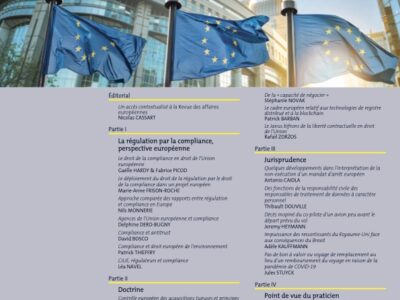
► Full Reference: M.-A. Frison-Roche, "The deployment of Regulatory Law through Compliance Law in the European project", in G. Hardy & F. Picod, Compliance Regulation from a European Perspective, Law and European Affairs (L.E.A.), 2023/2, pp. 345-352. - 🚧read the bilingual Working Paper which is the basis of this article, with additional developments, technical references and hyperlinks  - ► English Summary of the article: Compliance Law is neither a method of obeying regulations, nor a simple neutral method of ensuring the effectiveness of norms, nor a means of enforcement displaced from Ex Post to Ex Ante. It is an extension of Regulatory Law and goes beyond it. Like it, it aims to build spaces according to a political project specific to an area, such as Europe. Branch of Law looking to the future as Regulatory Law does, it constructs and maintains, in a systemic way, sustainable, albeit unstable, balances to achieve the ‘Monumental Goals’ in which its normativity resides: security, sustainability, probity, truth, and dignity. By internalising these Monumental Goals in the companies that are in a position to achieve them, the “crucial companies”, Compliance Law preserves the logic of Regulatory Law, offering it a prodigious expansion since it frees it from the condi- tion of a sector and territorial borders, which seemed tautological, by associating private powers and public will, which remains primary. In this way, Compliance can regulate the digital space and climate issue through political choices made by a sovereign Europe. - 🌐follow Marie-Anne Frison-Roche on LinkedIn 🌐follow Marie-Anne Frison-Roche on Instagram 🌐subscribe to the Newsletter MAFR Regulation, Compliance, Law

Articles in The Journal of Regulation & Compliance « JoRC »

📝Reinforce the Judge and the Lawyer to impose Compliance Law as a characteristic of the Rule of Law, in🕴️M.-A. Frison-Roche (ed.) 📘Compliance Jurisdictionalisation

► Full Reference: M.-A. Frison-Roche, "Reinforce the Judge and the Lawyer to impose Compliance Law as a characteristic of the Rule of Law", in M.-A. Frison-Roche (ed.), Compliance Jurisdictionalisation, Journal of Regulation & Compliance (JoRC) and Bruylant, "Compliance & Regulation" Serie, 2024, pp. 39-65 - 📝read the article - 🚧read the bilingual Working Paper which is the basis of this article, with additional developments, technical references and hyperlinks - 📘read a general presentation of the book, Compliance Jurisdictionalisation, in which this article is published - ► This article is the introduction of the book.   ► Summary of the article (done by the Journal of Regulation & Compliance): One can understand that the compliance mechanisms are presented with hostility because they seem designed to keep the judge away, whereas there is no Rule of Law without a judge. Solid arguments present compliance techniques as converging towards the uselessness of the judge (I). Certainly, we come across magistrates, and of all kinds, and powerful ones, but that would be a sign of imperfection: its ex-ante logic has been deployed in all its effectiveness, the judge would no longer be required… And the lawyer would disappear so with him… This perspective of a world without a judge, without a lawyer and ultimately without Law, where algorithms could organize through multiple processes in Ex Ante the obedience of everyone, the "conformity" of all our behaviors with all the regulatory mass that is applicable to us, supposes that this new branch of Law would be defined as the concentration of processes which gives full effectiveness to all the rules, regardless of their content. But supposing that this engineer's dream is even achievable, it is not possible in a democratic and free world to do without judges and lawyers. Therefore, it is imperative to recognize their contributions to Compliance Law, related and invaluable contributions (II). First of all, because a pure Ex Ante never existed and even in the time of the Chinese legists1 L’empire chinois n’a semble-t-il jamais apprécié les juges, ne leur faisant place que sous la forme de serviteurs purs de l’Etat, qu’ils soient des enquêteurs, des punisseurs et de gardiens de l’ordre public. Sur cet aspect du Droit chinois, v. … ; sur cette période particulièrement sanglante des légistes, où le principe de « certitude » de la législation a été portée à ses nues, v. …, people were still needed to interpret the regulations because a legal order must always be interpreted Ex Post by who must in any case answer the questions posed by the subjects of law, as soon as the political system admits to attributing to them the right to make claims before the Judge. Secondly the Attorney, whose office, although articulated with the Judge's office, is distinct from the latter, both more restricted and broader since he must appear in all cases where the judicial figure puts himself in square, outside the courts. However, Compliance Law has multiplied this since not only, extending Regulatory Law, it entrusts numerous powers to the administrative authorities, but it also transforms companies into judges, in respect of which the attorneys must deal with. Even more so, Compliance Law only takes its sense from its Monumental Goals2🕴️Frison-Roche, M.-A. (ed.), 📘​Compliance Monumental Goals, 2022.. It is in this that this branch of the Law preserves the freedom of human beings, in the digital space where the techniques of compliance protect them from the power of companies by the way that the Compliance Law forces these companies to use their power to protect people. However, firstly, it is the Judges who, in their diversity3The topic of this study is general. For a more analytical perspective, s.. 🕴️Frison-Roche, M.-A., « The function of the Judge in Compliance Law », in 🕴️Frison-Roche, M.A. (ed.), 📘Compliance Jurisdictionalisation, 2023. , impose as a reference the protection of human beings, either as a limit to the power of compliance tools4🕴️Frison-Roche, M.-A. (ed.), 📘Compliance Tools, 2021.  or as their very purpose. Secondly, the Attorney, again distinguishing himself from the Judge, if necessary, reminds us that all the parties whose interests are involved must be taken into consideration. In an ever more flexible, soft and dialogical Law, everyone presenting himself as the "advocate" of such and such a monumental goal: the Attorney is legitimate to be the first to occupy this place. - 🌐follow Marie-Anne Frison-Roche on LinkedIn 🌐follow Marie-Anne Frison-Roche on Instagram 🌐subscribe to the Newsletter MAFR Regulation, Compliance, Law

Monographs

📝La compliance, socle de la confidentialité nécessaire des avis juridiques élaborés en entreprise

► Full Reference: M.-A. Frison-Roche, "La compliance, socle de la confidentialité nécessaire des avis juridiques élaborés en entreprise" ("Compliance, the cornerstone of the confidentiality required for in-house legal opinions"), D. 2023, p. - 📝read the article (in French) - ► English Summary of the article: The French Law about the Ministry of Justice's 2023-2027 Orientation and Programming  ("loi d'orientation et de programmation du ministère de la justice 2023-2027") had introduced into the French legal system the confidentiality of in-house lawyers' opinions (before the  French Constitutional Council, on a question of parliamentary procedure, annulled this disposition, thus leaving the question still open).  This development is necessary in order to respond to the injunction for companies to comply more and more with the regulations, which is itself only one of the tools of a wider movement: Compliance Law. This branch of the law, notably through the French so-called Sapin 2 Act of 2016, the French Vigilance Act of 2017 and the European Digital Services Act (DSA), requires companies to implement the necessary means to satisfy the Monumental Goals contained in the laws or regulations. This presupposes, firstly, that companies have information (via alerts, risk mapping, vigilance, sustainability reports, etc.), enabling them to identify their conformity and non-conformity, so that they can, secondly, take effective action to put an end to current breaches, prevent future breaches and achieve the goals set by the Legislator. This Compliance System requires that the information made available to managers is reliable and honest. However, if non-conformity is not analysed and communicated in a way that is protected by confidentiality, the company will prefer not to know about it and will therefore be unable to take appropriate action, which will deprive the social community of its power to act in the future. This is why the confidentiality of in-house lawyers' opinions is based on the very definition of Compliance Law itself. - 🌐follow Marie-Anne Frison-Roche on LinkedIn 🌐follow Marie-Anne Frison-Roche on Instagram 🌐subscribe to the Newsletter MAFR Regulation, Compliance, Law

Videos

🎥L’avenir du Droit de la compliance (The futur of Compliance Law), in🧮 Nuit du Droit

► Full Reference: M.-A. Frison-Roche, "L'avenir du Droit de la compliance" (The futur of Compliance Law), in Cour de cassation (French Court of cassation), La Nuit du Droit 2023, October 4, 2023.  - 🎥 Watch the video (in French) - 🧮read the full programme of this event The Cour de cassation (French Court of cassation) had presented 4 successive themes insofar as they affect the future of Law: filiation, artificial intelligence, the environment and compliance. The President of the Chambre sociale de la Cour de cassation (Social Chamber of the Court of Cassation) gave a presentation on Compliance and the essential role played by the Judge. Then, the Parquet général (Prosecutor General's Office) then asked Fabien Raynaud, Conseiller d'État, about the importance of 'systemic cases' in Compliance Law and the dialogue between judges that it implies, using the Youporn case currently being examined by the judges. - ► General presentation of the speech: As my work has been seminal for Compliance Law, I was asked about the future of Compliance Law. - 🌐follow Marie-Anne Frison-Roche on LinkedIn 🌐follow Marie-Anne Frison-Roche on Instagram 🌐subscribe to the Newsletter MAFR Regulation, Compliance, Law

Conferences

conference

🎤Participation in the🏛️Law Day🧮Normes de Responsabilité Sociale des Entreprises /RSE & Devoir de Vigilance (Corporate Social Responsibility Standards /CSR & Duty of Vigilance)

🌐follow Marie-Anne Frison-Roche on LinkedIn 🌐subscribe to the Newsletter MAFR Regulation, Compliance, Law - ► Full Reference: M.-A. Frison-Roche, Participation à la Table ronde "Normes de Responsabilité Sociale des Entreprises (RSE & Devoir de Vigilance)" (Participation in the Round Table "Corporate Social Responsibility Standards (CSR & Duty of Vigilance)"), in Fribourg University, Journée du Droit, Fribourg University, Pérolles site, room C230, October 2, 2023. - 🧮see the full programme of this event 🎥​watch the video of this event (in French) - 🌐read the report written in French with photos, tags and links on LinkedIn and also with links to each the speech - ► General presentation of the event : This conference, build around 4 presentations and a debate between the speakers and then with the audience, aimed at explaining and understanding this fundamental movement and the new texts that express it in Switzerland, even if it is French law, such as the so-called 'Vigilance' law of 2017 and the draft European CS3D directive, because on the one hand it is a movement that begins with legal technique and on the other hand the texts in question are extraterritorial in scope, if only because of the notion of 'value chain'. In the first part of this round table, and to set the scene, I will outline the origin and content of the French 'Vigilance' law, the way in which the draft directive draws heavily on it, its relationship with Compliance Law, of which it constitutes the 'advanced point', and the decisive role it gives to the courts, in the general movement of the jurisdictionalisation of compliance. The purpose of this is to allow the discussion to get underway. 🕴️Idris Abdelkhalek, PhD candidate and lawyer, introduced the speakers and led the debate between them and the audience. He took questions from the audience on the intensity of the obligation weighing on companies, in particular between civil liability and criminal liability, between the obligation of means and the obligation of result, and on the way in which the duty of vigilance is applied to specific sectors such as defence. - ► Presentation of my speech : the subject of which was Presentation of French Vigilance law, European perspective and European Compliance System. My presentation was divided into four points. Firstly, I outlined the state of Law in France, in the novelty represented by the 2017 law known as the "Vigilance" law, whose principles are simple and strong, principles that are situated in the aims pursued, and the way in which this law inspires what is currently being negotiated: the CS3D Directive. Secondly, I stressed the need for companies to master these often technically complicated corpus, especially if we take into account the link between Vigilance and the CSRD directive on sustainability reporting and extra-financial information.  Thirdly, I have shown that an overall understanding can nevertheless be achieved, and that the technical nature of the 'tools' is better mastered if we place the duty of vigilance within Compliance Law, of which it constitutes the 'advanced point'. All of this anchors its legal normativity in the 'Monumental Goals' it serves, which in Europe are humanistic, since the aim is to protect, now but above all in the future because it is a branch of ex ante Law, the human beings involved in the systems (banking, finance, energy, digital, climate, etc.). Fourthly, I emphasised that this understanding enables everyone to play their part: political and public authorities, businesses and stakeholders. Even more, and at the heart of the matter, the judge plays an essential role, even in countries with so-called 'continental' Law. I have used current cases as examples. This is just the beginning, and judges need to train, specialise and work in dialogue to achieve this. - ► Presentation of the other speakers contributions : 🕴️Marion Paradas, Ambassador of France to Switzerland and Liechtenstein, opened the conference and gave a general presentation of the theme. Ambassador Marion Paradas presented the international challenge represented by Law, illustrated here by the duty of vigilance. She emphasised that this is a major issue, both now and in the future, for Swiss companies and French companies based in Switzerland, particularly as this duty extends throughout the "value chain" and in view of the CS3D directive, which will also have consequences for both. 🕴️Isabelle Chabloz Waidacher, Professor at the Faculty of Law in Fribourg and holder of the Chair of Economic Law at the University of Fribourg, gave a Presentation of Swiss Law. In particular, she emphasised the state of Swiss Law, which could have gone further than the 2017 French law known as the "Vigilance" law if the popular initiative reference had led to the adoption of a law, and which currently focuses more on information and transparency obligations, with CSR taking over from there. But she stresses that the reality of value chains will force Swiss companies to take into account the requirements of the European directive currently being adopted. 🕴️Renaud Roussel, Managing Director of Colas Switzerland, presented an entrepreneurial view of the subject. He began by outlining the concrete steps taken by his industrial group in Switzerland and around the world to implement its commitments to protect the environment, for example by ensuring the proper use of materials used in road construction. He also stressed the importance of human rights, particularly in labour relations, in the context of CSR and vigilance. He went on to point out that it was not always easy for a large company to meet its own requirements, or the requirements imposed on it by the law, because in the construction and public works sector in particular it is often small companies that are competing, competitors who do not bear the costs of such obligations. -

Conferences

🎤Conclusion, in 🧮L’eau : entre protection de la ressource et conflits d’usage

🌐follow Marie-Anne Frison-Roche on LinkedIn 🌐subscribe to the Newsletter MAFR Regulation, Compliance, Law - ► Full Reference: M.-A. Frison-Roche, "Conclusion", in Club des avocats environnementalistes, L’eau : entre protection de la ressource et conflits d’usage, Maison des Avocats, Auditorium, September 28, 2023. - 🧮see the full programme of this event -

Monographs

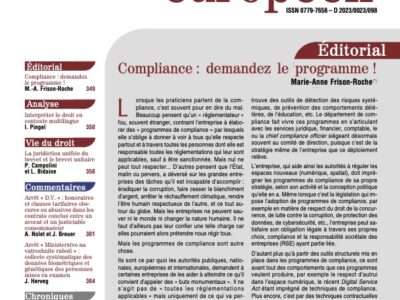
📝Compliance : demandez le programme ! (Compliance: ask for the programme!)

► Full Reference: M.-A. Frison-Roche, "Compliance : demandez le programme !" ("Compliance: ask for the programme!), J.D.E., 2023/7, No. 301, p. 349. - 📝read the article (in French) - 🌐see the LinkedIn post presenting this article - ► Summary of the article: Compliance programmes are neither constraints imposed by a 'mad regulator' forcing companies to show in advance that they comply with all the regulations applicable to them, nor are they a delegation by the State of tasks it is incapable of accomplishing, such as eradicating corruption or stopping global warming. On the contrary, they are a tool in the service of the alliance between public authorities and companies in the pursuit of the Monumental Goals of Compliance Law. Through them, the company implements actions to prevent the systemic risks associated with its activity. It thus assists the authorities in regulating new areas (digital, space) while adopting a sustainable strategy. As a result, it does not suffer from regulations, but participates in shaping the future. In this future, the judge plays a central role in shaping the compliance programmes that will be raised or challenged in 'systemic cases'. - 🌐follow Marie-Anne Frison-Roche on LinkedIn 🌐follow Marie-Anne Frison-Roche on Instagram 🌐subscribe to the Newsletter MAFR Regulation, Compliance, Law

Articles in a legal collective publication

📝Droit de la compliance et climat. Pour prévenir le risque et construire l’équilibre climatiques, in 🕴️M. Torre Schaub, 🕴️A. Stevignon et 🕴️B. Lormeteau (ed.), 📗Les risques climatiques à l’épreuve du droit

► Full Reference: M.-A. Frison-Roche, "Droit de la compliance et climat. Pour prévenir le risque et construire l'équilibre climatiques" ("Compliance Law and climate. Prevent the climate risk and build the climate balance"), in M. Torre Schaub, A. Stevignon and B. Lormeteau (ed.), Les risques climatiques à l'épreuve du droit, Mare & Martin, coll. "Collection de l'Institut des sciences juridique et philosophique de la Sorbonne", 2023, pp. 73-83 - 📝read the article (in French) - 🚧read the bilingual Working Paper which is the basis of this article, with additional developments, technical references and hyperlinks - ► Summary of the article: Compliance Law is beginning to emerge in climate topic, through the expression  "Climate Compliance Law", but the climate issue itself is the most perfect example of why General Compliance Law is made for.  It is indeed a new branch of Law, a global Law claiming to provide Ex Ante solutions here and now for global issues, so that in the future systemic catastrophies will not occur, will not happen: it is these "Monumental Goals" that give meaning, coherence, and simplicity to Compliance Law. Compliance Law, linked to the Rule of Law principle, makes it possible to go beyond the choice often presented between the effectiveness of the protection of the planet and the renunciation of freedoms, in particular the freedom to do business and the freedom of individuals, especially the protection of their data. Climate is thus exemplary of the object of Monumental Goals of Compliance Law (I). The systemic risk that it now constitutes is analogous to Banking or Digital Systemic Risks and therefore calls for the application of identical legal Compliance Tools, formerly put in place for Banking Regulatory and Compliance Law, recently invented for Digital. Compliance Law, extending Regulation Law, itself from the precondition of the Sector and the Territory, is therefore the branch which makes it possible to put in place new legal solutions, either by force (judicial agreements, compliance programs, etc.), or by will (commitments, global charters, etc.). Therefore, an alliance can exist between political and public authorities, and crucial economic operators (II), that the rise in power of the "raison d'être" is the sight and whose technical challenge is the collection of information that must be put in correlation. Scientists pooling Information, this public good, provided by public and private entities. The courts are at the center of this articulation between Compliance Law and Climate, which object is the Future. - 🌐follow Marie-Anne Frison-Roche on LinkedIn 🌐follow Marie-Anne Frison-Roche on Instagram 🌐subscribe to the Newsletter MAFR Regulation, Compliance, Law

Monographs

📝Le cas Petrobras, une juste adéquation de la responsabilité pour protéger les personnes impliquées dans des systèmes globaux (The Petrobras case: the right balance of responsibility to protect those involved in global systems)

► Full Reference: M.-A. Frison-Roche & Arnoldo Wald, "Le cas Petrobras, une juste adéquation de la responsabilité pour protéger les personnes impliquées dans des systèmes globaux" ("The Petrobras case: the right balance of responsibility to protect those involved in global systems"), RIDC, July-September 2023, No. 3, pp. 563-582. - ► Summary of the article: This article briefly outlines the main aspects of corporate liability in the capital market under Brazilian law, arising from the company’s duty to inform shareholders and investors, followed by a commentary on the recent partial award in an arbitration brought by minority shareholders against Petrobras, which underlines the legitimacy of the minority shareholders to engage the company’s liability. - 🌐follow Marie-Anne Frison-Roche on LinkedIn 🌐follow Marie-Anne Frison-Roche on Instagram 🌐subscribe to the Newsletter MAFR Regulation, Compliance, Law

Working papers

Working Paper

🚧Moving through Time to align Compliance with the rights of the defence

► Full Reference: M.-A. Frison-Roche, Moving through Time to align Compliance with the rights of the defence, Working Paper, September 2023. - 📕This working paper has been drawn up as the second part of the book Compliance et droits de la défense (Compliance and the rights of the defence), a first section summarising this book. - 📝This Working Paper was drawn up to serve as a basis for this second section, which sets out the general way in which the rights of the defence and the compliance system can be articulated, thank to this movement of moving back in time. - ► Summary of this Working Paper: The subject of Compliance & rights of the defence is difficult to pin down because it often gives rise to totally opposing presentations, which express the initial confrontation between Compliance and rights of the defence, which seems irreducible. This initial confrontation must be acknowledged, and this is even more necessary to prevent it from becoming definitive(I) But in a society governed by the Rule of Law, the rights of the defence are central, and the hierarchy of norms dictates that they remain the privilege of all those who risk being punished in the future. Admittedly, if we look at the course of events in a linear way, the Compliance mechanisms come in Ex Ante, whereas the rights of the defence would only be activated when the repressive procedures would later come to bear on the moral or natural person. The question would therefore not even arise, or not in a central way. But this reasoning creates a false compatibility between Compliance and the rights of the defence (II. Indeed, it is the perspective of punishment in the future that forms the basis for the attribution of rights of the defence in the present. This consideration of the future not only allows but obliges the Law to "move in time", to always think in advance about what might happen tomorrow: this is how we must think about the Compliance methods of Internal Investigation, the DPA (or in the French legal system the Convention judiciaire d'intérêt public and the French Guilty plea procedure (CRPC) (III). As soon as these Compliance Tools are being used in practice, at the time they are being used, we must already think about how their results will be used, results which they have often been used for, because the Internal Investigation is a formidable piece of Evidence for obtaining a conviction and/or a DPA, etc. : therefore, the rights of the defence must shift over time, from the future to the present of the Information collect. Two ambiguities that affect Compliance Law itself, ambiguities which the rights of the defence help to clarify, now appear more clearly.  The first concerns the place occupied by the consent of the person who could have been protected by the rights of defence but //who exercises his/her will to renounce them (IV). Consent, in relation to the will of which it is the expression, is also linked with the future and allows Compliance once again to take precedence over the prerogatives of the individual who chooses not to benefit from it. The omnipresence of 'consent' in Compliance is enlightening here… The second ambiguity concerns the place of secrecy (V). Secrecy seems to be the prerogative of the rights of the defence. But it can also be an effective Compliance Tool when Confidentiality enables the company to detect and prevent breaches. It may even constitute the very Monumental Goal of Compliance Law. This happens when the Goal of Compliance Law, in which legal normativity is placed, becomes the protection of the individual, as is the case for personal information. That guides the European Judge, in line with the humanism that underpins European Compliance Law, in finding the right balance, this protection and effectiveness, depending on whether the information must be given or must be not. - 🔓read the Working Paper developments below ⤵️ - 🌐follow Marie-Anne Frison-Roche on LinkedIn 🌐follow Marie-Anne Frison-Roche on Instagram 🌐subscribe to the Newsletter MAFR Regulation, Compliance, Law