Publications Related to General Law and Civil Law

Working papers

🚧 Rethinking the world from the notion of “data”

Law is a reconstruction of the world through definitions and categories, expressed in words, to which are imputed rules. There is always a share of invention in Law, articulated to a share of fidelity to the concrete world that it retranscribes, a combination enabling Law to regulate the latter. Law is put in difficulty by what the term "data", quite new, is not easy to define. The fact that it is strangely formulated in Latin to show that there is plurality, the data, before associating it with an English adjective when there are many, the "big data", does not advance us more on what a "data" is. Law is a practical art that works well only if it manipulates categories whose definition is mastered. This is why, in a first stage, we must recognize the uncertainties of the very notions of "data" (I), in order to orientate the adequate rules in the second step towards what is a given, namely a "pure" value in our consumer information society (II).   Read the article written in French on the basis à this working paper

Working papers

Au coeur du droit, du cinéma et de la famille : la vie (“At the heart of Law, Cinema and Family: Life”)

This working paper served as a basis for the preface of the book: Magalie Flores-Lonjou and Estelle Épinoux (ed.),  La famille au cinéma. Regards juridiques et esthétiques ("Family in Cinema. Legal and Aesthetic Perspectives"), pref. Marie-Anne Frison-Roche, coll. "Droit et Cinéma", Éditions Mare et Martin, 2016. Since the transmission of the text, this working paper has been updated many times.  It contains links towards approximatively 90 movies which appears relevant to me for this topic. 

Working papers

WHAT IS BASED PUNISHMENT IN FINANCIAL SYSTEM

Books

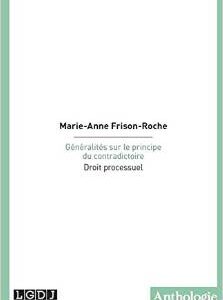
📕Généralités sur le principe du contradictoire. Étude de droit processuel (Generalities about the principle of contradictory. Study of procedural Law)

Full reference: Frison-Roche, M.A., Généralités sur le principe du contradictoire. Étude de droit processuel, coll. "Anthologie du Droit", Lextenso – LGDJ éditions, 2014, 221 p. - Republished from Généralités sur le principe du contradictoire », Étude de droit processuel, Th. Paris II, 1988.  This book is the publication of a thèse d'Etat (French official thesis) written under the direction of Jean Foyer and defended in the Panthéon-Assas University (Paris II) face to a jury made up among others of François Terré, René Chapus, Gérard Cornu, Geneviève Viney.  The main idea is to defend that the principle of contradictory is a simple and fundamental principle, without which there is no Law. It is the reason it is obvious to study it as in civil procedure as in criminal, administrative or arbitrary procedures, to take back a "Procedural Law" perspective conceived by Motulsky. Indeed, without a judge listening without having already decided the facts and Law versions that presents who's the situation will be affected by the decision that the judge will make, there is no rule of Law.  The main beneficiary of the principle of contradictory, it is not really the person, and it is in this that the contradictory is detached from the rights of the defense, it is the judge. Indeed, emphasizing contradictory versions of Law and facts which collide in front of him or her, the judge perceives more exactly and more fairly the world and the use of Law that he or she should favor. Thus, Law is better used. In this, we can consider that the principle of contradictory is consubstantial to Law. Read the summary (in French) Read the introduction (in French) Read the table of contents (in French)



Questions

LAW AND HISTORY: What is left of the French Revolution in the current French law?

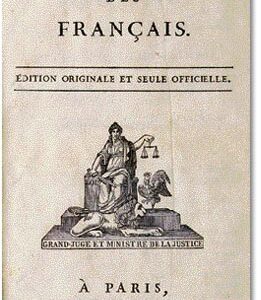
In a positivist conception of law or in in how it is taught , we tend to think that the history of law is an "auxiliary science". But if it happens that past events remain in the current law, so it is ignoring the current law to know nothing of the history of law. If we take the example of the French Revolution, a major divide in the French history, is there still something in the French law? If not, then let the knowledge of the Revolution to historians. If so, then the practical handling of the current French law requires knowledge and understanding of the French Revolution and its ideas, which are still working through today's law, for example through then texts still preserved in its letter and in its spirit.

Analyses

What is the law, ? : explanations by Muriel Fabre-Magnan

Introduction au droit.  The book of Muriel Fabre-Magnan is out. This is great. The law holds the attention of everyone all the time. Because daily life is full of law and there is the awareness of this. Because world live has a turn increasingly legal. Thus, the interest in the law is new, or at least has grown. But the law is off-putting for anyone who didn't study, who doesn't practice. This mass, which is enormous and as inert, seems belch through dramatic cases or convictions shattering. Thus, the desire to discover and to understand law seems meet a sort of end of inadmissibility, seems to be hampered by the legal matter itself. That is why everyone must buy Introduction au droit (Introduction to Law), the book (written in French) in the collection "Que sais-je ?" ("What can I know?"), by Muriel Fabre-Magnan. By reading this book of 124 pages, one can understand what may represent the law, not only for every day but also the law in society in a civilized world. The law is the key to a civilized system. But in a world which seems to be governed by the game of forces, the law is absent or just facade. Thus, reading, you'd think that the law is in fact very little … Read a presentation of the new edition of the Muriel Fabre-Magnan book : Introduction au droit.

Questions

LAW AND HISTORY: is The Civil Code “the pinnacle” of French law?

The "pinnacle" means the culmination of a successful issue. Here, the Code civil (French Civil Code) would be the point of perfection of French law. For many this qualification is required with evidence before this masterpiece of concision, practice and use of language. This implies a critique of the current French law, including a legislator that would had fallen very low. But the question nevertheless arises. Since before the Civil Code, there was a law that was not as unworthy. Moreover, after some general principles, all the civil law takes place into the Civil Code, family law, contract law, tort law, and so on. But the criminal law or public law aren't inserted in the book. Thus, it is rather the form, the art of writing the law that can be given to this term apogee Civil Code, not the substance that can bring so much praise to the Code civil because he never embraced the french law in its entirety. In addition, it is true that the form is the pinnacle of French law, but a French law that put the law should only be expressed through writing through codification rather than practices or casebased rules. We must therefore bow to bin assumptions before proclaiming that the Civil Code is the pinnacle of French law. Admitting it is rather the culmination of a certain conception of the law, a non indiscutable conception, he was a perfect and sublime event.