Publications Related to General Law and Civil Law

Working papers

Working Paper serving as the basis for a conference and an article

🚧Unicity and Diversity of Compliance Clauses: towards a Contractual Compliance System

► Full reference: M.-A. Frison-Roche, Unicity and Diversity of Compliance Clauses: towards a Contractual Compliance System, Working Paper, September 2026. - 📝 This Working Paper served as the basis for the conference « Unicité et Diversité des clauses de Compliance » (Unicity and Diversity of Compliance Clauses) (in French), given on 25 September 2026 in Lyon at the colloquium 🧮La contractualisation de la Compliance : clause après clause, organised by the Journal of Regulation & Compliance (JoRC) and the Université Jean Moulin Lyon 3, as part of the 🏗️2026 cycle of colloquia Compliance and Contract. 📘 It is the basis of the article to be published in the book 📘Compliance and Contract, in the 📚Compliance & Regulation series, co-published by the Journal of Regulation & Compliance (JoRC) and Bruylant. - ► Summary of the Working Paper: Practitioners insert into a wide variety of contracts clauses that are expressly designated as “Compliance clauses”. We lack a definition, so their legal regime is uncertain. To consolidate this practice and ensure that its development produces satisfactory effects, these clauses must be classified, named and distinguished from one another. In a first stage, a strong unicity of Compliance clauses appears. But this unicity is somewhat misleading. It proceeds from a confusion between contract and statute: whether the clause, as a block, obliges the other contracting party to comply with all the regulations, or borrows its unity from the particular corpus of which it claims to be the tool of application, the clause copies the legislation. This is the unified but rather archaic conception to which the Regulator has itself lent credence, by designating the Compliance clause only as a delegation within a normative power that would remain first and foremost its own. So as not to stop there, in a second stage, the study shows the great diversity of Compliance clauses, a de jure diversity born of the principle of contractual freedom and a de facto diversity resulting from the porosity of the clause to the activities concerned, the country and the persons. To be mastered, this diversity must be channelled by a nomenclature. It must also be preserved in a lasting way, because it stems from the general policy of the company and the project it wishes to develop, for example in the value chains it has chosen to build through regulatory contracts. Nevertheless, and this is the subject of the third stage, there is a deep and programmatic unicity of Compliance clauses, which lies in the systemic goals they serve. In practice, this unicity is built through an interlinked system of clauses, precisely described and specific to each undertaking. At the level of a large company, this can give rise to a Contractual Compliance System, which is articulated and allied with the regulatory system. - 🔓read the developments below⤵️ - 🌐follow Marie-Anne Frison-Roche on LinkedIn 🌐follow Marie-Anne Frison-Roche on Instagram 🌐subscribe to the Newsletter MAFR Regulation, Compliance, Law 🌐subscribe to the Video Newsletter MAFR Surplomb 🌐subscribe to the Newsletter MaFR Droit & Art

Working papers

Working Paper serving as the basis for a conference and an article

🚧The Audit Clause, Carousel of the Contractualisation of Compliance

► Full reference: M.-A. Frison-Roche, The Audit Clause, Carousel of the Contractualisation of Compliance, Working Paper, September 2026. - 📝 This Working Paper served as the basis for the conference « La clause d’audit corrélée à l’Obligation de Compliance » (The Audit Clause Correlated with the Compliance Obligation) (in French), given on 25 September 2026 in Lyon at the colloquium 🧮La contractualisation de la Compliance : clause après clause, organised by the Journal of Regulation & Compliance (JoRC) and the Université Jean Moulin Lyon 3, as part of the 🏗️2026 cycle of colloquia Compliance and Contract. 📘 It is the basis of the article to be published in the book 📘Compliance and Contract, in the 📚Compliance & Regulation series, co-published by the Journal of Regulation & Compliance (JoRC) and Bruylant. - ► Summary of the Working Paper: The audit clause is the most frequently cited and most common Compliance clause: it outsources internal control techniques onto a third party. A distinction must be drawn between the audit clause securing one’s own interests, the audit clause ensuring one’s own conformity and the audit clause carrying out a Compliance project. The audit clause then appears as the “necessary accessory” to the conformity and Compliance clause. It is the “objective reflection” of the legal Compliance Obligation, which requires “detecting” in order to act, and its “subjective reflection”, since the regulated party is in charge of those who, notably in value chains, are “concerned third parties”. In a first part, the Working Paper places itself inside the audit clause. It shows how to draft it in order to obtain the relevant information from the persons who hold it and where it is located: designating in advance the information sought, the persons, documents and places, the event triggering the audit, periodic or linked to an event, who conducts it and its modalities, according to a criterion of proportionality between the extent of the information sought and the objective pursued. It also shows how to integrate from the drafting stage the limits and risks of this audit contractually imposed on others, notably with regard to the rights of the defence and the strategic use of the audit report. In a second part, the Working Paper places itself outside the clause. The audit clause leans on other stipulations, conformity clause or Compliance clause, corporate relationships and governance techniques. Other clauses lean on it, in order to strike (dispute resolution, sanction and termination clauses) or to draw closer (remediation clause). The court will have to interpret it in the light of its purpose, as the “necessary accessory” to the application of Compliance Law. In conclusion, the Compliance audit clause appears as the carousel of the contractualisation of Compliance: where it is knotted, where conformity and Compliance are distinguished, where the judge contributes to the deployment of Compliance Law. - 🔓read the developments below⤵️

Books

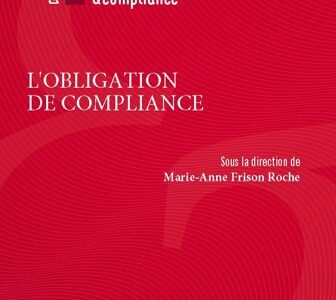
📕L’Obligation de Compliance (dir.)

► Full Reference: M.-A. Frison-Roche (dir.), L'Obligation de Compliance, coll."Régulations & Compliance", Journal of Regulation & Compliance (JoRC) and Dalloz, 2025, 816 p. - 📘 At the same time, a book in English, Compliance Obligation, is published in the collection copublished by the Journal of Regulation & Compliance (JoRC) and the Éditions Bruylant. - 📚This volume is one of a series of books devoted to Compliance in the series edited by Marie-Anne Frison-Roche. - ► General presentation of this book: Compliance is sometimes presented as something that cannot be avoided, which is tantamount to seeing it as the legal obligation par excellence, Criminal Law being its most appropriate mode of expression. It is sometimes presented as something that the company does out of ethical concern, self-regulation which is the opposite of legal obligation. For the moment, therefore, there is no single vision of the Compliance Obligation. This is all the less the case because of the multitude of texts, themselves constantly evolving and changing, which inject such a wide range of compliance obligations that we give up trying to establish any unity, thinking that, on a case-by-case basis, we will define a regime and a legal constraint of greater or lesser strength, aimed at one subject or debtor or another, for the benefit of one or other. This lack of unity, due to the absence of a definition of the Compliance Obligation, makes the application of the texts difficult to foresee and therefore makes the Judge fearful, even though he/she is going to take on more and more importance. This book asks the practical questions: What is Compliance obliging? Who is obliged to comply? and How far are we obliged to comply? and provides answers, Compliance practices, constraints and innovations will be better mastered and anticipated by all those they affect: companies, stakeholders, technicians, lawyers, consultants, institutions and courts. - 🏗️general construction of this Book: The book opens with a double Introduction.  The first, which is freely accessible, consists of a summary of the book, while the second, which is substantial, deals with the unified conception that we can, and indeed should, have, of the "Compliance Obligation", without losing the concrete and active character that characterises this branch of law. The first Part of the book aims to define the Compliance Obligation. To this end, Chapter I deals with the Nature of this obligation. Chapter II deals with the Spaces of the Compliance Obligation. The Part II aims to articulate the Compliance Obligation with other branches of Law.  The Part III of the book looks at the way in which the possibility of obliging and the means of obliging are provided.  To this end, Chapter I deals with the Convergence of the Sources of the Compliance Obligation. Chapter II considers International Arbitration as a reinforcement of the Compliance Obligation. To this end, Chapter I deals with the Convergence of the Sources of the Compliance Obligation. Chapter II considers International Arbitration as a reinforcement of the Compliance Obligation.  The last Part of the book is devoted to Vigilance, the leading edge of the Compliance Obligation. Chapter I is devoted to a study of the various sectors, and analyses the Intensities of the Vigilance Obligation. Chapter II deals with the Variations in Tension generated by the Vigilance Obligation. Finally, Chapter III deals with the New Modalities of the Compliance Obligation, highlighted by the Vigilance Imperative. - TABLE OF CONTENTS    ANCRER LES OBLIGATIONS DE COMPLIANCE SI DIVERSES    DANS LEUR NATURE, LEURS REGIMES ET LEUR FORCE  POUR DEGAGER  L'UNITE DE L'OBLIGATION DE COMPLIANCE LA RENDANT COMPREHENSIBLE ET PRATIQUABLE  (ANCHOR COMPLIANCE OBLIGATIONS, SO DIVERSE  IN THEIR NATURE, THEIR REGIMES AND THEIR FORCE, TO BRING OUT THE UNITY OF THE COMPLIANCE OBLIGATION MAKING IT COMPREHENSIBLE AND PRACTICABLE) ♦️ Obligation de Compliance : construire une structure de compliance produisant des effets crédibles au regard des Buts Monumentaux visés par le Législateur (Compliance Obligation: building a compliance structure that produces credible results with regard to the Monumental Goals targeted by the Legislator), by 🕴️Marie-Anne Frison-Roche   TITRE I. CERNER L’OBLIGATION DE COMPLIANCE  (IDENTIFYING THE COMPLIANCE OBLIGATION)   CHAPITRE I : LA NATURE DE L’OBLIGATION DE COMPLIANCE (THE NATURE OF THE COMPLIANCE OBLIGATION) Section 1 ♦️ La volonté, le cœur et le calcul, les trois traits cernant l'Obligation de Compliance  (Will, Heart and Calculation, the three traits encercling the Compliance Obligation), by 🕴️Marie-Anne Frison-Roche Section 2 ♦️ De la dette à l’obligation de compliance (From the Debt to the Compliance Obligation), by 🕴️Bruno Deffains Section 3 ♦️ Obligation de Compliance et droits humains (Compliance Obligation and Human Rights), by 🕴️Jean-Baptiste Racine Section 4 ♦️ L'Obligation de Compliance et les mutations de la souveraineté et de la citoyenneté (Compliance Obligation and changes in Sovereignty and Citizenship), by 🕴️René Sève Section 5 ♦️ La définition de l''obligation de compliance confrontée au droit de la cybersécurité (The definition of the Compliance Obligation in Cybersecurity Law) by🕴️Michel Séjean   CHAPITRE II : LES ESPACES DE L’OBLIGATION DE COMPLIANCE (SPACES OF THE COMPLIANCE OBLIGATION) Section 1 ♦️ Entités industrielles et Obligation de compliance (Industrial entities and Compliance Obligation), by 🕴️Etienne Maclouf Section 2 ♦️ L'Obligation de Compliance dans les chaînes de valeur (The Compliance Obligation in Value Chains), by 🕴️Lucien Rapp Section 3 ♦️ Compliance et conflits de lois. Le droit international de la vigilance-conformité à partir de quelques applications récentes sur le continent européen (Compliance and conflict of laws. International Law of Vigilance-Conformity, based on recent applications in Europe), by 🕴️Louis d'Avout    TITRE II. ARTICULER L’OBLIGATION DE COMPLIANCE AVEC DES BRANCHES DU DROIT (ARTICULATING THE COMPLIANCE OBLIGATION WITH BRANCHES OF LAW)   Section 2 ♦️ Droit fiscal et obligation de compliance (Tax Law and Compliance Obligation), by 🕴️Daniel Gutmann Section 3 ♦️ Le droit processuel, prototype de l'Obligation de Compliance (General Procedural Law, prototype of the Compliance Obligation), by 🕴️Marie-Anne Frison-Roche Section 4 ♦️ Le droit des sociétés et des marchés financiers face à l'Obligation de Compliance (Corporate and Financial Markets Law facing the Compliance Obligation), by 🕴️Anne-Valérie Le Fur Section 5 ♦️ Le rapport entre le Droit de la responsabilité civile et l'Obligation de Compliance (The link between Tort Law and Compliance Obligation), by 🕴️Jean-Sébastien Borghetti Section 6 ♦️ Dimensions environnementales et climatiques de l'Obligation de Compliance (Environmental and Climatic Dimensions of the Compliance Obligation), by 🕴️Marta Torre-Schaub Section 7 ♦️ Droit de la concurrence et Droit de la Compliance (Competition Law and Compliance Law), by 🕴️Jean-Christophe Roda Section 8 ♦️ L'Obligation de Compliance en Droit global (The Compliance Obligation in Global Law), by 🕴️Benoît Frydman & 🕴️Alice Briegleb Section 9 ♦️ Les juges du droit des entreprises en difficulté et les obligations de compliance (Judges of Insolvency Law and Compliance Obligations), by 🕴️Jean-Baptiste Barbièri   TITRE III. COMPLIANCE : DONNER ET SE DONNER LES MOYENS D’OBLIGER (COMPLIANCE : GIVE AND TAKE THE MEANS TO OBLIGE)   CHAPITRE I : LA CONVERGENCE DES SOURCES (CONVERGENCE OF SOURCES) Section 1 ♦️ Obligation sur obligation vaut (Compliance Obligation on Obligation works), by 🕴️Marie-Anne Frison-Roche Section 2 ♦️ Les technologies disponibles, prescrites ou proscrites pour satisfaire Compliance et Vigilance (Technologies available, prescribed or prohibited to meet Compliance and Vigilance requirements), by 🕴️Emmanuel Netter Section 3 ♦️ Contrainte légale et stratégie des entreprises en matière de Compliance (Legal Constraint and Company Strategies in Compliance matters), by 🕴️Jean-Philippe Denis & Nathalie Fabbe-Costes Section 4 ♦️ La loi, source de l’Obligation de Compliance (The Law, source of the Compliance Obligation), by 🕴️Jean-Baptiste Blanc Section 5 ♦️ Opposition et convergence des systèmes juridiques américains et européens dans les règles et cultures de compliance (Opposition and Convergence of American and European Legal Systems in Compliance Rules and Cultures), by 🕴️Raphaël Gauvain & 🕴️Blanche Balian Section 6 ♦️ Ce à quoi les engagements engagent qu'est un engagement (What a ), by 🕴️Marie-Anne Frison-Roche   CHAPITRE II : L’ARBITRAGE INTERNATIONAL EN RENFORT DE L’OBLIGATION DE COMPLIANCE (INTERNATIONAL ARBITRATION IN SUPPORT OF THE COMPLIANCE OBLIGATION) Section 1 ♦️ Comment l'arbitrage international peut être un renfort de l'Obligation de Compliance (How International Arbitration can reinforce the Compliance Obligation), by 🕴️Laurent Aynès Section 2 ♦️ La considération par l'Arbitrage de l'Obligation de Compliance pour une place d'arbitrage durable (Arbitration' consideration of Compliance Obligation for a Sustainable Arbitration Place),  by 🕴️Marie-Anne Frison-Roche  Section 3 ♦️ L’usage de l’arbitrage international pour renforcer l’obligation de Compliance : l’exemple du secteur de la construction (The use of International Arbitration to reinforce the Compliance Obligation: the example of the construction sector), by 🕴️Christophe Lapp Section 4 ♦️ L’arbitre, juge, superviseur, accompagnateur  ? (The Arbitrator, Judge, Supervisor, Support) , by 🕴️Jean-Baptiste Racine   TITRE IV. LA VIGILANCE, POINTE AVANCÉE DE L’OBLIGATION DE COMPLIANCE (VIGILANCE, SPEARHEAD OF THE COMPLIANCE OBLIGATION) Section 1 ♦️ La Vigilance, pointe avancée et part totale de l'Obligation de Compliance (….), by 🕴️Marie-Anne Frison-Roche CHAPITRE I : LES INTENSITÉS DE L’OBLIGATION DE VIGILANCE, POINTE AVANCÉE DU SYSTÈME DE COMPLIANCE (INTENSITIES OF THE VIGILANCE OBLIGATION, SPEARHEAD OF THE COMPLIANCE SYSTEM) Section 2 ♦️ L’intensité de l’Obligation de Vigilance selon les secteurs : le cas des opérateurs financiers (Intensity of the Vigilance Obligation by Sectors: the case of Financial Operators), by 🕴️Anne-Claire Rouaud Section 3 ♦️ L’intensité de l’Obligation de Vigilance selon les secteurs : le cas des opérateurs bancaires et d’assurance (Intensity of the Vigilance Obligation by Sectors: the case of Banking and Insurance Operators), by 🕴️Mathieu Françon Section 4 ♦️ L’intensité de l’obligation de vigilance selon les secteurs : le cas des opérateurs numériques (Intensity of the Vigilance Obligation by Sectors: the case of Digital Operators), by 🕴️Grégoire Loiseau Section 5 ♦️ L’Obligation de vigilance des opérateurs énergétiques (The Vigilance obligation of Energy Operators), by 🕴️Marie Lamoureux Section 2 ♦️ Transformation de la gouvernance et obligation de Vigilance (Transformation of Governance and Vigilance Obligation), by 🕴️Véronique Magniermag   CHAPITRE II : LES DISPUTES AUTOUR DE L'OBLIGATION DE VIGILANCE, POINTE AVANCÉE DU SYSTÈME DE COMPLIANCE, DANS SON RAPPORT AVEC LA RESPONSABILITÉ Section 1 ♦️ Le rapport entre le droit de la responsabilité civile et l'obligation de compliance, by 🕴️Jean-Sébastien Borghetti Section 2 ♦️ Repenser le concept de responsabilité civile à l’aune du devoir de vigilance, pointe avancée de la compliance (Rethinking the Concept of Civil Liability in the light of the Duty of Vigilance, Spearhead of Compliance), by 🕴️Mustapha Mekki Section 3 ♦️ Tensions et contradictions entre les instruments relatifs à la vigilance raisonnable des entreprises, by 🕴️Laurence Dubin Section 4 ♦️ Compliance, Vigilance et Responsabilité civile : mettre en ordre et raison garde (Compliance, Vigilance  and Civil Liability: put in order and keep the Reason), by 🕴️Marie-Anne Frison-Roche   CHAPITRE III : LES MODALITÉS NOUVELLES DE L'OBLIGATION DE COMPLIANCE, MISES EN LUMIÈRE PAR L'IMPÉRATIF DE VIGILANCE (NEW MODALITIES OF THE COMPLIANCE OBLIGATION, HIGHLIGHTED BY THE VIGILANCE IMPERATIVE) Section 1 ♦️ Clauses et contrats, modalités de l’obligation de vigilance (Clauses and Contracts, terms and conditions of implementation of the Vigilance Obligation), by 🕴️Gilles J. Martin Section 2 ♦️ La preuve de la bonne exécution de la Vigilance au regard du système probatoire de Compliance (Proof that Vigilance has been properly carried out with regard to the Compliance Evidence System), by 🕴️Jean-Christophe Roda   TITRE V. LE JUGE ET L'OBLIGATION DE COMPLIANCE (THE JUDGE AND THE COMPLIANCE OBLIGATION) Section 1 Section 1 ♦️ Devoir de vigilance et litiges commerciaux : une compétence à partager ?, par 🕴️François Ancel Section 2 ♦️ Les enjeux présents à venir de l’articulation des principes de procédure civile et commerciale avec la logique de compliance (Present and Future Challenges of Articulating Principles of Civil and Commercial Procedure with the Logic of Compliance), by 🕴️Thibault Goujon-Bethan Section 3 ♦️ Le juge de l’amiable et la compliance (The amicable settlement judge and compliance), by 🕴️Malik Chapuis Section 4 ♦️ Le Juge requis pour une Obligation de Compliance effective (The Judge required for an Effective Compliance Obligation), by 🕴️Marie-Anne Frison-Roche     L’OBLIGATION DE COMPLIANCE : VISION D’ENSEMBLE (COMPLIANCE OBLIGATION : OVERVIEW) ♦️ L'obligation de compliance, charge portée par les entreprises systémiques donnant vie au Droit de la Compliance. – lignes de force de l'ouvrage (The Compliance Obligation, a burden borne by Systemic Companies giving life to Compliance Law –  key points of the book (free access) by 🕴️Marie-Anne Frison-Roche - 🌐follow Marie-Anne Frison-Roche on LinkedIn 🌐follow Marie-Anne Frison-Roche on Instagram 🌐subscribe to the Newsletter MAFR Regulation, Compliance, Law 🌐subscribe to the VideoNews  MAFR Surplomb 🌐subscribe to the Newsletter MaFR Law & Art
Working papers

🚧The invention of the ‘right to a child’. The consequences of contractual practice as a source of childbearing

► Full reference : M.-A. Frison-Roche, The invention of the 'right to a child'. The consequences of contractual practice as a source of filiation, working document, Sept. 2024 – Oct. 2025. - 🎤This working document forms the basis of a presentation entitled, "Le "droit à l'enfant" est-il concevable, pourquoi et avec quelles conséquences" (Is the 'right to a child' conceivable, why and with what consequences", in Les nouvelles filiations. Diifférentes perspectives (New parentage. Different perspectives." held at the Paris Court of Appeal on 12 September 2024. - 📝Revised, this working document forms the basis of the article published in the dossier "Les nouvelles filiations. Regards croisés" (New parentage. Different perspectives), Act. jur. Dalloz Droit de la famille (in French). - ► Summary of this working document  :  Every legal system is built on concepts that form its pillars. Filiation is one such concept. A cas-law solution, presented as pragmatic and casuistic, can overturn this concept. Whether one agrees with it or not, it must first be acknowledged and assessed. Through a series of rulings on surrogacy, notably a ruling by its First Civil Chamber granting exequatur to a judgment recognising the filiation established by surrogacy between a child and persons with no biological link to the child and without recourse to adoption, the French Cour de Cassation has introduced the possibility of creating parentage by contract. This not only changes the concept of filiation but also changes the very structure of the French legal system, which is based on the distinction between persons and things. One may agree or disagree with this, but it must be said. Since the judge gives force to such a contract establishing filiation, with the foreign judge simply recognising it and the French judge ensuring only that the contract is balanced, the prospect opens up of a society in which individuals will be able to contractually create institutions at their disposal, within the private normative space of the contract, with the State's only function being to give effect to their right to legal recognition of their unique "project". Parentage is only a first example. Thus constructed on what was "inconceivable", i.e. a "right to a child", thanks to the contractual power to which the State should lend its force a posteriori, the judge makes parentage resulting from a contract technically "admissible" and opens up a contractually governed society. - 🔓read the working document below⤵️ - 🌐Follow Marie-Anne Frison-Roche on LinkedIn 🌐follow Marie-Anne Frison-Roche on Instagram 🌐Subscribe to the Newsletter MAFR Regulation, Compliance, Law 🌐Subscribe to the video newsletter MAFR Overhang 🌐Subscribe to the Newsletter MaFR Law & Art

Working papers

🚧In Compliance Law, the legal consequences for Entreprises of their commitments and undertakings

► Full Reference: M.-A. Frison-Roche, In Compliance Law, the legal consequences for Entreprises of their commitments and undertakings, June 2024. - 📝 This Working Paper is the basis for the contribution "In Compliance Law, the legal consequences for Entreprises of their commitments and undertakings", in📘Compliance Obligation. - ► Summary of this Working Paper: The innocents might believe, taking the Law and its words literally, that "commitments" are binding on those who make them. Shouldn't they be afraid of falling into the trap of the 'false friend', which is what the Law wants to protect them from (as stated in the prolegomena)? Indeed, the innocent persons think that those who make commitments ask what they must do and say what they will do. Yet, strangely enough, the 'commitments' that are so frequent and common in compliance behaviours are often considered by those who adopt them to have no binding value! Doubtless because they come under disciplines other than Law, such as the art of Management or Ethics. It is both very important and sometimes difficult to distinguish between these different Orders – Management, Moral Norms and Law – because they are intertwined, but because their respective standards do not have the same scope, it is important to untangle this tangle. This potentially creates a great deal of insecurity for companies (I). The legal certainty comes back when commitments take the form of contracts (II), which is becoming more common as companies contractualise their legal Compliance Obligations, thereby changing the nature of the resulting liability, with the contract retaining the imprint of the legal order or not having the same scope if this prerequisite is not present. But the contours and distinctions are not so uncontested. In fact, the qualification of unilateral undertaking of will is proposed to apprehend the various documents issued by the companies, with the consequences which are attached to that, in particular the transformation of the company into a 'debtor', which would change the position of the stakeholders with regard to it (III). It remains that the undertakings expressed by companies on so many important subjects cannot be ignored: they are facts (IV). It is as such that they must be legally considered. In this case, Civil Liability will have to deal with them if the company, in implementing what it says, what it writes and in the way it behaves, commits a fault or negligence that causes damage, not only the sole existence of an undertaking.  - 🔓read the developments below ⤵️ - 🌐follow Marie-Anne Frison-Roche on LinkedIn 🌐follow Marie-Anne Frison-Roche on Instagram 🌐subscribe to the Newsletter MAFR Regulation, Compliance, Law  🌐subscribe to the Video Newsletter MAFR Surplomb

Working papers

Working Paper for an article

🚧Compliance, Vigilance and Civil Liability: put in order and keep the sense of Reason

► Full Reference : M.-A. Frison-Roche, Compliance, Vigilance and Civil Liability: put in order and keep the sense of Reason, Working Paper, June 2024 - 📝 In its French version, this Working Paper is the basis of the contribution "Compliance, Vigilance et Responsabilité civile : mettre en l'ordre et raison garder", in 📕L'Obligation de Compliance - ► Summary of this Working Paper:  The descriptions of the Liability incurred by large companies as a result of their compliance obligations are very diverse, even contradictory, going beyond the wishes that may be expressed as to what this liability should be. The first part of this study therefore sets out the various liabilities incurred by companies, which differ in the conditions under which they are implemented and in their scope, so as not to confuse them. Indeed, as the various laws establish specific legal compliance obligations, they give rise to liabilities of varying conditions and scope, and it is not possible to avail of the regime of one in a situation that falls within the scope of another. It is therefore necessary to review the various bodies of compliance legislation, the GDPR, the ALM-FT regulations, the French so-called Sapin 2 law, the French so-called Vigilance law , the European IA Act , the European European DGA Act, etc., to recall the inflexion that each of these bodies of legislation has made to the liability rules applied to the companies subject to them. Nevertheless, the unicity of the Compliance Obligation, overcoming this necessary diversity of situations, regulations and liability regimes,  can provide grouping lines to indicate beyond this diversity the extent of the liability incurred by companies. Once this classification has been made, the second part of the study develops the observation that none of this can create any principle of general liability on large companies in terms of compliance, and in particular not in terms of vigilance. It is not possible to deduce a general principle of specific obligations of liability or specific obligations to reparation, for example in the area of vigilance, as the texts creating specific vigilance obligation refer to the conditions of commun Tort Law (proof damage and causality), and International Public Law does not have the force to generate a general principle binding companies in this respect. The third part stresses that it is nevertheless always possible to invoke Tort Law, and companies cannot claim to escape this. This may involve contractual liability, a situation  becoming increasingly frequent as companies contractualise their legal compliance obligations, reproducing them but also modifying them, and as Vigilance duty is an obligation that goes beyond the specific situations covered by the regulations.  But it is essential, and this is the subject of the fourth part, not to make companies pure and simple guarantors of the state of the world, present and future. Indeed, if we were to transform sectoral compliances into illustrations of what would then be a new general principle, but one that applied only to them, they would consequently exercise the other side of this coin, namely power over others. - 🔓read the Working Paper below⤵️ - 🌐follow Marie-Anne Frison-Roche sur LinkedIn 🌐follow Marie-Anne Frison-Roche on Instagram 🌐subscribe to the Newsletter MAFR Regulation, Compliance, Law 🌐subscribe to the Video Newsletter MAFR Surplomb

Working papers

Working Paper

🚧Conditions required to promote the “contractualisation” of the Law

🌐follow Marie-Anne Frison-Roche on LinkedIn 🌐subscribe to the Newsletter MAFR Regulation, Compliance, Law - ► Full Reference: M.-A. Frison-Roche, Conditions required to promote the "contractualisation" of the Law, Working Paper, June 2023. - 🎤This Working Paper has been done as a basis for the closing conference of the colloquia La contractualisation du droit. Acte II, organised by the Société de législation comparée (SLC) and the Procuradoria Geral do Estado do Rio de Janeiro (PGE-RJ), on 19, 20 and 21 June 2023. - 📝It is also the basis of the article "Les conditions requises pour favoriser la "contractualisation" du droit" ("Conditions required to promote the "contractualisation" of Law"), published in the book 📗La contractualisation du droit. Approches françaises et brésiliennes (Contractualisation of Law. French and Brazilian approaches). - ► English Summary of the Working Paper :  - 🔓read the Working Paper⤵️

Working papers

🚧Compliance contract, compliance clauses

🌐 follow Marie-Anne Frison-Roche on LinkedIn 🌐 subscribe to the Newsletter MAFR Regulation, Compliance, Law  - ► Full Reference: M.-A. Frison-Roche, Compliance contract, compliance clauses, working paper, September 2022. - ►Summary of this working paper:  Compliance Law has multiplied obligations. However, although Tort Law is emerging in Compliance issues and contracts are multiplying in practice, for the moment the relationship between Compliance Law and Contract Law is not very visible (I). However, there are contracts whose sole purpose is to give concrete form to Compliance, which creates a specific contract and must influence its implementation (II). Moreover, there is much to learn from the diversity of compliance stipulations scattered throughout a wide range of contracts (III). - 🔓read the developments below⤵️

Working papers

🚧 Conceiving Power

► Full reference: M.-A. Frison-Roche, Conceiving Power, Working Paper, December 2021 - 📝 This Working Paper serves as the basis for an article to be published in the collective book drawn up in tribute to Professor Emmanuel Gaillard.    - ► Working Paper summary: In 1985, Emmanuel Gaillard's central work came out under the title Le pouvoir en droit privé  (The Power in Private Law)📎1Gaillard, E., Le pouvoir en droit privé, préf. Cornu. G., coll. ..., Economica, 1985., but when it was defended in 1981, his thesis directed by Dean Cornu was entitled La notion de pouvoir en droit privé (The notion of Power in Private Law) 📎2Gaillard, E., La notion de pouvoir en droit privé, thèse .... ; . Let's give full force to the original title of the thesis.   The deletion of the term notion perhaps implies that by defining something the essential is done, that there would be something of a pleonasm in aiming at The notion of Power and The Power, as Law likes to economise on words.   But it was indeed a renewed, simpler and more powerful conception of the notion of Power, containing the entire regime necessarily imputed, that this work imposed, henceforth illuminating positive Law. Emmanuel Gaillard's definition, on the other hand, goes beyond Private Law. We would gladly have argued in favour of retaining the heading for the term Notion, proposing instead to dispense with the reference to Private Law alone …. Perhaps it was because the concept is so vast that in this seminal thesis its scope was restricted to Private Law, since the author already had to account for the sheer multiplicity of manifestations in this part of the legal system; Or perhaps it was because the concept of 'Power' is so familiar in Public Law that it would have needed less definition in Public Law (which, moreover, is so diversely proposed in this more political area, which is already careful on principle to distinguish between powers, which must always be plural in order to be separated), and that it was therefore reasonable to want to arrive at a single concept of Power in Private Law, where the notion of subjective rights is more familiar.  However, Emmanuel Gaillard's definition of Power as a prerogative placed, by legal rule or contract, in the hands of the person invested with them for the benefit, at least in part, of others, covers both Public and Private Law. This even contributes to the solidity of this thesis and explains why it flourishes today in legal systems where the distinction between Private Law and Public Law is weakening. The power of this definition lies in its simplicity. Simple and brave minds are often the most fruitful. As Dean Gérard Cornu points out in his preface, the author, in particular because he bases himself more on positive law, for example that relating to the powers of corporate officers, does not get bogged down in discussions between authors only to end up preferring one over the other. He arrives at a definition that is close to our everyday experience: the one we experience when we collect an envelope on behalf of someone else and the agent asks us in what capacity we claim to be doing this on his behalf. We then show him our 'power', the legal power to do so for the benefit of the person to whom the letter is addressed, and can thus exercise the power to withdraw the letter, even though it is personal. When legal and common sense come together, it is a good omen, not only in terms of form, because everyone can understand it and the Law must remain comprehensible, but also in terms of substance, because everyone must be able to control the exercise of a power that is exercised for and over others. For this letter addressed to someone else, the person who has been able to take it by virtue of the power conferred on him/her, could just as easily open it and read it, then destroy it or give it to the worst enemy of the person to whom it was addressed. In Power, there is always might to do, and the danger to others that Power contains therefore.  This highly legal definition of Power not only distances the holder from his/her own interests, but also channels the Power thus granted to the person who benefits from it. In this respect, Emmanuel Gaillard not only distinguished between Power and subjective right, but also identified the right amount of power required for this power to effectively fulfill this 'Mission', through the notion of abuse of power, when the holder uses for other beneficiaries this power that was conferred on him/her for this sole purpose. What is more, this concept makes it possible to distinguish Power from discretionary force, because the holder of Power thereby exercises factual , by acting for others, deciding for others, deciding on others. Because Power is inseparable from might, but might must remain the means of power and no more, the Law shall produce the antibodies that are not only the theory of abuse of power but also an Ex Ante responsibility that accounts must always be rendered, either to the other for whom everything is done or to a third party. For this third party is often there from the outset, the guardianship judge for example: because the Power was put in place because of the beneficiary's weakness, both in himself/herself and because of the situation, an impartial and disinterested third party is needed to ensure proper execution from the outset, without there even being a dispute. In this respect, how useful this thesis is for thinking about what Supervision is today!   This thesis, so clear, so simple and so strong, goes beyond Private or Civil Law. It is both much more restrictive than the more factual and political definition of Oower, which would be the ability to do something, and much broader than the usual definitions, since it embraces and legitimises de jure all situations where a person acts legally for the benefit of another.  Dean Cornu shows, moreover, in two sentences that such a notion of power also captures the office of the judge, who has power over others only to serve them 📎3"En droit processuel, l'office du juge aurait donné à l'auteur un renfort. Pour le juge, il n'est point de pouvoir sans devoir. Au-delà de la distinction de ce qu'il a obligation de faire ou faculté d'apprécier, il y a toujours, au creux de ce qu'il peut, le sceau de ce qu'il doit, un devoir gardien - comme un âme - de l'exercice du pouvoir." (p.5).. The definition corresponds to the mission of one who has power only to fulfill his office. It suits so well the conception we have today of Administration, especially if it takes the form of independent authorities. Moreover, Power thus contains its own limit in its very definition, since others are present in it: the holder has power only to serve others. From then on, it is only a power because it is a kind of Charge. Emmanuel Gaillard immediately uses the term: "Un individu se voit confier une charge qu'il exerce dans un intérêt au moins partiellement distinct du sien propre"  ("An individual is entrusted with an office which he exercises in an interest at least partially distinct from his own") 📎4n°3, p.9. . Dean Carbonnier, who reformed the legislation in this area 📎5🕴️J. Carbonnier, 📗Essai sur les lois, 1992 (on the guardianship).,, emphasised that the guardian has a public duty because the State entrusts him/her with a child. In the same way parental authority is a charge on the parents for the benefit of the children. More generally, Power is a burden that the Law places on a person to satisfy the interests of another. This definition offered by Emmanuel Gaillard in 1981, anchored in Private Law only insofar as it is the entire legal system, is premonitory of the Regulatory and Compliance Law as it unfolds today. It would be enough to continue the Gaillard's sentences, as if they had been half-written, to finish them 40 years later and find in them the mechanisms of Supervision of companies by public authorities which are now in place not to reduce their power but to ensure that they exercise it for the benefit of others 📎6S. in a general way, 🕴️M.-A. Frison-Roche (ed.), 📕Régulation, Supervision, Compliance, 2017.. The whole evolution of Company Law and Financial Law is here. Between the lines of this thesis, which develops the notion of duty 📎7Cornu, préface précitée : "Tous les pouvoirs sont, à double face, des pouvoirs-devoirs" (p.5)., we can also see what positive Law is developing today, in particular through the 'duty of Vigilance', this personal responsibility for the benefit of others (I). The definition of Power thus conceived contains within itself its regime and enables us to anticipate it better today: because the holder exercises Power only for others, at least partially, he is consubstantially accountable for it, responsibility being only one form of this accountability; because this service must be effective and others must benefit fully from it, because unlike the subjective right which allows the holder freely not to use his might, Power has never been the 'most absolute' availability to use his/her might: it is even the opposite. It is the expression of a Power assigned to a purpose, compelling the holder to use his/her Power to that end.  But it is equally necessary for the holder to have all the might to do so, otherwise the very notion of 'Power' is meaningless. This is the definition that should be given to the principle of Proportionality: the person on whom the Power rests must have not more power than is necessary, but all the power necessary to achieve the Monumental Goals for which the Power has been entrusted to him/her, so that others may derive full benefit from it (II).  In today's positive Law, the definition of Power as a Duty is found not only in Private Law but also in Public Law, not least because pure might, i.e. those that do not account for the use of their might, are in decline while concern for others is on the increase. The days of discretionary powers are over, and the increased independence of those who exercise Power over others requires them to be accountable. Beyond this Accountability, the personal Responsibility of those who have the Power to serve others is being established. But, no doubt because the Law is slow to evolve, the correlative idea that the holder of Power must have all the powers required to carry out his/her mission is less entrenched:  As Emmanuel Gaillard has shown, the Law has only gone part of the way in sanctioning excesses of power, when the holder uses his/her power for other goals, but it has not yet clearly established that the holder – sometimes forced – of a Power is legitimate in using all the means required to achieve the result for which this Power, i.e. a charge and a duty, has been conferred on him/her.   No doubt we need to read Emmanuel Gaillard's thesis again in all its potential, to imagine the reading we could do today of what he could have written as if on blank pages that would write themselves, a magical thesis where everything is already there, a thesis so short (250 pages) and so beautiful, so dense that it already contains the Law of the Future. The Law of the Future 📎8On Compliance Law as a Law of the Future, s. 🕴️M.-A. Frison-Roche, 📝Compliance Monumental Goals, beating heart of Compliance Law, in 🕴️M.-A. Frison-Roche (ed.), 📘Compliance Monumental Goals, 2023. On the consequences for Liability Law, which is now looking to the Future, s. 🕴️M.-A. Frison-Roche, 🚧Ex Ante Responsibility, 2021.  where there must be much more responsibility for the benefit of others📎9Sur la notion de "Responsabilité Ex Ante", v. Frison-Roche, M.-A., La responsabilité Ex Ante", in Archives de Philosophie du Droit, La responsabilité, 2022. and powers since this notion includes others who are the beneficiaries. Droit de l'Avenir where Emmanuel Gaillard will be present, in particular thanks to this work of doctrine offered in 1981.  So that, in practical terms, those who are entrusted with looking after others – for example, today all companies obliged by Compliance Law to look after others so that they are not destroyed by hatred in the digital space, by corruption in the economic system or by climate change in a projected future – do not find themselves challenged by the same Law for the means of exercising this power for the benefit of others, for example when this involves 'judging'. Dean Cornu himself emphasised the identity of the two offices. -                         Lire les développement ci-dessous⤵ - 🌐 follow Marie-Anne Frison-Roche on LinkedIn 🌐follow Marie-Anne Frison-Roche on Instagram 🌐subscribe to the Newsletter MAFR Regulation, Compliance, Law 

Working papers

Working Paper

🚧The Hypothesis of the category of Systemic Cases brought before the Judge

► Full Reference: M.-A. Frison-Roche, The Hypothesis of the category of Systemic Cases brought before the Judge, Working Paper, October 2021 and April 2022. - ► This working paper has served as the basis for an introductory speech 🎤L'hypothèse de la catégorie des causes systémiques (The Hypothesis of the cateory of Systemic Cases), in a more general conference which I coordinated and moderated, 🧱L'office du juge et les causes systémiques, which is part of a general cycle covering Penser l'office du juge, specific conference attending the 9th May 2002 into the Grand Chamber of the Cour de cassation.   This Working Paper was drawn up in October 2021 to build the conference on the assumption that among the diversity of "cases" brought to the courts by litigants, some constitute a specific category: "systemic cases", justifying treatment that is both specific (in that they are systemic, calling in particular for procedural solutions common to all and distinguishable from the treatment of non-systemic cases) and common treatment beyond the diversity of judges who deal with them (judicial and administrative judges, criminal and non-criminal judges, French and non-French judges, judges of the member-States legal orders and European Union judges, etc.).  This working paper does not aim to deal with the whole subject, i.e. both to determine this category of "systemic causes" and the consequences that must be drawn from it for the judge's office, since that is the very purpose of the conference, which is built around several presentations: it aims to deal with the first part of the subject, i.e. the very existence of this new processual category, which is "systemic causes", leaving for other work the practical consequences to be drawn from it in the processual treatment that it calls for. - 📝This Working Paper is also the basis of a forthcoming article - ► Summary of the Working Paper: xx - Read below the developments⤵️ - 🌐follow Marie-Anne Frison-Roche on LinkedIn 🌐follow Marie-Anne Frison-Roche on Instagram 🌐subscribe to the Newsletter MAFR. Regulation, Compliance, Law

Breaking news

📧 Doesn’t the Law have to intervene when Technology aims to capture thoughts by squeezing the medium of speech? Case of the implantation of a brain chip recording thoughts directly on a computer screen

►  An article published on July 14, 2021 by The Wall Street Journal, "Brain Implant Lets Man 'Speak' After Being Silent for More Than a Decade", relays the information that it is now possible, on an experimental basis, to implant in the brain a device allowing a person deprived by a neurological accident to speak to be able to express himself again by writing his thoughts directly on a computer screen, on which the words thought are displayed in sentences. - Several years of "fundamental" research, notably on the part of Facebook, which, in particular by subsidizing the French professor of neurosciences Stanislas Dehaene, in a comparison between the learning development of the brain and the development of "deep learning", have been successful. to allow people who have lost the use of the voice to write directly on screens without this vocal medium by going directly from thought to writing. This leads to three reflections, putting Law and Technology at the center: 1. at first glance, speech being only a medium between thought and expression, it would be conceivable to do without it; 2. However, it is required to draw a parallel with the new technology of "emotional recognition" by which thoughts are accessible to third parties, which thwarts the fundamental right to make one's thoughts inaccessible to others;  The news has shown precisely that this technology, making possible to capture the true thoughts of others despite feigned facial expressions, poses a problem with regard to the fundamental right to lie or to remain silent (see in this regard 📧 MaFR, "Compliance and Ethics Technologies may be inadmissible "in themselves" and conceiving of their "ethical use" is therefore not admissible: practical case on the control of workers' emotions "). 3. By anticipating the possible use of this new technology and the legal reaction to this potentiality, the same question raises whether, per se, such an implantation of a tool for "capturing thoughts directly in the brain" to obtain their "direct translation on a screen" should not be considered as the equivalent of capturing thoughts, just as infringing on everyone's fundamental right to keep their thoughts inaccessible. Here again, the fact that in one or two cases, this made it possible to cure a person does not legitimize the technology in itself. Likewise, the fact that the person "consents" is not sufficient to legitimize what may be a per se attack on the dignity of the human person if the technology has the effect of capturing thoughts with a loss of control. the person concerned. For the moment, in the description given by the researchers according to the article which relates the innovation, it is the transmitter who controls the technology but the elimination of the medium of speech or writing deserves to be conceptualized, in the loss of isolation of the individual, isolation to which the Western tradition has often associated Freedom. - ► s'inscrire à la Newsletter MaFR ComplianceTech®