
27 novembre 2021
Conférences

► Référence complète : Frison-Roche, M.-A., présidence de la session "The temporal dimension: Imminence and Intertemporally", in colloque Climate Change Cases before National and International Courts Cross-fertilization and Convergence, 27 novembre 2021, Paris.
____
Lire le programme complet du colloque (en anglais)
Résumé de la présentation du panel : The specific topic of our panel is the “temporal dimension” of the judicial cases of Climate change.
We shall listen to two great experts on this topic, which is Time.
Listening the other previous speakers, I understand how this topic is important, because Climate Change requires an immediate action and it create a political issue, because everyone comes before courts.
A basis and fundamental problem, because the times are not adjusted.
let's come back to basic notions, to have three times : “past, present, future”.
The issue of Climate Change is in the Future, the necessity of Action is in the Present and the basis temporal question is to know if Courts are the bodies adequate to responde ; maybe it is inevitable that Judge must be recreate their office because the time of the classical judicial office is the Past.
Immediately, this simple et huge problem appears : in a classical repartition, the judge is the legal character to intervenir for the Past, the present (maybe is for you and me), and the future is the time for the State, and more precisely for the Parliament.
But the climate change is a huge topic, not in the past, not in the present, but in the future.
Therefore a gap exists between the time of the topic and the time of the court before the case is explained for obtaining a solution : how to give a good answer ? Judge maybe must travel in time, from past to future …. Maybe, he must, but might he?
Classically, the judge can anticipate a very next future, but not the more distant and systemic future. Climate change belongs to the second one.
This is why the title of this panel is non only about the necessity to take in consideration the “imminence” but also the “intertemporally” : maybe court are the sole able to create this intertemporality between Past and Future, and by this way to obtain from States and companies to do something immediately !
By two legal ways.
Courts can stay in Past, supervising States, if they dispose of effective legal decisions taken by States in the past about Climate Change (essentially Paris Agreement, for instance transposed in the French legal system by a formal law). This is why an efficient judicial solution would be the possibility for the courts to oblige State to implement their more or less committment they had taken in the past for the future (as the Conseil d’Etat did in the Commune de Grande-Synthe Cas Law).
Even for that, the courts must adopt a creative notion of what is a commitment from a State through a Law... ; as they must do about private companies comitment (in their codes of conduct or soft law of corporate social responsability).
But what to do if States didn’t take such commitment ?
Some can allege Courts are not Parliaments and are not legitimate to rule for the future … It is a political issue, a very classical one but very accurate for Climate change (where States and companies are face to courts...) and maybe And as our colleague said, judicial system is quite technically weak to concretize human rights.
Therefore, the second way, more innovative, est the new use of Tort Law : no more a liability Ex Post, but a responsibility Ex Ante. In every legal system, even in Civil Law systems, Tort Law is conceived by courts (for instance in French Law).
If the new reasoning is conveived in Ex Ante, Tort Law must be a set of legal tools to reach the monumental tools to reach the "Monumental Goal" (being by nature future) which is the Climate Change stopping.
In this teleological reasoning, the admissibility and the choice remedies, must be adapted to obtain what is central : the effectivity and the efficiencicy.
In this sens, the judgement between two parties (which was an Ex Post act) may be conceived as an systemic efficient action (which was an Ex Ante act), because it must be.
_____

10 novembre 2021
Base Documentaire : Doctrine
Référence complète : Kemfouet, E.-D., Énergies renouvelables, transition énergétique et enjeux climatiques en droit africain, Revue Africaine de Droit de l’Environnement (African Journal of Environmental Law),n°6, nov. 2021.
___
______
Émile-Derlin KEMFOUET

20 octobre 2021
Base Documentaire : Doctrine
Référence complète : Gollier, Jean-Marc, Shell : le profit après le climat, Journal des tribunaux, 2021, p.723 s.
____

6 janvier 2021
Publications

Référence complète : Frison-Roche, M.-A., Environnemental Compliance Law, as an Ex Ante Responsability, for an annexe in a French Report on the liability for the environmental Damages, for the European Commission, janvier 2021.
_____
13 septembre 2020
Base Documentaire : Doctrine
►Référence complète : A. Maymont. ”Le droit de la compliance au secours de la stabilité financière”. Revue Banque, Revue Banque édition, 2020, pp. 50-53.
____
►Résumé de l'article : L'article reprend la définition du Droit de la Compliance comme ce qui prévient les risques de systèmes, notamment les "risques d'instabilité" qui affectent tout particulièrement les risques financiers, lesquels sont désormais principalement extra-financiers, notamment les cyber risques et les risques environnementaux et climatiques.
Il rappelle que le Droit de la Compliance incorpore le principe juridique de stabilité et confie aux autorités publiques le pouvoir d'inférer dans les contrats pour donner primauté à celui-ci. En matière de stabilité financière, c'est notamment l'ACPR et l'AMF qui le font.
Il souligne que pour être efficace, les régulateurs incitent les entreprises à coopérer. Leur action se justifie par l'ordre public financier, lequel évolue, le principe juridique de stabilité permet aux Autorités d'écarter les règles juridiques ordinaires, notamment la liberté contractuelle des banquiers, l'interdiction des ventes à découvert pendant le Covid étant une illustration de cela.
________

22 mai 2018
Publications
♾️ suivre Marie-Anne Frison-Roche sur LinkedIn
♾️ s'abonner à la Newsletter MAFR Regulation, Compliance, Law
____
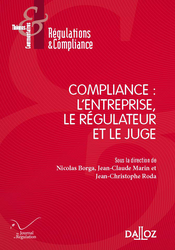
► Référence complète : M.-A. Frison-Roche, "Compliance : avant, maintenant, après", in N. Borga, J. -Cl. Marin et J.-Ch. Roda (dir.), Compliance : l'entreprise, le régulateur et le juge, Série Régulations & Compliance, Dalloz, 2018, p. 23-36.
____
____
🚧 Lire le document de travail sur la base duquel s'appuie l'article
🚧 Read the working paper on which the article is based : Compliance : Before, Now, After.
____
📝Lire l'autre article publié par Marie-Anne Frison-Roche dans cet ouvrage : Entreprise, Régulateur, Juge : penser la compliance par ces trois personnages.
______
► Résumé de l'article : Autant l'admettre. Parce que devant des règles de "Compliance si nombreuses et si disparates l'on a tant de mal à s'y retrouver, l'on est contraint à partir dans des directions si changeantes, que nous nous consolons de leur poids, de leur coût et de l'incompréhension que nous en avons en disant que la "Compliance" est "complexe" et "transdisciplinaire", comme si les mots compliqués pouvaient masquer notre désarroi. Mais la "Compliance" n'est pas un cataclysme, une bombe envoyée par les américains pour anéantir l'Europe, la nouvelle forme d'une Guerre froide en habits juridiques ; c'est une façon de voir des choses qui vient de loin, avec une cohérence qui lui est propre et qu'il faut avant tout comprendre. Pour mieux s'y déployer.
Si l'on comprend d'où vient ce nouveau corpus qui contraint aujourd'hui les entreprises à prouver qu'elles prennent effectivement en charge la concrétisation de certains buts qui les dépassent, notamment la lutte contre le blanchiment d'argent, la fraude fiscale, mais aussi la lutte contre la vente des êtres humains ou la lutte pour la préservation de la nature et de la planète, alors l'on peut continuer l'histoire, dans une nouvelle alliance entre certaines entreprises et les autorités publiques.
En effet, toutes les entreprises ne sont pas visées par une telle internalisation de "buts monumentaux" en leur sein. Une entreprise ordinaire a quant à elle vocation à se développer pour réaliser un but qui est le sien. Le système de Compliance ne peut concerner que des "entreprises cruciales". S'il doit y avoir changement de projet poursuivi par l'entreprise, cela ne peut tenir qu'à sa "position" dans un système. Cette position peut avoir une source objective (entreprise systémique) ou une source subjective, parce que l'entreprise veut concrétiser ces buts globaux car elle veut être "responsable". Dans ce cas, l'entreprise supporte alors la charge de preuve qu'un tel discours de responsabilité nouvelle correspond à un comportement et à une culture effective. Le poids des règles existe déjà aujourd'hui. Et c'est encore comme cela qu'aujourd'hui d'une façon négative et passive que la Compliance est perçue, par ceux qui la "subissent" (entreprises), voire par ceux qui l'appliquent (autorités publiques).
La transformation vers une "culture de confiance, c'est l'enjeu d'un passage entre aujourd'hui et demain. En effet demain, c'est une relation de confiance qui pourrait se construire entre ces entreprises-là et les autorités publiques, parce qu'elles partageaient les informations (enjeu systémique), parce qu'elles seraient d'accord sur les buts monumentaux (tous centrés sur la protection des êtres humains, que le seul fonctionnement marchand ne peut produire, que les seuls États ne peuvent assurer).
En cela, la "Compliance" est avant tout un pari, celui de la place des êtres humains sur des marchés mondialisés.
____
► English Summary of this article. We have to admit, because we find it difficult to find ourselves in front of so numerous and disparate rules, going in all directions and constantly changing, we console ourselves with their weight, their cost and our misunderstanding by affirming that Compliance is "complex" and "transdisciplinary", as if complicated words could mask our disarray. But "Compliance" is not a cataclysm, a bomb sent by the Americans to annihilate Europe, the new form of a Cold War in legal dress, it is a way of seeing things that comes from afar, with a coherence of its own and which must first be understood.
If one understands where this new corpus comes from, which now obliges companies to prove that they effectively take on the fulfillment of certain goals that go beyond them, notably the fight against money laundering, tax evasion , but also the fight against the sale of human beings or the struggle for the preservation of nature and the Earth, then we can continue the story.
Indeed, not all companies are targeted by such internalization of "monumental goals" within them." An ordinary enterprise is destined to develop itself in order to achieve a goal which is its own. The concern of these goals can only be for the "crucial enterprises. "If there is to be a change in the corporate project, then it can only depend on its" position "in a system, a financial, economic, social, global system, or because it has itself decided that it would be so. The company then bears the burden of proof that such a discourse of new responsibility corresponds to a behavior and an effective culture. The weight of the rules already exists today. And it is for the moment that now, in a negative and passive way, Compliance is perceived, by those who "undergo" it (companies), even by those who apply it (public authorities).
The transformation towards a "culture of trust" is the issue between today and tomorrow, because tomorrow, it is a relationship of trust that could be built between these companies and the public authorities, because they would share information (systemic issue), because they would agree on the less technical monumental goals (protection of human beings issue).
In this, "Compliance" is above all a bet, that of the place of human beings in globalized markets.
____
Consulter les autres titres de la Série dans laquelle est publié l'ouvrage.
27 mars 2017
Base Documentaire : Doctrine
Référence complète : Lequet, P., Loi « devoir de vigilance » : de l'intérêt des normes de management des risques, in Revue juridique de l'environnement, vol.42, n°4, 2017, pp.705-725.
Les étudiants de Sciences po, peuvent consulter l'article via le Drive, dossier "MAFR- Régulation & Compliance"