Articles

Articles

Interview in a newspaper

« La compliance est avant tout une affaire humaine » (Compliance is first and foremost a human issue)

► Full Reference: M.-A. Frison-Roche,  « La compliance est avant tout une affaire humaine» (Compliance is first and foremost a human issue), interview conducted by Olivia Dufour for Actu-juridique, Lextenso, 23 January 2025.   - ► read the interview: 💬in French) - 🏛️🏛️🏛️🏛️this interview was organised following a number of official opening hearings of Parisian courts, in particular that of the Paris Judicial Court on 21 January 2025, at which the presidents of these courts explained the role now played by systemic litigation and compliance and/or vigilance law, in particular in the internal organisation of their courts. - ► presentation of this interview:  Q. (translated): At the start of the new session of the official opening hearings of Paris Court of First Instance on 21 January, President Stéphane Noël spoke at length about the creation of a 34th chamber dedicated to handling cases relating to companies' obligation of vigilance. What are the advantages of this new specialisation? MAFR Answer Summary: It corresponds to the jurisdiction given to the Paris Court of First Instance by the French 2020 so-called Confidence Act, which extends the French 2017 so-called Vigilance Act. It reflects the importance of Compliance Law, of which Vigilance is the leading edge.   Q. (translated): The court president points out that this new litigation raises questions about the role of the courts, which is to "concilier le respect des buts fondamentaux pour la protection de l’humanité avec la possibilité pour les entreprises d’apprécier la maitrise des risques et leur éventuelle responsabilité" ("reconcile respect for the monumental goals of protecting humanity with the ability of companies to assess the control of risks and their potential liability"). What do you think?   MAFR Answer Summary: the role of the judge has been renewed, as they take charge of the future of the systems and participates in the achievement of the Monumental Goals of Compliance Law. Companies are subject by law to a new compliance obligation and must demonstrate their diligence. They may be held liable under the general ordinary legal regime, as set out in the French 2017 Act on Vigilance duty, if the claimant demonstrates the existence of fault or negligence, damage and a causal link between the 2.   Q. (translated): All this comes under the heading of compliance, a concept you've been working on for 10 years and which is still not fully understood and is too often confused with conformity….   MAFR Answer Summary: The 2 aforementioned concepts ("conformity" and "compliance") were identified in the article I published in 2016 entitled Le droit de la compliance"Compliance law". This notion has taken a long time to mature because, on the one hand, it is a radically new branch of law that has an impact on the other branches. On the other hand, indeed,  there is confusion between 'compliance' and 'conformity'. Conformity is the obedience to applicable regulations; compliance is the active participation in the achievement of monumental goals to preserve or save systems in which humans are involved. Conformity is, and is only, a tool of Compliance Law.   Q. (translated):  The Nanterre Court has just created a chamber for Emerging Systemic and Regulatory Litigation. Does this confirm the interest of the courts in this fundamental development?   MAFR Answer Summary: This statement by the President of the Nanterre Court of Appeal at his hearing on 20 January 2025 illustrates the Regulation – Compliance – Vigilance continuum. He involves training for judges and dialogue between judges. Training and dialogue are being put in place.   Q. (translated):  Y a-t-il d’autres initiatives en ce sens ? MAFR Answer Summary:Le président du Tribunal de commerce Paris à son audience du 15 janvier 2025 a annoncé la création d'une chambre des contentieux complexe. Les contentieux systémiques émergents, que le Droit de la Compliance peut engendrer, ont vocation à y être présentés. Là  aussi, formation et dialogue se mettent en place.   Q. (translated):  Que manque-t-il encore ? MAFR Answer Summary: puisque le Droit de la compliance se contractualise de plus en plus, notamment dans les chaines de valeur concernées par les techniques de vigilance, l'arbitrage international est concerné. Des arbitres internationaux intégrant le droit de la compliance, et pas seulement attaché à telle et telle réglementation sectorielle, sont un enjeu d'attractivité de la Place de Paris. Cela va émerger, notamment par le dynamisme de la Cour internationale d'arbitrage, dont le siège est à Paris.


Articles

📝Antitrust, natural field of Systemic Litigation

► Full Reference: M.-A. Frison-Roche, "Antitrust, natural field of Systemic Litigation", Concurrences, November 2024, No. 4, Art. No. 120776. - 📝read the article (in English) - 🚧read the bilingual Working Paper which is the basis of this article, with additional developments, technical references and hyperlinks - ► English Summary of this article: Systemic Litigation is a specific category of Litigation in which beyond the dispute between the parties the interest of a System is involved, in particular its future. Competition Law is a natural and long-standing field for this category, which is now emerging strongly for information, climate and energy systems.  It should be remembered that a market is not self-regulating and cannot continue to function in the long term unless it has the benefit of a judge, a figure who is specific in that he/she is both external to it and yet apprehends its specific interest. In order to satisfy this double requirement, liberal legal organisations often entrust the competition authority with jurisdiction over this Systemic Litigation. Ordinary courts will also hear such cases, either on appeal or in other proceedings, and it cannot be claimed that courts are excluded, the systemic dimension of the dispute being expressed by the presence of the competition authority in the proceedings. This explains the procedural rules that are hard to justify otherwise. The Authority, the European Commission for example, must be able to develop and express the specific interests of the competition system. This special role of the competition authority in this type of litigation, because it is systemic, has been in place for decades and should serve as a model for Systemic Litigation, which is being developed for other systems whose sustainability is now referred to the courts.

Articles

💬L’interdiction de la GPA posée par le Code civil n’existe plus

► Full Reference: M.-A. Frison-Roche, "GPA : "L’interdiction de la GPA posée par le Code civil n’existe plus" ("The French Civil Code ban on surrogacy no longer exists"), interview with Olivia Dufour, Actu-Juridique, 26 November 2024 - 💬read the interview (in French) - ► Presentation of the interview by the journal: "Un simple arrêt de section rendu par la première civile de la Cour de cassation le 14 novembre 2024 peut-il donner plein effet à une "pure convention de GPA" ? Telle est la question que l’on peut se poser à la suite de cette décision. Éléments de réponse avec le professeur Marie-Anne Frison-Roche. ". - 🕴️M.-A. Frison-Roche, 📕GPA : dire Oui ou dire Non, 2018 - ► Questions posées, réponses apportées :  Actu-Juridique. Question : Un arrêt de section de la première chambre civile de la Cour de cassation rendu le 14 novembre dernier en matière de gestation pour autrui (GPA) a suscité l’émotion. Est-il exact de dire qu’en pratique, suite à cette décision, la prohibition en France de la GPA n’existe plus ?   Marie-Anne Frison-Roche. Réponse. :    A.J. Q. : Quels étaient les faits de l’espèce et en quoi diffèrent-ils des autres affaires ? MaFR. R. : O A.J. Q. : L’Europe avait-elle déjà pris position sur la GPA et si oui, par quels textes et dans quel sens ? MaFR. R. : En Europe, c'est la jurisprudence de la CEDH qui en 2014 (arrêts Mennesson) est venu briser la jurisprudence française pour imposer que la filiation de l'enfant né d'une GPA réalisée à l'étranger dans un pays où la GPA est licite puisse être établie à l'égard du père dont les gamètes avaient été utilisées. Il ne restait plus alors qu'à procéder à l'adoption par le conjoint de celui-ci. La législation interne ne fût pas pour autant modifiée mais le fonctionnement de l'état-civil permet de rendre inefficace la prohibition. Mais c'était à la fois dire Non et Oui… L'enjeu fût donc de modifier les textes, soit pour exclure la GPA plus fortement, soit pour l'admettre plus ouvertement.   A.J. Q. : En quoi la technique juridique utilisée pour faire reconnaître cette GPA en France était-elle différente de ce que l’on connait usuellement ? MaFR. R. : C   A.J. Q. : Quelle est la portée de cet arrêt ? MaFR. R. : I   A.J. Q. : Qu’en est-il du rapport avec l’adoption ? MaFR. R. : S   A.J. Q. : Le rapporteur n’a-t-il pas évoqué une possibilité de déguiser une adoption illicite à l’étranger sous une GPA ? MaFR. R. : S

Articles

Interview

💬Compliance & arbitrage : les prémices d’une symbiose (💬Compliance & Arbitration: the beginnings of a symbiosis)

► Full Reference: M.-A. Frison-Roche, E. Silva Romero, G. Filhol, V. Autret, B. Sillaman et K. Hennessee, Compliance & arbitrage : les prémices d’une symbiose, propos recueillis par O. Delaunay, LJA Magazine, septembre-octobre 2024, pp. 12-20 - 💬read the collective interview (in French) - read the presentation of this interview on LinkedIn - ► Topics covered during this collective interview:  The development of Compliance in an international environment The Arbitrator and the concept of Compliance Linking Arbitration and Compliance systems - ► Summary of my interventions: Compliance Law appears to be developing in the context of international trade and Arbitration. For my part, I placed particular emphasis on the fact that the first reports were the result of "negative reports" between Compliance and Arbitration, through Criminal Law and the obligation of arbitrators to ensure that they don't give effectivity to pacts of corruption. But the future lies in a more 'positive' and fruitful relationship between this new branch of law, Compliance Law, and the solid prospect offered by Arbitration, in that the arbitrator, this natural judge of international trade, will be able to support the contractualisation of Compliance obligations, particularly about due diligences in structural chains of activities and duty of vigilance. Thus competent, the international arbitrator must respond to what the Monumental Goals in which Compliance Law is rooted expect of him/her: to provide solutions and remedies to issues that often concern an entire chain of activity or an entire sector in a more systemic perspective than in a traditional conception. This applies not only to investment arbitration, but also, for instance, to infrastructure arbitration. The concern for sustainability and the systemic perspective must be integrated into the reasoning and produce appropriate case law, a sort of new doctrine in the arbitration order, that will make more attractive the arbitration place that will most solidly link the skills of specialists in Compliance Law and Arbitration Law.

Articles

📧Ne pas confondre process de conformité et Droit de la Compliance: les conséquences pratiques (Don’t confuse compliance processes with compliance law: practical consequences)

► Full Reference: M.-A. Frison-Roche, "Ne pas confondre process de conformité et Droit de la Compliance: les conséquences pratiques (Don't confuse compliance processes with compliance law: practical consequences)", Newsletter MAFR Law, Compliance, Regulation, May 5, 2024 - 📧Read by freely subscribing other news of the Newsletter MAFR – Law, Compliance, Regulation - ► News summary : Reducing Compliance to conformity processes can be fatal for companies. Reading Norbert Alter's book on management in a two-pronged movement which, according to the author, has consisted on the one hand in draining companies of all process and control, and on the other hand in injecting learning about ethics, benevolence and concern for others, has been detrimental in that the first movement has systemically destroyed meaning, meaning which is then so difficult to inculcate. This is very instructive if we look at it from a legal perspective: in effect, it corresponds to what is happening between Compliance Law and Compliance Processes. In the latter case, we might even consider that it is “liability” in the legal sense that is at stake: the company would incur liability at the slightest failure of the non-compliance process, whereas Compliance Law, a branch teleologically built on the Monumental Goals that constitute its legal standards (preservation of systems, e.g. banking, financial, health, energy, digital, climate systems, etc.), implies only an obligation of means. Compliance law does not require companies to follow processes blindly and to the letter, but to demonstrate the effects that have already been achieved and that it is reasonably plausible that they will achieve in the future. In this respect, compliance is essentially a probationary obligation. - 📧read the article published on 5 May 2024 on this topic in the Newsletter MAFR – Law, Compliance, Regulation ⤵️

Articles

💬”Nous voyons émerger aujourd’hui le contentieux systémique”, contrepoint à l’entretien du Premier Président de la Cour d’appel de Paris Jacques Boulard, 💬Contentieux systémique : “Il est important, pour les magistrats, de rester au plus près des réalités”

► Full Reference: M.-A. Frison-Roche, ""Nous voyons émerger aujourd’hui le contentieux systémique"" (""We are now seeing the emergence of the Systemic Litigation""), interview with Olivia Dufour, counterpoint to the interview with the Premier Président de la Cour d'appel de Paris (First President of the Paris Court of Appeal) Jacques Boulard, "Contentieux systémique : "Il est important, pour les magistrats, de rester au plus près des réalités"" ("Systemic litigation: "It is important for judges to remain as close as possible to reality""), Actu-Juridique, March 28, 2024 - 💬read the interview (in French) - This interview is a counterpoint to the interview conducted with Jacques Boulard, Premier Président de la Cour d'appel de Paris (First President of the Paris Court of Appeal), on the Court of Appeal's threefold initiative in establishing the Conseil de Justice Économique – CJE (Economic Justice Council), the additional chamber (5-12) to hear vigilance litigation in particular  and the setting up of the series of conference-debates on the Contentieux Systémique Émergent (Emerging Systemic Litigation): read the interview (in French). This interview highlights Marie-Anne Frison-Roche's position at the Conseil de Justice Économique and her role as scientific director of the series of conference-debates.  As a counterpoint, the journal conducts a specific interview with Marie-Anne Frison-Roche on the specific issue of the Contentieux Systémique Émergent (Emerging Systemic Litigation) cycle. - ► Presentation of the interview by the journal : "Marie-Anne Frison-Roche, professeur de droit de la régulation et de la compliance et responsable scientifique du cycle « Contentieux systémique émergent » nous explique la notion de contentieux systémique et l’importance de la démarche engagée par le Premier président." (Free translation : "Marie-Anne Frison-Roche, Professor of Regulatory Law and Compliance Law and Scientific Director of the "Contentieux systémique émergent" ("Emerging Systemic Litigation") cycle, explains the concept of Systemic Litigation and the importance of the approach adopted by the First President.") - For the record, the 2024 conference-debates of the "Contentieux systémique émergent" ("Emerging Systemic Litigation") cycle: Conférence inaugurale – Vendredi 29 mars 2024, de 11h à 12h30, IMPORTANCE ET SPÉCIFICITÉ DU CONTENTIEUX SYSTÉMIQUE ÉMERGENT   Deuxième conférence – Vendredi 26 avril 2024, de 11h à 12h30, LA VIGILANCE, NOUVEAU CHAMP DE CONTENTIEUX SYSTÉMIQUE   Troisième conférence – Lundi 27 mai 2024, de 11h à 12h30, LES TECHNIQUES DE SUPERVISION DES CONTENUS NUMÉRIQUES DISPONIBLES SUR LES PLATEFORMES   Quatrième conférence – Lundi 24 juin 2024, de 11h à 12h30, L’INTELLIGENCE ARTIFICIELLE, NOUVEAU CHAMP DE CONTENTIEUX SYSTÉMIQUE   Cinquième conférence – Lundi 9 septembre 2024, de 11h à 12h30, LA PORTÉE DES NORMES DE DROIT DUR, DE DROIT SOUPLE ET DES NORMES TECHNIQUES DANS LE CONTENTIEUX SYSTÉMIQUE ÉMERGENT   Sixième conférence – Lundi 14 octobre 2024, de 11h à 12h30, LES TECHNIQUES PROBATOIRES ADÉQUATES DANS LE CONTENTIEUX SYSTÉMIQUE ÉMERGENT   Septième conférence – Lundi 18 novembre 2024, de 11h à 12h30, DISCUSSION OUVERTE   Conférence de clôture de l’année 2024 – Lundi 16 décembre 2024, de 16h à 18h, L’EXPÉRIENCE DES JURIDICTIONS DANS LE CONTENTIEUX SYSTÉMIQUE ÉMERGENT - ► For the record, presentation of the interview of the Premier Président (First President) by the journal (in French): "Vendredi 29 mars aura lieu la première conférence-débat du cycle de formation « Contentieux systémique émergent » à la Cour d’appel de Paris. Cette initiative s’inscrit dans le cadre d’une politique qui a menée à la création d’un Conseil de justice économique ainsi qu’à la mise en place d’une nouvelle chambre dédiée au devoir de vigilance et à la responsabilité écologique. Le Premier président de la Cour d’appel de Paris, Jacques Boulard, nous explique les objectifs et les enjeux de ces innovations.".

Articles

💬You Porn : La CJUE face au défi de la protection des mineurs

► Full Reference: M.-A. Frison-Roche, "You Porn : La CJUE face au défi de la protection des mineurs" ("You Porn: The CJEU faces the challenge of protecting minors"), interview with Olivia Dufour, Actu-Juridique, March 11, 2024 - 💬read the interview (in French) - ► Presentation of the interview by the journal (in French): "Depuis bientôt deux ans, l’Arcom tente de contraindre les sites pornographiques à mettre en place des procédés techniques sérieux de contrôle d’âge des internautes qui accèdent à leurs sites, afin que la protection des mineurs organisée par le droit pénal soit effective. Il y a à la fois une procédure civile en cours, basée notamment sur le décret qui met en œuvre ce dispositif, et un recours administratif, contestant la légalité du décret sur lequel s’appuie le régulateur pour mettre en demeure les sites d’adopter ces dispositifs techniques. Dans ce dernier contentieux, le Conseil d’État a, par sa décision du 6 mars 2024, adressé plusieurs questions préjudicielles à la CJUE pour déterminer quelle était la marge de manœuvre des États membres à l’encontre des sites qui ne respectent pas leur législation. Nous avons demandé au professeur Marie-Anne Frison-Roche, spécialiste de droit de la compliance, de nous éclairer sur les enjeux de ce contentieux hors normes.". - ► Questions asked (in French):  Pouvez-vous nous rappeler brièvement la genèse de ce cas manifestement complexe ? C’est la première fois qu’apparaît dans une décision de justice la notion de « cause systémique » dont vous êtes l’auteure. De quoi s’agit-il exactement ? Sur ces entrefaites, une décision de la CJUE est venue bouleverser la donne… Revenons au recours devant le Conseil d’État contre le décret, il semble que le Conseil d’État avait donc le choix entre deux solutions : suivre la CJUE et donc renoncer à protéger les enfants de la pornographie en France ou bien s’émanciper de cette jurisprudence européenne au risque de se le voir reprocher. Qu’a-t-il décidé finalement ?
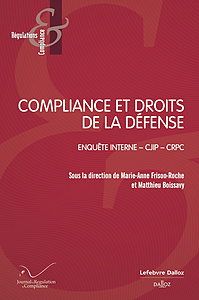
Couverture – Compliance et droits de la défense

Articles

📧📕Compliance et droits de la défense. Enquête interne – CJIP – CRPC : les lignes de force de l’ouvrage (Compliance and rights of the defence. Internal investigation – French Judicial Public Interest Agreement – French guilty plea procedure : the main themes of the book)

► Full Reference: M.-A. Frison-Roche, Compliance et droits de la défense. Enquête interne – CJIP – CRPC : les lignes de force de l'ouvrage (Compliance and rights of the defence. Internal investigation – French Judicial Public Interest Agreement – French guilty plea procedure : the main themes of the book), Newsletter MAFR Law, Compliance, Regulation, March 5, 2024 - 📧Read by freely subscribing other news of the Newsletter MAFR – Law, Compliance, Regulation - 🧱Compliance and rights of defense: a book to design them together to improve practices   The book Compliance et droits de la défense (Compliance and rights of the defence), co-published by the Journal of Regulation & Compliance (JoRC ) and Dalloz, takes as its starting point practices ranging from internal investigations to convention judiciaire d’intérêt public – CJIP (Judicial Public Interest Agreement) and comparution sur reconnaissance préalable de culpabilité – CRPC (French guilty plea procedure), to measure the way in which Compliance makes room, or not, for the rights of the defense.   📧read the general presentation of the book and, in a very detailed presentation of the book's main points, the presentation of each of the contributions, published on March 5, 2024 in the Newsletter MAFR – Law, Compliance, Regulation
Couverture – Compliance et droits de la défense

Articles

📧Comment articuler Compliance et droits de la défense ? (How to articulate Compliance and the rights of the defence ?)

► Full Reference: M.-A. Frison-Roche, "Comment articuler Compliance et droits de la défense ?" ("How to articulate Compliance and rights of the defence"), Newsletter MAFR Law, Compliance, Regulation, December 10, 2023 - 📧Read by freely subscribing other news of the Newsletter MAFR – Law, Compliance, Regulation - 🧱Acknowledging their specific characteristics to better articulate Compliance and the rights of the defence The book, Compliance et droits de la défense (Compliance and the rights of the defence), co-edited by the Journal of Regulation & Compliance (JoRC) and Dalloz, deals with their relationship per se, a relationship illustrated by the internal investigation, the CJIP and the CRPC. Its aim is to explain what Compliance Law is and what the rights of the defence are, in order to find better ways of articulating them: sometimes to rank them, more often to find their points of contact and increase them. Above all, the starting point must be practice. - 📧read the article published on 10 December 2023 on this topic in the Newsletter MAFR – Law, Compliance, Regulation ⤵️ - follow Marie-Anne Frison-Roche on LinkedIn follow Marie-Anne Frison-Roche on Instagram subscribe to the Newsletter MAFR Regulation, Compliance, Law