A SUPPRIMER : volonté (tag anglais vidé)

Logo-partage-JoRC-Paris1-IRJS

Organisation of events

🏗️Cycle of colloquia 2026: Compliance and Contract

🧮 Compliance et Droit commun des contrats (Compliance and General Contract Law), in 🏗️Compliance and Contract

► Full reference: Journal of Regulation & Compliance (JoRC) and Université Paris 1 Panthéon-Sorbonne, Institut de recherche juridique de la Sorbonne (IRJS) (Sorbonne Legal Research Institute), Compliance et Droit commun des contrats (Compliance and General Contract Law), 7 October 2026. see on Instagram the carousel devoted to the conference (in French) see on Instagram the programme of the conference (in French) - 🏗️ This symposium is part of the series of symposiums organised by the Journal of Regulation & Compliance (JoRC) and its partner universities, focusing in 2026 on the general theme of Compliance and Contract. - The symposium is under the scientific responsibility of 🕴️Nicolas Bargue, Senior Lecturer (maître de conférences) at the Sorbonne Law School (Université Paris 1 Panthéon-Sorbonne), co-director of the Contract, Civil Liability and Insurance Department of the IRJS, 🕴️Marie-Anne Frison-Roche, Professor of Law (agrégée des Facultés de Droit), Director of the Journal of Regulation & Compliance (JoRC) and of the European School of Regulation and Compliance (EeRC), and 🕴️Julia Heinich, Professor at the Sorbonne Law School (Université Paris 1 Panthéon-Sorbonne). - Registration with the IRJS: Registration for the symposium « Compliance et droit commun des contrats » of 7 October 2026 | Labo – IRJS - 🧮The symposium, organised by the Journal of Regulation & Compliance (JoRC) and the Institut de recherche juridique de la Sorbonne (IRJS), will take place on Wednesday 7 October 2026, from 9:15 am to 1 pm, at Université Paris 1 Panthéon-Sorbonne, Room 6 of the Centre Panthéon, 12 place du Panthéon, 75005 Paris. It will be held in French. - Presentation of the topic: While Contract Law, in its common rules expressed by the “general theory of contracts”, is often considered to be the most developed branch of Law in practice and the most studied at university, at first glance it seems to be given little consideration when it comes to Compliance. The relationship between the contract and the documents, standards and ethical acts so numerous in Compliance techniques, to which is added the soft law produced by courts, regulators, supervisors and companies themselves, is an open question. Thus the “commitments” that punctuate the techniques and behaviours making up the “compliance culture” have a central place in Compliance Law; but their place, if not their equivalence with the Contract, is not established. To gain a firmer footing in the analysis of the practices of companies that insert compliance clauses into multiple contracts, to observe that Compliance can be the very subject of a specific contract — the “compliance contract” —, or even to assist in the conception that judges develop of their office when they hear contractual litigation involving Compliance, we must return to general Contract Law. If we stop viewing Compliance Law solely through the prism of repression, the Contract does not have the same place: the compliance obligation can be conceived as also having the contract as a legitimate source, a contract which, under general law, has its source in the autonomy of the will and all its consequences — contractual freedom, binding force, effect on third parties. This is the subject of this symposium which, following the classic diptych of formation and performance, takes up the contractual thread from the founding principles of autonomy and freedoms, binding force and its relativity, the meeting of wills, groups of contracts and regulatory contracts often drawn up to implement compliance policies. Specific performance and contractual liability under general law are themselves coloured in a singular way when a compliance concern has been inserted into the contract. - The proceedings of this symposium will form the basis of a specific chapter in the following publications: 📕Compliance et Contrat, forthcoming in the series 📚Régulations & Compliance, co-published by the Journal of Regulation & Compliance (JoRC) and Lefebvre-Dalloz. 📘Compliance and Contract, forthcoming in the 📚Compliance & Regulation Series, co-published by the Journal of Regulation & Compliance (JoRC) and Lefebvre-Bruylant. 🔻 See the programme below
Couverture – L’Obligation de Compliance

Articles in a JoRC book

Contribution in a collective legal book

“Obligation sur Obligation vaut” (Obligation upon obligation work), in 🕴️M.-A. Frison-Roche (dir.), 📕L’obligation de Compliancevolonté dans l’Obligation de Compliance: obligation sur obligation vaut (The role of will in the Compliance Obligation: obligation upon obligation is valid and useful), in 🕴️M.-A. Frison-Roche (dir.), 📕L’obligation de Compliance (Compliance Obligation)

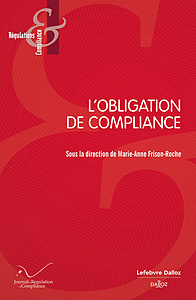
► Full Reference: M.-A. Frison-Roche, "Obligation sur Obligation vaut" ("Obligation upon obligation work"), in M.-A. Frison-Roche (dir.), L'Obligation de Compliance, Journal of Regulation & Compliance (JoRC) and Dalloz, coll. "Régulations & Compliance", 2025, pp. 324-354. - 📝read the article - 🚧read the bilingual Working Paper on the basis this article has been written, with more developments, technical references and hyperlinks - 📕read the general presentation of the book, L'Obligation de Compliance, in which this article is published 📚see the general presentation of the series "Régulations & Compliance" in which this book is published - ► English Summary of this contribution: The demonstration of the part played by Will in the Compliance Obligation incumbent on companies is based on the distinction and articulation between the Regulatory Legal Obligation and the spontaneous Obligation of companies, in the use that companies make of their will to implement their Regulatory Legal Obligation and the use that they make of it to produce even new ambitions. This is why the demonstration is carried out in 3 stages. The first part of the demonstration consists in finding the part played by the free will of companies in their Compliance Obligation by putting an end to two confusions: the first, which, within the Contract and Tort Law itself but also within Compliance Law, splits up and confuses "free will" and "consent", which would no longer require freely expressed acceptance; the second, which, specific to Compliance Law, confuses "Compliance" and "conformity", reducing the former to mechanical obedience, which would exclude any free will. Having clarified this, the rest of this study focuses on the 2 ways in which a company subject to a Compliance Obligation by regulations expresses a part of its free will, which the study expresses in this proposed adage: Obligation upon Obligation is valid, since the regulatory legal obligation to which the company responds by the obedience owed by all those subject to the Law may be superimposed by its free will, which will then oblige it. The first case of Obligation upon Obligation, studied in a second part, concerns the means by which the Regulatory Legal Compliance Obligation is implemented, the company subject to the Monumental Goals set by the Law remaining free to choose the means by which it will contribute to achieving them. Its free will will thus be exercised over the choice and implementation of the means. This can take two legal forms: contracts on the one hand and "commitments" on the other. Thirdly, the second case of Obligation upon Obligation, which is more radical, is that in which, in addition to Compliance's regulatory legal Obligation, the company draws on its free will to repeat the terms of its regulatory legal Obligation (because it is prohibited from contradicting it), a repetition which can be far-reaching, because the legal nature (and therefore the legal regime) is changed. The judgment handed down by the The Hague Court of Appeal on 12 November 2024, in the case law Shell, illustrates this. What is more, the free will of the company can play its part in the Compliance Obligation by increasing the Compliance Obligation. This is where the alliance is strongest. The interpretation of the specific obligations that result must remain that of the Monumental Goals in a teleological application that gives coherence to the whole. - follow Marie-Anne Frison-Roche on LinkedIn follow Marie-Anne Frison-Roche on Instagram subscribe to the Newsletter MAFR Regulation, Compliance, Law subscribe to the Video Newsletter MAFR Surplomb subscribe to the Newsletter MaFR Droit & Art

Surplomb - Notion

🎬The geographical boundaries of Compliance

Working papers

Working Paper

🚧Will, Heart and Calculation, the three traits encercling the Compliance Obligation

► Full Reference: M.-A. Frison-Roche, The will, the heart and the calculation, the three traits encercling the Compliance Obligation, March 2024. - 📝 This Working Paper is the basis for the contribution "The will, the heart and the calculation, the three traits encercling the Compliance Obligation", in📘Compliance Obligation. - ► Summary of this Working Paper: There is often a dispute over the pertinent definition of Compliance Law, but the scale and force of the resulting obligation for the companies subject to it is clear.  It remains difficult to define. First, we must not to be overwhelmed by the many obligations through which the Compliance Obligation takes shape, such as the obligation to map, to investigate, to be vigilant, to sanction, to educate, to collaborate, and so on. Not only this obligations list is very long, it is also open-ended, with companies themselves and judges adding to it as and when companies, sectors and cases require.  Nor should we be led astray by the distance that can be drawn between the contours of this Compliance Obligation, which can be as much a matter of will, a generous feeling for a close or distant other in space or time, or the result of a calculation. This plurality does not pose a problem if we do not concentrate all our efforts on distinguishing these secondary obligations from one another but on measuring what they are the implementation of, this Compliance Obligation which ensures that entities, companies, stakeholders and public authorities, contribute to achieving the Goals targeted by Compliance Law, Monumental Goals which give unity to the Compliance Obligation.  Thus unified by the same spirit, the implementation of all these secondary obligations, which seem at once disparate, innumerable and often mechanical, find unity in their regime and the way in which Regulators and Judges must control, sanction and extend them, since the Compliance Obligation breathes a common spirit into them.  In the same way that the multiplicity of compliance techniques must not mask the uniqueness of the Compliance Obligation, the multiplicity of sources must not produce a similar screen. Indeed, the Legislator has often issued a prescription, an order with which companies must comply, Compliance then often being perceived as required obedience. But the company itself expresses a will that is autonomous from that of the Legislator, the vocabulary of self-regulation and/or ethics being used in this perspective, because it affirms that it devotes forces to taking into consideration the situation of others when it would not be compelled to do so, but that it does so nonetheless because it cares about them. However, the management of reputational risks and the value of bonds of trust, or a suspicious reading of managerial choices, lead us to say that all this is merely a calculation. Thus, the contribution sets out to identify the Compliance Obligation by recognising the role of all these different sources. It emphasises that, in monitoring the proper performance of technical compliance obligations by Managers, Regulators and Judges, insofar as they implement the Compliance Obligation, it is pointless to limit oneself to a single source or to rank them abruptly in order of importance. The Compliance Obligation is part of the very definition of Compliance Law, built on the political ambition to achieve these Monumental Goals of preserving systems – banking, financial, energy, digital, etc. – in the future, so that human beings who cannot but depend on them are not crushed by them, or even benefit from them. This is the teleological yardstick by which the Compliance Obligation is measured, and with it all the secondary obligations that give it concrete form, whatever their source and whatever the reason why the initial standard was adopted. In order to define Compliance's Obligation, the contribution endeavours to recognise the contribution of all these three sources: Will, Heart and Calculation.  - 🔓read the developments below ⤵️ - follow Marie-Anne Frison-Roche on LinkedIn follow Marie-Anne Frison-Roche on Instagram subscribe to the Newsletter MAFR Regulation, Compliance, Law  subscribe to the Video Newsletter MAFR Surplomb

Organisation of events

🧱Co-organisation of the Symposium 🧮L’arbitrage international en renfort de l’Obligation de Compliance (International Arbitration in support of the Compliance Obligation)

► Full Reference: L. Aynès, M.-A. Frison-Roche, J.-B. Racine and E. Silva-Romero (dir.), L’arbitrage international en renfort de l’obligation de Compliance (International Arbitration in support of the Compliance Obligation), Journal of Regulation & Compliance (JoRC) and Institute of World Business Law of the ICC (Institute), Conseil Économique Social et Environnemental (CESE), Paris, February 9, 2024 - consult on LinkedIn a general présentation of this event, which links to a presentation and a report of each speech - 🏗️This symposium takes place in the cycle of symposiums organised by the Journal of Regulation & Compliance (JoRC) and its partners Universities, focusing in 2023-2024 on the general theme of the Compliance Obligation - 📚The works will then be inserted in the books: 📕L’obligation de Compliance, to be published in the 📚Régulations & Compliance Serie, co-published by the Journal of Regulation & Compliance (JoRC) and Dalloz, published in French. 📘Compliance Obligation, to be published on the 📚Compliance & Regulation Serie, co-published by the Journal of Regulation & Compliance (JoRC) and Dalloz, published in English. - ► General presentation of the symposium: “Compliance Obligation” appears to be far from International Arbitration if Compliance Law is only understood in terms of binding regulations or even Criminal Law. Arbitration would only have contact with Compliance Obligation in a repulsive way, when a person claims to have enforced a contract before an arbitration court that disregards a compliance prohibition, e.g. corruption or money laundering. It is therefore from a negative angle that the cross-over has taken place. The fact that Arbitration Law respects the requisite of Criminal Law is nothing new. Moreover, the power of Compliance in its detection and prevention tools, particularly in terms of evidence, no doubt increases the global efficiency. But Compliance Obligation is based on Monumental Goals, notably linked to global human rights and active ambitions about environment and climate which, particularly in the value chain economy, take the legal form of compliance clauses, or even compliance contracts, or various commitments and plans, which the parties can ask the international arbitrator to enforce. They will do so even more as arbitrators are often the only international, or even global, judges available. The use they will do of Contract Law, Quasi-Contract Law, Enforcement Law, Tort Law, reinforces Compliance Law in a global dimension. - - ► Interviennent : 🎤 Laurent Aynès, emeritus Professor at Paris 1 Panthéon-Sorbonne University, Attorney, Darrois Villey Maillot Brochier (Paris) 🎤 Marie-Anne Frison-Roche, Professor of Regulatory and Compliance Law, Director of the Journal of Regulation & Compliance (JoRC) 🎤 Jean-François Guillemin, former General Secretary of the Bouygues Group 🎤 Christophe Lapp, Attorney, Advant Altana (Paris) 🎤 Jean-Baptiste Racine, Full Professor at Paris Panthéon-Assas University (Paris 2) 🎤 Eduardo Silva-Romero, President of the Institute of World Business Law of the ICC (Institute), Attorney, Wordstone (Paris) - 🧮Read a detailed presentation of the event below⤵️ - follow Marie-Anne Frison-Roche on LinkedIn follow Marie-Anne Frison-Roche on Instagram subscribe to the Newsletter MAFR Regulation, Compliance, Law

Conferences

🎤Préalable : ce qu’est un engagement (Prerequisite: the Commitment), in 🧮L’arbitrage international en renfort de l’obligation de Compliance

► Full Reference: M.-A. Frison-Roche, "Préalable : ce qu'est un engagement" ("Prerequisite: the Commitment"), in L. Aynès, M.-A. Frison-Roche, J.-B. Racine and E. Silva-Romero (dir.), L'arbitrage international en renfort de l'obligation de Compliance (International Arbitration in support of the Compliance Obligation), Journal of Regulation & Compliance (JoRC) and Institute of World Business Law of the ICC (Institute), Conseil Économique Social et Environnemental (CESE), Paris, February 9, 2024 - 🧮see the full programme of this event - consult on LinkedIn a general presentation of this event, which links to a presentation of each speech (in French) - 🧱consult the scientific direction sheet of this event, which gives an account of the various speeches made - 🔲see the slides used to support the presentation (in French) - 🎤see a presentation of the conference "Préalable : ce qu'est l'Obligation de Compliance" ("Prerequisite: what is the Compliance Obligation"), given at the same symposium - 🎤see a presentation of the conference "Le renforcement des engagements de Compliance par le renvoi Ex Ante à l'arbitrage international" ("Reinforcing Compliance commitments by referring Ex Ante to International Arbitration") which was finally not pronounced but will be the subject of an 📝article in the forthcoming book 📘Compliance Obligation  - ► Presentation of the conference: Having defined the Compliance Obligation in "Préalable : ce qu'est l'Obligation de Compliance" ("Prerequisite: what is the Compliance Obligation"), I set out to define what a commitment is. No one doubts that commitments, as words, constitute facts that can engage the liability of companies if there are inconsistencies or lies. The question today is whether a commitment can constitute a legal act, binding in ex ante. Companies make commitments either to fulfil their legal Compliance obligations, which is simply obeying the law, or to express their own wishes, either for themselves or for others. The cases are often confused, even though the scope is not the same. If the commitment takes the form of a contract, Compliance is concerned if the contract is used as an Ex Ante Compliance Tool📎1🕴️M.-A. Frison-Roche (ed.), 📘Compliance Tools, 2021., either if the entire contract has this purpose, or if a compliance clause is inserted, and an arbitration clause may be linked to it. The commitment, a concept that comes more from the Economics of Regulation, was conceived between a Regulatory Authority and a Company: it is the unilateral decision of the Authority that gives legal force to the commitment. Case law confirms this (Conseil d'État (French Council of State)📎2🏛️Conseil d'État (French Council of State), 21 April 2023, No. 464349, Sté Orange v. Arcep. and Conseil constitutionnel (French Constitutional Council)📎3🏛️Conseil constitutionnel (French Constitutional Council), 19 March 2021, decision No. 2021-891 QPC, Association Générations futures et autres.) and this is particularly clear in Competition Law, but it is also true of the convention judiciaire d'intérêt public – CJIP (French Judicial Public Interest Agreement). If commitment is central to Compliance, particularly Vigilance, it is because Compliance Law is an extension of Regulatory Law📎4🕴️M.-A. Frison-Roche, 🚧From Regulation Law to Compliance Law ; 🚧Compliance Law loses the ties of Regulation Law but retains its principles: consequences for companies, 2018 ; 🚧The deployment of Regulatory Law through Compliance Law in the European project, 2023.. The company is forcibly instituted by the Compliance regulator, particularly in value chains, or on digital spaces (DSA). In drawing up a plan, the company is fulfilling its legal obligation. But if we were to consider that it is a commitment, then we would also have to consider that the plan is the result of its will, that it must consult the stakeholders in its preparation, but that the source of the plan is its will: the provisions are not stipulations, are not applications of the law, but unilateral voluntary provisions. In this respect, and because its source is the will of the company (which does not prevent its co-construction), a plan could contain a "graduated offer" of arbitration. This offer could be included in commitments that are less regulated by law, such as those made in the context of CSR. - follow Marie-Anne Frison-Roche on LinkedIn follow Marie-Anne Frison-Roche on Instagram subscribe to the Newsletter MAFR Regulation, Compliance, Law

Working papers

Working Paper

🚧 Obligation upon Obligation is valid and useful

► Full Reference: M.-A. Frison-Roche, The role of will in the Compliance Obligation: Obligation upon Obligation is valid and useful, Working Paper, June 2023. - 🎤  This working paper was originally drawn up as a basis for the talk, Obligation on Obligation is worth, on the first day of the conference I co-organised:🧮Compliance : Obligation, devoir, pouvoir, culture (Compliance: Obligation, duty, power, culture), on 13 June 2023. - It was subsequently used as the basis for a forthcoming article: 📝La part de la volonté dans l’obligation de compliance : Obligation sur Obligation vaut". in📕L'obligation de compliance, in the collection 📚Régulations & Compliance 📝The role of will in the Compliance Obligation: Obligation upon Obligation is valid and useful, in📘Compliance Obligation, in the collection 📚Compliance & Regulation - ► Summary of this Working Paper: The demonstration of the part played by the entreprises' Will in the Compliance Obligation incumbent on them is carried out in 3 stages. The first stage of the demonstration consists in finding the part played by the free will of companies in their Compliance Obligation by putting an end to two confusions: the first which, within the Law of Contract and Tort itself but also within Compliance Law, splits and confuses "free will" and "consent", which would no longer require freely expressed acceptance; the second, specific to Compliance Law, which confuses "Compliance" and "conformity", reducing the former to mechanical obedience which could exclude any free Will. Having clarified this, the rest of the study focuses on the 2 ways in which a company subject to a Compliance Obligation by compulsory regulations expresses a part of its free Will, which the study expresses in this proposed adage: Obligation upon Obligation is valid, since the legal obligation to which the company responds by the obedience owed by all those subject to the regulations may be superimposed by its free Will, which will then oblige it. The first case of Obligation upon Obligation, studied in a second part, concerns the means by which the compulsory Compliance Obligation is implemented, the company subject to the Monumental Goals set by the Legislator remaining free to choose the means by which the company will contribute to achieving them. Its free Will will thus be exercised over the choice and implementation of the means. This can take two legal forms: Contracts on the one hand and "Commitments" on the other. In the third part, the second case of Obligation upon Obligation, which is more radical, is that in which, in addition to Compliance's legal compulsory Obligation, the company draws on its free Will to repeat the terms of its legal Obligation (because it is prohibited from contradicting it), a repetition which can be far-reaching, because the legal nature (and therefore the legal regime) is changed. The judgment handed down by the The Hague Court of Appeal on 12 November 2024, in the so-called Shell case, illustrates this. What is more, the company's free Will can play its part in the Compliance Obligation by increasing the legal Obligation. This is where the alliance is strongest. The interpretation of the specific and diverses obligations that result must remain that of the Monumental Goals in a teleological application that gives coherence to the whole. - 🔓read the developments below⤵️ - follow Marie-Anne Frison-Roche on LinkedIn follow Marie-Anne Frison-Roche on Instagram subscribe to the Newsletter MAFR Regulation, Compliance, Law  subscribe to the Video Newsletter MAFR Surplomb