Value Chain

Working papers

Working Paper serving as the basis for an article concluding a book

🚧Taking into account the legal landscape in Africa to fulfil the Vigilance Obligation

► Full reference : M.-A. Frison-Roche, Taking African legal geography into account to achieve an efficient vigilance system, working paper, August 2025/February 2026 - 🎤This working paper follows on from the closing address at the symposium Devoir de vigilance, quelles perspectives africaines ? Regards croisés en droit international, droit comparé et droit OHADA (Vigilance Duty: what are the prospects in Africa? Perspectives from international law, comparative law and OHADA Law, organised by the Faculty of Law of Bordeaux, through its Institut de Recherches en Droit des Affaires et du Patrimoine – IRDAP (Institute for Research in Business and Property Law), held on 15 November 2024.  - 📝This working paper forms the basis of the article "Considérer la géographie juridique africaine pour y réussir l'obligation de vigilance", which concludes the volume edited by Eustache da Allada in 2026 by Éditions Lefebvre-Dalloz, in the “Thèmes & Commentaires” collection,📗Devoir de vigilance, quelles perspectives africaines ? Regards croisés en droit international, droit comparé et droit OHADA (Vigilance Duty: what are the African perspectives? Comparative perspectives in international law, comparative law and OHADA Law). To this end, following an initial draft in August 2025, it was revised a second time to better incorporate the written contributions that make up the book, since the article on which it is based sets out a personal approach drawing on external research whilst also needing to synthesise these contributions. - ► Summary of the working paper :  The French “Vigilance” Act of 2017 incorporated the technical provisions and the spirit of the “Sapin 2” Act of 2016. They share a common goal. They have been and remain a common source of controversy and passion. At their heart lies the establishment of a “compliance obligation”, for which vigilance techniques form the “edge ” in serving a grand ambition: to protect systems from risks, both now and in the future, in order to protect the people involved in them. The passion that continues to surround the Vigilance Act, which gave rise to the European CS3D , is misguided, because the law and passion are never allies. Some would passionately want to see vigilance triumph by condemning companies to perform miracles; others would passionately want to see the destruction of all the texts that established the very concept of this Compliance Law, built upon these Humanist Monumental Goals. But let us acknowledge that in these debates on the Vigilance Obligation, which is being legally implemented across value chains, Africa is often cited as an example in a general discussion. It is not often considered as a distinct case with its own legal landscape. No reliance is placed on its strengths or on its own legal mechanisms, even though value chains – particularly industrial ones – so often lead to it, both now and in the future. Through analyses of the Vigilance Obligation, Africa is perceived as a place of retribution or of a new form of paternalism, and when its future is envisaged, prospects seem to be lacking, even though the very essence of compliance—and therefore of Vigilance—is the future.  If we take a less confrontational view and focus instead on the ‘legal geography’ of African countries and their social and inter-state structures, we see that the concern for others, both present and future – which ultimately constitutes the Monumental Goal of Compliance Law and thus of the Vigilance Obligation – is more prevalent in Africa than it is in Europe, which is now built upon legal individualism. This concern for others is reflected in legal mechanisms akin to mediation and various legal structures that our own institutions would do well to heed: our legislators before adopting bills, and our judges who might listen to them as amici curiae before reaching a decision. If we turn our attention to the African continent, which is exploited by certain segments of value chains, and to labour organisations, it becomes clear that here too, legislation and sanctions are not the whole story. Compliance techniques that make use of soft law and the contractual frameworks underpinning the chains themselves can remove the element of abstraction that is, by nature, inherent in general legislation. Moving forward through contracts under the supervision and with the support of the courts is an approach that could prove more fruitful than well-intentioned legislation, which has served as a catalyst, in line with the privileged position of contract law within OHADA. This serves to enhance the judge’s authority. The Compliance Judicialisation is also linked to the growing connection between Compliance and Contracts. However, it appears that not only can European judges specialising in Compliance Law and Vigilance Obligation thus rule on matters concerning Africa, which they can only know from a distance – though it is the lot of every judge to be an outsider – but African and inter-state Courts, notably through OHADA, can address the Vigilance Obligation because value chains are constituted by contracts. By developing it not as a foreign concept to be assimilated, but as that which expresses the very heart of the Law in Africa: concern for others, solidarity, the search for compromises and solutions so that the social and environmental system – that is to say, the human system – may endure into the Future. - 🔓Read the developments below⤵️


Working papers

Working Paper for📺MAFR - OverHang (Notion)

🚧Arbitration, a highly appropriate technique for deploying Compliance Law, in particular to satisfy the Vigilance Obligation

► Full Reference: M.-A. Frison-Roche, Arbitration, a highly appropriate technique for deploying Compliance Law, in particular to satisfy the Vigilance Obligation, Working Paper, March 2025. - 🎤 This Working Paper was developed as a basis for the Overhang👁 video  on …  April 2025 : click HERE  - 🎬🎬🎬In the collection of the Overhangs👁 It falls into the Notion category. ►Watch the complete collection of the Overhangs👁 : click HERE - ► Summary of this Working Paper: If Arbitration has so far not developed much in Compliance Law, it is because this new branch of Law is not well known. Indeed, if it were simply a matter of 'conformity' with mandatory regulations, then Arbitration involving rights that are freely available to the parties and Compliance would be 2 worlds that must ignore each other. But Compliance Law is defined quite differently. Its normativity lies in the Monumental Goals set by the political authorities, which oblige large companies, because these compagnies are in a position to do so, to contribute to achieving these Goals, namely the future preservation of the Systems (banking, digital, climate, energy, etc.) and human beings involved. While the Goal is constrained, the company is free to choose the means, as long as these means  are credible. Arbitration is one of them. From the arbitration clause to the appropriate award. One example is the Duty of Vigilance, the cutting edge of Compliance. In order to effectively find solutions in the value chain that the company governs, Arbitration is a suitable means of achieving the Monumental Goals of environmental protection and human rights, under the control of the Judge.       - 🔓read the developments below⤵️

Surplomb - Notion

🎬The geographical boundaries of Compliance

Conferences

Conference

🎤Considérer la géographie pour réussir le Devoir de Vigilance (Taking Geography into account for a successful Vigilance Duty), in 🧮Devoir de vigilance, quelles perspectives africaines ? Regards croisés en droit international, droit comparé et droit OHADA

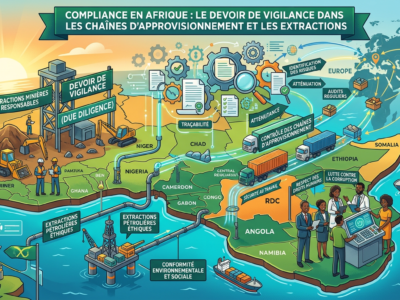
► Full Reference: M.-A. Frison-Roche, "Considérer la géographie pour réussir le Devoir de Vigilance" ("Taking Geography into account for a successful Vigilance Duty"), concluding speech in Devoir de vigilance, quelles perspectives africaines ? Regards croisés en droit international, droit comparé et droit OHADA (Vigilance Duty : what African perspectives? Cross-analysis of International Law, Comparative Law and OHADA Law), Institut de Recherche en Droit des Affaires et du Patrimoine (IRDAP), Bordeaux, 15 November 2024. - 🧮see the full programme of this manifestation (in French) - ► English summary of this concluding speech: This concluding speech was made "on the bench", i.e. directly after listening to all the day's speakers. It is not, therefore, based on an a priori conception of the subject, but on the impression that emerged from the whole, as one speaker followed another. The general impression is that these compliance instruments, of which the vigilance tool is the spurred head, are only appropriate if they fulfill the purpose for which they were devised and imposed, which presupposes that they are appropriate to the concrete situations to which they apply: to the country, to the legislation that shapes and expresses this country, to its economy, to its population. There is certainly room for improvement. But Vigilance legal instruments, like Compliance Law, are new mechanisms that are in the process of taking shape: we must seek to improve them and find solutions: 🧱🕴🏻mafr, 🚧Duty of Vigilance: the way forward, 2024   This is not easy, especially if we get lost in the jigsaw puzzle of texts and decisions in which the vigilance technique fits, particularly at French, European and international level: 🧱🕴🏻mafr, 🚧Vigilance, a piece of the European puzzle, 2023   Listening to all the many and varied speakers, it is clear that progress needs to be made to ensure that the Vigilance instrument takes greater account of the concrete situations reflected in the various legal systems of African countries, and in particular the unified OHADA legal system. It can be done, as long as everyone is willing to bear it in mind. 🧱🕴🏻J.-B. Racine, 📝Geographical dominance in the choice and the use of compliance tools. Introductory remarks, in 🧱🕴🏻mafr (ed.), 📘Compliance Tools, 2021   The speakers demonstrated that the good feelings of Paris or Brussels can pave the way for African hell, for example when about the children labour. The same is true of the fight against corruption, as Mohamed Salah showed. 🧱🕴🏻M.M. Salah ,📝Conception and Application of Compliance in Africa, in 🧱🕴🏻mafr (ed.), 📘Compliance Tools, 2021 - Meanwhile, listening to each other, it appears that often, despite using the same words, the speakers were not talking about the same thing, particularly not in terms of what the very term "Vigilance" refers to, the difference between the French and English being a challenge because "due diligences" are not the same than Vigilance duty . This is a sign that what we call a duty, or an obligation, or a spontaneous commitment, or a legal order criminally sanctioned, which are not at all the same thing, shows the immaturity of this notion of "Vigilance". What's more, we sometimes talk about the climate, or human rights, or the need to fight corruption or money laundering. These latter concerns are undoubtedly covered by texts classified under Compliance Law, some of which assert that Vigilance is the cutting edge, while others claim that Compliance is alien to or merely a component of Vigilance, because Vigilance embraces ethics, while Compliance is merely obedience to the norm ('conformity'). It is clear that the absence of an agreement on definitions is a handicap in practice, as we do not know which legal regime will apply. This uncertainty is problematic in practice because the regulations don't  lay down definitions which alone make it possible to deduce the outline of the obligations of each party, particularly not those of the companies, which ask for instructions for use. Companies receive contradictory interpretations for the same situation, depending on who you are dealing with (a regulator or an NGO for example) or depending on the text (a text specific to the industrial activity, a text specific to the country, or a text from the country of the ordering company on the duty of vigilance, or a text from ordinary contract law or a text that will come from a soft law that remains rather mysterious).   This uncertainty feeds the passion that surrounds the issue of vigilance, with everyone speaking out, the specialists who want to talk about it being suspected of being a technocrat or captured, and those who don't speak out being the local population for whom others speak out. As a result, two phenomena are set to persist, which we had hardly anticipated but which are set to increase: the contractualisation of all vigilance mechanisms and the jurisdictionalisation of all vigilance organisation. - The first phenomenon is the contracting of Vigilance. This contractualisation is the means by which companies have been carrying out their legal compliance obligations for years, using a contractual art that is becoming increasingly sophisticated. We have very little information on these contracts, which are nonetheless what allow companies to obey the regulations and also to add to them, a combination of obedience and contractual freedom, the effects of which in practice have not yet been fully measured. 🧱🕴🏻mafr, 🚧Will, Heart and Calculation, the Three Traits Encercling the Compliance Obligation, 2024 🧱🕴🏻mafr (ed.), 📘Compliance and Contract, 2025   But they do raise essential questions. Firstly, they will bring back the jurisdiction of general courts , for example the commercial courts (tribunaux de commerce) in France, and the courts of the countries where the industrial operations take place: moreover, they are the natural route to international arbitration. They are a new type of contract, since they structure "value chains" (a managerial concept). 🧱🕴🏻mafr, 🚧Compliance Contract, Compliance Clauses, 2022   There are two key issues concerning these contracts: they directly concern African countries, their economic activity and their populations, as described throughout all the speeches. The first is to know who governs the structural apparatus constituted by these 'regulatory contracts' through which chains of activity are built as durable structures. Who is strong and who is weak, between companies and states? The second is to find out how much of the reality of the country and of local economic activity is taken into account by the subsidiary, and how much consideration is given to the local people involved: are the people who are actually involved really "taken into consideration" when we speak for them? Who is best placed to speak on their behalf, to defend them, to get to know them? If we want to contextualise, refine and get to know the situation as closely as possible, in other words if we want to have definitions so that we know what we are talking about, but at the same time start from geographical and human realities, then it is the Judge who appears because the court starts from the facts. - This is the second phenomenon that has emerged and is set to increase: the jurisdictionalisation of Vigilance. 🧱🕴🏻mafr (ed.), 📘Compliance Jurisdictionalisation, 2023 This is understandable, since the judge is able to take cognisance of the facts, the situation in Uganda or Tanzania, and what is often referred to as the "extraterritoriality" of the Compliance mechanisms being thus compensated for. However, the exclusive jurisdiction of the Paris Court of First Instance (decided in France by a 2021 law) may become more difficult, as it is even further away from Africa than the ordering company is. But it is precisely the contract judges who can be called upon to rule on the basis of Contract Law. This central role of the judge raises a number of procedural difficulties that have either not yet been resolved, moreover are not still being perceive 🧱🕴🏻mafr (dir.), 🧮Le Droit processuel de la Vigilance (Vigilance Genreral Procedural Law), 2024   At the interface between procedure and substance, evidentiary issues require the development of a new evidentiary system. When the relevant facts are in Africa but the company accountable for them is in France under legislation adopted in Europe, this must be taken into account. 🧱🕴🏻mafr, 📝The Judge, the Compliance Obligation and the Company. The Compliance Evidence System, in 🧱🕴🏻mafr (ed.), 📘Compliance Jurisdictionalisation, 2023   What's more, since the Monumental Goal is to prevent, manage and detect risks, it is the future that is the main object of proof. A difficult subject by its very nature of the future, which calls for caution. Caution is to be expected from Judges, who may prefer the solution of an agreement: the contract and the commitment come back, for example through mediation, among the methods of conflict resolution. But as close as possible to where it happens, OHADA's courts can then be called upon to hear States and populations.   What is more, in contractualisation (at which point the two major phenomena, contractualisation and jurisdictionalisation, enter into a dialectic), the clauses work together to activate the natural judge of the international contract, including vigilance clauses: the international arbitrator. 🧱🕴🏻L. Aynès, 📝How international arbitration can reinforce the Compliance Obligation, in 🧱🕴🏻mafr (ed.), 📘Compliance Obligation, 2025   OHADA has institutional arbitration mechanisms. Now is the time to guide them so that they open up Africa to Vigilance and open up Vigilance to Africa. In concrete terms.
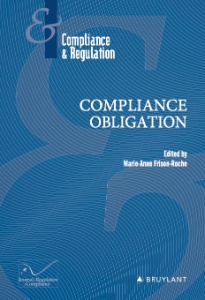
Couverture – Compliance Obligation

Articles in a JoRC book

RAPP, Lucien🕴️

📝Compliance, Value Chains and Service Economy, in 🕴️M.-A. Frison-Roche (ed.), 📘Compliance Obligation

► Full Reference: L. Rapp, "Compliance, Value Chains and Service Economy", in M.-A. Frison-Roche (ed.), Compliance Obligation, Journal of Regulation & Compliance (JoRC) and Bruylant, "Compliance & Regulation" Serie, to be published - 📘read a general presentation of the book, Compliance Obligation, in which this article is published - ► Summary of the article (done by the author, translated by the Journal of Regulation & Compliance – JoRC): Based on an analysis of the value chains of companies in the space sector and their recent evolution, this contribution examine the role, place and current transformations of compliance policies and strategies in the context of an industrial transformation that has become essential: the transition from an industrial economy to a service economy. - 🦉This article is available in full text to those registered for Professor Marie-Anne Frison-Roche's courses -

Organisation of events

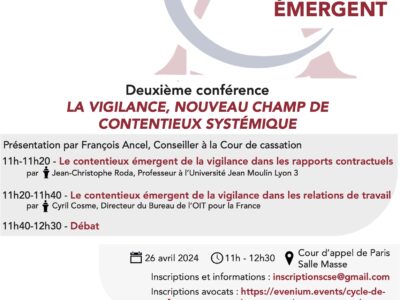
Second conference-debate of the cycle "Contentieux Systémique Émergent" ("Emerging Systemic Litigation")

🧮La vigilance, nouveau champ de contentieux systémique (Vigilance, new field of Systemic Litigation), in cycle of conference-debates “Contentieux Systémique Émergent” (Emerging Systemic Litigation)

► Full Reference: La vigilance, nouveau champ de contentieux systémique (Vigilance, new field of Systemic Ligation), in cycle of conference-debates "Contentieux Systémique Émergent" ("Emerging Systemic Litigation"), organised on the initiative of the Cour d'appel de Paris (Paris Cour of Appeal), with the Cour de cassation (French Court of cassation), the Cour d'appel de Versailles (Versailles Court of Appeal), the École nationale de la magistrature – ENM (French National School for the Judiciary) and the École de formation des barreaux du ressort de la Cour d'appel de Paris – EFB (Paris Bar School), under the scientific direction of Marie-Anne Frison-Roche, 26 April 2024, 11am.-12.30am., Cour d'appel de Paris, Massé courtroom - 🧮see the full programme of the cycle Contentieux Systémique Émergent (Emerging Systemic Litigation) - see on LinkedIn the report of this event - 🧱read below the report of this event⤵️ - ► Presentation of the conference: The duty of vigilance imposed by the 2017 French law is being contractualised, either by ad hoc contracts or by stipulations that reproduce the legal provisions, adjust them or go beyond them. This adoption by the Contract and Tort Law is valuable but not without risk. The systemic scope of the underlying law on the one hand and of economic structures on the other, the firm or the value chain, will permeate litigation. The example of labour relations is instructive in this respect. - 🧮Programme of this event:  Second conference-debate LA VIGILANCE, NOUVEAU CHAMP DE CONTENTIEUX SYSTÉMIQUE (VIGILANCE, NEW FIELD OF SYSTEMIC LITIGATION)   Paris Court of Appeal, Massé courtroom General presentation of the topic and moderation by 🕴️François Ancel, Judge at the Première Chambre civile de la Cour de cassation (First Civil Chamber of the French Court of cassation) 🕰️11am.-11.20am. 🎤Le contentieux émergent de la Vigilance dans les rapports contractuels (Emerging Vigilance Litigation in Contractual Relationships), by 🕴️Jean-Christophe Roda, Full Professor at Jean-Moulin Lyon 3 University 🕰️11.20am.-11.40am. 🎤Le contentieux émergent de la Vigilance dans les relations de travail (Emerging Vigilance Litigation in Employment Relationships), by 🕴️Cyril Cosme, Director of the French Office of the International Labour Organization (ILO) 🕰️11.40am.-12.30am. Debate - 🔴Registrations and information requests can be sent to: inscriptionscse@gmail.com 🔴For the attorneys, registrations have to be sent to the following address: https://evenium.events/cycle-de-conferences-contentieux-systemique-emergent/  ⚠️The conference-debates are held in person only, in the Cour d’appel de Paris (Paris Court of Appeal). - 🧱read below a detailed presentation of this event⤵️ -

Working papers

Working Paper

🚧 Obligation upon Obligation is valid and useful

► Full Reference: M.-A. Frison-Roche, The role of will in the Compliance Obligation: Obligation upon Obligation is valid and useful, Working Paper, June 2023. - 🎤  This working paper was originally drawn up as a basis for the talk, Obligation on Obligation is worth, on the first day of the conference I co-organised:🧮Compliance : Obligation, devoir, pouvoir, culture (Compliance: Obligation, duty, power, culture), on 13 June 2023. - It was subsequently used as the basis for an article published subsequently: 📝La part de la volonté dans l’obligation de compliance : Obligation sur Obligation vaut“. in📕L’obligation de compliance, in the collection 📚Régulations & Compliance 📝The role of will in the Compliance Obligation: Obligation upon Obligation is valid and useful, in📘Compliance Obligation, in the collection 📚Compliance & Regulation - ► Summary of this Working Paper: The demonstration of the part played by the entreprises’ Will in the Compliance Obligation incumbent on them is carried out in 3 stages. The first stage of the demonstration consists in finding the part played by the free will of companies in their Compliance Obligation by putting an end to two confusions: the first which, within the Law of Contract and Tort itself but also within Compliance Law, splits and confuses “free will” and “consent”, which would no longer require freely expressed acceptance; the second, specific to Compliance Law, which confuses “Compliance” and “conformity”, reducing the former to mechanical obedience which could exclude any free Will. Having clarified this, the rest of the study focuses on the 2 ways in which a company subject to a Compliance Obligation by compulsory regulations expresses a part of its free Will, which the study expresses in this proposed adage: Obligation upon Obligation is valid, since the legal obligation to which the company responds by the obedience owed by all those subject to the regulations may be superimposed by its free Will, which will then oblige it. The first case of Obligation upon Obligation, studied in a second part, concerns the means by which the compulsory Compliance Obligation is implemented, the company subject to the Monumental Goals set by the Legislator remaining free to choose the means by which the company will contribute to achieving them. Its free Will will thus be exercised over the choice and implementation of the means. This can take two legal forms: Contracts on the one hand and “Commitments” on the other. In the third part, the second case of Obligation upon Obligation, which is more radical, is that in which, in addition to Compliance’s legal compulsory Obligation, the company draws on its free Will to repeat the terms of its legal Obligation (because it is prohibited from contradicting it), a repetition which can be far-reaching, because the legal nature (and therefore the legal regime) is changed. The judgment handed down by the The Hague Court of Appeal on 12 November 2024, in the so-called Shell case, illustrates this. What is more, the company’s free Will can play its part in the Compliance Obligation by increasing the legal Obligation. This is where the alliance is strongest. The interpretation of the specific and diverses obligations that result must remain that of the Monumental Goals in a teleological application that gives coherence to the whole. - 🔓read the developments below⤵️ - follow Marie-Anne Frison-Roche on LinkedIn follow Marie-Anne Frison-Roche on Instagram subscribe to the Newsletter MAFR Regulation, Compliance, Law  subscribe to the Video Newsletter MAFR Surplomb