Value Chain

DADUSH, Sarah🕴🏻

📝Prosocial Contracts: Making Relational Contracts More Relational, in 📰Law and Contemporary Problems, 2022

► Full Reference: S. Dadush, “Prosocial Contracts: Making Relational Contracts More Relational”, Law and Contemporary Problems, vol. 85, no. 2, 2022, pp. 153-175. - ► Summary: starting from the mass cancellation of garment orders by fashion brands at the outset of the Covid-19 pandemic, to the detriment of suppliers and their workers, the author proposes “prosocial contracts”: supply contracts that take into account the people affected by their performance, starting with the workers in the chain, and that make relational contracts more truly relational. - 🦉 The article is available in full text to those registered in Professor Marie-Anne Frison-Roche’s courses.

SHORT, Jodi L.🕴🏻, TOFFEL, Michael W.🕴🏻 and HUGILL, Andrea R.🕴🏻

📝Monitoring Global Supply Chains, in 📰Strategic Management Journal, 2016

► Full Reference: J. L. Short, M. W. Toffel and A. R. Hugill, “Monitoring Global Supply Chains”, Strategic Management Journal, vol. 37, no. 9, 2016, pp. 1878-1897. - ► Summary: to guard against reputational spillovers from the dangerous, illegal or unethical conduct of their suppliers, firms increasingly rely on private social auditors. Analysing nearly 17,000 supplier audits, the authors show that auditors report fewer violations when they have audited the factory before, when audit teams are less experienced or less trained, when they are all male, and when the audit is paid for by the audited supplier. They draw lessons on governance structures that can reduce information asymmetries in supply chains. - 🦉 The article is available in full text to those registered in Professor Marie-Anne Frison-Roche’s courses.

PARELLA, Kishanthi🕴🏻

📝Contractual Stakeholderism, in 📰Boston University Law Review, 2022

► Full Reference: K. Parella, “Contractual Stakeholderism”, Boston University Law Review, vol. 102, no. 3, 2022, pp. 865-924. - ► Summary: starting from the Business Roundtable’s 2019 commitment to all stakeholders, the author proposes “contractual stakeholderism”. She argues for moving from a benefits-based justification of stakeholder protection to a harms-based approach focused on the risks that corporate activity creates for stakeholders, identifying five dimensions of inequality that expose them. Since many of these harms arise from corporate contracting choices, this protection can be implemented through the negotiation, drafting and performance of contracts. - 🦉 The article is available in full text to those registered in Professor Marie-Anne Frison-Roche’s courses.

SNYDER, David V.🕴🏻, MASLOW, Susan A.🕴🏻 and DADUSH, Sarah🕴🏻

📝Balancing Buyer and Supplier Responsibilities: Model Contract Clauses to Protect Workers in International Supply Chains, Version 2.0, in 📰The Business Lawyer, 2021-2022

► Full Reference: D. V. Snyder, S. A. Maslow and S. Dadush (Working Group to Draft Model Contract Clauses to Protect Human Rights in International Supply Chains, ABA Business Law Section), “Balancing Buyer and Supplier Responsibilities: Model Contract Clauses to Protect Workers in International Supply Chains, Version 2.0”, The Business Lawyer, vol. 77, no. 1, 2021-2022, pp. 115-182. - ► Summary: report of a working group of the American Bar Association Business Law Section proposing model contract clauses (Model Contract Clauses, Version 2.0) to protect workers in international supply chains. Departing from the model of the buyer’s unilateral control over the supplier, Version 2.0 shares responsibilities between the two, imposes obligations on the buyer itself and favours remediation for the benefit of workers over mere termination of the contract. - 🦉 The article is available in full text to those registered in Professor Marie-Anne Frison-Roche’s courses.

BIRD, Robert C.🕴🏻

📝Contractual Deterrence and the Ethical Supply Chain, in 📰Boston College Law Review, 2022

► Full Reference: R. C. Bird, “Contractual Deterrence and the Ethical Supply Chain”, Boston College Law Review, vol. 63, no. 8, 2022, pp. 2539-2620. - ► Summary: the author starts from the contractual architecture of global supply chains and the “cat and mouse” game through which suppliers evade the controls of lead firms. Drawing on deterrence theory, he argues that contractual enforcement of ethical standards is effective only if it is predictably certain – monitoring capacity, transparency between lead firms and suppliers, a track record of actual enforcement – and equitably significant, which requires deterrence-based trust and real influence over the contractual relationship. - 🦉 The article is available in full text to those registered in Professor Marie-Anne Frison-Roche’s courses.

CAFAGGI, Fabrizio🕴🏻 and IAMICELI, Paola🕴🏻

📝La dimension systémique des pratiques commerciales déloyales dans les chaînes d’approvisionnement alimentaire : un point de vue sur la directive 2019/633/UE et sa transposition par les États membres (The Systemic Dimension of Unfair Trading Practices in Food Supply Chains: A Perspective on Directive 2019/633/EU and its Transposition by the Member States), in 📰Revue internationale de droit économique, 2021, vol. XXXV, no. 4

► Full reference: F. Cafaggi and P. Iamiceli, « La dimension systémique des pratiques commerciales déloyales dans les chaînes d’approvisionnement alimentaire : un point de vue sur la directive 2019/633/UE et sa transposition par les États membres » (The Systemic Dimension of Unfair Trading Practices in Food Supply Chains: A Perspective on Directive 2019/633/EU and its Transposition by the Member States), Revue internationale de droit économique, 2021/4, vol. XXXV, pp. 91-122; article largely based on “Unfair Trading Practices in Food Supply Chains. Regulatory Responses and Institutional Alternatives in the Light of the New EU Directive”, European Review of Private Law, vol. 27, no. 5, 2019, pp. 1075-1114. - ► Summary: the authors argue that unfair trading practices in supply chains have specific features which call for specific rules and remedies. They distinguish isolated practices, whose effects remain essentially within the bilateral contractual relationship, from systemic practices, whose effects spread directly or indirectly along the chain and have far more serious consequences, both distributive and exclusionary. Drawing on Directive 2019/633/EU on unfair trading practices in the agricultural and food supply chain and its transposition by several Member States, they build a conceptual framework to supplement European and national regulation with rules reflecting the chain dimension of these practices: systemic effects should be taken into account both in defining the prohibited practice and in choosing and shaping sanctions and remedies. Although Member States have rarely adopted these distinctions in transposition, they could play an important role before the courts when liabilities, sanctions and remedies must be determined. - 🦉 The article is available in full text to those registered in Professor Marie-Anne Frison-Roche’s courses.

KNÖPFEL, Laura🕴🏻

📝Une perspective anthropologique sur les pratiques de responsabilité des entreprises dans les chaînes de valeur mondiales (An Anthropological Perspective on Corporate Responsibility Practices in Global Value Chains), in 📰Revue internationale de droit économique, 2021, vol. XXXV, no. 4

► Full reference: L. Knöpfel, « Une perspective anthropologique sur les pratiques de responsabilité des entreprises dans les chaînes de valeur mondiales » (An Anthropological Perspective on Corporate Responsibility Practices in Global Value Chains), Revue internationale de droit économique, 2021/4, vol. XXXV, pp. 45-67. - ► Summary: the author adopts a legal anthropology perspective on the governance of mining companies in global value chains, taking the reader into the relationships between a primary-sector company and local communities at the “resource frontier” in El Cesar, northern Colombia. After a methodological intervention on research into responsibility in value chains, she studies a particular corporate responsibility practice, social programmes, through corporate gifts and the social licence to operate, relations of dependence and detachment between the company and the communities, and the compensatory function of these programmes. She argues that social programmes sustain a cycle of reciprocity through which the company forges close and entangled relationships with the communities and assumes far-reaching responsibilities for their economic and social well-being. This understanding finds a legal counterpart in contractual obligations and third-party beneficiary rights: contract law could and should therefore play a central role in regulating global value chains, in the primary sector and beyond. - 🦉 The article is available in full text to those registered in Professor Marie-Anne Frison-Roche’s courses.

ULFBECK, Vibe🕴🏻 and HANSEN, Ole🕴🏻

📝Des clauses de durabilité dans un droit des contrats non durable ? (Sustainability Clauses in an Unsustainable Contract Law?), in 📰Revue internationale de droit économique, 2021, vol. XXXV, no. 4

► Full reference: V. Ulfbeck and O. Hansen, « Des clauses de durabilité dans un droit des contrats non durable ? » (Sustainability Clauses in an Unsustainable Contract Law?), Revue internationale de droit économique, 2021/4, vol. XXXV, pp. 69-90; French translation of the article first published as “Sustainability Clauses in an Unsustainable Contract Law?”, European Review of Contract Law, vol. 16, no. 1, 2020, pp. 186-205. - ► Summary: the authors start from the observation that companies in global value chains, often led by a firm with strong market power, insert sustainability clauses into their contracts, or refer to their codes of conduct, imposing on the supplier requirements relating to the environment, working conditions, human rights and anti-corruption, and often obliging it to pass them on to its own suppliers. They examine the view that general contract law, that is, default rules, should develop to serve this sustainability agenda, through three areas: principles of interpretation, express terms and the notion of third-party beneficiary. They then highlight the internal tension created in the chain by the pursuit of sustainability goals external to the parties’ interests, set against the need to protect the supplier as the weaker party: the incalculable nature of sustainability obligations and unilateral variation rights are two examples. Finally, they seek to reconcile these conflicting goals within a contract law that is itself sustainable. - 🦉 The article is available in full text to those registered in Professor Marie-Anne Frison-Roche’s courses.

BECKERS, Anna🕴🏻

📝L’image juridique évolutive des chaînes de valeur mondiales. Introduction au numéro spécial (The Evolving Legal Image of Global Value Chains. Introduction to the Special Issue), in 📰Revue internationale de droit économique, 2021, vol. XXXV, no. 4

► Full reference: A. Beckers, « L’image juridique évolutive des chaînes de valeur mondiales. Introduction au numéro spécial » (The Evolving Legal Image of Global Value Chains. Introduction to the Special Issue), Revue internationale de droit économique, 2021/4, vol. XXXV, pp. 5-18. - ► Summary: the author, introducing a special issue she edited with Hans-W. Micklitz, observes that global value chains have become a subject of legal research, driven by the national and European legislation targeting them and by case law increasingly concerned with the allocation of responsibility within global supply chains, yet they remain conceptually obscure. She identifies two causes: the fragmentation of the debate between branches of law – company, contract and tort law on the one hand, trade law and import regulation on the other – and the neglect of the private regulatory structures and power imbalances specific to these chains, which the social sciences have long studied. After reviewing how each of these branches of law approaches value chains, she argues that doctrinal legal analysis should be more closely linked to the study of the private practices and governance mechanisms that constitute them. She then presents the contributions to the issue, which address the question from the perspectives of the company, the contract, tort and trade, together with Kampourakis’s contribution on private regulation within value chains. - 🦉 The article is available in full text to those registered in Professor Marie-Anne Frison-Roche’s courses.

GILSON, Ronald J.🕴🏻, SABEL, Charles F.🕴🏻 and SCOTT, Robert E.🕴🏻

📝Contracting for Innovation: Vertical Disintegration and Interfirm Collaboration, in 📰Columbia Law Review, 2009, vol. 109, no. 3

► Full reference: R. J. Gilson, C. F. Sabel and R. E. Scott, “Contracting for Innovation: Vertical Disintegration and Interfirm Collaboration”, Columbia Law Review, vol. 109, no. 3, April 2009, pp. 431-502. - ► Summary: the authors observe that rapidly innovating industries do not behave as industrial organisation theory predicts. That theory holds that, when partners in a supply chain must make transaction-specific investments, the risk of opportunism drives them away from contract and towards vertical integration. Yet practice moves the other way: firms, unable to maintain cutting-edge technology themselves in every field their products require, are vertically disintegrating and entrusting to partners components they once made, developing forms of contracting that lie beyond the reach of contract theory models. A first part describes this vertical disintegration in a world of uncertainty, in Knight’s sense, and distinguishes modular, relational and iterative collaboration, the latter alone avoiding the “modularity trap”. A second part shows how contract responds to this continuous uncertainty, where the economic theory of incomplete contracts sees no general solution. A third part analyses three exemplary contracts: the Deere-Stanadyne, Apple-SCI and Warner-Lambert-Ligand agreements. In a fourth part, the authors draw from them a theory of contractual collaboration and co-design: “contracting for innovation” braids explicit and implicit commitments. The formal contract does not impose the outcome, which cannot be specified in advance, but organises a process of information exchange, joint evaluation and joint decision-making; the parallel investments each party makes in learning the other’s capabilities raise switching costs and deter opportunism, where neither explicit contracting, nor renegotiation, nor the prospect of future dealings suffices. A final part returns to the theory of the firm, whose boundaries are redrawn by contract. - 🦉 The article is available in full text to those registered in Professor Marie-Anne Frison-Roche’s courses.

MONTEILLET, Vanessa🕴🏻

📝Le contrat, outil de mise en œuvre des obligations de vigilance entre les partenaires de la chaîne de valeur, in 📗Engagements et contrats à l’aune des mutations environnementales

► Full reference: V. Monteillet, « Le contrat, outil de mise en œuvre des obligations de vigilance entre les partenaires de la chaîne de valeur », in M. Hautereau-Boutonnet, J. Rochfeld and B. Parance (eds.), Engagements et contrats à l’aune des mutations environnementales, Dalloz, “Thèmes & commentaires – Actes” series, 2025, pp. 15-24, in French. - ► Summary: the author starts from the observation that the French Act no. 2017-399 of 27 March 2017 on the duty of vigilance of parent companies and ordering companies sets a goal – establishing a culture of social and environmental risk management throughout the value chain – without predetermining the means. After seven years of application of the Act and the adoption of Directive (EU) 2024/1760 of 13 June 2024, she shows that the contract formalising exchanges between ordering companies, their subcontractors and their suppliers is one of the operational instruments of Vigilance, wanted by public authorities but criticised by non-governmental organisations, since the Rana Plaza building had been audited a few days before its collapse. A first part deals with the drafting of the contractual content, which enables partners in the value chain to anticipate risks. The first requirement is to master contractual technique: the purpose of vigilance clauses and the “cascading contractualisation” of the contractual assurances required by the Directive, and the subject matter of these clauses, which refer to the company’s charters and codes of conduct, to international instruments and, increasingly, to technical standards. The second is to ensure contractual balance: monitoring and auditing of business partners, allocation of the cost of these controls, cooperation with partners and support for SMEs, with a view to the model contractual clauses that the Commission must adopt by 26 January 2027. A second part addresses the modulation of contractual effects and the fair allocation of risks between partners. The contractual relationship is regulated by the ordering company: enhanced prevention action plan, suspension or termination of the business relationship, sanction clauses subject to review for significant imbalance, consultation of stakeholders, which recalls the theory of contractual solidarism. Lastly, the contractual chain is made accountable in light of Article 29 of the Directive: the ordering company’s failure of vigilance may cover the harmful act of the subcontractor, and joint and several liability towards the victim may be shifted, at the stage of contribution to the debt, onto the business partner through the clauses (French Civil Code, Art. 1313 and 1317). - 🦉 The article is available in full text to those registered in Professor Marie-Anne Frison-Roche’s courses.
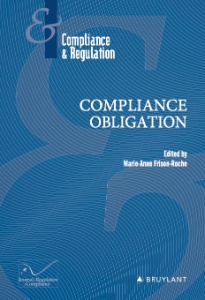
Couverture – Compliance Obligation

Articles in a JoRC book

article in a legal collective book

📝Arbitration consideration of Compliance Obligation for a sustainable Arbitration Place, in 🕴️M.-A. Frison-Roche (dir.), 📘Compliance Obligation,

► Full Reference: M.-A. Frison-Roche, Arbitration consideration of Compliance Obligation for a sustainable Arbitration Place", in M.-A. Frison-Roche (ed.), Compliance Obligation, Journal of Regulation & Compliance (JoRC) and Bruylant, "Compliance & Regulation" Serie, 2026, forthcoming. - 📝read the article - 📘read a general presentation of the book, Compliance Obligation, in which this article is published - ► Summary of this article: The first part of this study assesses the evolving relationship between Arbitration Law and Compliance Law, which depends on the very definition of the Compliance Obligation (I). Indeed, these relations have been negative for as long as Compliance has been seen solely in terms of "conformity", i.e. obeying the rules or being punished. These relationships are undergoing a metamorphosis, because the Compliance Obligation refers to a positive and dynamic definition, anchored in the Monumental Goals that companies anchor in the contracts that structure their value chains. Based on this development, the second part of the study aims to establish the techniques of Arbitration and the office of the arbitrator to increase the systemic efficiency of the Compliance Obligation, thereby strengthening the attractiveness of the Place (II). First and foremost, it is a question of culture: the culture of Compliance must permeate the world of Arbitration, and vice versa. To achieve this, it is advisable to take advantage of the fact that in Compliance Law the distinction between Public and Private Law is less significant, while the concern for the long term of contractually forged structural relationships is essential. To encourage such a movement to deploy the Compliance Obligation, promoting the strengthening of a Sustainable Arbitration Place (III), the first tool is the contract. Since contracts structure value chains and enable companies to fulfill their legal Compliance Obligation but also to add their own will to it, stipulations or offers relating to Arbitration should be included in them. In addition, the adoption of non-binding texts can set out a guiding principle to ensure that concern for the Monumental Goals is appropriate in order the Compliance Obligation to be taken into account by Arbitrators.
Couverture – Compliance Obligation

Publication director

🏗️ copublishing and direction of the collection: 📚Compliance & Regulation

Publication of :🕴️ M.-A. Frison-Roche (ed.),📘 Compliance Obligation

► Full Reference: M.-A. Frison-Roche (ed.), Compliance Obligation, Journal of Regulation & Compliance (JoRC) and Bruylant, "Compliance & Regulation" Serie, 2026, to be published - 📕In parallel, a book in French L'Obligation de compliance, is published in the collection "Régulations & Compliance" co-published by the Journal of Regulation & Compliance (JoRC) and Lefebvre-Dalloz.  - 📚This book is inserted in this series created by Marie-Anne Frison-Roche for developing Compliance Law.  read the presentations of the other books of this Compliance Series: further books: 🕴️M.-A. Frison-Roche (ed.), 📘Compliance Evidential System, 2027 🕴️M.-A. Frison-Roche (ed.), 📘Compliance and Contract, 2027   previous books: ​🕴️M.-A. Frison-Roche (ed), 📘Compliance Juridictionnalisation, 2023 🕴️M.-A. Frison-Roche (ed), 📘Compliance Monumental Goals, 2022 🕴️M.-A. Frison-Roche (ed.), 📘Compliance Tools, 2021 - ► go to the general presentation of this 📚Series ​Compliance & Regulation, conceived, founded et managed by Marie-Anne Frison-Roche, co-published par the Journal of Regulation & Compliance (JoRC) and Bruylant.  - 🧮the book follows the cycle of colloquia organised by the Journal of Regulation & Compliance (JoRC) and its Universities partners. - ► general presentation of the book: Compliance is sometimes presented as something that cannot be avoided, which is tantamount to seeing it as the legal obligation par excellence, Criminal Law being its most appropriate mode of expression. However, this is not so evident. Moreover, it is becoming difficult to find a unity to the set of compliance tools, encompassing what refers to a moral representation of the world, or even to the cultures specific to each company, Compliance Law only having to produce incentives or translate this ethical movement. The obligation of compliance is therefore difficult to define. This difficulty to define affecting the obligation of compliance reflects the uncertainty that still affects Compliance Law in which this obligation develops. Indeed, if we were to limit this branch of law to the obligation to "be conform" with the applicable regulations, the obligation would then be located more in these "regulations", the classical branches of Law which are Contract Law and Tort Law organising "Obligations" paradoxically remaining distant from it. In practice, however, it is on the one hand Liability actions that give life to legal requirements, while companies make themselves responsible through commitments, often unilateral, while contracts multiply, the articulation between legal requirements and corporate and contractual organisations ultimately creating a new way of "governing" not only companies but also what is external to them, so that the Monumental Goals, that Compliance Law substantially aims at, are achieved.  The various Compliance Tools illustrate this spectrum of the Compliance Obligation which varies in its intensity and takes many forms, either as an extension of the classic legal instruments, as in the field of information, or in a more novel way through specific instruments, such as whistleblowing or vigilance. The contract, in that it is by nature an Ex-Ante instrument and not very constrained by borders, can then appear as a natural instrument in the compliance system, as is the Judge who is the guarantor of the proper execution of Contract and Tort laws. The relationship between companies, stakeholders and political authorities is thus renewed. - 🏗️general construction of the book The book opens with a substantial Introduction, putting the different sort of obligations of compliance in legal categories for showing that companies must build structures of compliance (obligation of result) and act to contribute with states and stakeholders to reach Monumental Goals (obligation of means).  The first part is devoted to the definition of the Compliance Obligation.  The second part presents the articulation of Compliance obligation with the other branchs of Law, because the specific obligation is built by Compliance Law, as new substantial branch of Law but also by many other branchs of Law. The third part develops the pratical means established to obtained the Compliance Obligation to be effective, efficace and efficient. The fourth part takes the Obligation  of Vigilance as an illustration of all these considerations and the discussion about the future of this sparehead fo the Compliance Obligation .  The fifth part refers to the place and the role of the judges, natural characters for any obligation.  - TABLE OF CONTENTS    ANCHORING THE SO DIVERSE COMPLIANCE OBLIGATIONS IN THEIR NATURE, REGIMES AND FORCE TO BRING OUT THE VERY UNITY OF THE COMPLIANCE OBLIGATION, MAKING IT COMPREHENSIBLE AND PRACTICABLE    🔹 Compliance Obligation: building a compliance structure that produces credible results withe regard to the Monumentals Goals targeted by the Legislator, by 🕴️Marie-Anne Frison-Roche   TITLE I. IDENTIFYING THE COMPLIANCE OBLIGATION   CHAPTER I: NATURE OF THE COMPLIANCE OBLIGATION Section 1 🔹 Will, Heart and Calculation, the three marks surrounding the Compliance Obligation, by 🕴️Marie-Anne Frison-Roche Section 2 🔹 Debt, as the basis of the compliance obligation, by 🕴️Bruno Deffains Section 3 🔹 Compliance Obligation and Human Rights, by 🕴️Jean-Baptiste Racine Section 4 🔹 Compliance Obligation and changes in Sovereignty and Citizenship, by 🕴️René Sève Section 5 🔹 The definition of the Compliance Obligation in Cybersecurity, by 🕴️Michel Séjean   CHAPTER II: SPACES OF THE COMPLIANCE OBLIGATION Section 1 🔹 Industrial Entities and Compliance Obligation, by 🕴️Etienne Maclouf Section 2 🔹 Compliance, Value Chains and Service Economy, by 🕴️Lucien Rapp Section 3 🔹 Compliance and conflict of laws. International Law of Vigilance-Conformity, based on applications in Europe, by 🕴️Louis d'Avout    TITLE II. ARTICULATING THE COMPLIANCE OBLIGATION WITH OTHER BRANCHES OF LAW   Section 1 🔹 Tax Law and Compliance Obligation, by 🕴️Daniel Gutmann Section 2 🔹 General Procedural Law, prototype of the Compliance Obligation, by 🕴️Marie-Anne Frison-Roche Section 3 🔹 Corporate and Financial Markets Law facing the Compliance Obligation, by 🕴️Anne-Valérie Le Fur Section 4 🔹 Transformation of Governance and Vigilance Obligation, by 🕴️Véronique Magnier Section 5 🔹 The Relation between Tort Law and Compliance Obligation, by 🕴️Jean-Sébastien Borghetti Section 6 🔹 Environmental and Climate Compliance, by 🕴️Marta Torre-Schaub Section 7 🔹 Competition Law and Compliance Law, by 🕴️Jean-Christophe Roda Section 8 🔹 The Compliance Obligation in Global Law, by 🕴️Benoît Frydman & 🕴️Alice Briegleb Section 9 🔹 Environmental an Climatic Dimensions of the Compliance Obligation, by 🕴️Marta Torre-Schaub Section 10 🔹 Judge of Insolvency Law and Compliance Obligations, by 🕴️Jean-Baptiste Barbièri   TITLE III. COMPLIANCE: GIVE AND TAKE THE MEANS TO OBLIGE   CHAPTER I: COMPLIANCE OBLIGATION: THE CONVERGENCE OF SOURCES Section 1 🔹 Compliance Obligation upon Obligation works, by 🕴️Marie-Anne Frison-Roche Section 2 🔹 Conformity technologies to meet Compliance Law requirements. Some examples in Digital Law, by 🕴️Emmanuel Netter Section 3 🔹 Legal Constraint and Company Strategies in Compliance matters, by 🕴️Jean-Philippe Denis & 🕴️Nathalie Fabbe-Coste Section 4 🔹 Opposition and convergence of American and European legal systems in Compliance Rules and Systems, by 🕴️Raphaël Gauvain & 🕴️Blanche Balian Section 5 🔹 In Compliance Law, the legal consequences for Entreprises of their Commitments and Undertakings, by 🕴️Marie-Anne Frison-Roche   CHAPTER II: INTERNATIONAL ARBITRATION IN SUPPORT OF THE COMPLIANCE OBLIGATION Section 1 🔹 How International Arbitration can reinforce the Compliance Obligation, by  🕴️Laurent Aynès Section 2 🔹 Arbitration consideration of Compliance Obligation for a Sustainable Arbitration Place, by 🕴️Marie-Anne Frison-Roche Section 3 🔹 The Arbitral Tribunal's Award in Kind, in support of the Compliance Obligation, by 🕴️Eduardo Silva Romero Section 4 🔹 The use of International Arbitration to reinforce the Compliance Obligation: the example of the construction sector, by 🕴️Christophe Lapp  Section 5 🔹 The Arbitrator, Judge, Supervisor, Support, by 🕴️Jean-Baptiste Racine   TITLE IV. VIGILANCE, SPEARHEAD OF THE COMPLIANCE OBLIGATION Section 1 🔹 Vigilance Obligation, Spearheard and Total Share of the Compliance Obligation, by 🕴️Marie-Anne Frison-Roche   CHAPTER I: INTENSITIES OF THE VIGILANCE OBLIGATION, SPEARHEAD OF THE COMPLIANCE SYSTEM Section 2 🔹 Intensity of the Vigilance Obligation by Sectors: the case of Financial Operators, by 🕴️Anne-Claire Rouaud Section 3 🔹 Intensity of the Vigilance Obligation by Sectors: the case of Digital Operators, by 🕴️Grégoire Loiseau Section 4 🔹 Intensity of the Vigilance Obligation by Sectors: the case of Energy Operators, by 🕴️Marie Lamoureux   CHAPTER II: GENERAL EVOLUTION OF THE VIGILANCE OBLIGATION Section 1 🔹 Rethinking the Concept of Civil Liability in the light of the Duty of Vigilance, Spearhead of Compliance, by 🕴️Mustapha Mekki Section 2 🔹 Contracts and clauses, implementation and modalities of the Vigilance Obligation, by 🕴️Gilles J. Martin Section 3 🔹 Proof that Vigilance has been properly carried out with regard to the Compliance Evidence System, by 🕴️Jean-Christophe Roda Section 4 🔹 Compliance, Vigilance and Civil Liability: put in order and keep the Reason, by 🕴️Marie-Anne Frison-Roche   Title V. THE JUDGE AND THE COMPLIANCE OBLIGATION Section 1 🔹 Present and Future Challenges of Articulating Principles of Civil and Commercial Procedure with the Logic of Compliance, by 🕴️Thibault Goujon-Bethan Section 2 🔹 The Judge required for an Effective Compliance Obligation, by 🕴️Marie-Anne Frison-Roche - CONCLUSION THE COMPLIANCE OBLIGATION: A BURDEN BORNE BY SYSTEMIC COMPANIES GIVING LIFE TO COMPLIANCE LAW   (conclusion and key points of the books, free access)

Reports

🧱⚙️Mission confiée par le garde des Sceaux, 🏛 Droit de la compliance, souveraineté juridique et attractivité économique (Mission entrusted by the French Minister of Justice: Compliance Law, Legal Sovereignty and Economic Attractiveness)

► Full reference: M.-A. Frison-Roche, Mission entrusted by the French Minister of Justice, Droit de la compliance, souveraineté juridique et attractivité économique (Compliance Law, Legal Sovereignty and Economic Attractiveness), 2025-2026. - 📜read the engagement letter of 5 September 2025 by which the French Minister of Justice entrusted Marie-Anne Frison-Roche with this mission (in French) - 📑The report of the mission, Déployer le Droit de la Compliance pour renforcer la souveraineté et accroître l’attractivité de la France avec l’Europe (Deploying Compliance Law to Strengthen France’s Sovereignty and Increase its Attractiveness with Europe), will be submitted to the French Minister of Justice in a French version and in an English version.

Videos

concluding lecture

🖥️L’avenir de la compliance (The future of Compliance), in 🧮La compliance (Compliance)

► Full reference : M.-A. Frison-Roche, "The Future of Compliance", series Compliance, Centre Perelman, Brussels, 23 February 2026. - 🧮view the full programme for the series Compliance (in French) - ► English presentation of this concluding conference in the series Compliance : The future of Compliance: who knows what it holds? Anyone who practises and studies the texts, litigation, structures and behaviours will have to admit that they do not know what will become of what has emerged as a new branch of law. It is not easily recognised, probably for three reasons. Firstly, because the birth of a new branch of law is an unusual phenomenon, whose disruptive and regenerative waves are felt in all branches of law and other regulatory systems, accompanying and reflecting the new world we have already entered, whether we like it or not. Secondly, because it is unpleasant (especially if you are a professor…) to begin and conclude with the fact that you do not know. Thirdly, because it is not very marketable, and in today's large and growing "compliance market", it is not very smart, if you want to sell compliance products (whether they be algorithms, new services to be linked to the highest level of companies, specialities in law firms, new chairs in various schools), to say that you don't know. So the experts say they know. For my part, I meet many people who are "experts" and who are "knowledgeable". What is surprising is the diversity of their discourse, which casts doubt on the solidity of the projection, particularly on the meaning of words: for example, not only words that could be described as "new" (which we then try to anchor in old words) such as "compliance/conformity" and "governance", but also words that we are undoubtedly more familiar with, such as "commitment" and "responsibility" or "sanction", i.e. the very pillars of the matter. Why is this a cause for concern, apart from the fact that it is always better to know what we are talking about, rather than everyone talking in their own corner, for their own compliance corpus, for their like-minded friends, with the subject matter becoming increasingly siloed? Because the object of Compliance Law is the future. So, the future of this branch of law which its object is the future is by nature very uncertain.   It will therefore be assumed in advance that not knowing the future is a major difficulty when it comes to Compliance Law, in that this branch of law is unified in that it is ex ante and its object is the future. The difficulty is neither of the same nature nor of the same magnitude when it comes to the legislator, the "regulator", the regulated company (calculating or political), or the judge faced with systemic compliance litigation. That said, in a first part, one can imagine the future possibilities for Compliance (because that is what it boils down to, given the number of candidates eager to seize the instruments of power that are the " Compliance tools"). It is not a foregone conclusion that this future will be governed by Law. The consequences could take care of that. Or the order given by the leader (Trump, for instance), and that would go down all the better as he states that he certainly does not care about human beings but that he wields the power of Compliance to restore the climate balance (through Chinese regulations): except to say that there is no unified Compliance Law. That there would be one for the climate and another for human rights. So what about the future consistency of European Law, which links the two in the CSRD and the CS3D? Particularly in value chains. The question then is: what will be the uniqueness of Compliance Law in the future? -   In a second part, since we do not know how things will turn out, from omnibus to omnibus, from a government hostile to the Law to a government appealing to the Due Process, from case law to case law, from special law to common law, we must weigh up the advantages and disadvantages of the various perspectives. There is never one perspective where everything is good and another where everything is bad, because in that case there would be no choice and no policy: it would be enough to have information, to be "rational" and to go for the right solution rather than the wrong one. Beyond general statements that a combination of compliance and ethics is welcome, which is not in doubt in the superb statements made in this regard, it is necessary to look at the advantages and disadvantages of the direction we may take. Firstly, there is the disappearance of Compliance Law, with the advantage of reducing the regulatory burden on those subject to it and the disadvantage of abandoning altruistic and global ambitions (these two Monumental Goals may overlap). Secundly, it could involve the creation of a global empire, with the advantage of a simplified American empire, whether extraterritorialised by the state or by companies and their governance or technology, with the advantage of a Western model and the disadvantage of the crushing of "mondialisation" by globalisation and the disappearance of the specific ambitions of States. Thirdly, it may be a contribution to a war between powers, particularly through the European DSA and the data war, with the advantage of European maturity in Compliance Law as an extension of Regulatory Law and the disadvantage that we could move from a war in the metaphorical sense (never use metaphors in Law) to a war. Quaterly, it could be a new rule of Law in which systemic companies participate in an alliance to achieve Monumental political Goals decided by States and political authorities, preserving systems for the future ("sustainability") so that human beings are not crushed by them but benefit from them. The disadvantage is that we have to relearn the Law, because although it has nothing to do with conformity, which is only an instrument, Compliance Law changes all branches of Law and requires the integration of other techniques, particularly political and technological ones. -   In third part, in practice, we must strive in advance to reduce the disadvantages associated with the shortcomings of possible future developments in Compliance Law, just as we must strive in advance to increase the advantages associated with the qualities of possible future developments in Compliance Law. The disadvantage lies in the very nature of Compliance Law, namely its great power, because unlike Competition Law, it calls for and increases power. We must therefore counteract the prospect of compliance techniques, particularly those related to Information, being monopolised by those who only want to use them to consolidate or extend their power, laughing at Ethics and Monumental Goals. This means that supervision techniques on the one hand and a renewed role for judges on the other must be considered. The quality attached to possible futures stems from the fact that we could uphold a "Global Law" (reference to the work of Benoît Frydman, among others) and that, faced with the possible disappearance of Public International Law and the imperative preservation of value chains, particularly in the context of possible war, the alliance between supervised systemic companies and the political authorities in charge of the future of the social group that legitimises them may appear to be a legitimate, effective, efficiate and efficient system. -   ⛏️Go further  : 🕴🏻M.-A. Frison-Roche, 📝Compliance Law, 2016 🕴🏻M.-A. Frison-Roche, 📝Conceiving Power, 2021 🕴🏻M.-A. Frison-Roche, 📕Compliance Monumental Goals, 2022  🕴🏻M.-A. Frison-Roche, 📝The Birth of a New Branch of Law: Compliance Law, 2024 🕴🏻M.-A. Frison-Roche, 📝Compliance Law and conformity: distinguishing between them to better articulate them, 2024 🕴🏻M.-A. Frison-Roche, 📕Complianceo Obligation, 2025 🕴🏻M.-A. Frison-Roche, 📝Compliance Law and Systemic Litigation, 2025
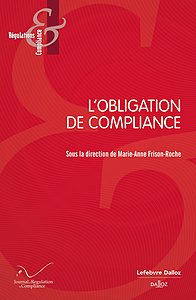
Couverture – L’Obligation de Compliance

Articles in a JoRC book

📝Concevoir l’Obligation de Compliance : faire usage de sa position pour participer à la réalisation des Buts Monumentaux de la Compliance (Conceiving the Compliance Obligation: Using its Position to take part in achieving the Compliance Monumental Goals), in 🕴️M.-A. Frison-Roche (ed.), 📕L’Obligation de Compliance

► Full Reference: M.-A. Frison-Roche, "Concevoir l'Obligation de Compliance : faire usage de sa position pour participer à la réalisation des Buts Monumentaux de la Compliance" ("Conceiving the Compliance Obligation: Using its Position to take part in achieving the Compliance Monumental Goals"), in M.-A. Frison-Roche (ed.), L'Obligation de Compliance, Journal of Regulation & Compliance (JoRC) and Dalloz, "Régulations & Compliance" Serie, 2025, pp. 3-44. - 📝read the article (in French) - 🚧read the bilingual Working Paper on the basis this contribution has been built, with  more developments, technical references and hyperlinks.  - 📕read a general presentation of the book, L'Obligation de Compliance, in which this article is published  - ► English summary of this contribution: Rather than getting bogged down in definitional disputes, given that Compliance Law is itself a incipient branch of Law, the idea of this contribution is to take as a starting point the different regimes of so many different compliance obligations to which laws and regulations subject large companies: sometimes they must apply them to the letter and sometimes they are only penalised in the event of fault or negligence. This brings us back to the distinction between obligations of result and obligations of means. Although it might be risky to transpose the expression and regime of contractual obligations to legal obligations, starting from this observation in the Compliance Evidentiary System of a plurality of obligations of means and of result, depending on whether we are dealing with this or that technical compliance obligation, we must first classify them. It would appear that this plurality does not constitute a definitive obstacle to the creation of a single definition of the Compliance Obligation. On the contrary, it makes it possible to clarify the situation, to trace the paths through what is so often described as a legal jumble, an unmanageable mass of regulations. Indeed, insofar as the company obliged under Compliance Law participates in the achievement of the Monumental Goals on which this branch of Law is normatively based, a legal obligation which may be relayed by contract or even by ethics, it can only be an obligation of means, by virtue of this very teleological nature and the scale of the goals targeted, for example the happy outcome of the climate crisis which is beginning or the desired effective equality between human beings. This established principle leaves room for the fact that the behaviour required is marked out by processes put in place by structured tools, most often legally described, for example the establishment of a vigilance plan or regularly organised training courses (effectiveness), are obligations of result, while the positive effects produced by this plan or these training courses (efficacy) are obligations of means. This is even more the case when the aim is to transform the system as a whole, i.e. to ensure that the system is solidly based, that there is a culture of equality, and that everyone respects everyone else – all of which come under the heading of efficiency. The Compliance Obligation thus appears unified because, gradually, and whatever the various compliance obligations in question, their intensity or their sector, its structural process prerequisites are first and foremost structures to be established which the Law, through the Judge in particular, will require to be put in place but will not require anything more, whereas striving towards the achievement of the aforementioned Monumental Goals will be an obligation of means, which may seem lighter, but corresponds to an immeasurable ambition, linked with these Goals. Moreover, because these structures (warning platforms, training, audits, contracts and clauses, etc.) only have meaning in order to produce effects and behaviour leading to changes converging towards the Monumental Goals, it is the obligations of means that are most important and not the obligations of result. The judge must also take this into account. Finally, the Compliance Obligation, which therefore consists of this interweaving of multiple compliance obligations of result and means of using the Entreprise's position, ultimately aims at system efficiency, in Europe at system civilisation, for which companies must show not so much that they have followed the processes correctly (result) but that this has produced effects that converge with the Goals sought by the legislator (effects produced according to a credible trajectory). This is how a crucial economic operator, responsible Ex Ante, should organise itself and behave.
Couverture – L’Obligation de Compliance

Articles in a JoRC book

DENIS, Jean-Philippe🕴️ & FABBE-COSTES Nathalie🕴️

📝Contrainte légale et stratégie des entreprises en matière de Compliance (Legal Constraint and Strategy of Firms in Compliance Matters), in 🕴️M.-A. Frison-Roche (dir.), 📕L’Obligation de Compliance

► Full Reference: J.-Ph. Denis and N. Fabbe-Costes, “Contrainte légale et stratégie des entreprises en matière de Compliance” (Legal Constraint and Strategy of Firms in Compliance Matters), in M.-A. Frison-Roche (dir.), L’Obligation de Compliance, Journal of Regulation & Compliance (JoRC) and Lefebvre-Dalloz, coll. “Régulations & Compliance”, 2025, pp. 369-391. - read the general presentation of the book, L’Obligation de Compliance, in which the contribution is published - ► This article is written in French. English summary of this contribution (done by the Journal of Regulation & Compliance – JoRC): From the perspective of Management Science, the authors place the laws successively adopted within the emergence of “sustainable development” in environmental matters, which has shaped the way firms are managed. This stemmed from a global awareness of the “Monumental Goals” constituted by the preservation of the planet, resting mainly on firms. The change has nevertheless been brought about more under constraint than voluntarily, with mandatory laws relaying the pressure of stakeholders. The authors show that firms have responded by integrating the Goals imposed but have not been able to follow such ambitions through to the end, owing in particular to a failure to understand highly complex regulations, backed by criminal and civil liability. Research combining Law and Management is intended to facilitate this implementation in practice. - 🦉This article is available in full text to those registered for Professor Marie-Anne Frison-Roche’s courses -
Couverture – L’Obligation de Compliance

Articles in a JoRC book

RAPP, Lucien🕴️

📝Compliance, Chaines de valeur et Économie servicielle (Compliance, Value Chains and Service Economy), in 🕴️M.-A. Frison-Roche (dir.), 📕L’Obligation de Compliance

► Full Reference: L. Rapp, “Compliance, Chaines de valeur et Économie servicielle” (Compliance, Value Chains and Service Economy), in M.-A. Frison-Roche (dir.), L’obligation de Compliance, Journal of Regulation & Compliance (JoRC) and Lefebvre-Dalloz, coll. “Régulations & Compliance“, 2025, pp. 153-172. - read the general contribution of the book, L’Obligation de Compliance, in which this contribution is published - ► This article is written in French. English summary of this contribution (done by the Author): Based on an analysis of the value chains of companies in the space sector and their recent evolution, this contribution examine the role, place and current transformations of compliance policies and strategies in the context of an industrial transformation that has become essential: the transition from an industrial economy to a service economy. - 🦉This article is available in full text to those registered for Professor Marie-Anne Frison-Roche’s courses -
Couverture – L’Obligation de Compliance

Articles in a JoRC book

RODA, Jean-Christophe🕴️

📝Obligations de compliance et concurrence : les liaisons dangereuses ? (Compliance obligations and Competition: dangerous liaisons?), in 🕴️M.-A. Frison-Roche (dir.), 📕L’obligation de Compliance

► Full Reference: J.-Ch. Roda “Obligations de compliance et concurrence : les liaisons dangereuses ? (Compliance obligations and Competition: dangerous liaisons?)”, in M.-A. Frison-Roche (ed.), L’Obligation de Compliance, Journal of Regulation & Compliance (JoRC) and Lefebvre-Dalloz, coll. “Régulations & Compliance“, 2025, pp. 287-297. - read a general presentation of the book, L’Obligation de Compliance, in which this contribution is published - ► This article is written in French. English summary of this contribution (done by the Journal of Regulation & Compliance – JoRC): The author stresses that if Compliance Law and Competition Law may seem far apart today, it is because many people today have a restricted and inaccurate view of Competition Law. Indeed, if Competition Law is reduced to being no more than that which enables offer and demand rule to function fully, then ‘compliance obligations’ need to be injected into this sort of ‘natural law’ of the market backed up by the legal system, compliance obligations giving humanity to the whole. But if Competition Law is given back its rightful dimension, which it has in its more classical conception, the links between the obligations arising from the 2 branches of Law find harmonious relationships. They are all the more necessary because, particularly through the Duty of Vigilance, Civil Competition Law is going to interfere because of the contractualisation of this legal obligation and the possible significant imbalance that could be identified, the article stressing that the application of Compliance stipulations on a partner could end up being analysed as a power, justifying merger control or at the very least a dominant position legal qualification, the abuse of which will be sanctioned. It is for this reason that the 2024 CS3D reminds us that it must be implemented in respect with competition legal rules. However, the author emphasises that it is towards a kind of ‘Ethical Competition’ that compliance obligations are leading, leading to new practices. The results, described in the second part of the article, are increasing the influence of the Compliance Obligation, which embodies the ambition of a “just transition” and a “social Europe”. These ambitions are rejected by the advocates of the so-called “neo-liberal” conception of what Competition Law should be, but the conception of “Competition-Means” was indeed that of the American designers of the corpus of appropriate rules in the nineteenth century, when it was necessary in particular to fight against the large infrastructure monopolies, and it was also that of the jurists who founded the European Union. Only the minimal view of what falls within the scope of competition leads to opposition to the Compliance Obligation. The author therefore stresses that “il semble aujourd’hui évident que la compliance doit être la boussole du droit de la concurrence (it seems obvious today that Compliance must be the compass of Competition Law)”. It is in this spirit that companies must draft the compliance clauses that will multiply to structure the value chains they have set up, providing in particular for the resolution of tensions, or even conflicts, with partners. The author concludes that it is in this way that crucial companies will demonstrate their “particular responsibility” both and in the same way with regard to Competition Law and Compliance Law. - 🦉This article is available in full text to those registered for Professor Marie-Anne Frison-Roche’s courses
Couverture – L’Obligation de Compliance

Articles in a JoRC book

article in a collective legal book

📝La considération par l’arbitrage de l’obligation de Compliance pour une place d’arbitrage durable (“Arbitration consideration of Compliance Obligation for a sustainable Arbitration Place”), in 🕴️M.-A. Frison-Roche (dir.), 📕L’Obligation de Complianc

► Full Reference: M.-A. Frison-Roche, "La considération par l'arbitrage de l'obligation de Compliance pour une place d'arbitrage durable" (Arbitration consideration of Compliance Obligation for a sustainable Arbitration Place), in M.-A. Frison-Roche (ed.), L'Obligation de Compliance, Journal of Regulation & Compliance (JoRC) and Lefebvre-Dalloz, coll. "Régulations & Compliance", 2025, pp. 451-470. - 📝read the article (in French) - 🚧read the bilingual Working Paper on the basis this contribution has been built, with  more developments, technical references and hyperlinks.  - 📕read a general presentation of the book, L'Obligation de Compliance, in which this article is published  - ► This article is written in French. English summary of this contribution (done by the Journal of Regulation & Compliance – JoRC): The first part of this study assesses the evolving relationship between Arbitration Law and Compliance Law, which depends on the very definition of the Compliance Obligation (I). Indeed, these relations have been negative for as long as Compliance has been seen solely in terms of "conformity", i.e. obeying the rules or being punished. These relationships are undergoing a metamorphosis, because the Compliance Obligation refers to a positive and dynamic definition, anchored in the Monumental Goals that companies anchor in the contracts that structure their value chains. Based on this development, the second part of the study aims to establish the techniques of Arbitration and the office of the arbitrator to increase the systemic efficiency of the Compliance Obligation, thereby strengthening the attractiveness of the Place (II). First and foremost, it is a question of culture: the culture of Compliance must permeate the world of Arbitration, and vice versa. To achieve this, it is advisable to take advantage of the fact that in Compliance Law the distinction between Public and Private Law is less significant, while the concern for the long term of contractually forged structural relationships is essential. To encourage such a movement to deploy the Compliance Obligation, promoting the strengthening of a Sustainable Arbitration Place (III), the first tool is the contract. Since contracts structure value chains and enable companies to fulfill their legal Compliance Obligation but also to add their own will to it, stipulations or offers relating to Arbitration should be included in them. In addition, the adoption of non-binding texts can set out a guiding principle to ensure that concern for the Monumental Goals is appropriate in order the Compliance Obligation to be taken into account by Arbitrators.