United States

Working papers

Analysis of blockchains with regard to the uses they can fulfill and the functions that the ministerial officers must ensure

First of all, this working document was used as a support for an oral intervention done in French on the general topic.  L'officier ministèriel est-il soluble dans la blockchain ? (Is the ministerial officer soluble in the blockchain?) at the "Club du Droit", which took place at the Conseil supérieur du Notariat on May 14, 2019, in Pars. Consult the general presentation of the conference (in French). Then it serves as a basis for an article to be published in the Revue Defrénois (in French). - Introduction & Summary. The technical analysis of the confrontation between the tool that is the blockchain and the function that ensure these particular people who are the "ministerial officers"1Sur la confrontation déjà faite dans l'analyse économique de la "régulation" et la fonction notariale, v. Frison-Roche, M.-A., ...., might make it possible to deduce the use that they must make of it. . For this, it is necessary to keep in mind this distinction so simple: the blockchain is a tool, a thing, a machine, an algorithm, a mechanical, mathematical power, while the ministerial officer is a human being. This refers to the distinction that the Western legal system, whether Civil Law or Common Law, poses as summa divisio: the distinction between human beings and things. This first distinction is formulated so that we do not treat human beings as things, since they are legally qualified as "person"2Frison-Roche, M.A., Pour protéger les êtres humains, la nécessité éthique de la notion juridique de personne, 2018. . This is not a natural idea, because if the opportunity arises we would be inclined to treat the other human being as thing. It would be nice and effective. But Law, in its first principle, opposes it, to protect the one who can not afford to be a wolf for the other. This political reason implies that this distinction remains very clear and strong. Now, many try at any moment to make us forget it. For this essential distinction to remain effective, not only should we not imagine human beings as things (reduced to their bodies, for example, or reduced to mechanical acts of consumption3Anders, G., notamment dans son ouvrage central L'obsolescence de l'homme (1956), présentant l'être humain réduit à l'état de "machine désirante" par une société de pure et simple consommation. Le souci qu'il en a comme philosophe rejoint le souci qu'en avait Jacque Ellul, comme juriste, s'inquiétant de la "société technicienne" (...). Or, les machines correspondent aujourd'hui au dessin que ces auteurs du milieu du XXième siècle en faisaient. De la même façon, Alain Supiot rapporte à Kafka le souci du "machinisme" dans le fonctionnement des institutions humaines (....) ; il ne fait notamment dans son analyse de Kafka comme "artiste de la Loi" (2019).), like this is notably described and denounced by Alain Supiot in his successive works4Par exemple Supiot, A., La gouvernance par les nombres, 2015 ; Mondialisation ou globalisation ? Les leçons de Simone Weil, 2019 ; Le droit au XXIème siècle : droit, technique et écoumène (dernière leçon au Collège de France, 22 mai 2019). Sur cette idée folle et dévastatrice qu'il faut faire davantage confiance aux machines qu'il ne faut faire confiance aux êtres humains, ce qui justifierait donc de "mécaniser" les autres humains, idée folle reprise le plus souvent par les auteurs avec entrain, v. par ex. Caprioli, E.A., La blockchain ou la confiance dans la technologie, JCP 2016. 672, n° 3. , but it is also necessary that, especially by an imagined vocabulary, one represents things as acting like people, whereas it does not only machines and tools. But technology represents more and more things with anthromophormi forms and reactions , through robots which "speak", "intelligent" machines, etc. The economic success of promoters of machines and other human-like robots, mechanical solutions presented as "intelligent", is based on forgetting the distinction between the person and things. It is certainly possible to erase this distinction from our system of thought. The difficulty is that it is the basis of Western Lawl5Frison-Roche, M.-A., La disparition de la distinction de jure entre la personne et les choses : gain fabuleux, gain catastrophique, 2017.  and that there are strong reasons to keep it because this distinction protects the weak human being from injustice, permits him and her to participate in the general  order, to avoid an order built on a pure balance of power which can only lead to violence. It is this background that is played in the practical questiond of insertion of blockchains and other technologies and the way in which the various professions must exercise their functions today. If these tools are consistent with these functions, or even improve them, professionals must welcome them without suspicion, or even participate directly in developing them. If these tools are not capable of fulfilling certain functions entrusted to these professionals, then these functions must not be inadvertently or maliciously inserted into a blockchain, whose capacity for preservation and reliability does not amount to anything, because a thing doesn't have any ability to think. This is why we must start from the functions, by dinstinguising the technical function of conservation, duplication and elaboration of acts (I). It seems that assuming the technical reliability of preservation and duplication acquired through the blockchain, as soon as there is a part of elaboration in the act, human intervention must step in because a machine is unfit to check the facts. Here we find the distinction between the retranscribed negotium, this retranscription never being mechanical, and the instrumentum itself, which, split from what gave rise to it, can be subjected to duplicative and conservation technologies. These technologies of conservation and duplication could be so efficient that the notions of original and copy could be questioned because of the reliability of the blockchain (II). Thus the blockain is an effective technology on the instrumentum as documents divided from the negotium, but it can not guarantee the correspondence between the two ; it has only the reliability in the conservation, the availability and the duplication to infinity of the instrumentum, of what is extremely useful, and justifies that ministerial officers incorporate this technology. But the function of these are not limited to being agents of conservation and duplicators. We do not simply move from the copyist monk to the blockchain. The main and so precious function of the ministerial officers is to check the accuracy of the mentions of the instrumentum in relation to the reality of the negotium. This is so precious for a market economy to have this correspondance6Frison-Roche, M.-A., L'acte authentique, acte de marché, 2010. . The ministerial officer does so as a human being, while a machine can neither check this correspondence nor advise the parties – especially not the weak part in the negotium. This is why the State – which has never ignored the effectiveness of "decentralization" techniques – has decentralized its office and its correspondance. With a sole and autonomous machine, it is not possible to know if  acts correspond to the objective reality of the transactions (their object) as well as to their subjective reality (consent). If we choose not to entrust this to human beings carrying this function, for which a machine is unfit, it would be a political choice It will have a price (III). This would be the choice of a very liquid and unsecured market (without intermediary, with the benefit of lower cost in Ex Ante and higher risk for the long term). In policy, the balance is always between security and liquidity, especillay in financial systemic policy. This was done by American Law, wich prefered low costs and high liquidity, especially for real estate loans, which were securitized by subprime mortgages. For the moment, this choice is not made in this sense by European Law, safety concern in the elaboration of the acts being preferred and the distinction between the human aptitude and the mechanical aptitude remaining. And we know that in the first system the reajustment takes the form of a general crisis, which reinjects the reality of the negotiums, lost in the instrumentums.  What price are we ready to pay ? Once this distinction is clearly made, because the elaboration of an acte mus be made bye the ministerial officer, human being invested by the State of the particular charge ensures the accuracy of the mentions of the act with the reality of people, wills, obligations and goods, it is all the more expedient for ministerial officiers to organize themselves to develop blockchain technology. Indeed, once this act has been developed reliably, ans as such deserves to be "authentic", because of the continuum between elaboration, preservation and duplication, because it is up to the ministerial officiers to draw up the deeds more incontestably reliable. It is up to them to equip themselves with the technological means of best conservation and duplication of acts elabored by them (IV). 

Books

GPA : DIRE OUI OU DIRE NON

Working papers

🚧 THE IMPOSSIBLE UNICITY OF THE LEGAL CATEGORY OF WHISTLEBLOWERS

This working paper served as a basis for a conference done in French for the Centre de droit comparé (Center for Comparative Law) in Paris on 23 November 2018. Updated, it has served as a basis for an article published in French in a book of the Société de Législation comparé (Society of Comparative Legislation).   -   "The whistleblowers". This is a new expression. Which wins a full success. Barely heard once, we hear it everywhere … A theme not only of academic teaching, but rather a topic of daily conversation. Because it is every day that we speak about it, in terms more or less graceful. For example President Donald Trump on October 1, 2019 told the press he "wants to interrogate" the whistleblower who would have unlawfully denounced him and would not have, according to him, the right to conceal his own identity, evidence in this according Donald Trump of the false character of his assertions against him, while his lawyer indicates on October 6, 2019 that he does not speak on behalf of a single whistleblower thus taken apart but of a plurality people who gave information against the President of the United States. Even the most imaginative scriptwriters would not have written twists as abruptly or so fast. Spectators, we wait for the next episode, secretly hoping for climbs and slashs. Precisely if we go to the cinema, it is still a whistleblower whose dedication and success, or even drama, we are told, for the benefit of the global society, and especially of Democracy, since the secrets are fought for the benefit of the truth. Thus, the movie The Secret Man designates Mark Felt as the first whistleblower. Returning to what is often presented as a more "serious" media, for example in France the radio "France Culture" we can learn the story of a historian who worked as an archivist on events that the political power would have wanted to keep hidden by possibly destroying their traces but that his profession led to preserve1On the more general fact that cinema is undoubtedly the medium which most seriously restores the state of the Law, c. Frison-Roche, M.-A., Au coeur du Droit, du cinéma et de la famille : la vie, 2016.: here it is expressly presented to the studious listeners as a "whistleblower" … While the same radio is trying to find the one that could be, as in a kind of contest, the "first whistleblowers"2L'histoire du premier lanceur d'alerte, France Culture, septembre 2019. ?. This rewriting of History can be made because finally Voltaire for Calas, or Zola for Dreyfus did they anything else?  It is also a topic of legislative debate since in the United States the Dodd-Frank Act of 2010 inserted in the 1934 law that established the Securities & Exchanges Commission (SEC) a complete system for retribution and remuneration of whistleblowers, while after elaborating guidelines about about in 20123European Commission, Guidelines on Whistleblowing, 6 of December 2012, SEC(2012) 679 final, updated on 23 of April 2018. , the European Commission has published the text on November 20, 2018 in order to give the character a unified European status, in the device gradually developed to protect the one that was presented in 2018 as who  like that : ""The new whistleblowers' protection rules will be a game changer. In the globalised world where the temptation to maximise profit sometimes at the expense of the law is real we need to support people who are ready to take the risk to uncover serious violations of EU law. We owe it to the honest people of Europe.". Step for the Directive of October 7, 2019.  In Europe, the Directive first approved by a Resolution of the European Parliament on 16 April 2019 on protection of persons reporting breaches of Union law and then adopted on 7 October 2019 (Directive 2019/78 (EU) of the European Parliament European Union and the Council of the European Union on the Protection of Persons Reporting Breaches of Union law, will have to be transposed in the next two years to the legal systems of the Member States. is not general, since only "violations of European Union Law" are targeted but the character of the "whistleblower" is more generally referred to: it is "whole"4However, precisely the so common use of plurality ("whistleblowers") raises doubts about the uniqueness of the character. On this question, see. all the first part of the developments of this study, which leads to the conclusion rather than beyond the multitude of particular cases, there are rather two kinds of whistleblowers. V. infra I.. In short, the whistleblower is a star 5The director of the film La fille de Brest says that she considers the whistleblower at the origin of the case of the Pick as a "movie character".. A kind of historical character, covered with blows and glory, going from Voltaire to Snowden, one as the other being incarnated on the screens6Thus, the adventures of Snowden were brought to the screen by Oliver Stone in 2016, Snowden. On the question of knowing whether this film "faithfully reproduces" or not the case, Schetizer, P., Le film Snowden est-il à la hauteur de la réalité?, 2017. This article is favorable to the whistleblower, and to the film which tells us with emotion his case, in particular because (sic), it is easier than to read the Washington Post. …. Recognized by national legislations, which associate to him a legal regime of protection to such a point that, like a tunic of Nessus, it is this legal regime which will define his character and not the opposite. When we read the French law of December 9, 2016 relative à la transparence à la lutte contre la corruption et à la modernisation de la vie économique (on transparency in the fight against corruption and the modernization of economic life), usually known as "Sapin 2 Act", we note that the lawmaker makes much of this character, because he devotes to him the chapter II: "De la protection des7Underlined by us. lanceurs d'alerte" ("The protection of7Underlined by us. whistle-blowers") and that it is by his very protection that the French Parliament formally opens the door of Law to him and throws it openly. But why a plural? Certainly when we read the recitals of the European Directive of 7 October 2019 on the protection of whistleblowers8About this directive, v. the developments infra, this is only an enumeration of all the subjects about which it is a good idea to to protect them, which encourages us to see in this plural only the index of this non-exhaustive list of topics about which it is good that we are alerted, sign of the lack of definition … Reading the French law known as "Sapin 2" makes us less severe but more perplex. Indeed, from this plurality covered by the title of the chapter devoted to Les lanceurs d'alerte ("The whistleblowers"), there is no longer any question in the rest of the law, in the very definition that follows, Article 6 which opens this chapter devoted the "whistleblowers" offering the player immediately a singular since it begins as follows:  "Un9Underlined by us. lanceur d'alerte est une personne …" (A! footnote-1684 whistleblower is a person …"). No more mention of diversity. The art of legislative writing would have even required that the qualifying article should not be singular but not yet indefinite.  Thus seem to contradict in this law "Sapin 2" itself the very title which presents the character, in that it uses a definite plural ("the whistleblowers") while the article of definition which presents the topic does it by using the singular indefinite : "a whistleblower….". This is a first reason to move forward only in a very cautious way, in this "step by step" that constitutes a word-by-word reading: a gloss. This method consists in taking literally the expression itself. The second reason for this technical choice is that the gloss is well suited to an introduction of a collective work, allowing more specific developments to take place in other contributions, for example on the techniques, the difficulties and the limits of this protection, or the history of it, or the reasons for the arrival in French law of these American or Brithish whistleblowers and the way they develop, or not, in other legal systems or other countries. I will therefore content myself with taking again literally this already legal expression: The (I) launchers (II) of alert (III). See below developments.  

Articles

Les lois extraterritoriales américaines comme facteur d’accélération de la compliance

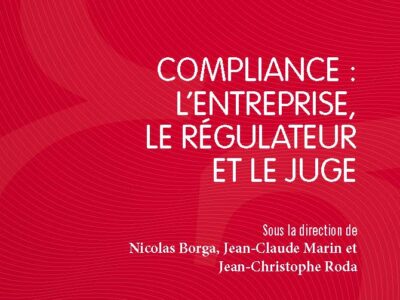
Full reference : Audit, M., Les lois extraterritoriales américaines comme facteur d'accélération de la compliance, in Borga, N., Marin, J.-Cl. et Roda, J.-Cl. (dir.), Compliance : l'entreprise, le régulateur et le juge, Série Régulations & Compliance, Dalloz, 2018, pp. 45-54.   Read a general presentation of the book in which the article is published Read the other titres offre sérieux in which the book is pubished

Articles

Apprendre le Droit américain avec Miss Sloane

Publication director

🏗️ copublishing and direction of the collection: 📚Régulations & Compliance

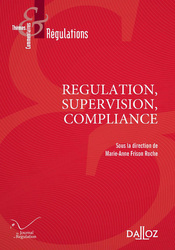
Publication of 🕴️M.-A. Frison-Roche (ed.), 📕Régulation, Supervision, Compliance (Regulation, Supervision, Compliance)

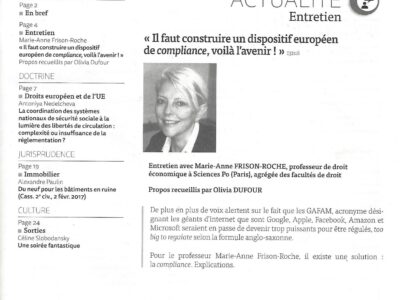
► Full Reference: M.-A. Frison-Roche (ed.), Régulation, Supervision, Compliance (Regulation, Supervision, Compliance), Dalloz, coll. “Thèmes & Commentaires”, “Régulations” Serie, 2017, 148 p. - ► General presentation of the book: Regulation. Supervision. Compliance. Three terms that until recently were virtually unknown in legal systems. Or at least considered to be peculiar to Anglo-American legal systems: Regulation, Supervision, Compliance. These terms are like Trojan horses through which Common Law is taking over our legal traditions to make European companies, especially banks, bend over backwards, take over institutions and impose methods. Three words by which the invasion is carried out. Through the violence of repression and compliance penalties, through the mildness of codes of conduct and corporate social responsibility. By laws as new as they are strange, such as the French so-called “Sapin 2” law or the French law introducing a “duty of vigilance” for companies whose fault would be to have succeeded in expanding internationally. One can have this defensive conception of Compliance, generating a “Compliance Law”, produced by the internalisation of Regulatory Law in global economic operators, who are then subject to supervision by Regulators, even though these firms are not regulated, with Compliance extending beyond the supervised sectors (banks and insurance companies). We can (and maybe must) have a more welcoming, and therefore more offensive, conception of Compliance. It can be the crucible of a relationship of trust on a supra-national scale between these operators and the regulators, the former being able to contribute, like the latter, to serving goals that go beyond them all, of which the fight against corruption and money laundering are but a few examples. In this way, the issue is the construction of the European Compliance Law. - 📝read the interview given by Marie-Anne Frison-Roche to the Petites Affiches, “We need to build a European compliance system – that’s the future! ire l’entretien donné par Marie-Anne Frison-Roche aux Petites Affiches ,“Il faut construire un dispositif européen de compliance, voilà l’avenir !” (“We need to build a European Compliance System – that’s the Future!”), about the publication of this book (in French) - 🧮This book follow a cycle of conférences organised in 2016 by the Journal of Regulation (JoR) in collaboration with the École d’Affaires Publiques and the Département d’Économie of Sciences Po (Paris), under the scientific direction of Marie-Anne Frison-Roche, Director of the Journal of Regulation (JoR) - This volume is the continuation of the books dedicated to Compliance in this collection. ► Read the presentations of the other books in the series: the following books: 🕴️N. Borga, J.-Cl. Marin and J.-Ch. Roda (eds.), 📕Compliance : l’entreprise, le régulateur et le juge, 2018 🕴️M.-A. Frison-Roche (ed.), 📕Pour une Europe de la Compliance, 2019 🕴️M.-A. Frison-Roche (ed.), 📕Les outils de la Compliance, 2021 🕴️M.-A. Frison-Roche (ed.), 📕Les Buts Monumentaux de la Compliance, 2022 🕴️M.-A. Frison-Roche (ed.), 📕La juridictionnalisation de la Compliance, 2023 🕴️M.-A. Frison-Roche and M. Boissavy (eds.), 📕Compliance et droits de la défense. Enquête interne – CJIP – CRPC, 2024 🕴️M.-A. Frison-Roche (ed.), 📕L’Obligation de Compliance, 2025 🕴️M.-A. Frison-Roche (ed.), 📕Compliance et Contrat, forthcoming 🕴️L. Laref (ed.), 📕Compliance et vigilance bancaire, forthcoming 🕴️M.-A. Frison-Roche, 📕Le système juridique de l’adressage de l’Internet. Une structure multi-acteurs, gage de durabilité (The Legal System of Internet Addressing. A Multi-Stakeholder Structure, the Pledge of its Sustainability), forthcoming 🕴️M.-A. Frison-Roche (ed.), 📕Le système probatoire de la Compliance, forthcoming   the previous books: 🕴️M.-A. Frison-Roche (ed.), 📕Internet, espace d’interrégulation, 2016 📚Read the presentations of the other titles of the Serie. - 🏗️General construction of the book:  Consulter le sommaire de l’ouvrage. - ► Understand the book through the Table of Contents and the summaries of each article:  🕴️M.-A. Frison-Roche, 📝Du droit de la régulation au droit de la compliance   I. AUTOUR DE LA NOTION DE COMPLIANCE (AROUND THE NOTION OF COMPLIANCE) 🕴️B. de Juvigny, 📝La compliance, bras armé de la régulation 🕴️I. Falque-Pierrotin, 📝L’Europe des données ou l’individu au coeur d’un système de compliance 🕴️B. Lasserre, 📝Concurrence et bien public 🕴️J.-M. Sauvé, 📝Compliance, droit public et juge administratif 🕴️J.-Cl. Marin, 📝Droit pénal et compliance   II. CHOCS ET ACCLIMATATION DE LA COMPLIANCE DANS LE SYSTÈME JURIDIQUE (SHOCKS AND ACCLIMATISATION OF COMPLIANCE IN THE LEGAL SYSTEM) 🕴️D. Migaud, 📝Le nouveau rapport entre l’État et les normes impliquées dans la compliance 🕴️A. C. Bénichou, 📝Nouvelles technologies : réflexions sur la compliance et l’éthique 🕴️J.-M. Darrois, 📝La loi Sapin II : un défi pour les avocats 🕴️Y. Perrier, 📝“Diplomatie” de la compliance et de sa régulation   III. LES DIALOGUES OUVERTS PAR LA COMPLIANCE (DIALOGUES OPENED UP BY COMPLIANCE) 🕴️J.-B. Auby, 📝Le dialogue de la norme étatique et de la compliance 🕴️L. Donnedieu De Vabres, 📝Pas de compliance sans confiance 🕴️J. Bédier, 📝La compliance, un outil actif de développement de l’entreprise  🕴️A. De La Cotardière, 📝Le rôle de l’avocat en matière de compliance - 🌐follow Marie-Anne Frison-Roche on LinkedIn 🌐follow Marie-Anne Frison-Roche on Instagram 🌐subscribe to the Newsletter MAFR Regulation, Compliance, Law

Glossary

Translation

First of all, the Regulation and Compliance Law is difficult to understand in others languages than English, through translation, for example in French.  This corpus of rules and institutions suffers from ambiguity and confusion because of its vocabulary of Anglophone origin, in which words or expressions that are similar or identical have not the same meaning in English and, for example, in French.. To every lord all honor, this is the case for the term "Regulation". In English, "regulation" refers to the phenomenon which the French language expresses by the term "Régulation". But it can also aim at the complete fitting of what will hold a sector reaching a market failure and in which regulation is only one tool among others. The expression "regulatory system" will be used with precision, but also the term "Regulation", the use of the capital letter indicating the difference between the simple administrative power to take texts ("regulation") and the entire system which supports the sector ("Regulation"). It is inevitable that in a quick reading, or even by the play of digital, which overwrites the capital letters, and the automatic translations, this distinction of formulation, which stands for a lower / upper case, disappears. And confusion arises. The consequences are considerable. It is notably because of this homonymy, that frequently in the French language one puts at the same level the Droit de la Régulation ("regulatory law, Regulation") and the réglementation (regulation). It will be based on such an association, of a tautological nature, to assert that "by nature" the Regulatory Law  is "public law", since the author of the reglementation (regulation) is a person of public law, in particular the State or Independent administrative authorities such as Regulators. There remains the current and difficult justification for the considerable presence of contracts, arbitrators, etc. Except to criticize the very idea of Regulatory Law, because it would be the sign of a sort of victory of the private interests, since conceived by instruments of private law. Thus two major disadvantages appear. First of all, it maintains in the Law of Regulation the summa divisio of Public and Private Law, which is no longer able to account for the evolution of Law in this field and leads observers, notably economists or international Institutions, to assert that the Common Law system would be more adapted today to the world economy notably because if it does indeed place administrative law, constitutional law, etc., it does not conceive them through the distinction Law Public / private law, as the Continental system of Civil Law continues to do. Secondly, no doubt because this new Law draws on economic and financial theories that are mainly built in the United Kingdom and the United States, the habit is taken to no longer translate. In other languages, for example, texts written in French are phrases such as "le Régulateur doit être  accountable". It is inaccurate that the idea of ​​accountability is reducible to the idea of ​​"responsibility". The authors do not translate it, they do not recopy and insert it in texts written in French. One passes from the "translation-treason" to the absence of translation, that is to say to the domination of the system of thought whose word is native, here the U.K. and the U.S.A. One of the current major issues of this phenomenon is in the very term of "Compliance". The French term "conformité" does not translate it. To respect what compliance is, it is appropriate for the moment to recopy the word itself, so as not to denature the concept by a translation. The challenge is to find a francophone word that expresses this new idea, particularly with regard to legal systems that are not common law, so that their general framework remains.