United States

Articles in a JoRC book

RODA, Jean-Christophe🕴️

📝Compliance, enquêtes internes et compétitivité internationale : quels risques pour les entreprises françaises (à la lumière du Droit antitrust) ?, in 🕴️M.-A. Frison-Roche (dir.), 📕Les Buts Monumentaux de la Compliance

► Full Reference: J.-Ch. Roda, "Compliance, enquêtes internes et compétitivité internationale : quels risques pour les entreprises françaises (à la lumière du droit antitrust) ?" ("Compliance, internal investigations and international competitiveness: what are risks for the French companies (in the light of Antitrust Law)?"), in M.-A. Frison-Roche (ed.), Les Buts Monumentaux de la Compliance, coll. "Régulations & Compliance", Journal of Regulation & Compliance (JoRC) and Dalloz, 2022, pp. 367-380. - 📕read a general presentation of the book, Les Buts Monumentaux de la Compliance, in which this article is published - ► Summary of the article (done by the Journal of Regulation & Compliance): The author draws on American and European Competition Law to measure whether internal investigations, as far as they provide factual elements, can provide foreign authorities and competitors, here American, with "sensitive information" (notably via leniency programs), and as such constitute a competitive handicap. But this turns out to be quite difficult, whereas compliance audits, for example under the legal duty of vigilance, can provide American litigants with useful information, drawn from internal documents, in particular the reports of compliance officers, which can be captured by the procedures of discovery. French law remains weak face of these dangers, due to its refusal to recognize the legal privilege mechanism concerning these internal documents, contrary to the American Law and the consequent effectiveness of discovery in international procedures, concerning internal documents, in particular resulting from internal investigations. Solutions have been proposed, the activation of a new conception of blocking laws being complex, the prospect of adopting a legal privilege being more effective, but there would remain the hypothesis of an international conflict of privilege, American Law having a strict design of legal advice justifying it and judges checking that  powerful companies do not use it artificially. -

Conferences

Cycle of colloquia 2021 around Compliance Jurisdictionalisation

Compliance Law, between American Procedural Law and European Procedural Law (Le Droit de la Compliance, creuset entre Droit processuel américain et Droit processuel européen)

This scientific event is placed under the scientific responsibility of Marie-Anne Frison-Roche and Arnaud van Waeyenberge. It is organized by the Journal of Regulation & Compliance (JoRC) and by the Centre Perelman of Brussels University. This event is part of the 2021 colloquia cycle around the general theme of Compliance Jurisdictionalisation.     The different interventions will be then transformed into contributions in the books La juridictionnalisation de la Compliance  and Compliance Juridictionnalization  which will be published in the Regulation & Compliance serie, jointly published by the JoRC and Dalloz for the book in French and by JoRC and Bruylant for the book in English.  This colloquium will take place in Brussels in October 2021.   Presentation of the theme:    Notably  will speak: Marie-Anne Frison-Roche, professor at Sciences Po – Paris Arnaud van Waeyenberge, professor at HEC Paris and researcher at Centre Perelman   Read a detailed presentation of the colloquium below:   

Videos

🎤 The Potential of Compliance Law (Les potentialités du Droit de la Compliance)

Full reference : Frison-Roche, M.-A., The Potential of Compliance Law (Les potentialités du Droit de la Compliance), conference given to Muriel Fabre-Magnan's students, Paris I, 17th of March 2021. -   This conference has been designed for Paris I's students following a Law cursus, specialized in Law of obligations and especially in Tort Law.  It therefore aims to show the technical content of Compliance Law and what it can become.  It has been followed by a debate with students.  Summary: Compliance Law is a branch of Law in the process of being born. We can be sure of its existence in the French positive Law, through the technical examination of laws called "Sapin 2" (2016) and "Vigilance" (2017). It appears at radically new. It is the reason why it is perceived as an attack, especially from United-States and we rather use legal knowledge to counter it. But if we study the historical reasons of its adoption in the United-States and the "monumental goals", whether they are negative (what should not appear in the future) or positive (what should appear in the future), we can measure that this Law, which is essentially Ex Ante could be the means through which scattered but legitimate public authorities and powerful but illegitimate big firms could ally. Therefore potentially Compliance Law could be the worst, simple tool of obedience (mechanical "conformité") or the best: what through which we could do something face to global problems, like global warming, or what we would accept to look in the face: the care for others.  Read the slides on which this conference was based (in French)

Articles

FRISON-ROCHE, Marie-Anne

💬 “Health Data Hub est un coup de maître du Conseil d’État” (“Health Data Hub is a stroke of genius of the Conseil d’État”)

Full reference: Frison-Roche, M.-A., "Health Data Hub est un coup de maître du Conseil d'État", interview realized by Olivia Dufour for Actu-juridiques, Lextenso, 22nd of October 2020 Read the news of 19th of October 2020 of the Newsletter MAFR – Law, Compliance, Regulation on which relies this interview: Conditions for the legality of a platform managed by an American company hosting European health data​: French Conseil d'État decision  To go further, on the question of Compliance Law concerning Health Data Protection, read the news of 25th of August 2020: The always in expansion "Right to be Forgotten"​: a legitimate Oxymore in Compliance Law built on Information. Example of​ Cancer Survivors Protection 

Articles

Conditions for the legality of a platform managed by an American company hosting European health data​: French Conseil d’État decision

Full reference: Frison-Roche, M.-A., Conditions for the legality of a platform managed by an American company hosting European health data​: French Conseil d'État decision, Newsletter MAFR – Law, Compliance, Regulation, 19th of October 2020 Read by freely subscribing the other news of the Newsletter MAFR – Law, Compliance, Regulation -   News Summary: In its ordinance of 13th of October 2020, Conseil national du logiciel libre (called Health Data Hub), the Conseil d'État (French Administrative Supreme Court) has determined the legal rules governing the possibility to give the management of sensitive data on a platform to a non-europeans firm, through the specific case of the decree and of the contract by which the management of the platform centralizing health data to fight against Covid-19 has been given to the Irish subsidiary of an American firm, Microsoft.  The Conseil d'État used firstly CJEU case law, especially the decision of 16th of July 2020, called Schrems 2, in the light of which it was interpreted and French Law and the contract linking GIP and The Conseil d'État concluded that it was not possible to transfer this data to United-Sates, that the contract could be only interpreted like this and that decree and contract's modifications secured this. But it observed that the risk of obtention by American public authorities was remaining.  Because public order requires the maintenance of this platform and that it does not exist for the moment other technical solution, the Conseil d'État maintained the principle of its management by Microsoft, until a European operator is found. During this, the control by the CNIL (French Data Regulator), whose the observations has been taken into consideration, will be operated.  We can retain three lessons from this great decision: There is a perfect continuum between Ex Ante and Ex Post, because by a referred, the Conseil d'État succeed in obtaining an update of the decree, a modification of the contractual clauses by Microsoft and of the words of the Minister in order to, as soon as possible, the platform is managed by an European operator. Thus, because it is Compliance Law, the relevant time of the judge is the future.  The Conseil d'État put the protection of people at the heart of its reasoning, what is compliant to the definition of Compliance Law. It succeeded to solve the dilemma: either protecting people thanks to the person to fight against the virus, or protecting people by preventing the centralization of data and their captation by American public authorities. Through a "political" decision, that is an action for the future, the Conseil found a provisional solution to protect people against the disease and against the dispossession of their data, requiring that an European solution is found.  The Conseil d'État emphasized the Court of Justice of The European Union as the alpha and omega of Compliance Law. By interpreting the contract between a GIP (Public interest Group) and an Irish subsidy of an American group only with regards to the case law of the Court of Justice of European Union, the Conseil d'Etat shows that sovereign Europe of Data can be built. And that courts are at the heart of this.  -   Read the interview given on this Ordinance Health Data Hub   To go further about the question of Compliance Law concerning health data protection, read the news of 25th of August 2020: The always in expansion "Right to be Forgotten"​: a legitimate Oxymore in Compliance Law built on Information. Example of​ Cancer Survivors Protection   

Reports, Reports

BAER, Bill

Proposals to Strengthen the Antitrust Laws and Restore Competition Online

Full reference: Baer, B., Proposals to Strengthen the Antitrust Laws and Restore Competition Online, Testimony before the United-States House of Representatives, Committee on Judiciary, Subcommittee on Antitrust, Commercial and Administrative Law, 1st of October 2020 Read the testimony Read Bill Baer's presentation by Brookings Institution of which he is a member

Articles in a legal collective publication

📝The impossible legal unicity of the category of “whistleblowers” (“L’impossible unicité juridique de la catégorie des “lanceurs d’alertes” “)

Full reference: Frison-Roche, M.-A., L'impossible unicité juridique de la catégorie des "lanceurs d'alertes" ("The impossible legal unicity of the category of "whistleblowers""), in Chacornac, J. (dir.), Lanceurs d'alertes, regards comparatistes, ("Whistleblowers, comparative perspectives"), Publications of the Centre français de droit comparé ("French Comparative Law Center"), May 2020, Volume 21, pp. 13-31.    Read the article (in French).    Read the general presentation of the collective book in which this article is published Read the bilingual working paper which had served of basis for this article.  Read the presentation of the conference "Les lanceurs d'alertes: glose" (Whistleblowers: glose") and especially the slides elabored for the colloquium organized by the Centre français de droit comparé ("French Comparative Law Center") on 23th of November 2018 under the direction of Jérôme Chacornac - Introduction of the article "Whistleblowers". This is a new expression. Which is a great success. Barely heard once, we hear it everywhere … A topic not of course or knowledge test, but rather a topic of daily conversation. Because it is spoken to us every day, in more or less gracious terms. For example President Donald Trump on October 1, 2019 declared to the press "want to question" the whistleblower who would have illegally denounced him and would not, according to him, have the right to conceal his identity, proof in this according to him of the lying character of his assertions against him, while his lawyer indicates on October 6, 2019 that he is not speaking on behalf of a single whistleblower thus taken to task but of a plurality of people who gave information against the President of the United States. Even the most imaginative screenwriters would not have written such brutal and rapid twists and turns. Spectators, we are waiting for the next episode, secretly hoping for the escalation. And precisely if we go to the cinema, it is still a whistleblower whose dedication and success, we are told about, even the drama, for the benefit of global society, and in particular democracy, since the secrets are fought for the benefit of the truth. The Secret Man designates Mark Felt as the first whistleblower. Returning to what we often present as being a more "serious" media1On the more general fact that cinema is undoubtedly the medium which most seriously restores the state of the Law, c. Frison-Roche, M.-A., Au coeur du Droit, du cinéma et de la famille : la vie, 2016., we listen to France-Culture and here is another story told by a historian who worked as an archivist on events that political power would have liked to keep hidden by possibly destroying their traces but which its trade led to preserve: here it is expressly presented to the studious listeners like a "whistleblower" …. While the same radio tries to find the one who could well be, as in a kind of contest the "first whistleblower"2L'histoire du premier lanceur d'alerte, France Culture, septembre 2019. ? …. This rewriting of History can be defended because ultimately what did other Voltaire do for Calas, or Zola for Dreyfus? It is also a subject of legislative discussion since in the United States the Dodd-Frank law of 2010 inserted in the law of 1934 which established the Securities & Exchanges Commission a complete device of remuneration and remuneration of the whistleblowers, whereas after having developed flexible but guiding lines in this regard in 20123European Commission, Guidelines on Whistleblowing, 6 of December 2012, SEC(2012) 679 final, updated on 23 of April 2018. , the European Commission published on November 20, 2018 the text of what will become a Directive intended to give a unified European status to the character, in the system gradually developed to protect the one who was presented in 2018 as that "cannot be punished for having done what is right". In Europe, the Directive first approved by a Resolution of the European Parliament on April 16, 2019 on the protection of persons denouncing breaches of Union Law and then adopted on October 7, 2019 (Directive of the European Parliament and of the Council of European Union on the Protection of Persons who Report Violations of European Union Law, different title, it should be noted, will have to be transposed into the laws of the Member States within the next two years. , since only "violations of Union Law" are targeted, but the character of the "whistleblower" is more generally targeted: he is "whole"4However, precisely the so common use of plurality ("whistleblowers") raises doubts about the uniqueness of the character. On this question, see. all the first part of the developments of this study, which leads to the conclusion rather than beyond the multitude of particular cases, there are rather two kinds of whistleblowers. V. infra I.. In short, the whistleblower is a star5The director of the film La fille de Brest says that she considers the whistleblower at the origin of the case of the Pick as a "movie character".. A sort of historical figure, covered in blows and glory, going from Voltaire to Snowden, both of whom find themselves embodied on the screens6Thus, the adventures of Snowden were brought to the screen by Oliver Stone in 2016, Snowden. On the question of knowing whether this film "faithfully reproduces" or not the case, Schetizer, P., Le film Snowden est-il à la hauteur de la réalité?, 2017. This article is favorable to the whistleblower, and to the film which tells us with emotion his case, in particular because (sic), it is easier than to read the Washington Post. …., Consecrated by law, which associates with it a legal regime of protection to such an extent that, like a Nessus tunic, it is this legal regime which will define the character and not the reverse. When we read the law of December 9, 2016 relating to transparency in the fight against corruption and the modernization of economic life, known as "Sapin 2", we notice that the Legislator makes much of this character, since 'he dedicates its chapter II to him7Underlined by us.: "From the protection of whistleblowers", and that it is by his very protection that he formally opens the door of Right to him. But why a plural? Admittedly when we read the recitals of the Community Directive of October 7, 2019 on the protection of whistleblowers8About this directive, v. the developments infra, it is only a list of all the subjects on which it is a good idea to protect them, which therefore prompts us to see in this plural only the index of this non-exhaustive list of subjects which it is good to tell us, a sign of the lack of definition of who should alert us. Reading the French law known as "Sapin 2" makes it less severe but more perplexing. Indeed, this plurality referred to by the title of the chapter devoted to "whistleblowers", there is no longer any question in the rest of the law, in the very definition which follows, article 6 which opens this chapter devoted to "whistleblowers" offering the reader immediately a singular since it begins as follows: "A9Underlined by us. whistleblower is a person …". No mention of diversity. The art of legislative writing would however have required that the qualifying article not only be singular but that it should not yet be undefined. Stendhal if he had still deigned to have the law for bedside book would have wanted to find at the beginning of chapter a sentence like: "The10Underlined by us. whistleblower is a person …". Thus seem to contradict themselves within the law "Sapin 2 the very title which presents the character, in that it uses a defined plural (the) while the defining article which presents it is in the undefined singular (one). … Here is a first reason not to advance any more but in a very careful way, in this "step by step" that constitutes a reading word for word: a gloss. This consists of taking the expression itself literally. The second reason for this technical choice is that the gloss is well suited to the introduction of a collective work, thus allowing more targeted developments to take place in other contributions, on the techniques, the difficulties and the limits of this protection, or on its history, or the reasons for the arrival in French law of these whistleblowers and the way they develop, or not, elsewhere. I am therefore going to content myself with taking this already legal expression to the letter: The (I) whistle (III). blowers (II).       
Books

Chacornac, Jérôme (ed.)

Lanceurs d’alerte: Regards comparatistes

Full reference: Chacornac, J. (ed.), Lanceurs d'alerte: regards comparatistes (written in French), Editions de la Société de Législation Comparée, Vol. 21, avril 2020, 192 p. This book follows the conference organized by the Centre français de droit Comparé on 23rd of November 2018   Read the fourth of cover (in French) Read the table of contents (in French) Read the presentation of Marie-Anne Frison-Roche's article: L'impossible unicité de la catégorie des lanceurs d'alerte, which is the introduction of the book     -

Working papers

Anchor points of the risk mapping process in the legal system

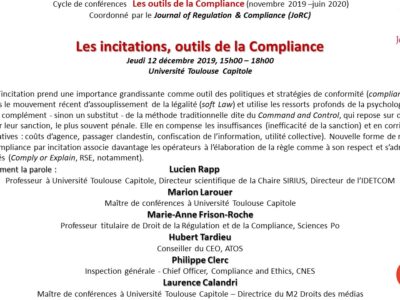
  This Working Paper served as the basis for an intervention in the conference organized in the conference cycle organized by the Journal of Regulation & Compliance (JoRC) on the theme: Compliance Tools, in collaboration with many university partners: this first conference is organized in collaboration with the Sciences po Economics Department and is held on November 28, 2019 at Sciences po and deals with the more specific theme of Risk mapping. It also serves as the basis for the book edited by Marie-Anne Frison-Roche, Compliance Tools, which will be released in the Regulations & Compliance collection.   -    Is the consideration by Law of the Risk Mapping mechanism so new? At first glance yes, and one might even be surprised at this novelty, since this rational anticipation of risks should have been recognized for a long time. But this is perhaps due to the more general fact that Risk itself has only recently become an autonomous legal object in Economic Law, in particular because Risk does not have at all the same position in Competition Law and in Regulation Law (I) .. Its position is even opposed in the both, Risk becoming central in Regulation Law. Compliance Law being the extension of Regulatory Law, it is also built on the "concern" of Risk and the internalization of this consideration in enterprises therefore takes the form of mapping. A closer look maybe not,even  before the specific  French laws, called "Sapin 2" and "Vigilance" and beyond them, case law decisions giving a general scope to maps drawn up by operators, or increasing the obligation that 'they have to do it (II). In this, general and precise technical Law offers points of support for Compliance Law, strengthening it in its tools.  

Articles

By Compliance, continental criminal justice mechanisms have come from inquisitorial procedure to adversarial system

Référence générale : Frison-Roche, M.-A., "La justice pénale est passée de l'inquisitoire à l'accusatoire" (By Compliance, Continental Criminal Justice Mechanisms have come from Inquisitorial Procedure to Adversarial System), Interview in French about the impact of the "conventions judiciaire d'intérêt public", the French equivalent of DPI, and Compliance Procedures in French Law, Lettre des juristes d'affaires, n°1416, October 14, 2019. Summary : In this interview and through the three questions asked, the answers show that we have gone from an inquisitorial system to an adversarial system, which is a  sort of Revolution especially in matter of proofw. The French legal system must be adapted, but also or, above all, this conception of Compliance efficiency is a mechanism without a judge. The expression of "deal of justice" is excessive, because precisely if there is a "deal", there is no a "judge" : the prosecutor was not a judge. These mechanisms are also handled by the administrative Independant Bodies of Regulation or Supervision, which act here as "prosecuting authorities", that is to say as prosecutor. They also "deal" the non-appearance of the judge, the opposite of "justice", in a classical conception which is the figure of the judge. It is true that in the case of the "convention judiciaire d'intérêt public" the French Law requires an approval by the judge of the CJIP: it is then that the stake moved. There is a change of culture: the prosecutor is in the center, the Regulator or the Supervisor are the "prosecuting authority" and it is as approval authority that the judge or the administrative Sanctions Committee intervenes. But later. When the essential are the proofs obtained in the first lapse of time. The firm or the person can be evaded by asserting his "right to the judge". This judge who seeks the truth while an authority to pursue wants something else: win. We must understand that.    Read the Interview (in French) and the answers to these three questions:  1. En quoi les mécanismes de justice négociée, relativement récents en France, bouleversent les concepts hexagonaux de l’ordre judiciaire ? /  How the negotiated justice mechanisms, relatively recent in France, upset the hexagonal concepts of the judiciary? 2. Les entreprises ont-elles véritablement le choix d’accepter ces « deals de justice » ? / Do companies really have the choice to accept these "deals of justice"? 3. En matière de lutte contre la corruption, les autorités de poursuite se comportent désormais comme des juges puisqu’ils exigent des engagements pour le futur. Quels sont les risques ? / In the fight against corruption, prosecution authorities now behave like judges since they demand commitments for the future. What are the risks ?