Regulation

Articles in The Journal of Regulation & Compliance « JoRC »

AUGAGNEUR, Luc-Marie🕴️

📝The jurisdictionalisation of reputation by platforms, in 🕴️M.-A. Frison-Roche (ed.), 📘Compliance Jurisdictionalisation

► Full Reference: L.-M. Augagneur, "The jurisdictionalisation of reputation by platforms", in M.-A. Frison-Roche (ed.), Compliance Jurisdictionalisation, Journal of Regulation & Compliance (JoRC) and Bruylant, coll. "Compliance & Regulation", 2024, pp. 109-125  - 📘read a general presentation of the book, Compliance Jurisdictionalisation, in which this article is published - ► Summary of the article (done by the Author): The large platforms are in the position of arbiter of the reputation economy (referencing, notoriety) in which they themselves act. Although the stakes are usually low on a unit basis, the jurisdiction of reputation represents significant aggregate stakes. Platforms are thus led to detect and assess reputation manipulations (by users: SEO, fake reviews, fake followers; or by the platforms themselves as highlighted by the Google Shopping decision issued by the European Commission in 2017) that are implemented on a large scale with algorithmic tools. The identification and treatment of manipulations is itself only possible by means of artificial intelligence tools. Google thus proceeds with an automated downgrading mechanism for sites that do not follow its guidelines, with the possibility of requesting a review through a very summary procedure entirely conducted by an algorithm. Tripadvisor, on the other hand, uses an algorithm to detect false reviews based on "fraud modeling to identify electronic patterns that cannot be detected by the human eye". It only conducts a human investigation in limited cases. This jurisdictionality of reputation has little in common with that defined by the jurisprudence of the Court of Justice (legal origin, contradictory procedure, independence, application of the Rules of Law). It is characterized, on the one hand, by the absence of transparency of the rules and even of the existence of rules stated in predicative form and applied by deductive reasoning. It is replaced by an inductive probabilistic model by the identification of abnormal behaviors in relation to centroids. This approach of course raises the issue of statistical bias. More fundamentally, it reflects a transition from Rule of Law, not so much to "Code is Law" (Laurence Lessig), but to "Data is Law", that is, to a governance of numbers (rather than "by" numbers). It also comes back to a form of collective jurisdictionality, since the sanction comes from a computational apprehension of the phenomena of the multitude and not from an individual appreciation. Finally, it appears particularly consubstantial with compliance, since it is based on a teleological approach (the search for a finality rather than the application of principles). On the other hand, this jurisdictionality is characterized by man-machine cooperation, whether in the decision-making process (which poses the problem of automaticity bias) or in the contradictory procedure (which poses, in particular, the problems of discussion with the machine and the explicability of the machine response). Until now, the supervision of these processes has been based essentially on the mechanisms of transparency, a limited adversarial requirement and the accessibility of appeal channels. The French Law Loi pour une République Numérique ("Law  for a Digital Republic"), the European Legislation Platform-to-Business Regulation and the Omnibus Directive, have thus set requirements on the ranking criteria on platforms. The Omnibus Directive also requires that professionals guarantee that reviews come from consumers through reasonable and proportionate measures. As for the European Digital Services Act, it provides for transparency on content moderation rules, procedures and algorithms. But this transparency is often a sham. In the same way and for the moment the requirements of sufficient human intervention and adversarial processes appear very limited in the draft text. The most efficient forms of this jurisdictionality ultimately emerge from the role played by third parties in a form of participatory dispute resolution. Thus, for example, FakeSpot detects false Tripadvisor reviews, Sistrix establishes a ranking index that helped establish the manipulation of Google's algorithm in the Google Shopping case by detecting artifacts based on algorithm changes. Moreover, the draft Digital Services Act envisages recognizing a specific status for trusted flaggers who identify illegal content on platforms. This singular jurisdictional configuration (judge and party platform, massive situations, algorithmic systems for handling manipulations) thus leads us to reconsider the grammar of the jurisdictional process and its characteristics. If Law is a language (Alain Sériaux), it offers a new grammatical form that would be that of the middle way (mesotès) described by Benevéniste. Between the active and the passive way, there is a way in which the subject carries out an action in which he includes himself. Now, it is the very nature of this jurisdictionality of compliance to make laws by including oneself in them (nomos tithestai). In this respect, the irruption of artificial intelligence in this jurisdictional treatment undoubtedly bears witness to the renewal of the language of Law. - 🦉This article is available in full text to those registered for Professor Marie-Anne Frison-Roche's courses -

Conferences

🎤Conclusion. Compliance et contrats publics : une alliance naturelle (Conclusion. Compliance and Public Contracts: a natural alliance), in 🧮Compliance et contrats publics

► Full Reference : M.-A. Frison-Roche, "Conclusion. Compliance et contrats publics : une alliance naturelle" ("Conclusion. Compliance and Public Contracts: a natural alliance"), in M.-A. Frison-Roche, C. Gilles & A. Oumedjkane (dir.), Compliance et contrats publics (Compliance and public contracts), Journal of Regulation & Compliance (JoRC), Centre de recherches et d’études administratives de Montpellier (CREAM) and Centre d’Études et de Recherches Comparatives Constitutionnelles et Politiques (CERCOP) of the Montpellier University, Faculté de droit et de science politique de Montpellier, 39 rue de l’Université, Amphiteatre C Paul Valéry, January 12, 2024 - 🧮see the full programme of this event - ✏️read the notes taken on the spot to draw up the symposium conclusion - 🌐consult on LinkedIn a general presentation of this event, which links to a presentation of each speech (in French) - 🧱consult the co-organisation sheet of this event, giving an account of the various speakers - ► English Summary of the conference: Firstly, it would appear that, as with all the contracts studied in the area of Compliance, public contracts are, for the public authorities or public companies, an instrument through which they implement the Compliance Obligation imposed on them by the laws and regulations. Public bodies involved in public contracts are particularly concerned because of the points of contact, even intimacy, between Compliance Law and the general interest. But the contract, whether public or private, remains in its classic conception what results from the expression of two wills which exchange their consents📎1🕴️M.-A. Frison-Roche, 🚧Compliance contract, Compliance clauses, 2022..   Secondly, in terms of free will, public contracts can be the means by which public bodies and their co-contractors express their conception of what needs to be done to preserve the future, for example in environmental and social matters. On the contrary, the seemingly technical issue of exclusions from public contracts, whether they be automatic exclusions or optional exclusions, expresses the extent to which economically powerful players (public authorities, municipalities, public companies) take care of each other. In this respect, Compliance Law runs counter to Competition Law📎2🕴️M.-A. Frison-Roche, 🚧Competition Law and Compliance Law, 2018. and profoundly affects Public Procurement Law.   But thirdly, the public contract, in that it expresses the general interest by its very nature, its ex ante nature reinforces regulatory action and the nature of Compliance as an extension of Regulation📎3🕴️M.-A. Frison-Roche (ed.), 📕Régulation, Supervision, Compliance (Regulation, Supervision, Compliance), 2017.. It appears to be the most appropriate instrument for this new branch of Law, without the need for it to be transformed. This underlines the extent to which Compliance Law must draw on classical Law, in this case Administrative Law.   Moreover, fourthly, the public contract appears to be the model for the Compliance Contract. The public contract is a model first of all because of the central place of the general interest. The "Monumental Goals" in which the substantive definition of  Compliance Law is anchored📎4🕴️M.-A. Frison-Roche, 📝Compliance Monumental Goals, beating heart of Compliance Law, in 🕴️M.-A. Frison-Roche (ed.), 📘Compliance Monumental Goals, 2022. are a development of this. Admittedly, this concern for the general interest drives the public entity, but the "raison d'être" of companies more generally also incorporates it through "governance", profoundly renewed by Compliance. The public contract is also a model because the contract is handled by a powerful party, in this case the public entity. The subject of Compliance Law is the powerful company, and only that company, chosen because it is powerful and because it uses that power to achieve the Monumental Goals. In this respect, the "exorbitant powers" that characterise the public contractor are reconstituted either by Compliance laws or by stipulations, which confer on all obliged or voluntary companies – by virtue of CSR, which has many points of contact with Compliance Law as long as it is not confused with obeying the applicable regulations (which is what "conformity" is)📎5🕴️M.-A. Frison-Roche, 📝Reinforce the Judge and the Lawyer to impose Compliance Law as a characteristic of the Rule of Law, in 🕴️M.-A. Frison-Roche (ed.), 📘Compliance Jurisdictionalisation, 2023. – a power over the co-contractor, or even over third parties, equivalent to that of the public entity📎6🕴️M.-A. Frison-Roche, 🚧Use of private companies by Compliance Law to serve Human Rights, 2023..  The judge is the one who, through contractual litigation, both public and private, will bring to life these Monumental Goals desired by the State, carried by powerful entities (administration, companies), pledge of the Rule of Law📎7🕴️M.-A. Frison-Roche, 📝Reinforce the Judge and the Lawyer to impose Compliance Law as a characteristic of the Rule of Law, in 🕴️M.-A. Frison-Roche (ed.), 📘Compliance Jurisdictionalisation, 2023.. These include contractual mechanisms for information, audit, disclosure, control, collaboration, supervision, etc., through which the company, whether private or public, takes charge of the structure it has created, for example the value chain it masters📎8🕴️M.-A. Frison-Roche, 📝Assessment of whistleblowing and the obligation of vigilance regarding International Competitiveness, in 🕴️M.-A. Frison-Roche (ed.), 📘Compliance Monumental Goals, 2022..   It can therefore be concluded that this logic of a public contract as an instrument of administrative action to achieve goals of general interest, now fully taken up in Compliance Law, must be acculturated into the Ordinary Contract Law and must be preserved in Public Contract Law, which presupposes a new balance with Competition Law, which for a long time carried within Public Law a contract model without concern for sustainability or the collective interest. To achieve this, dialogue between judges is essential. The Conseil d'État (French Council of State) and the Cour de cassation (French Court of cassation) set the example📎9Conseil d'État (French Council of State) and Cour de cassation (French Court of cassation), 📗Du droit de la régulation au droit de la compliance : quel rôle pour le juge ?, La Documentation Française, 2024 (to be published).. - 📝This conference will be followed by an article, "The public contract, model of the Compliance Contract", which will be published in the book 📘Compliance and contract. - 🌐follow Marie-Anne Frison-Roche on LinkedIn 🌐follow Marie-Anne Frison-Roche on Instagram 🌐subscribe to the Newsletter MAFR Regulation, Compliance, Law

Articles in a legal collective publication

article in a collective publication

📝The deployment of Regulatory Law through Compliance Law in the European project

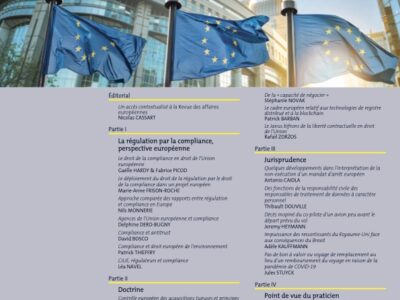
► Full Reference: M.-A. Frison-Roche, "The deployment of Regulatory Law through Compliance Law in the European project", in G. Hardy & F. Picod, Compliance Regulation from a European Perspective, Law and European Affairs (L.E.A.), 2023/2, pp. 345-352. - 🚧read the bilingual Working Paper which is the basis of this article, with additional developments, technical references and hyperlinks  - ► English Summary of the article: Compliance Law is neither a method of obeying regulations, nor a simple neutral method of ensuring the effectiveness of norms, nor a means of enforcement displaced from Ex Post to Ex Ante. It is an extension of Regulatory Law and goes beyond it. Like it, it aims to build spaces according to a political project specific to an area, such as Europe. Branch of Law looking to the future as Regulatory Law does, it constructs and maintains, in a systemic way, sustainable, albeit unstable, balances to achieve the ‘Monumental Goals’ in which its normativity resides: security, sustainability, probity, truth, and dignity. By internalising these Monumental Goals in the companies that are in a position to achieve them, the “crucial companies”, Compliance Law preserves the logic of Regulatory Law, offering it a prodigious expansion since it frees it from the condi- tion of a sector and territorial borders, which seemed tautological, by associating private powers and public will, which remains primary. In this way, Compliance can regulate the digital space and climate issue through political choices made by a sovereign Europe. - 🌐follow Marie-Anne Frison-Roche on LinkedIn 🌐follow Marie-Anne Frison-Roche on Instagram 🌐subscribe to the Newsletter MAFR Regulation, Compliance, Law

Breaking news

💬La profession investit le Droit de la compliance et détermine sa Raison d’être

🌐follow Marie-Anne Frison-Roche on LinkedIn 🌐subscribe to the Newsletter MAFR Regulation, Compliance, Law - ► Full Reference: M.-A. Frison-Roche & S. Vernet, "La profession investit le Droit de la compliance et détermine sa Raison d’être" ("The profession invests Compliance Law and determines its Raison d'être"), Actualités, Ordre des Géomètres-Experts, July 28, 2023 - 💬read the interview (in French) - ► Presentation of the interview by the Ordre des Géomètres-Experts: "Pour mieux répondre aux défis d’une société en pleine mutation, ainsi qu’aux attentes de ses clients et concitoyens, la profession détermine sa Raison d’être. Séverine Vernet, première Vice-présidente de l’Ordre des géomètres-experts et Marie-Anne Frison-Roche, professeur de droit économique et spécialiste du droit de la régulation et de la compliance, nous expliquent cette démarche innovante." ("To better meet the challenges of a rapidly changing society and the expectations of its customers and fellow citizens, the profession is defining its raison d'être. Séverine Vernet, First Vice-President of the Ordre des géomètres-experts, and Marie-Anne Frison-Roche, Professor of Economic Law and specialist in Regulatory and Compliance Law, explain this innovative approach."). - ► Questions asked (in French):  Séverine Vernet, vous êtes la première Vice-présidente de l’OGE et présidente de la nouvelle commission compliance. Permettez-moi tout d’abord de vous féliciter pour votre réélection. Quels seront les prochains chantiers du mandat qui démarre ? Et votre ambition pour ce nouveau mandat ?​ Marie-Anne Frison-Roche (mafr), vous êtes professeur d’université, spécialiste de droit économique et plus particulièrement du droit de la régulation et de la compliance, vous accompagnez l’Ordre dans la mise en place de cette démarche. Séverine Vernet parle de compliance. Pourriez-vous nous en proposer une définition ?   L’OGE a créé une commission compliance spécifique que vous présidez. Pouvez-vous nous en dire un peu plus ?   Comment passe-t-on d’un organisme de régulation à un acteur de la compliance ? En quoi est-ce innovant pour un Ordre professionnel ?   Comment allez-vous vous y prendre pour engager la profession ?   Quelles seront les étapes pour passer de la régulation à la compliance ? -

Conferences

🎤Participation in the panel “Vigilance (due diligence)”, in 🧮150th Anniversary Symposium of the ILA/ADI

🌐 follow Marie-Anne Frison-Roche sur LinkedIn 🌐subscribe to the Newsletter MAFR Regulation, Compliance, Law  - ► Full Reference: M.-A. Frison-Roche, participation in the panel "Vigilance (due diligence)", in International Law Association (ILA), 150th Anniversary Symposium of the ILA/ADI, Paris, 19 June 2023. - 🧮See the full programme of this event -

Reports

Financial Stability Board

The Use of Supervisory and Regulatory Technology by Authorities and Regulated Institutions

Full reference: Financial Stability Board, The Use of Supervisory and Regulatory Technology by Authorities and Regulated Institutions. Market Developments and Stability Implications, Report of 9th of October 2020, 36 p.  Read the report Read the presentation of the report by the Financial Stability Board To go further on the question of the use of new technologies in regulatory processes, read Marie-Anne Frison-Roche's working paper: Analysis of blockchains with regards with the uses they can fulfill and the functions that the ministerial officers must ensure  

Articles

The Economic Impact of Law: a new report about it. And what about Regulation & Compliance? 3 lessons

Full reference: Frison-Roche, M.-A., The Economic Impact of Law: a new report about it. And what about Regulation & Compliance? 3 lessons, Newsletter MAFR – Law, Regulation, Compliance, 24th of September 2020 Read by freely subscribing the other news of the Newsletter MAFR – Law, Regulation, Compliance   Summary of the news:  On 18th of September 2020, the European Economic and Social Committee (EESC) published a report about the impact of Rule of Law on Economic Growth.  The EESC defines the Rule of Law as the obligation to "all public powers act within the constraints laid down by law, in accordance with the values of democracy and fundamental rights, and under the control of independent and impartial courts". According to the Committee, the Rule of Law thus defined is favorable and even necessary to a durable economic growth especially because instability of regulations, absence of guarantee of labor and property rights, discrimination or non-application of contracts poorly favors or are detrimental for investments and economic agents' productive activities. The EESC observes by the way that countries which respect the Rule of Law grow more rapidly than those which do not respect it. The Committee also insists on the destructive effect of corruption which destroys public services, public action, public institutions on the long run and confidence, increasing inequalities.  Although EESC approves the actions of European Commission to advance Rule of Law in the Union, it however invites the Commission to continue its efforts by giving a more important place to jurisdictions and by protecting better media freedom in a context of rising autocratic forces in Eastern Europe.  We can learn three lessons from this report: The common interest of European Union States to guarantee the Rule of Law. Indeed, Rule of Law is not only written in article 2 of TFEU and has been consecrated by CJEU case law, it is also a condition of economic progress.  The fight against corruption must be the object of a redoubled effort. In this perspective, Compliance Law is able to offer appropriate innovating legal tools. To a definition of Regulation and Compliance Law as a simple process of application of mechanical legal rules, it is necessary to substitute a definition of Regulation and Compliance Law based on the notion of "monumental goals" and people protection. In this perspective, these branches of Law would prove to be powerful tools in the service of the advancement of the rule of law in the European space.

Articles

The control by regulator of the essential infrastructure manager’s investment plan: example of electric network and the notion of “doctrine”

Full reference: Frison-Roche, M.-A., The control by regulator of the essential infrastructure manager's investment plan: example of electric network and the notion of "doctrine", Newsletter MAFR – Law, Compliance, Regulation, 24th of August 2020 Read by freely subscribing other news of the Newsletter MAFR – Law, Compliance, Regulation   Summary of the news On 31st of July 2020, the Commission de Régulation de l'Energie (CRE and French energy regulator) has examined the investment plan of the French electric network manager (RTE) as it does every year. This investment plan is an economic document but it also contains societal purposes, especially the adaptation of the electric network in order to integrate renewable energies.  The control by the CRE is not a financial control. The crucial operator (RTE) is free to decide the way it wants to manage its budget. The CRE just advices on the financial side by recommending for exemple to be more flexible in its financial strategies. The true CRE's control is about the investment plan's general orientations, the methodology of needs analysis and crucial operator's investment choices which must be aligned with those of the regulator. Such a control leads to the emergence of an "investment doctrine" from the side of the crucial operator, mixing its own choices and the regulator's guidelines. Beyond this, the elaboration of the investment plan is the result of a true co-writing between the regulator and the firm which discuss together, exchanges points of view and methods. Such a method, expressing a kind of coregulation, could be used in other sectors. 

Reports

Council of the European Union

INFORMATION NOTE FROM THE EUROPEAN COMMISSION TO THE PERMANENT REPRESENTATIVES COMMITTEE ABOUT THE PROGRESS ON COMBATTING HATE SPEECH ONLINE THROUGH THE EU CODE OF CONDUCT

Full reference: Information Note From the European Commission to the Permanent Representatives Committee About the Progress on Combatting Hate Speech Online Through the EU Code of Conduct, Council of the European Union, 27th of September 2019, 7p. Read the note

Articles in The Journal of Regulation & Compliance « JoRC »

MUSCA, Xavier🕴️

📝Construire une Europe de la compliance en donnant une meilleure place aux entreprises, in 🕴️M.-A. Frison-Roche (ed.), 📕Pour une Europe de la Compliance

► Full Reference: X. Musca, "Construire une Europe de la compliance en donnant une meilleure place aux entreprises" ("Building the Europe of the Compliance by giving companies a greater role to play"), in M.-A. Frison-Roche (ed.), Pour une Europe de la Compliance, series "Régulations & Compliance", Dalloz, 2019, pp. 39-47. - 📕read a general presentation of the book, Pour une Europe de la Compliance, in which this article is published - ► Summary of the article (done by the Journal of Regulation & Compliance):    🦉This article is available in full text to those registered for Professor Marie-Anne Frison-Roche's courses -