Neutrality

Breaking news

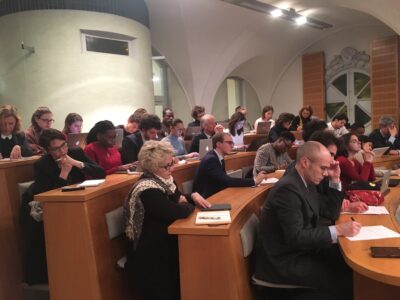
Dans la conférence inaugurale du 2 mars 2018 sur “L’Europe de la Compliance”, la qualité aggravante ou atténuante d’un programme de compliance en cas de manquement a été particulièrement discutée

During the discussion that followed the inaugural conference for the Cycle Pour une Europe de la Compliance (For a Europe of Compliance) that Koen Lenaerts devoted to the role of the Court of Justice of the European Union in the construction of the Europe of Compliance, and after a first discussion led by Antoine Garapon, a problem has particularly emerged. Indeed, President Koen Lenaerts has taken up the question of the influence of the adoption of a "compliance program" by a company when subsequently anticompetitive behavior is imputed to it. Competition or regulatory authorities, as well as courts, have three possibilities: either to consider that the company had done what it could to prevent this behavior, to educate the persons in its charge, that this prevention not enough but must be taken into account in its "discharge" to lighten its sanction; on the contrary, to consider that the adoption of such a compliance program by the enterprise by which it expresses its express and pro-active desire to bear the efficiency of the standard itself while at the same time it disregards it constitutes an aggravating circumstance of its responsibility; consider that the fact must remain neutral in the judge's assessment of the behavior. The Court of Justice stands by the third solution. But everyone agrees that this is an essential question for which the arguments are well-founded, the European Commission, on the other hand, leaning towards the qualification of an aggravating fact. During the discussion, it was emphasized in the opposite direction that in the perspective of Compliance as an incentive mechanism, not taking into account on the part of companies the adoption of such expensive programs is very discouraging for them. Moreover, this contradicts the definition of compliance as a "Trust pact" between the company and the public authority.   -     QWhat can be done to remain from this discussion of a very great interest? So it's a question that is still open, because the arguments are strong and we could say that "everyone is right", and companies that want to take note of their behavior, and authorities who can not be abused by what would be only a screen of behavior violating Law. The question is maybe whether the choice of "neutrality" of the Court of Justice is a solution of waiting or a decision of non-choice, because one could never know if a company is "sincere" or not when it has adopted a Compliance Program. It is probably here that a solution could be found: in probative mechanisms. Because in these matters, it is by technical processes by which the subject of law (that is to say the company) reveals that it has done everything to achieve the Compliance purpose (obligation of means strengthened). ). It is probably by formulating probative requirements of this kind that the Court of Justice could move out of its position of neutrality. While it is true that the judge must be "impartial" in relation to the facts, the attitude of giving no "relevance" to a fact as important as the compliance programs is inherently annoying. It seems difficult to associate a substantive rule, nor is it desirable to practice casuistry. But, because Economic Law lends itself to it, a probationary system that the Court would make clear would perhaps be a good solution.   -   Dans l'ouvrage qui paraîtra à la fin du cycle de conférences, un article sera inséré dans l'ouvrage sur cette question plus particulière de la portée des programmes de conformité sur l'appréciation du comportement de l'opérateur au regard des faits qui lui sont reprochés, question sur laquelle les différents régulateurs des différents systèmes juridiques divergent. In the book that will be published at the end of the conference cycle, an article will be inserted in it  on this particular question of the effects of compliance programs on the appreciation of the behavior of the enterprises with regard to the facts that are reproached, an issue on which the different regulators of the different legal systems diverge. For the moment.


Working papers

🚧Globalization from the point of view of Law

► Full Reference: Frison-Roche, M.-A., Globalization from the point of view of Law, working paper, May 2017. - 🎤 This working paper initially served as a basis for a synthesis report made in French in the colloquium organized by the Association Henri Capitant in the International German Days on the subject of "Le Droit et la Mondialisation" (Law and Globalization). 📝 Il sert dans un second temps de base à l'article paru dans l'ouvrage La Mondialisation. 📝 it serves as a second basis for the article (written in English, with a Spanish Summary) to be published in the Brezilian journal Rarb – Revista de Arbitragem e Mediação  (Revue d`Arbitrage et Médiation). It uses the Bilingual Dictionary of the Law of Regulation and Compliance. - ► Summary of the Working: Globalization is a confusing phenomenon for the jurist. The first thing to do is to take its measure. Once it has been taken, it is essential that we allow ourselves to think of something about it, even if we have to think about it. For example, on whether the phenomenon is new or not, which allows a second assessment of what is taking place. If, in so far as the law can and must "pretend" to defend every being, a universal claim destined to face the global field of forces, the following question – but secondary – is formulated: quid facere? Nothing ? Next to nothing ? Or regulate? Or can we still claim that the Law fulfills its primary duty, which is to protect the weak, including the forces of globalization? - read the Working Paper below⤵️

Working papers

Bank and Competition

 Bank and Competition do not mix. It is not so much that the banks would act as repeat offenders on which the competition authorities should raise the tone by increasingly heavy penalties so that the competitive lesson is finally heard. It is rather two orders confronting each other, two incomprehensions face to face. Indeed, the banks find it appropriate to agree in order for the banking system to function. Moreover, governments demand them political behavior by financing the economy when the economy does not rely on financial markets. Hence, how would they themselves behave in a market consisting of selfish behavior and aggression towards their counterparts? If we plunge into this melting pot of incomprehension that engenders the violent clash between the banks, which evoke their mission, even their duty, and the competition authorities which avail themselves of theirs, we run into the pitfall of the definition even of what a bank is. It can be estimated that a bank is a provider of various services, operating in competing markets. In this perspective, the law ensures the proper functioning, the authorities that keep the efficiency of the markets seizing the banks that carry out their activities. But if we choose to insist that banks are what make the economy work and strengthen the social bond, then they are an integral part of their own system: the banking system. Moreover, the latter is an essential element of society, a perspective in which competition is merely contiguous. The more Europe manages to build banking Europe, the more it elaborates a mechanism for resolving difficulties, the more the bank is above all a matter of State and not of financial markets. In what is the political course of the history of peoples, competition ceases to be its first measure. It is therefore necessary to start from the undisputed existence of banking markets and the competitive mechanism which the law correlates with (I)). But the scale of the resistance reveals that it seems to have intentionally or not to have passed on the elementary and the essential: the very definition of what is a bank II. If it is accepted that the bank is the operator of the banking system, which fuels the economy as a whole, then competition law has only an adjacent role and can not constitute its backbone (III). The European Banking Union is demonstrating this.  

I-2.0: Is there a compelling need for neutral action in regulated economic sectors ? ?

TRANSLATED SUMMARIES ENGLISH “Acting in a neutral way” is an oxymoron. “Companies often require however that States use their powers in a neutral way (eg tax neutrality). In regulated sectors, some are right or even duty , of not being neutral. Firstly, it is the State, which requires the market for other purposes, other temporalities and other values​​. Secondly, they are also the “crucial operators”, which are sort of regulators of second degree, such as transmission system operators or companies capital markets firms. The difficulty increases when the systeme requires neutrality of regulators and judges, when first build economic policy and the second create jurisprudence. Their consistency, impartiality and rationality can create an objectifiable neutralitys FRENCH «Agir de façon neutre» est un oxymoron. «Les entreprises ont souvent besoin, cependant, que les États utilisent leurs pouvoirs de manière neutre (neutralité fiscale par exemple). Dans les secteurs réglementés, certains ont le droit ou même le devoir de ne pas être neutre. Tout d’abord, c’est l’État, qui insère le marché à d’autres fins, d’autres temporalités et d’autres valeurs. En second lieu, ils sont aussi les «opérateurs crucial», qui sont des sortes de régulateurs du second degré : par exemple les opérateurs de réseaux de transport ou de entreprises de marchés financiers. La difficulté augmente lorsque le systeme économique et politique exige la neutralité des autorités de régulation et des juges, alors que les premiers construisent la politique économique et les seconds construisent la jurisprudence. Le respect qu’ils doivent avoir de l’impartialité et d’une rationalité suffisamment objectivables pourra permettre cette objectivité requise.

I-1.36: Neutrality of the State: between myth and reality

Translated Summaries In The Journal of Regulation the summaries’ translation are done by the Editors and not by the authors ENGLISH At first sight, the notion of the neutrality of the State seems to be obvious and simple, almost a pleonasm. Being above isolated individuals, the State is responsible for the general interest, even envisioned on a long-term basis. However when one gets deeper into the analysis, this first observation, evident at first sight, must be mitigated and qualified. FRENCH A première vue, la notion de la neutralité de l’Etat semble être évidente et simple, presque un pléonasme. Etant au-dessus d’ individus isolés, l’État est responsable de l’intérêt général, même envisagé sur le long terme. Toutefois, A aller plus loin dans l’analyse, cette première observation, évidente à première vue, doivent être atténués et expliquée. SPANISH A primera vista, la noción de la neutralidad estatal parece ser obvio y simple, casi un pleonasmo. Estando por encima de los individuos aislados, el Estado es responsable por el interés general, aun cuando considerado a largo plazo. Pero cuando uno se sumerge en el análisis, esta primera observación, evidente a primera vista, puede ser mitigado y calificado. ITALIAN A prima vista, la nozione di neutralità dello Stato sembra un concetto ovvio e semplice, quasi un pleonasmo. Lo Stato, al di sopra degli individui singolarmente considerati, è responsabile dell’interesse generale, persino a lungo termine. Tuttavia, quando si analizza in modo più approfondito tale concetto, questa prima osservazione, evidente a prima vista, deve essere relativizzata e specificata. ………………… Other translations forthcoming.

I-2.4: The principle of the neutrality of standards (the example of accounting standards)

Translated Summaries ENGLISH The subject of neutrality brings to my mind a certain number of preliminary ideas and reminiscences. First of all, the image of Buddha comes to mind, because it alone expresses the extent to which neutrality is an endless subject, since by thinking about the fact that he isn’t thinking about anything, Buddha is still thinking about something. It also makes me think of contemporary music’s constant attempts to attain a form of neutrality: yet this goal remains unattainable, because it is evident that the search for the neutral, in a sound or a timbre, can probably never be found.   FRENCH Tout d’abord, la figure du Bouddha, qui exprime à elle seule combien la question de la neutralité est un thème sans fin, car en pensant qu’il ne pense à rien, le Bouddha pense malgré tout à quelque chose. Il me fait penser aussi à la musique contemporaine, à son souci constant d’atteindre une forme de neutralité ; préoccupation à jamais déçue lorsqu’elle reconnaît ultimement que le neutre, en ayant toujours une qualité – un son, un timbre – est probablement introuvable.   SPANISH El principio de los estándares de la neutralidad (el ejemplo de estándares de contabilidad) El tema de la neutralidad trae a luz un cierto número de ideas preliminares. Para comenzar, la figura de Buda viene a mente, porque él sólo expresa la naturaleza interminable que es el tema de la neutralidad, ya que al pensar en el hecho de que él no piensa en absolutamente nada, Buda aún así piensa en algo. También me hace pensar el intento constante de la música contemporánea de alcanzar una forma de neutralidad: pero este objetivo permanece inalcanzable, porque es evidente que la búsqueda de lo neutral, en un sonido o un timbre, probablemente nunca se podrá encontrar. ………………… Other translations forthcoming.

I-2.3: Neutralization in economically regulated industries using procedural law techniques

Translated Summaries ENGLISH Article: Neutralization in economically regulated industries using procedural law techniques In itself, regulation does not necessary require judicial review of regulators’ acts, whether the regulator is a ministry or an independent authority. In short, regulators could have the “last word” in all circumstances. However, because of an equal concern for democratic legitimacy and care to respect its international commitments, the French Parliament is convinced that judicial review over regulators’ actions is necessary. - FRENCH Article : La neutralisation dans les secteurs économiques régulés par les techniques procédurales En soi, la régulation n’appelle pas nécessairement un contrôle juridictionnel du régulateur, qu’il soit une administration ou une autorité indépendante. Ce régulateur, sommes toutes, pourrait avoir en toutes circonstances « le dernier mot ». Pourtant, moitié par conviction démocratique, moitié par prudence en raison de ses engagements internationaux, le législateur français s’est convaincu qu’un tel contrôle était indispensable. - SPANISH Artículo: Neutralización en industrias económicamente reguladas usando técnicas del derecho procesal. En sí mismo, la regulación no requiere de revisión judicial de las acciones del regulador, ya sea que el regulador es un ministerio o una autoridad independiente. Para resumir, los reguladores podrían tener la “última palabra” en todas las circunstancias. No obstante, una preocupación por la legitimidad democrática y deseo de respetar sus compromisos internacionales, el Parlamente francés está convencido que una revisión judicial sobre las acciones de los reguladores es necesaria. -   ………………… Other translations forthcoming.

I-2.2: Regulation and Neutrality: The Case of Financial Markets

At first glance, associating the terms regulation and neutrality seems to be an oxymoron, to cite Marie-Anne Frison-Roche’s expression*. Before […]

I-2.1: What does it mean to be neutral ? Socrates in the land of regulators

Translated Summaries In The Journal of Regulation the summaries’ translation are done by the Editors and not by the authors ENGLISH Article: What does it mean to be neutral ? Socrates in the land of regulators Should regulatory agencies, as we define them in today’s economic and cultural world, be obligated to be neutral in accomplishing their regulatory activities? What would the meaning of such an obligation be? ITALIAN Articolo: Cosa vuol dire essere neutrale? Socrate nella terra dei regolatori Le autorità di regolazione, come sono denominate oggigiorno nel mondo economico e culturale, dovrebbero essere obbligate ad essere neutrali quando compiono le loro attività di regolazione? Quale sarebbe il significato di un tale obbligo? ………………… Other translations forthcoming.