Lawyer

Articles

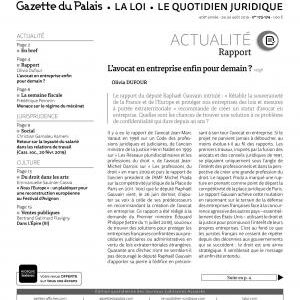
💬Et si le secret de l’avocat était l’allié de la lutte contre le blanchiment ? (Why would the attorney not be an ally in the fight against money laundering?)

Full reference: Frison-Roche, M.-A., Et si le secret de l’avocat était l’allié de la lutte contre le blanchiment ?, interview realized by Olivia Dufour for Actu-juridiques, Lextenso, 15th of October 2020 Read the interview (in French) To go deeper on the place of the attorney in Compliance Law, read Marie-Anne Frison-Roche's working paper: The Attorney, Vector of Conviction in the New Compliance System

Articles

Attorney’s Professional Secret & Filter mechanism in balance with fighting Money Laundering: constitutional analysis in favor of Attorney’s Secret

Full Reference : Frison-Roche, M.-A.,Attorney's Professional Secret & Filter mechanism in balance with fighting Money Laundering: constitutional analysis in favor of Attorney's Secret, Newsletter MAFR – Law, Compliance, Regulation, October 9, 2020.   Summary: By its judgment of September 24, 2020, the Constitutional Court of Belgium released an essential judgment which considers: – Compliance Law which imposes obligations on entities to fight against money laundering and the financing of terrorism is legal requirements which must be analyzed on the basis of these goals – the national transposition law is "broader" than the transposed European texts since it is anchored in the Constitution – the provisions of the law imposing the declaration of suspicion on an employee of the Attorney or on a Compliance Officer concerning information covered by the professional secrecy of the Attorney, the basis of Democracy, must therefore be canceled. This reasoning is remarkable and very solid. It is not unique to Belgium.   Lire par abonnement gratuit les autres News dans la Newsletter MAFR – Law, Compliance, Regulation

Books

📜Guide. L’avocat français et les enquêtes internes

► Full Reference: Conseil national des barreaux (CNB) and Centre de recherche et d'étude des avocats (CREA), Guide. L'avocat français et les enquêtes internes (Guide. The French attorney and the internal investigations), June 2020. - ► read the guide (in French) -

Articles in a legal collective publication

The attorney, vector of conviction in the new Compliance system (L’avocat, porteur de conviction dans le nouveau système de Compliance)

Référence générale : Frison-Roche, M.-A., L'avocat, porteur de conviction dans le nouveau système de Compliance, Dalloz Avocat, mars 2020. This editorial opens a thematic collective publication about Compliance. A synthetic article on all the contributions, published in May 2020, mirrors it: "Attorney and Compliance – The future of the character and his tool: Law, Humanism and Defense" - English Summary of the article (written in French) :  If we perceive Compliance Law as an aggression of the private company and a binding set of mechanisms that have no meaning and added value for it, then the attorney has a utility: to defend the business. It can do so not only during the sanctions phase, but also to prevent it. But this function is not central. He and she becomes so if we understand Compliance Law as being a body of substantial rules, pursuing a "monumental goal": the protection of the person, goal injected by political bodies and taken up by the operator. From this, the company must convince everyone to take it back, inside the company and outside. In a general and contradictory debate, the attorney carries this conviction, because he and shed is always convincing those who in the end judge (market, public opinion, etc.) that is their raison d'être.   Read the article   -     Read the Working Paper underlying this article, with the technical references and all the articles serving as the basis for all the assertions in this article          

Working papers

The attorney, vector of conviction in the new Compliance system

This Working Paper written in English is the basis for an article published in French in the French journal Dalloz Avocat , in March 2020.       Summary of the working Paper. If we perceive Compliance Law as an aggression of the private company and a binding set of mechanisms that have no meaning and added value for it, then the attorney has a utility: defending the business. It can do so not only during the sanctions phase, but also to prevent it. But this function is not central. It becomes so if we understand Compliance Law as a body of substantial rules, pursuing a "monumental goal": the protection of the person, goal injected by political bodies and taken up by the operator. From this, the company must convince everyone to take it back, inside the company and outside. In a general and contradictory debate, the attorney carries this conviction, because he and she is always convincing those who at the end judge (market, public opinion, etc.) that is their raison d'être.   (In this short document, the pop-ups refer to the different works that develop each of the points)


Articles

La compliance, un progrès

Glossary

Professional body

Professions play a key role in self-regulatory systems, especially the liberal professions, as soon as they are respected by companies and professionals. Professions are increasingly institutionalized, either by orders or by professions, which form networks or international associations. In this way, unlike the States, which are challenged by their borders, the professions are adapted to globalization because they develop global associations that adopt common technical standards and ethical charters of behavior. The other side of the coin is probably procedural, in the transparency of procedures and sanctions, since professional organizations take responsibility for sanctioning their own members themselves, exposing them to capture or even pushing them to conflict of interest. Professions such as banking and finance must now demonstrate that they can create the confidence they need and fuel their industry.

Working papers

🚧Globalization from the point of view of Law

► Full Reference: M.-A. Frison-Roche, Globalization from the point of view of Law, working paper, May 2017. - 🎤 This working paper initially served as a basis for a synthesis report made in French in the colloquium organized by the Association Henri Capitant in the International German Days on the subject of “Le Droit et la Mondialisation” (Law and Globalization). 📝 It then served as the basis for the article published in the book La Mondialisation. 📝 it serves as a second basis for the article (written in English, with a Spanish Summary) to be published in the Brezilian journal Rarb – Revista de Arbitragem e Mediação (Revue d`Arbitrage et Médiation). It uses the Bilingual Dictionary of the Law of Regulation and Compliance. - ► Summary of the Working: Globalization is a confusing phenomenon for the jurist. The first thing to do is to take its measure. Once it has been taken, it is essential that we allow ourselves to think of something about it, even if we have to think about it. For example, on whether the phenomenon is new or not, which allows a second assessment of what is taking place. If, in so far as the law can and must “pretend” to defend every being, a universal claim destined to face the global field of forces, the following question – but secondary – is formulated: quid facere? Nothing ? Next to nothing ? Or regulate? Or can we still claim that the Law fulfills its primary duty, which is to protect the weak, including the forces of globalization? - read the Working Paper below⤵️