Lawyer

Articles in The Journal of Regulation & Compliance « JoRC »

📝Reinforce the Judge and the Lawyer to impose Compliance Law as a characteristic of the Rule of Law, in🕴️M.-A. Frison-Roche (ed.) 📘Compliance Jurisdictionalisation

► Full Reference: M.-A. Frison-Roche, "Reinforce the Judge and the Lawyer to impose Compliance Law as a characteristic of the Rule of Law", in M.-A. Frison-Roche (ed.), Compliance Jurisdictionalisation, Journal of Regulation & Compliance (JoRC) and Bruylant, "Compliance & Regulation" Serie, 2024, pp. 39-65 - 📝read the article - 🚧read the bilingual Working Paper which is the basis of this article, with additional developments, technical references and hyperlinks - 📘read a general presentation of the book, Compliance Jurisdictionalisation, in which this article is published - ► This article is the introduction of the book.   ► Summary of the article (done by the Journal of Regulation & Compliance): One can understand that the compliance mechanisms are presented with hostility because they seem designed to keep the judge away, whereas there is no Rule of Law without a judge. Solid arguments present compliance techniques as converging towards the uselessness of the judge (I). Certainly, we come across magistrates, and of all kinds, and powerful ones, but that would be a sign of imperfection: its ex-ante logic has been deployed in all its effectiveness, the judge would no longer be required… And the lawyer would disappear so with him… This perspective of a world without a judge, without a lawyer and ultimately without Law, where algorithms could organize through multiple processes in Ex Ante the obedience of everyone, the "conformity" of all our behaviors with all the regulatory mass that is applicable to us, supposes that this new branch of Law would be defined as the concentration of processes which gives full effectiveness to all the rules, regardless of their content. But supposing that this engineer's dream is even achievable, it is not possible in a democratic and free world to do without judges and lawyers. Therefore, it is imperative to recognize their contributions to Compliance Law, related and invaluable contributions (II). First of all, because a pure Ex Ante never existed and even in the time of the Chinese legists1 L’empire chinois n’a semble-t-il jamais apprécié les juges, ne leur faisant place que sous la forme de serviteurs purs de l’Etat, qu’ils soient des enquêteurs, des punisseurs et de gardiens de l’ordre public. Sur cet aspect du Droit chinois, v. … ; sur cette période particulièrement sanglante des légistes, où le principe de « certitude » de la législation a été portée à ses nues, v. …, people were still needed to interpret the regulations because a legal order must always be interpreted Ex Post by who must in any case answer the questions posed by the subjects of law, as soon as the political system admits to attributing to them the right to make claims before the Judge. Secondly the Attorney, whose office, although articulated with the Judge's office, is distinct from the latter, both more restricted and broader since he must appear in all cases where the judicial figure puts himself in square, outside the courts. However, Compliance Law has multiplied this since not only, extending Regulatory Law, it entrusts numerous powers to the administrative authorities, but it also transforms companies into judges, in respect of which the attorneys must deal with. Even more so, Compliance Law only takes its sense from its Monumental Goals2🕴️Frison-Roche, M.-A. (ed.), 📘​Compliance Monumental Goals, 2022.. It is in this that this branch of the Law preserves the freedom of human beings, in the digital space where the techniques of compliance protect them from the power of companies by the way that the Compliance Law forces these companies to use their power to protect people. However, firstly, it is the Judges who, in their diversity3The topic of this study is general. For a more analytical perspective, s.. 🕴️Frison-Roche, M.-A., « The function of the Judge in Compliance Law », in 🕴️Frison-Roche, M.A. (ed.), 📘Compliance Jurisdictionalisation, 2023. , impose as a reference the protection of human beings, either as a limit to the power of compliance tools4🕴️Frison-Roche, M.-A. (ed.), 📘Compliance Tools, 2021.  or as their very purpose. Secondly, the Attorney, again distinguishing himself from the Judge, if necessary, reminds us that all the parties whose interests are involved must be taken into consideration. In an ever more flexible, soft and dialogical Law, everyone presenting himself as the "advocate" of such and such a monumental goal: the Attorney is legitimate to be the first to occupy this place. - 🌐follow Marie-Anne Frison-Roche on LinkedIn 🌐follow Marie-Anne Frison-Roche on Instagram 🌐subscribe to the Newsletter MAFR Regulation, Compliance, Law
Breaking news

💬Enquêtes internes : une activité en plein développement pour les avocats (“Internal investigations: a growing business for attorneys”)

🌐follow Marie-Anne Frison-Roche on LinkedIn 🌐subscribe to the Newsletter MAFR Regulation, Compliance, Law - ► Full Reference: M.-A. Frison-Roche & M. Boissavy, "Enquêtes internes : une activité en plein développement pour les avocats" ("Internal investigations: a growing business for attorneys"), interview with Miren Lartigue, Gazette du Palais, 25 April 2023. - 💬read the interview (in French) - ► Presentation of the interview by the journal (in French): "Inspirées des Anglo-saxons et boostées par la loi Sapin II du 9 décembre 2016, les enquêtes internes sont de plus en plus utilisées par les entreprises françaises pour vérifier la réalité de pratiques douteuses en leur sein, découvertes ou alléguées. Parce qu’il s’agit d’un nouveau champ d’activité pour les avocats, le Conseil national des barreaux (CNB) y a consacré une journée lors de son colloque organisé les 20 et 21 avril 2023 sur le thème « Avocat et droits de la défense dans les enquêtes internes et la justice négociée », qui a réuni 750 participants sur deux jours. Matthieu Boissavy et Marie-Anne Frison-Roche, qui ont participé à l’organisation de cet évènement, nous expliquent les contours de ce nouveau métier." - ► Questions asked (in French):  Quels sont la place et le rôle de l’avocat dans les enquêtes internes et pourquoi le CNB a-t-il souhaité organiser une journée consacrée à ce sujet ?   ​​​Quel est leur rôle dans la réception des alertes ?   Et dans l’enquête interne proprement dite ?   Quelle est la complémentarité de l’avocat avec le juriste interne ?   Quels sont outils utilisés pour le calcul des préjudices, la collecte et le traitement des données ?   Comment s’applique la déontologie de l’avocat ?   Et qu’en est-il des droits de la défense ?   Quelle est l’étendue du secret professionnel de l’avocat ? -

Breaking news

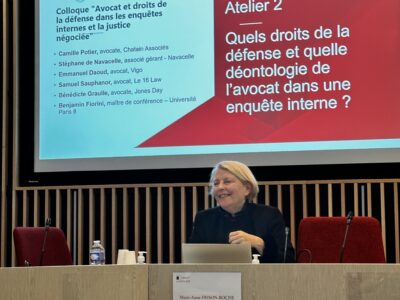
💬Avocat et droits de la défense dans les enquêtes internes et la justice négociée

🌐follow Marie-Anne Frison-Roche on LinkedIn 🌐subscribe to the Newsletter MAFR Regulation, Compliance, Law  - ► Full Reference: M.-A. Frison-Roche & M. Boissavy, "Avocat et droits de la défense dans les enquêtes internes et la justice négociée" ("Attorneys and rights of the defence in internal investigations and negociated justice"), interview with Marina Brillié-Champaux, Dalloz Actu Étudiant, 6 April 2023. - 💬read the interview (in French) - ► Presentation of the interview by the journal (in French): "Futurs avocats, c’est à vous que s’adresse cette interview de Marie-Anne Frison-Roche, agrégée des Facultés de Droit, directrice du Journal of Regulation & Compliance (JoRC) et de Matthieu Boissavy, avocat aux barreaux de Paris et de New York, médiateur, membre du Conseil National des Barreaux, vice-président de la commission Libertés et droits de l’Homme. Les 20 et 21 avril 2023 le Conseil national des barreaux, sous l’impulsion de ses commissions Libertés et droits de l’Homme et Droit et Entreprise, organise un colloque sur le thème « Avocat et droits de la défense dans les enquêtes internes et la justice négociée ». Si vous êtes déjà dans la profession, il se peut que leurs réponses vous intéressent pour le respect du droit à la justice !" - ► Questions asked (in French):  En quoi consistent les enquêtes internes ?   Qu’appelle-t-on la justice négociée ?   Qu’attendez-vous de ce colloque ?   Le questionnaire de Désiré Dalloz Quel est votre meilleur souvenir d’étudiant ? Quels sont votre héros et votre héroïne de fiction préférés ? Quel est votre droit de l’Homme préféré ? -

Breaking news

💬Colloque : « Avocat et droits de la défense dans les enquêtes internes et la justice négociée »

🌐follow Marie-Anne Frison-Roche on LinkedIn 🌐subscribe to the Newsletter MAFR Regulation, Compliance, Law  - ► Full Reference: M.-A. Frison-Roche & M. Boissavy, "Colloque : « Avocat et droits de la défense dans les enquêtes internes et la justice négociée »" ("Symposium: "Lawyers and rights of the defence in internal investigations""), interview with Olivia Dufour, Actu-Juridique, 3rd April 2023. - 💬read the interview (in French) - ► Presentation of the interview by the journal (in French): "Le Conseil national des barreaux (CNB) organise les 20 et 21 avril prochains un colloque intitulé « Avocat et droits de la défense dans les enquêtes internes et la justice négociée ». Matthieu Boissavy, avocat aux barreaux de Paris et de New York, médiateur et vice-président de la commission Libertés et droits de l’Homme du Conseil national des barreaux et Marie-Anne Frison-Roche, professeure de droit, directrice du Journal of Regulation and Compliance nous expliquent les enjeux de ces nouvelles pratiques judiciaires qui bousculent le rôle traditionnel des acteurs de la justice, qu’il s’agisse des avocats ou des magistrats." - ► Questions asked (in French):  Le CNB organise les 20 et 21 avril prochains un colloque sur le thème : Avocats et droits de la défense dans les enquêtes internes et la justice négociée. Pourquoi ce choix ?​ La compliance n’est-elle pas en train de bouleverser le métier d’avocat ? ​​​ Comment cela se traduit-il en pratique ?​ Quelles sont les implications déontologiques, ne faut-il pas inventer de nouvelles règles ? Qu’est-ce que la CJIP a changé dans le métier d’avocat ? Quels sont les nouveaux risques pour l’avocat ? Cela modifie-t-il les relations entre avocats, parquet et juges du siège ? -

Articles

💬Les juges vont être de plus en plus présents dans le droit de la compliance

🌐follow Marie-Anne Frison-Roche on LinkedIn 🌐subscribe to the Newsletter MAFR Regulation, Compliance, Law  - ► Full reference: M.-A. Frison-Roche, , F. Ancel, N. Roret, "Les juges vont être de plus en plus présents dans le droit de la compliance" ("Judges will be more and more involved in Compliance Law"), interview with Olivia Dufour, Actu-Juridique, 1st March 2023. - 💬read the interview (in French) - ► Presentation of the interview by the journal (in French) : "À l’instigation du professeur Marie-Anne Frison-Roche, l’École nationale de la magistrature (ENM) a proposé pour la première fois début février une formation en compliance à destination des magistrats et des avocats. François Ancel, conseiller la Cour de cassation, Nathalie Roret, avocate et directrice de l’ENM et Marie-Anne Frison-Roche plaident d’une seule voix pour le renforcement du rôle des acteurs judiciaires dans la compliance." - ► Questions asked (in French):  D’où est venue l’idée d’aborder ce droit en cours d’émergence qui semble encore très confidentiel ? En effet, on croit souvent savoir ce qu’est la compliance, en la confondant avec la conformité, pouvez-vous expliquer ce qui les distingue ?​​ On constate, en lisant le programme de la formation, que toutes les branches du droit sont concernées par la compliance depuis le droit des sociétés jusqu’au pénal en passant par les contrats et la responsabilité. Pouvez-vous nous donner des exemples ?​ Comment se redistribuent les rôles entre les avocats, les juges et les entreprises dans cette nouvelle configuration qu’est la compliance ?​ En quoi est-ce important pour les magistrats d’appréhender ce nouvel univers ?​ Ces transformations sont-elles cantonnées à la compliance ou peuvent-elles sortir de son champ ?​ Par exemple qu’en est-il de la question très controversée du rôle de l’avocat à l’égard du juge ?​ Avez-vous constaté lors de cette formation une amélioration du dialogue entre les différents acteurs ?​ Cette formation va-t-elle être instituée de manière permanente dans la formation des magistrats et des avocats ? Une autre manifestation est-elle prévue ? -

Publication director

🏗️ copublishing and direction of the collection: 📚Régulations & Compliance

Publication of🕴️M.-A. Frison-Roche (ed.), 📕 La juridictionnalisation de la Compliance

► Full Reference: M.-A. Frison-Roche (ed.), La juridictionnalisation de la Compliance, série “Régulations & Compliance“, Journal of Regulation & Compliance (JoRC) and Dalloz, 2023, 490 p.  - ► This book in few words: Sanctions, controls, appeals, deals: judges and lawyers are everywhere in the Compliance mechanisms, creating unprecedented situations, sometimes without a solution yet available.  Even though Compliance was designed to avoid the judge and produce security by avoiding conflict. This jurisdictionalisation is therefore new. Forcing companies to prosecute and judge, a constrained role, perhaps against their nature. Leading to the adaptation of major procedural principles, with difficulty. Confronting arbitration with new perspectives. Putting the judge at heart, in mechanisms designed so that he is not there. How in practice to organize these opposites and anticipate the solutions? This is the challenge taken up by this book. - 📘 In parallel, the English version of this book, Compliance Jurisdictionalisation, is published in the series co-published by the Journal of Regulation & Compliance (JoRC) and Bruylant.  - 📅  This book comes after a  cycle of colloquia organised in 2021 by the Journal of Regulation & Compliance (JoRC) and its Academic Partners. -   This volume is the continuation of the books dedicated to Compliance in this collection. ► Read the presentations of the other books in the series: the following books: 🕴️M.-A. Frison-Roche and M. Boissavy (eds.), 📕Compliance et droits de la défense. Enquête interne – CJIP – CRPC, 2024 🕴️M.-A. Frison-Roche (ed.), 📕L’Obligation de Compliance, 2025 🕴️M.-A. Frison-Roche (ed.), 📕Compliance et Contrat, forthcoming 🕴️L. Laref (ed.), 📕Compliance et vigilance bancaire, forthcoming 🕴️M.-A. Frison-Roche, 📕Le système juridique de l’adressage de l’Internet. Une structure multi-acteurs, gage de durabilité (The Legal System of Internet Addressing. A Multi-Stakeholder Structure, the Pledge of its Sustainability), forthcoming 🕴️M.-A. Frison-Roche (ed.), 📕Le système probatoire de la Compliance, forthcoming   the previous books: 🕴️M.-A. Frison-Roche (ed.), 📕Les Buts Monumentaux de la Compliance, 2022 🕴️M.-A. Frison-Roche (ed.), 📕Les outils de la Compliance, 2021 🕴️M.-A. Frison-Roche (ed.), 📕Pour une Europe de la Compliance, 2019 🕴️N. Borga, J.-Cl. Marin and J.-Ch. Roda (eds.), 📕Compliance : l’entreprise, le régulateur et le juge, 2018 🕴️M.-A. Frison-Roche (ed.), 📕Régulation, Supervision, Compliance, 2017 🕴️M.-A. Frison-Roche (ed.), 📕Internet, espace d’interrégulation, 2016 📕 Read the presentations of the other titles of the collection. - ► General presentation of the book: There have always been Judges and Lawyers in Compliance Law, because this branch of Law is an extension of Regulatory Law in which they have a core place. This results from the fact that the decisions taken in respect of Compliance are contestable in Court, including Arbitration, those issued by the Company, such as those of States or Authorities, the Judge in turn becoming what Compliance Law is effective. The novelty lies more in the phenomenon of “jurisdictionalisation”, that is the trial model penetrates all Compliance Law, and not only the Ex-Post part that it includes. Moreover, it seems that this jurisdictionalisation influences the non-legal dimension of Compliance. This movement has effects that must be measured and causes that must be understood. Advantages and disadvantages that must be balanced. If only to form an opinion vis-à-vis Companies that have become Prosecutors and Judges of themselves and others …: encourage this “Jurisdictionalisation of Compliance”, fight it, perhaps influence it? In any case, understand it! - 🏗️ General construction of this book: The book begins by a double Introduction, the first (in free access) summarizing the book, the second, substantial, relating to the need to reinforce the Judge and the Lawyer to impose the Compliance Law as a characteristic of the Rule of Law.  The first Part is devoted to what is specific to Compliance Law. of Compliance: the transformation of companies into Prosecutors and Judges of themselves, even of others. The second Part relates to Compliance general procedural Law, the procedure being the way between the dispute and the judgement.  The third Part continues this journey to the judge and aims to measure the influence of the reasoning and requirements of Compliance Law in dispute resolution methods where it was not, with some exceptions, present, but where it has a great future: Arbitration. Because trial and judicial decision are inseparable, because legal techniques and the Rule of Law should not be divided but compliance techniques could paradoxically be the weapon of their dissociation, because the power to judge and the procedures surrounding the latter must not be dissociated, because therefore Compliance mechanisms and the Rule of Law must be thought out and practiced then, the rise in power of one must be the sign of the rise in power of the other, and not the price of the ‘weakening of the Rule of Law, the fourth Part relates to the Judges in the Compliance mechanisms and culture.  -   DOUBLE INTRODUCTION 🕴️M.-A. Frison-Roche, 📝Lignes de force de l’ouvrage La juridictionnalisation de la Compliance free access to the full text  🕴️M.-A. Frison-Roche, 📝Conforter le rôle du Juge et de l’Avocat pour imposer la Compliance comme caractéristique de l’État de Droit   I. L’ENTREPRISE INSTITUÉE PROCUREUR ET JUGE D’ELLE-MEME ET D’AUTRUI PAR LE DROIT DE LA COMPLIANCE (“THE COMPANY ESTABLISHED PROSECUTOR AND JUDGE OF ITSELF AND OTHERS BY COMPLIANCE LAW”) 🕴️M.-A. Frison-Roche,📝 Le “jugeant-jugé”. Articuler les mots et les choses face à l’éprouvant conflit d’intérêts  🕴️C. Granier, 📝Réflexions sur l’existence d’une jurisprudence des entreprises 🕴️L.-M. Augagneur, 📝La juridictionnalisation de la réputation par les plateformes 🕴️A. Bruneau, 📝L’entreprise juge d’elle-même : la fonction compliance dans la banque 🕴️J.-M. Coulon, 📝Le Droit de la Compliance dans le secteur d’activité de la construction et les contradictions, impossibilités et impasses auxquelles les entreprises sont confrontées 🕴️Lapp, Ch., 📝La compliance dans l’entreprise : les statuts du process 🕴️J. Heymann, 📝La nature juridique de la “Cour suprême” de Facebook 🕴️D. Latour, 📝Les enquêtes internes au sein des entreprises 🕴️A. Bavitot,  📝Le façonnage de l’entreprise par les accords de justice pénale négociée 🕴️S. Merabet, 📝La vigilance, être juge et ne pas juger   II. LE DROIT PROCESSUEL À L’OEUVRE DANS LE DROIT DE LA COMPLIANCE  (“GENERAL PROCEDURAL LAW IN COMPLIANCE LAW”) 🕴️N. Cayrol, 📝Des principes processuels en Droit de la Compliance 🕴️F. Ancel,📝Le principe processuel de compliance, un nouveau principe directeur du procès ? 🕴️B. Sillaman, 📝Secret professionnel et coopération : les leçons de procédure tirées de l’expérience américaine pour une application universelle 🕴️A. Linden, 📝Motivation et publicité des décisions de la formation restreinte de la Commission nationale de l’informatique et des libertés (CNIL) dans une perspective de compliance 🕴️S. Scemla,🕴️D. Paillot, 📝La difficile appréhension des droits de la défense par les autorités de contrôle en matière de compliance 🕴️M.-A. Frison-Roche, 📝Ajuster par la nature des choses du Droit processuel au Droit de la Compliance   III. L’ARTICULATION DE LA COMPLIANCE ET DE L’ARBITRAGE INTERNATIONAL (“ARTICULATION BETWEEN COMPLIANCE LAW AND INTERNATIONAL ARBITRATION”) 🕴️J.-B. Racine, 📝Compliance et Arbitrage. Essai de problématisation 🕴️E. Silva-Romero,🕴️R. Legru, 📝Quelle place pour la Compliance dans l’arbitrage d’investissement ? 🕴️C. Kessedjian, 📝L’arbitrage au service de la lutte contre la violation des droits de la personne humaine par les entreprises  🕴️M. Audit, 📝La position de l’arbitre en matière de compliance 🕴️J. Jourdan-Marques, 📝L’arbitre, juge ex ante de la compliance ? 🕴️E. Kleiman, 📝Les objectifs de la compliance confrontés aux acteurs de l’arbitrage 🕴️F.-X. Train, 📝Arbitrage et procédure parallèles exercées au titre de la compliance 🕴️Cl. Debourg, 📝La compliance au stade du contrôle des sentences arbitrales   IV. LE JUGE DANS LE DROIT DE LA COMPLIANCE (“THE JUDGE IN COMPLIANCE LAW”) 🕴️M.-A. Frison-Roche, 📝Le juge, l’obligation de compliance et l’entreprise. Le système probatoire de la Compliance 🕴️J. Morel-Maroger, 📝La réception des normes de la compliance par les juges de l’Union européenne 🕴️S. Schiller, 📝Un juge unique en cas de manquement international à des obligations de compliance ? 🕴️O. Douvreleur, 📝Compliance et juge du droit 🕴️F. Raynaud, 📝Le juge administratif et la compliance 🕴️E. Wennerström, 📝Quelques réflexions sur la Compliance et la Cour européenne des droits de l’Homme - 🌐follow Marie-Anne Frison-Roche on LinkedIn 🌐follow Marie-Anne Frison-Roche on Instagram 🌐subscribe to the Newsletter MAFR Regulation, Compliance, Law 🌐subscribe to the Video Newsletter MAFR Surplomb

Articles in The Journal of Regulation & Compliance « JoRC »

📝Conforter le rôle du juge et de l’avocat pour imposer la Compliance comme caractéristique de l’État de Droit, in🕴️M.-A. Frison-Roche (ed.), 📕La juridictionnalisation de la Compliance

🌐 follow Marie-Anne Frison-Roche on LinkedIn 🌐 subscribe to the Newsletter MAFR Regulation, Compliance, Law  - ► Full Reference: M.-A. Frison-Roche, "Conforter le rôle du Juge et de l'Avocat pour imposer la Compliance comme caractéristique de l'État de Droit" ("Reinforce the Judge and the Attorney to impose Compliance Law as a characteristic of the Rule of Law"), in M.-A. Frison-Roche (dir.), La juridictionnalisation de la Compliance, coll. "Régulations & Compliance", Journal of Regulation & Compliance (JoRC) and Dalloz, 2023, pp. 29-55.  - ► This article is the introduction of the book.   - 📝read the article (in French)   - 🚧read the bilingual Working Paper which is the basis of this article, with additional developments, technical references and hyperlinks  -   📕read a general presentation of the book, La juridictionnalisation de la Compliance, in which this article is published - ► Summary of the article (done by the Journal of Regulation & Compliance): One can understand that the compliance mechanisms are presented with hostility because they seem designed to keep the judge away, whereas there is no Rule of Law without a judge. Solid arguments present compliance techniques as converging towards the uselessness of the judge (I). Certainly, we come across magistrates, and of all kinds, and powerful ones, but that would be a sign of imperfection: its ex-ante logic has been deployed in all its effectiveness, the judge would no longer be required… And the lawyer would disappear so with him… This perspective of a world without a judge, without a lawyer and ultimately without Law, where algorithms could organize through multiple processes in Ex Ante the obedience of everyone, the "conformity" of all our behaviors with all the regulatory mass that is applicable to us, supposes that this new branch of Law would be defined as the concentration of processes which gives full effectiveness to all the rules, regardless of their content. But supposing that this engineer's dream is even achievable, it is not possible in a democratic and free world to do without judges and lawyers. Therefore, it is imperative to recognize their contributions to Compliance Law, related and invaluable contributions (II). First of all, because a pure Ex Ante never existed and even in the time of the Chinese legists, people were still needed to interpret the regulations because a legal order must always be interpreted Ex Post by who must in any case answer the questions posed by the subjects of law, as soon as the political system admits to attributing to them the right to make claims before the Judge. Secondly the Attorney, whose office, although articulated with the Judge's office, is distinct from the latter, both more restricted and broader since he must appear in all cases where the judicial figure puts himself in square, outside the courts. However, Compliance Law has multiplied this since not only, extending Regulatory Law, it entrusts numerous powers to the administrative authorities, but it also transforms companies into judges, in respect of which the attorneys must deal with. Even more so, Compliance Law only takes its sense from its Monumental Goals. It is in this that this branch of the Law preserves the freedom of human beings, in the digital space where the techniques of compliance protect them from the power of companies by the way that the Compliance Law forces these companies to use their power to protect people. However, firstly, it is the Judges who, in their diversity, impose as a reference the protection of human beings, either as a limit to the power of compliance tools or as their very purpose. Secondly, the Attorney, again distinguishing himself from the Judge, if necessary, reminds us that all the parties whose interests are involved must be taken into consideration. In an ever more flexible, soft, and dialogical Law, everyone presenting himself as the "advocate" of such and such a monumental goal: the Attorney is legitimate to be the first to occupy this place. -
Articles in The Journal of Regulation & Compliance « JoRC »

SILLIMAN, Bryan🕴️

📝Secret professionnel et coopération : les leçons de procédure tirées de l’expérience américaine pour une application universelle, in 🕴️M.-A. Frison-Roche (ed.), 📕La juridictionnalisation de la Compliance

► Full Reference: B. Silliman, "Secret professionnel et coopération : les leçons de procédure tirées de l’expérience américaine pour une application universelle" ("Privilege and cooperation, procedural lessons learned from the U.S for global application"), in M.-A. Frison-Roche (ed.), La juridictionnalisation de la Compliance, coll. "Régulations & Compliance", Journal of Regulation & Compliance (JoRC) and Dalloz, 2023, pp. 231-234.   - 📕read a general presentation of the book, La juridictionnalisation de la Compliance, in which this article is published - ► English summary of the article (done by the Journal of Regulation & Compliance): The French legal system is evolving, organizing interaction between lawyers with regulators and prosecutors, especially in investigations about corruption or corporate misconduct, adopting U.S. negotiated resolutions such as the Convention judiciaire d'intérêt public, which encourages "collaboration" between them.  The author describes the evolution of the U.S. DOJ doctrine and askes French to be inspired by the U.S. procedural experience, U.S. where this mechanism came from. Indeed, the DOJ released memoranda about what the "collaboration" means. At the end (2006 Memorandum), the DOJ has considered that the legal privilege must remain intact when the information is not only factual to maintain trust between prosecutors, regulators, and lawyers. French authorities do not follow this way. The author regrets it and thinks they should adopt the same reasoning as the American authority on the secret professionnel of the avocat, especially when he intervenes in the company internal investigation. - 🦉This article is available in full text for those registered for Professor Marie-Anne Frison-Roche's courses

Articles in The Journal of Regulation & Compliance « JoRC »

SILLAMAN, Bryan🕴️

📝Taking the Compliance U.S. Procedural Experience globally, in 🕴️M.-A. Frison-Roche (ed.), 📘Compliance Jurisdictionalisation

► Full Reference:  B. Sillaman, "Taking the Compliance U.S. Procedural Experience globally", in M.-A. Frison-Roche (ed.), Compliance Jurisdictionalisation, Journal of Regulation & Compliance (JoRC) and Bruylant, coll. "Compliance & Regulation", to be published.  - 📘read a general presentation of the book, Compliance Jurisdictionalisation, in which this article is published   - ► Summary of the article (done by the Journal of Regulation & Compliance): The French legal system is evolving, organizing interaction between lawyers with regulators and prosecutors, specially in investigations about corruption or corporate misconduct, adopting U.S. negotiated resolutions such as the Convention judiciaire d'intérêt public, which encourages "collaboration" between them.  The author describes the evolution of the U.S. DOJ doctrine and askes French to be inspired by the U.S. procedural experience, U.S. where this mechanism came from. Indeed, the DOJ released memoranda about what the "collaboration" means. At the end (2006 Memorandum), the DOJ has considered that the legal privilege must remain intact when the information is not only factual in order to maintain trust between prosecutors, regulators and lawyers. French authorities do not follow this way. The author regrets it and thinks they should adopt the same reasoning as the American authority on the secret professionnel of the avocat, especially when he intervenes in the company internal investigation. - 🦉This article is available in full text to those registered for Professor Marie-Anne Frison-Roche's courses -

Working papers

🚧Reinforce the Judge and the Attorney to impose Compliance Law as a characteristic of the Rule of Law

► Full Reference: Frison-Roche, M.-A, Reinforce the judge and the lawyer to impose Compliance Law as a characteristic of the Rule of Law, Working Paper, August 2021. - 🎤 this working document has been made to prepare some elements of the opening intervention in the symposium Quels juges pour la Compliance) ? (Which judges for Compliance?), co-organized by the Journal of Regulation & Compliance and the Institut Droit Dauphine, held at the Paris Dauphine University on September 23, 2021, constituting the first part of the intervention. - 📝it has been also the basis for an article:  📕 published in its French version in the book La juridictionnalisation de la Compliance, in the collection📚Régulations & Compliance  📘published in its English version in the book Compliance Jurisdictionalisation, in the collection 📚Compliance & Regulation - ► Summary of the Working Paper: One can understand that the compliance mechanisms are presented with hostility because they seem designed to keep the judge away, whereas there is no Rule of Law without a judge. Solid arguments present compliance techniques as converging towards the uselessness of the judge (I). Certainly, we come across magistrates, and of all kinds, and powerful ones, but that would be a sign of imperfection: its ex-ante logic has been deployed in all its effectiveness, the judge would no longer be required… And the lawyer would disappear so with him… This perspective of a world without a judge, without a lawyer and ultimately without Law, where algorithms could organize through multiple processes in Ex Ante the obedience of everyone, the "conformity" of all our behaviors with all the regulatory mass that is applicable to us, supposes that this new branch of Law would be defined as the concentration of processes which gives full effectiveness to all the rules, regardless of their content. But supposing that this engineer's dream is even achievable, it is not possible in a democratic and free world to do without judges and lawyers. Therefore, it is imperative to recognize their contributions to Compliance Law, related and invaluable contributions (II). First of all, because a pure Ex Ante never existed and even in the time of the Chinese legists1 L’empire chinois n’a semble-t-il jamais apprécié les juges, ne leur faisant place que sous la forme de serviteurs purs de l’Etat, qu’ils soient des enquêteurs, des punisseurs et de gardiens de l’ordre public. Sur cet aspect du Droit chinois, v. … ; sur cette période particulièrement sanglante des légistes, où le principe de « certitude » de la législation a été portée à ses nues, v. …, people were still needed to interpret the regulations because a legal order must always be interpreted Ex Post by who must in any case answer the questions posed by the subjects of law, as soon as the political system admits to attributing to them the right to make claims before the Judge. Secondly the Attorney, whose office, although articulated with the Judge's office, is distinct from the latter, both more restricted and broader since he must appear in all cases where the judicial figure puts himself in square, outside the courts. However, Compliance Law has multiplied this since not only, extending Regulatory Law, it entrusts numerous powers to the administrative authorities, but it also transforms companies into judges, in respect of which the attorneys must deal with. Even more so, Compliance Law only takes its sense from its Monumental Goals2🕴️Frison-Roche, M.-A. (ed.), 📘​Compliance Monumental Goals, 2022.. It is in this that this branch of the Law preserves the freedom of human beings, in the digital space where the techniques of compliance protect them from the power of companies by the way that the Compliance Law forces these companies to use their power to protect people. However, firstly, it is the Judges who, in their diversity3The topic of this study is general. For a more analytical perspective, s.. 🕴️Frison-Roche, M.-A., « The function of the Judge in Compliance Law », in 🕴️Frison-Roche, M.A. (ed.), 📘Compliance Jurisdictionalisation, 2023. , impose as a reference the protection of human beings, either as a limit to the power of compliance tools4🕴️Frison-Roche, M.-A. (ed.), 📘Compliance Tools, 2021.  or as their very purpose. Secondly, the Attorney, again distinguishing himself from the Judge, if necessary, reminds us that all the parties whose interests are involved must be taken into consideration. In an ever more flexible, soft and dialogical Law, everyone presenting himself as the "advocate" of such and such a monumental goal: the Attorney is legitimate to be the first to occupy this place. - 🔓read the Working Paper developments below⤵️

Articles in The Journal of Regulation & Compliance « JoRC »

AMICO, Thomas🕴️

📝La Compliance ou le passage de l’ex post à l’ex ante. Une révolution copernicienne pour l’avocat pénaliste ?, in 🕴️M.-A. Frison-Roche (ed.), 📕Les outils de la Compliance

► Full Reference : Th. Amico, "La Compliance ou le passage de l'ex post à l'ex ante. Une révolution copernicienne pour l'avocat pénaliste ?" ("Compliance or the passage from ex post to ex ante: a Compernican revolution for the criminal lawyer?"), in M.-A. Frison-Roche (ed.), Les outils de la Compliance, coll. "Régulations & Compliance", Journal of Regulation & Compliance (JoRC) and Dalloz, 2021, p. 145-154. - 📕read a general presentation of the book, Les outils de la Compliance, in which this article is published - ► Summary of the article (done by the Journal of Regulation & Compliance): After referring to various definitions of Compliance Law, the author insists on the usefulness of the criminal lawyer in that he, familiar with the Ex-Post that constitutes the sanction, can be of good advice. in the Ex-Ante in which new compliance mechanisms are being developed, such as risk mapping or third-party assessment. Addressing the punitive dimension of Compliance Law, the author shows that the criminal lawyer therefore naturally has a place there, whether it concerns the powers exercised by an administrative authority or the criminal law itself. In that he can "anticipate criminal proceedings", the criminal lawyer is therefore best able to ensure that the company does not expose itself to them, in particular in a good mastery of internal investigations, thus ruling out the criminal risk. -

Articles

💬Et si le secret de l’avocat était l’allié de la lutte contre le blanchiment ? (Why would the attorney not be an ally in the fight against money laundering?)

Full reference: Frison-Roche, M.-A., Et si le secret de l’avocat était l’allié de la lutte contre le blanchiment ?, interview realized by Olivia Dufour for Actu-juridiques, Lextenso, 15th of October 2020 Read the interview (in French) To go deeper on the place of the attorney in Compliance Law, read Marie-Anne Frison-Roche's working paper: The Attorney, Vector of Conviction in the New Compliance System

Articles

Attorney’s Professional Secret & Filter mechanism in balance with fighting Money Laundering: constitutional analysis in favor of Attorney’s Secret

Full Reference : Frison-Roche, M.-A.,Attorney's Professional Secret & Filter mechanism in balance with fighting Money Laundering: constitutional analysis in favor of Attorney's Secret, Newsletter MAFR – Law, Compliance, Regulation, October 9, 2020.   Summary: By its judgment of September 24, 2020, the Constitutional Court of Belgium released an essential judgment which considers: – Compliance Law which imposes obligations on entities to fight against money laundering and the financing of terrorism is legal requirements which must be analyzed on the basis of these goals – the national transposition law is "broader" than the transposed European texts since it is anchored in the Constitution – the provisions of the law imposing the declaration of suspicion on an employee of the Attorney or on a Compliance Officer concerning information covered by the professional secrecy of the Attorney, the basis of Democracy, must therefore be canceled. This reasoning is remarkable and very solid. It is not unique to Belgium.   Lire par abonnement gratuit les autres News dans la Newsletter MAFR – Law, Compliance, Regulation