Definition
🌐 follow Marie-Anne Frison-Roche on LinkedIn 🌐 subscribe to the Newsletter MAFR Regulation, Compliance, Law - ► Full Reference: [rubrique p="Présentation"]M.-A. Frison-Roche,[/rubrique] "Compliance Monumental Goals, Beating Heart of Compliance Law", in M.-A. Frison-Roche (ed.), [lien a="compliance-monumental-goals"]Compliance Monumental Goals[/lien], series "[rubrique p="Responsabilités éditoriales > Direction de la collection Compliance & Regulation, JoRC et Bruylant"]Compliance & Regulation[/rubrique]", Journal of Regulation & Compliance (JoRC) and Bruylant, 2023, pp. 33-58, p. - ► Article Summary: Compliance Law can be defined as the set of processes requiring companies to show that they comply with all the regulations that apply to them. It is also possible to define this branch of Law by a normative heart: the "Monumental Goals". These explain the technical new legal solutions, thus made them clearer, accessible and anticipable. This definition is also based on a bet, that of caring for others that human beings can have in common, a form of universality. Through the Monumental Goals, appears a definition of Compliance Law that is new, original, and specific. This new term "Compliance", even in non-English vocabulary, in fact designates a new ambition: that a systemic catastrophe shall not be repeated in the future. This Monumental Goal was designed by History, which gives it a different dimension in the United States and in Europe. But the heart is common in the West, because it is always about detecting and preventing what could produce a future systemic catastrophe, which falls under "negative monumental goals", even to act so that the future is positively different ("positive monumental goals"), the whole being articulated in the notion of "concern for others", the Monumental Goals thus unifying Compliance Law. In this, they reveal and reinforce the always systemic nature of Compliance Law, as management of systemic risks and extension of Regulation Law, outside of any sector, which makes solutions available for non-sector spaces, in particular digital space. Because wanting to prevent the future (preventing evil from happening; making good happen) is by nature political, Compliance Law by nature concretizes ambitions of a political nature, in particular in its positive monumental goals, notably effective equality between human beings, including geographically distant or future human beings. The practical consequences of this definition of Compliance Law by Monumental Goals are immense. A contrario, this makes it possible to avoid the excesses of a "conformity law" aimed at the effectiveness of all applicable regulations, an extremely dangerous perspective. This makes it possible to select effective Compliance Tools regarding these goals, to grasp the spirit of the material without being locked into its flow of letters. This leads to not dissociating the power required of companies and the permanent supervision that the public authorities must exercise over them. We can therefore expect a lot from such a definition of Compliance Law by its Monumental Goals. It engenders an alliance between the Political Power, legitimate to enact the Monumental Goals, and the crucial operators, in a position to concretize them and appointed because they are able to do so. It makes it possible to find global legal solutions for global systemic difficulties that are a priori insurmountable, particularly in climate matters and for the effective protection of people in the now digital world in which we live. It expresses values that can unite human beings. In this, Compliance Law built on Monumental Goals is also a bet. Even if the requirement of "conformity" is articulated with this present conception of what Compliance Law is, this conception based on Monumental Law is based on the human ability to be free, while conformity law supposes more the human ability to obey. Therefore, Compliance Law, defined by the Monumental Goals, is essential for our future, while conformity law is not. - 🚧 [lien a="les-buts-monumentaux-coeur-battant-de-la-normativi"]read the bilingual Working Papier, with more technical developments, references, and links[/lien] - 📘read a [lien a="compliance-monumental-goals"]general presentation of the book, Compliance Monumental Goal, in which this article is published[/lien][lien a="les-outils-de-la-compliance"].[/lien] - ► read the presentations of the other Marie-Anne Frison-Roche's contributions in this book: 📝[lien a="proportionality-and-compliance-in-frison-roche-m-a"]Definition of Principe of Proportionality and Definition of Compliance Law[/lien], 📝 [lien a="compliance-and-role-of-companies-in-the-creation-a"]Role and Place of Companies in the Creation and Effectiveness of Compliance Law in Crisis[/lien], 📝 [lien a="assessment-of-whistleblowing-and-the-obligation-of"]Assessment of Whistleblowing and the duty of Vigilance[/lien]


🌐follow Marie-Anne Frison-Roche on LinkedIn 🌐subscribe to the Newsletter MAFR Regulation, Compliance, Law - ► Full Reference: [rubrique p="Présentation"]M.-A. Frison-Roche,[/rubrique] "Les Buts Monumentaux, cœur battant du Droit de la Compliance" ("Monumental Goals, beating heart of Compliance Law"), in M.-A. Frison-Roche (ed.), [lien a="les-buts-monumentaux-de-la-compliance"]Les Buts Monumentaux de la Compliance[/lien], coll. "[rubrique p='Responsabilités éditoriales > Direction de la collection "Régulations & Compliance", JoRC & Dalloz']Régulations & Compliance[/rubrique]", Journal of Regulation & Compliance (JoRC) and Dalloz, 2022, pp. 21-44. - 📝read the article (in French) - 🚧read the [lien a="les-buts-monumentaux-coeur-battant-de-la-normativi"]bilingual Working Paper which is the basis of this article[/lien], with additional developments, technical references and hyperlinks - 📕read a general presentation of the book, [lien a="les-buts-monumentaux-de-la-compliance"]Les Buts Monumentaux de la Compliance[/lien], in which this article is published - ► Summary of the article: Compliance Law can be defined as the set of processes requiring companies to show that they comply with all the regulations that apply to them. It is also possible to define this branch of Law by a normative heart: the "Monumental Goals". These explain the technical new legal solutions, thus made them clearer, accessible and anticipable. This definition is also based on a bet, that of caring for others that human beings can have in common, a universality. Through the Monumental Goals, appears a definition of Compliance Law that is new, original, and specific. This new term "Compliance", even in non-English vocabulary, in fact designates a new ambition: that a systemic catastrophe shall not be repeated in the future. This Monumental Goal was designed by History, which gives it a different dimension in the United States and in Europe. But the heart is common in the West, because it is always about detecting and preventing what could produce a future systemic catastrophe, which falls under "negative monumental goals", even to act so that the future is positively different ("positive monumental goals"), the whole being articulated in the notion of "concern for others", the Monumental Goals thus unifying Compliance Law. In this, they reveal and reinforce the always systemic nature of Compliance Law, as management of systemic risks and extension of Regulation Law, outside of any sector, which makes solutions available for non-sector spaces, in particular digital space. Because wanting to prevent the future (preventing evil from happening; making good happen) is by nature political, Compliance Law by nature concretizes ambitions of a political nature, in particular in its positive monumental goals, notably effective equality between human beings, including geographically distant or future human beings. The practical consequences of this definition of Compliance Law by Monumental Goals are immense. A contrario, this makes it possible to avoid the excesses of a "conformity law" aimed at the effectiveness of all applicable regulations, a very dangerous perspective. This makes it possible to select effective Compliance Tools with regard to these goals, to grasp the spirit of the material without being locked into its flow of letters. This leads to not dissociating the power required of companies and the permanent supervision that the public authorities must exercise over them. We can therefore expect a lot from such a definition of Compliance Law by its Monumental Goals. It engenders an alliance between the Political Power, legitimate to enact the Monumental Goals, and the crucial operators, in a position to concretize them and appointed because they are able to do so. It makes it possible to find global legal solutions for global systemic difficulties that are a priori insurmountable, particularly in climate matters and for the effective protection of people in the now digital world in which we live. It expresses values that can unite human beings. In this, Compliance Law built on Monumental Goals is also a bet. Even if the requirement of "conformity" is articulated with this present conception of what Compliance Law is, this conception based on Monumental Law is based on the human ability to be free, while conformity law supposes more the human ability to obey. Therefore Compliance Law, defined by the Monumental Goals, is essential for our future, while conformity law is not. -

Full Reference: Frison-Roche, M.-A., Notes pour une synthèse sur le vif pour le colloque "Les Buts Monumentaux de la Compliance : radioscopie d'une notion" (Notes for an on the fly synthesis for[lien a="radioscopie-dune-notion-les-buts-monumentaux-de-la"] [/lien][lien a="rapport-de-synthese-in-la-concurrence-dans-tous-se"]the Colloquium "The Compliance Monumental Goals: Radioscopy for a Notion"[/lien]), September 16, 2021. - ► Read the [lien a="radioscopie-dune-notion-les-buts-monumentaux-de-la"]general programme of the Colloquium Compliance Law Monumental Goals[/lien] ► Read the [lien a="rapport-de-synthese-in-les-buts-monumentaux-radios"]presentation of the synthesis Report, notably its Summary[/lien]. - ► Methodology: The topic is not treated in a strictly personal point of view, as it will be in the book on The [lien a="compliance-monumental-goals"]Compliance Monumental Goals[/lien], in an article devoted to "Defining Compliance Monumental Goals and their branch of Law", more personal article. It will be even more clearly the expression of a personal vision of the definition of what is "Compliance" and what is "Compliance Law", with in particular the distinctions that should be done, in particular with "conformity" because these are these "Monumental Goals", a notion proposed in 2016 which makes it possible to distinguish the procedural notion of "conformity" (just obey) and the substantive notion of "Compliance Law". This article will include the multiple academic and technical references that should be done to do this. But in the time allotted in a day's collloquium and because the purpose of a synthesis is to highlight on the spot what was common in the contributions heard, the document is based only on the different speechs made and is not enriched with technical references, nor does it refer to personal works. - 🔻read below the notes exhaustely taken


🌐follow Marie-Anne Frison-Roche on LinkedIn 🌐subscribe to the Newsletter MAFR Regulation, Compliance, Law - ► Full Reference: [rubrique p="Présentation"]M.-A. Frison-Roche[/rubrique], Monumental Goals, beating heart of Compliance Law, Working Paper, August 2021 - 📝This Working Paper is the basis for the article, "[lien a="les-buts-monumentaux-cur-battant-du-droit-de-la-co"]Les buts monumentaux, cœur battant du droit de la compliance[/lien]", constituting the introduction ⤵ 📕in its French version, of the book [lien a="les-buts-monumentaux-de-la-compliance"]Les buts monumentaux de la Compliance[/lien], in the Series 📚[rubrique p='Responsabilités éditoriales > Direction de la collection "Régulations & Compliance", JoRC & Dalloz']Régulations & Compliance[/rubrique] 📘in its English version, of the book, [lien a="compliance-monumental-goals"]Compliance Monumental Goals[/lien], in the Series 📚[rubrique p="Responsabilités éditoriales > Direction de la collection Compliance & Regulation, JoRC et Bruylant"]Compliance & Regulation[/rubrique] - ► Summary of the Working Paper: Compliance Law can be defined as the set of processes requiring companies to show that they comply with all the regulations that apply to them. It is also possible to define this branch of Law by a normative heart: the "Monumental Goals". These explain the technical new legal solutions, thus made them clearer, accessible and anticipable. This definition is also based on a bet, that of caring for others that human beings can have in common, a universality. Through the Monumental Goals, appears a definition of Compliance Law that is new, original, and specific. This new term "Compliance", even in non-English vocabulary, in fact designates a new ambition: that a systemic catastrophe shall not be repeated in the future. This Monumental Goal was designed by History, which gives it a different dimension in the United States and in Europe. But the heart is common in the West, because it is always about detecting and preventing what could produce a future systemic catastrophe, which falls under "negative monumental goals", even to act so that the future is positively different ("positive monumental goals"), the whole being articulated in the notion of "concern for others", the Monumental Goals thus unifying Compliance Law. In this, they reveal and reinforce the always systemic nature of Compliance Law, as management of systemic risks and extension of Regulation Law, outside of any sector, which makes solutions available for non-sector spaces, in particular digital space. Because wanting to prevent the future (preventing evil from happening; making good happen) is by nature political, Compliance Law by nature concretizes ambitions of a political nature, in particular in its positive monumental goals, notably effective equality between human beings, including geographically distant or future human beings. The practical consequences of this definition of Compliance Law by Monumental Goals are immense. A contrario, this makes it possible to avoid the excesses of a "conformity law" aimed at the effectiveness of all applicable regulations, a very dangerous perspective. This makes it possible to select effective Compliance Tools with regard to these goals, to grasp the spirit of the material without being locked into its flow of letters. This leads to not dissociating the power required of companies and the permanent supervision that the public authorities must exercise over them. We can therefore expect a lot from such a definition of Compliance Law by its Monumental Goals. It engenders an alliance between the Political Power, legitimate to enact the Monumental Goals, and the crucial operators, in a position to concretize them and appointed because they are able to do so. It makes it possible to find global legal solutions for global systemic difficulties that are a priori insurmountable, particularly in climate matters and for the effective protection of people in the now digital world in which we live. It expresses values that can unite human beings. In this, Compliance Law built on Monumental Goals is also a bet. Even if the requirement of "conformity" is articulated with this present conception of what Compliance Law is, this conception based on Monumental Law is based on the human ability to be free, while conformity law supposes more the human ability to obey. Therefore Compliance Law, defined by the Monumental Goals, is essential for our future, while conformity law is not. - Read the developments below⤵️

Full reference : Frison-Roche, M.-A., The Potential of Compliance Law (Les potentialités du Droit de la Compliance), conference given to Muriel Fabre-Magnan's students, Paris I, 17th of March 2021. - This conference has been designed for Paris I's students following a Law cursus, specialized in Law of obligations and especially in Tort Law. It therefore aims to show the technical content of Compliance Law and what it can become. It has been followed by a debate with students. Summary: Compliance Law is a branch of Law in the process of being born. We can be sure of its existence in the French positive Law, through the technical examination of laws called "Sapin 2" (2016) and "Vigilance" (2017). It appears at radically new. It is the reason why it is perceived as an attack, especially from United-States and we rather use legal knowledge to counter it. But if we study the historical reasons of its adoption in the United-States and the "monumental goals", whether they are negative (what should not appear in the future) or positive (what should appear in the future), we can measure that this Law, which is essentially Ex Ante could be the means through which scattered but legitimate public authorities and powerful but illegitimate big firms could ally. Therefore potentially Compliance Law could be the worst, simple tool of obedience (mechanical "conformité") or the best: what through which we could do something face to global problems, like global warming, or what we would accept to look in the face: the care for others. Read the slides on which this conference was based (in French)

Full reference : Frison-Roche, M.-A., Devoir de vigilance des entreprises : vers un Droit de la responsabilité ex ante ? (Duty of vigilance for companies: towards an ex ante liability law?), conference-debate, The Faculty of Law, University of Oslo, Norway, 9th of February 2021. The conference-debate is moderated by Catherine Banet, Associate Professor, Scandinavian Insitute of Maritime Law, Department of Energy and Resources Law, University of Oslo


🎥Compliance Law, an adequate legal framework for GAIA-X, in 🧮GaiaX Summit2020, The World with GAIA-X
► Full Reference: [rubrique p="Présentation"]M.-A. Frison-Roche[/rubrique], "Compliance Law, an adequate legal framework for GAIA-X", in Pan-European GAIA - X Summit, The World with GAIA-X, November18, 2020. - 🧮See the general presentation of the Summit - 📈See the slides, basis of this intervention. - ► Summary of the intervention: Europe may offer an adequate legal framework for the GAIA-X project through Compliance Law. Compliance Law is a new form for Regulatory Law, driven by "Monumental Goals", negative Monumental Goals, for instance prevention of systemic failures, and positive Monumental Goals, for instance innovation or stability. This very new branch of Law works on these Monumental Goals, which must be explicit and internalized in Crucial Enterprises. These Crucial Enterprises concretize these Goals, supervised by public Authorities. European Compliance Law already works, for instance about Personal Data protection (case law and GDPR) or prevention banking systemic failures (Banking Union), Compliance Tools being in balance with Competition principle. European Union Law is moving from the Ex-Post Competition Law to the Ex-Ante Compliance Law, internalizing Monumental Goals in Crucial Enterprises. There is a perfect adequacy between European Compliance Law and GAIA-X. This project built by Crucial Enterprises must be supervised by public authority, maybe a specific or the European Commission. The governance of GAIA-X must be transparent and accountable. This private organization must use it powers in respect of the proportionality principle, controlled by the public supervisory body. The legal framework is required but it is sufficient. - 📈see the slides, basis of this intervention. - 🎥watch the video of this intervention. -



CANTO-SPERBER, Monique🕴️
► Full Reference: M. Canto-Sperber, "La compliance et les définitions traditionnelles de la vertu" ("Compliance and traditional definitions of virtue"), in [rubrique p="Présentation"]M.-A. Frison-Roche[/rubrique] (ed.), [lien a="pour-une-europe-de-la-compliance"]Pour une Europe de la Compliance[/lien], series "[rubrique p='Responsabilités éditoriales > Direction de la collection "Régulations & Compliance", JoRC & Dalloz']Régulations & Compliance[/rubrique]", Dalloz, 2019, pp. 73-77. - 📕read a general presentation of the book, [lien a="pour-une-europe-de-la-compliance-dir"]Pour une Europe de la Compliance[/lien], in which this article is published - ► Summary of the article (done by the Journal of Regulation & Compliance): - 🦉This article is available in full text to those registered for Professor Marie-Anne Frison-Roche's courses -
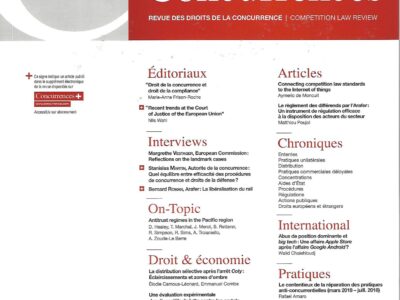
► Full Reference : Frison-Roche, M.-A., Droit de la concurrence et droit de la compliance ("Competition Law and Compliance Law), November 2018, in Revue Concurrences n° 4-2018, Art. n° 88053, pp. 1-4. - ► Summary: Compliance Law is a new branch of Law, still under construction. One can have a “narrow definition” of seeing it as the obligation of businesses to show that they are constantly and actively complying with the law. One can have a richer definition, of a substantive nature, defining it as the obligation or the own will of certain companies to achieve “monumental goals” that go beyond economic and financial performance. Competition Law partly integrates its two conceptions of Compliance: Precursor, Competition Law concretizes dynamically the first conception of Compliance Law. It is with more difficulties but also much more future that Competition Law can express in dialectic the second conception of Compliance Law as internationalization of these “monumental goals”, especially in the digital space. - 📝 read the article (in French) - 🚧[lien a="droit-de-la-concurrence-et-droit-de-la-complianc-2"]read the Working Paper on which this Article is based, with footnotes, technical references and hypertext links. [/lien] -