Crisis

Articles in The Journal of Regulation & Compliance « JoRC »

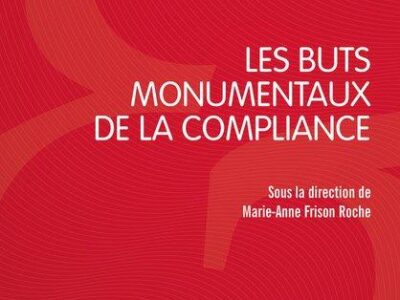
📝Place et rôle des entreprises dans la création et l’effectivité du Droit de la Compliance en cas de crise, in 🕴️M.-A. Frison-Roche (ed.), 📕Les Buts Monumentaux de la Compliance

🌐 follow Marie-Anne Frison-Roche on LinkedIn 🌐 subscribe to the Newsletter MAFR Regulation, Compliance, Law  - ► Full Reference: M.-A. Frison-Roche, "Place et rôle des entreprises dans la création et l'effectivité du Droit de la Compliance en cas de crise" ("Place and rôle of Companies in the Creation and Effectiveness of Compliance Law in Crisis"), in M.-A. Frison-Roche (ed.), Les Buts Monumentaux de la Compliance, coll. "Régulations & Compliance", Journal of Regulation & Compliance (JoRC) and Dalloz, 2022, pp. 339-352. - 📝read the article (in French)    - 🚧read the bilingual Working Paper which is the basis of this article, with additional developments, technical references, and hyperlinks - 📕read a general presentation of the book, Les Buts Monumentaux de la Compliance, in which this article is published - ► Summary of the article (done by the Journal of Regulation & Compliance): This article has a very topic: the place of private Companies, regarding the chapter's issue: "the ordeal of a crisis". The crisis constitutes a "test" it brings evidence. Let us take it as such. Indeed, during the health crisis, Companies have helped the Public Authorities to resist the shock, to endure and to get out of the Crisis. They did so by force, but they also took initiatives in this direction. From this too, we must learn lessons for the next crisis that will come. It is possible that this has already started in the form of another global and systemic crisis: the environmental crisis. In view of what we have been able to observe and the evolution of the Law, of the standards adopted by the Authorities but also by the new case law, what can we expect from Companies in the face of this next Crisis, willingly and strength? -

Working papers

🚧Compliance, Artificial Intelligence and Business Management: the right measure

🌐 follow Marie-Anne Frison-Roche on LinkedIn 🌐subscribe to the Newsletter MAFR Regulation, Compliance, Law  - ► Full Reference: Frison-Roche, M.-A. Compliance, Artificial Intelligence and Business Management: the right measure, Working Paper, June 2022.  - ► Summary of the Working Paper: Of the next European Regulation on artificial intelligence, the European Commission has a quite neutral conception of AI for obtaining a consensus between the Member States, while the Regulators and certain States have a more substantial conception of technology, wanting its power to be used to protect people, firstly from these new tools themselves, secondly from what is an amplification of the evils of the classic world, such as hate or misinformation. This is the reflection of two conceptions of Compliance. Firstly, Compliance can be defined as neutral processes that increase the effectiveness of what would be the obligation for companies or their desire for efficient risk management (in particular the consideration of "legal risks") to prove being "conform" to all regulations that are applicable to itself and all persons to whom the firm is accountable. This is often referred to as the "compliance obligation" or "obligation of conformity". This conception implies considerable practical consequences for the company which, in order to succeed in this "total exploit", would then have to resort to artificial intelligence tools constituting a "total and infallible solution", which mechanically generate for it the obligation to "know " all the "regulatory mass", to detect all "non-compliances", to conceive its relationship to the Law in terms of "risk of non-compliance", fully supported by Compliance by Design which could, without human intervention , eliminate legal risk and ensure "compliance total efficiency" in Ex Ante. The "legal price" of this technological dream is extremely high because all the "regulatory" requirements will then be transformed into obligations of result, any failure generating liability. The Compliance probationary system will become overwhelming for the company, both in terms of burden of proof, means of proof, and transfers, without exemption from proof. Objective responsibilities for others will multiply. The "law of conformity" will multiply Ex Ante systemic penalties, the border with criminal law being less and less preserved. It is essential to avoid this, both for businesses and for the Rule of Law. For this, we must use Artificial Intelligence to its proper extent: it may constitute a "massive aid", without ever claiming to be a total and infallible solution, because it is the human who must be at the center of the compliance system functioning thank to the firms and not the machinery. For this, it is necessary to adopt a substantial conception of Compliance Law (and not a sort of Conformity Law or Obedience Law). It does not at all cover all the applicable regulations and it is not at all "neutral", being in no way a series of processes. This new branch of Law is substantially built on Monumental Goals. These are either of a negative nature (preventing a systemic crisis from happening, in many but specific perspectives: banking, financial, health, climate, etc.), or of a positive nature (building a better balance, in particular between human beings, in the company and beyond). In this conception which appears increasingly strongly, artificial intelligence finds its place, more modest. As Compliance Law is based on information, Artificial Intelligence is essential to capture it and make first connections, first stages for successive analyses, done by human beings, making what is essential: the commitment of the company, both by the leaders and by all those who are "embarked" by a "culture of Compliance" which is at both built and common. This restores the required seal between Criminal Law and what can be asked of the mechanical use of Artificial Intelligence; this puts the obligation of means back as a principle. This restores the principal place to the lawyer and the compliance officer, so that the culture of compliance is articulated with the specificities of a sector and the identity of the company itself. Indeed, the culture of compliance being inseparable from a culture of values, Compliance by design requires a dual technique, both mathematical and legal culture. It is why European Compliance Law, because it is rooted in the European humanist tradition, is a model. -

Conferences

📅 Cycle of colloquia 2021 around Compliance monumental goals

📅 Public norms and Compliance in time of crisis : monumental goals put to a test (Normes publiques et Compliance en temps de crise : les buts monumentaux à l’épreuve)

This scientific manifestation is placed under the scientific direction of Marie-Anne Frison-Roche, Pascale Idoux, Antoine Oumedjkane and Adrien Tehrani. It is organized by the Journal of Regulation & Compliance (JoRC) and by the Faculté de Droit et de Science Politique de l'Université de Montpellier (Centre de Recherches et d'Etudes Administratives de Montpellier and Centre du Droit de l'Entreprise). 📅 This manifestation is part of the cycle of colloquia organized in 2021 around the general topic of Compliance Monumental Goals.        The interventions will give rise to the production of articles which will be part of  📕  Les bus monumentaux de la Compliance,    to be published in the Series Regulations & Compliance , co-published par the Journal of Regulation & Compliance (JoRC) and Dalloz. 📘Compliance Monumental Goals,    dans la Série Compliance & Regulation , co-published by par le Journal of Regulation & Compliance (JoRC) and Bruylant.   This manifestation took place on Zoom on 17th of May 2021.  Registrations: anouk.leguillou@mafr.fr  Assistance to this event may be validated as part of the continuing education of lawyers. In addition, scientific videos will be extracted and disseminated later.   Presentation of the topic: In the overall problematic of "Monumental goals", this conference retains a particular case: that of the crisis and the emergency situation that it generates. First of all, in general, does the importance of public norms in the emergency context engendered by a crisis situation imply a marginalization of Compliance? Don't private actors also have their place in these circumstances, at the service of the "monumental goals" that the public authorities want to maintain, or even which appear specifically? Secondly, more concretely, we have been living for many months in a health crisis. By taking it as a framework and, within it from particular cases, how public and private actors react, act, adjust? and how do the courts assess these movements? Going from the most general to the most specific, this conference aims to identify criteria, limits, of what could be specific rules when the emergency of a crisis meets Compliance, and will examine specific situations.   Working method: The conference is therefore built on a general issue, which was the subject of a "working paper", written by Antoine Oumedjkane, Adrien Tehrani and Pascale Idoux, on which the speakers will have thought in advance and from which they are intended to study the question from their particular perspective. The conference, which is essentially interactive, therefore begins with an outline of the main lines of this general work. It is followed by the examination of concrete practical cases. They are as follows: 1️⃣ hydro-alcoholic gel, its manufacture, price, availability, 2️⃣ information and regulation on all media in Covid period 3️⃣ the use of the bicycle during the state of health emergency A first conclusion, thematically limited, will relate to Revealed by the crisis situation, the place of private initiative in Compliance Law. A second, more general, undoubtedly open-ended conclusion is drawn from this confrontation between general reflection and concrete cases which must be resolved in a particular crisis.   speakers:  🎤 Jean-Bernard Auby, Emeritus Professor of Sciences po (Paris) 🎤 Julien Bonnet, Professor at Montpellier University and member of the CERCOP 🎤 Guylain Clamour, Dean of Montpellier Law School 🎤 Marie-Anne Frison-Roche, agrégée des Facultés de droit, Professor of Regulation and Compliance Law at Sciences Po (Paris) and Director of the Journal of Regulation & Compliance (JoRC) 🎤 Pascale Idoux, Professor at Montpellier University  🎤 Pascale Léglise, adjointe au directeur des libertés publiques et des affaires juridiques (Deputy Director of Civil Liberties and Legal Affairs) of the Ministère de l'intérieur (Home Ministry) 🎤 Michèle Léridon, Member of the Conseil supérieur de l'audiovisuel (French Media Regulator), President of the working group Pluralisme, déontologie, supervision des plateformes en ligne (Pluralism, Deontology, Supervision of Online Platforms) 🎤 Antoine Oumedjkane, Researcher of the Centre de recherche et d'études administratives (Research and Administrative Studies Center) of Montpellier University 🎤 Nelly Sudres, Maître de conférences at Montpellier University and member of the Centre de Recherches et d'Etudes Administratives (Research and Administrative Studies Center) of Montpellier University 🎤 Adrien Tehrani, Professor at Montpellier University and member of the Centre du Droit de l'Entreprise (Company Law Center) 🎤Xavier Vallad, Group Legal Director, Intermarché   ⤵️Read a more detailed presentation of the manifestation below:
Working papers

🚧 Place and Role of Companies in the Creation and Effectiveness of Compliance Law in Crisis

Full Reference: Frison-Roche, M.-A. Place and Role of Companies in the Creation and Effectiveness of Compliance Law in Crisis, Working Paper, May 2021.  -   This Working Paper has been elaborated as basis for a conference in the colloquium of Mai 17, 2021 (done in French: Normes publiques et Compliance en temps de crise : les buts monumentaux à l'épreuve. This video is made with English substitutes.  It is also the basis for an article in the book Compliance Monumental Goals, the English version of which is co-published by the Journal of Regulation & Compliance (JoRC) and Bruylant. Summary: This article has a very topic: the place of private Companies, with regard to the chapter's issue: "the ordeal of a crisis". The crisis constitutes a "test", that is to say, it brings evidence. Let us take it as such. Indeed, during the health crisis, it appears that Companies have helped the Public Authorities to resist the shock, to endure and to get out of the Crisis. They did so by force, but they also took initiatives in this direction. From this too, we must learn lessons for the next crisis that will come. It is possible that this has already started in the form of another global and systemic crisis: the environmental crisis. In view of what we have been able to observe and the evolution of the Law, of the standards adopted by the Authorities but also by the new case law, what can we expect from Companies in the face of this next Crisis, willingly and strength    Lire ci-dessous les développements.

Working papers

Compliance Law, Health crisis and Future

This interview was conducted in French with Olivia Dufour, for an article published in French in the digital publication Actualité Juridique. Its subject is  the confrontation between the current health crisis situation and the Compliance Law.    Summary. After defining Compliance Law, distinguishing the procedural and poor definition and the substantial and rich definition, the starting point is to admit the aporia: the type of health crisis caused by Covid-19 will be renewed and it is imperative to prevent it, even to manage it, then to organize the crisis exit. Public Authorities are legitimate to do so, but because this type of crisis being global and the State being consubstantially linked to borders, States are hardly powerful. Their traditional International Law shows their  limits in this current crisis and one cannot hope that this configulration will improve radically. In contrast, some companies and markets, notably the financial markets, are global. But the markets are not legitimate to carry out such missions and counting on the generosity of certain large companies is far too fragile in front of the "monumental goal" that is the prevention of the next health crisis, crisis which must never happen. How to get out of this aporia? By Compliance Law, basis of, in a literal and strong sense, the "Law of the Future".  We need to be inspired by the Banking and Financial Compliance Law. Designed in the United States after the 1929 crisis to tend towards the "monumental goal" of the absence of a new devastating crisis in the country and the world,  this set of new legal mechanisms gave duty and power of supervision, regulation and compliance to market authorities and central bankers. These are independent of governments but in constant contact with them. Today, they claim to have as first priority the fight against climate change. Now and for the future, they must also be given the responsibility and the powers to prevent a global health disaster, similar to a global ecological disaster, similar to a global financial disaster. This does not require a modification of the texts because their mandate consists in fighting instability. Stability must become a primary legal principle, of which the fight against monetary instability was only a first example. By the new use that central banks must make of it by preventing and managing health crises, Compliance Law will ensure that the future will be not catastrophic.

Books

Patrick BOLTON - Morgan DESPRES - Luiz Awazu PEREIRA DA SILVA Frédéric SAMAMA - Romain SVARTZMAN, The Green Swan

The Green Swan

Reference: Patrick BOLTON – Morgan DESPRES – Luiz Awazu PEREIRA DA SILVA – Frédéric SAMAMA – Romain SVARTZMAN, The green swan: central banking and financial stability in the age of climate change, Banque des Règlements Internationaux, Janvier 2020 Accede to article

Articles in a non-legal collective publication

Roda, Jean-Christophe

La crise du droit antitrust

Full reference: Roda, J.-C., La crise du droit antitrust in Mélanges en l'honneur de Jacques Mestre, coll. Mélanges, Lextenso – LGDJ, 2019, pp. 839-854 Sciences Po's students can read the article via MAFR Sciences Po's Drive Regulation & Compliance 

Working papers

Analysis of blockchains with regard to the uses they can fulfill and the functions that the ministerial officers must ensure

First of all, this working document was used as a support for an oral intervention done in French on the general topic.  L'officier ministèriel est-il soluble dans la blockchain ? (Is the ministerial officer soluble in the blockchain?) at the "Club du Droit", which took place at the Conseil supérieur du Notariat on May 14, 2019, in Pars. Consult the general presentation of the conference (in French). Then it serves as a basis for an article to be published in the Revue Defrénois (in French). - Introduction & Summary. The technical analysis of the confrontation between the tool that is the blockchain and the function that ensure these particular people who are the "ministerial officers"1Sur la confrontation déjà faite dans l'analyse économique de la "régulation" et la fonction notariale, v. Frison-Roche, M.-A., ...., might make it possible to deduce the use that they must make of it. . For this, it is necessary to keep in mind this distinction so simple: the blockchain is a tool, a thing, a machine, an algorithm, a mechanical, mathematical power, while the ministerial officer is a human being. This refers to the distinction that the Western legal system, whether Civil Law or Common Law, poses as summa divisio: the distinction between human beings and things. This first distinction is formulated so that we do not treat human beings as things, since they are legally qualified as "person"2Frison-Roche, M.A., Pour protéger les êtres humains, la nécessité éthique de la notion juridique de personne, 2018. . This is not a natural idea, because if the opportunity arises we would be inclined to treat the other human being as thing. It would be nice and effective. But Law, in its first principle, opposes it, to protect the one who can not afford to be a wolf for the other. This political reason implies that this distinction remains very clear and strong. Now, many try at any moment to make us forget it. For this essential distinction to remain effective, not only should we not imagine human beings as things (reduced to their bodies, for example, or reduced to mechanical acts of consumption3Anders, G., notamment dans son ouvrage central L'obsolescence de l'homme (1956), présentant l'être humain réduit à l'état de "machine désirante" par une société de pure et simple consommation. Le souci qu'il en a comme philosophe rejoint le souci qu'en avait Jacque Ellul, comme juriste, s'inquiétant de la "société technicienne" (...). Or, les machines correspondent aujourd'hui au dessin que ces auteurs du milieu du XXième siècle en faisaient. De la même façon, Alain Supiot rapporte à Kafka le souci du "machinisme" dans le fonctionnement des institutions humaines (....) ; il ne fait notamment dans son analyse de Kafka comme "artiste de la Loi" (2019).), like this is notably described and denounced by Alain Supiot in his successive works4Par exemple Supiot, A., La gouvernance par les nombres, 2015 ; Mondialisation ou globalisation ? Les leçons de Simone Weil, 2019 ; Le droit au XXIème siècle : droit, technique et écoumène (dernière leçon au Collège de France, 22 mai 2019). Sur cette idée folle et dévastatrice qu'il faut faire davantage confiance aux machines qu'il ne faut faire confiance aux êtres humains, ce qui justifierait donc de "mécaniser" les autres humains, idée folle reprise le plus souvent par les auteurs avec entrain, v. par ex. Caprioli, E.A., La blockchain ou la confiance dans la technologie, JCP 2016. 672, n° 3. , but it is also necessary that, especially by an imagined vocabulary, one represents things as acting like people, whereas it does not only machines and tools. But technology represents more and more things with anthromophormi forms and reactions , through robots which "speak", "intelligent" machines, etc. The economic success of promoters of machines and other human-like robots, mechanical solutions presented as "intelligent", is based on forgetting the distinction between the person and things. It is certainly possible to erase this distinction from our system of thought. The difficulty is that it is the basis of Western Lawl5Frison-Roche, M.-A., La disparition de la distinction de jure entre la personne et les choses : gain fabuleux, gain catastrophique, 2017.  and that there are strong reasons to keep it because this distinction protects the weak human being from injustice, permits him and her to participate in the general  order, to avoid an order built on a pure balance of power which can only lead to violence. It is this background that is played in the practical questiond of insertion of blockchains and other technologies and the way in which the various professions must exercise their functions today. If these tools are consistent with these functions, or even improve them, professionals must welcome them without suspicion, or even participate directly in developing them. If these tools are not capable of fulfilling certain functions entrusted to these professionals, then these functions must not be inadvertently or maliciously inserted into a blockchain, whose capacity for preservation and reliability does not amount to anything, because a thing doesn't have any ability to think. This is why we must start from the functions, by dinstinguising the technical function of conservation, duplication and elaboration of acts (I). It seems that assuming the technical reliability of preservation and duplication acquired through the blockchain, as soon as there is a part of elaboration in the act, human intervention must step in because a machine is unfit to check the facts. Here we find the distinction between the retranscribed negotium, this retranscription never being mechanical, and the instrumentum itself, which, split from what gave rise to it, can be subjected to duplicative and conservation technologies. These technologies of conservation and duplication could be so efficient that the notions of original and copy could be questioned because of the reliability of the blockchain (II). Thus the blockain is an effective technology on the instrumentum as documents divided from the negotium, but it can not guarantee the correspondence between the two ; it has only the reliability in the conservation, the availability and the duplication to infinity of the instrumentum, of what is extremely useful, and justifies that ministerial officers incorporate this technology. But the function of these are not limited to being agents of conservation and duplicators. We do not simply move from the copyist monk to the blockchain. The main and so precious function of the ministerial officers is to check the accuracy of the mentions of the instrumentum in relation to the reality of the negotium. This is so precious for a market economy to have this correspondance6Frison-Roche, M.-A., L'acte authentique, acte de marché, 2010. . The ministerial officer does so as a human being, while a machine can neither check this correspondence nor advise the parties – especially not the weak part in the negotium. This is why the State – which has never ignored the effectiveness of "decentralization" techniques – has decentralized its office and its correspondance. With a sole and autonomous machine, it is not possible to know if  acts correspond to the objective reality of the transactions (their object) as well as to their subjective reality (consent). If we choose not to entrust this to human beings carrying this function, for which a machine is unfit, it would be a political choice It will have a price (III). This would be the choice of a very liquid and unsecured market (without intermediary, with the benefit of lower cost in Ex Ante and higher risk for the long term). In policy, the balance is always between security and liquidity, especillay in financial systemic policy. This was done by American Law, wich prefered low costs and high liquidity, especially for real estate loans, which were securitized by subprime mortgages. For the moment, this choice is not made in this sense by European Law, safety concern in the elaboration of the acts being preferred and the distinction between the human aptitude and the mechanical aptitude remaining. And we know that in the first system the reajustment takes the form of a general crisis, which reinjects the reality of the negotiums, lost in the instrumentums.  What price are we ready to pay ? Once this distinction is clearly made, because the elaboration of an acte mus be made bye the ministerial officer, human being invested by the State of the particular charge ensures the accuracy of the mentions of the act with the reality of people, wills, obligations and goods, it is all the more expedient for ministerial officiers to organize themselves to develop blockchain technology. Indeed, once this act has been developed reliably, ans as such deserves to be "authentic", because of the continuum between elaboration, preservation and duplication, because it is up to the ministerial officiers to draw up the deeds more incontestably reliable. It is up to them to equip themselves with the technological means of best conservation and duplication of acts elabored by them (IV). 

I-2.4: The principle of the neutrality of standards (the example of accounting standards)

Translated Summaries ENGLISH The subject of neutrality brings to my mind a certain number of preliminary ideas and reminiscences. First of all, the image of Buddha comes to mind, because it alone expresses the extent to which neutrality is an endless subject, since by thinking about the fact that he isn’t thinking about anything, Buddha is still thinking about something. It also makes me think of contemporary music’s constant attempts to attain a form of neutrality: yet this goal remains unattainable, because it is evident that the search for the neutral, in a sound or a timbre, can probably never be found.   FRENCH Tout d’abord, la figure du Bouddha, qui exprime à elle seule combien la question de la neutralité est un thème sans fin, car en pensant qu’il ne pense à rien, le Bouddha pense malgré tout à quelque chose. Il me fait penser aussi à la musique contemporaine, à son souci constant d’atteindre une forme de neutralité ; préoccupation à jamais déçue lorsqu’elle reconnaît ultimement que le neutre, en ayant toujours une qualité – un son, un timbre – est probablement introuvable.   SPANISH El principio de los estándares de la neutralidad (el ejemplo de estándares de contabilidad) El tema de la neutralidad trae a luz un cierto número de ideas preliminares. Para comenzar, la figura de Buda viene a mente, porque él sólo expresa la naturaleza interminable que es el tema de la neutralidad, ya que al pensar en el hecho de que él no piensa en absolutamente nada, Buda aún así piensa en algo. También me hace pensar el intento constante de la música contemporánea de alcanzar una forma de neutralidad: pero este objetivo permanece inalcanzable, porque es evidente que la búsqueda de lo neutral, en un sonido o un timbre, probablemente nunca se podrá encontrar. ………………… Other translations forthcoming.