Criminal Law

Breaking news

📧 On June 3, 2021, UK Financial Markets Authority skillfully expresses its position on the interference of cryptocurrencies on criminal interference and consumer protection

►  Money Laundering, Cryptocurrency and the Art of Saying It: the Financial Conduct Authority (FCA) statement of June 3, 2021 and the Art of Saying It. Law is softer than ever.   The English have their way of saying things: thus the Financial Conduct Authority -FCA, the British financial market regulator, published on June 3, 2021 a press release whose expression is remarkable. Its subject matter is crypto-assets and, like in an essay plan à la française, it is built in two parts.  In the part I, it is just mentioned that the deadline for companies in this industry to obtain a registration, which was due to end soon, will be postponed to March 2022. Why? Because almost all of them have not been able to demonstrate their ability not to be resistant to money laundering and other criminal activities. This is in no way presented as a conviction, just the objective cause of a postponement of the date, the time for the Financial Regulatory Authority to better examine the files, themselves to be completed by applicants. The part II concerns consumer protection. The Authority point out that the consumer can lose everything in an extremely risky products and underlines that it is unlikely that this ruined layman will even be able to access the ombudsman to obtain anything. It is purely informative. This is how the English bodies formulate their opinion on cryptoasset. It's elegant (the press is more direct). This also makes it possible not to be covered with insults by the worshipers of these objects: are expressed just a technical delay granted and not a conviction that cryptoasset could be per se  an instrument of criminality, just a probationary difficulty ; and just a regret on the non-access to the ombudsman for these cryptoassets consumers. But if the evolution of the bubble leads these investors to ruine shows, the Regulator will have warned and expressed in advance the regrets he had of the lack of legal technique to protect them. And if the facts show that it is massively through cryptocurrency that the crime is whitewashed, the Regulator has shown everyone his prudence, the delay it will have take to examine the files  and its kind foresight. No one more than a British knows what Liability is.    -        

Articles in The Journal of Regulation & Compliance « JoRC »

📝Compliance et incitations : un couple à propulser, in 🕴️M.-A. Frison-Roche (ed.), 📕Les outils de la Compliance

► Full Reference: M.-A. Frison-Roche, "Compliance et incitations: un couple à propulser " ("Compliance and incentives : a promising tandem"), in M.-A. Frison-Roche (ed.), Les outils de la Compliance, coll. "Régulations & Compliance", Journal of Regulation & Compliance (JoRC) and Dalloz, 2021, pp. 123-130. - 📝read the article (in French) - 🚧read the bilingual Working Paper which is the basis of this article, with more developments, technical references and hypertext links - 📕read a general presentation of the book, Les outils de la Compliance, in which this article is published - ► Summary of the article (done by the Journal of Regulation and Compliance): The theory of incentives targets the mechanisms which do not use directly constraint (except to present sanctions themselves as incentives) but which leads nevertheless to expected behaviors. To appreciate the links which must or must not be done between incentives and Compliance, we should proceed in two times.  First, the association appears natural between incentive mechanisms and "Compliance Law" since the later is defined in a dynamic way. Indeed, if it is defined placing its legal normativity in its "monumental goals", as the end of corruption, the detection of money laundering in order to underlying criminality disappears, or as the effective protection of environment or the concrete care of human beings, then what matters is not the means in themselves but the effective tension towards these "monumental goals". In this perspective, what was related to public policies led by States, because they are definitively not able to do it, the charge is internalized in the firms which are able to tend towards this goals: "crucial operators" because they have the geographical, technological, informational and financial means.  In this perspective, the internalization of public willingness provoking a split with the concept of State linked to a territory which deprives Politics of its constraint power, incentive mechanisms appear as the most efficient mean to reach these monumental goals. They appear as this "natural" mean both negatively and positively defined. Negatively in which they do not need in Ex Ante institutional localizable sources and sanction power in Ex Post: it is enough to substitute the interest to obligation. Positively, incentives relay through operators' strategies what was the so critical and joked form of public action: the "plan". The duration is thus injected thanks to Compliance mechanisms, as we can see it through the development of it in the care for environment ("plan climat") or through the educational mechanism, which could be conceived only in duration.   However, the opposition seems radical between Compliance Law and Incentives. And this because of three convictions often developed and that we have to overcome. First, the idea that in a general way, there would be a Law only if there is a mechanism of immediate constraint which is associated to the norm. As long as the incentive is not based on obligation, then it will be nothing… Secondly, and as if that were a kind of consolation …, Compliance would not be really Law either … We so often say that it is only about a methodology, a range of processes without sense, procedures to follow without trying to understand, process that algorithms integrate in a mechanic without end and without sense or that on the contrary, Compliance would be full of sense by Ethics and Morality, which are far from Law. While incentives talk to the human spirit which calculate, Compliance would be so a process through which machines will be connected to other machines, so an extra soul, where calculation has no place… Thirdly, solutions would be to be find in Competition Law because it can do without States, submit them and approach what is a-sectorial, especially finance and digital, the world being financialized and digitalized. The violence of Competition Law which comes in Ex Ante thanks to "Compliance sanctions" applying for example to essential infrastructures Law, by continuing to deny the salience of the duration and taking care of the "market power" would be also not compatible with a marriage with incentive mechanisms which rely on duration and power of those to which it is applied, converging towards goals, which are set by what Competition Law ignores: the project. This project which pretends to build the future is the one of politics and of companies, which use their deployed power in time to concretize it. It is without any doubt there that the future of Europe is.  To overcome this triple difficulty, it is thus necessary, in a second time, to modify our conception of Law, especially thanks to Compliance Law, in which this new branch is autonomous from Competition Law, and even sometimes opposed to it, in order to the insertion of incentive mechanisms permit to unknown or against Competition Law organizations to reach "monumental goals" which are imperative to take into consideration. For example, the taking into consideration of climate challenges or the building of a sovereign identity of the data. This is expressly set by European Commission which supervises such initiatives, supervision being what is articulated with Compliance, in a couple that go beyond Regulation, and replaces in Ex Ante Competition Law, salient branch for Ex Post. All the texts which are in the process of expressing it are based on this reformed couple: Compliance and Incentive. This couple supposes that we recognize as such the existence of companies as project carriers, project which is the creation of marketed wealth circulating on a market, which could be an industrial project specific to a geographical zone both economical and political. Regulation is deployed to go away from the notion of sector and to transform itself in supervision of crucial firms in the correspondance between the project and the action, what refers to the notion of "plan". In this, banking supervision is just the advanced bastion of all thematic, energetic, climatic and health plans, or more broadly industrial and technological that could by incentive be implemented, this conception of Compliance permitting to build zones which are not reduced to immediate market exchange. The incentive corresponds to the fact that Compliance Law relies on the power of the firm to reach its own political goals, for example fighting against disinformation in the digital space or obtaining a healthy environnement. This supposes that Compliance stops to be only conceived as a model of rules effectivity, for example of Competition Law, to be recognized as a substantial branch of Law. A branch which expresses political goals. A branch which is anchored in crucial firms whose it recognizes the autonomy with regards to markets. This makes it possible, in particular through the coupling with incentive mechanisms leading to long-term collaborative operations supervised by public authorities, not to be governed by simple Competition Law, inapt to bring projects to fruition. -

Articles in The Journal of Regulation & Compliance « JoRC »

AMICO, Thomas🕴️

📝La Compliance ou le passage de l’ex post à l’ex ante. Une révolution copernicienne pour l’avocat pénaliste ?, in 🕴️M.-A. Frison-Roche (ed.), 📕Les outils de la Compliance

► Full Reference : Th. Amico, "La Compliance ou le passage de l'ex post à l'ex ante. Une révolution copernicienne pour l'avocat pénaliste ?" ("Compliance or the passage from ex post to ex ante: a Compernican revolution for the criminal lawyer?"), in M.-A. Frison-Roche (ed.), Les outils de la Compliance, coll. "Régulations & Compliance", Journal of Regulation & Compliance (JoRC) and Dalloz, 2021, p. 145-154. - 📕read a general presentation of the book, Les outils de la Compliance, in which this article is published - ► Summary of the article (done by the Journal of Regulation & Compliance): After referring to various definitions of Compliance Law, the author insists on the usefulness of the criminal lawyer in that he, familiar with the Ex-Post that constitutes the sanction, can be of good advice. in the Ex-Ante in which new compliance mechanisms are being developed, such as risk mapping or third-party assessment. Addressing the punitive dimension of Compliance Law, the author shows that the criminal lawyer therefore naturally has a place there, whether it concerns the powers exercised by an administrative authority or the criminal law itself. In that he can "anticipate criminal proceedings", the criminal lawyer is therefore best able to ensure that the company does not expose itself to them, in particular in a good mastery of internal investigations, thus ruling out the criminal risk. -

Articles in The Journal of Regulation & Compliance « JoRC »

TRAIN, François-Xavier🕴🏿

📝Arbitrage et procédures parallèles exercées au titre de la compliance, in🕴🏿M.-A. Frison-Roche (ed.), 📕La juridictionnalisation de la Compliance

► Full Reference: F.-X. Train, "Arbitrage et procédures parallèles exercées au titre de la compliance" ("Arbitration and parallel proceedings exercised in Compliance Procedure"), in M.-A. Frison-Roche (ed.), La juridictionnalisation de la Compliance, coll. "Régulations & Compliance", Journal of Regulation & Compliance (JoRC) and Dalloz, 2023, pp. 355-368.  - 📕read a general presentation of the book, La juridictionnalisation de la Compliance, in which this article is published - ► The summary below describes the article that follows an intervention in the scientific manifestation Compliance et Arbitrage, co-organised by the Journal of Regulation & Compliance (JoRC) and the University Panthéon-Assas (Paris II). This conference was designed by Marie-Anne Frison-Roche and Jean-Baptiste Racine, scientific co-directors, and took place in Paris II University on March 31, 2021.  In the book, the article will be published in the Chapter III, devoted to: Compliance et Arbitrage international. - ► Summary of the article (done by the Journal of Regulation & Compliance): Firstly, the article insists on the principle of the autonomy of the international arbitration procedure, in relation to which parallel procedures remain watertight, whether they are criminal or done under Compliance Law. In the arbitral proceedings taking place independently, the arbitrators before whom the facts also referred to in these parallel proceedings, in particular the facts of corruption, are alleged before them as facts through their unlawful nature: it is at this title that they can and must apprehend them, using the standard of proof which is the bundle of clues. Secondly, the article highlights the limits of the autonomy of international arbitration. These may be de facto limits because in the search for evidence by arbitrators, red flags are often insufficiently consistent evidence to establish a sentence, especially since this sentence may be subject to control by the judge of its conformity to international public order, the annulment by the judge being able to be based on external elements, even after the arbitration procedure. It may then be wise for the arbitrators, who are not forced to do so, to suspend their proceedings to wait the results of the parallel proceedings initiated under Compliance Law, so that the procedures and their results could be harmonious. -

Videos

🎥 The Economic Attractiveness of Impartiality (“L’attractivité économique de l’impartialité”), in “”Economic Attractiveness, Judge Office and Impartiality. Thinking the judge Office” (“L’attractivité économique, l’office du juge et l’impartialité. Penser l’office du juge”)

►  Full Reference : Frison-Roche, M.-A., The Economic Attractiveness of Impartiality ("L'attractivité économique de l'impartialité"), in ""Economic Attractiveness, Judge Office and Impartiality. Thinking the judge Office" ("L'attractivité économique, l'office du juge et l'impartialité. Penser l'office du juge"),  -   🎥 watch the conference (in French with English subtitles) -   📝 read the colloquium program ( in French) 📝 see the general program of the cycle on the Judge Office. -   📝 read François Ancel's article of 14th of January 2021 in the Receuil Dalloz and which report this colloquium (in French)      📝 read the Working Paper, basis of this conference. This Working Paper is significantly different from the conference because it was conceived befor the colloquia cycle beginning. In addition, since this manifestation was a Round Table, the conference has taken more into account previous conferences and what said the other two speakers.   📊 see the slides, basis of the conference (in French) The slides could not be shown during the conference. Orally, it was appropriate to more develop the introductory remarks for emphasizing the human and unique dimension of the Judge Office, expected in economic matters. As a result, the second part of the conference was not given orally, so slides therefore remain the only media available. - ►  Summary of the conference : To fit into the ambition of this general colloquia cycle, which is to "Think the Judge Office" and in this round table which apprehends the imperative of economic attractiveness of this office, firstly emerges the seemingly contradictory relationship between this imperative and the distance that the judge must maintain. Thus it is often asserted that the judge should be internalized at this point in the "places", – an economic concept of great scope (to which the first part of the introduction is devoted, defining the "place" at the same time as a closed and porous space and as a "systemic litigant" -, that he/she should ipso facto lose his/her distance, that is to say his/her impartiality. As places are in competition, even if weighing on one hand the effectiveness of the place, and on the other hand the impartiality of a judge who is external to this place – Judge referring to the Law , Impartiality would necessarily emerge weakened. It would then be necessary on a case-by-case basis to get the judge to give the desired concessions… The conference aim is to take the opposite position and to state that the Place – in particular because they must be strongly distinguished from the Markets, of which they were the ancestors – require a Judge, who is at the same time "singular", that is to say with a personality, a face, opinions, and in distance so that his/her imagination does not surprise Place. Indeed, these require a human Justice, and a not mechanical one and singular judges, of whom the juge des référés or the arbitrator are the epigone, meets this need. But for reducing their "margins of discretion", how Economy qualifies the Impartiality of a person who can never be neutral, the singular Judge's Office must be inserted into mechanisms reducing these margins. In this way, the Place may reach a Judge who is always more impartial, and in doing so the Place becomes always more attractive. To achieve this in practice, the place expresses two legitimate expectations, as a "systemic litigant", whose satisfaction increases and the singular Judge's Impartiality and increases the Attractiveness of the Place as a space. This clearly shows that the Place's Attractiveness and the Judge's Impartiality, because judges are inserted into procedures, into institutions and into a "jurisdictional family", are not only not contradictory, but are on the contrary convergent, one fueling the other. Concretely, and judicial practice shows it, it is necessary to consolidate the particular Judge's Impartiality by inserting him/her into collective processes. As it is necessary to promote a radiance of Impartiality by strengthening the "jurisdictional family". To consolidate the singular Judge's Impartiality  by inserting him/her into collective processes, it is necessary to admit without hesitation the subjectivity of the judge, to seek it even. The reduction of the margins of discretion, definition of impartiality, being obtained by the inclusion of the judge in a procedure of which he /her alone is the master but in which he/her is not alone. This has the technical consequence that he/her is himself/herself in an adversarial debate, not only during the proceedings, but also before (in the media), inside the judgment (and the decision of the Criminal Chamber of 25 November 2020 is a model of that) and after the judgment. By that, the Judge shows that by his/her office he/she is in the future, as climate justice will show. In addition, to limit his/her margins of discretion, the singular judge must fit into a rational principle of coherence, vertical and horizontal. Vertical coherence, because he/she integrates what it is said and the technique of the "determining opinion" is to be encouraged, the singular judge having to avoid it only if he/she has "strong reasons" to do it. This is to follow  this general rule Comply or Explain (which is the very opposite of blind obedience). Horizontal coherence, because the singular judge either sticks to what he/she said, estoppel also being a rule of logic. But above all, the institution must extract as much as possible from " institutional doctrines", by all means, of which the annual reports are an example. To consolidate the singular Judge's Impartiality by strengthening the notion and reality of the "Jurisdictional Family", it is necessary to have of it a broader conception, which could lead to "guidelines" common to various jurisdictions, and a stronger one, by integrating those surrounding the judge to lead to judgment. In this, the procedure before the Court of Justice of the European Union, working on a common file, is a model. If this community were even stronger, the Judge Office would be even more useful than it is already in the digital space. Thus, Judges who are always human, always diverse, always singular, who listen, consider and adjust to the situation, who within a Jurisdictional Family fit into an Institutional Doctrine which transcends and supports them but which they transform if there is a strong reason to do so, a reason always expressed said: this is the embodied Impartiality that makes an economic and financial Place attractive.   -      

Articles

Why the decision of the French Constitutional Council of 7.08.2020 about authors of terrorist offences is so informative for Compliance & Criminal Law

Full reference: Frison-Roche, M.-A., Why the decision of the French Constitutional Council of 7.08.2020 about authors of terrorist offences is so informative for Compliance & Criminal Law, Newsletter MAFR – Law, Compliance, Regulation, 13th of August 2020 Read, by freely subscribing, the other news in the Newsletter MAFR – Law, Compliance, Regulation    Summary of the news On 7th of August 2020, the Conseil Constitutionnel (French Constitutional Court) made a decision concerning the constitutionality of a French law implementing safety measures against authors of terrorist offenses after their sentence. The law permitting to impose, through an act from the administration, various controls or interdiction to communicate with some people for authors of terrorist offenses after the end of their sanction.   Although the Conseil Constitutionnel estimated that such dispositions was disproportionate with regards to the objective, which prompted it to censor the text, it recognized that, since terrorism seriously disturbs public order through intimidation and terror, the fight against terrorism contributes to the objective of constitutional value consisting of preventing attacks on the public order. Thus it is not the nature but the intensity of the proposed measures which pushed the Conseil Constitutionnel to state this text not constitutional. By the way, the Conseil affirms that if the legislator submits it a law whose the measures are more proportionate to the goal, these, although Ex Ante and justified only by the existence of a risk, will be declared in conformity with the Constitution. The Conseil Constitutionnel confirms here that the fight against terrorism financing is a "monumental goal" of Compliance Law. 

Working papers

🚧 Resolve the contradiction between “sanction” and “Incentive” under the fire of Compliance Law

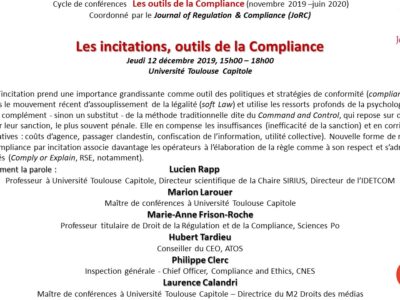
This Working Paper has been the basis for the first conference of the two conferences in the colloquium in Toulouse (France) under the scientific direction of Lucien Rapp, about Les incitations, outils de la Compliance ("Incitations, as Compliance Tools"), on December 12, 2019, the first one about The sanction as incitation and the second one about Incitations and Compliance Law (synthesis of this colloquium).  Then, it has been the basis for the article, to be published in the books Les outils de la Compliance and Compliance Tools in the Series Régulations & Compliance. Read a general presentation of this book.     Summary and Introduction of this Working Paper: At first glance, Compliance and Incentives appear to be totally opposite. For two major reasons. In the first place, because the sanctions have a central place in the Law of Compliance and the incentives suppose an absence of constraint on the operators. Secondly, because the incentives are linked to self-regulation and that Compliance Law assumes a strong presence of public authorities. Taking the first reason, one should choose: either Compliance or Incentives! Either the effectiveness of one or the effectiveness of the others; either the techniques of one or the techniques of others; either the philosophy of one or the philosophy of the others. Resign oneself to the loss that such a necessary choice would involve. But to put the terms thus amounts to think poorly about the situations and reduce the fields of the solutions which they call for. If we take a rich definition of Compliance Law, it is possible on the contrary to articulate Compliance and Incentives. From this perspective, sanctions can no longer become what blocks the use of incentives but, on the contrary, what constitutes them. Even more, the coupling between Incentives and the requirements of Compliance Law must be strongly encouraged, as soon as the public authorities supervise in Ex Ante all the initiatives taken by the "crucial operators".  This working document deals with the first issue1La seconde problématique est analysée in "Compliance et Incitation : un couple à propulser", 2020.. Indeed, the so-called incentive theory targets mechanisms that do not directly use coercion. They would therefore have little place in Compliance Law. But Compliance seems saturated with sanction procedures. We can even say that it seems to put them at the center, the public authorities presenting the number of sanctions as a sign of success, while the companies seem obsessed with their prospects, the two concerns ending in such a strange convergence that are the D.P.O… An honest observer can only feel immediately uneasy. Indeed, he can only raise the definition of the sanction as a "constraint" triggered Ex Post, at the very heart of Compliance Law which is presented as a set of Ex Ante mechanisms. Based on this contradiction in terms, should we give up the association and think that it would be wrong against the spirit to think of the sanction as an incentive? It is undoubtedly in this connection that one perceives most clearly the clash of two cultures, which do not communicate, while technically they apply to the same situations. Indeed, because Compliance was firstly designed by Finance, everything is a tool for it. Therefore, the tendancy to think about the sanction only as an incentive is very strong in Compliance Law. It manifests itself continuously and will not stop (I). But whatever the reasons are to conceive it this way, the principles of the Rule of Law cannot disappear and if we do not want them to be erased, then they must be articulated (II). It’s an essential adjustment. This is why we can literally say that Compliance has set Criminal Law on fire by its conception, logical but closed in on itself, of sanctions as simple incentives. For Law to remain, however, it is necessary to hold a very firm definition of Compliance Law centered on its Monumental Goal, which is the protection of the person.

Working papers

🚧 Compliance and Incentives: a couple to propel by the notion of “Incentive Compliance”

This working document serves as the basis for two conference given in the symposium made under the direction of Lucien Rapp, Les incitations, outils de la Compliance ("Incitations: Compliance Tools"). Référence : Frison-Roche, M.-A., Compliance et Incitations : un couple à propulser, in Faculté de droit de l'Université Toulouse-Capitole, et Journal of Regulation & Compliance (JoRC),Les incitations, outils de la Compliance, 12 décembre 2019, Toulouse.  This Working Paper has been the basis for two conferences in the colloquium in Toulouse (France) under the scientific direction of Lucien Rapp, about Les incitations, outils de la Compliance ("Incitations, as Compliance Tools"), on December 12, 2019, the first one about The sanction as incitation and the second one about Incitations and Compliance Law (synthesis of this colloquium). sur le thème de la sanction comme incitation, la seconde en synthèse de ce colloque sur  After it has been the basis for the article, to be published in the books Les outils de la Compliance and Compliance Tools in the Series Régulations & Compliance. Read a general presentation of this book.   - Summary of this Working Paper: Compliance and Incentives appear at first glance to be totally opposite. Not only because sanctions are at the heart of Compliance and that sanction is associated with constraint while incentive is associated with non-constrained1Voir cette question analysée d’une façon autonome, Frison-Roche, M.A., Résoudre la contradiction entre « sanction » et « incitation » sous le feu du Droit de la Compliance, 2020., but also because incentives are linked to self-regulation and that Compliance Law requires a strong presence of public authorities. Thus, one should choose: either Compliance or Incentives! Either the effectiveness of one or the effectiveness of the others; either the techniques of one, or the techniques of others; either the philosophy of one or the philosophy of the others. Resign yourself to the waste that such a necessary choice would involve. But putting the terms thus is thinking poorly about the situations and reducing the fields of the solutions which they call for. If we take a rich definition of Compliance Law, we can on the contrary articulate Compliance and Incentives. To do this, the concept of “incentive Compliance” should be developed. This concept is not only appropriate, but it is necessary in a new conception of Sovereignty. For example for the digital Europe. -   Read the developments below.   

Videos

The French Council of State (Conseil d’État) confirms the wide and therefore severe application of the sanctions mechanism in the Compliance Law concerning the freezing of assets, by its decision of November 15, 2019, La Banque Postale v. ACPR

Watch the video explaining the content, meaning and scope of the decision made by the Conseil d'État (French Council of State) on November 15, 2019, La Banque Postale v. Autorité de contrôle prudentiel et de résolution (ACPR). The Autorité de contrôle prudentiel et de résolution – ACPR (French Authority of prudential control and resolution) pronounced a very high sanction, representing 7% of La Banque Postale's net annual result. The breach is constituted by the fact of not having prevented the use of the banking technique of the "money order" which was used to escape the freezing of the assets. The Conseil d'État recalls that by nature if the assets are frozen, it is not possible that anyone is able to dispose of these assets. However, by the use of "money orders", persons targeted by asset freezing decisions, tools used in connection with the fight against money laundering and the fight against terrorism, had been able to circulate money to from accounts managed by La Banque Postale, of which they were not customers. This case was not foreseen at the time when the Bank Postale was sanctioned by the ACPR for not having prevented such a use, the texts forcing it under its obligations of "conformity" to prevent this behavior of violation background gels on the part of his customers, but only that. This case of a use of a means by a person who is not a customer of the bank was not foreseen at the time when the alleged facts took place and the Bank claims not to be able to be punished since in the repressive matter it is necessary to respect the principle of non-retroactivity of the texts, – in this case texts later supplemented to aim at such an assumption -, the non-retroactivity being a major principle itself related to the principle of the legality of the offenses and the penalties. We are therefore in the hypothesis of a silence of the texts. What to decide? Can the Bank be condemned and so heavily or not by the ACPR? The Bank does not think so.  It acted against this sanction decision firstly because those who used these money orders were not its clients. It has strong reasons to avail itself of this fact, since subsequently the texts needed to be modified to aim not only the use of this technique of money order by those who have a count in the bank and also by those who act with cash through the bank without a count, that is to say without an account holder to look at. Because we are in criminal matters, the restrictive interpretation and non-retroactivity of the text should lead to follow the reasoning of the Bank. But the Conseil d'État does not because it considers that implicitly but necessarily even with this subsequent modification of the text, it had aimed that use before. By this way, the Conseil d'Étatuncil develops a very broad concept of the obligations of banks in their role in the fight against money laundering, and therefore a very repressive point of view, which permeates their "obligation of Compliance". Thus, when the bank also argues that it can not be sanctioned since for it this activity of money order is  deficit and that it did not cause harm to its customers even by assuming badly its obligations, theConseil d'État stresses that this is not a pertinent perspective since the Compliance obligations falls within the "overriding general interest of protection of public order and public security, to which the freezing of assets legislation responds". -   Read the  judgment of the Conseil d'État ( in French). 

Working papers

Anchor points of the risk mapping process in the legal system

  This Working Paper served as the basis for an intervention in the conference organized in the conference cycle organized by the Journal of Regulation & Compliance (JoRC) on the theme: Compliance Tools, in collaboration with many university partners: this first conference is organized in collaboration with the Sciences po Economics Department and is held on November 28, 2019 at Sciences po and deals with the more specific theme of Risk mapping. It also serves as the basis for the book edited by Marie-Anne Frison-Roche, Compliance Tools, which will be released in the Regulations & Compliance collection.   -    Is the consideration by Law of the Risk Mapping mechanism so new? At first glance yes, and one might even be surprised at this novelty, since this rational anticipation of risks should have been recognized for a long time. But this is perhaps due to the more general fact that Risk itself has only recently become an autonomous legal object in Economic Law, in particular because Risk does not have at all the same position in Competition Law and in Regulation Law (I) .. Its position is even opposed in the both, Risk becoming central in Regulation Law. Compliance Law being the extension of Regulatory Law, it is also built on the "concern" of Risk and the internalization of this consideration in enterprises therefore takes the form of mapping. A closer look maybe not,even  before the specific  French laws, called "Sapin 2" and "Vigilance" and beyond them, case law decisions giving a general scope to maps drawn up by operators, or increasing the obligation that 'they have to do it (II). In this, general and precise technical Law offers points of support for Compliance Law, strengthening it in its tools.  

Articles

By Compliance, continental criminal justice mechanisms have come from inquisitorial procedure to adversarial system

Référence générale : Frison-Roche, M.-A., "La justice pénale est passée de l'inquisitoire à l'accusatoire" (By Compliance, Continental Criminal Justice Mechanisms have come from Inquisitorial Procedure to Adversarial System), Interview in French about the impact of the "conventions judiciaire d'intérêt public", the French equivalent of DPI, and Compliance Procedures in French Law, Lettre des juristes d'affaires, n°1416, October 14, 2019. Summary : In this interview and through the three questions asked, the answers show that we have gone from an inquisitorial system to an adversarial system, which is a  sort of Revolution especially in matter of proofw. The French legal system must be adapted, but also or, above all, this conception of Compliance efficiency is a mechanism without a judge. The expression of "deal of justice" is excessive, because precisely if there is a "deal", there is no a "judge" : the prosecutor was not a judge. These mechanisms are also handled by the administrative Independant Bodies of Regulation or Supervision, which act here as "prosecuting authorities", that is to say as prosecutor. They also "deal" the non-appearance of the judge, the opposite of "justice", in a classical conception which is the figure of the judge. It is true that in the case of the "convention judiciaire d'intérêt public" the French Law requires an approval by the judge of the CJIP: it is then that the stake moved. There is a change of culture: the prosecutor is in the center, the Regulator or the Supervisor are the "prosecuting authority" and it is as approval authority that the judge or the administrative Sanctions Committee intervenes. But later. When the essential are the proofs obtained in the first lapse of time. The firm or the person can be evaded by asserting his "right to the judge". This judge who seeks the truth while an authority to pursue wants something else: win. We must understand that.    Read the Interview (in French) and the answers to these three questions:  1. En quoi les mécanismes de justice négociée, relativement récents en France, bouleversent les concepts hexagonaux de l’ordre judiciaire ? /  How the negotiated justice mechanisms, relatively recent in France, upset the hexagonal concepts of the judiciary? 2. Les entreprises ont-elles véritablement le choix d’accepter ces « deals de justice » ? / Do companies really have the choice to accept these "deals of justice"? 3. En matière de lutte contre la corruption, les autorités de poursuite se comportent désormais comme des juges puisqu’ils exigent des engagements pour le futur. Quels sont les risques ? / In the fight against corruption, prosecution authorities now behave like judges since they demand commitments for the future. What are the risks ?