Compliance

Breaking news

In the inaugural conference of March 2, 2018, Koen Lenaerts brings the “Europe of Compliance” to life

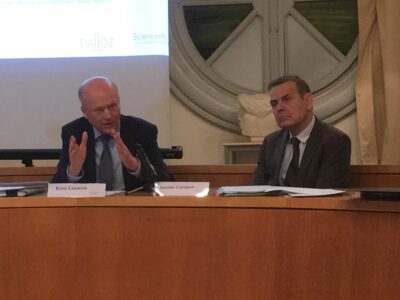
Among all the things that were important to remember, one of the things that struck me most in the extraordinary conference of the President of the Court of Justice of the European Union Koen Lenaerts on "Europe of the Compliance "held on March 2, 2018 was his ability to make" live Europe ". Not only to make it understand but also to make it "live". Here is the challenge: that compliance is not an accumulation of processes without reason and without flesh, but a living whole taking its meaning into consideration of the human being, a person whose judge is concerned. On 2 March 2018, Koen Lenaerts therefore came to an amphitheater at the University Panthéon-Assas (Paris 2) to inaugurate the series of conferences organized by the Journal of Regulation & Compliance (JoRC), a cycle that has the general title: Pour une Europe de la Compliance (For the Europe of Compliance). The School of Public Affairs of Sciences Po, the Department of Economics of Sciences Po, the Ecole doctorale de droit privé  (Doctoral School of Private Law) at the Université Panthéon-Assas- Paris 2 (Panthéon-Assas University – Paris 2) and the School of Law of the University Panthéon-Sorbonne (Paris I), are associated with this cycle. Many personalities will take the floor. Presented by Professor Thierry Bonneau, the conference made by President Koen Lenaerts was extremely rich and solid, perfectly constructed. Everyone had known the quality of the conference to be delivered by the President of the CJEU. The content of his demonstration will be found in the article he will give for the book that will be published in the Régulations & Compliance Series edited by Marie-Anne Frison-Roche at Éditions Dalloz. And the reader will find all the strength of this demonstration. This is necessary to venture into this area of "Compliance" : Koen Lenaerts recalled that we were still looking for the definition and a French term that would do justice to a satisfactory definition1Frison-Roche, M.-A., Compliance Law, 2016.. This question was echoed by Antoine Garapon in his discussion. Embodying the firmness that must be shown when words are uncertain, President Koen Lenaerts emphasized that the European Union is based on "Rule of Law". This means that the behaviors must respect Law. For that, – and that is why it is necessary to take in the literal sense the English expression "to comply with", the enterprise must not be passive but to make sure that its behavior is actually respectful of legal prescriptions. In this, there is a general paradigm shift, which inverses the relation betwenn the operator and the rules, from the Ex Post to the Ex Ante2On this passage, which internalises the "Regulatory Law" in the company, c. not. Frison-Roche, M.-A., From Regulation Law to Compliance Law, 2017, and the book, Régulation, Supervision, Compliance (Regulation, Supervision, Compliance), 2017.  as the entreprise has to be itself active to secure the effectiveness of the rule of Law. This internalization of the rule by the company develops both a procedural culture and a behavioral culture, in which companies can express an ethical dimension and build a "Trust Pact" 3About this notion, s. Frison-Roche, M.-A., Compliance and Trust, 2017 ; Drawing the Circles of Compliance Law, 2017. with states and public authorities. This change has been brought about by globalization, since states no longer have the means to impose ethical norms of behavior on businesses through the Ex Post intervention of their jurisdiction, but States like companies are gaining the benefit of this internalisation of rules in compagnies because the Compliance is inseparable from the accountability by which the company is compelled to justify that it actually tends to achieve the overall goals assigned by the public authority. Thus, after exposing the general movement by which Europe opened up to this upheaval, President Koen Lenaerts took on three technical dimensions crossed by this new conception. The first is the Financial Markets Law. The second is Competition Law, about which the President has notably developed the Court's reflections on whether the adoption of a compliance program by an enterprise found to have violated Competition Law, in particular by "negligence" is neutral, or constitutes a mitigating circumstance or constitutes an aggravating circumstance. This question was taken up after the presentation in the discussion with the room. The third is that of personal data. Taking again as in a waltz with three times his remarks, the president of the Court of Justice found that the compliance, whereas it consists in transforming the Ex Post into Ex Ante becomes juridicalised and in this the Court of justice holds its not only in Europe but also in relation to the world, without however ever forgetting that it is the States that are drawing up the rules that are the foundation of Europe. We will find in the article that will be published all these precious elements and no doubt that the elegance of the pen will be equal to that of speech. But, written exercise requires, the reader will not find what we had the chance to attend: the story of two cases by the one I would prefer to name the "Professor Koen Lenaerts". Two famous cases, which we teachers, comment and remind in our courses, that students learn and recite, quote in their copies. But never that way. The first case is the Schrerms case, where the court said that Facebook could not transfer this person's personal data to the United States since he was opposed to it. To make it clear, the President revived it through the litigant, who was a student and for this reason he spoke directly to the students present in the amphitheater. He pointed out that the plaintiff at the origin of the case was a law student, like them. He detailed his situation in Austria, making some quotes in perfect German, pointing out that this student was now at the doctoral stage, inviting students to be brave, as he was. At each episode of the story, the speaker told the students, making some detours on his own student life because finally we were all in family … Alma Mater. But his hands were telling the story even more: they were thrown themselves into the story, they brewed the space, it seemed as if they themselves were no more grandiloquent than the speaker but found their place exactly , in a magisterial position. Yes, here is a president in front of which companies have a hard time hiding the truth, a president with such firm hands and whose torso does not move but turns to the left and right to talk to everyone. The second story was even more beautiful. The Google Spain case, I know it. I even know it by heart. I read it, commented on it, cited it a lot of times … But all of a sudden that's what happened to a small Spanish merchant: President Koen Lenaerts told us his story, and I rediscovered the case. A small Spanish shopkeeper, whose name the speaker uttered in perfect Spanish, obtained from the Court of Justice that his "right to be forgotten" was recognized. President underlined the apparent paradox of his  insistence for the appearance of his surname in the judgment by which this person had thus obtained the erasing of his surname! Yes, I did not notice … Why did he ask for the mention of his name in the right to have his name deleted? Because it's a matter of honor. This is what the speaker insisted: do not joke with honor. And if you do, even Google will lose. The merchant had been subject to a forced property sale procedure because of financial difficulty, which spanish newspapers had echoed. His honor was been trampled. Then, by a happy return of fortune, he had recovered his property, his prosperity, his reputation. But from that, the press had not talked about it. Some lines in a newspaper of legal announcements, but that it is nothing for the human soul. That's why he wanted these mechanical digital links to disappear, which always and for all end up with articles presenting him as a wretch without ever ending up with articles presenting him as a prosperous merchant (because of the non-existence of these second articles). The speaker emphasized this dimension very much. And we know that the General Regulations that will come into force in May 2018 on personal data, which intrigues so much the Americans, draws in the judgment Google Spain its main solution in the matter: this "right to be forgotten" , subjective right so strange. He emphasized this dimension very much. And we know that the General Regulations that will come into force in May 2018 on personal data, which intrigues so much the Americans, draws in the judgment Google Spain its main solution in the matter: this "right to be forgotten" , subjective right so strange. Listening to President Koen Lenaerts, how not to think of Carbonnier? to  his articles of it, especially on sociological rule : "small causes, great effects"? From this conference, it will remain a great article, but as in the theater, where the ephemeral is part of the beauty of this art, what were these two stories, told by the one who knew how to listen when it was necessary to decide the two cases, stories told with the two firm hands that danced inviting students to enter this round, even as the President of the Court of Justice had to leave immediately to Luxembourg to hold such heavy obligations, yes it was simply beautiful .    

Breaking news

In the inaugural conference on “Europe of Compliance, Antoine Garapon highlights strengths and weaknesses of Europe

On 2 March 2018, Koen Lenaerts came to an amphitheater at the University Panthéon-Assas (Paris 2) to inaugurate the series of conferences organized by the Journal of Regulation & Compliance (JoRC), a cycle that has the general title: Pour une Europe de la Compliance (For the Europe of Compliance). The School of Public Affairs of Sciences Po, the Department of Economics of Sciences Po, the Ecole doctorale de droit privé  (Doctoral School of Private Law) at the Université Panthéon-Assas- Paris 2 (Panthéon-Assas University – Paris 2) and the School of Law of the University Panthéon-Sorbonne (Paris I), are associated with this cycle. Many personalities will take the floor. They will give contributions for the book that will be published in the Régulations & Compliance Series edited by Marie-Anne Frison-Roche at Éditions Dalloz. After an admirable lecture offered by Koen Lenaerts, Antoine Garaponfootnote-941Notably author of  Deals of Justice. , secrétaire générale de l'Institut des Hautes Études pour la Justice (Secretary General of the Institute of Higher Studies for Justice), reacted perfectly in "premier discutant", stressing as everyone his great interest in listening to the demonstration made by the President of the Court of Justice. He felt that it was hardly possible to speak of "Compliance Law"2Contra Frison-Roche, M.-A., Le Droit de la Compliance, 2016., because it is above all a Law that ceases to be "prescriptive" to become "relational" ", companies organizing themselves to put goals that are reached in relation with the public authorities. Companies thus develop a "systemic Law" that develops on its own, with alert mechanisms put in place directly by companies that care before the continuity of their economic activities. The notion of third parties disappears, a sort of "direct government" takes the place of the "indirect government" represented by the "third party", the companies having integrated this third party into their own organization, which upsets their relation to time and puts in place a "metajuridic" system. Antoine Garapon then asks the question of how such a "conversion" could take place, that is to say, this transition of control systeme from the Ex Post mode to the Ex Ante, resulting in companies internalize the task of effective rules3On this path from Ex Post to Ex Post , v. Frison-Roche, M.-A., From Regulation Law to Compliance Law, 2017.. He believes that on the one hand, the system that advocates it has the "market power to impose it and, on the other hand, those who demand it in this system make a" vision of the world "explicit. Antoine Garapon adds the need for a "moral ambition". However, Antoine Garapon pointed out the United States have met these three conditions. In his discussion, Antoine Garapon, on the other hand, felt that Europe did not bring them together and that Europe "starts with a handicap", because it does not consider worlwide, because it has no vision of the world, because it has not operated on moral integration. He insisted that the Court of Justice can carry these three conditions, especially with regard to personal data. Because this is about the digital that Europe has a market power. It is about personal data that the Court of Justice is the place where Europe is both a market and values4On this perspective, s. not. Frison-Roche, M.-A. (dir.), Frison-Roche, M.-A. (dir.), Internet, espace d'interrégulation, 2017.. This is why the Court of Justice of the European Union does have a central role for this construction. -   These very constructed, very instructive remarks of Antoine Garapon, thanks to him, perfectly showed, in mirror of the conference of the President of the Court of Justice, the stake: the future. Beyond the disputatio around the definitions, it is indeed the question of whether or not Europe will build its own compliance mechanisms. By finding a vocabulary of its own. Not only in French, because the Law is made of words, but also with new words, which leave us "translated-glued" and which will carry European ambitions, as it was the case for the "right to be forgotten" ", very often quoted in the discussion. Of course, this presupposes "power". But we must already pretend. And the Law has always claimed to pretend. It is in this that it is an Order. This is probably why President Koen Lenaerts insisted on the "juridicization" of compliance, as does the hand of Law that arises on an object.    

Working papers

🚧 Compliance : before, now, after

This working paper serves as a support for the article to be published in the book written in French, Ingall-Montagnier, Ph., Marin, J.-Cl., Roda, J.-Ch. (dir.), Compliance : l'entreprise,le régulateur et le juges, in the Serie Regulations, co-edited by Éditions Dalloz and the Journal of Regulation and Compliance (JoRC). This work uses by links the Compliance and Regulation Law bilingual Dictionnary. - Summary. We have to admit it. Because in front of so numerous and so disparate Compliance rules we pain so much to figure out, we are constraint to go in so changing directions, that we console ourselves with their weight, their cost and our misunderstanding by affirming that Compliance is "complex" and "transdisciplinary", as if complicated words could mask our disarray. But "Compliance" is not a cataclysm, a bomb sent by the Americans to annihilate Europe, the new form of a Cold War in legal dress, it is a way of seeing things that comes from afar, with its own coherence and which must first be understood. If one understands where this new corpus comes from, which now obliges companies to prove that they effectively take on the fulfillment of certain goals that go beyond them, notably the fight against money laundering, tax evasion, but also the fight against the sale of human beings or the struggle for the preservation of nature and Earth, then we can continue the story. Indeed, not all companies are targeted by such internalization of "monumental goals" within them." An ordinary firm is destined to develop itself in order to achieve a goal which is its own. The concern of these goals can only be for the "crucial firm. "If there is to be a change in the corporate project, then it can only depend on its" position "in a system, a financial, economic, social, global system, or because it has itself decided that it would be so. The company then bears the burden of proof that such a discourse of new responsibility corresponds to a behavior and an effective culture. The weight of the rules already exists today. And it is for the moment that now, in a negative and passive way, Compliance is perceived, by those who "undergo" it (companies), even by those who apply it (public authorities). The transformation towards a "culture of trust" is the issue between today and tomorrow, because tomorrow, it is a relationship of trust that could be built between these companies and the public authorities, because they would share information (systemic issue), because they would agree on the less technical monumental goals (protection of human beings issue). In this perspective, "Compliance" is above all a bet, that of the place of human beings in globalized markets.

Articles in a legal collective publication

Compliance et confiance

Articles

La compliance a-t-elle une valeur ?

Full reference : Augagneur, L.-M., La compliance a-t-elle une valeur ?, JCP E, n° 40, 5 octobre 2017, p. 1522. Sciences Po students can read the article via the drive, folder "MAFR-Régulation & Compliance".

Publication director

🏗️ copublishing and direction of the collection: 📚Régulations & Compliance

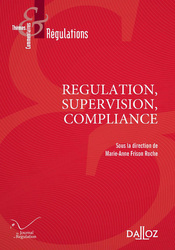
Publication of 🕴️M.-A. Frison-Roche (ed.), 📕Régulation, Supervision, Compliance (Regulation, Supervision, Compliance)

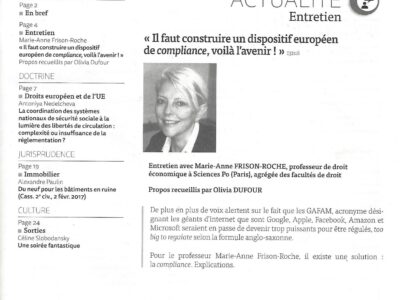
► Full Reference: M.-A. Frison-Roche (ed.), Régulation, Supervision, Compliance (Regulation, Supervision, Compliance), Dalloz, coll. “Thèmes & Commentaires”, “Régulations” Serie, 2017, 148 p. - ► General presentation of the book: Regulation. Supervision. Compliance. Three terms that until recently were virtually unknown in legal systems. Or at least considered to be peculiar to Anglo-American legal systems: Regulation, Supervision, Compliance. These terms are like Trojan horses through which Common Law is taking over our legal traditions to make European companies, especially banks, bend over backwards, take over institutions and impose methods. Three words by which the invasion is carried out. Through the violence of repression and compliance penalties, through the mildness of codes of conduct and corporate social responsibility. By laws as new as they are strange, such as the French so-called “Sapin 2” law or the French law introducing a “duty of vigilance” for companies whose fault would be to have succeeded in expanding internationally. One can have this defensive conception of Compliance, generating a “Compliance Law”, produced by the internalisation of Regulatory Law in global economic operators, who are then subject to supervision by Regulators, even though these firms are not regulated, with Compliance extending beyond the supervised sectors (banks and insurance companies). We can (and maybe must) have a more welcoming, and therefore more offensive, conception of Compliance. It can be the crucible of a relationship of trust on a supra-national scale between these operators and the regulators, the former being able to contribute, like the latter, to serving goals that go beyond them all, of which the fight against corruption and money laundering are but a few examples. In this way, the issue is the construction of the European Compliance Law. - 📝read the interview given by Marie-Anne Frison-Roche to the Petites Affiches, “We need to build a European compliance system – that’s the future! ire l’entretien donné par Marie-Anne Frison-Roche aux Petites Affiches ,“Il faut construire un dispositif européen de compliance, voilà l’avenir !” (“We need to build a European Compliance System – that’s the Future!”), about the publication of this book (in French) - 🧮This book follow a cycle of conférences organised in 2016 by the Journal of Regulation (JoR) in collaboration with the École d’Affaires Publiques and the Département d’Économie of Sciences Po (Paris), under the scientific direction of Marie-Anne Frison-Roche, Director of the Journal of Regulation (JoR) - This volume is the continuation of the books dedicated to Compliance in this collection. ► Read the presentations of the other books in the series: the following books: 🕴️N. Borga, J.-Cl. Marin and J.-Ch. Roda (eds.), 📕Compliance : l’entreprise, le régulateur et le juge, 2018 🕴️M.-A. Frison-Roche (ed.), 📕Pour une Europe de la Compliance, 2019 🕴️M.-A. Frison-Roche (ed.), 📕Les outils de la Compliance, 2021 🕴️M.-A. Frison-Roche (ed.), 📕Les Buts Monumentaux de la Compliance, 2022 🕴️M.-A. Frison-Roche (ed.), 📕La juridictionnalisation de la Compliance, 2023 🕴️M.-A. Frison-Roche and M. Boissavy (eds.), 📕Compliance et droits de la défense. Enquête interne – CJIP – CRPC, 2024 🕴️M.-A. Frison-Roche (ed.), 📕L’Obligation de Compliance, 2025 🕴️M.-A. Frison-Roche (ed.), 📕Compliance et Contrat, forthcoming 🕴️L. Laref (ed.), 📕Compliance et vigilance bancaire, forthcoming 🕴️M.-A. Frison-Roche, 📕Le système juridique de l’adressage de l’Internet. Une structure multi-acteurs, gage de durabilité (The Legal System of Internet Addressing. A Multi-Stakeholder Structure, the Pledge of its Sustainability), forthcoming 🕴️M.-A. Frison-Roche (ed.), 📕Le système probatoire de la Compliance, forthcoming   the previous books: 🕴️M.-A. Frison-Roche (ed.), 📕Internet, espace d’interrégulation, 2016 📚Read the presentations of the other titles of the Serie. - 🏗️General construction of the book:  Consulter le sommaire de l’ouvrage. - ► Understand the book through the Table of Contents and the summaries of each article:  🕴️M.-A. Frison-Roche, 📝Du droit de la régulation au droit de la compliance   I. AUTOUR DE LA NOTION DE COMPLIANCE (AROUND THE NOTION OF COMPLIANCE) 🕴️B. de Juvigny, 📝La compliance, bras armé de la régulation 🕴️I. Falque-Pierrotin, 📝L’Europe des données ou l’individu au coeur d’un système de compliance 🕴️B. Lasserre, 📝Concurrence et bien public 🕴️J.-M. Sauvé, 📝Compliance, droit public et juge administratif 🕴️J.-Cl. Marin, 📝Droit pénal et compliance   II. CHOCS ET ACCLIMATATION DE LA COMPLIANCE DANS LE SYSTÈME JURIDIQUE (SHOCKS AND ACCLIMATISATION OF COMPLIANCE IN THE LEGAL SYSTEM) 🕴️D. Migaud, 📝Le nouveau rapport entre l’État et les normes impliquées dans la compliance 🕴️A. C. Bénichou, 📝Nouvelles technologies : réflexions sur la compliance et l’éthique 🕴️J.-M. Darrois, 📝La loi Sapin II : un défi pour les avocats 🕴️Y. Perrier, 📝“Diplomatie” de la compliance et de sa régulation   III. LES DIALOGUES OUVERTS PAR LA COMPLIANCE (DIALOGUES OPENED UP BY COMPLIANCE) 🕴️J.-B. Auby, 📝Le dialogue de la norme étatique et de la compliance 🕴️L. Donnedieu De Vabres, 📝Pas de compliance sans confiance 🕴️J. Bédier, 📝La compliance, un outil actif de développement de l’entreprise  🕴️A. De La Cotardière, 📝Le rôle de l’avocat en matière de compliance - 🌐follow Marie-Anne Frison-Roche on LinkedIn 🌐follow Marie-Anne Frison-Roche on Instagram 🌐subscribe to the Newsletter MAFR Regulation, Compliance, Law

Articles in The Journal of Regulation & Compliance « JoRC »

JUVIGNY, Benoît de🕴️

📝La compliance, bras armé de la régulation financière, in 🕴️M.-A. Frison-Roche (ed), 📕Régulation, Supervision, Compliance

► Full Reference: B. de Juvigny, "La compliance, bras armé de la régulation financière" ("Compliance, the arm of financial regulation"), in M.-A. Frison-Roche (ed.), Régulation, Supervision, Compliance, Dalloz, coll. "Thèmes & Commentaires", "Régulations" Serie, 2017, pp. 17-28 - 📕read a general presentation of the book, Régulation, Supervision, Compliance, in which this article is published - ► English summary of the article (done by the Journal of Regulation & Compliance – JoRC):  - 🦉This article is available in full text to those registered for Professor Marie-Anne Frison-Roche's courses -

Articles in a legal collective publication

Le dialogue de la norme étatique et de la compliance

Full reference : Auby, J.-B., Le dialogue de la norme étatique et de la compliance, in Frison-Roche, M.-A. (dir.), Régulation, Supervision, Compliance, Série Régulations, Dalloz, 2017.   Read the General presentation of the book in which the article is published.   Read the other books of the sérieux in which the book is published   Sciences Po Students can read the article via the Drive, folder "MAFR-Régulation"

Working papers

🚧Drawing the Circles of Compliance Law

This working paper is the support for the article to appear in the collective book  dedicated to our very dear friend and colleague Philippe Néau-Leduc. It uses the Bilingual Dictionary of the Regulatory and Compliance Law. Compliance Law has the same teleological functioning as the Economic Law to which it belongs, which consists in placing the normativity of rules, decisions and reasoning in the aims pursued. Once we know what the goals of compliance techniques are, then we know who should be responsible for them, who must be subject to them, who must activate the rules: compliance rules must be activated by those who are in the best position to achieve the outcome in order to achieve the goal sought by the authority which designed the compliance mechanism. The "circles" are thus plotted in a rational and pragmatic way. That, all of it ("useful effect"), but not beyond that. The notion of efficiency does not always imply balancing: on the contrary, it can involve drawing circles which designate those who are "placed" to carry the burden of the rules because they are capable of producing them the desired effects. Within these circles, the rules must apply without restriction and without compromise, but they must not apply beyond these circles. Drawing such circles requires defining the Law of Compliance itself, since on the one hand the choice of those who must implement the Compliance depends on the aims of the Compliance and on the other hand the definition of the Law of Compliance is itself teleological in nature. This is why, contrary to the assertion that the exercise of definition would be useless in these matters, which would be above all on a case-by-case basis, this effort to define and determine the purposes is, on the contrary, necessary in practice to show which enterprise must bear the obligations of compliance and which must not. But it is enough to have posed this to reveal the major difficulty of the Compliance, that explains resistances, and even gives the impression that one is confronted with an aporia. If, as a matter of principle, what is expected of the "users" of the Compliance mechanisms must be articulated to the aim that is affected by the authors of the compliance mechanisms to them, we must have a minimum correspondence between the aims of these authors (Legislators and Regulators) and the aims pursued by those who are responsible for implementing them: companies. However, this correspondence does not exist at first sight, because the compliance mechanisms are found to be uniquely based on "monumental goals" which the public authorities have a legitimate concern, whereas companies have for their own interest . The two circles do not match. The internationalization of concern for these aims in companies would therefore be only a mechanism of violence of which enterprises are the object, violence felt as such. (I). To resolve this violence, it is better to stop confusing the State and enterprises, whose goals are not the same, and draw the circle of subjects of law "eligible" for Compliance. It is highly legitimate to target certain entities, in particular this category of companies, which are the "crucial operators", in a binding way, as it is legitimate to govern companies that have expressed a desire to surpass their own interests. These circles of a different nature can overlap on a concrete operator: for example, if a bank – alway a crucial operator that is structural because it is systemic – is also international – a crucial operator because of its activity – decides to worry about others by commitments verified by the authorities to overcome their own interest (social responsibility), but these different circles are not confused. In any case, companies may belong to only one circle, or even belong to none. In the latter case, they must therefore remain beyond the reach of the pressure and cost of Compliance Law, in particular because they are not objectively required to realize the "monumental goals" aimed at effectiveness and do not want it: in a liberal system, it is for the public authorities to aim at the general interest, the ordinary people indirectly participating in it by paying the tax. (II). It is by making these "Compliance Circles" of eligible subjects of this specific Law to implement the heavy but justified and controlled burden of Compliance with regard to the monumental goals that this new system  aims, that then opens a royal way in order to find a uniqueness and to increase the "monumental function" of the Compliance Law by a relation of Trust towards the global general interest, rather than the mechanical application of rules whose meaning is not understood and whose perception is no longer perceived than violence.

Conferences

The functions of Compliance. A political choice to do

Reférence complète : Frison-Roche, M.-A., Les fonctions de la Compliance. Un choix politique à faire ("The functions of Compliance. A political choice to do"), in  Borga, N. et Roda, J.-Ch. (dir.), La compliance : nouveaux enjeux pour les entreprises, nouveaux rôles pour les juristes ? ("Compliance: new challenges for companies, new roles for lawyers?"), Centre du Droit de l'entreprise Louis Josserand, Université Lyon IIII Jean Moulin, France, Lyon, 2 juin 2017. Read the program (in French) Summary of the conference : Compliance mechanisms are being constituted in "Compliance Law", new branch of Economic Law. Its functions are determined by the goals. But the goals are "monumental", since it is nothing less than the end of corruption, trading in influence, arms trafficking, international terrorism, trafficking in human beings, selling of human organs, the effective safeguard of environmental protection, safeguarding the planet, access to culture for all, preservation of civilization, the effectiveness of human rights … The goals of a company are not a priori of this order, even if every firm understands that it is clever to appear amiable. By comparing the two types of goals, a difference of nature is measured. By the Compliance Law, companies are therefore invited to "get out of themselves. Consequently, the functions that shape the contours of Compliance Law transform those who are the "subjects of law", the enterprises: these are the subjects, insofar as they are agents of legality. But this can not be the case for all companies. If the effect of Compliance were to be generalized to all companies, this would be catastrophic and would make no sense. However, who firmly and precisely drew the circle of "legal subjects eligible to be the legality agent" of Compliance? With the considerable costs and responsibilities that go with it? If it has not been the Legislator, it will have to be the Judge. Because the judge is guardian of the spirit of Law and guardian of legal orders. Especially if it is a global legal order. - Moreover, companies are not only passive subjects of Compliance Law – which would be the case of a misunderstood Compliance Law – but are also active subjects of Compliance Law. Indeed, these "monumental goals" which draw the functions of the Compliance are exactly the same as those of the Corporate Social Responsibility. Thus, if the Compliance is conceived of only as an immense and empty submission of all undertakings to total regulation, the result will be an opposition between the regulatory power and the will of undertakings, a concrete opposition between public authorities and companies. If, on the other hand, we conceive Compliance Law as that by which "crucial enterprises" like the Regulators are moving towards the realization of "monumental goals, then Compliance Law crystallizes a" Trust Pact""between the two, Which goes beyond the borders and becomes a means of regulating globalization. This second conception is the future of European Law. -   See the slides (in French). Read the working paper on which the conference is based (working paper in English)

Conferences

Is the contract the optimal instrument of CSR?

Reference : Frison-Roche, M.-A., Le contrat est-il l'instrument optimal de la RSE ? ("Is the Contract the optimal instrument of CSR?")  in Trébulle, F.-G. (modérateur), Les instruments de la RSE : le contrat (The instruments of CSR"), cycle of conferences organized by the Cour de cassation (French Civil Supreme Court and the Universities of Paris-Dauphine, Paris VIII and Paris I),Cour de cassation, Paris, 11 mai 2017. Read the slides (in French) as served as the basis of the conference les slides Read the program on the Cour de cassation  wesite (in French). Read the program of the whole cycle of conferences in which this conference enters (in French)   Corporate Social Responsibility belongs to Economic Law. It thus enters into its logic of efficiency, leading to apprehend any legal mechanism as an instrument, the contract as the others. This does not mean that everything is only an instrument, on the contrary. Economic Law, when it takes the form of Regulation Law, places the principles in the aims pursued. It is in these principles that it can meet CSR if the goals are the same. In view of these aims, everything is an instrument. On the scale of goals which are "monumental"1On this notion of "Monumental Goal", see Frison-Roche, M-A., Compliance Law, 2016 ; From Regulation Law to Compliance Law, 2017., in that they are global, in that they seem unattainable, such as the fight against child labor, such as the end of corruption or the sale of human beings, all legal instruments become interchangeable, from the Constitution to the contract, from the hard law to the soft law. The only criterion becomes efficiency to achieve the goal. We then reach the efficiency, criterion of the Regulation Law. New laws, such as in France in 2016 the Sapin 2 law or in 2017 the law establishing a "duty of vigilance" with uncertain contours, may use the contract only as a vehicle for legal obligations to be performed by the company2For a whole demonstration, see Frison-Roche, M.-A.,From Regulation Law to Compliance Law, 2017.. The contract becomes an instrument of the Compliance Law, chosen as the optimal instrument of the Internalized Regulation Law in the company. But the contract can also be chosen as an instrument by the company in that it pursues the same goals of general interest, becoming global3On this notion of "global general interest", and maybe of "global public service", see Frison-Roche, M.A., From Regulation Law to Compliance Law, 2017 .. The contract is then chosen as an Ex Ante tool, which will be refined to the specificity of the company, exceeded the generality of the law and which will be able to resolve the diversity of national laws by more comprehensive contractual relations. Moreover, the contract can integrate active Ex Post mechanisms, such as the warning launcher or the controller, audits, or even form an ecosystem by training clauses to disseminate a CSR culture. By these contractual provisions, the contract operates the mixing of times, the Ex-Ante and the Ex Post, which the legislation can not do, refines it to what the particular enterprise is . In this, the contract converges towards what is being constructed: a Compliance Law.