Compliance Law

Working papers

🚧The deployment of Regulatory Law through Compliance Law in the European project

🌐follow Marie-Anne Frison-Roche on LinkedIn 🌐subscribe to the  Newsletter MAFR Regulation, Compliance, Law - ► Full Reference: M.-A. Frison-Roche, The deployment of Regulatory Law through Compliance Law in the European project, Working Paper, July 2023. - 📝this Working Paper is the basis for the article "Le déploiement du Droit de la Régulation par le Droit de la Compliance dans le projet européen" ("The deployment of Regulatory Law through Compliance Law in the European project"), which is part of the special issue La régulation par la compliance, perspective européenne, published in French by the Revue des affaires européennes (Law and European Affairs). - ► Summary of this Working Paper: Compliance Law is neither a method of obeying regulations, nor a simple neutral method of ensuring the effectiveness of norms, nor a means of enforcement displaced from Ex Post to Ex Ante.  It is an extension of Regulatory Law and goes beyond it. Like it, it aims to build spaces according to a political project specific to an area, such as Europe. Branch of Law looking to the future as Regulatory Law does, it constructs and maintains, in a systemic way, sustainable, albeit unstable, balances to achieve the 'Monumental Goals' in which its normativity resides: : security, sustainability, probity, truth, and dignity. By internalising these Monumental Goals in the companies in a position to achieve them, the "crucial companies", Compliance Law preserves the logic of Regulatory Law, offering it a prodigious expansion since it frees it from the condition of a sector and territorial borders, which seemed tautological, by associating private powers and public will, which remains primary. In this way, Compliance can regulate the digital space and climate issue through political choices made by a sovereign Europe. -   🔓read the developments below⤵️

Breaking news

💬Compliance : les cours suprêmes s’emparent de la question de ses enjeux juridictionnels (Compliance : the Supreme Courts take up the issue of its jurisdictional implications)

🌐follow Marie-Anne Frison-Roche on LinkedIn 🌐subscribe to the Newsletter MAFR Regulation, Compliance, Law  - ► Full Reference:  M.-A. Frison-Roche et A. Seban, "Compliance : les cours suprêmes s’emparent de la question de ses enjeux juridictionnels" ("Compliance : the Supreme Courts take up the issue of its jurisdictional implications"), interview with Olivia Dufour, Actu-Juridique, 5 July 2023. - 💬read the interview (in French) - ► Presentation of the interview by the journal (in French): "Le 2 juin dernier s’est tenu au Conseil d’État un colloque fondateur sur le rôle du juge dans la compliance. Le professeur Marie-Anne Frison-Roche et le conseiller d’État Alain Seban, qui ont tout deux contribué aux débats, ont accepté de commenter les principaux enseignements des travaux de cette journée." - ► Questions asked (in French):  Le colloque « De la régulation à la compliance, quel rôle pour les juges » qui s’est tenu au Conseil d’État le 2 juin dernier a rassemblé juges civils et administratifs. En quoi le juge administratif est-il concerné par la compliance qui semble plutôt une affaire d’entreprises et donc de justice civile et commerciale ?  ​Vincent Vigneau, président de la chambre commerciale de la Cour de cassation rappelle que la compliance a plutôt vocation à éviter le juge en se situant ex ante, pourtant on découvre que le juge lui-même accepte de plus en plus de se prononcer en ex ante… qu’en est-il ?  Quel peut donc être le rôle du juge dans la compliance ? Peut-il contribuer à faire émerger un droit de la compliance et à l’harmoniser ?  ​ ​François Ancel semble considérer que le rôle juge va devoir adapter son office à la compliance, il évoque trois concepts : téléologique, soutenabilité et efficacité… Le juge dispose-t-il en l’état de tous les outils nécessaires ? Si tel n’est pas le cas, que faut-il créer ? En quoi le dialogue des juges, civil/administratif, national/européen, national/international, est-il important ? Que veut dire F. Ancel quand il déclare que le juge doit évoluer du constat à la trajectoire ? Existe-t-il des domaines où la compliance entre en conflit avec des principes processuels, par exemple le principe de légalité des peines ? En quoi la notion de « buts monumentaux », que vous avez créée en 2016, a-t-elle trouvé sa place dans le droit ? -

Conferences

🎤Participation in the panel “Vigilance (due diligence)”, in 🧮150th Anniversary Symposium of the ILA/ADI

🌐 follow Marie-Anne Frison-Roche sur LinkedIn 🌐subscribe to the Newsletter MAFR Regulation, Compliance, Law  - ► Full Reference: M.-A. Frison-Roche, participation in the panel "Vigilance (due diligence)", in International Law Association (ILA), 150th Anniversary Symposium of the ILA/ADI, Paris, 19 June 2023. - 🧮See the full programme of this event -

Working papers

Working Paper

🚧 Obligation upon Obligation is valid and useful

► Full Reference: M.-A. Frison-Roche, The role of will in the Compliance Obligation: Obligation upon Obligation is valid and useful, Working Paper, June 2023. - 🎤  This working paper was originally drawn up as a basis for the talk, Obligation on Obligation is worth, on the first day of the conference I co-organised:🧮Compliance : Obligation, devoir, pouvoir, culture (Compliance: Obligation, duty, power, culture), on 13 June 2023. - It was subsequently used as the basis for a forthcoming article: 📝La part de la volonté dans l’obligation de compliance : Obligation sur Obligation vaut". in📕L'obligation de compliance, in the collection 📚Régulations & Compliance 📝The role of will in the Compliance Obligation: Obligation upon Obligation is valid and useful, in📘Compliance Obligation, in the collection 📚Compliance & Regulation - ► Summary of this Working Paper: The demonstration of the part played by the entreprises' Will in the Compliance Obligation incumbent on them is carried out in 3 stages. The first stage of the demonstration consists in finding the part played by the free will of companies in their Compliance Obligation by putting an end to two confusions: the first which, within the Law of Contract and Tort itself but also within Compliance Law, splits and confuses "free will" and "consent", which would no longer require freely expressed acceptance; the second, specific to Compliance Law, which confuses "Compliance" and "conformity", reducing the former to mechanical obedience which could exclude any free Will. Having clarified this, the rest of the study focuses on the 2 ways in which a company subject to a Compliance Obligation by compulsory regulations expresses a part of its free Will, which the study expresses in this proposed adage: Obligation upon Obligation is valid, since the legal obligation to which the company responds by the obedience owed by all those subject to the regulations may be superimposed by its free Will, which will then oblige it. The first case of Obligation upon Obligation, studied in a second part, concerns the means by which the compulsory Compliance Obligation is implemented, the company subject to the Monumental Goals set by the Legislator remaining free to choose the means by which the company will contribute to achieving them. Its free Will will thus be exercised over the choice and implementation of the means. This can take two legal forms: Contracts on the one hand and "Commitments" on the other. In the third part, the second case of Obligation upon Obligation, which is more radical, is that in which, in addition to Compliance's legal compulsory Obligation, the company draws on its free Will to repeat the terms of its legal Obligation (because it is prohibited from contradicting it), a repetition which can be far-reaching, because the legal nature (and therefore the legal regime) is changed. The judgment handed down by the The Hague Court of Appeal on 12 November 2024, in the so-called Shell case, illustrates this. What is more, the company's free Will can play its part in the Compliance Obligation by increasing the legal Obligation. This is where the alliance is strongest. The interpretation of the specific and diverses obligations that result must remain that of the Monumental Goals in a teleological application that gives coherence to the whole. - 🔓read the developments below⤵️ - 🌐follow Marie-Anne Frison-Roche on LinkedIn 🌐follow Marie-Anne Frison-Roche on Instagram 🌐subscribe to the Newsletter MAFR Regulation, Compliance, Law  🌐subscribe to the Video Newsletter MAFR Surplomb

Breaking news

📧Message personnel

Conferences

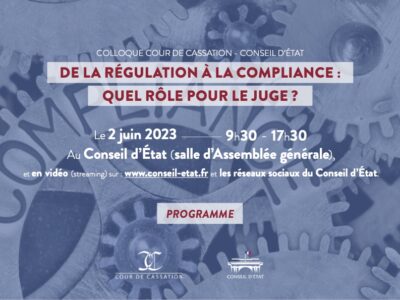
🎥Le rôle du Juge dans le déploiement du Droit de la Régulation en Droit de la Compliance (The role of the Judge in the deployment of Regulatory Law in Compliance Law), in 🧮De la Régulation à la Compliance : le rôle du juge ?

► Full Reference: M.-A. Frison-Roche, Le rôle du Juge dans le déploiement du Droit de la Régulation en Droit de la Compliance (The role of the Judge in the deployment of Regulatory Law in Compliance Law), in Conseil d'État (French Administrative Supreme Court) and Cour de cassation (French Judiciaire Supreme Court of cassation), De la Régulation à la Compliance : quel rôle pour le Juge ? ("From Regulatory to Compliance : what role for the judge?"), speech constituting the "closing session" of the bi-annual joint symposium of the two High Courts, held at the Conseil d'État, Salle d'Assemblée générale, 2 June 2023. The event was held in French. - 🧮See the full programme of this event (in French) - 🎥watch the interview given about the conclusion, done after the speech (in French) - 🧮read the general programme of the manifestation (in French) - 📚read the bibliographical dossier du participant. (participant's file made in French) - 🎥watch the general introductory speechs of Didier-Roland Tabuteau, Vice-Président du Conseil d'État, de Christophe Soulard, Premier Président de la Cour de cassation, and of François Molins, Procureur général près la Cour de cassation ;  and the interventions in the first session devoted to the path from the Regulatory to the Compliance with Marie-Anne Barbat-Layani, présidente de l'AMF, Jean-Yves Ollier, conseiller d'Etat, Daniel Calleja-Crespo, directeur général du service juridique de la Commission européenne andChristine Guegen, , première avocate générale de la chambre commerciale de la Cour de cassation - 🎥watch the speechs in the second session devoted to the office of the judge with  Vincent Vigneau, président de la chambre commerciale de la Cour de cassation, François Ancel, conseiller à la première chambre civile de la Cour de cassatin, Astrid Mignon-Colombet, avocate à la Cour, Lucien Rapp, professeur à Toulouse-Capitol and Alain Seban, conseiller d'Etat ; the speechs of the third session dedicated to the Compliance new frontiers, with Christophe Chantepy, président de la section du contentieux du Conseil d'État, Roch-Olivier Maistre, président de l'Arcom, Paul Nihoul, juge au Tribunal de l'Union européenne, Jean-François Bohnert, procureur de la République financier, Joëlle Tolédano, professeure émérite à Dauphine ; the final session with Marie-Anne Frison-Roche - 🎥watch this final speech by Marie-Anne Frison-Roche, which formed the closing session of the event - 🚧read the bilingual Working Paper used as basis for the article to be published later - 💬read the interview given by Marie-Anne Frison-Roche and Alain Seban after the colloquia and entitled "Compliance : les cours suprêmes s’emparent de la question de ses enjeux juridictionnels" ("Compliance : the Supreme Courts take up the issue of its jurisdictional implications") - ► English presentation of this general conclusion: Having a definition of Compliance Law in mind, a definition around which there still seems to be so much dispute, is not required to understand that this Law is what will enable us to enter and deal with a new world and if this subject is so fascinating to young people who want to become lawyers, prosecutors, regulators or judges, even though they are not taught this subject, it is because they have understood that with Compliance Law they will be able to actively participate in this new world and build it. This is the way we want it to take it, with force and courage in a sort of collective adventure. In this way, the Judges have a monumental role to play, which is at the very heart of Compliance Law. They will necessarily be so because demands and claims will converge on them from all sides, from Internet users, consumers, investors, associations and companies, and the Judge will have to respond. This has already started and is only just beginning. Judges must be prepared. Four expectations are emerging as to what their role should be. Firstly, judges must persist in their role as guardians of the Rule of Law, in a Compliance Law impregnated with technologies (algorithms) that could be described as insensitive. Secondly, beyond this vital role as guardian of the Rule of Law, the Judge has a new role in the extraordinary deployment of Compliance Law, which is measured in terms of the novelty of the normative control it exercises, the commitments it supports, the remedies it finds and the sustainability it reinforces. Thirdly, in the natural space of justice, the judge responds to parties who make claims of compliance, both as plaintiff and defendant, because the causes of compliance are systemic causes that deserve a new jurisdictional treatment. Fourthly, given the novelty and scope of this innovative approach, all judges must converge in terms of content, qualifications, and methods if they are both to continue their traditional role as guardians of the Rule of Law and to be able to endure their new role, a dialogue in which they have so much to contribute to each other. - 🌐follow Marie-Anne Frison-Roche on LinkedIn 🌐follow Marie-Anne Frison-Roche on Instagram 🌐subscribe to the Newsletter MAFR Regulation, Compliance, Law 

Conferences

conference

🎤Conclusions, in 🧮le devoir de vigilance des entreprises : l’âge de la maturité ?

🌐 flollow Marie-Anne Frison-Roche on LinkedIn 🌐subscribe to the Newsletter MAFR Regulation, Compliance, Law  - ► Full Reference: M.-A. Frison-Roche, "Conclusions", in Ch. Maubernard et A. Brès (dir.), Institut de droit européen des droits de l'homme et Centre de droit de l'entreprise, Université de Montpellier, Le devoir de vigilance des entreprises : l'âge de la maturité?("The Entreprises duty of vigilance: the maturity age?") , Montpellier, May 25, 2023. The conference is held in French. - 🧮see the manifestation programme (in French) - 🌐 read the report done on LinkedIn (in French) - ► English summary of this final speech of the manifestation: It is rather difficult to draw a conclusion after listening so many contributions. For three reasons: firstly, because of their richness and extreme diversity; secondly, because of the fact that we do not know whether the duty of vigilance is under the French law of 2017 (known as the Vigilance Law) or in other national, European and international texts or beyond or below the legal rules; thirdly, because we do not know what is meant by the "maturity" of a legal concept. But in the end, since the question posed by the title itself of the colloquium is Duty of Vigilance: the age of maturity? the answer is clearly: no. But this is regrettable. It is therefore essential to explore the ways in which the duty of vigilance can mature.  If we find merit in this duty which has now entered the legal system, there are eight intersecting avenues, which must be exploited. The first path is progression through the passage of time, rediscovering what in the past was already vigilance and what in the future will be its deployment. The second way is to progress by fixing the vocabulary, because we are witnessing a great battle of words, overtly or covertly, in French or English. The third path is progression through the emergence of principles, or even a principle, rediscovered or invented. The fourth path is progression through coherence brought to the legal system(s), which at present suffer from gaps and inconsistencies, which could be remedied by methods such as centralising litigation or, more radically, ignoring borders. The fifth path is progression through the fact that it works, because vigilance techniques are those of Compliance, of which vigilance is the leading edge, and the challenge is to find solutions. The sixth path is progression through using power of the legal system not only to create new areas of relevance – starting with the notion of vigilance, but also that of the value chain – but also to impose new indifferences, namely indifference to the figure of the market (to which laws prefer the company and the value chain) and indifference to borders. The seventh path is progression through bringing perspectives closer together, in order to find solutions even when interests are opposed. This is where the two techniques of contract and mediation are very welcome. The eighth path is progression through culture, because the culture of vigilance, like the culture of compliance, must be developed within companies and supply chains, and must become common to them and their stakeholders. - 🚧read the Working Paper written just after this oral conclusion in preparation for the article to be published. -  

MAFR Chronicles Compliance Law

📚chronique MAFR Compliance Law

📝La loi, la compliance, le contrat et le juge : places et alliances (Regulations, Compliance, Contracts, and Judges: places and alliances”)

🌐 follow Marie-Anne Frison-Roche on LinkedIn 🌐 subscribe to the Newsletter MAFR Regulation, Compliance, Law - ► Full Reference: M.-A. Frison-Roche, "La loi, la compliance, le contrat et le juge : places et alliances" ("Regulations, Compliance, Contracts, and Judges: places and alliances"), Chronique of Compliance Law, D. 2023, pp. 906-908. - 📝read the article (in French) - ► English summary of this article: Compliance Law brings together the forces of regulations, contracts, and judges' decisions to achieve monumental goals so that in the future human beings will not be crushed by systems but will instead benefit from them. In this teleological and systemic branch of Law, legislators, regulators, companies, stakeholders, and judges must find their place. This can lead to bonds of obedience, a vision of 'conformity'. But conformity is only a tool of compliance, whose vigilance is the advanced point of this new branch of Law in which the alliance makes it possible to find solutions, the contract being then a usual mode of elaborating means under the control of the judge. - 🚧read the bilingual Working Paper which is the basis of this article, with additional developments, technical references and hyperlinks - 📚read the other articles published in this chronique of Compliance Law published in the Recueil Dalloz -

Working papers

Working Paper

🚧Use of private companies by Compliance Law to serve Human Rights

► Full reference: M.-A. Frison-Roche, Use of private companies by Compliance Law to serve Human Rights, Working Paper, May 2023. - This Working Paper is the basis of: 🎤a conference done in French in Toulouse on June 16, 2023 📝an article previously written before and for this conference, and subsequently published in the book Puissances privées et droits de l'homme ("Private Powers and Human Rights") - ►Summary of this Working Paper: Following the legal tradition, Law creates a link between power with a legitimate source, the State, public power being its prerogative, while private companies exercise their power only in the shadow of this public power exercised ex ante.  The triviality of Economic Law, of which Competition Law is at the heart, consisting of the activity of companies that use their power on markets, relegates the action of the State to the rank of an exception, admissible if the State, which claims to exercise this contrary power, justifies it.  The distribution of roles is thus reversed, in that the places are exchanged, but the model of opposition is shared. This model of opposition exhausts the forces of the organisations, which are relegated to being the exception. However, if we want to achieve great ambitions, for example to give concrete reality to human rights beyond the legal system within which the public authorities exercise their normative powers, we must rely on a new branch of Law, remarkable for its pragmatism and the scope of the ambitions, including humanist ambitions, that it embodies: Compliance Law. Compliance Law is thus the branch of Law which makes the concern for others, concretised by human rights, borne by the entities in a position to satisfy it, that is to say the systemic entities, of which the large companies are the direct subjects of law (I). The result is a new division between Public Authorities, legitimate to formulate the Monumental Goal of protecting human beings, and private organisations, which adjust to this according to the type of human rights and the means put in place to preserve them. Corporations are sought after because they are powerful, in that they are in a position to make human rights a reality, in their indifference to territory, in the centralisation of Information, technologies and economic, human, and financial means. This alliance is essential to ensure that the system does not lead to a transfer of political choices from Public Authorities to private companies; this alliance leads to systemic efficiency. The result is a new definition of sovereignty as we see it taking shape in the digital space, which is not a particular sector since it is the world that has been digitalised, the climate issue justifying the same new distribution of roles (II).  -   🔓read the full developments below⤵️ - 🌐 follow Marie-Anne Frison-Roche on LinkedIn 🌐follow Marie-Anne Frison-Roche on Instagram 🌐 subscribe to the Newsletter MAFR Regulation, Compliance, Law 

Working papers

Working Paper

🚧The role of the Judge in the deployment of Regulatory Law through Compliance Law

► Full Reference: M.-A. Frison-Roche, The role of the Judge in the deployment of Regulatory Law through Compliance Law, Working Paper, April  2023. - 🎤 This working paper was drawn up to serve as the basis for the concluding summary session of the colloquium organised by the Conseil d'État (French Administrative Supreme Court) and the Cour de cassation (French Judicial Supreme Court), De la régulation à la compliance: quel rôle pour le juge? ("From Regulation to Compliance: what role for the Judge?") held on 2 June 2023 at the Conseil d'État.  - 📝 This working paper also served as the basis for the article that concludes the book De la régulation à la compliance : quel rôle pour le juge, published by the La Documentation Française, 2024. - ► Working Paper Summary: It is remarkable to note the unity of conception and practice between professionals who tend to work in administrative jurisdictions and professionals who tend to work in judicial jurisdictions: they all note, in similar terms, an essential movement: what Regulatory Law is, how it has been transformed into Compliance Law, and how in one and even more so in the other the Judge is at the centre of it. Judges, as well as regulators and European officials, explain this and use different examples to illustrate the profound transformation this has brought about for the law and for the companies responsible for increasing the systemic effectiveness of the rules through the practice and dissemination of a culture of compliance. The role of the judge participating in this Ex Ante transformation is renewed, whether he is a public law judge or a private law judge, in a greater unity of the legal system.   - 🔓read the Working Paper below⤵️ - 🌐follow Marie-Anne Frison-Roche on LinkedIn 🌐follow Marie-Anne Frison-Roche on Instagram 🌐subscribe to the Newsletter MAFR Regulation, Compliance, Law

Articles

📧Face aux clauses de Compliance : le Juge (colloque du 7 avril 2023)

🌐 follow Marie-Anne Frison-Roche on LinkedIn 🌐 subscribe to the Newsletter MAFR Regulation, Compliance, Law  - ► Full Reference: M.-A. Frison-Roche, "Face aux clauses de Compliance : le Juge (colloque du 7 avril 2023)" ("Facing Compliance clauses: the Judge (symposium of 7 April 2023)"), Newsletter MAFR – Law, Compliance, Regulation, 4 April 2023. - 📧Read by freely subscribing other news of the Newsletter MAFR – Law, Compliance, Regulation - Compliance Law is starting to be known; mainly through two blocks: Firstly the spectacular sanctions by which it made as its entry in Europe by the "BNPP sanction" of 2014. 🔴M.-A. Frison-Roche, 📝Le Droit de la Compliance, 2016 Secondly, the accumulation of tools, legal and non-legal, with which companies have equipped themselves: plans to detect and prevent breaches, internal investigations, mapping, ad hoc training, etc. 🔴M.-A. Frison-Roche (dir), 📘Compliance Tools, 2021   But what is the "compliance obligation" in the name of which these fearful and heavy sanctions are pronounced and these new and multiple tools are put in place? We do not have a very clear idea. That is why the Journal of Regulation & Compliance (JoRC) and its partner universities have chosen to focus on the topic of the Compliance Obligation in a series of symposiums held in 2023. 🔴JoRC, 🏗️L'obligation de compliance, 2023   It could be said that the company is "obliged" by Compliance because it is obliged by the Law, as Compliance would only mean obeying "regulations" (a term used to describe everything that is obligatory, from the Constitution to ethical charters, etc.). The English vocabulary "comply with" suggests this, as does the Chinese practice of Compliance. The difference would then only be the fact that the company shows its "stakeholders" that it does in fact respect all these texts that commit it.   But the practice and the jurist remember that what is sometimes considered as the heart of the Law, since Roman Law, is Obligations Law, having as its object Contract Law and Tort Law.   Yet, in practice, companies have put contracts concerning compliance everywhere, and they are relatively little studied. 🔴M.-A. Frison-Roche, 📝Contrat de compliance, clauses de compliance, 2023 These may be entire contracts whose very purpose is to entrust another with the task of fulfilling all or part of the compliance obligation incumbent on the company, with regard to personal data. These may be clauses inserted in contracts with another purpose, for instance sales contracts in a value chain, where the company stipulates that the other company will also ensure compliance obligations for itself or for the other company, e.g. detect and prevent corruption, be vigilant, etc. Contract Law has already taken on compliance in practice, especially in long-term economic transactions with an international dimension. The judge has always been present in Obligation Law.   How is the triangle articulated: Judge – Compliance – Obligation?   The Judge has been present from the outset in the development of the Compliance Obligation through criminal liability, administrative liability and the obligation for the company to become a judge of itself, particularly through internal investigations. 🔴M.-A. Frison-Roche (dir.), 📘Compliance Jurisdictionalisation, 2023   The Judge is also present through Obligation Law stricto sensu, first of all through liability, which is transformed under the effect of the compliance system, which operates more in the logic of "accountability" and generates legal mechanisms of "ex ante liability". 🔴M.-A. Frison-Roche, 📝La responsabilité Ex Ante, pilier du Droit de la Compliance, 2022   In contractual matters, the Judge will intervene, in particular with regard to the stipulations which, in the contracts which form the architecture of the value chains, ensure the efficacy (and no longer only the effectiveness) of the duty of vigilance. The Judge will then intervene under the French law of 2017, known as the "Vigilance Law", 🔴M.-A. Frison-Roche, 🚧Vigilance, Buts Monumentaux de la Compliance et "Société vigilante", 2023 but also, because the Judge is the "judge of the contract", he will intervene as such.   To identify the Obligation of Compliance,  🔴M.-A. Frison-Roche (dir.), 📘Compliance Obligation, 2024 it is therefore necessary to analyse the way in which the Judge apprehends or should in the future apprehend contracts and compliance clauses.   That's why, in the above-mentioned cycle of symposiums, a symposium is being held on 7 April 2023. It is co-organised by the Journal of Regulation & Compliance (JoRC) and the Law Faculty of Perpignan, and has been designed under the scientific direction of Walid Chaiehloudj and Marie-Anne Frison-Roche. 🧮Le juge face aux clauses et aux contrats de compliance (The Judge facing clauses and contrats of compliance) -


Breaking news

💬Colloque : « Avocat et droits de la défense dans les enquêtes internes et la justice négociée »

🌐follow Marie-Anne Frison-Roche on LinkedIn 🌐subscribe to the Newsletter MAFR Regulation, Compliance, Law  - ► Full Reference: M.-A. Frison-Roche & M. Boissavy, "Colloque : « Avocat et droits de la défense dans les enquêtes internes et la justice négociée »" ("Symposium: "Lawyers and rights of the defence in internal investigations""), interview with Olivia Dufour, Actu-Juridique, 3rd April 2023. - 💬read the interview (in French) - ► Presentation of the interview by the journal (in French): "Le Conseil national des barreaux (CNB) organise les 20 et 21 avril prochains un colloque intitulé « Avocat et droits de la défense dans les enquêtes internes et la justice négociée ». Matthieu Boissavy, avocat aux barreaux de Paris et de New York, médiateur et vice-président de la commission Libertés et droits de l’Homme du Conseil national des barreaux et Marie-Anne Frison-Roche, professeure de droit, directrice du Journal of Regulation and Compliance nous expliquent les enjeux de ces nouvelles pratiques judiciaires qui bousculent le rôle traditionnel des acteurs de la justice, qu’il s’agisse des avocats ou des magistrats." - ► Questions asked (in French):  Le CNB organise les 20 et 21 avril prochains un colloque sur le thème : Avocats et droits de la défense dans les enquêtes internes et la justice négociée. Pourquoi ce choix ?​ La compliance n’est-elle pas en train de bouleverser le métier d’avocat ? ​​​ Comment cela se traduit-il en pratique ?​ Quelles sont les implications déontologiques, ne faut-il pas inventer de nouvelles règles ? Qu’est-ce que la CJIP a changé dans le métier d’avocat ? Quels sont les nouveaux risques pour l’avocat ? Cela modifie-t-il les relations entre avocats, parquet et juges du siège ? -