Compliance Law

Reports

BAYROU, François

Électricité: le devoir de lucidité (Electricity: the duty of lucidity)

Full reference: Bayrou, F., Electricité: le devoir de lucidité (Electricity: the duty of lucidity), note n°4 from the Haut-Commissariat au Plan (French government planification agency), 23rd of March 2021, 37 p.   Read the note (in French) Read the summary of the note done by the Haut-Commissariat au Plan on is official website (in French)

Videos

🎤 The Potential of Compliance Law (Les potentialités du Droit de la Compliance)

Full reference : Frison-Roche, M.-A., The Potential of Compliance Law (Les potentialités du Droit de la Compliance), conference given to Muriel Fabre-Magnan's students, Paris I, 17th of March 2021. -   This conference has been designed for Paris I's students following a Law cursus, specialized in Law of obligations and especially in Tort Law.  It therefore aims to show the technical content of Compliance Law and what it can become.  It has been followed by a debate with students.  Summary: Compliance Law is a branch of Law in the process of being born. We can be sure of its existence in the French positive Law, through the technical examination of laws called "Sapin 2" (2016) and "Vigilance" (2017). It appears at radically new. It is the reason why it is perceived as an attack, especially from United-States and we rather use legal knowledge to counter it. But if we study the historical reasons of its adoption in the United-States and the "monumental goals", whether they are negative (what should not appear in the future) or positive (what should appear in the future), we can measure that this Law, which is essentially Ex Ante could be the means through which scattered but legitimate public authorities and powerful but illegitimate big firms could ally. Therefore potentially Compliance Law could be the worst, simple tool of obedience (mechanical "conformité") or the best: what through which we could do something face to global problems, like global warming, or what we would accept to look in the face: the care for others.  Read the slides on which this conference was based (in French)

Jurisprudence

Autorité de Contrôle Prudentiel et de Résolution (French Banking Regulator), Commission des sanctions (Commission of sanctions)

Decision of 24th of February 2021 2021, ING France

Full reference: Autorité de Contrôle Prudentiel et de Résolution (French Banking Regulator), Commission des sanctions (Commission of sanctions), 24th of February 2021, ING Bank France, procedure n°2020-02   Read the decision (in French)   In this decision, the ACPR Sanctions Commission condemns IGN Bank France to a reprimand and a financial penalty of 3 million euros because of the inadequacy of its measures to fight corruption, money laundering and financing of terrorism.   Extract from the decision summarizing ING France's breaches of its Compliance obligations to fight against corruption, money laundering and financing of terrorism: "At the time of the on-site check, ING France's risk classification was incomplete and ineffective (grievance 1) and its system for monitoring its business relations (complaint 2) and their operations (grievance 4) presented serious deficiencies, as well as its organization and procedures for fund transfers (grievance 3). The updating of customer knowledge was insufficient (grievance 5), as were the detection of PEPs and the implementation of measures due diligence for this category of clientele (grievance 6). For the implementation of its due diligence obligations, numerous shortcomings were noted, whether these were breaches of the obligation to carry out a reinforced examination (grievance 7) or breaches of the obligation to send Tracfin a DS, initial (grievance 8) or additional (grievance 9). Finally, the detection of persons subject to an asset freezing measure was not fully effective (grievance 10) " (our translation of the decision which is only available in French).

Videos

🎤 Devoir de vigilance pour les entreprises: vers un droit de la responsabilité ex ante? (Duty of vigilance for companies: towards an ex ante liability law?)

Full reference : Frison-Roche, M.-A., Devoir de vigilance des entreprises : vers un Droit de la responsabilité ex ante ? (Duty of vigilance for companies: towards an ex ante liability law?), conference-debate, The Faculty of Law, University of Oslo, Norway, 9th of February 2021.  The conference-debate is moderated by Catherine Banet, Associate Professor, Scandinavian Insitute of Maritime Law, Department of Energy and Resources Law, University of Oslo

Articles

💬”Let’s Use the Power of GAFAMs in the Service of General Interest!” (“Utilisons la puissance des GAFAMs au service de l’intérêt général!”)

Full reference: Frison-Roche, M.-A., "Let's Use the Power of GAFAMs in the Service of General Interest!" ("Utilisons la puissance des GAFAMs au service de l'intérêt général!"), interview done by Olivia Dufour, Actu-juridiques Lextenso, 11st of January 2021 Read the interview (in French) To read the article translated in English by us, read the working paper on which this interview is based   Summary of the interview by Olivia Dufour: Marie-Anne Frison-Roche, Professor of Regulation and Compliance Law, reported to the government in 2019 about Internet governance. For this expert, giving a disciplinary power to GAFAMs is the only effective solution. And the suppression of Donald Trump's account is not likely to call this analysis into question.   The three questions (translated in English here by ourselves) asked by Olivia Dufour are:  The deletion of Donald Trump's Twitter account arouses strong emotions on social networks, and not only among his supporters. What do you think about this ? However, this incident does raise concern. Are we not giving too much power to these private companies? This raises the question in France of the relevance of the Avia system … Should we therefore resolve by default to give our freedoms to private and opaque mastodons?   Read the answers to these three questions (in French)   To go further, especially about the logics that guide the Avia system, see: Frison-Roche, M.-A., "Hate on internet: we need to responsibilize digital operators" ("Haine sur internet: il faut responsabiliser les opérateurs numériques"), 2020 Frison-Roche, M.-A., The contribution of Compliance Law to Internet Governance, report to Government, 2019

Articles in a legal collective publication

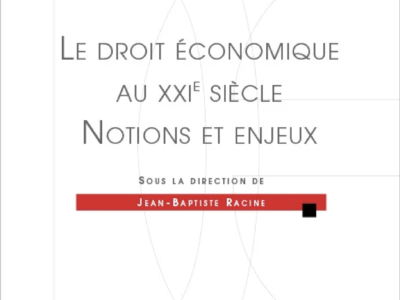
📝La compliance, in 🕴️J.-B. Racine (ed.), 📕Le droit économique au XXIe siècle. Notions et enjeux

► Full Reference: M.-A. Frison-Roche, "La compliance" ("Compliance"), in J.-B. Racine (ed.), Le droit économique au XXIe siècle. Notions et enjeux, LGDJ, "Droit & Économie" Serie, 2020, pp. 97-108 - 📝read the article (in French) - 🚧read the bilingual Working Paper which is the basis of this article, with additional developments, technical references and hyperlinks - 📕read a general presentation of the book, Le droit économique au XXIe siècle. Notions et enjeux, in which this article is published - 📚see the presentation of the other books published in this Serie, founded and directed by Marie-Anne Frison-Roche   ► English Summary of the article:  - 🌐follow Marie-Anne Frison-Roche on LinkedIn 🌐follow Marie-Anne Frison-Roche on Instagram 🌐subscribe to the Newsletter MAFR Regulation, Compliance, Law

Articles

New SEC Report to Congress about Whistleblower Program: what is common between American and European conception

Full reference: Frison-Roche, M.-A., New SEC Report to Congress about Whistleblower Program: what is common between American and European conception, Newsletter MAFR – Law, Compliance, Regulation, 1st of December 2020 Read by freely subscribing other news of the Newsletter MAFR – Law, Compliance, Regulation   Summary of the news Like every year since the adoption of the Dodd-Frank Act, the Securities and Exchanges Commission (SEC) and especially its Office of the Whistleblowers (OWB) handed to the Congress of the United-States a report about the success of its program concerning whistleblowers, especially estimated with the amount of financial rewards granted to them during the year. This report especially presents the amount granted to whistleblowers, the quality of the collected information and the efficacy of SEC's whistleblowers' protection process. If Americans condition the effectiveness of whistleblowing to the remuneration of whistleblowers, Europeans oppose the "ethical whistleblower" who shares information for the love of Law to the "bounty hunter" uniquely motivated by financial reward and favor the former to the later, as it is proven in the French Law Sapin II of 2016 (which do not propose financial reward to whistleblowers) or the British Public Interest Disclosure of 1998 (which just propose a financial compensation of the whistleblower's losses linked to whistleblowing).  However, American and European conceptions are not so far from each other. As United-States, Europe has a real care for legal effectivity, even if, because of their different legal traditions, Americans favor effectivity of rights while European favor effectivity of Law. If it places effectivity at the center of its preoccupations, Europe should conceive with less aversion the possibility to financially incite whistleblowers. Moreover, United-States and Europe share the same common willingness to protect whistleblowers and if rewarding would enable a better protection, then Europe should not reject it, as shows the recent declarations of the French Defenders of Rights. It is not excluded that both systems converges in a close future. 

Articles

💬Facebook: Quand le Droit de la Compliance démontre sa capacité à protéger les personnes (Facebook: When Compliance Law proves its ability to protect people)

Full reference: Frison-Roche, M.-A., Facebook: Quand le Droit de la Compliance démontre sa capacité à protéger les personnes (Facebook: When Compliance Law proves its ability to protect people), interview with Olivia Dufour, Actu-juridiques Lextenso, 23rd of November 2020 Read the interview (in French) Read the news of the Newsletter MAFR – Law, Compliance, Regulation about this question

Jurisprudence

Court of Justice of the European Union

Decision of 18th of November 2020, RyanAir vs DelayFix

Full reference: CJEU, 1st chamber, 18th of November 2020, decision C‑519/19, Ryanair DAC vs DelayFix Read the decision   Summary of the decision This decision of the CJEU of 18th of November 2020 is about the jurisdiction clause for any dispute in air transport contracts, here those of Ryanair. This decision is especially interesting about the question to know whether the professional assignee (collection company) of a debt whose holder was a consumer may or may not avail itself of the consumer protection provisions, canceling the scope of this type of clause.  The Court takes back the criteria and the solution already used in 2019 about a credit contract: the protection applies by the criterion of the parties to the contract and not of the parties to the disputes. Such a clause is effective only if the integrality of the contract is transferred to the professional, and not only some of the stipulations. This Regulatory decision, through "private enforcement", incentivizes consumers to transfer their compensation claim (around 250 euros) to collection companies which, in turn, discipline airlines to stay on schedule.