Compliance Law

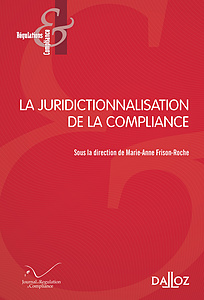
Couverture – La juridictionnalisation de la Compliance

Articles in a legal collective publication

LINDEN, Alexandre🕴️

📝Motivation et publicité des décisions de la formation restreinte de la Commission nationale de l’informatique et des libertés (CNIL) dans une perspective de compliance, in 🕴️M.-A. Frison-Roche (ed.), Collection Régulations & Compliance La juridictionnalisation de la Compliance

► Full Reference: A. Linden, “Motivation et publicité des décisions de la formation restreinte de la Commission nationale de l’informatique et des libertés (CNIL) dans une perspective de compliance” (“Motivation and publicity of the decisions of the restricted committee of the French Personal Data Protection Commission (Commission nationale de l’informatique et des libertés–CNIL) in a compliance perspective”), in M.-A. Frison-Roche (ed.), La juridictionnalisation de la Compliance, coll. “Régulations & Compliance“, Journal of Regulation & Compliance (JoRC) and Dalloz, 2023, pp. 235-239. - read a general presentation of the book, La juridictionnalisation de la Compliance, in which this article is published - ► Summary of the article (done by the Journal of Regulation and Compliance): In the event of a breach of the personal data protection rules, the restricted formation of the French personal data protection Commission (CNIL) pronounces fines, injunctions of “compliance” or calls to order. It can order the publication of these measures, which can be contested before the French High Administrative supreme court (Conseil d’État). It is essential that these decisions be justified, not only in order to respect this principle of law but also concretely to obtain the public concerned, being very heterogeneous, understand them, the educational role of the CNIL also being applicable. The principle of publicity is handled with nuance, the data controllers often requesting a closed door and, in fact, very few public attending the hearing. The publicity of decisions is in itself a sanction. The publication may moreover not be total or may only have a time, anonymization often allowing the balance between necessary pedagogy and preservation of interests, the CNIL taking great attention to the very modalities of publication, even if it cannot control the circulation and the media use which is then made of it. -
Couverture – La juridictionnalisation de la Compliance

Articles in a legal collective publication

SCHILLER, Sophie🕴️

📝Un juge unique en cas de manquement international à des obligations de compliance ?, in 🕴️M.-A. Frison-Roche (ed.), Collection Régulations & Compliance La juridictionnalisation de la Compliance

► Full Reference: S. Schiller, “Un juge unique en cas de manquement international à des obligations de compliance ?” (“A single judge in the event of an international breach of compliance obligations?”), in M.-A. Frison-Roche (ed.), La juridictionnalisation de la Compliance, coll. “Régulations & Compliance“, Journal of Regulation & Compliance (JoRC) and Dalloz, 2023, pp. 453-464. - read a general presentation of the book, La juridictionnalisation de la Compliance, in which this article is published - ► Summary of the article (done by the author, translated by the Journal of Regulation & Compliance): Given the very international nature of the topic apprehended, the actors involved and therefore the compliance disputes, it is essential to know if a person can be implicated before several judges, attached to different states or even if he can be condemned by several jurisdictions. The answer is given by the non bis in idem principle, which is the subject of a abondant case law on the basis of Article 4 of Protocol n°7 of the ECHR, clearly inapplicable for jurisdictions emanating from different States. To assess whether breaches of compliance obligations may be subject to multiple sanctions in different states, it will first be necessary to ascertain whether there is a textual basis to be invoked. At European level, Article 50 of the Charter of Fundamental Rights now allows the principle of ne bis in idem to be invoked. Applicable to all areas of compliance, it provides very strong protection which covers not only sanctions, but also prosecutions. Like its effects, the scope of Article 50 is very broad. The procedures concerned are those which have a repressive nature, beyond those pronounced by criminal courts in the strict sense, which makes it possible to cover the convictions pronounced by one of the many regulatory authorities competent in matters of compliance. Internationally, the situation is less clear. Article 14-7 of the International Covenant on Civil and Political Rights may be invoked, if several obstacles are overcome, including the decision of 2 November 1987 of the Human Rights Committee which restricted it to the internal framework, requiring a double conviction by the same State. Even if these principles are applicable, two specificities of compliance situations risk hampering their application, the first related to the applicable procedural rules, in particular the rules of jurisdiction, the second related to the specificities of the situation. The application of the non bis in idem rule is only formally accepted with regard to universal jurisdiction and personal jurisdiction, that is to say extraterritorial jurisdiction, which is only part of the jurisdiction. . The Cour de cassation (French Judiciary Supreme Court) confirmed this in the famous so-called “Oil for food” judgment of March 14, 2018. The refusal to recognize this principle as universal, regardless of the jurisdiction rule in question, deprives French companies of a defense. Moreover, the repression of breaches of compliance rules is more and more often resolved through transactional mechanisms. The latter will not always fall within the scope of European and international rules laying down the non bis in idem principle, for lack of being sometimes qualified as “final judgment” under the terms of Article 50 of the Charter of Fundamental Rights of the European Union and Article 14-7 of the International Covenant on Civil and Political Rights. Breaches in terms of compliance are often based on multiple acts. This results from prescriptions the starting point of which is delayed at the last event and a facilitated jurisdiction for French courts when only one of the constitutive facts is found in France. In terms of compliance, the non bis in idem principle therefore generally does not protect companies and does not prevent them from being sued before the courts of two different countries for the same case. It nevertheless grants them another protection by obliging them to take into account foreign decisions in determining the amount of the penalty. The sanction against Airbus SE in the Judicial Convention of Public Interest (CJIP) of January 29, 2020 is a perfect illustration of this. Breaches in terms of compliance are often based on multiple acts. This causes delays in the starting point of prescriptions, starting point delayed at the last event, and this facilitates judicial jurisdiction for French courts when only one of the constitutive facts is found in France. In terms of compliance, the non bis in idem principle therefore generally does not protect companies and does not prevent them from being sued before the courts of two different countries for the same case. It nevertheless grants them another protection by obliging them to take into account foreign decisions in determining the amount of the penalty. The sanction against Airbus SE in the Convention judiciaire d’intérêt public -CJIP (French Judicial Convention of Public Interest) of January 29, 2020 is a perfect illustration of this. -
Couverture – La juridictionnalisation de la Compliance

Articles in a legal collective publication

DOUVRELEUR, Olivier🕴️

📝Compliance et juge du droit, in 🕴️M.-A. Frison-Roche (ed.), Collection Régulations & Compliance La juridictionnalisation de la Compliance

► Full Reference: O. Douvreleur, “Compliance et juge du droit” (“Compliance and Judge ruling only on points of Law”), in M.-A. Frison-Roche (ed.), La juridictionnalisation de la Compliance, coll. “Régulations & Compliance“, Journal of Regulation & Compliance (JoRC) and Dalloz, 2023, pp. 465-471. - read a general presentation of the book, La juridictionnalisation de la Compliance, in which this article is published - ► Summary of the article (done by the Journal of Regulation & Compliance): Compliance maintains with the judge complex relations, and even more with the judge ruling only on points of Law (in France, the Court de Cassation in the judicial order, the one who, in principle, does not know the facts that he leaves to the sovereign appreciation of the judges ruling on the substance of the disputes. At first glance, compliance is a technique internalised in companies and the place occupied by negotiated justice techniques leave little room for intervention by the judge ruling only on points of Law However, his role is intended to develop, in particular with regard to the duty of vigilance or in the articulation between the different branches of Law when compliance meets Labor Law, or even in the adjustment between American Law and the other legal systems, especially French legal system. The way in which the principle of Proportionality will take place in Compliance Law is also a major issue for the judge ruling only on points of Law. -
Couverture – La juridictionnalisation de la Compliance

Articles in a legal collective publication

JOURDAN-MARQUES, Jérémy🕴️

📝L’arbitre, juge ex ante de la compliance ?, in 🕴️M.-A. Frison-Roche (ed.), Collection Régulations & Compliance La juridictionnalisation de la Compliance

► Full Reference: J. Jourdan-Marques, “L’arbitre, juge ex ante de la compliance ?” (“The arbitrator, ex ante judge of compliance?”), in M.-A. Frison-Roche (ed.), La juridictionnalisation de la Compliance, coll. “Régulations & Compliance“, Journal of Regulation & Compliance (JoRC) and Dalloz, 2023, pp. 317-334. - read a general presentation of the book, La juridictionnalisation de la Compliance, in which this article is published - ► The summary below describes an article which follows an intervention in the scientific manifestation L’entreprise instituée Juge et Procureur d’elle-même par le Droit de la Compliance (“The company instituted Judge and Prosecutor of itself by Compliance Law”), co-organized by the Journal of Regulation & Compliance (JoRC) and the Faculty of Law Lyon 3. This colloquium was designed by Marie-Anne Frison-Roche and Jean-Christophe Roda, scientific co-directors, and took place in Lyon on June 23, 2021. Due to the very close proximity of the content of this article to a scientific manifestation that was held previously, in the same series of colloquia, manifestation on Compliance and Arbitration, designed by Marie-Anne Frison-Roche and Jean-Baptiste Racine, and which took place in Paris on March 31, 2021 in Paris, it was decided with the author and the scientific managers of the scientific events concerned to publish the article not in Title I of the book, devoted to the topic of the Company instituted Judge and Prosecutor of itself by Compliance Law, but in Title III, devoted to the topic of Compliance and International Arbitration. - ► Summary of the article (done by the Journal of Regulation & Compliance) : The article begins with a long introduction relating to the general relationship between Compliance and Arbitration. Then the author in a first part examines the place of the Arbitration upstream of the occurrence of the dispute, aiming at the relations of the company in its organization with other companies for its economic activities, for example commercial agents. The author examines the way in which Arbitration can resolve difficulties which arise between them, including when these issues are otherwise apprehended by Compliance Law and the institutions in charge of it, in particular because of the facts of corruption are alleged and the fact is alleged by the debtor himself when payment has not yet been requested by the creditor. The legal question then becomes whether or not there is a “dispute”. Being even further upstream, the author takes the hypothesis of the adoption of a compliance program in which recourse to arbitration would be inserted by the Company, insertion which could then be at the origin of exemption from criminal liability, an arbitration award being able to produce such an effect if it is recognized in the legal order. The second part of the article considers Arbitration in the absence of multiple parties, which could correspond to the acts issued by the Oversight Board of Facebook, this kind of tribunal and judge not being seized by parties to a litigation. It might be adequate to qualify this mechanism as an arbitration, even if this qualification is difficult to retain. In any case, if we did so by admission that a unilateral request gives rise to a jurisdictional mission, there should be guarantees surrounding such institutionalization. They can go through specific bodies for Compliance cases, outside or within existing arbitration institutions, which must then become the driving force in the matter. In addition, the choice of arbitrators should undoubtedly go through the institution itself so that impartiality remains unchallenged and profiles of arbitrators would be truly varied. The procedure would also have vocation to be inflected because of the absence of real litigation, justifying the adjustment of the adversarial principle (in the narrow sense of this one, linked to the debate) in particular by the intervention of amicus curiae and to avoid the fraud through arbitration and in procedure. In the absence of an adversary, the procedural office of the arbitrator could be reconsidered: without modifying the terms of the case, it would be appropriate for the arbitrator to have more power to decide on the adequate measures to be taken to remedy the non- conformity with compliance requirements. Finally, publicity seems to the author essential so that the arbitration is not instrumentalised by the parties, publicity which could also concern the debates and the documents produced. These admittedly very high requirements would in return give great credibility to the resulting award, justifying its scope, and one could consider labeling such a result, a label that the company could claim. The author concludes that these transformations would move away so much from Arbitration that it would denature it, in particular because of the absence of litigation, but this allows Companies to outsource the management of the more and more heavier responsibility engendered by Compliance Law, by offering Compagnies the assistance of a judicial authority, as soon as the procedural guarantees are reinforced. -
Couverture – La juridictionnalisation de la Compliance

Articles in a JoRC book

WENNERSTRÖM, Erik🕴️

📝Quelques réflexions sur la Compliance et la Cour européenne des droits de l’homme, in 🕴️M.-A. Frison-Roche (ed.), Collection Régulations & Compliance La juridictionnalisation de la Compliance

► Full Reference: E. Wennerström, “Quelques réflexions sur la Compliance et la Cour européenne des droits de l’homme” (“Some Reflections on Compliance and the European Court of Human Rights”), in M.-A. Frison-Roche (ed.), La juridictionnalisation de la Compliance, coll. “Régulations & Compliance“, Journal of Regulation & Compliance (JoRC) and Dalloz, 2023, pp. 479-489. - read a general presentation of the book, La juridictionnalisation de la Compliance, in which this article is published - ► Summary of the article (done by the Journal of Regulation & Compliance): The development of the European Court of Human Rights case law, contributing to European integration, has incorporated the substantial concept of ​​”compliance” which goes beyond the idea of ​​legality with respect to which companies remain passive, and promotes legal orders as systems in interaction with another. The author develops the spirit and scope of Protocol 15 by which both the principle of subsidiarity and the margins of appreciation the signatory States are organized, mechanisms governed by the principle of proportionality. Subsidiarity means that the States are in the best position to design the most adequate application of the Convention, the close links between the States allowing its effective application. In addition, the new opinion procedure which allows a national court to have during a case the non-binding opinion of the ECHR ensures better compliance with the objectives of the Convention. The case-law of the Court takes up this substantial requirement through its doctrine, in particular identified in the Bosphorus case, by stressing that the accession of a State to the European Union presumes its compliance when implementing EU law with the obligations arising from the ECHR, even if this presumption can be refuted if the protection is manifestly lacking, which was admitted in several cases, in particular concerning the right to an impartial tribunal in matters of economic regulation. The different legal orders are thus articulated. The author concludes that the European Court of Human Rights, like the Court of Justice of the Union, contributes to the construction of Compliance Law in Europe, from an Ex Ante perspective favoring opinions rather than Ex Post sanctions and creating, in particular through the Bosphorus doctrine, elements of security and confidence for European integration around common values. -

Articles in a legal collective publication

AUDIT, Mathias🕴️

📝La position de l’arbitre en matière de compliance, in 🕴️M.-A. Frison-Roche (ed.), Collection Régulations & Compliance La juridictionnalisation de la Compliance

► Full Reference: M. Audit, “La position de l’arbitre en matière de compliance” (“The position of the arbitrator in matters of compliance”), in M.-A. Frison-Roche (ed.), La juridictionnalisation de la Compliance, coll. “Régulations & Compliance“, Journal of Regulation & Compliance (JoRC) and Dalloz, 2023, pp. 303-315. - read a general presentation of the book, La juridictionnalisation de la Compliance, in which this article is published - ► The summary below describes an article that follows an intervention in the scientific manifestation Compliance et Arbitrage, co-organised by the Journal of Regulation & Compliance (JoRC) and the University Panthéon-Assas (Paris II). This conference was designed by Marie-Anne Frison-Roche and Jean-Baptiste Racine, scientific co-directors, and took place in Paris II University on March 31, 2021. In the book, the article will be published in its Title III, devoted to: Compliance et Arbitrage. - ► Summary of the article (done by the Journal of Regulation & Compliance): For the arbitrator to intervene in matters of Compliance, a “Compliance Obligation” must exist. The identification of this specific obligation is tricky because it cannot generally be identified per se, if it is grasped only through Criminal Law, which does not enter directly into the field of Arbitration, which has developed an autonomous conception of the facts, in particular facts of corruption, which are also criminally reproachable. But because the obligation of compliance is itself autonomous, since it is a question of detecting and preventing various offenses and breaches, the arbitrators rely on the detection and prevention mechanisms as such, distinct from the possible behaviors that the Law wants they don’t happen. But the question of the source of this compliance obligation is central because it must arise from a standard that can lead to Arbitration. This is the case of the contract, for example an intermediary contract which not only prohibits any corrupt practice but also provides for audit or control, or even the case of national laws, in particular the UK Bribery Act or the so-called French “Sapin 2” law, or even decisions imposing compliance programs or the unconstrained adoption of these by the company. According to its source, the arbitrator will take the Compliance obligation into account. If a Compliance obligation, having a source giving its significance in an Arbitration proceeding, is considered by the arbitrator to be breached, the consequences often depend on this source. The solution is classic if it is the lex contractus, more difficult if it is a Law which has inserted this obligation in the lex societatis, the requirements of compliance being generally considered as mandatory laws. If the arbitrators cannot apply the sanctions attached by the repressive law, they can support their decision in consideration of the breach found to assess the legality of a behavior or the validity of a contract, the ICC Rules for combating corruption being able to serve them as an analysis guide. -
Couverture – La juridictionnalisation de la Compliance

Articles in a JoRC book

📝Conforter le rôle du juge et de l’avocat pour imposer la Compliance comme caractéristique de l’État de Droit, in🕴️M.-A. Frison-Roche (ed.), Collection Régulations & Compliance La juridictionnalisation de la Compliance

🌐 follow Marie-Anne Frison-Roche on LinkedIn 🌐 subscribe to the Newsletter MAFR Regulation, Compliance, Law  - ► Full Reference: M.-A. Frison-Roche, “Conforter le rôle du Juge et de l’Avocat pour imposer la Compliance comme caractéristique de l’État de Droit” (“Reinforce the Judge and the Attorney to impose Compliance Law as a characteristic of the Rule of Law”), in M.-A. Frison-Roche (dir.), La juridictionnalisation de la Compliance, coll. “Régulations & Compliance“, Journal of Regulation & Compliance (JoRC) and Dalloz, 2023, pp. 29-55. - ► This article is the introduction of the book. - 📝read the article (in French) - 🚧read the bilingual Working Paper which is the basis of this article, with additional developments, technical references and hyperlinks - read a general presentation of the book, La juridictionnalisation de la Compliance, in which this article is published - ► Summary of the article (done by the Journal of Regulation & Compliance): One can understand that the compliance mechanisms are presented with hostility because they seem designed to keep the judge away, whereas there is no Rule of Law without a judge. Solid arguments present compliance techniques as converging towards the uselessness of the judge (I). Certainly, we come across magistrates, and of all kinds, and powerful ones, but that would be a sign of imperfection: its ex-ante logic has been deployed in all its effectiveness, the judge would no longer be required… And the lawyer would disappear so with him… This perspective of a world without a judge, without a lawyer and ultimately without Law, where algorithms could organize through multiple processes in Ex Ante the obedience of everyone, the “conformity” of all our behaviors with all the regulatory mass that is applicable to us, supposes that this new branch of Law would be defined as the concentration of processes which gives full effectiveness to all the rules, regardless of their content. But supposing that this engineer’s dream is even achievable, it is not possible in a democratic and free world to do without judges and lawyers. Therefore, it is imperative to recognize their contributions to Compliance Law, related and invaluable contributions (II). First of all, because a pure Ex Ante never existed and even in the time of the Chinese legists, people were still needed to interpret the regulations because a legal order must always be interpreted Ex Post by who must in any case answer the questions posed by the subjects of law, as soon as the political system admits to attributing to them the right to make claims before the Judge. Secondly the Attorney, whose office, although articulated with the Judge’s office, is distinct from the latter, both more restricted and broader since he must appear in all cases where the judicial figure puts himself in square, outside the courts. However, Compliance Law has multiplied this since not only, extending Regulatory Law, it entrusts numerous powers to the administrative authorities, but it also transforms companies into judges, in respect of which the attorneys must deal with. Even more so, Compliance Law only takes its sense from its Monumental Goals. It is in this that this branch of the Law preserves the freedom of human beings, in the digital space where the techniques of compliance protect them from the power of companies by the way that the Compliance Law forces these companies to use their power to protect people. However, firstly, it is the Judges who, in their diversity, impose as a reference the protection of human beings, either as a limit to the power of compliance tools or as their very purpose. Secondly, the Attorney, again distinguishing himself from the Judge, if necessary, reminds us that all the parties whose interests are involved must be taken into consideration. In an ever more flexible, soft, and dialogical Law, everyone presenting himself as the “advocate” of such and such a monumental goal: the Attorney is legitimate to be the first to occupy this place. -
Couverture – La juridictionnalisation de la Compliance

Articles in a JoRC book

SILVA-ROMERO, Eduardo🕴🏿 and LEGRU, Raphaëlle🕴🏿

📝Quelle place pour la Compliance dans l’arbitrage d’investissement ?, in🕴🏿M.-A. Frison-Roche (ed.), Collection Régulations & Compliance La juridictionnalisation de la Compliance

► Full Reference: E. Silva-Romero and R. Legru, “Quelle place pour la Compliance dans l’arbitrage d’investissement ?” (“What place for Compliance in investment arbitration?”), in M.-A. Frison-Roche (dir.), La juridictionnalisation de la Compliance, coll. “Régulations & Compliance“, Journal of Regulation & Compliance (JoRC) and Dalloz, 2023, pp. 281-293. - read a general presentation of the book, La juridictionnalisation de la Compliance, in which this article is published - ► The summary below describes an article that follows an intervention in the scientific manifestation Compliance et Arbitrage, co-organised by the Journal of Regulation & Compliance (JoRC) and the University Panthéon-Assas (Paris II). This conference was designed by Marie-Anne Frison-Roche and Jean-Baptiste Racine, scientific co-directors, and took place in Paris II University on March 31, 2021. In the book, the article will be published in Title II, devoted to: Compliance et Arbitrage. - ► Summary of the article (done by the Journal of Regulation & Compliance): The authors emphasize the new and growing place of Compliance in International Arbitration, particularly in the requirement of respect for ethical values, since arbitrators can implement Ethics, sometimes lacking in international trade, or even must put their power only at the service of investors who respect the Rule of Law. Thus, Compliance is deployed through the classic control by the arbitrators of the legality of the investment, which applies both to the establishment of the treaty itself and to the investor. In a more recent way, the arbitrator can control about an investment project a sort of “social license to operate” of the investor, concept related to the social responsibility of the companies, appeared for the protection of the peoples indigenous. Moreover, Compliance can justify a substantial assessment by the arbitrator of the effective respect of the human rights and the environment protection via an investment treaty, the State party remaining able to act for the effectiveness of these concerns. -
Couverture – La juridictionnalisation de la Compliance

Articles in a JoRC book

RAYNAUD, Fabien🕴️

📝Le juge administratif et la compliance, in 🕴️M.-A. Frison-Roche (ed.), Collection Régulations & Compliance La juridictionnalisation de la Compliance

► Full Reference: F. Raynaud, “Le juge administratif et la compliance” (“The Administrative Judge and the Compliance Law”), ​in M.-A. Frison-Roche (ed.), La juridictionnalisation de la Compliance, coll. “Régulations & Compliance“, Journal of Regulation & Compliance (JoRC) and Dalloz, 2023, pp. 473-478. - read a general presentation of the book, La juridictionnalisation de la Compliance, in which this article is published - ► Summary of the article (done par the Journal of Regulation & Compliance): The author studies the close relationship between Compliance Law and Soft Law, such as the Administrative Judge has made room for it in his case law. This was particularly the case with the judgments of the Conseil d’État (French Council of State) in 2016, relating to legal topic of Regulatory Law, which is extended by Compliance Law. This concern to internalize in companies what the public authorities want had also been taken into consideration by the Conseil d’État by small touches from 2010 and has continually expanded. This is particularly the case when the document issued is “de nature à produire des effets notables, notamment de nature économique, ou ont pour objet d’influer de manière significative sur les comportements des personnes auxquelles ils s’adressent” (“likely to produce significant effects, in particular of an economic nature, or are intended to significantly influence the behavior of the people to whom they are addressed“), which is related to compliance issues directly. This new concept adopted by the Conseil d’État has led it to review and control numerous “positions”, “recommendations”, “guidelines”, etc., adopted by multiple authorities, to protect the persons on whom these acts have a “notable effect”, the Conseil sometimes not hesitating to censor the issuing body. In Banking compliance, the Soft Law, more specifically issued by the European Banking Authority, gave the Administrative Judge the opportunity to adjust his control with that exercised by the Court of Justice seized by a preliminary question. Thus, “Par sa jurisprudence sur la justiciabilité des actes de droit de souple, le Conseil d’État s’affirme donc comme un acteur de la compliance en permettant aux entités visées par ces actes et soumises à leur égard à une obligation de compliance de saisir le juge administratif d’un recours en annulation contre ces actes, afin qu’ils puissent être soumis à un contrôle de légalité et, le cas échéant, annulés” (“Through its case law on the justiciability of Soft Law acts, the Conseil d’État therefore asserts itself as a compliance actor by allowing the entities covered by these acts and subject to a compliance obligation in their regard to seize the administrative judge of an action for annulment against these acts, so that these acts can be subjected to a control of legality and, if necessary, annulled”). But must the administrative judge be seized. It can be the case in new fields, for example in climate matters, as he we in the Grande Synthe case. By its decision, “Le Conseil d’État va ainsi au bout de la logique du dispositif mis en place par le législateur et par le pouvoir réglementaire pour mettre en œuvre les accords de Paris, lesquels reposent sur une forme de compliance à l’échelle mondiale, chaque Etat signataire s’engageant, en quelque sorte, à faire le nécessaire pour atteindre un objectif commun à une date donnée, à charge pour chacun de s’organiser pour l’atteindre. En l’absence d’un juge international capable de vérifier le respect de ces engagements, le juge national apparait le plus naturel pour accepter de vérifier, lorsqu’il est saisi d’un litige en ce sens, que ces engagements ne restent pas lettre morte. ” (“The Conseil d’État thus goes to the end of the logic of the system put in place by the legislator and by the administrative power to implement the Paris Agreements, which are based on a form of compliance at the worldwide scale, each signatory State undertaking, in a way, to do what is necessary to achieve a common goal by a given date, it being up to each to organize itself to achieve it. to verify compliance with these commitments, the national judge seems the most natural to accept to verify, when seized of a dispute in this sense, that these commitments do not remain a dead letter“.). Through this general movement, “La compliance est devenue un nouveau mode de régulation d’un nombre croissant d’activités. ” (“Compliance has become a new way of regulating a growing number of activities.”). -
Couverture – La juridictionnalisation de la Compliance

Articles in a JoRC book

📝Le juge, l’obligation de compliance et l’entreprise. Le système probatoire de la Compliance, in🕴️M.-A. Frison-Roche (ed.), Collection Régulations & Compliance La juridictionnalisation de la Complian

► Full Reference: M.-A. Frison-Roche, “Le juge, l’obligation de compliance et l’entreprise. Le système probatoire de la Compliance” (“The judge, the compliance obligation, and the company. The Compliance probationary system”), in M.-A. Frison-Roche (ed.), La juridictionnalisation de la Compliance, coll. “Régulations & Compliance“, Journal of Regulation & Compliance (JoRC) and Dalloz, 2023, p 409-442. - 📝read the article (in French) - 🚧read the bilingual Working Paper which is the basis of this article, with additional developments, technical references and hyperlinks - read a general presentation of the book, La juridictionnalisation de la Compliance, in which this article is published - ► Summary of the article (done by the Journal of Regulation & Compliance): the article aims to identify the link that must be established between the company in its relationship with the compliance obligations it assumes and the judges to whom it is accountable in this respect: this link is established by evidence. The evidentiary system of proof has yet to be constructed, and it is the purpose of this long study to lay the groundwork. To this end, the article begins with a description of what is designated here as the “probatory square” in a “probatory system” that is superimposed on the system of rules of substantive legal system. This is all the more important because Compliance seems to be in frontal collision in its very principles with the general principles of the evidentiary system, in particular because it seems that the company would have to prove the existence of the Law or that it would have to bear in a definitive way the burden of proving the absence of violation, which seems to be contrary not only to the presumption of innocence but also to the principle of the freedom of action and of undertaking. In order to re-articulate Compliance Law, the obligations of compliance which legitimately weigh on the company, it is necessary to return to the probatory system specific to Compliance, so that it remains within the Rule of Law. This presupposes the adoption of a substantial definition of Compliance, which is not only compliance with the rules, which is only a minimal dimension, but implies that Compliance Law should be defined by the Monumental Goals on which the public authorities and the companies are in substantial alliance. The evidentiary system of principle makes play between its four summits that are the burden of proof, the objects of proof this evidentiary square of principle, between the burden of proof, the means of proof and their admissibility. Compliance Law does not fall outside this evidential square, thus marking its full membership of the Rule of Law In order to lay the foundations of the evidential system specific to Compliance Law, the first part of the article identifies the objects of proof which are specific to it, by distinguishing between the structural devices, on the one hand, and the expected behaviours, on the other. The first involves proving that the structures required to achieve the Monumental Goals of Compliance have actually been put in place. The object of proof is then the effectiveness of this implementation, which presents the effectiveness of the system. As far as behavioral obligations are concerned, the object of proof is the efforts made by the company to obtain them, the principle of proportionality governing the establishment of this proof, while the systemic efficiency of the whole reinforces the evidential system. However, the wisdom of evidence lies in the fact that, even though the principle remains that of freedom of evidence, the company must establish the effectiveness, efficiency, and effectiveness of the whole, independently of the burden of proof. The second part of the article concerns those who bear the burden of proof in Compliance Law. The latter places the burden of proof on the company in principle, in view of its legal obligations. This burden comes from the legal origin of the obligations, which blocks the “round of the burden of proof”. But in the interference of the different vertices of the evidentiary square, the question becomes more delicate when it comes to determining the contours of the compliance obligations that the company must perform. Moreover, the burden of proof may itself be the subject of proof, just as the company’s performance of its legal obligations may also be the subject of contracts, which brings us back to the evidentiary system ordinarily applicable to contractual obligations. The situation is different when it comes to a “compliance contract” or when it comes to one or more compliance stipulations, concepts that are still not very well developed in Contract Law. Furthermore, as all branches of Law belong to a legal system governed by the Rule of Law, other branches of law interfere and modify the methods and solutions of proof. This is the case when the fact, which is the object of proof, can give rise to a sanction, the Law of repression imposing its own solutions in the matter of the burden of proof. In the third part of the article, the relevant means of proof in Compliance Law are examined, used in that Compliance Law is above all a branch of Law whose object is on the one hand information and on the other hand the Future. Open questions remain, such as whether companies could be forced by the Judge to build technologies to invent new means of proof. To show that they are indeed achieving the Monumental Goals they are charged with. In the fourth part, the vital character of the pre-constitution of evidence is shown, which is the reflection of the Ex-Ante nature of Compliance Law: evidence must be pre-constituted to avoid the very prospect of having to use it, by finding all the means to establish the effectiveness, efficiency and even the effectiveness of the various Compliance Tools. If companies do all this methodically, the Compliance evidence system will be established, in harmony with the general evidence system, Compliance Law and the Rule of Law. - 🌐 follow Marie-Anne Frison-Roche sur LinkedIn 🌐follow Marie-Anne Frison-Roche on Instagram 🌐subscribe to the Newsletter MAFR Regulation, Compliance, Law 
Couverture – La juridictionnalisation de la Compliance

Articles in a JoRC book

TRAIN, François-Xavier🕴🏿

📝Arbitrage et procédures parallèles exercées au titre de la compliance, in🕴🏿M.-A. Frison-Roche (ed.), Collection Régulations & Compliance La juridictionnalisation de la Compliance

► Full Reference: F.-X. Train, “Arbitrage et procédures parallèles exercées au titre de la compliance” (“Arbitration and parallel proceedings exercised in Compliance Procedure”), in M.-A. Frison-Roche (ed.), La juridictionnalisation de la Compliance, coll. “Régulations & Compliance“, Journal of Regulation & Compliance (JoRC) and Dalloz, 2023, pp. 355-368. - read a general presentation of the book, La juridictionnalisation de la Compliance, in which this article is published - ► The summary below describes the article that follows an intervention in the scientific manifestation Compliance et Arbitrage, co-organised by the Journal of Regulation & Compliance (JoRC) and the University Panthéon-Assas (Paris II). This conference was designed by Marie-Anne Frison-Roche and Jean-Baptiste Racine, scientific co-directors, and took place in Paris II University on March 31, 2021. In the book, the article will be published in the Chapter III, devoted to: Compliance et Arbitrage international. - ► Summary of the article (done by the Journal of Regulation & Compliance): Firstly, the article insists on the principle of the autonomy of the international arbitration procedure, in relation to which parallel procedures remain watertight, whether they are criminal or done under Compliance Law. In the arbitral proceedings taking place independently, the arbitrators before whom the facts also referred to in these parallel proceedings, in particular the facts of corruption, are alleged before them as facts through their unlawful nature: it is at this title that they can and must apprehend them, using the standard of proof which is the bundle of clues. Secondly, the article highlights the limits of the autonomy of international arbitration. These may be de facto limits because in the search for evidence by arbitrators, red flags are often insufficiently consistent evidence to establish a sentence, especially since this sentence may be subject to control by the judge of its conformity to international public order, the annulment by the judge being able to be based on external elements, even after the arbitration procedure. It may then be wise for the arbitrators, who are not forced to do so, to suspend their proceedings to wait the results of the parallel proceedings initiated under Compliance Law, so that the procedures and their results could be harmonious. -
Couverture – La juridictionnalisation de la Compliance

Articles in a JoRC book

ANCEL, François🕴️

📝Le principe processuel de compliance, un nouveau principe directeur du procès ?, in 🕴️M.-A. Frison-Roche (ed.), Collection Régulations & Compliance La juridictionnalisation de la Compliance

► Full Reference: F. Ancel, “Le principe processuel de compliance, un nouveau principe directeur du procès ?” (The procedural principle of compliance, a new trial leading principle?), in M.-A. Frison-Roche (ed.), La juridictionnalisation de la Compliance, coll. “Régulations & Compliance“, Journal of Regulation & Compliance (JoRC) and Dalloz, 2023, pp. 225-230. - read a general presentation of the book, La juridictionnalisation de la compliance, in which this article is published - ► Summary of the article (done by the Journal of Regulation & Compliance): Through this article, the author formulates a proposal: elevating the principle of compliance to the rank of leading principle of the trial. To support this, the author firstly emphasizes the convergence of the aims of compliance and the purpose of the trial. Indeed, emphasizing that Compliance Law does not oust either the State or the judge, as soon as compliance means that the person must keep their commitments and that the trial is also based on this principle that the parties must conform to the principles and to their own “speech”, compliance thus becomes a trial leading principle. In a second part of the article, the author illustrates his point in a very concrete way. First, the protocols of procedure which are drawn up by the courts and the bars are commitments which should justify a form of constraint which, if it should not have the same form and nature as that of the law, must all the same even have consequences when a party fails to do so. Secondly, relying on French case law which sanctions a party which had accepted the principle of an arbitration and then systematically hinders its implementation, the author suggests that under the principle of compliance can be grouped the notions for the instant scattered of loyalty, consistency (estoppel) and efficiency. Thus, this “open practice” echoing the “open way” of a procedural principle of compliance brings out this one. -
Couverture – La juridictionnalisation de la Compliance

Books

Collection Régulations & Compliance La Juridictionnalisation de la Compliance

► Full Reference: M.-A. Frison-Roche (ed.), La juridictionnalisation de la Compliance, série “Régulations & Compliance“, Journal of Regulation & Compliance (JoRC) and Dalloz, 2023, 490 p. - ► Presentation of this book: Sanctions, controls, appeals, deals: judges and lawyers are everywhere in the Compliance mechanisms, creating unprecedented situations, sometimes without a solution yet available. Even though Compliance was designed to avoid the judge and produce security by avoiding conflict. This jurisdictionalisation is therefore new. Forcing companies to prosecute and judge, a constrained role, perhaps against their nature. Leading to the adaptation of major procedural principles, with difficulty. Confronting arbitration with new perspectives. Putting the judge at heart, in mechanisms designed so that he is not there. How in practice to organize these opposites and anticipate the solutions? This is the challenge taken up by this book. -  In parallel, the English version of this book, Compliance Jurisdictionalisation, is published in the series co-published by the Journal of Regulation & Compliance (JoRC) and Bruylant. - 🧮 This book comes after a cycle of colloquia organised in 2021 by the Journal of Regulation & Compliance (JoRC) and its Academic Partners. - This volume is the continuation of the books dedicated to Compliance in the collection “Régulations & Compliance”, founded and managed by Marie-Anne Frison-Roche, copublished by the Journal of Regulation & Compliance (JoRC) and Dalloz. - 🏗️ General construction of this book: The book begins by a double Introduction, the first (in free access) summarizing the book, the second, substantial, relating to the need to reinforce the Judge and the Lawyer to impose the Compliance Law as a characteristic of the Rule of Law. The first Part is devoted to what is specific to Compliance Law. of Compliance: the transformation of companies into Prosecutors and Judges of themselves, even of others. The second Part relates to Compliance general procedural Law, the procedure being the way between the dispute and the judgement. The third Part continues this journey to the judge and aims to measure the influence of the reasoning and requirements of Compliance Law in dispute resolution methods where it was not, with some exceptions, present, but where it has a great future: Arbitration. Because trial and judicial decision are inseparable, because legal techniques and the Rule of Law should not be divided but compliance techniques could paradoxically be the weapon of their dissociation, because the power to judge and the procedures surrounding the latter must not be dissociated, because therefore Compliance mechanisms and the Rule of Law must be thought out and practiced then, the rise in power of one must be the sign of the rise in power of the other, and not the price of the ‘weakening of the Rule of Law, the fourth Part relates to the Judges in the Compliance mechanisms and culture. - ► Read in free access the article: M.-A. Frison-Roche, “Lignes de force de l’ouvrage La Juridictionnalisation de la Compliance” (Lines of Forces of the book La juridictionnalisation de la Compliance). - ►Read below the summaries of each contribution of the book⤵️ - 🌐 follow Marie-Anne Frison-Roche on LinkedIn 🌐follow Marie-Anne Frison-Roche on Instagram 🌐 subscribe to the Newsletter MAFR Regulation, Compliance, Law 

Conferences

🎤Compliance Law: Overview, in 🧮Compliance Law

🌐 follow Marie-Anne Frison-Roche on LinkedIn 🌐subscribe to the Newsletter MAFR Regulation, Compliance, Law  - ► Full Reference : M.-A. Frison-Roche, "Droit de la compliance : Tour d'horizon" ("Compliance Law: Overview"), in Droit de la compliance (Compliance Law), French National School for the Judiciary (Ecole nationale de la magistrature – ENM), Paris, 2 February 2023. This conference is given in French. - 🧮See the full programme of this event - ► Presentation of the conference: Compliance Law is mysterious in itself, because it is still in creation, because its presence and power are felt, but it is difficult to grasp it. It is necessary, however, because it deals with the most important, even the most dramatic, facts and carries with it the greatest ambitions. Magistrates must also "make the effort" to participate in the "adventure of Compliance Law", because it affects, and even overturns, all subjects, and because the Prosecutor and the Judge play an increasing role in it. Because the purpose of this conference is to introduce the two days of a training course designed for magistrates and open to lawyers, it only provides an "overview" of, so that we do not get lost in the sprawling regulations, the global mechanisms and the political ambitions that permeate them. This is why, without going into any of the subjects, it is about opening up four ways of entering what is a branch of Law that is being born before our eyes: 1. Understanding Compliance Law through "regulations" 2. Understanding Compliance Law through "tools" 3. Understanding Compliance Law through "methods" 4. Understanding Compliance Law through "goals" The four approches are legitimate because the four dimensions are articulated in positive Law. But the more positive Law is consolidated, the more its normativity through the goals that give normativity, or even a simplicity without which the whole is not humanly controllable. These Goals are monumental and Europe bears them more and better than other areas of the world.   - 🚧See the slides used as a support of the presentation (in French) -

Organisation of events

🧱Co-organisation id the Course ENM 🧮Droit de la Compliance

► Full reference: M.-A. Frison-Roche, co-organisation de la formation ENM Droit de la Compliance, co-organisé entre l'École nationale de la magistrature et le Journal of Regulation & Compliance (JoRC), les 2 et 3 février 2023.  - ► General presentation of the course: The two-day session is designed for magistrates and practicing lawyers who are not necessarily specialized, to enable them, based on concrete cases, to understand the issues, objectives, and methods of compliance mechanisms in companies, including the increasing judicialization and the supranational dimension strengthen, modifying the office of the judge and the role of lawyers. The analysis is made from the angle of Civil Law (contract, tort), Company Law, Labor Law and Criminal Law, but also governance, financial markets, regulatory, climate and digital issues. - ► Brief bibliography:  M.-A. Frison-Roche (dir.), Compliance Jurisdictionalisation, coll. "Régulations & Compliance", Journal of Regulation & Compliance (JoRC) and Dalloz, 2023. ​M.-A. Frison-Roche (dir.), Compliance Monumental Goals, coll. "Régulations & Compliance", Journal of Regulation & Compliance (JoRC) and Dalloz, 2022. M.-A. Frison-Roche (dir.), Compliance Tools, coll. "Régulations & Compliance", Journal of Regulation & Compliance (JoRC) and Dalloz, 2021. N. Borga, J.-Cl. Marin, J.-Ch. Roda (dir), Compliance : l'entreprise, le régulateur et le juge, coll. Régulations & Compliance, Journal of Regulation & Compliance (JoRC) and Dalloz, 2018. M.-A. Frison-Roche (dir.), Pour une Europe de la Compliance, coll. "Régulations & Compliance", Journal of Regulation & Compliance (JoRC) and Dalloz, 2019. M.-A. Frison-Roche (dir.), Régulation, Supervision, Compliance, coll. "Régulations", Journal of Regulation & Compliance (JoRC) and Dalloz, 2017. - ► Will speak:  🎤François Ancel, Judge at the Première chambre civile de la Cour de cassation ( First civil chamber of the Court of Cassation) 🎤Guillaume Beaussonie, Professor at Toulouse 1 Capitole University  🎤Jean-François Bohnert, Procureur national financier  🎤Gilles Briatta, Group General Secretary of the Groupe Société Générale  🎤Marie-Anne Frison-Roche, Director of the Journal of Regulation & Compliance (JoRC) 🎤Cécile Granier, senior lecturer at Jean-Moulin Lyon 3 University  🎤Jean-Michel Hayat, Premier Président honoraire de la Cour d'appel de Paris 🎤Christophe Ingrain, Avocat à la Cour  🎤Anne-Valérie Le Fur, Professor at Versailles Saint-Quentin-en-Yvelines University  🎤Stanislas Pottier, Senior Advisor to the General Management of Amundi 🎤Jean-Baptiste Racine, Professeur à l'Université Panthéon-Assas (Paris II) 🎤Juliette Thery, Membre du Collège de l'Arcom - Lire une présentation détaillée de la manifestation ci-dessous⤵️

MAFR Chronicles Compliance Law

📝Contrat de compliance, clauses de compliance

► Full Reference: M.-A. Frison-Roche, "Contrat de compliance, clauses de compliance", Chronique of Compliance Law, D. 2022, pp. 2115-2117. - 📝reac the article (this article is written in French) - ► English summary of the article: Compliance Law is often seen only as an obligation to comply with regulations. Contract Law is masked by the study of texts and sanctions. Civil liability cases are beginning to highlight the commitments of companies, acts of will. It remains to discern the importance of contracts. First, there is a specific contract: the "compliance contract". Its purpose is to provide a third party with a service, the means for the company to "comply" with the legal systems requirements ("contract of conformity"), and/or to enable the company to achieve the monumental goals that characterize Compliance Law (contract of compliance). The interpretation and the regime of these compliance contracts must be marked by the Compliance Law that permeates it. Secondly, there are a multitude of stipulations aimed at conformity and Compliance. - 🚧read the working paper written in English: Compliance contract, Compliance stipulations - 📚read the other articles published in this chronique of Compliance Law published in the Recueil Dalloz. - 🌐 follow Marie-Anne Frison-Roche sur LinkedIn 🌐follow Marie-Anne Frison-Roche on Instagram 🌐subscribe  to the Newsletter MAFR Regulation, Compliance, Law 

Conferences

🎤Audition as amica curiae by the Paris First Instance Civil Court, in summary proceedings, on the Compliance System and the place of the duty of vigilance in it

► Full Reference: M.-A. Frison-Roche, Audition as amica curiae by the Paris First Instance Civil Court, in summary proceedings, on the Compliance System and the place of the duty of vigilance in it, 26 October 2022 - The hearing was held in the presence of two other amici curiae, also appointed by the Court: Professors Jean-Baptiste Racine and Bruno Deffains. The hearing was requested by and on the initiative of the Paris First Instance Civil Court in connection with a dispute between associations and TotalEnergie, the former alleging breaches of due diligence by the latter, and the Court asking highly qualified individuals to shed light on the Compliance System and its implications. - 📝read the hearing report published on 27 October 2022 by Olivia Dufour (Actu-juridique) 📝read the article reporting on the hearing of 7 December 2022, representing the presentation of Compliance Law by MaFR, published on 7 December 2022 by Mathilde Golla (Les Echos) 📝read the article on the use of amicus curiae, starting with the use made in this case, published on 8 December 2022 by Nicolas Cayrol (Recueil Dalloz) - 🌐follow Marie-Anne Frison-Roche on LinkedIn 🌐follow Marie-Anne Frison-Roche on Instagram 🌐subscribe to the Newsletter MAFR. Regulation, Compliance, Law