JoRC

Breaking news

In the inaugural conference on “Europe of Compliance, Antoine Garapon highlights strengths and weaknesses of Europe

On 2 March 2018, Koen Lenaerts came to an amphitheater at the University Panthéon-Assas (Paris 2) to inaugurate the series of conferences organized by the Journal of Regulation & Compliance (JoRC), a cycle that has the general title: Pour une Europe de la Compliance (For the Europe of Compliance). The School of Public Affairs of Sciences Po, the Department of Economics of Sciences Po, the Ecole doctorale de droit privé  (Doctoral School of Private Law) at the Université Panthéon-Assas- Paris 2 (Panthéon-Assas University – Paris 2) and the School of Law of the University Panthéon-Sorbonne (Paris I), are associated with this cycle. Many personalities will take the floor. They will give contributions for the book that will be published in the Régulations & Compliance Series edited by Marie-Anne Frison-Roche at Éditions Dalloz. After an admirable lecture offered by Koen Lenaerts, Antoine Garaponfootnote-941Notably author of  Deals of Justice. , secrétaire générale de l'Institut des Hautes Études pour la Justice (Secretary General of the Institute of Higher Studies for Justice), reacted perfectly in "premier discutant", stressing as everyone his great interest in listening to the demonstration made by the President of the Court of Justice. He felt that it was hardly possible to speak of "Compliance Law"2Contra Frison-Roche, M.-A., Le Droit de la Compliance, 2016., because it is above all a Law that ceases to be "prescriptive" to become "relational" ", companies organizing themselves to put goals that are reached in relation with the public authorities. Companies thus develop a "systemic Law" that develops on its own, with alert mechanisms put in place directly by companies that care before the continuity of their economic activities. The notion of third parties disappears, a sort of "direct government" takes the place of the "indirect government" represented by the "third party", the companies having integrated this third party into their own organization, which upsets their relation to time and puts in place a "metajuridic" system. Antoine Garapon then asks the question of how such a "conversion" could take place, that is to say, this transition of control systeme from the Ex Post mode to the Ex Ante, resulting in companies internalize the task of effective rules3On this path from Ex Post to Ex Post , v. Frison-Roche, M.-A., From Regulation Law to Compliance Law, 2017.. He believes that on the one hand, the system that advocates it has the "market power to impose it and, on the other hand, those who demand it in this system make a" vision of the world "explicit. Antoine Garapon adds the need for a "moral ambition". However, Antoine Garapon pointed out the United States have met these three conditions. In his discussion, Antoine Garapon, on the other hand, felt that Europe did not bring them together and that Europe "starts with a handicap", because it does not consider worlwide, because it has no vision of the world, because it has not operated on moral integration. He insisted that the Court of Justice can carry these three conditions, especially with regard to personal data. Because this is about the digital that Europe has a market power. It is about personal data that the Court of Justice is the place where Europe is both a market and values4On this perspective, s. not. Frison-Roche, M.-A. (dir.), Frison-Roche, M.-A. (dir.), Internet, espace d'interrégulation, 2017.. This is why the Court of Justice of the European Union does have a central role for this construction. -   These very constructed, very instructive remarks of Antoine Garapon, thanks to him, perfectly showed, in mirror of the conference of the President of the Court of Justice, the stake: the future. Beyond the disputatio around the definitions, it is indeed the question of whether or not Europe will build its own compliance mechanisms. By finding a vocabulary of its own. Not only in French, because the Law is made of words, but also with new words, which leave us "translated-glued" and which will carry European ambitions, as it was the case for the "right to be forgotten" ", very often quoted in the discussion. Of course, this presupposes "power". But we must already pretend. And the Law has always claimed to pretend. It is in this that it is an Order. This is probably why President Koen Lenaerts insisted on the "juridicization" of compliance, as does the hand of Law that arises on an object.    

Breaking news

Dans la conférence inaugurale du 2 mars 2018 sur “L’Europe de la Compliance”, la qualité aggravante ou atténuante d’un programme de compliance en cas de manquement a été particulièrement discutée

During the discussion that followed the inaugural conference for the Cycle Pour une Europe de la Compliance (For a Europe of Compliance) that Koen Lenaerts devoted to the role of the Court of Justice of the European Union in the construction of the Europe of Compliance, and after a first discussion led by Antoine Garapon, a problem has particularly emerged. Indeed, President Koen Lenaerts has taken up the question of the influence of the adoption of a "compliance program" by a company when subsequently anticompetitive behavior is imputed to it. Competition or regulatory authorities, as well as courts, have three possibilities: either to consider that the company had done what it could to prevent this behavior, to educate the persons in its charge, that this prevention not enough but must be taken into account in its "discharge" to lighten its sanction; on the contrary, to consider that the adoption of such a compliance program by the enterprise by which it expresses its express and pro-active desire to bear the efficiency of the standard itself while at the same time it disregards it constitutes an aggravating circumstance of its responsibility; consider that the fact must remain neutral in the judge's assessment of the behavior. The Court of Justice stands by the third solution. But everyone agrees that this is an essential question for which the arguments are well-founded, the European Commission, on the other hand, leaning towards the qualification of an aggravating fact. During the discussion, it was emphasized in the opposite direction that in the perspective of Compliance as an incentive mechanism, not taking into account on the part of companies the adoption of such expensive programs is very discouraging for them. Moreover, this contradicts the definition of compliance as a "Trust pact" between the company and the public authority.   -     QWhat can be done to remain from this discussion of a very great interest? So it's a question that is still open, because the arguments are strong and we could say that "everyone is right", and companies that want to take note of their behavior, and authorities who can not be abused by what would be only a screen of behavior violating Law. The question is maybe whether the choice of "neutrality" of the Court of Justice is a solution of waiting or a decision of non-choice, because one could never know if a company is "sincere" or not when it has adopted a Compliance Program. It is probably here that a solution could be found: in probative mechanisms. Because in these matters, it is by technical processes by which the subject of law (that is to say the company) reveals that it has done everything to achieve the Compliance purpose (obligation of means strengthened). ). It is probably by formulating probative requirements of this kind that the Court of Justice could move out of its position of neutrality. While it is true that the judge must be "impartial" in relation to the facts, the attitude of giving no "relevance" to a fact as important as the compliance programs is inherently annoying. It seems difficult to associate a substantive rule, nor is it desirable to practice casuistry. But, because Economic Law lends itself to it, a probationary system that the Court would make clear would perhaps be a good solution.   -   Dans l'ouvrage qui paraîtra à la fin du cycle de conférences, un article sera inséré dans l'ouvrage sur cette question plus particulière de la portée des programmes de conformité sur l'appréciation du comportement de l'opérateur au regard des faits qui lui sont reprochés, question sur laquelle les différents régulateurs des différents systèmes juridiques divergent. In the book that will be published at the end of the conference cycle, an article will be inserted in it  on this particular question of the effects of compliance programs on the appreciation of the behavior of the enterprises with regard to the facts that are reproached, an issue on which the different regulators of the different legal systems diverge. For the moment.

Articles

The challenge of qualification for the application of regulatory regimes. For example, what is a bitcoin?

Qualification is the key operation in Law. For example, if one says what a bitcoin is, then one assigns to it the regime which corresponds to this "nature" that one has thus said; One could say that the "token" that it constitutes corresponds to nothing of what it existed before. In this case, their creation, storage, management, sale, loan, purchase does not correspond to any particular category that pre-existed. They therefore come under what is called "the category unnamed". It is then in a liberal system the vacuum of liberty that applies to it. In a system of liberty, it is contractual freedom, freedom which attaches to the property right, the articulation between the contract and the property being sufficient. Technology can establish such a qualification, because the risk inherent in a system of freedom is also borne by the blockchain mechanism. Indeed, by the spread of risk on the one hand, and the safety of machines on the other, there would be no need to worry, and the principle of freedom could give credence to the idea that the "token" would be a sui generis category. But central banks and financial regulators are probably not convinced and prefer to qualify by bringing the "token" to a pre-existing category, which automatically triggers the legal regime. It is well known that the art of qualification consists in choosing from among the attainable qualifications the one which will allow the application of the regime which is the most adequate to satisfy the aim which one wishes to attain. In terms of regulation, governed entirely by goals, qualification is therefore primarily a matter of strategy. Now, to affirm that the bitcoin is a sui generis object amounts to not regulating its emission, usages and intermediations, not to control those who make use of it. It amounts to taking away the merits of self-regulation. This was excluded. First of all by the Central Banks. Bitcoins and other tokens, based on the mechanical security of the blockchain, can be described as "money" when it is a matter of their acquisition to allow people to  access other goods. The central bankers retained the qualification of "currency", which does not prohibit their issuance but which justifies the application of banking Regulation. Then by the Financial Regulators. Indeed, the same tokens of securities and financial instruments can be described when they are issued by persons who issue them to raise funds, buyers bringing money not to acquire other things but in consideration of  the future value of the undertaking which issued them. On July 25, 2017, the SEC therefore classified them as securities and applied all of the financial law in order to protect these investments and the capital markets. Once again, we measure that the norm of the Regulation resides in these aims and that on the other hand its main tool is in the qualification of the various activities which are "new" only if the Regulator wants it

Books

Régulation, Supervision, Compliance (Regulation, Supervision, Compliance)

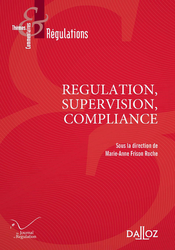
General reference : Frison-Roche, M.-A. (ed.), Régulation, Supervision, Compliance (english translation: "Regulation, Supervision, Compliance"), Paris, collection "Régulations", Dalloz, 2017, to be published. This collective book is published in French but summaries of every article are available in English Acces to book purchase order Book presentation in English : Regulation. Supervision. Compliance. Three terms almost unknown to legal systems. Or at least considered as peculiar to Anglo-American legal systems: Regulation, Supervision, Compliance. So many expressions that would constitute Trojan horses by which the Common Law and american mechanisms would seize the other legal traditions to better bend European companies, especially banks, appropriating institutions, imposing strange methods. Three words by which the invasion is carried out. Through the violence of repression and penalties of compliance, by the mildness of codes of conduct and corporate social responsibility. By laws as new as strange such as in France the law known as "Sapin 2" or the law instituting a "duty of vigilance" to companies whose failure would be to have successfully deployed internationally their activities. One can have this defensive conception of Compliance, generating a "Compliance Law", produced by internalization in global economic operators of the Regulation Law, which are then subject to Supervision by Regulators, even though these firms are not regulated, as the Compliance does extend beyond supervised sectors (banks and insurance companies). We can (and maybe must) have a more welcoming, and therefore more offensive, concept of Compliance. This can be the crucible of a relationship of supra-national Trust between these operators and regulators, the former being able to contribute as the latter to serving goals that all exceed them and whose fight against corruption and money laundering are only examples. In this way, the issue is the construction of the European Compliance Law.   Authors : Jean-Bernard Auby, Jérôme Bédier, Alain Bénichou, Jean-Michel Darrois Isabelle Falque-Pierrotin, Marie-Anne Frison-Roche, Benoît de Juvigny, Jacques de Larosière, Bruno Lasserre, Arnaud de La Cotardière, Jean-Claude Marin, Didier Migaud,, Yves Perrier, Jean-Marc Sauvé.   Voir la présentation du cycle de conférences sur lesquelles s'est construit l'ouvrage.   Voir la présentation générale de la collection dans laquelle l'ouvrage est publié.   Utiliser le bon pour commander l'ouvrage.

Conferences

Conference cycle : Regulation, Supervision, Compliance

Organised by the Journal of Regulation (JoR) in partnership with Sciences Po School of Public Affairs and Economics Department, under the scientific supervision of Marie-Anne Frison-Roche, economic law professeur at Sciences Po, director of the Journal of Regulation (JOR). The sessions will be held at the Conseil Economique, Social et Environnemental (CESE). Each session, which will be held (in French) from 5pm to 7pm, will give the stage to a panel of 3 to 4 speakers and will be concluded by a Q&A session with the audience.  The sessions will be held for seven weeks in a row, from October 5th to November 30th, 2016. Read the common question to all the sessions of the conference cycle (English translation coming soon) In parallel, a book will be elaborated from these sessions. It will be issued as part of the Régulations book series, published by Dalloz, which had already published the book Internet, espace d'interrégulation. Read the detailed description of each session (French version only).  

I-0.2 Débats autour de l’évolution de la régulation bancaire et ses impacts

ENGLISH After a video recording of his first conference devoted to the relations between Regulation and Supreme Courts, The Journal of Regulation published a book on the future of the audit, based on another conference. This present document, written in French worked with KPMG, from conference co-hosted with this company and the “Ecole de Droit de la Sorbonne”, is devoted to the debates around banking regulation and its impacts. The challenge is to enable the persons concerned, that is to say to all citizens to express their opinion on an issue that concerns them directly, but whose technical dimensions, real or serviced, stand them aloof.   FRENCH Après sa vidéo retraçant sa première conférence consacrée aux relations entre la régulation et les Cours suprêmes, le Journal of Regulation a publié un libre sur L’avenir de l’audit, consacré sur la conférence suite. La présente publication, écrite en française, élaborée avec KPMG, à partir de la conférence organise avec celle-ci et l’Ecole de Droit de la Sorbonne, est consacrée aux Débats autour de la régulation bancaire et ses impacts. L’enjeu est de rendre les personnes concernées, c’est-à-dire tous les citoyens, aptes à exprimer leurs opinion sur un sujet qui les concerne tous directement mais dont la technicité, réelle ou entretenue, les tient à l’écart.

I-2.0: Is there a compelling need for neutral action in regulated economic sectors ? ?

TRANSLATED SUMMARIES ENGLISH “Acting in a neutral way” is an oxymoron. “Companies often require however that States use their powers in a neutral way (eg tax neutrality). In regulated sectors, some are right or even duty , of not being neutral. Firstly, it is the State, which requires the market for other purposes, other temporalities and other values​​. Secondly, they are also the “crucial operators”, which are sort of regulators of second degree, such as transmission system operators or companies capital markets firms. The difficulty increases when the systeme requires neutrality of regulators and judges, when first build economic policy and the second create jurisprudence. Their consistency, impartiality and rationality can create an objectifiable neutralitys FRENCH «Agir de façon neutre» est un oxymoron. «Les entreprises ont souvent besoin, cependant, que les États utilisent leurs pouvoirs de manière neutre (neutralité fiscale par exemple). Dans les secteurs réglementés, certains ont le droit ou même le devoir de ne pas être neutre. Tout d’abord, c’est l’État, qui insère le marché à d’autres fins, d’autres temporalités et d’autres valeurs. En second lieu, ils sont aussi les «opérateurs crucial», qui sont des sortes de régulateurs du second degré : par exemple les opérateurs de réseaux de transport ou de entreprises de marchés financiers. La difficulté augmente lorsque le systeme économique et politique exige la neutralité des autorités de régulation et des juges, alors que les premiers construisent la politique économique et les seconds construisent la jurisprudence. Le respect qu’ils doivent avoir de l’impartialité et d’une rationalité suffisamment objectivables pourra permettre cette objectivité requise.