Questions on Law

Analyses

What is the law, ? : explanations by Muriel Fabre-Magnan

Introduction au droit.  The book of Muriel Fabre-Magnan is out. This is great. The law holds the attention of everyone all the time. Because daily life is full of law and there is the awareness of this. Because world live has a turn increasingly legal. Thus, the interest in the law is new, or at least has grown. But the law is off-putting for anyone who didn't study, who doesn't practice. This mass, which is enormous and as inert, seems belch through dramatic cases or convictions shattering. Thus, the desire to discover and to understand law seems meet a sort of end of inadmissibility, seems to be hampered by the legal matter itself. That is why everyone must buy Introduction au droit (Introduction to Law), the book (written in French) in the collection "Que sais-je ?" ("What can I know?"), by Muriel Fabre-Magnan. By reading this book of 124 pages, one can understand what may represent the law, not only for every day but also the law in society in a civilized world. The law is the key to a civilized system. But in a world which seems to be governed by the game of forces, the law is absent or just facade. Thus, reading, you'd think that the law is in fact very little … Read a presentation of the new edition of the Muriel Fabre-Magnan book : Introduction au droit.

Questions

LAW AND HISTORY: is The Civil Code “the pinnacle” of French law?

The "pinnacle" means the culmination of a successful issue. Here, the Code civil (French Civil Code) would be the point of perfection of French law. For many this qualification is required with evidence before this masterpiece of concision, practice and use of language. This implies a critique of the current French law, including a legislator that would had fallen very low. But the question nevertheless arises. Since before the Civil Code, there was a law that was not as unworthy. Moreover, after some general principles, all the civil law takes place into the Civil Code, family law, contract law, tort law, and so on. But the criminal law or public law aren't inserted in the book. Thus, it is rather the form, the art of writing the law that can be given to this term apogee Civil Code, not the substance that can bring so much praise to the Code civil because he never embraced the french law in its entirety. In addition, it is true that the form is the pinnacle of French law, but a French law that put the law should only be expressed through writing through codification rather than practices or casebased rules. We must therefore bow to bin assumptions before proclaiming that the Civil Code is the pinnacle of French law. Admitting it is rather the culmination of a certain conception of the law, a non indiscutable conception, he was a perfect and sublime event.

Working papers

Home made Family

The family is built on one basic idea which is so powerful that legal rules are organised around it as spontanely. But if the paradigm is changing, then all the rules change with the strength of the evidence. However, in the 1970s, we changed paradigm. Previously, for millennia, the basic idea was the family as a group. Depending on the time or period, the group has varied in its contours, squares and powers granted to individual members, but the idea of group was acquired. Family was a group which was a part of the social group, kept by the State. From the 1970s, the family becomes the developed project done by a free and independent person. This project designed by a person wishing to build family that suits him or her will result in the fact that the individual meets other individuals whose family project crosses his or her. Contract becomes the perfect tool for these home-made families This desires adjustment corresponds to the market model. Concretely, market of ideal family provides services for satisfaction of various projects, all legitimate as expression of desir. The sufficient link between individuals  is affection and will, the center is the child. The market offers new perspectives, such as ideal partner and even more perfect child, becoming jewel. The idea of ​​Market has triumphed.

Questions

LAW AND HISTORY: In British Law, Is the obligation to drive on the left an arbitrary rule?

One of the reasons why the law has a bad reputation is that it would be "arbitrary". It would be composed of rules, imposing to do this or not to to do that, without strong reasons. Ultimately, what we do does not matter, as long as we all behave in a similar way. No matter the substance in the legal rule which is adopted, the law, is primarily question of order. And a frequent example is the rule to drive on the left or to drive on the right on the roads.. Because it is a legal rule. It is often said that the law is "like that" and it is made just for the sole purpose of ensuring that everyone does the same, so there is no accident . But is that such an arbitrary rule ? Do the British, driving on the left, have no more reason to do so  that French who drive on the right ? If we can show that British legal rule has a more rational basis, then we must end up suspecting that no rule of law is established "without reason."

Articles in a legal collective publication

📝Experts et procédure : l’amicus curiae (Experts and procedure: the amicus curiae)

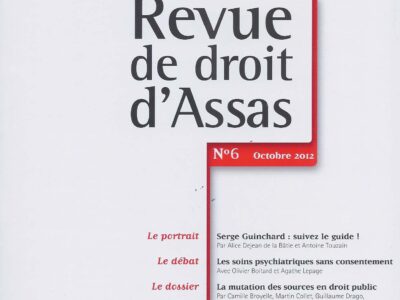
► Référence complète : M.-A. Frison-Roche, "Experts et procédure : l'amicus curiae" ("Experts and procedure: the amicus curiae"), Revue de droit d'Assas, october 2012, pp. 91-94 - 📝read the article (in French) - ► English Summary of the article: A recent thesis has argued that amicus curiae is becoming a common principle of Procedural Law. This shows its importance. The fact that the mechanism, the character, is designated by a Latin formula leads us to suspect that something is being concealed that legal technique ordinarily forbids: it is the legal expert and the party's expert, which is what the amicus curiae most often is, either one or the other, or both at the same time. Therefore, removing the prudish cloak of Latin, it is these two difficulties that must be addressed. If we exclude the legal expert, it is because "jura novit curia" ("the court knows Law". But this rule, which recalls the principle that "no one is supposed to be ignorant of the law", merely indicates a sharing of the burden of evoking facts and Law between the parties and the judge (Motulsky) and not a presumption of knowledge. Consequently, the modest, and therefore self-confident, judge has no reason, either psychological or legal, to shy away from a legal expertise. As for the party's expert, or the judge's expert who is highly influenced by a party, a profession, a social group, in short, a judge's expert who is in fact an expert held by a party, this can only be a problem if the judge cannot keep his distance from this expert whose opinion is biased by the weight of the party. But first of all, any opinion is biased. Whether it is given in bad faith or good faith, it is biased, and in rhetoric we know that an opinion biased in good faith is more dangerous than a bought opinion, because the latter is known to be twisted by self-interest. In this respect, the person who listens to it, the judge, knows the difference. Indeed, the legal system that recognises the party's expert and the amicus curiae, i.e. North American Law or European Union Law, draws the necessary procedural consequence: they include the party's expert opinion in the adversarial debate. It is the principle of adversarial debate, the principle of principles in the conduct of proceedings, that makes amicus curiae acceptable and welcome, since it provides the judge with a scientific input that the latter does not have. -

Publication director

🏗️ direction of the collection: 📚Cours Dalloz – Série Droit privé

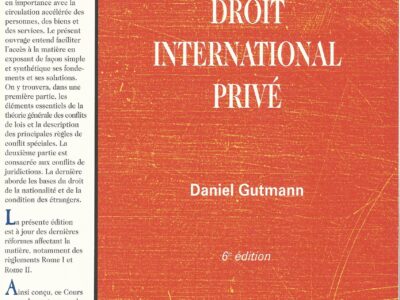
📚Publication of : 🕴️Daniel GUTMANN, 📕Droit international privé (Private International Law), 6th ed.

► Full Reference : D. Gutmann, Droit international privé (Private International Law), 1st ed. 1999 – 6th and last ed., 2009, Dalloz, “Cours Dalloz-Série Droit privé” Series. The subject was subsequently covered by a book entrusted to Bernard Haftel. - 📕Read the back cover (in French) - 📕Read the table of contents (in French) - 📚See the entire collection in which the book is published. -

Monographs

📝La jurisprudence massive (The Massive Jurisprudence)

► Full Reference: M.-A. Frison-Roche, in collaboration with Serge Bories, "La jurisprudence massive" ("The Massive Jurisprudence"), D. 1993, chron., pp. 287-330 - 📝read the article (in French) - ► English Summary of the article: The term "jurisprudence" is likely to have several meanings: on the one hand, jurisprudence stricto sensu, that emanating from the High Courts; on the other hand, "massive jurisprudence", designating all legal decisions rendered by the courts. This study of "mass case law" is divided into two parts: the first sets out the advantages of analysing mass judgments (I.), and the second develops the method that should be used to study these judgments (II.). The analysis of massive jurisprudence is of threefold interest: educational, scientific and practical. Educational, in that it provides a more concrete, comprehensive and detailed view of the subject being taught. Scientific, in that it provides a global perspective, making it possible to take a closer look at reality and thus analyse the phenomena of pluralism in case law and anticipate 'elite case law' or legislative developments. And lastly, it is practical, in that it enables legislators to learn as quickly as possible about the practical application of the law and its consequences, so that they can potentially react to counter any perverse effects and/or use this information to adapt their legal policy decisions. The analysis method involves 3 stages. Firstly, a prior qualitative analysis of the banal judgment must be carried out, based on the extraction of key words and concepts contained in the decision, in order to transform the raw information into data. Next, categories of analysis need to be established, based on the structure of the data collected and the research hypotheses, in order to process the mass of refined data collected. It is also essential to have access to all the data used to adopt the decision. In the final stage, complementary methods, such as studying the case file or interviewing magistrates, should be added to the textual analysis. - 🌐follow Marie-Anne Frison-Roche on LinkedIn 🌐follow Marie-Anne Frison-Roche on Instagram 🌐subscribe to the Newsletter MAFR Regulation, Compliance, Law