Philosophy, theory and sociology of law

Working papers

The Legislation, Painting of Life

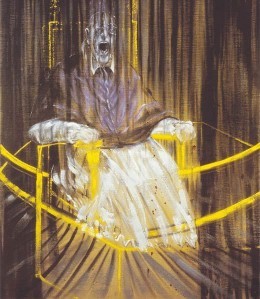
This working document is the basis for an article published in the Archives of Philosophy of Law (APD). Summary: Painting so well that the canvas is a living object is a technical feat that was achieved by little1Il est remarquable que pour Bacon, Van Gogh, que le premier considére comme un "héros",  a peint d'une "façon littérale" et que c'est grâce à celui qu'il a pu grâce à son "technicité" restitué "la vie" désertique du paysage. . Francis Bacon obtained from the canvas that it made it his business to preserve life in it, while Carbonnier, with a similar modesty before the canvas and the profession, obtained that the Law was only a framework, but that it did not however, leave this place to no one and especially not to public opinion, so that everyone can in their own way and within this framework make their own right, on which the legislator in his delicacy and to use the terms of the Dean n affixes only a "thin varnish". These two masters of art built frames with rudimentary principles so that on this canvas the movement could happen by itself. Thus the Legislator created by Carbonnier offered each family the freedom to weave their rights every day. However, the childhood of the art of stretching the canvas over the loom came back to the Legislator alone. It is then possible, as Bacon did, to obtain an immobile object which allows the mobile figures to constantly arise. Regulatory scribbles are a thousand miles from this Legislative Art. - In numerous writings and interviews, The painter Francis Bacon explains his act as a painter: it is "preserving the vitality of the canvas". In the book he devoted to it, Gilles Deleuze pointed out that Bacon said that "the procedures used do not force the Figure to stand still"2Deleuze, G., Francis Bacon, rééd. par Badiou, A. et Cassin, B., .   With the same pedagogical friendliness, in numerous writings and interviews, the jurist Carbonnier explains his act as a legislator, in particular in his collection of texts Essais sur les lois: legislate well, and let life unfold through texts, well after their adoption, because posed on pages which are never white, written compositions which are only the "varnish" of the life which must be able to throb in these Laws which one presents however so often but so strangely as "engraved in marble ". While on the contrary it is only a question of "preserving" the vitality of what is under the letter of the Law, the life of each one, life which does not resemble that of the neighbor, to obtain that the web of the legislative system is so flexible that this system lives by itself after the promulgation of the texts. But it may seem to force the line to find elements common to two characters who undoubtedly were unaware of their reciprocal existence or at least, although living at the same time, did not appear similar. Before showing how similar their action is, therefore, put them face to face beforehand. PREREQUISITES REQUIRED: FACING FRANCIS BACON AND JEAN CARBONNIER   Thus, the family painted in broad outlines by a few new articles of the Civil Code written by Carbonnier could nevertheless flourish afterwards, in each family, without the need to rewrite the text. One might be surprised that Carbonnier expressly only likes the Law and not the judiciary, this association of the Right to the Law often being worth rigidity; yet – and the formula made him famous – he conceived of the Law as only "flexible", without recognizing the judge as a general source of the Law, without recognizing him the power to soften over time the edge of the adapted law formerly, then once. In fact, the Flexible Droit volume brings together almost only texts relating to laws, while in his latest work, Droit et passion du Droit sous la Vième République, he challenges the influence of the courts over the Law. Carbonnier abides by the Law. These laws which we are constantly told us that their quality should be never to move …. And to evoke in order to convince us the imperative of legal certainty, predictability, etc., each new report on the subject saying the same thing as the previous one, this one serving as a reference for the next one. Thus, all these numerous works explain to us that, in the ideal towards which one should tend, the Law does not move in the main lines while the judge, by "jurisprudence" comes to adapt it and that thanks to "dialogue ", even to the" dialectic "between legislation and jurisprudence", cahin-caha we arrive at something suitable. In practice. And here is legal security well served, since it would be the only concern. A universal model to apply everywhere , at everything.   But this presentation, now very common and also constituting the vulgate of the economic analysis of law, does not correspond to the conception of Carbonnier, who did not admit the creative power of the Judge, being, like Motulsky, above all a jurist . Because if he asked as a question "Any law in itself is an evil?", It is only to answer it firmly: No, going so far as to compare in this article the announcement of a new law with the announcement made by the angel Gabriel. Perhaps it is his attachment to the Law, his refusal to consider the jurisprudence as the source of the law, his respect for the legal matter itself that make his work today less cited than the work of sociologists who do not know not more the legal technique than the economists who describe the "legal regulation" to adopt to be effective? It should also be noted that its legislative art is little used today3...., in Verdier, R. (dir.), Jean Carbonnier. L'homme et l'oeuvre. . When laws are written by experts who do not deem it useful to know the law (for example to reform collective procedures solely on the basis of economic knowledge), who even think it useful to not know it so as not to be captured by his technicality, there is no need to look on the side of Carbonnier.  It is true that to make a painting, to have the strength to fade in front of your canvas, you must master the technicality to return to the childhood of art, ambition of all artists, all teachers, all the Masters. Francis Bacon, also a wise reader of writers, rejecting the modern opposition between painted lines and written texts, repeated at each interview that he awaits "the accident" which comes alone to get the flesh out of the skin that traps him4Comment dès lors ne pas penser à la définition de l'écriture par Céline, la définition comme le fait de tanner sa peau sur la table de l'écrivain ? . This technicality of the accident, this unexpected preparedness that allows life to find its place in the stretched canvas. Carbonnier did not do anything else: stretch the canvas of the Law so that family life can, in each of the families we make up, unfold overflowing with the text which is only "varnished". But it is nevertheless a law, as Bacon never disputed making paintings.   The theme of Carbonnier Sociologie juridique's book is this necessary presence of law in a sociological analysis which would not betray the law presented while managing to keep its distance: that is to say, let it breathe, allowing us to watch live. This is why, like Truffaut, he took an interest in children's pocket money. By a game of mirrors, Carbonnier explained, for example about the reform he conceived of the Law of matrimonial regimes and whose genesis he explained in an article in L'Année sociologique5Terré, Fr., Jean Carbonnier et l'année sociologique, L'Année sociologique, 2007/2, vol.57, pp.555-569., that the sociology of law must allow distant readers that we are faced with the only written sheet of the work to see the living law come out of the pages. As historians aspire, History being living matter, as the author of literature understands it. Carbonnier wrote a novel about himself. A novel about a legislator therefore. "Self-fiction". We know judges of absolute modernity who have brought this art to its excellence, similarly concerned with writing life. Admittedly, one could underline that if Francis Bacon signed his tables, which attaches to him the work and holds the Figure which moves there, it was not the case for Carbonnier. You must already be a scholar to know that the author of the train of reforms of the XXth century which transformed the Civil Code has for patronym "Jean Carbonnier": the Legislator is an abstract character, who, like the State, always carries this same title , like the King, and passes indifferently from head to head, from the dead instant to the crowned instant. Whoever looks at the painting will attribute it to Francis Bacon because it is written on it, while on the contrary he will designate for example the law of July 15, 1975 as the law reforming the law of divorce, without referring to the human being who designed it. Yes, it is the Parliament, which, in the name of the People via the Representation, is the author of the Laws. And not such and such.   So the comparison would not be worth. But let's take a detour by Romain Gary. The action of this one showed what one could call "the right of the literature", ie what can go the power of this one. Its power is so great that the author can never appear in it6"le droit de la littérature est de n'y apparaître jamais comme auteur".. Romain Gary not only wrote under pseudonym, which allowed him to pass under the radar of the legal standard of Gongourt which cannot be given twice – and which was it, but wrote himself a book supposedly written by his ghostwriter after the hoax discovered – and therefore supposedly finished, speaking ill of Romain Gary, against which he protested but nevertheless undertook legally not to complain in court. While he himself wrote the book. The author can be a ghost, which multiplies, ghost of the ghost, is discovered only to hide under his face that is believed to be discovered, etc. But by dint of covering the smoke with smoke, the author himself disappears: and then remains the pure work, the Figure which moves alone, perfectly free. Thus under the mask of the Legislator, it was Carbonnier who designed and wrote, without ever signing, because it is the Law who speaks, and never Carbonnier. No greater tribute a law clerk can pay to the Law than disappearing under his letter. Thus, an author does not recognize his signature, it is only a clue, not a condition. There is no need to go to Law & Literrature, a current which dries up the Law rather to cover it with a conception of the Law as a fabric of strategic lies and retrospective narratives of justification of decisions. No, Carbonnier, far too erudite and far too good a jurist to go towards a thought above all critical of an object, made sociology to show us a living Law and at the same time had a sociological conception of Legislative Art , writing laws which capture in their austere lines the daily and various lives which will come after the writing of a law which writes only in capital letters, general, aiming nothing special so that the particular remains in the hands of each individual7Comme le souligne très bien Frédérique Niboyer, pour montrer que les lois actuelles qui visent tous le cas possibles (ce qui est impossible) empruntent une méthode contraire à celle de Carbonnier : ""Le doyen Carbonnier avait une autre conception : une loi générale devait pouvoir s’adapter à tous (d’où le pluralisme du droit de la famille) tout en ouvrant des champs à d’autres ordres normatifs, alors qu’aujourd’hui le « légicentrisme » devient roi : la seule norme à laquelle on fasse confiance serait ici la loi qui, partant, doit être spécialisée pour chaque catégorie.".. But how, if we get the judge out of the normative game, can the law be "flexible"? If not by drawing up laws which "preserve" in themselves, in their "canvas" even their vitality, which allows them to move, in an ink which must never be dry or reach marble?   Why not make the connection between the two creators, Francis Bacon and Jean Carbonnier? How even not to do it, the design and the method are so similar to them. When Bacon paints scenes of daily life as a field of ruin, while Carbonnier aims only "the interest of the child", on which one glosses so much, only as "a key which opens on a vacant lot"8Cité par Frédérique Niboyet, L'héritage de Carbonnier dans le droit matrimonial actuel : entre continuité et rupture, 2012, n°5. , how not to bring them together? For the two authors, painting for one and the law for the other, both must tear them away from their static support so that there is expressed and "preserves" life in its mobility itself. Even more, it is thanks to this support, which we thought motionless, that the fluidity of life appears to us. Thus life is, for them, the common object of painting and the law. This definition is carried by few people, because we find so often in the presentations which are made of the Law the imperative of a choice to operate, to put on the side of the immobile or on the side of the mobile, but not this conception of mobility expressed by an immobile support (I). It must be recognized that few have the level of technical mastery and thinking of Bacon and Carbonnier. But if we go back to Carbonnier's conception of the law, while at a distance, as would do, in his own words, in his own country a "foreign" legislator9Carbonnier, "A beau mentir qui vient de loin",  in relation to it, laws that 'he nevertheless made with a master's hand, was it not in terms of painter that he described it, evoking the "frame" that it constitutes and the "thin varnish" by which it must simply always cover life which always prevails, since it is the canvas? (II).       The two authors thus put life at the center, one of the tables, the other of the laws. Yet two motionless objects, some made of "canvas", others made of "marble". But both wanted – emphasizing the difficulty of the task – forcibly reinserted into the materially intrinsic immobility of the object – the canvas of the table that the flaking of the paint by the passage of time will damage , the letter of the Law that subsequent reforms will challenge – life. That is to say, finally give them their true object. And yet impossible to restore. And they got there. Undoubtedly by their own qualities: mastered technicality, modesty, perseverance, effacement before life itself which unfolds and occupies all the space and "does its work" on the support, which becomes mobile. Thus Francis Bacon's paintings move as the laws written by Carbonnier live, which is natural since it was directly inserted. What modesty was it worth to fade to this point. Achieve by technical prowess that life is still throbbing in the canvas, in the text published in the Official Journal. Only in what by nature is fixed: the canvas, the Law, not only does life still throb, as if by "inadvertence", as Francis Bacon says, because life has a hard life, but because the masters that they were so delicate and so masters of their Art that they made everything that it was the very object of their work: the canvas of the picture was for Francis Bacon what life was made of, the marble of the law was for Carbonnier that by law life was made.   So as when the Master of Sewing removes the thread, the canvas no longer exists, the diary has long been lost, but life is still there. This is no coincidence, as sociologists who seem to boast of knowing nothing about law seem to present, speak of a "legislative vacuum" and always ask for more "new laws", sometimes stressing that Carbonnier was also arbitrary in law that bad in sociology – because there is to say it. On the contrary, it is the Law bringing to its perfection: practical art, the Law relates to life and if in advance, in its very conception, it knows how to fade in front of life, it then joins in practice the art of painting because it takes a painter to force life on canvas (I). This requires a painter, because we often talk about legislative art but it is also appropriate to talk about artists who hold the pen. These do not "regulate", they draw a picture which, through the effect of correspondence, can let life continue to unfold because the ink is never dry. Of this table, it is the law which forms the framework, a light framework which allows to keep contours to what is the Right and what is not. Carbonnier always knew that in relation to life, Law was only a "thin varnish". Like all great masters, it was modest, drawing up great pictures, that were the complete reforms of the Civil Code that he wrote, never forgetting to conceive them only as a varnish so that life always finds its way out, breathe, in the same movement of a woman coming down the stairs or of a Pope who rules on his throne (II).
Couverture – Pour une Europe de la Compliance

Publication director

🏗️ copublishing and direction of the collection: 📚Régulations & Compliance

Collection Régulations & Compliance Publication of🕴️M.-A. Frison-Roche (ed.), Collection Régulations & Compliance Pour une Europe de la Compliance (For the Europe of the Compliance), 2019

🌐 follow Marie-Anne Frison-Roche on LinkedIn 🌐 subscribe to the Newsletter MAFR Regulation, Compliance, Law - ► Full Reference: M.-A. Frison-Roche (ed.), Pour une Europe de la Compliance (For the Europe of the Compliance), series “Régulations & Compliance“, Dalloz, 2019, 124 p.  - This volume is the continuation of the books dedicated to Compliance in this collection. ► Read the presentations of the other books in the series: the following books: 🕴️M.-A. Frison-Roche (ed.), Les outils de la Compliance (Compliance Tools), 2021 🕴️M.-A. Frison-Roche (ed.), Les Buts Monumentaux de la Compliance (Compliance Monumental Goals), 2022 🕴️M.-A. Frison-Roche (ed.), La juridictionnalisation de la Compliance (Compliance Jurisdictionalisation), 2023 🕴️M.-A. Frison-Roche and M. Boissavy (eds.), Compliance et droits de la défense. Enquête interne – CJIP – CRPC (Compliance and rights of the defence. Internal investigation – French Judicial Public Interest Agreement – French guilty plea procedure), 2024 🕴️M.-A. Frison-Roche (ed.), L’Obligation de Compliance (Compliance Obligation), 2025 🕴️M.-A. Frison-Roche (ed.), Compliance et Contrat (Compliance and Contract), forthcoming 🕴️L. Laref (ed.), Compliance et vigilance bancaire (Compliance and Banking Vigilance), forthcoming 🕴️M.-A. Frison-Roche, Le système juridique global des noms de domaine. Structure multi-acteurs et durabilité de l’Internet (The Global Legal System of Domain Names. Multi-Stakeholder Structure and Sustainability of the Internet), forthcoming 🕴️M.-A. Frison-Roche (ed.), Le système probatoire de la Compliance, forthcoming   the previous books: 🕴️N. Borga, J.-Cl. Marin and J.-Ch. Roda (eds.), Compliance : l’entreprise, le régulateur et le juge (Compliance: the Company, the Regulator and the Judge), 2018 🕴️M.-A. Frison-Roche (ed.), Régulation, Supervision, Compliance (Regulation, Supervision, Compliance), 2017 🕴️M.-A. Frison-Roche (ed.), Internet, espace d’interrégulation (Internet, Space of Interregulation), 2016 Read the presentations of the other titles of the collection. - ► General presentation of the book: This book is written in French. The topic is : “For the Europe of the Compliance“. See below its general presentation in English.  The political dimension is intrinsic to the Compliance Law. Indeed, compliance mechanisms consist of internalizing in certains companies the obligation to implement goals of general interest set by Public Authorities. These public bodies control the Ex Ante reorganization that implies for these companies and punish Ex Post the possible structural inadequacy of these compagnies, becoming transparent for this purpose.  This new mode of governance establishes a continuum between Regulation, Supervision, Compliance (book published in 2017) and renew the links between Companies, Regulators and Judges1Frison-Roche, M.-A., Compliance, see.  This political dimension must be increased: the Compliance Law of Compliance must today be used to build Europe. One can observe not only the construction of the  European Compliance Law, object-by-object, sector-by-sector, purpose-by-purpose, but also the construction of the European Compliance Law that transcends and unifies them. Becoming independent of American Law and ceasing to be in reaction, even on the defensive, the Compliance Law contributes to the European project, offering it a higher ambition, that Europe can carry and, by this way, can carry the Europe itself, not only to preserve the European economy from corruption or money laundering, but by claiming the protection of nature and human beings. This is why the book describes the “reasons and objectives” of the Europe of the Compliance, which makes it possible to describe, detect and even predict the ways and means. - ► Understand the book through the Table of Contents and the summaries of each article:  🕴️M.-A. Frison-Roche, 📝Avant propos  🕴️K. Lenaerts, 📝Le juge de l’Union européenne dans une Europe de la compliance 🕴️M.-A. Frison-Roche, 📝Un droit substantiel de la compliance, appuyé sur la tradition européenne humaniste   I. LES RAISONS ET LES OBJECTIFS D’UNE EUROPE DE LA COMPLIANCE (THE REASONS AND OBJECTIVES OF THE EUROPE OF THE COMPLIANCE)  🕴️X. Musca, 📝Construire une Europe de la compliance en donnant une meilleure place aux entreprises 🕴️P. Vimont, 📝La place de la diplomatie dans l’avancée d’une Europe de la compliance 🕴️P. Sellal, 📝Les vertus de la compliance : une réponse possible aux faiblesses de l’Union européenne ? 🕴️J.-J. Daigre, 📝Compliance, entreprise et Europe   II. LES VOIES ET MOYENS D’UNE EUROPE DE LA COMPLIANCE  (THE WAYS AND MEANS OF THE EUROPE OF THE COMPLIANCE) 🕴️J.-Cl. Marin, 📝Quels outils pour la construction du droit de la compliance en Europe ? 🕴️M. Canto-Sperber, 📝La compliance et les définitions traditionnelles de la vertu 🕴️T. Bonneau, 📝Compliance et secteur bancaire et financier en Europe 🕴️C. Duchaine, 📝L’Agence française anticorruption, à l’appui de l’Europe de la compliance 🕴️D. Martin, 📝Les contraintes et les vertus de la compliance 🕴️A. de La Cotardière, 📝Construire une Europe de la compliance lisible pour les entreprises -

Working papers

🚧 Having a good behavior in the digital space

►  Complete reference : Frison-Roche, M.-A., Having a good behavior in the digital space, working paper, April 2019. - 📝  This working document serves as a basis for a contribution to the collective book dedicated to Professor Michel Vivant, article written en French.   Summary: The jurist sees the world through the way he learns to speak1Cornu, G., Linguistique juridique, 2005. , legal vocabulary build by Law itself, whether in common law or in civil law. Thus, we think we are dealing with the human being who does not move, taken by the legal notion expressed by the term "person", their body and their biological development in time, from the birth to the death, holding entirely in this hollow of that word "person", while the behavior of the human being with regard to the world, others and things, are grouped in other branches of Law: the Contract and Tort Law and the Property Law, which are only what people do with and about things. The Law of the Environment has already come to blur this distinction, so finally so strange because this classical conception refers to a person taken firstly in his immobility (Law of individuals), and then in his only actions (Contrats and Tort Law, Property Law). Indeed, the very notion of "environment" implies that the person is not isolated, that he/she is "surrounded", that he/she is what he/she is and will become because of what surrounds him/her ; in return the world is permanently affected by his/her personal action. On second thought, when once "Law of Individuals" was not distinguished from Family Law, the human being was more fully restored by this division in the legal system that not only followed him/her from birth to death but also in him/her most valuable interactions: parents, siblings, couples, children. Thus Family Law was finer and more faithful to what is the life of a human being. To have instituted Law of Individuals, it is thus to have promoted of the human being a vision certainly more concrete, because it is above all of their identity and their body about what Law speaks, astonishing that we have not noticed before that women are not men like the others. To have instituted the Law of the people, it is thus to have promoted of the human being a vision certainly more concrete, because it is above all of his identity and his body that one speaks to us, astonishing that the we have not noticed before that women are not men like the others2Frison-Roche, M.-A. & Sève, R., Le Droit au féminin (ed.), 2003. without however remembering that abstraction is sometimes the best of protections3Under this "mask" of the "subject of Law", we are all equal. S. Archives de Philosophie du Droit, Le sujet de droit, 1989..  But it is also to have isolated human beings, split from what they do, what they touch, what they say to others. It is by taking legally a static perception of a "man without relationship". We have gone from the legal individualism of the Law of the sole man. From this concrete vision, we have all the benefits but Law, much more than in the eighteenth century, perceives the human being as an isolated subject, whose corporeality ceases to be veiled by Law4Baud, J.P., L'affaire de la main volée. Histoire juridique du corps humain, 1993. , but for whom the relation to others or to things does not define him or her. Which brings the human being a lot closer to things. An human being who is a legal subject who does what they wants, as they can, limited by the force of things. But in fact things are so powerful and the human being, in fact, so weak. For example, the marks people leave are erased by time. Their grip on the world stops at the extent of their knowledge, the time and money they have, building to use better their own time and to reach projects that they designed, In this conception, Person and Liberty are one, returning the subject to their solitude. This freedom will come into conflict with the need for order, expressed by society, social contract, state, law, which imposes limits on freedom of one to preserve freedom of the other, as recalled by the French Déclaration des Droits de l'Homme  of 1789. Thus, it is not possible de jure to transform every desire in action,, even though the means would be within reach of the person in question, because certain behaviors are prohibited in that they would cause too much disorder and if they are nevertheless committed, they are punished for order to return. Thus, what could be called "law of behavior", obligations to do and not to be put in criminal, civil and administrative Law, national and international Law, substantial Law and procedural Law :they will protect the human being in movment pushed by the principle of freedom forward others and thing, movement inherent in their status as a Person.  The human being is therefore limited in what they want to do. In the first place by the fact: their exhausting forces, their death that will come, the time counted, the money that is lacking, the knowledge that they does not even know not holding, all that is to say by their very humanity; Secondly, by the Law which forbids so many actions …: not to kill, not to steal, not to take the spouse of others, not to pass as true what is false, etc. For the human being on the move, full of life and projects, Law has always had a "rabat-joy" side. It is for that reason often ridiculous and criticized because of all its restraining regulations, even hated or feared in that it would prevent to live according to our desire, which is always my "good pleasure", good since it is mine. Isolated and all-powerful, the human being alone not wanting to consider other than its desire alone. Psychoanalysis, however, has shown that Law, in that it sets limits, assigns to the human being a place and a way of being held with respect to things and other persons. If one no longer stands themselves by the prohibition of the satisfaction of all desire (the first of which is the death of the other), social life is no longer possible5On neurosis as a constitutive mode of child sociability, s. Lebovici, S., "C'est pas juste", in La justice. L'obligation impossible, 1994. . Thank to the Law, everyone follows the same Rule at the table, from which a discussion can take place between guests and without which it can not6Read the article of Alain Supiot about the idée of Rule common of all, under the discussion between all, presented by this author through the artwork of Kafka : "Kafka, artiste de la loi", 2019; Kafka is very present in the work of Alain Supiot, for example in his First Lesson in the Collège de France, 2012, or in an Introduction of La Gouvernance par les nombres ; This latter book is now available in English : Governance by numbers. The making a legal model of allegiance, 2017 (translated by S. Brown). . You stand straight in your chair, you do not eat with your fingers, you do not speak with your mouth full, you do not interrupt the speaker. Admittedly, one often learns at the beginning of the learning of the Law that one should not confuse "politeness" and Law. That these rules are politeness and that this is not Law … But this presentation aims to make it possible to admit that the criterion of Law would be in the effectiveness of a sanction by the public power: the fine, the prison, the confiscation of a good, which the rudeness does not trigger whereas Law would imply it: by this way we are thus persuaded of the intimacy between the public power (the State) and Law… But later, after this first lesson learned, the doubt comes from the consubstansuality between Law and State. Is it not rather appropriate to consider that Law is what must lead everyone to "behave well" with regard to things and people around them? The question of punishment is important, but it is second, it is not the very definition of Law. The French author Carbonnier pointed out that the gendarme's "kepi" is the "Law sign", that is to say what it is recognized without hesitation, but it is not its definition. The first issue dealt with by Law is then not so much the freedom of the person as the presence of others. How to use one's freedom and the associated deployment of forces in the presence of others? How could I not using it when I would like to harm them, or if the nuisance created for them by the use of my free strength is indifferent to me7That's why splitting Persons Law and Family Law masks another reality: the family is not made up of third parties. The links are there. They pre-exist. Starting from the only Persons Law pushes to think one can "build" his/her  family by links drawn on white paper: the contracting of the families made up of individuals becomes thinkable, even natural. How can Law lead me to use my means for their benefit while our interests do not converge?  We do not use our force against others because we have interest or desire, we do not give him the support of our strength while he indifferent us, because Law holds us. If the superego was not enough. If Law and the "parental function of the States" did not make alliance. We do it because we hold ourselves Or rather we were holding ourselves. Because today a new world has appeared: the digital world that allows everyone not to "hold" himself, that is to say to constantly abuse others, never to take them into consideration, to attack massively. It's a new experience. It is not a pathological phenomenon, as is delinquency (which simply leads to punishment), nor a structural failure in a principle otherwise admitted (which leads to regulatory remedies) but rather a new use, which would be a new rule: in the digital space, one can do anything to everyone, one is not held by anything or anyone, one can "let go" (I). This lack of "good behavior" is incompatible with the idea of ​​Law, in that Law is made for human beings and protect those who can not afford to protect themselves; that is why this general situation must be remedied  (II).

Reports

📓 L’apport du Droit de la Compliance dans la Gouvernance d’Internet (The contribution of Compliance Law in the Governance of Internet))

► Full Reference: M.-A. Frison-Roche, L'apport du Droit de la Compliance dans la Gouvernance d'Internet  (The contribution of Compliance Law to the Internet Governance), Report asked by the French Government, published the 15th of July 2019, 139 p. - ► Report Summary. Governing the Internet? Compliance Law can help. Compliance Law is for the Policy Maker to aim for global goals that they require to be achieved by companies in a position to do so. In the digital space built on the sole principle of Liberty, the Politics must insert a second principle: the Person. The respect of this One, in balance with the Freedom, can be required by the Policy Maker via Compliance Law, which internalises this specific pretention in the digital companies. Liberalism and Humanism become the two pillars of Internet Governance. The humanism of European Compliance Law then enriches US Compliance law. The crucial digital operators thus forced, like Facebook, YouTube, Google, etc., must then exercise powers only to better achieve these goals to protect persons (against hatred, inadequate exploitation of data, terrorism, violation of intellectual property, etc.). They must guarantee the rights of individuals, including intellectual property rights. To do this, they must be recognized as "second level regulators", supervised by Public Authorities. This governance of the Internet by Compliance Law is ongoing. By the European Banking Union. By green finance. By the GDPR. We must force the line and give unity and simplicity that are still lacking, by infusing a political dimension to Compliance: the Person. The European Court of Justice has always done it. The European Commission through its DG Connect is ready.   ► 📓 Read the reporte (in French) 📝 Read the Report Summary in 3 pages (in English) 📝 Read the Report Summary in 6 pages (in English) -   ►  Plan of the Report (4 chapters): an ascertainment of the digitization of the world (1), the challenge of civilization that this constitutes (2), the relations of Compliance mechanisms as it should be conceived between Europe and the United States, not to mention that the world is not limited to them, with the concrete solutions that result from this (3) and concrete practical solutions to better organize an effective digital governance, inspired by what is particularly in the banking sector, and continuing what has already been done in Europe in the digital field, which has already made it exemplary and what it must continue, France can be force of proposal by the example (4). -   📝  Read the written presentation of the Report done by Minister Cédric O (in French). 🏛 Listen to the oral  presentation of the Report by Minister Cédric O durant the parliamentary discussion of the law against hate contente on the Internet (in French). -   💬 Read the interview published the 18 July 2019 : "Gouvernance d'Internet : un enjeu de civilisation" ( "Governing Internet: an Issue of Civilization"), given in French,  📻 Listen the Radio broadcast of July 21, 2019 during which its consequences are applied to the cryptocurrency "Libra" (given in French) 🏛 Presentation of the Report to the Conseil Supérieur de l'Audiovisuel- CSA (French Council of Audiovisual) on Septembre 5, by a discussion with its members presentation (in French) 💬 Read the  Interview published the 20 December 2019 : "Le droit de la compliance pour réguler l'Internet" ("Compliance Law for regulate Internet"), given in French -     read below the 54 propositions of the Report ⤵️ - 🌐 follow Marie-Anne Frison-Roche on LinkedIn 🌐follow Marie-Anne Frison-Roche on Instagram 🌐subscribe to the Newsletter MAFR Regulation, Compliance, Law 

Articles in a non-legal collective publication

FRISON-ROCHE, Marie-Anne

Creating “Regulation Law” at Dauphine

Full reference: Frison-Roche, M.-A., Creating "Regulation Law" at Dauphine, in Huault, I. and Bouchard, B. (ed.), 50 years of Research in Dauphine. 1968-2019, 2019, pp. 110-114 Read Marie-Anne Frison-Roche's article (in French)   Read also:  The foreword of the book written by Bruno Bouchard (in French) The preface of the book written by Ivar Ekeland (in French) The table of contents of the book (in French)

Working papers

🚧 THE IMPOSSIBLE UNICITY OF THE LEGAL CATEGORY OF WHISTLEBLOWERS

This working paper served as a basis for a conference done in French for the Centre de droit comparé (Center for Comparative Law) in Paris on 23 November 2018. Updated, it has served as a basis for an article published in French in a book of the Société de Législation comparé (Society of Comparative Legislation).   -   "The whistleblowers". This is a new expression. Which wins a full success. Barely heard once, we hear it everywhere … A theme not only of academic teaching, but rather a topic of daily conversation. Because it is every day that we speak about it, in terms more or less graceful. For example President Donald Trump on October 1, 2019 told the press he "wants to interrogate" the whistleblower who would have unlawfully denounced him and would not have, according to him, the right to conceal his own identity, evidence in this according Donald Trump of the false character of his assertions against him, while his lawyer indicates on October 6, 2019 that he does not speak on behalf of a single whistleblower thus taken apart but of a plurality people who gave information against the President of the United States. Even the most imaginative scriptwriters would not have written twists as abruptly or so fast. Spectators, we wait for the next episode, secretly hoping for climbs and slashs. Precisely if we go to the cinema, it is still a whistleblower whose dedication and success, or even drama, we are told, for the benefit of the global society, and especially of Democracy, since the secrets are fought for the benefit of the truth. Thus, the movie The Secret Man designates Mark Felt as the first whistleblower. Returning to what is often presented as a more "serious" media, for example in France the radio "France Culture" we can learn the story of a historian who worked as an archivist on events that the political power would have wanted to keep hidden by possibly destroying their traces but that his profession led to preserve1On the more general fact that cinema is undoubtedly the medium which most seriously restores the state of the Law, c. Frison-Roche, M.-A., Au coeur du Droit, du cinéma et de la famille : la vie, 2016.: here it is expressly presented to the studious listeners as a "whistleblower" … While the same radio is trying to find the one that could be, as in a kind of contest, the "first whistleblowers"2L'histoire du premier lanceur d'alerte, France Culture, septembre 2019. ?. This rewriting of History can be made because finally Voltaire for Calas, or Zola for Dreyfus did they anything else?  It is also a topic of legislative debate since in the United States the Dodd-Frank Act of 2010 inserted in the 1934 law that established the Securities & Exchanges Commission (SEC) a complete system for retribution and remuneration of whistleblowers, while after elaborating guidelines about about in 20123European Commission, Guidelines on Whistleblowing, 6 of December 2012, SEC(2012) 679 final, updated on 23 of April 2018. , the European Commission has published the text on November 20, 2018 in order to give the character a unified European status, in the device gradually developed to protect the one that was presented in 2018 as who  like that : ""The new whistleblowers' protection rules will be a game changer. In the globalised world where the temptation to maximise profit sometimes at the expense of the law is real we need to support people who are ready to take the risk to uncover serious violations of EU law. We owe it to the honest people of Europe.". Step for the Directive of October 7, 2019.  In Europe, the Directive first approved by a Resolution of the European Parliament on 16 April 2019 on protection of persons reporting breaches of Union law and then adopted on 7 October 2019 (Directive 2019/78 (EU) of the European Parliament European Union and the Council of the European Union on the Protection of Persons Reporting Breaches of Union law, will have to be transposed in the next two years to the legal systems of the Member States. is not general, since only "violations of European Union Law" are targeted but the character of the "whistleblower" is more generally referred to: it is "whole"4However, precisely the so common use of plurality ("whistleblowers") raises doubts about the uniqueness of the character. On this question, see. all the first part of the developments of this study, which leads to the conclusion rather than beyond the multitude of particular cases, there are rather two kinds of whistleblowers. V. infra I.. In short, the whistleblower is a star 5The director of the film La fille de Brest says that she considers the whistleblower at the origin of the case of the Pick as a "movie character".. A kind of historical character, covered with blows and glory, going from Voltaire to Snowden, one as the other being incarnated on the screens6Thus, the adventures of Snowden were brought to the screen by Oliver Stone in 2016, Snowden. On the question of knowing whether this film "faithfully reproduces" or not the case, Schetizer, P., Le film Snowden est-il à la hauteur de la réalité?, 2017. This article is favorable to the whistleblower, and to the film which tells us with emotion his case, in particular because (sic), it is easier than to read the Washington Post. …. Recognized by national legislations, which associate to him a legal regime of protection to such a point that, like a tunic of Nessus, it is this legal regime which will define his character and not the opposite. When we read the French law of December 9, 2016 relative à la transparence à la lutte contre la corruption et à la modernisation de la vie économique (on transparency in the fight against corruption and the modernization of economic life), usually known as "Sapin 2 Act", we note that the lawmaker makes much of this character, because he devotes to him the chapter II: "De la protection des7Underlined by us. lanceurs d'alerte" ("The protection of7Underlined by us. whistle-blowers") and that it is by his very protection that the French Parliament formally opens the door of Law to him and throws it openly. But why a plural? Certainly when we read the recitals of the European Directive of 7 October 2019 on the protection of whistleblowers8About this directive, v. the developments infra, this is only an enumeration of all the subjects about which it is a good idea to to protect them, which encourages us to see in this plural only the index of this non-exhaustive list of topics about which it is good that we are alerted, sign of the lack of definition … Reading the French law known as "Sapin 2" makes us less severe but more perplex. Indeed, from this plurality covered by the title of the chapter devoted to Les lanceurs d'alerte ("The whistleblowers"), there is no longer any question in the rest of the law, in the very definition that follows, Article 6 which opens this chapter devoted the "whistleblowers" offering the player immediately a singular since it begins as follows:  "Un9Underlined by us. lanceur d'alerte est une personne …" (A! footnote-1684 whistleblower is a person …"). No more mention of diversity. The art of legislative writing would have even required that the qualifying article should not be singular but not yet indefinite.  Thus seem to contradict in this law "Sapin 2" itself the very title which presents the character, in that it uses a definite plural ("the whistleblowers") while the article of definition which presents the topic does it by using the singular indefinite : "a whistleblower….". This is a first reason to move forward only in a very cautious way, in this "step by step" that constitutes a word-by-word reading: a gloss. This method consists in taking literally the expression itself. The second reason for this technical choice is that the gloss is well suited to an introduction of a collective work, allowing more specific developments to take place in other contributions, for example on the techniques, the difficulties and the limits of this protection, or the history of it, or the reasons for the arrival in French law of these American or Brithish whistleblowers and the way they develop, or not, in other legal systems or other countries. I will therefore content myself with taking again literally this already legal expression: The (I) launchers (II) of alert (III). See below developments.