Justice and procedure

Working papers

Working Paper for 📺Overhang

🚧Dans le silence des textes, vers qui se tourner en cas de manquement à une disposition du Droit de la Compliance ?

► Full Reference: M.-A. Frison-Roche, Who is responsible for making the Compliance provision effective? Is it the company or the public authority? Example of data: CE, 27 January 2025, B. c/ CNIL, Working Paper, February 2025.   - 🎤 This Working Paper was developed as a basis for the Overhang👁 video  on 8 February 2025 : click HERE (in French) - 🎬🎬🎬In the collection of the Overhangs👁 It falls into the News category. ►Watch the complete collection of the Overhangs👁 : click HERE - ► Summary of this Working Paper: In its decision of 27 January 2025, B. v CNIL, the French Administrative Supreme Court (Conseil d'État ) had to provide a solution to a case that the Compliance rules applicable to data had not expressly provided for. Can a person who believes that another person has failed to fulfill their obligations under the GDPR refer the matter to the French Data Protection Regulator (CNIL) and not the data controller? The Conseil d'État considers that the question is clear and that there is no point in referring a preliminary question to the ECJ. Indeed, the texts require the person alleging that his or her right has been infringed to first contact the data controller to have the information deleted before subsequently referring the matter to the CNIL. Furthermore, this case involved personal information inserted by doctors in an expert report submitted to a court. The Conseil d'État agreed with the CNIL that it was not required to review and assess the evidence, which is the role of the court. This shows that, while the right to alert can be used to refer cases directly to the administrative authorities, here the specific takes precedence over the general, with the spirit of the Law entrusting the direct preservation of rights to the data controller, with the CNIL's supervisory and sanctioning role coming only at a later stage. This illustrates the more general nature of Compliance Law, which relies primarily on the operators themselves. Furthermore, as a melting pot of various subjective rights, in this case the right to erasure but also the right to contribute to the debates, the Conseil d'État stresses that it is the role of the judicial judge to ensure the fairness of the debates. - 🔓read the developments below⤵️ - 🌐follow Marie-Anne Frison-Roche sur LinkedIn 🌐follow Marie-Anne Frison-Roche on Instagram 🌐subscribe to the Newsletter MAFR Regulation, Compliance, Law  🌐subscribe to the Video Newsletter MAFR Surplomb

Working papers

Working Paper for 📺Overhang

🚧The French Judicial Public Interest Agreement and the time saved: the Areva and Orano CJIP of 2 December 2024

► Full Reference: M.-A. Frison-Roche, The French Judicial Public Interest Agreement and the time saved: the Areva and Orano CJIP of 2 December 2024, Working Paper, January 2025. - 🎤 This Working Paper was developed as a basis for the Overhang👁 video  on 25 January 2025 : click HERE (in French) - 🎬🎬🎬In the collection of the Overhangs👁 It falls into the News category. ►Watch the complete collection of the Overhangs👁 : click HERE - ► Summary of this Working Paper: On 2 December 2024, Areva/Orano signed a Public Interest Judicial Agreement (CJIP) with the French National Financial Prosecutor's Office, validated by the order of 9 December 2024 of the President of the Paris Judicial Court. The case concerns the bribery of a foreign public official in Mongolia through the use of an intermediary. This perfectly illustrates the primary advantage of this Compliance Tool, which consists of closing a situation that could deprive a company of the means to act in the future. Even if neither the CJIP nor the validation order constitutes an admission of guilt or a conviction, the acts of bribery of a foreign public official can no longer give rise to prosecution. However, the future has been taken care of, because as soon as Tracfin passed the first information to the Public Prosecutor's Office, the company cooperated and set up a programme to actively fight corruption ("compliance programme"). The CJIP extends this by a compliance programme supervised by the French Anticorruption Agency. One month after the CJIP, the Mongolian government and the company, in the presence of the French government, announced on 17 January 2025 the signing of a contract to operate a uranium mine, the same industrial coopération that had given rise to these reprehensible acts. The CJIP made it possible to move forward in time.       - 🔓read the developments below⤵️ - 🌐follow Marie-Anne Frison-Roche sur LinkedIn 🌐follow Marie-Anne Frison-Roche on Instagram 🌐subscribe to the Newsletter MAFR Regulation, Compliance, Law  🌐subscribe to the Video Newsletter MAFR Surplomb

Articles

Interview in a newspaper

« La compliance est avant tout une affaire humaine » (Compliance is first and foremost a human issue)

► Full Reference: M.-A. Frison-Roche,  « La compliance est avant tout une affaire humaine» (Compliance is first and foremost a human issue), interview conducted by Olivia Dufour for Actu-juridique, Lextenso, 23 January 2025.   - ► read the interview: 💬in French) - 🏛️🏛️🏛️🏛️this interview was organised following a number of official opening hearings of Parisian courts, in particular that of the Paris Judicial Court on 21 January 2025, at which the presidents of these courts explained the role now played by systemic litigation and compliance and/or vigilance law, in particular in the internal organisation of their courts. - ► presentation of this interview:  Q. (translated): At the start of the new session of the official opening hearings of Paris Court of First Instance on 21 January, President Stéphane Noël spoke at length about the creation of a 34th chamber dedicated to handling cases relating to companies' obligation of vigilance. What are the advantages of this new specialisation? MAFR Answer Summary: It corresponds to the jurisdiction given to the Paris Court of First Instance by the French 2020 so-called Confidence Act, which extends the French 2017 so-called Vigilance Act. It reflects the importance of Compliance Law, of which Vigilance is the leading edge.   Q. (translated): The court president points out that this new litigation raises questions about the role of the courts, which is to "concilier le respect des buts fondamentaux pour la protection de l’humanité avec la possibilité pour les entreprises d’apprécier la maitrise des risques et leur éventuelle responsabilité" ("reconcile respect for the monumental goals of protecting humanity with the ability of companies to assess the control of risks and their potential liability"). What do you think?   MAFR Answer Summary: the role of the judge has been renewed, as they take charge of the future of the systems and participates in the achievement of the Monumental Goals of Compliance Law. Companies are subject by law to a new compliance obligation and must demonstrate their diligence. They may be held liable under the general ordinary legal regime, as set out in the French 2017 Act on Vigilance duty, if the claimant demonstrates the existence of fault or negligence, damage and a causal link between the 2.   Q. (translated): All this comes under the heading of compliance, a concept you've been working on for 10 years and which is still not fully understood and is too often confused with conformity….   MAFR Answer Summary: The 2 aforementioned concepts ("conformity" and "compliance") were identified in the article I published in 2016 entitled Le droit de la compliance"Compliance law". This notion has taken a long time to mature because, on the one hand, it is a radically new branch of law that has an impact on the other branches. On the other hand, indeed,  there is confusion between 'compliance' and 'conformity'. Conformity is the obedience to applicable regulations; compliance is the active participation in the achievement of monumental goals to preserve or save systems in which humans are involved. Conformity is, and is only, a tool of Compliance Law.   Q. (translated):  The Nanterre Court has just created a chamber for Emerging Systemic and Regulatory Litigation. Does this confirm the interest of the courts in this fundamental development?   MAFR Answer Summary: This statement by the President of the Nanterre Court of Appeal at his hearing on 20 January 2025 illustrates the Regulation – Compliance – Vigilance continuum. He involves training for judges and dialogue between judges. Training and dialogue are being put in place.   Q. (translated):  Y a-t-il d’autres initiatives en ce sens ? MAFR Answer Summary:Le président du Tribunal de commerce Paris à son audience du 15 janvier 2025 a annoncé la création d'une chambre des contentieux complexe. Les contentieux systémiques émergents, que le Droit de la Compliance peut engendrer, ont vocation à y être présentés. Là  aussi, formation et dialogue se mettent en place.   Q. (translated):  Que manque-t-il encore ? MAFR Answer Summary: puisque le Droit de la compliance se contractualise de plus en plus, notamment dans les chaines de valeur concernées par les techniques de vigilance, l'arbitrage international est concerné. Des arbitres internationaux intégrant le droit de la compliance, et pas seulement attaché à telle et telle réglementation sectorielle, sont un enjeu d'attractivité de la Place de Paris. Cela va émerger, notamment par le dynamisme de la Cour internationale d'arbitrage, dont le siège est à Paris. - 🌐suivre Marie-Anne Frison-Roche sur LinkedIn 🌐suivre Marie-Anne Frison-Roche sur Instagram 🌐s'abonner à la Newsletter MAFR Regulation, Compliance, Law 🌐s'abonner à la Newsletter en vidéo MAFR Surplomb

Working papers

Working Paper

🚧Identifying and anticipating the practice of Emerging Systemic Litigation: a necessity for organizing it

► Full Reference: M.-A. Frison-Roche, Identifying and anticipating the practice of Emerging Systemic Litigation: a necessity for organizing it​ , Working Paper, December 2024. - 🎤This working paper was drawn up to serve as the basis for the speech that opened the colloquium L’expérience des juridictions dans le Contentieux Systémique Émergent, in the cycle of conferences-debates "Contentieux Systémique Émergent," which was held in French on 16 December 2024 at the Paris Court of Appeal.   - 📝It will also constitute the basis of the first contribution to the book to be published in French in 2025, Le contentieux systémique émergent (Emerging Systemic Litigation). - ► Summary of this Working Paper : Systemic Litigation is for the moment a practice that has not been clearly identified. This is a handicap in practice, firstly because it can be confused with other things, such as the "systemic method" that this category of Litigation calls for and to which it cannot be reduced and which this method exceeds, and secondly because if this practice is not conceptualised, secondly, because if this practice is not conceptualised, even if only by a shared definition, it is difficult for the courts to organise themselves and for the potential parties to the dispute and to the proceedings to anticipate the procedural and substantive solutions that will be adopted tomorrow. The difficulty is compounded by the fact that not all emerging disputes are Systemic and not all systemic disputes are emerging. For example, banking regulation litigation and litigation concerning the operation of competitive markets or sectoral regulation are systemic disputes that are not emerging. But it so happens that technological developments have given rise to new systemic litigation, which the courts, judges and parties have had to adapt to because the systems themselves are entering the courthouses. A series of conferences has been organised to report on this practice, focusing on technology, legislation, management, court organisation, procedure and the role of the judge. They have thus made it possible to build up common, cross-disciplinary knowledge so that innovations can be developed and expressed in the organisation of the courts, in procedures, particularly in the relationship between judges and lawyers, and in the openness of proceedings, in the conception of the judge's office, which must be singular when the case, because a systemic is implied, is systemic. This specificity leads to judges who are less hierarchical among themselves and more specialised, leading to procedural forms that place dialogue and adversarial proceedings no longer as a desire and support but as the primary guiding principle.   - 🔓read the developments of this Working Paper below⤵️ - 🌐follow Marie-Anne Frison-Roche sur LinkedIn 🌐follow Marie-Anne Frison-Roche on Instagram 🌐subscribe to the Newsletter MAFR Regulation, Compliance, Law 🌐subscribe to the Video Newsletter MAFR Surplomb

Organisation of events

🧱⚙️scientific organisation of 🧮L’expérience des juridictions dans le Contentieux Systémique Émergent (Courts Experience in Emerging Systemic Litigation), in cycle of conference-debates “Contentieux Systémique Émergent” (“Emerging Systemic Litigation”)

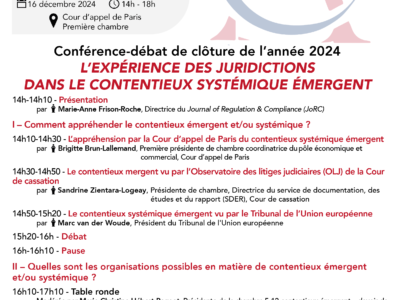
► Full Reference: L’expérience des juridictions dans le Contentieux Systémique Émergent (Courts Experience in Emerging Systemic Litigation), in cycle of conference-debates "Contentieux Systémique Émergent" ("Emerging Systemic Litigation"), organised on the initiative of the Cour d'appel de Paris (Paris Cour of Appeal), with the Cour de cassation (French Court of cassation), the Cour d'appel de Versailles (Versailles Court of Appeal), the École nationale de la magistrature – ENM (French National School for the Judiciary) and the École de formation des barreaux du ressort de la Cour d'appel de Paris – EFB (Paris Bar School), under the scientific direction of Marie-Anne Frison-Roche, 16 December 2024, 2pm.-6pm., Cour d'appel de Paris, Première Chambre (First Chamber) - ► Presentation of the conference:  - 🧮Programme of this event:  Closing conference-debate of 2024 L'EXPÉRIENCE DES JURIDICTIONS DANS LE CONTENTIEUX SYSTÉMIQUE ÉMERGENT  (COURTS EXPERIENCE IN EMERGING SYSTEMIC LITIGATION) Paris Court of Appeal, First Chamber   🕰️2pm.-2.10pm. Présentation (Introduction), by 🕴️Marie-Anne Frison-Roche, Professor of Regulatory Law and  Compliance Law, Director of the Journal of Regulation & Compliance (JoRC), Scientific Director of the Cycle of conferences-debates on the Emerging Systemic Litigation – ESL)   I – Comment appréhender le contentieux émergent et/ou systémique ?  (I – How to deal with Emerging and/or Systemic Litigation?) 🕰️2.10pm.-2.30pm. 🎤L’appréhension par la Cour d’appel de Paris du Contentieux Systémique Émergent (The Paris Court of Appeal's approach to Emerging Systemic Litigation), by 🕴️Brigitte Brun-Lallemand, Première présidente de chambre coordinatrice du pôle économique et commercial, Cour d’appel de Paris (First President of Chamber, Coordinator of the Economic and Commercial Division, Paris Court of Appeal) 🕰️2.30pm.-2.50pm. 🎤Le contentieux émergent vu par l’Observatoire des litiges judiciaires (OLJ) de la Cour de cassation, par 🕴️Sandrine Zientara-Logeay, Présidente de chambre, Directrice du service de documentation, des études et du rapport – SDER, Cour de cassation (President of Chamber, Director of the Department of Documentation, Studies and Reports – SDER, French Court of cassation)  🕰️2.50pm.-3.20pm. 🎤Le contentieux systémique Eémergent vu par le Tribunal de l’Union européenne (Emerging Systemic Litigation as seen by the General Court of the European Union), par 🕴️Marc van der Woude, President of the General Court of the European Union  🕰️3.20pm.-4pm. Debate 🕰️4pm.-4.20pm. Break   II – Quelles sont les organisations possibles en matière de contentieux émergent et/ou systémique ?  (II – How to organise with Emerging and/or Systemic Litigation?) 🕰️4.10pm.-5.10pm. 🎤Table ronde (Round Table) Moderated by 🕴️Marie-Christine Hébert-Pageot, Présidente de la chambre 5-12 contentieux émergent – devoir de vigilance et responsabilité écologique, Cour d‘appel de Paris (President of the 5-12 Chamber emerging litigation – duty of vigilance and ecological liability, Paris Court of Appeal) Speakers: 🕴️Stéphane Noël, Président du Tribunal judiciaire de Paris (President of the Paris First Instance Civil Court) 🕴️Patrick Sayer, Président du Tribunal de commerce de Paris (President of the Paris First Instance Commercial Court) 🕴️Jean-François Beynel, Premier président de la Cour d’appel de Versailles (First President of the Versailles Court of Appeal) and 🕴️Benjamin Deparis, Président du Tribunal judiciaire de Nanterre (President of the Nanterre First Instance Civil Court) 🕰️5.10pm.-5.40pm. Debate   🕰️5.40pm.-6pm. 🎤Conclusion. Le Contentieux Systémique Émergent : dialogues (Conclusion. Emerging Systemic Litigation: Dialogues), by 🕴️Jacques Boulard, Premier Président de la Cour d’appel de Paris (First President of the Paris Court of Appeal) - 🔴Registrations and information requests can be sent to: inscriptionscse@gmail.com 🔴For the attorneys, registrations have to be sent to the following address: https://evenium.events/cycle-de-conferences-contentieux-systemique-emergent/  ⚠️The conference-debates are held in person only, in the Cour d’appel de Paris (Paris Court of Appeal). -

Conferences

Conference

🎤Identifier et anticiper la pratique du Contentieux Systémique Émergent ; Présentation de 🧮L’expérience des juridictions dans le Contentieux Systémique Émergent

► Full Reference: M.-A. Frison-Roche, Identifier et anticiper la pratique du Contentieux Systémique Émergent (Identifying and anticipating the practice of Emerging Systemic Litigation) ; Presentation of L’expérience des juridictions dans le Contentieux Systémique Émergent (Courts Experience in Emerging Systemic Litigation), in cycle of conference-debates "Contentieux Systémique Émergent" ("Emerging Systemic Litigation"), organised on the initiative of the Cour d'appel de Paris (Paris Cour of Appeal), with the Cour de cassation (French Court of cassation), the Cour d'appel de Versailles (Versailles Court of Appeal), the École nationale de la magistrature – ENM (French National School for the Judiciary) and the École de formation des barreaux du ressort de la Cour d'appel de Paris – EFB (Paris Bar School), under the scientific direction of Marie-Anne Frison-Roche, 16 December 2024, 2pm.-6pm., Cour d'appel de Paris, Première Chambre (First Chamber). - 🧮see the full programme of this event - ⚙️This event has been conceived as a part of the cycle of conference-debates "Contentieux Systémique Émergent" ("Emerging Systemic Litigation"), organised on the initiative of the Cour d'appel de Paris (Paris Cour of Appeal), with the Cour de cassation (French Court of cassation), the Cour d'appel de Versailles (Versailles Court of Appeal), the École nationale de la magistrature – ENM (French National School for the Judiciary) and the École de formation des barreaux du ressort de la Cour d'appel de Paris – EFB (Paris Bar School), under the scientific direction of Marie-Anne Frison-Roche - ► English Summary of the conference:  - 🌐follow Marie-Anne Frison-Roche on LinkedIn 🌐follow Marie-Anne Frison-Roche on Instagram 🌐subscribe to the Newsletter MAFR Regulation, Compliance, Law 🌐subscribe to the Newsletter Surplomb, par MAFR

Articles

📝Antitrust, natural field of Systemic Litigation

► Full Reference: M.-A. Frison-Roche, "Antitrust, natural field of Systemic Litigation", Concurrences, November 2024, No. 4, Art. No. 120776. - 📝read the article (in English) - 🚧read the bilingual Working Paper which is the basis of this article, with additional developments, technical references and hyperlinks - ► English Summary of this article: Systemic Litigation is a specific category of Litigation in which beyond the dispute between the parties the interest of a System is involved, in particular its future. Competition Law is a natural and long-standing field for this category, which is now emerging strongly for information, climate and energy systems.  It should be remembered that a market is not self-regulating and cannot continue to function in the long term unless it has the benefit of a judge, a figure who is specific in that he/she is both external to it and yet apprehends its specific interest. In order to satisfy this double requirement, liberal legal organisations often entrust the competition authority with jurisdiction over this Systemic Litigation. Ordinary courts will also hear such cases, either on appeal or in other proceedings, and it cannot be claimed that courts are excluded, the systemic dimension of the dispute being expressed by the presence of the competition authority in the proceedings. This explains the procedural rules that are hard to justify otherwise. The Authority, the European Commission for example, must be able to develop and express the specific interests of the competition system. This special role of the competition authority in this type of litigation, because it is systemic, has been in place for decades and should serve as a model for Systemic Litigation, which is being developed for other systems whose sustainability is now referred to the courts. - 🌐follow Marie-Anne Frison-Roche on LinkedIn 🌐follow Marie-Anne Frison-Roche on Instagram 🌐subscribe to the Newsletter MAFR Regulation, Compliance, Law 🌐subscribe to the Newsletter Surplomb, par MAFR

Articles

💬L’interdiction de la GPA posée par le Code civil n’existe plus

► Full Reference: M.-A. Frison-Roche, "GPA : "L’interdiction de la GPA posée par le Code civil n’existe plus" ("The French Civil Code ban on surrogacy no longer exists"), interview with Olivia Dufour, Actu-Juridique, 26 November 2024 - 💬read the interview (in French) - ► Presentation of the interview by the journal: "Un simple arrêt de section rendu par la première civile de la Cour de cassation le 14 novembre 2024 peut-il donner plein effet à une "pure convention de GPA" ? Telle est la question que l’on peut se poser à la suite de cette décision. Éléments de réponse avec le professeur Marie-Anne Frison-Roche. ". - 🕴️M.-A. Frison-Roche, 📕GPA : dire Oui ou dire Non, 2018 - ► Questions posées, réponses apportées :  Actu-Juridique. Question : Un arrêt de section de la première chambre civile de la Cour de cassation rendu le 14 novembre dernier en matière de gestation pour autrui (GPA) a suscité l’émotion. Est-il exact de dire qu’en pratique, suite à cette décision, la prohibition en France de la GPA n’existe plus ?   Marie-Anne Frison-Roche. Réponse. :    A.J. Q. : Quels étaient les faits de l’espèce et en quoi diffèrent-ils des autres affaires ? MaFR. R. : O A.J. Q. : L’Europe avait-elle déjà pris position sur la GPA et si oui, par quels textes et dans quel sens ? MaFR. R. : En Europe, c'est la jurisprudence de la CEDH qui en 2014 (arrêts Mennesson) est venu briser la jurisprudence française pour imposer que la filiation de l'enfant né d'une GPA réalisée à l'étranger dans un pays où la GPA est licite puisse être établie à l'égard du père dont les gamètes avaient été utilisées. Il ne restait plus alors qu'à procéder à l'adoption par le conjoint de celui-ci. La législation interne ne fût pas pour autant modifiée mais le fonctionnement de l'état-civil permet de rendre inefficace la prohibition. Mais c'était à la fois dire Non et Oui… L'enjeu fût donc de modifier les textes, soit pour exclure la GPA plus fortement, soit pour l'admettre plus ouvertement.   A.J. Q. : En quoi la technique juridique utilisée pour faire reconnaître cette GPA en France était-elle différente de ce que l’on connait usuellement ? MaFR. R. : C   A.J. Q. : Quelle est la portée de cet arrêt ? MaFR. R. : I   A.J. Q. : Qu’en est-il du rapport avec l’adoption ? MaFR. R. : S   A.J. Q. : Le rapporteur n’a-t-il pas évoqué une possibilité de déguiser une adoption illicite à l’étranger sous une GPA ? MaFR. R. : S - 🌐follow Marie-Anne Frison-Roche on LinkedIn 🌐follow Marie-Anne Frison-Roche on Instagram 🌐subscribe to the Newsletter MAFR Regulation, Compliance, Law 🌐subscribe to the Newsletter Surplomb, par MAFR

Organisation of events

🧱⚙️Coordination of the conference 🧮Dans l’espace de justice, les pratiques juridictionnelles au service du futur (In the Space of Justice, Jurisdictional Practices at the Service of the Future)

► Full Reference: M.-A. Frison-Roche, coordination of the conference Dans l’espace de justice, les pratiques juridictionnelles au service du futur (In the Space of Justice, Jurisdictional Practices at the Service of the Future), in Cour de cassation, cycle of conferences "Penser les pratiques juridictionnelles au service d’un espace de justice" ("Thinking jurisdictional practices in the service of a Space of Justice"), 21 November 2023, 4pm.-6.30pm. - ► General presentation of the conference: The conception of the conference takes account of the fact that the event comes almost last in the cycle. Previous themes have been ‘jurisdictional practices’ insofar as they are ‘at the service of a European area of justice’ (February 2023), ‘enlightened’ (March 2023), ‘attractive’ (June 2023), ‘interactive’ (September 2023) and ‘peacemaking’ (December 2023). The conference's problematic stems from an observation: today, judges are facing claims that relate directly to the future. Of course, in their traditional office judges deal with the future of disputed situations, but today it is the future of systems in their entirety that is sometimes submitted to them through a dispute or a request, and a solution is sought. The possible presence of future generations is just one sign of this. The space of justice may seem unsuitable for such gigantic trials, both in terms of their subject matter and their impact. No doubt a distinction must be made between judges, and some judges may seem more familiar than others with the systemic issues that the future brings with it. Perhaps the judge's prudence should lead him not to use his power over the future, for example in the handling of sanctions, forgetting that the future by its very nature contains an element of the unknown, a fundamental prudence which the principle of the legality of offences and penalties expresses. But the future is not a blank page either and the judge, without inventing it, can check the coherence of those who write the law, if he is a constitutional judge, those who write contracts and commitments, if he is a civil or commercial judge. In order to fulfil their office, which the stakeholders are demanding, judges need to think about and deal with this new systemic object before them: the future. To understand it, judges draw on available jurisdictional practices, adjust others, and link them together using new methods. - 🧮read the programme of the cycle of conférences in 2023 (in French) -

Conferences

conference

🎥Synthèse (Synthesis), in 🧮Les pratiques juridictionnelles au service d’un espace juridique pour le futur (In the Space of Justice, Jurisdictional Practices at the Service of the Future)

► Full Reference: M.-A. Frison-Roche, "Synthèse" ("Synthesis"), in M.-A. Frison-Roche (dir.), Dans l’espace de justice, les pratiques juridictionnelles au service du futur (In the Space of Justice, Jurisdictional Practices at the Service of the Future), in Cour de cassation, cycle of conferences "Penser les pratiques juridictionnelles au service d’un espace de justice" ("Thinking about jurisdictional practices in the service of an area of justice"), 21 November 2024, 4pm.-6pm. - 🧮see the program of this manifestation (in French) - ► English summary of this conference:  The topic covered takes account of the fact that this scientific event comes almost last in this cycle of conferences Penser les pratiques juridictionnelles au service d’un espace de justice ("Thinking about jurisdictional practices in the service of an area of justice"). Indeed, 'jurisdictional practices' have previously been addressed insofar as they are 'at the service of a European area of justice' (February 2023), enlightened (March 2023), attractive (June 2023), interactive (September 2023), peacemaking (December 2023). The approach here is different and complementary. The conference's starting point is the observation that, today, many new claims are made before Judges that relate directly to the Future. Admittedly, in their traditional role, Judges deal with the Future of disputed situations, but today it is the Future of Systems in their entirety that is sometimes submitted to them through a dispute or a claim. Moreover, they may be asked to find a systemic solution. The possible presence of future generations is just one sign of this change. The courtroom may seem unsuitable for trials of such gigantic proportions, both in terms of their subject matter and their impact. No doubt a distinction must be drawn between judges, some of whom may appear more familiar than others with the systemic issues that the Future brings with itself. Perhaps the judge's prudence should guide him/her in the use they make of their powers when they relate to the future, for example in the handling of sanctions, because the future by its very nature contains an element of the unknown, a fundamental prudence that the principle of the legality of offences and penalties expresses. But the future is not a blank page and Judges, without inventing it, can, indeed must, monitor the coherence of those who write the legal rules, if they are constitutional judges, and of those who write contracts and commitments, if they are civil and commercial judges. In order to fulfill their role, particularly with regard to the demands of stakeholders, judges need to think about and deal with this new systemic object before them: the future. To understand it, Judges draw on available jurisdictional practices, adjust others and combine them, using new methods. - 🧮see below the complete programme of this manifestation⤵️ - 🌐follow Marie-Anne Frison-Roche on LinkedIn 🌐follow Marie-Anne Frison-Roche on Instagram 🌐subscribe to the Newsletter MAFR Regulation, Compliance, Law

Organisation of events

🧱⚙️scientifi organisation and moderation of 🧮Le Droit processuel de la Vigilance (Vigilance General Procedural Law), in cycle de conférences-débats “Contentieux Systémique Émergent”

► Full Reference: Le Droit processuel de la Vigilance (Vigilance General Procedural Law), in cycle of conference-debates "Contentieux Systémique Émergent" ("Emerging Systemic Litigation"), organised on the initiative of the Cour d'appel de Paris (Paris Cour of Appeal), with the Cour de cassation (French Court of cassation), the Cour d'appel de Versailles (Versailles Court of Appeal), the École nationale de la magistrature – ENM (French National School for the Judiciary) and the École de formation des barreaux du ressort de la Cour d'appel de Paris – EFB (Paris Bar School), under the scientific direction of Marie-Anne Frison-Roche, November 18, 2024, 11h-12h30, Cour d'appel de Paris, Cassin courtroom - ► Presentation of the conférence:  - 🧮Programme of this event:  Seventh conference-debate LE DROIT PROCESSUEL DE LA VIGILANCE (VIGILANCE GENERAL PROCEDURAL LAW) Paris Court of Appeal, Cassin courtroom Presentation and moderation par Marie-Anne Frison-Roche, Professor of Regulatory and Compliance Law, Director ot the Journal of Regulation & Compliance (JoRC) 🕰️11h-11h20. 🎤, by 🕴️Marie-Anne Frison-Roche, Professor of Regulatory and Compliance Law, Director ot the Journal of Regulation & Compliance (JoRC) 🕰️11h20-11h40. 🎤, by 🕴️Natalie Fricero, Emeritus Professor of Law at Côte d'Azur University 🕰️11h40-12h30. Debate - 🔴Registrations and information requests can be sent to: inscriptionscse@gmail.com 🔴For the attorneys, registrations have to be sent to the following address: https://evenium.events/cycle-de-conferences-contentieux-systemique-emergent/  ⚠️The conference-debates are held in person only, in the Cour d’appel de Paris (Paris Court of Appeal). -

Conferences

Conference

🎤Choix et embranchements de compétences lorsqu’un enjeu de vigilance est allégué (Choice and Branching of Jurisdiction when a Vigilance issue is Alleged), in 🧮Le Droit processuel de la Vigilance (Vigilance General Procedural Law)

► Full Reference: M.-A. Frison-Roche, "Choix et embranchements de compétences lorsqu'un enjeu de vigilance est allégué" ("Choice and Branching of Jurisdiction when a Vigilance issue is Alleged"), in Le Droit processuel de la Vigilance (Vigilance General Procedural Law), in cycle of conference-debates "Contentieux Systémique Émergent" ("Emerging Systemic Litigation"), organised on the initiative of the Cour d'appel de Paris (Paris Cour of Appeal), with the Cour de cassation (French Court of cassation), the Cour d'appel de Versailles (Versailles Court of Appeal), the École nationale de la magistrature – ENM (French National School for the Judiciary) and the École de formation des barreaux du ressort de la Cour d'appel de Paris – EFB (Paris Bar School), under the scientific direction of Marie-Anne Frison-Roche, November 18, 2024, 11h-12h30, Cour d'appel de Paris, Cassin courtroom - 🕴️An other speaker to this conference is Natalie Fricero, Emeritus Professor at Côte d'Azur University 🧮see the full programme of this event - ⚙️This event was conceived as part of the "Emerging Systemic Litigation" cycle of conference-debates, organized by the Paris Court of appeal, in conjunction with the French Court of cassation, the Versailles Court of appeal, the French National School for the Judiciary and the Paris Bar School, under the scientific direction of Marie-Anne Frison-Roche. - ► English Summary of the conference: This speech opens the conference. It therefore logically focuses on the question of "jurisdictional competence". It is divided into successive points which are progressively linked to each other. The first point consists to insist on this rule : the organisation of the courts and their jurisdiction can never be detached from the substance of the matter in dispute. This explains why the issue of jurisdiction is such a source of passion for as long as the very definition of Vigilance remains so contentious, and why the 2021 legislature's belief that it could put out the fire has only served to exacerbate it. The second point relates to the first proposed solution, i.e. maintaining the exclusivity of the Paris First Judicial Court, which is acceptable in principle because by specialising judges acquire a "technical competence" but which presents a very damaging "Bibendum risk". The third point relates to the second solution proposed, namely the reference to the Motulskian notion of the 'basis of demand', which provokes a fork in the road, with the risk of interminable conflicts and divergent interpretations. The fourth point is the need to find the best solution, i.e. the least bad solution, consisting above all of forming practical alliances, without requiring new texts, for this particular type of litigation which does not come under any branch of Law and which justifies a dialogue between the heads of the courts.           - 🔓read the key points of this speech below ⤵️ - 🌐follow Marie-Anne Frison-Roche on LinkedIn 🌐follow Marie-Anne Frison-Roche on Instagram 🌐subscribe to the Newsletter MAFR Regulation, Compliance, Law 🌐subscribe to the Newsletter Surplomb, par MAFR