Justice and procedure

Conferences

Conference

🎤Les spécificités à concevoir dans l’audience publique des contentieux systémiques de vigilance (The Specific Features of Public Hearings to conceive on Vigilance Systemic Litigation), in 🧮Le Droit processuel de la Vigilance (Vigilance General Procedural Law)

► Full Reference: M.-A. Frison-Roche, "Les spécificités à concevoir dans l'audience publique des contentieux systémiques de vigilance" ("The Specific Features of Public Hearings to conceive on Vigilance Systemic Litigation"), in Le Droit processuel de la Vigilance (Vigilance General Procedural Law), in cycle of conference-debates "Contentieux Systémique Émergent" ("Emerging Systemic Litigation"), organised on the initiative of the Cour d'appel de Paris (Paris Cour of Appeal), with the Cour de cassation (French Court of cassation), the Cour d'appel de Versailles (Versailles Court of Appeal), the École nationale de la magistrature – ENM (French National School for the Judiciary) and the École de formation des barreaux du ressort de la Cour d'appel de Paris – EFB (Paris Bar School), under the scientific direction of Marie-Anne Frison-Roche, November 18, 2024, 11h-12h30, Cour d'appel de Paris, Cassin courtroom - 🕴️An other speaker to this conference is Natalie Fricero, Emeritus Professor at Côte d'Azur University 🧮see the full programme of this event - ⚙️This event was conceived as part of the "Emerging Systemic Litigation" cycle of conference-debates, organized by the Paris Court of appeal, in conjunction with the French Court of cassation, the Versailles Court of appeal, the French National School for the Judiciary and the Paris Bar School, under the scientific direction of Marie-Anne Frison-Roche. - ► English Summary of the conference:  - 🌐follow Marie-Anne Frison-Roche on LinkedIn 🌐follow Marie-Anne Frison-Roche on Instagram 🌐subscribe to the Newsletter MAFR Regulation, Compliance, Law 🌐subscribe to the Newsletter Surplomb, par MAFR

Conferences

Conference

🎤Considérer la géographie pour réussir le Devoir de Vigilance (Taking Geography into account for a successful Vigilance Duty), in 🧮Devoir de vigilance, quelles perspectives africaines ? Regards croisés en droit international, droit comparé et droit OHADA

► Full Reference: M.-A. Frison-Roche, "Considérer la géographie pour réussir le Devoir de Vigilance" ("Taking Geography into account for a successful Vigilance Duty"), concluding speech in Devoir de vigilance, quelles perspectives africaines ? Regards croisés en droit international, droit comparé et droit OHADA (Vigilance Duty : what African perspectives? Cross-analysis of International Law, Comparative Law and OHADA Law), Institut de Recherche en Droit des Affaires et du Patrimoine (IRDAP), Bordeaux, 15 November 2024. - 🧮see the full programme of this manifestation (in French) - ► English summary of this concluding speech: This concluding speech was made "on the bench", i.e. directly after listening to all the day's speakers. It is not, therefore, based on an a priori conception of the subject, but on the impression that emerged from the whole, as one speaker followed another. The general impression is that these compliance instruments, of which the vigilance tool is the spurred head, are only appropriate if they fulfill the purpose for which they were devised and imposed, which presupposes that they are appropriate to the concrete situations to which they apply: to the country, to the legislation that shapes and expresses this country, to its economy, to its population. There is certainly room for improvement. But Vigilance legal instruments, like Compliance Law, are new mechanisms that are in the process of taking shape: we must seek to improve them and find solutions: 🧱🕴🏻mafr, 🚧Duty of Vigilance: the way forward, 2024   This is not easy, especially if we get lost in the jigsaw puzzle of texts and decisions in which the vigilance technique fits, particularly at French, European and international level: 🧱🕴🏻mafr, 🚧Vigilance, a piece of the European puzzle, 2023   Listening to all the many and varied speakers, it is clear that progress needs to be made to ensure that the Vigilance instrument takes greater account of the concrete situations reflected in the various legal systems of African countries, and in particular the unified OHADA legal system. It can be done, as long as everyone is willing to bear it in mind. 🧱🕴🏻J.-B. Racine, 📝Geographical dominance in the choice and the use of compliance tools. Introductory remarks, in 🧱🕴🏻mafr (ed.), 📘Compliance Tools, 2021   The speakers demonstrated that the good feelings of Paris or Brussels can pave the way for African hell, for example when about the children labour. The same is true of the fight against corruption, as Mohamed Salah showed. 🧱🕴🏻M.M. Salah ,📝Conception and Application of Compliance in Africa, in 🧱🕴🏻mafr (ed.), 📘Compliance Tools, 2021 - Meanwhile, listening to each other, it appears that often, despite using the same words, the speakers were not talking about the same thing, particularly not in terms of what the very term "Vigilance" refers to, the difference between the French and English being a challenge because "due diligences" are not the same than Vigilance duty . This is a sign that what we call a duty, or an obligation, or a spontaneous commitment, or a legal order criminally sanctioned, which are not at all the same thing, shows the immaturity of this notion of "Vigilance". What's more, we sometimes talk about the climate, or human rights, or the need to fight corruption or money laundering. These latter concerns are undoubtedly covered by texts classified under Compliance Law, some of which assert that Vigilance is the cutting edge, while others claim that Compliance is alien to or merely a component of Vigilance, because Vigilance embraces ethics, while Compliance is merely obedience to the norm ('conformity'). It is clear that the absence of an agreement on definitions is a handicap in practice, as we do not know which legal regime will apply. This uncertainty is problematic in practice because the regulations don't  lay down definitions which alone make it possible to deduce the outline of the obligations of each party, particularly not those of the companies, which ask for instructions for use. Companies receive contradictory interpretations for the same situation, depending on who you are dealing with (a regulator or an NGO for example) or depending on the text (a text specific to the industrial activity, a text specific to the country, or a text from the country of the ordering company on the duty of vigilance, or a text from ordinary contract law or a text that will come from a soft law that remains rather mysterious).   This uncertainty feeds the passion that surrounds the issue of vigilance, with everyone speaking out, the specialists who want to talk about it being suspected of being a technocrat or captured, and those who don't speak out being the local population for whom others speak out. As a result, two phenomena are set to persist, which we had hardly anticipated but which are set to increase: the contractualisation of all vigilance mechanisms and the jurisdictionalisation of all vigilance organisation. - The first phenomenon is the contracting of Vigilance. This contractualisation is the means by which companies have been carrying out their legal compliance obligations for years, using a contractual art that is becoming increasingly sophisticated. We have very little information on these contracts, which are nonetheless what allow companies to obey the regulations and also to add to them, a combination of obedience and contractual freedom, the effects of which in practice have not yet been fully measured. 🧱🕴🏻mafr, 🚧Will, Heart and Calculation, the Three Traits Encercling the Compliance Obligation, 2024 🧱🕴🏻mafr (ed.), 📘Compliance and Contract, 2025   But they do raise essential questions. Firstly, they will bring back the jurisdiction of general courts , for example the commercial courts (tribunaux de commerce) in France, and the courts of the countries where the industrial operations take place: moreover, they are the natural route to international arbitration. They are a new type of contract, since they structure "value chains" (a managerial concept). 🧱🕴🏻mafr, 🚧Compliance Contract, Compliance Clauses, 2022   There are two key issues concerning these contracts: they directly concern African countries, their economic activity and their populations, as described throughout all the speeches. The first is to know who governs the structural apparatus constituted by these 'regulatory contracts' through which chains of activity are built as durable structures. Who is strong and who is weak, between companies and states? The second is to find out how much of the reality of the country and of local economic activity is taken into account by the subsidiary, and how much consideration is given to the local people involved: are the people who are actually involved really "taken into consideration" when we speak for them? Who is best placed to speak on their behalf, to defend them, to get to know them? If we want to contextualise, refine and get to know the situation as closely as possible, in other words if we want to have definitions so that we know what we are talking about, but at the same time start from geographical and human realities, then it is the Judge who appears because the court starts from the facts. - This is the second phenomenon that has emerged and is set to increase: the jurisdictionalisation of Vigilance. 🧱🕴🏻mafr (ed.), 📘Compliance Jurisdictionalisation, 2023 This is understandable, since the judge is able to take cognisance of the facts, the situation in Uganda or Tanzania, and what is often referred to as the "extraterritoriality" of the Compliance mechanisms being thus compensated for. However, the exclusive jurisdiction of the Paris Court of First Instance (decided in France by a 2021 law) may become more difficult, as it is even further away from Africa than the ordering company is. But it is precisely the contract judges who can be called upon to rule on the basis of Contract Law. This central role of the judge raises a number of procedural difficulties that have either not yet been resolved, moreover are not still being perceive 🧱🕴🏻mafr (dir.), 🧮Le Droit processuel de la Vigilance (Vigilance Genreral Procedural Law), 2024   At the interface between procedure and substance, evidentiary issues require the development of a new evidentiary system. When the relevant facts are in Africa but the company accountable for them is in France under legislation adopted in Europe, this must be taken into account. 🧱🕴🏻mafr, 📝The Judge, the Compliance Obligation and the Company. The Compliance Evidence System, in 🧱🕴🏻mafr (ed.), 📘Compliance Jurisdictionalisation, 2023   What's more, since the Monumental Goal is to prevent, manage and detect risks, it is the future that is the main object of proof. A difficult subject by its very nature of the future, which calls for caution. Caution is to be expected from Judges, who may prefer the solution of an agreement: the contract and the commitment come back, for example through mediation, among the methods of conflict resolution. But as close as possible to where it happens, OHADA's courts can then be called upon to hear States and populations.   What is more, in contractualisation (at which point the two major phenomena, contractualisation and jurisdictionalisation, enter into a dialectic), the clauses work together to activate the natural judge of the international contract, including vigilance clauses: the international arbitrator. 🧱🕴🏻L. Aynès, 📝How international arbitration can reinforce the Compliance Obligation, in 🧱🕴🏻mafr (ed.), 📘Compliance Obligation, 2025   OHADA has institutional arbitration mechanisms. Now is the time to guide them so that they open up Africa to Vigilance and open up Vigilance to Africa. In concrete terms. - 🌐follow Marie-Anne Frison-Roche on LinkedIn 🌐follow Marie-Anne Frison-Roche on Instagram 🌐subscribe to the Newsletter MAFR Regulation, Compliance, Law 🌐subscribe to the Newsletter Surplomb, par MAFR

Surplomb - Notion

🎬Procedural Law of Regulation and Compliance

Articles in a legal collective publication

💬”Les droits de la défense sont au bénéfice de tout le monde, y compris de l’entreprise elle-même” (The rights of defence benefit everyone, including the company itself)

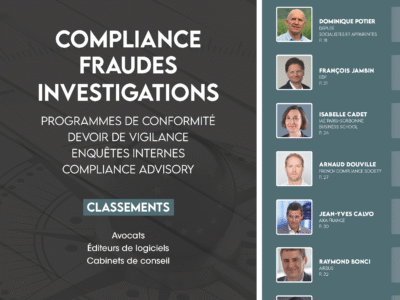
► Full Reference: M.-A. Frison-Roche, "Les droits de la défense sont au bénéfice de tout le monde, y compris de l’entreprise elle-même" (The rights of defence benefit everyone, including the company itself), interview by Chloé Lassel, in Guide Compliance Fraudes Investigations, edition 2024, ed. Décideurs, Oct. 2024, pp. - 💬read the interview (in French) 🌐its  présentation on LinkedIn (in French) - ► Presentation of this interview by Décideurs juridiques : "Directrice du Journal of Regulation & Compliance (JoRC) et fondatrice de l’École européenne de droit de la régulation et de la compliance, Marie-Anne Frison-Roche revient sur la révolution du droit de la compliance, son articulation avec les enquêtes internes et les droits de la défense, la place que vont y prendre les contrats et l’arbitrage international." ("Marie-Anne Frison-Roche, Director of the Journal of Regulation & Compliance (JoRC) and founder of the European School of Regulatory and Compliance Law, looks back at the revolution in Compliance Law, its relationship with internal investigations and the rights of the defence, and the role that contracts and international arbitration will play in it. - ► Questions asked, Answers given:  Décideurs. Question : La compliance est au cœur des préoccupations des entreprises depuis plusieurs années. Pouvez-vous expliquer ce que c’est exactement ? (Compliance has been a key concern for companies for several years. Can you explain what it is exactly?) Marie-Anne Frison-Roche. English summary Answer: 'Compliance' should not be confused with 'Compliance', which I defined in 2016. Compliance Law is an extension of Regulatory Law, by freeing the latter from the existence of a sector as a prerequisite and a regulatory authority as an indicator. Internalised in the company, it manifests itself, for example, in Vigilance mechanisms, which are its cutting edge. Through Compliance, the political authority asks companies to help it achieve "Monumental Goals", as I have suggested, standards in which this new branch of Law is anchored (anti-money laundering, anti-corruption, sustainability, etc.).   D. Q. : Les entreprises doivent désormais être enquêtrices et juges de ce qu’il leur arrive. Voire transmettre aux autorités, lorsqu’il le faut, des informations pouvant les incriminer. Comment concilier ces obligations avec les droits de la défense ? (Companies must now be investigators and judges of what happens to them. When necessary, they can even pass on incriminating information to the authorities. How do you reconcile these obligations with the rights of the defence?) MaFR. English summary A.: In 2023, I proposed this expression of companies as "prosecutors and judges of themselves", and the place that this should give to the rights of the defence, and in 2024 I will work out the right balance between internal investigations and the rights of the defence. For the moment, this balance has not been achieved.   D. Q. : Dans l’un de vos ouvrages, François Ancel, conseiller à la première chambre civile de la Cour de cassation, écrit que la compliance renouvelle l’office du juge. Comment concilier cette idée avec l’office habituel du juge qui est celui de se prononcer sur des faits avérés et non pas futurs ? (In one of your books, François Ancel, judge in the First Civil Chamber of the French Court of Cassation, writes that Compliance is renewing the role of the judge. How do you reconcile this idea with the judge's usual role, which is to rule on proven facts rather than future ones?) MaFR. English summary A.: Indeed, In this book La juridictionnalisation de la compliance (Compliance Jurisdictionalisation), he stresses that the role of the civil and commercial courts is being profoundly renewed, in particular because they must deal with what I described in 2021 as "Systemic Litigation" and must rule on the future. From then on, the ordinary courts will take centre stage.   D. Q. : Le recours aux clauses de compliance est-il une solution pour être à la hauteur des ambitions de la compliance et de ses exigences ? (Is the use of compliance clauses a solution for living up to the ambitions and requirements of compliance?) MaFR. English summary A.: Indeed, in 2022, I developed the concepts of 'Compliance Contract' and 'Compliance clauses', by which companies implement their legal compliance obligations. This gives rise to Regulatory Contracts, particularly in business chains. This gives a great deal of leeway and power, but also Responsibility, to the companies that invent them.   D. Q. : Le recours aux arbitrages doit-il être privilégié ? (D. Q. Should recourse to arbitration be preferred?) MaFR. English summary A.: It has to be. Because there is a contract. Even though Compliance is closely bound up with the legal obligations and public order, and possibly international public order. Even if this is not yet apparent, Compliance and International Arbitration are natural allies. - 🌐follow Marie-Anne Frison-Roche on LinkedIn 🌐follow Marie-Anne Frison-Roche on Instagram 🌐subscribe to the Newsletter MAFR. Regulation, Compliance, Law 🌐subscribe to the Newsletter Surplomb, par MAFR

Organisation of events

⚙️ scientific organisation of a public manifestation

🧱⚙️scientific organisation and moderation of 🧮Les techniques probatoires adéquates dans le Contentieux Systémique Émergent (Appropriate Evidentiary Techniques in Emerging Systemic Litigation), in cycle of conference-debates “Contentieux Systémique Émergent” (“Emerging Systemic Litigation”)

► Full Reference: Les techniques probatoires adéquates dans le Contentieux Systémique Émergent (Appropriate Evidentiary Techniques in Emerging Systemic Litigation), in cycle of conference-debates "Contentieux Systémique Émergent" ("Emerging Systemic Litigation"), organised on the initiative of the Cour d'appel de Paris (Paris Cour of Appeal), with the Cour de cassation (French Court of cassation), the Cour d'appel de Versailles (Versailles Court of Appeal), the École nationale de la magistrature – ENM (French National School for the Judiciary) and the École de formation des barreaux du ressort de la Cour d'appel de Paris – EFB (Paris Bar School), under the scientific direction of Marie-Anne Frison-Roche, October 14, 2024, 11am.-12.30pm., Paris Court of Appeal, Masse courtroom - ► Presentation of the conference:  - 🧮Programme of this event:  Sixth conference-debate LES TECHNIQUES PROBATOIRES ADÉQUATES DANS LE CONTENTIEUX SYSTÉMIQUE ÉMERGENT  (APPROPRIATE EVIDENTIARY TECHNIQUES IN EMERGING SYSTEMIC LITIGATION) Cour d’appel de Paris, salle Masse Presentation and moderation by 🕴️Marie-Anne Frison-Roche, Professor of Regulatory and Compliance Law, Director of the Journal of Regulation & Compliance (JoRC) 🕰️11am.-11.10am. 🎤La crédibilité (Credibility), by 🕴️Marie-Anne Frison-Roche, Professor of Regulatory and Compliance Law, Director of the Journal of Regulation & Compliance (JoRC) 🕰️11.10am.-11.30am. 🎤Ce que des entreprises font et les preuves disponibles qui en résultent (What firms are doing and evidence available as a result), by 🕴️Nathalie Fabbe-Costes, Professor of management at Aix-Marseille University  🕰️11.30am-11.50am. 🎤Les différentes techniques probatoires quand un système est impliqué dans un litige (The various evidential techniques when a system is involved in a dispute), by 🕴️Thibault Goujon-Bethan, Professor of Law at Jean-Moulin Lyon 3 University, director of the Centre patrimoine et contrats, director of the IEJ de Lyon 🕰️11.50am.-12h30pm. Debate - 🔴Registrations and information requests can be sent to: inscriptionscse@gmail.com 🔴For the attorneys, registrations have to be sent to the following address: https://evenium.events/cycle-de-conferences-contentieux-systemique-emergent/  ⚠️The conference-debates are held in person only, in the Cour d’appel de Paris (Paris Court of Appeal). -

Articles

Interview

💬Compliance & arbitrage : les prémices d’une symbiose (💬Compliance & Arbitration: the beginnings of a symbiosis)

► Full Reference: M.-A. Frison-Roche, E. Silva Romero, G. Filhol, V. Autret, B. Sillaman et K. Hennessee, Compliance & arbitrage : les prémices d’une symbiose, propos recueillis par O. Delaunay, LJA Magazine, septembre-octobre 2024, pp. 12-20 - 💬read the collective interview (in French) - 🌐read the presentation of this interview on LinkedIn - ► Topics covered during this collective interview:  The development of Compliance in an international environment The Arbitrator and the concept of Compliance Linking Arbitration and Compliance systems - ► Summary of my interventions: Compliance Law appears to be developing in the context of international trade and Arbitration. For my part, I placed particular emphasis on the fact that the first reports were the result of "negative reports" between Compliance and Arbitration, through Criminal Law and the obligation of arbitrators to ensure that they don't give effectivity to pacts of corruption. But the future lies in a more 'positive' and fruitful relationship between this new branch of law, Compliance Law, and the solid prospect offered by Arbitration, in that the arbitrator, this natural judge of international trade, will be able to support the contractualisation of Compliance obligations, particularly about due diligences in structural chains of activities and duty of vigilance. Thus competent, the international arbitrator must respond to what the Monumental Goals in which Compliance Law is rooted expect of him/her: to provide solutions and remedies to issues that often concern an entire chain of activity or an entire sector in a more systemic perspective than in a traditional conception. This applies not only to investment arbitration, but also, for instance, to infrastructure arbitration. The concern for sustainability and the systemic perspective must be integrated into the reasoning and produce appropriate case law, a sort of new doctrine in the arbitration order, that will make more attractive the arbitration place that will most solidly link the skills of specialists in Compliance Law and Arbitration Law. - 🌐follow Marie-Anne Frison-Roche on LinkedIn 🌐follow Marie-Anne Frison-Roche on Instagram 🌐subscribe to the Newsletter MAFR. Regulation, Compliance, Law 🌐subscribe to the Newsletter Surplomb, by MAFR

Working papers

Working Paper for 📺Overhang

🚧Monumental Goals, normative anchoring of Compliance

► Full Reference: M.-A. Frison-Roche, Monumental Goals, normative anchoring of Compliance, Working Paper, February 2025.   - 🎬This working document has been drawn up to serve as basis to the video Overhang👁 of  the 1st February 2025: click HERE - 🎬🎬🎬In the collection of the Overhangs👁 It falls into the Notions category. ►Watch the complete collection of the Overhangs👁 : click HERE - ► Summary of this  Working Paper: Compliance, of which conformity is only one instrument (the 2 should not be confused), must be understood through the ‘Monumental Goals’ : political ambitions pursued by the public authorities and internalised in the entities in a position to achieve them, i.e. large companies. These Goals are Monumental in that they concern systems: ensuring that these systems do not collapse in the future = ‘Negative Monumental Goals’ (e.g. fight against corruption, against climate change); more ambitious still, they may aim to improve systems = ‘Positive Monumental Goals’ (e.g. effective equality between women and men). Their systemic nature gives rise to Systemic Litigation. - 🔓read the developments below⤵️ - 🌐follow Marie-Anne Frison-Roche sur LinkedIn 🌐follow Marie-Anne Frison-Roche on Instagram 🌐subscribe to the Newsletter MAFR Regulation, Compliance, Law  🌐subscribe to the Video Newsletter MAFR Overhang/Surplomb

Organisation of events

🧱⚙️scientific organisation of 🧮L’incidence du devoir de vigilance sur les litiges commerciaux (The impact of the duty of vigilance on commercial litigation)

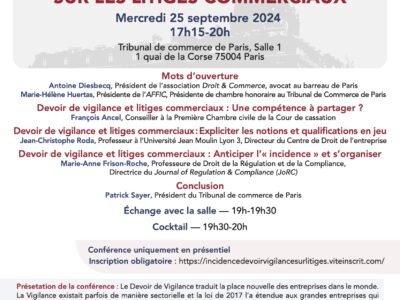
► Full Reference: M.-A. Frison-Roche, coordination of the conference L'incidence du devoir de vigilance sur les litiges commerciaux (The impact of the duty of vigilance on commercial litigation), Tribunal de commerce de Paris (Paris Commercial Court), Droit & Commerce and Association Française en Faveur de l'Institution Consulaire (AFFIC), Tribunal de commerce de Paris, 25 September 2024, 5.15p.m. to 8p.m. - 🧮see the full programme of this event - 🌐consult on LinkedIn a general présentation of this event (in French) - ► General presentation of the conference: The Duty of Vigilance reflects the new role of firms in the world. Vigilance sometimes existed on a sectoral basis, but the 2017 French law extended it to large companies that control value chains. The French so-called "confiance" law gave the Tribunal judiciaire de Paris (Paris First Instance Civil Court) jurisdiction to hear "actions relatives" ("actions relating") to this duty. This does not mean, however, that the commercial courts will no longer have jurisdiction. Firstly, vigilance may go beyond the scope of the 2017 French law. Secondly, vigilance may concern not only the plan drawn up by the firm, but also Commercial Contract Law or Liability Law, special Distribution Law, etc. Commercial courts will have to develop a doctrine for dividing up and coordinating disputes, in particular by staying proceedings within certain disputes. To build a unified or at least non-contradictory case law on vigilance, we need to imagine a dialogue between judges and new procedures. - 🧮Programme of this event:  L'INCIDENCE DU DEVOIR DE VIGILANCE SUR LES LITIGES COMMERCIAUX (THE IMPACT OF THE DUTY OF VIGILANCE ON COMMERCIAL LITIGATION) Paris First Instance Commercial Court, room 1 🕰️5.15pm.-5.30pm. Welcome 🕰️5.30pm.-5.40pm. 🎤Mots d'ouverture (Opening words), by 🕴️Antoine Diesbecq, President of Droit & Commerce, attorney at the Paris Bar and 🕴️Marie-Hélène Huertas, President of AFFIC, Honorary President of Chamber of the Paris First Instance Commercial Court 🕰️5.40pm.-6pm. 🎤Devoir de vigilance et litiges commerciaux : Une compétence à partager ? (Duty of Vigilance and Commercial Litigation: A jurisdiction to share?), by 🕴️François Ancel, Judge at the Première Chambre civile de la Cour de cassation (First Civil Chamber of the French Court of cassation) 🕰️6pm.-6.20pm. 🎤Devoir de vigilance et litiges commerciaux : Expliciter les notions et qualifications en jeu (Duty of Vigilance and Commercial Litigation: Explain the concepts and qualifications involved?), by 🕴️Jean-Christophe Roda, Full Professor at Jean Moulin Lyon 3 University, Director of the Centre de Droit de l’entreprise 🕰️6.20pm.-6.40pm. 🎤Devoir de vigilance et litiges commerciaux : Anticiper l''incidence" et s’organiser (Duty of Vigilance and Commercial Litigation: Anticipating the "impact" and getting organised), by 🕴️Marie-Anne Frison-Roche, Professor of Regulatory Law and Compliance Law, Director of the Journal of Regulation & Compliance (JoRC) 🕰️6.40pm.-7pm. 🎤Conclusion (Conclusion), by 🕴️Patrick Sayer, President of the Tribunal de commerce de Paris (Paris First Instance Commercial Court) 🕰️7pm.-7.30pm. Discussion with the audience 🕰️7.30pm.-8pm. Cocktail - 🌐follow Marie-Anne Frison-Roche on LinkedIn 🌐follow Marie-Anne Frison-Roche on Instagram 🌐subscribe to the Newsletter MAFR Regulation, Compliance, Law

Conferences

Conference

🎤Devoir de vigilance et litiges commerciaux : Anticiper l'”incidence” et s’organiser (Duty of vigilance and Commercial Litigation: Anticipating the “impact” and getting organised), in 🧮L’incidence du devoir de vigilance sur les litiges commerciaux (The Impact of the Duty of Vigilance on Commercial Litigation)

► Full Reference: M.-A. Frison-Roche, "Devoir de vigilance et litiges commerciaux : Anticiper l'"incidence" et s’organiser" ("Duty of vigilance and Commercial Litigation: Anticipating the "impact" and getting organised"), in L'incidence du devoir de vigilance sur les litiges commerciaux (The Impact of the Duty of Vigilance on Commercial Litigation), Tribunal de commerce de Paris (Paris Commercial Court), Droit & Commerce and Association Française en Faveur de l'Institution Consulaire (AFFIC), Tribunal de commerce de Paris, September 25, 2024, 17.15pm to 20pm - 🌐read the report of this speech on LinkedIn (in French) - 🧮see the full programme of this event (in French) - 🧱consult the scientific coordination sheet of this event - 🌐consult on LinkedIn a general presentation of this event (in French) - ► English Summary of the conference: After listening to the enlightening speeches of François Ancel and Jean-Christophe Roda, I had the great opportunity to emphasise, as they did, that the duty of vigilance, in the respect of French laws of 2017 and 2021, with a view to the transposition of the CS3D, does not imply, so brutally as has been said, a lack of knowledge by judges other than those of the Tribunal judiciaire de Paris (Paris First Instance Civil Court) of this new Law, which is the extension of Compliance Law, as François Ancel reminded us. Because Commercial Court judges deal with Contract Law on a daily basis, and because companies build their value chains through contracts that should be described as "regulatory contracts", the duty of vigilance has an "impact" on these disputes. These disputes may be of a "systemic" nature. This can only result not in jurisdictional trenches, but in "shared jurisdiction", along the lines drawn by François Ancel. This sharing must be built through a dialogue between judges, a necessary method on which Patrick Sayer concluded this elaborate conference on an essential and forward-looking subject. - 🌐follow Marie-Anne Frison-Roche on LinkedIn 🌐follow Marie-Anne Frison-Roche on Instagram 🌐subscribe to the Newsletter MAFR Regulation, Compliance, Law 🌐subscribe to the Video Newsletter MAFR Surplomb

Publication director

🏗️ direction of the collection: 📚Cours Dalloz – Série Droit privé

📚Publication of : 🕴️Xavier PIN, 📕Droit pénal général (General Criminal Law), 16th ed.

► Full Reference : X. Pin, Droit pénal général 2025 (General Criminal Law 2025), 16th ed., 2024, Dalloz, “Cours Dalloz-Série Droit privé” Series, 722 p. - ► General presentation of the book (written in French) : The new 2024 edition of this book, up to date with the latest reforms, first deals with the « criminal law » in its determination and application; it then deals with « the offence », its characterisation and its attribution, and ends, in a third part, with « the penalty », distinguishing between the penalty incurred, the penalty imposed and the penalty enforced. - 📚See the entire collection in which the book is published. - 📚Books in the collection directly related to this one : 🕴️Ch. André, 📕Droit pénal spécial (Special Criminal Law) 🕴️É. Verny, 📕Procédure pénale (Criminal Procedure) 🕴️G. Beaussonie, 📕Droit pénal des affaires (Business Criminal Law) -

Organisation of events

🧱⚙️scientific organisation and moderation of 🧮Le rapport de durabilité : obligation et Contentieux Systémiques Émergents (The Sustainability Report: Emerging Systemic Obligation and Litigation), in cycle of conference-debates “Contentieux Systémique Émergent” (“Emerging Systemic Litigation”)

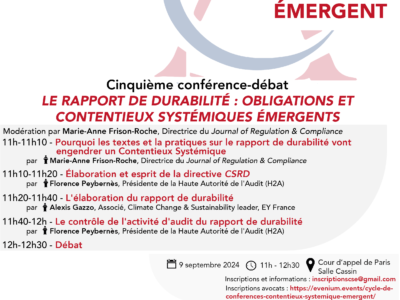
► Full Reference: M.-A. Frison-Roche, Scientific direction of the conference Le rapport de durabilité : obligation et Contentieux Systémiques Émergents (The Sustainability Report: Emerging Systemic Obligations and Litigation), in cycle of conference-debates "Contentieux Systémique Émergent" ("Emerging Systemic Litigation"), organised on the initiative of the Cour d'appel de Paris (Paris Cour of Appeal), with the Cour de cassation (French Court of cassation), the Cour d'appel de Versailles (Versailles Court of Appeal), the École nationale de la magistrature – ENM (French National School for the Judiciary) and the École de formation des barreaux du ressort de la Cour d'appel de Paris – EFB (Paris Bar School) and MAFR, September 19, 2024, 11h-12h30, Cour d'appel de Paris, Cassin courtroom - ► Presentation of the conférence: Sustainability is a new legal concept, the lineaments of which can be found in certain sectors and branches of Law, and which today has both multiple resulting obligations and a definition that is sufficiently unified to allow it to be grasped through the technique and the requirement of the "Sustainability Report", which translates a requirement linked to the systems themselves. The dual materiality mechanism illustrates this. The Litigation that will ensue shall be imbued with this systemic dimension, since this report was required from this perspective, and the notion of Sustainability itself was conceived in the same way. What is commonly referred to as "ESG" reflects this perspective, which is both structural and long-term: Information is central here, since it is a Report, anchored in  the new conception of Corporate Law that is imbued with Governance, where internal and external stakeholders are present. The various Supervisors and Regulators, who go beyond supervising professionals to regulate activities, are also bound to have a role to play in this Emerging Systemic Litigation. In order to understand and anticipate this, this conference is built around an analysis of the construction of the Sustainability Report and an analysis of the role of the Regulatory and Supervisory Authority, the French Audit Authority, the Haute Autorité de l'Audit – H2A. These analyses are carried out with a view to the Systemic Litigation that will arise from these new requirements and practices, in correlation with Litigation linked to other fields of Systemic Litigation such as Vigilance field. - 🧮Programme of this event:  Fith conference-debate LE RAPPORT DE DURABILITÉ : OBLIGATIONS ET CONTENTIEUX SYSTÉMIQUES ÉMERGENTS (THE SUSTAINABILITY REPORT: EMERGING SYSTEMIC OBLIGATIONS AND LITIGATION) Paris Court of Appeal, Cassin courtroom 🕰️11am.-11.10am. 🎤Pourquoi les textes et la pratiques sur le rapport de durabilité vont engendrer un Contentieux Systémique (Why the texts and practices on sustainability reporting will give rise to Systemic Litigation), by 🕴️Marie-Anne Frison-Roche, Professor of Regulatory Law and Compliance Law, Director of the Journal of Regulation & Compliance (JoRC) ➡️read the presentation of this speech 🕰️11.10am.-11.20am. 🎤Élaboration et esprit de la directive CSRD (Elaboration and spirit of the CSRD), by 🕴️Florence Peybernès, President of the Haute Autorité de l'Audit – H2A (French High Audit Authority) 🕰️11.20am.-11.40am. 🎤Comment construire un rapport de durabilité ? (How to build a sustainability report?), by 🕴️Alexis Gazzo, Partner, Climate Change & Sustainability leader, EY France 🕰️11.40am.-12pm. 🎤Le contrôle de l'activité d'audit du rapport de durabilité (The control of the audit of the sustainability report), by 🕴️Florence Peybernès, President of the Haute Autorité de l'Audit – H2A (French High Audit Authority) 🕰️12pm.-12.30pm. Debate - 🔴Registrations and information requests can be sent to: inscriptionscse@gmail.com 🔴For the attorneys, registrations have to be sent to the following address: https://evenium.events/cycle-de-conferences-contentieux-systemique-emergent/  ⚠️The conference-debates are held in person only, in the Cour d’appel de Paris (Paris Court of Appeal). -

Publication director

🏗️ direction of the collection: 📚Cours Dalloz – Série Droit privé

📚Publication of : 🕴️Claude BRENNER, 📕Procédures civiles d’exécution (Civil Enforcement Procedures), 12th ed.

► Full Reference : Cl. Brenner, Procédures civiles d’exécution (Civil Enforcement Procedures), 1st ed. 1998 – 12th ed., 2024, Dalloz, “Cours Dalloz-Série Droit privé” Series, 330 p. - ► General presentation of the book (written in French) : In the 12th edition of this textbook, up to date with the reform of the law of security interests, Claude Brenner sets out the rules on civil enforcement procedures as a complement to the Law of Obligations, since they make effective the binding force of contracts and the liability of persons. Up to date with all the successive reforms, this textbook makes it possible to understand the subject as a whole, in its common rules and in the specific procedures that have developed within it. The book is built in two titles, the first dealing with enforcement procedures, the second with distribution procedures. - 📕Read the back cover (in French) - 📕Read the table of contents (in French) - 📚See the entire collection in which the book is published. - 📚Books in the collection directly related to this one : 🕴️N. Cayrol, 📕Procédure civile (Civil Procedure) 🕴️J.-B. Seube, 📕Droit des sûretés (Law of Security Interests) -

Working papers

🚧The invention of the ‘right to a child’. The consequences of contractual practice as a source of childbearing

► Full reference : M.-A. Frison-Roche, The invention of the 'right to a child'. The consequences of contractual practice as a source of filiation, working document, Sept. 2024 – Oct. 2025. - 🎤This working document forms the basis of a presentation entitled, "Le "droit à l'enfant" est-il concevable, pourquoi et avec quelles conséquences" (Is the 'right to a child' conceivable, why and with what consequences", in Les nouvelles filiations. Diifférentes perspectives (New parentage. Different perspectives." held at the Paris Court of Appeal on 12 September 2024. - 📝Revised, this working document forms the basis of the article published in the dossier "Les nouvelles filiations. Regards croisés" (New parentage. Different perspectives), Act. jur. Dalloz Droit de la famille (in French). - ► Summary of this working document  :  Every legal system is built on concepts that form its pillars. Filiation is one such concept. A cas-law solution, presented as pragmatic and casuistic, can overturn this concept. Whether one agrees with it or not, it must first be acknowledged and assessed. Through a series of rulings on surrogacy, notably a ruling by its First Civil Chamber granting exequatur to a judgment recognising the filiation established by surrogacy between a child and persons with no biological link to the child and without recourse to adoption, the French Cour de Cassation has introduced the possibility of creating parentage by contract. This not only changes the concept of filiation but also changes the very structure of the French legal system, which is based on the distinction between persons and things. One may agree or disagree with this, but it must be said. Since the judge gives force to such a contract establishing filiation, with the foreign judge simply recognising it and the French judge ensuring only that the contract is balanced, the prospect opens up of a society in which individuals will be able to contractually create institutions at their disposal, within the private normative space of the contract, with the State's only function being to give effect to their right to legal recognition of their unique "project". Parentage is only a first example. Thus constructed on what was "inconceivable", i.e. a "right to a child", thanks to the contractual power to which the State should lend its force a posteriori, the judge makes parentage resulting from a contract technically "admissible" and opens up a contractually governed society. - 🔓read the working document below⤵️ - 🌐Follow Marie-Anne Frison-Roche on LinkedIn 🌐follow Marie-Anne Frison-Roche on Instagram 🌐Subscribe to the Newsletter MAFR Regulation, Compliance, Law 🌐Subscribe to the video newsletter MAFR Overhang 🌐Subscribe to the Newsletter MaFR Law & Art

Publication director

🏗️ direction of the collection: 📚Cours Dalloz – Série Droit privé

📚Publication of : 🕴️Christophe ANDRÉ, 📕Droit pénal spécial (Special Criminal Law), 7th ed.

► Full Reference : Ch. André, Droit pénal spécial (Special Criminal Law), 1st ed. 2010 – 7th ed., 2021, Dalloz, “Cours Dalloz-Série Droit privé” Series, 552 p. - ► General presentation of the book (written in French) : This edition of the Course is up to date with the reforms that continually modify criminal offences, particularly in economic and financial matters but also in social matters (for example the « gilets jaunes »), showing above all the constant crisis of a criminal law in decay, now fragmented into special repressive laws. Today, it is not only a special criminal law but also, indeed above all, a criminal law of exceptions (which raises problems with regard to general criminal law, itself inseparable from criminal procedure) that students and practitioners alike must learn. This Course is built in three parts. The first deals with offences against persons; the second with offences against property; the third with offences against the Nation, the State and public peace. The elements of criminal procedure, inseparable from criminal law, are explained for each offence examined. - 📚See the entire collection in which the book is published. - 📚Books in the collection directly related to this one : 📕Droit pénal général (General Criminal Law) 📕Procédure pénale (Criminal Procedure) 📕Droit pénal des affaires (Business Criminal Law) -

Working papers

Working Paper

🚧Antitrust, natural field of Systemic Litigation

► Full Reference: M.-A. Frison-Roche, Antitrust, natural field of Systemic Litigation, Working Paper, July 2024 - 📝This working paper has been prepared as a basis for the article to be published "Antitrust, natural field of Systemic Litigation" in the Review Concurrences in September 2024 - ► Summary of this Working Paper: Systemic Litigation is a specific category of Litigation in which beyond the dispute between the parties the interest of a System is involved, in particular its future. Competition Law is a natural and long-standing field for this category, which is now emerging strongly for information, climate and energy systems.  It should be remembered that a market is not self-regulating and cannot continue to function in the long term unless it has the benefit of a judge, a figure who is specific in that he/she is both external to it and yet apprehends its specific interest. In order to satisfy this double requirement, liberal legal organisations often entrust the competition authority with jurisdiction over this Systemic Litigation. Ordinary courts will also hear such cases, either on appeal or in other proceedings, and it cannot be claimed that courts are excluded, the systemic dimension of the dispute being expressed by the presence of the competition authority in the proceedings. This explains the procedural rules that are hard to justify otherwise. The Authority, the European Commission for example, must be able to develop and express the specific interests of the competition system. This special role of the competition authority in this type of litigation, because it is systemic, has been in place for decades and should serve as a model for Systemic Litigation, which is being developed for other systems whose sustainability is now referred to the courts. - 🔓read the developments below⤵️ - 🌐follow Marie-Anne Frison-Roche sur LinkedIn 🌐follow Marie-Anne Frison-Roche on Instagram 🌐subscribe to the Newsletter MAFR Regulation, Compliance, Law 🌐subscribe to the Video Newsletter MAFR Surplomb