Global law

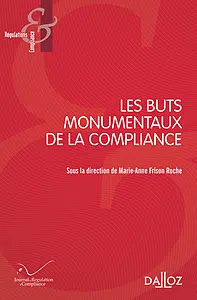
Couverture – Les Buts Monumentaux de la Compliance

Articles in a JoRC book

📝Le principe de proximité systémique active, corolaire du renouvellement du principe de souveraineté par le Droit de la Compliance, in 🕴️M.-A. Frison-Roche (ed.), Collection Régulations & Compliance Les Buts Monumentaux de la Compliance

🌐 follow Marie-Anne Frison-Roche on LinkedIn 🌐 subscribe to the Newsletter MAFR Regulation, Compliance, Law  - ► Full Reference: M.-A. Frison-Roche, “Le principe de proximité systémique active, corolaire du renouvellement du principe de souveraineté par le Droit de la Compliance” (“The principle of active systemic proximity: corollary of the renewal of the principle of sovereignty by Compliance Law”), in M.-A. Frison-Roche (ed.), Les Buts Monumentaux de la Compliance, coll. “Régulations & Compliance“, Journal of Regulation & Compliance (JoRC) and Dalloz, 2022, pp. 501-520. - 📝read the article (in French) - 🚧read the bilingual Working Paper which is the basis of this article, with additional developments, technical references and hyperlinks - read a general presentation of the book, Les Buts Monumentaux de la Compliance, in which this article is published - ► Summary of the article (done by the Journal of Regulation & Compliance): Surprisingly, it is often in a quarrelsome, angry, dissatisfied tone that we first speak of Compliance, especially when Compliance takes a legal form, because it is then we talk about sanctions coming from afar. These sanctions would strike both extremely hard and in an illegitimate way, Law only therefore takes its part in Compliance to increase its brutality: the Law is what would prolong the war between States to better hit this kind of civilian population that would be the companies…, in a new kind of “planetary total war”… Why so much detestation, which can only be generated by such a presentation? Because, thanks to the power of Law, Compliance would therefore be the means for a State, finally found, to meddle in the affairs of others to serve its own interests, including those of its companies, to go to war against other States and to the companies they care about without even having to formally declare the war to them. Compliance Law would finally allow a State that is not even a strategist, just smarter, to leave its territory to regulate others. It is true that it seems even more exasperating that it would also be under the guise of virtue and good purposes. Thus, it is not possible to count the number of the writings that describe and comment on the occurrences of the expression “Trojan horse”, “economic war”, etc. There are thus more articles on this subject of Compliance Law as a means of going to dictate to subjects of law who are nevertheless subject to other legal systems their behavior and to sanction them for having failed to do so, than on all other technical Compliance matters. As soon as the term “extraterritoriality” is dropped, the knives are drawn. The dejection of defeat… because who can fight against American power, American Law seducing everyone? The call for resistance, or at the very least for “reaction”… In any case, it would be necessary to put the analysis back on its true terrain: politics, conquest, war, so leaving the legal technique there, area which would be good for the naive and above all count the divisions amassed on each side of the borders, then note that only the United States would have had the ingenuity to count many of them, with their armada of judges, prosecutors and lawyers, with Compliance Law amassed like so many gold coins since the 1930s, American companies relaying the assault by internalizing Compliance Law through internal codes, law that is “soft” only in name, and community standards governing the planet according to American principles, the solution then consisting of line up as many of them as possible in reaction, then attempt to “block” the assault. Because if there is no Global Law, Compliance Law would have succeeded in globalizing American Law. The technique of blocking laws would therefore be the happy outcome on which the forces should concentrate to restore “sovereignty”, since Europe had been invaded, by surprise by some famous texts (FCPA) and some cases whose evocation (BNP case) to the French ear sounds like a Waterloo. Compliance Law would therefore only be a morne plaine… But is this how we should understand the notion of Sovereignty? Has the so-called question of “the extraterritoriality of Compliance Law” not been totally biased by the question, certainly important but with both very precise and extremely specific outlines, of embargoes which have almost not related to Compliance Law? The first thing to do is therefore to see more clearly in this kind of fight of extraterritoriality, by isolating the question of embargoes from other objects which should not be assessed in the same way (I). This done, it appears that where Compliance Law is required, it must be effectively indifferent to the territory: because Compliance Law intervenes where the territory, in the very concrete sense of the land in which we are anchor is not present in the situation to be governed, situation to which our minds have so much difficulty adapting and which, however, is now the most common situation: finance, space, digital. If we want the idea of ​​civilization to remain there, that the notion of “limit” be central there. However, Sovereignty is not linked to omnipotence, it is the grandchildren who believe that, it is on the contrary linked to the notion of limits (II). But if the limit had been naturally given to human beings by the territory, the ground on which we walk and the border on which we stumble and which protects us from aggression, if the limit had been naturally given to human beings by death and the oblivion into which our body and our imagination eventually fall. Indeed, technology erases both natural limits. The Law was the very reflection of these limits, since it was built on the idea of ​​life and death, with this idea that, for example, we could no longer continue to live after our death. Digital technology could challenge this. In the same way, Law had in the same “natural” way reflected the terrestrial borders, since Public International Law being internal Public Law, took care that each sovereign subject remained in its terrestrial borders and did not go beyond, without the agreement of others, Public International Law organizing both the friendly reception of the other, by treaties and diplomacy, as well as unfriendly entry, by the Law of War, while Private International Law welcomes foreign legal systems if a extraterritorial element is already present in the situation. The complexity of the rules and the subtlety of the solutions do not modify the solidity of this base, always linking the Law to the material reality of this world which are our bodies, which appear and disappear and our “being” with them, and the earth squared by borders. Borders have always been crossed, International Commercial Law being only an economic and financial translation of this natural taste for travel which does not question the territory, human beings passing from one to another. But the Global has arrived, not only in its opportunities, being not an issue because one can always give up the best, but also in global risks whose birth, development and result are not mastered and of which it is not relevant to thinking only of repairing the damage, because preventing risks from degenerating into a systemic catastrophe is what is at stake today. What if territory slips away and hubris seizes human beings who claim that technology could be the new wings leading a fortunate few to the sun of immortality? We could go towards a world that is both catastrophic and limitless, two qualifiers that classical philosophers considered identical. Law being what brings measure, therefore limits in a world which, through technology, promises to some the deliverance of all these “natural” limits, could, by the new branch of Compliance Law, again inserting limits to a world which, without this contribution, would become disproportionate, some being able to dispose of others without any limit: in doing so, Compliance Law would then become an instrument of Sovereignty, in that it could impose limits, not by powerlessness but on the contrary by the force of Law. This explains why Compliance is so expressly linked to the political project of “Digital Sovereignty”. To renew this relationship between Law and Sovereignty, where the State takes a new place, we must think of new principles. A new principle is proposed here: the Principle of “Proximity”, which must be inserted into the Ex-Ante and systemic Law that is Compliance Law. Thus inserted, the Principle of Proximity can be defined in a negative way, without resorting to the notion of territory, and in a positive way, to posit as being “close” what is close systemically, in the present and in the future, Compliance Law being a branch of Systemic Law having as its object the Future. Thus, thinking in terms of Proximity consists of conceiving this notion as a Systemic Principle, which then renews the notion of Sovereignty and founds the action of entities in a position to act: Companies (III). If we think of proximity not in a territorial way, the territory having a strong political dimension but not a systemic dimension, but if we think of systemic proximity in a concrete way through the direct effects of an object whose situation immediately impacts ours (as in the climatic space, or in the digital space), then the notion of territory is no longer primary, and we can do without it. If the idea of ​​Humanism should finally have some reality, in the same way that a company donneuse d’ordre (“order giver”) has a duty of Compliance regarding who works for it, this again meets the definition of Compliance Law as the protector of human beings who are close because they are internalized in the object consumers take. It is this legal technique that allows the transmission, with the thing sold, of the procedural right of action for contractual liability. Therefore, a Principle of Active Systemic Proximity justifies the action of companies to intervene, in the same way that public authorities are then legitimate to supervise them in the indifference of the formal legal connection, principe of indifference already functioning in the digital space and in environmental and humanist vigilance. It is therefore appropriate to no longer be hampered by what is a bad quarrel of the extraterritoriality of Compliance Law (I), to show the consubstantial Indifference to the territory of this new branch of Law (II) and to propose the formulation of a new Principle: the “Principle of Active Systemic Proximity (III). -

Couverture – Les Buts Monumentaux de la Compliance

Books

Collection Régulations & Compliance Les Buts Monumentaux de la Compliance

🌐follow Marie-Anne Frison-Roche on LinkedIn 🌐subscribe to the Newsletter MAFR Regulation, Compliance, Law  - ► Full Reference: M.-A. Frison-Roche (ed.), Les Buts Monumentaux de la Compliance (Compliance Monumental Goals), coll. “Régulations & Compliance“, Journal of Regulation & Compliance (JoRC) and Dalloz, 2022, 520 p. - In parallel, the English version of this book, Compliance Monumental Goals, is published in the collection co-published by the Journal of Regulation & Compliance (JoRC) and Bruylant. - 📅This book comes after a cycle of colloquia 2021 organised by the Journal of Regulation & Compliance (JoRC)and its Universities partners. - This volume is one of the books dedicated to Compliance in the collection Régulations & Compliance: read the presentations of the other titles of this collection. - ► General presentation of the book: Seize Compliance by its mind: its Monumental Goals. The notion of “monumental goals” of Compliance was proposed in 2016 by Marie-Anne Frison-Roche1🕴️M.-A. Frison-Roche, 📝Le Droit de la compliance, 2016. . It has become explicit in the texts and the resolution of cases, for example to fight against climate change, make human beings effectively equal, force to be extraterritorially vigilant about suppliers. Compliance Monumental Goals are targeted ex ante by regulations, contracts, CSR, and international treaties. Creating an alliance between business and political authorities, aiming for a new form of sovereignty. The presence in litigation of these Monumental Goals of global dimension renews the responsibilities and the Judge office. Describing and conceiving these Monumental Goals makes it possible to anticipate Compliance Law, which is more powerful every day. - 🏗️General construction of the book: The book opens with a double Introduction, the first summarizing the book (in free access) ​and the second, more substantial, proposing the Monumental Goals as definition of Compliance Law putting them at its “beating heart”, giving this new branch of law its originality and specificity, explaining what, in the History of the United States and Europe, gave birth to this singular corpus and justifies a substantial definition of Compliance Law. The concept of Monumental Goals is explained, justifying both systemic and political nature of Compliance Law, the practical consequences of which legal specific rules are thus better identified and limited, since Compliance Law does not lead to all-obedience. We can then determine what we can expect from this Law of the Future that is Compliance Law. From there, the book unfolds in 5 titles. A first Title is devoted to the “radioscopy” of this notion, in itself and branch of Law by branch of Law. A second Title aims to measure how the Monumental Goals are questioned by a crisis, for example in a health situation, but not in that example, if they aggravate it and must be discarded, or if, on the contrary, they are exactly conceived for this hypothesis. of crisis, risks, catastrophes and that it is advisable to exploit them, in order, in this “test”, to benefit from the alliance between the political authorities, public powers and crucial operators. Once made explicit and tested, the Monumental Goals must find a sure way to be considered. Therefore, a third Title aims to measure in principle and in practice how the Proportionality method can help the integration of Compliance, thus giving a new dimension to the Law without dragging it into insecurity and illegitimate grabbing of powers. But because Compliance Monumental Goals express a very great ambition, the question of a bearable, even beneficial relationship with the international competitiveness of companies, standards and systems must be opened. This is the object of the fourth Title. Finally, because the Monumental Goals express by nature a new ambition of the Law in a world which must not give up in what could be the prospect of its abyss, the fifth Title has for object the relationship between the Monumental Goals of Compliance and Sovereignty. - ► Understand the book through the Table of Contents and the summaries of each article:   DOUBLE INTRODUCTION 🕴️M.-A. Frison-Roche, 📝Résumé de l’ouvrage Les buts monumentaux du droit de la compliance (free access : click here to read this article (in French)) 🕴️M.-A. Frison-Roche, 📝Les Buts Monumentaux, cœur battant du Droit de la Compliance I. LA NOTION DE BUTS MONUMENTAUX DE LA COMPLIANCE (“THE IDEA OF COMPLIANCE MONUMENTAL GOALS”)  🕴️R.-O. Maistre, 📝Quels buts fondamentaux pour le régulateur dans un paysage audiovisuel et numérique en pleine mutation ? 🕴️A.V. Le Fur, 📝Intérêt et raison d’être de l’entreprise : quelle articulation avec les Buts Monumentaux de la Compliance ? 🕴️A. Le Goff, 📝La part des banques dans la concrétisation des Buts Monumentaux de la Compliance 🕴️J.-F. Vaquieri,📝Les “Buts Monumentaux” perçus par l’entreprise. L’exemple d’Enedis 🕴️M. Malaurie-Vignal, 📝Les Buts Monumentaux du droit du marché. Réflexion sur la méthode 🕴️D. de La Garanderie, 📝Sur les Buts Monumentaux de la Compliance sociale  🕴️C. Peicuti & 🕴️J. Beyssade, 📝La féminisation des postes à responsabilité dans les entreprises comme But de la Compliance. Exemple du secteur bancaire 🕴️I. Gavanon, 📝Le droit des données personnelles dans l’économie numérique à l’épreuve des Buts Monumentaux 🕴️B. Petit, 📝Les Buts Monumentaux du droit (européen) des relations de travail : un système mouvant aux équilibres à consolider 🕴️G. Beaussonie, 📝Droit pénal et Compliance font-ils système ? 🕴️Ch. Huglo, 📝À quelles conditions le Droit climatique pourrait-il constituer un But Monumental prioritaire ? II. MISE EN OEUVRE DES BUTS MONUMENTAUX DE LA COMPLIANCE EN ARTICULATION DU PRINCIPE MAJEUR DE LA PROPORTIONNALITÉ (“IMPLEMENTATION OF COMPLIANCE MONUMENTAL GOALS IN ARTICULATION OF THE MAJOR PRINCIPLE OF PROPORTIONALITY”)  🕴️L. Rapp, 📝Conformité, proportionnalité et normativité 🕴️B. Bär-Bouyssière, 📝Les obstacles pratiques à la place effective de la proportionnalité dans la Compliance 🕴️A. Mendoza-Caminade, 📝Compliance, proportionnalité et évaluation 🕴️L. Meziani, 📝Proportionnalité en Compliance, garant de l’ordre public en entreprise 🕴️M. Segonds, 📝Compliance, proportionnalité et sanction  🕴️M.-A. Frison-Roche, 📝Définition du principe de proportionnalité et définition du Droit de la Compliance III. LES BUTS MONUMENTAUX DE LA COMPLIANCE ÉPROUVÉS PAR LES SITUATIONS DE CRISES (“THE COMPLIANCE MONUMENTAL GOALS TESTED BY CRISIS SITUATIONS”) 🕴️A. Oumedjkane, A. Tehrani et P. Idoux, 📝Normes publiques et Compliance en temps de crise : les Buts Monumentaux à l’épreuve. Éléments pour une problématique 🕴️J. Bonnet, 📝La crise, occasion de saisir la Compliance comme mode de communication des autorités publiques 🕴️N. Sudres, 📝Gel hydroalcoolique, Covid-19 et Compliance. Des insuffisances de la démarche de conformité à l’émergence d’îlots de Compliance 🕴️M.-A. Frison-Roche, 📝Place et rôle des entreprises dans la création et l’effectivité du Droit de la Compliance en cas de crise IV. EFFECTIVITÉ DES BUTS MONUMENTAUX DE LA COMPLIANCE ET COMPÉTITIVITÉ INTERNATIONALE (“EFFECTIVENESS OF COMPLIANCE MONUMENTAL GOALS AND INTERNATIONAL COMPETITIVENESS”)  🕴️B. Deffains, 📝L’enjeu économique de compétitivité internationale de la Compliance 🕴️J.-Ch. Roda, 📝Compliance, enquêtes internes et compétitivité internationale : quels risques pour les entreprises françaises (à la lumière du droit antitrust) ? 🕴️F. Marty, 📝L’apport des programmes de conformité à la compétitivité internationale : une perspective concurrentielle 🕴️S. Lochmann, 📝Les agences de notation ESG et l’effectivité de la Compliance face à la compétitivité internationale 🕴️M.-A. Frison-Roche, 📝Appréciation du lancement d’alerte et de l’obligation de vigilance au regard de la compétitivité internationale V. LA COMPLIANCE PORTÉE PAR LES BUTS MONUMENTAUX, NOUVELLE VOIE DE SOUVERAINETÉ (“COMPLIANCE SUPPORTED BY MONUMENTAL GOALS AND NEW WAY OF SOVEREIGNTY”)  🕴️R. Bismuth, 📝Compliance et souveraineté : relations ambigües 🕴️L. Benzoni, 📝Commerce international, compétitivité des entreprises et souveraineté : vers une économie politique de la Compliance 🕴️M.-A. Boursier, 📝Les Buts Monumentaux de la Compliance : mode d’expression des États 🕴️S. Pottier, 📝Pour une Compliance européenne, vecteur d’affirmation économique et politique 🕴️Ch. André, 📝Souveraineté étatique, souveraineté populaire : quel contrat social pour la Compliance ? 🕴️M.-A. Frison-Roche, 📝Le principe de proximité systémique active, corollaire du renouvellement du principe de souveraineté par le Droit de la Compliance -

Working papers

🚧Compliance Law and Climate. Prevent Climate Risk and build Climate Balance

  🌐follow Marie-Anne Frison-Roche on LinkedIn 🌐subscribe to the Newsletter MAFR Regulation, Compliance, Law  - ► Full Reference: M.-A. Frison-Roche, Compliance Law and Climate. To prevent Climate Risk and build Climate Balance, January 2022. - 🎤 In its French version, this Working Paper had been written for a speech  for  the colloquium held under the scientific direction of Marta Torre-Schaub, Béatrice Lormeteau, & Anne Stevignon, Les risques climatiques à l’épreuve du droit Comment le droit fait-il face aux nouveaux risques engendrés par la crise climatique ? , at the University Panthéon-Sorbonne (Paris I), Amphithéâtre Liard, on March 17, 2022. - 📝it is also the basis of an article : "Droit de la compliance et climat. Pour prévenir le risque et construire l'équilibre climatiques" ("Compliance Law and climate. Prevent the climate risk and build the climate balance") - ► Summary of this Working Paper: Compliance Law is beginning to emerge in climate topic, through the expression  "Climate Compliance Law", but the climate issue itself is the most perfect example of why General Compliance Law is made for.  It is indeed a new branch of Law, a global Law claiming to provide Ex Ante solutions here and now for global issues, so that in the future systemic catastrophies will not occur, will not happen: it is these "Monumental Goals" that give meaning, coherence, and simplicity to Compliance Law. Compliance Law, linked to the Rule of Law principle, makes it possible to go beyond the choice often presented between the effectiveness of the protection of the planet and the renunciation of freedoms, in particular the freedom to do business and the freedom of individuals, especially the protection of their data. Climate is thus exemplary of the object of Monumental Goals of Compliance Law (I). The systemic risk that it now constitutes is analogous to Banking or Digital Systemic Risks and therefore calls for the application of identical legal Compliance Tools, formerly put in place for Banking Regulatory and Compliance Law, recently invented for Digital. Compliance Law, extending Regulation Law, itself from the precondition of the Sector and the Territory, is therefore the branch which makes it possible to put in place new legal solutions, either by force (judicial agreements, compliance programs, etc.), or by will (commitments, global charters, etc.). Therefore, an alliance can exist between political and public authorities, and crucial economic operators (II), that the rise in power of the "raison d'être" is the sight and whose technical challenge is the collection of information that must be put in correlation. Scientists pooling Information, this public good, provided by public and private entities. The courts are at the center of this articulation between Compliance Law and Climate, which object is the Future. -   🔓read the developments below⤵️ -

Conferences

🎤The temporal dimension: imminence and intertemporally, in 📅Climate Change Cases before National and International Courts Cross-fertilization and Convergence”

► Full Reference: Frison-Roche, M.-A., Chair for "The temporal dimension: Imminence and Intertemporally", in Climate Change Cases before National and International Courts Cross-fertilization and Convergence", November 27, 2021, Paris.  -   read the program   Summary of the panel presentation: The specific topic of our panel is the “temporal dimension” of the judicial cases of Climate change. We shall listen to two great experts on this topic, which is Time. Listening the other previous speakers, I understand how this topic is important, because Climate Change requires an immediate action and it create a political issue, because everyone comes before courts. A basis and fundamental problem, because the times are not adjusted.  let's come back to basic notions, to have three times : “past, present, future”.   The issue of Climate Change is in the Future, the necessity of Action is in the Present and the basis temporal question is to know if Courts are the bodies adequate to responde ; maybe it is inevitable that Judge must be recreate their office because the time of the classical judicial office is the Past. Immediately, this simple et huge problem appears : in a classical repartition, the judge is the legal character to intervenir for the Past, the present (maybe is for you and me), and the future is the time for the State, and more precisely for the Parliament. But the climate change is a huge topic, not in the past, not in the present, but in the future. Therefore a gap exists between the time of the topic and the time of the court before the case is explained for obtaining a solution : how to give a good answer ? Judge maybe must travel in time, from past to future …. Maybe, he must, but might he? Classically, the judge can anticipate a very next future, but not the more distant and systemic future. Climate change belongs to the second one. This is why the title of this panel is non only about the necessity to take in consideration the “imminence” but also the “intertemporally” : maybe court are the sole able to create this intertemporality between Past and Future, and by this way to obtain from States and companies to do something immediately !   By two legal ways.    Courts can stay in Past, supervising States, if they dispose of effective legal decisions taken by States in the past about Climate Change (essentially Paris Agreement, for instance transposed in the French legal system by a formal law). This is why an efficient judicial solution would be the possibility for the courts to oblige State to implement their more or less committment they had taken in the past for the future (as the Conseil d’État did in the Commune de Grande-Synthe Cas Law). Even for that, the courts must adopt a creative notion of what is a commitment from a State through a Law… ; as they must do about private companies comitment (in their codes of conduct or soft law of corporate social responsability).    But what to do if States didn’t take such commitment ? Some can allege Courts are not Parliaments and are not legitimate to rule for the future … It is a political issue, a very classical one but very accurate for Climate change (where States and companies are face to courts…) and maybe  And as our colleague said, judicial system is quite technically weak to concretize human rights.   Therefore, the second way, more innovative, est the new use of Tort Law : no more a liability Ex Post, but a responsibility Ex Ante. In every legal system, even in Civil Law systems, Tort Law is conceived by courts (for instance in French Law).  If the new reasoning is conveived in Ex Ante, Tort Law must be a set of legal tools to reach the monumental tools to reach the "Monumental Goal" (being by nature future) which is the Climate Change stopping.  In this teleological reasoning, the admissibility and the choice remedies, must be adapted to obtain what is central : the effectivity and the efficiencicy.  In this sens, the judgement between two parties (which was an Ex Post act) may be conceived as an systemic efficient action (which was an Ex Ante act), because it must be.  -        

Conferences

🎤Appréciation du lancement d’alerte et de l’obligation de vigilance au regard de la compétitivité internationale (” (“Assessment of Whistleblowing and Vigilance Duty with regard to international competitiveness”)in 📅 “Effectivité de la Compliance et Compétitivité internationale”

  ► Référence complète: Frison-Roche, M.A., Appréciation du lancement d'alerte et de l'obligation de vigilance au regard de la  compétitivité internationale (" ("Assessment of Whistleblowing and Vigilance Duty with regard to international competitiveness"),  in Benzoni, L., Deffains, B. et Frison-Roche, M.-A.(dir.) , Effectivité de la Compliance et Compétitivité internationale("Compliance Effectivity and International Competitiveness"), seminar co-organised by the  Journal of Regulation & Compliance (JoRC) and the Centre de recherche sur l'Économie et le Droit (CRED)  of the Panthéon-Assas University, November 4, 2021.  -   ►This intervention is thematic ; it is articulated with those more general carried out in introduction by Bruno Deffains particularly focused on the necessarily global scope of Compliance and in conclusion by Laurent Benzoni on Compliance as a potential new pillar of industrial policy, the whole of the colloquium having been conceived by the three of us. - 📅 read the semirar program    📅 this scientific event is part of the 2021 colloquia cycle, organized by the Journal of Regulation & Compliance (JoRC) and its Universities partners, on the general theme of Compliance Monumental Goals. -   🚧  read the bilingual Working Paper, basis of this conference -   ►see the slides used during the conference -   ► Conference Summary: First of all and independently of the technical topic itself which, as the slides show, is focused on these two techniques based on Information which are the Whistleblowing and the Vigilance duty, it is essentiel to pose that the techniques themselves are conceived totally  differently depending on whether Compliance Law is conceived as a mechanical process and totally binding to fully comply with all applicable regulations and to demonstrate it in advance, under the threat of terrible fines, this definition being the both completely frightening and meaningless since what these applicable regulations contains is irrelevant, in which case the prospect of competitiveness boils down to notions of costs and also procedural considerations of foreseeability and legal certainty; or if Compliance Law is conceived as a new and substantial branch of Law Ex Ante developed to detect and prevent the systemic crises being before us, of which the climate crisis is unfortunately the epigone and which requires above all Action, an action of such magnitude which requires the alliance of all forces, that of States, companies, courts and people, in a renewal of concepts, particularly legal ones, and in the indifference of territories, which puts Compliance immediately at its right level: the world, because the scientifically emerging crisis is global, the so-called "extraterritoriality" theme now being misnamed. From this new general conception, the Vigilance obligation, about which so much was said when it was imposed in France in 2017, is the advanced point, soon taken up in Europe and whose scope must be naturally global, because that Compliance Law is consubstantially global. Taking up more technically the legal techniques of Compliance and confronting them with the Competitiveness of firms, it is necessary that these Compliance Tools do not harm this Competitiveness because Compliance Law , supporting immense ambitions, can only function through an alliance between political  wills (with great pretensions, i.e. save the planet) and the entities which are able to concretize them (the crucial economic operators): the Compliance tools designed by legal systems must preserve the companies which put them in place and never favor their competitors. On the basis of this principle, it is possible to assess these two legal techniques,  namely the whistleblowing and the Vigilance duty,  which both capture Information, which, as such, gives them a uniqueness and places them in the global Competition for Information. Taking the whistleblowing first, it appears that its first beneficiary is the company itself since it discovers a weakness and can therefore remedy it. This is why, beyond the principle of protection of the whistleblower by the access of somebody to the legal statute conceived in France by the law known as "Sapin 2", it is criticized that all the incentives are not used for that the holder of such information transmits it to the manager and that the same law continues to require the absence of financial counterpart, the "heroic figure of the whistleblower and the refusal of his remuneration depriving the company of a means information and improvement. The American solution is better and tt is regrettable that the law transposing the European Directive maintains this ineffective conception. But French legislation has on the contrary developed the right incentive as to the person whom the information must be transmitted to is the manager, then externally if the latter does nothing. The solution is better that the American solution because the incentive is thus made to push the internal manager to act and put an remedy to the internal dysfunction, which increases the competitiveness of the company. Even more, even if it seems counter-intuitive, the French Vigilance Duty greatly increases the competitiveness of the companies which are subject to it. Indeed, the 2017 Law by obliging them to prevent and fight against  human rights and environment violations has tacitly given them all the necessary powers to do so, in particular the power to capture Information on third-party companies, including ( and even above all) those which are not subject to transparency obligations. In this, companies, insofar as they are personally responsible, hold a supervisory power over others, a power which allows Compliance Law to globalize and which, in the process, increases their own power. This is why the obligation of vigilance is in many respects a boon for the companies which are subject to it. The resumption of the mechanism by the next European Directive, itself indifferent to the territory, will only strengthen this global power on other firms, even foreign ones. - ► This  conférence et le document de travail servent de base à un article dans un ouvrage : 📝This conference and the Working Paper constitute the basis for an article:    in its French version in the book  Les buts monumentaux de la Compliance, in the Series    Régulations & Compliance    in its English version in the book Compliance Monumental Goals, in the Series    Compliance & Regulation -  

Working papers

🚧Duty of Vigilance, Whistleblowing and International Competitiveness

► Full Reference: Frison-Roche, M.-A., Duty of Vigilance, Whistleblowing and International Competitiveness, Working Paper, September 2021. -   🎤 this Working Paper is the basis for a conference , in the colloquium Effectiveness of Compliance and International Competitiveness, co-organised  by the Journal of Regulation & Compliance (JoRC) and the Center for Law and Economics of the Panthéon-Assas University (Paris II),   November 4, 2021 - 📝this Working Paper is also the basis for an article. This article is to be published ⤵ in its French version in the book Les buts monumentaux de la Compliance, in the series 📚Régulations & Compliance  in its English version in the book Compliance Monumental Goals, in the series la collection 📚Compliance & Regulation - ► Working Paper Summary: The "Compliance Tools" are very diverse. If it has been chosen to study more particularly among these the obligation of vigilance and the whistleblower, these rather than others and to study them together, it is because they present in the perspective of the specific topic chosen, namely "international competitiveness", and for companies, and for economic zones considered, and for legal system inseparable from them, a uniqueness: these are mechanisms which release Information.  By order of the law, the company will not only stop ignoring what it covered with the handkerchief that Tartuffe held out to it or that a conception of Company Law legitimately allowed it to ignore. This article does not examine if this revolution made by Compliance Law expresses in the legal system is on the one hand legitimate and on the other hand effective: the article measures what is happening at the regard to "international competitiveness". Compliance Law is therefore be examined here through its instruments, and not in relation to its normativity. In fact, its instruments are intended to provide Information and to make this information available, in its presentation, in its intelligibility and in the hands of those who are able to use Information in perspective of the Compliance Monumental Goals, achieving them.  Regarding this central notion of Information, international competitiveness will be more particularly concerned because Compliance Law will oblige the company itself to seek out, then expose to everyone's eyes, in particular its competitors, its weaknesses, its projects, its alliances, its flaws. This does not pose a problem if its competitors themselves are often subject to this new branch of Law, which goes far beyond transparency, which is already a new mechanism because a company is not a transparent organization and Competition Law that governs ordinary businesses never required this. But if they are not subject to this incredibly special branch of Law that is Compliance Law, then there is a distortion of competitiveness by the very fact of the Law. It is possible to pretend that the markets like virtue, that they give it credit because they are themselves based on the idea of "promise", which is ultimately based on a moral concept, but this provision of Information to others, while others remain opaque, is a major problem of competitiveness, which the legal requirement of "loyal commercial practices" only very partially considers. Therefore, it is necessary to first examine what is the economic and financial power of the information captured by the company on itself thank to Compliance Law making available to all but firstly to the compagny itself through the whistblowing mechanism, organised by the laws, differently in the US and Europe (I). Compliance Law also obliges companies to be accountable not only for what they do but also for what others do for them. Through the obligation of Vigilance, objective Ex Ante obligation and duty, the company obtains a power of Information on others which could well resolve what is often presented as the dispute aporetic of the extraterritoriality of Compliance Law, thus making accountable companies hitherto protected by their "preserved" legal system and thereby affected by the effectiveness of Compliance Law (II). - read below the developments

Working papers

Working Paper

🚧The Hypothesis of the category of Systemic Cases brought before the Judge

► Full Reference: M.-A. Frison-Roche, The Hypothesis of the category of Systemic Cases brought before the Judge, Working Paper, October 2021 and April 2022. - ► This working paper has served as the basis for an introductory speech 🎤L'hypothèse de la catégorie des causes systémiques (The Hypothesis of the cateory of Systemic Cases), in a more general conference which I coordinated and moderated, 🧱L'office du juge et les causes systémiques, which is part of a general cycle covering Penser l'office du juge, specific conference attending the 9th May 2002 into the Grand Chamber of the Cour de cassation.   This Working Paper was drawn up in October 2021 to build the conference on the assumption that among the diversity of "cases" brought to the courts by litigants, some constitute a specific category: "systemic cases", justifying treatment that is both specific (in that they are systemic, calling in particular for procedural solutions common to all and distinguishable from the treatment of non-systemic cases) and common treatment beyond the diversity of judges who deal with them (judicial and administrative judges, criminal and non-criminal judges, French and non-French judges, judges of the member-States legal orders and European Union judges, etc.).  This working paper does not aim to deal with the whole subject, i.e. both to determine this category of "systemic causes" and the consequences that must be drawn from it for the judge's office, since that is the very purpose of the conference, which is built around several presentations: it aims to deal with the first part of the subject, i.e. the very existence of this new processual category, which is "systemic causes", leaving for other work the practical consequences to be drawn from it in the processual treatment that it calls for. - 📝This Working Paper is also the basis of a forthcoming article - ► Summary of the Working Paper: xx - Read below the developments⤵️ - 🌐follow Marie-Anne Frison-Roche on LinkedIn 🌐follow Marie-Anne Frison-Roche on Instagram 🌐subscribe to the Newsletter MAFR. Regulation, Compliance, Law

Organisation of events

📅 Scientific Co-organization of the colloquium “Radioscopie d’une notion : les “buts monumentaux” de la Compliance (“Radioscopy of a notion: the Compliance “monumental goals””), in “Les buts monumentaux de la Compliance” (“Compliance Monumental Goals”)”

► co-organized between Laboratoire DANTE and the Journal of Regulation & Compliance (JoRC), this colloquium) is the core manifestation of the 2021 series of colloquia devoted to the general theme of Compliance Monumental Goals. It will take place on 16th of September 2021, at the Maison du Barreau, in Paris. This first work is in French but will be the basis of the book in English : Compliance Monumental Goals,    This book will be published in the Compliance & Regulation Series, co-published by the JoRC and Bruylant. ► Presentation of the colloquium Thematic: To understand the notion of “Monumental Goals”, it is firstly necessary to take crossed perspectives on them, particularly through the prism of Labor Law, Environmental Law and Enterprise Law. Many questions appear. Does the notion of “Monumental Goals” present any substance in Law? Is it uniformly understood, or do specificities appear, forged by specific cultures and disciplinary practices? What are the sources and implicit references or echoes? Because even if we admit the part of novelty, there is undoubtedly an anchoring in traditional legal concepts, like the general interest or sovereignty. How does the shift from meta-legal (prima facie introduced by the concept) to legal take place, and where do any operational difficulties lie when legal actors are called upon to act? The question of a possible categorization of “Monumental Goals” will thus be explored, through these three legal disciplines whose historicity, goals and implications for firms differ. These reflections allow to ask why and how these “Monumental Goals” are developed. Indeed, what is the relevance of the association of “Monumental Goals” and Compliance? Beyond theoretical considerations relating to the meaning of Law, is this really an effective alloy encouraging companies to behave differently? By what ways? These questions arise in particular with regard to the imperatives of legal certainty and the operative nature of the concept. The question of “Monumental Goals” will thus be explored by the operational actors of compliance, both those who act within companies and those who act from the lato sensu State sphere, for understanding whether this notion is a pure rhetoric figure or constitutes a particularly promising lever for the evolution of market behavior. ► with : 🎤 Christophe André, maître de conférences à l’Université Paris – Saclay (lecturer at the Paris-Saclay University) 🎤 Guillaume Beaussonie, professeur à l’Université Toulouse-1-Capitole (law professor at Toulouse-1-Capitole University) 🎤 Regis Bismuth, professeur de droit à Sciences po, Paris (law professor at Sciences po Paris) 🎤 Marie-Emma Boursier, doyen de l’Université Paris – Saclay (dean of the Paris-Saclay University) 🎤 Muriel Chagny, professeur l’Université Paris – Saclay, directrice du Laboratoire Dante (Professor at the Paris-Saclay University, director of the Laboratory Dante) 🎤 Marie-Anne Frison-Roche, professeur à Sciences po (Paris) (Professor at Sciences Po Paris) 🎤 Isabelle Gavanon, avocate à la Cour d’Appel de Paris (attorney before the Paris Court of Appeal) 🎤 Emma Guernaoui, ATER à l’Université Paris II Panthéon-Assas (ATER at Paris II Panthéon-Assas University) 🎤 Dominique Heintz, avocat à la Cour d’ appel de Paris (attorney before the Paris Court of Appeal) 🎤 Christian Huglo, avocat à la Cour d’ appel de Paris (attorney before the Paris Court of Appeal) 🎤Dominique de La Garanderie, avocat à la Cour d’appel de Paris (attorney before the Paris Court of Appeal) 🎤 Anne-Valérie Le Fur, professeur à l’Université Paris – Saclay (Professor at Paris-Saclay University) 🎤 Anne Le Goff, secrétaire générale déléguée d’Arkéa (Deputy Secretary general at Arkéa) 🎤 Roch-Olivier Maistre, président du Conseil supérieur de l’audiovisuel (President of the French audiovisual regulation authority) 🎤 Marie Malaurie, professeur à l’Université Paris-Saclay (professor at the Paris-Saclay University) 🎤 Jérôme Marilly, avocat général à la Cour d’Appel de Paris (General attorney before the Paris Court of Appeal) 🎤 Benoît Petit, maître de conférences (HDR) à l’Université Paris-Saclay (lecturer at the Paris-Saclay University) 🎤 Jean-François Vaquieri, Secrétaire Général d’Enedis (Secretary General of Enedis) - Read a detailed presentation below:  

Working papers

🚧Ex Ante Responsibility

► Full Reference: M.-A. Frison-Roche, Ex Ante Responsibility, Working Paper, December 2021. - 📝This Working Paper has been the basis for an article written in French, "La responsabilité Ex Ante", published in the Archives de Philosophie du droit (APD), in the book 📗La Responsabilité (2022). - ►  Working Paper Summary: Quel est le temps auquel s'articule la responsabilité ? La question est si classique que toutes les réponses ont été dessinées : si l'on est responsable plus aisément par rapport au temps, car l'on peut alors plus aisément faire un lien entre la situation appréhendée, sa réalisation dans le passé la rendant plus facilement connaissable, et le poids de "responsabilité" que l'on impute sur une personne, l'on peut articuler la responsabilité avec le futur. Si l'on brise le poids de cette responsabilité avec un évènement ou une situation, par exemple. Le Principe Responsabilité de Jonas ou l'Ethique de la Responsabilité font ainsi voyager la Responsabilité dans le temps, par un rapport entre le Droit et l'Ethique.  D'ailleurs l'on pourrait soutenir que le Droit peut faire ce qu'il veut et imputer une responsabilité à quiconque pour le temps qu'il désigne, par exemple désigne comme porteur d'une responsabilité, c'est-à-dire d'un poids, celui qu'il veut. Le "responsable" serait alors le titulaire d'une sorte de "poids pur", qui le charge parce que le Droit l'a voulu pour le temps qu'il veut, par exemple un devoir d'agir pour que le futur soit dessiné comme le veut le Droit, alors même que le Responsable n'a rien à se reprocher dans le passé.  Mais les Cours constitutionnelle défendent un rapport minimal entre la Responsabilité et le poids que celle-ci fait porter une personne, fut-t-elle morale, gardant ainsi le lien consubstantiel entre le Droit et la Morale, la technique juridique de la Responsabilité ne pouvant équivaloir à celle d'un prélèvement obligatoire. Ainsi l'idée d'une Responsabilité Ex Ante est simple dans son principe (I). Elle est celle d'un poids juridiquement posé sur une personne soit par elle-même (engagement), soit par la Loi ou par le Juge sur une personne de faire quelque chose pour que n'advienne pas quelque chose qui adviendrait ou pour qu'advienne quelque chose qui n'adviendrait pas si elle ne le faisait pas. Mais les conditions juridiques pour admettre un tel poids alors même que le lien avec une situation passée serait brisé est plus difficile (II). On continue certes continuer à voir dans le futur le passé, ce qui facilite le voyage dans le temps, et fonda par exemple le contrôle Ex Ante du contrôle des concentrations. Mais l'on peut se briser même de cette facilité et regarder non plus le rapport entre le passé et le futur, mais le présent et le futur : ce que l'on sait déjà aujourd'hui du futur, ce qui met en jeu le rapport entre le Droit et la Science ; ce que l'on observe de l'emprise de la personne présente sur le moment présent, c'est-à-dire le Pouvoir, ce qui fait en jeu le rapport entre le Droit et l'Economie politique. Dans cette dimension-là, la contrainte de la Responsabilité Ex Ante est alors maniée par le Juge, dont l'office lui-même devient un office Ex Ante. Les pouvoirs obligés Ex Ante par une telle responsabilité maniée par le Juge étaient les personnes en situation de pouvoir, sont non seulement les entreprises, mais encore les Etats, qui perdent le privilège – partagé avec les contractants – de disposer juridiquement du futur, et notamment en leur sein le Législateur.  Une telle révolution, qui se déroule sous nos yeux, s'explique parce qu'il faut agir maintenant pour que le futur ne soit pas catastrophique. La science nous informe qu'il le sera entéléchiquement. Il est donc juridiquement requis de désigner des responsables, non pas parce qu'ils auraient fait quelque chose, la dimension Ex Post n'étant pas le sujet, mais pour qu'ils fassent quelque chose, la Responsabilité Ex Ante étant un élément central de cette nouvelle branche du Droit qu'est le Droit de la Compliance.   

Working papers

🚧 Monumental Goals, beating heart of Compliance Law

🌐follow Marie-Anne Frison-Roche on LinkedIn 🌐subscribe to the Newsletter MAFR Regulation, Compliance, Law  - ► Full Reference: M.-A. Frison-Roche, Monumental Goals, beating heart of Compliance Law, Working Paper, August 2021 - 📝This Working Paper is the basis for the article, "Les buts monumentaux, cœur battant du droit de la compliance", constituting the introduction ⤵ in its French version, of the book Les buts monumentaux de la Compliance, in  the Series 📚Régulations & Compliance  in its English version, of the book, Compliance Monumental Goals, in the Series 📚Compliance & Regulation - ► Summary of the Working Paper: Compliance Law can be defined as the set of processes requiring companies to show that they comply with all the regulations that apply to them. It is also possible to  define this branch of Law by a normative heart: the "Monumental Goals". These explain the technical new legal solutions, thus made them clearer, accessible and anticipable. This definition is also based on a bet, that of caring for others that human beings can have in common, a universality.  Through the Monumental Goals, appears a definition of Compliance Law that is new, original, and specific. This new term "Compliance", even in non-English vocabulary, in fact designates a new ambition: that a systemic catastrophe shall not be repeated in the future. This Monumental Goal was designed by History, which gives it a different dimension in the United States and in Europe. But the heart is common in the West, because it is always about detecting and preventing what could produce a future systemic catastrophe, which falls under "negative monumental goals", even to act so that the future is positively different ("positive monumental goals"), the whole being articulated in the notion of "concern for others", the Monumental Goals thus unifying Compliance Law. In this, they reveal and reinforce the always systemic nature of Compliance Law, as management of systemic risks and extension of Regulation Law, outside of any sector, which makes solutions available for non-sector spaces, in particular digital space. Because wanting to prevent the future (preventing evil from happening; making good happen) is by nature political, Compliance Law by nature concretizes ambitions of a political nature, in particular in its positive monumental goals, notably effective equality between human beings, including geographically distant or future human beings. The practical consequences of this definition of Compliance Law by Monumental Goals are immense. A contrario, this makes it possible to avoid the excesses of a "conformity law" aimed at the effectiveness of all applicable regulations, a very dangerous perspective. This makes it possible to select effective Compliance Tools with regard to these goals, to grasp the spirit of the material without being locked into its flow of letters. This leads to not dissociating the power required of companies and the permanent supervision that the public authorities must exercise over them. We can therefore expect a lot from such a definition of Compliance Law by its Monumental Goals. It engenders an alliance between the Political Power, legitimate to enact the Monumental Goals, and the crucial operators, in a position to concretize them and appointed because they are able to do so. It makes it possible to find global legal solutions for global systemic difficulties that are a priori insurmountable, particularly in climate matters and for the effective protection of people in the now digital world in which we live. It expresses values that can unite human beings. In this, Compliance Law built on Monumental Goals is also a bet. Even if the requirement of "conformity" is articulated with this present conception of what Compliance Law is, this conception based on Monumental Law is based on the human ability to be free, while conformity law supposes more the human ability to obey. Therefore Compliance Law, defined by the Monumental Goals, is essential for our future, while conformity law is not. - Read the developments below⤵️

Breaking news

📧 To regulate food sector, do not legally design everything in terms of markets, design in terms of chains, and companies connecting upstream and downstream

►Under the scientific direction of Professor Emmanuelle Claudel, the French Association Droit et Commerce  devotes its annual conference to ➡️📅 "La concurrence dans tous ses états". In her introduction retracing the entire evolution of this Law, Emmanuelle Claudel underlined that competition Law takes a distance from its basic concepts, such as the notion of "market". The branch of Law is finding more and more points of contact with Regulatory and Compliance Law. -   In fact, in an economic and social system whose organization needs to be readjusted, the notion of “chain" must find its rightful place in conjunction with the notion of "market". For many objects, it is relevant to think not only in terms of "market" but in terms of chains. Indeed the "chain" gives consistency to the object itself. For example forests or food, as European Commission did (I). But looking more concretely at the economic space, directly seeing people and things, such as agricultural products and what they are used for, that is to say to feed human beings, then this "Monumental Goal" must be entrusted to Crucial Entreprises the task of achieving it (II). Compliance Law can in the future caring of this, by setting new obligations, but also by loosening the so violent relationship, by its very indifference, between competition and food products.   I. NO LONGER THINK ONLY IN TERMS OF "MARKETS" BUT IN TERMS OF CHAIN: THE EXAMPLE FROM THE FARM TO THE FORK We are starting to assert this for the forest but also for agriculture that the European Commission now connects with food. So food should not be seen simply as a succession of "markets". In fact, if we only conceive them in this way, the agricultural markets, which should benefit from the financing offered by financial markets, are sometimes grabbed by them, which can literally starve the world rather than helping to feed it. Today, we agree to think about agriculture as a "chain" and, as the European Commission writes: From farm to fork. Indeed if agriculture is an important "sector" it is because it allows to feed the population. This basic fact has often been forgotten, in particular because competition Law, based on trade in products and not on the products themselves (of which it only measures the substituability, to identify the relevant markets) is not interested in what things are made for. We should not blame it, but in return, it cannot claim to dominate everything, since it is only pertinent for this small part of our life. European Commission, which is emerging more and more from the neutral notion of the market to move towards the substantive notions of products and of what they are made for, of their results (happy or unhappy), is in the process of setting up an industrial policy and what could be a real agricultural policy, which is not made only of subsidies. It consists in saying that it is necessary to design a chain which starts from the soil, its agricultural and livestock use to achieve what it is for: feeding the population. It seems simple, but in a Law dominated by the sole Competition Law, which fought for example by the techniques of price support, it is a new way, because it is concrete, to conceive. But how to do it ? Because Economy does not necessarily have to be administered, Compliance Law can be of great help, especially through the wholesale markets.   II. INTERNALIZING THE MONUMENTAL GOALS OF AGRICULTURAL SECTORS IN THEIR CRUCIAL ENTERPRISES Rather than administering the sectors, it is advisable to internalize in crucial companies the Monumental Goals which concern the future of the social group, for example feeding the population. It is for this reason that we must conceive "wholesale markets", not only as does Competition Law, which qualifies them as markets between the producers and the resellers, but as companies which are, within vital chains, are in charge of supervising the link between upstream and downstream so that the goal is realized. This is why these companies are directly concerned by Compliance Law, in its not mechanical definition of Compliance with the legal requirements applicable to them (which is our obligation to all) but in its definition which puts Compliance as something beyond Competition Law (➡️📝Frison-Roche, M.-A., Competition Law and Compliance Law, 2018) Wholesale markets for food therefore have a decisive role to play, as demonstrated by the French Rungis market company which, during the time of the health crisis, helped to ensure the continuity of supply (see more generally Journal of Regulation & Compliance (JoRC) and Montpellier University, ➡️📅colloquium Public Norms and Compliance in times of crisis: monumental goals put to the test, contributions serving as a basis for a chapter in ➡️Compliance Monumental Goals, 2022). The internalization of these Goals in Companies resolves the aporia with which States are confronted in their intimacy with the notion of borders. Indeed, il is useful to adopt a definition of "wholesale markets" no longer through the definition of the "market" but through the definition of "the crucial enterprise", which is itself "regulated" (Frison- Roche, M.-A., ➡️📝The Crucial Companies and their Regulation, 2014). "Wholesale markets" are businesses where retailers go to get their supplies every day, remembering what the market place was like, remembering the time when the market is the place where human beings met, where the exchanges were not between capital and commodities but between people (Supiot, A., ➡️📕Mondialisation ou Globalisation, 2019). These companies are grouped together in a global association: the World Union of Wholesale Markets. For wholesale companies, it is a question of coming together to ensure that the chains operate from soil maintenance to the mouths of human beings. Because it is so difficult to find a World Regulator which is at the same time legitimate and effective in agricultural matters. It is possible that a public regulator is more legitimate but it is for the moment impossible to establish worldwide (see generally ➡️📕Collart-Dutilleul, Fr. and Le Dolley, E., ed., Droit, économie et marchés de matières premières agricoles, 2013). Therefore, an alliance between the political authorities, which care about public health and crucial companies, of which these "wholesale markets" are an example, by "Compliance Obligations" thus understood, is a concrete prospect. This then results in an obligation and a power of Vigilance and coordination, which can already be found in banking (a sector where Compliance Law is more mature than elsewhere) which must develop, rather than being the object of the segmentation that, by nature, traditional Competition Law generates, market by market, market against market. - ► subscribe to the French Newsletter MaFR ComplianceTech®

Conferences

🎤 The judge-judged / Articulate words and things face to the stressful conflict of interests, in “The Firm established as Prosecutor and Judge of itself by Compliance Law

Full reference: Frison-Roche, M.-A., The judge-judged: Articulate words and things face to the difficult conflicts of interest, in L'entreprise instituée Procureur et Juge d'elle-même par le Droit de la Compliance, colloquium co-organized by the Journal of Regulation & Compliance (JoRC) and Lyon 3 Law School, 23rd of June 2021. -   This conference was in French ; the Working Paper on which this conference was based is in French and in English: The judge-judged: Articulate words and things face to the stressful conflicts of interest  📅  June 23, 2021, 9h30 – 18h30  🧭 Lyon,  Lyon 3 Law School, "Salle de la Rotonde" and online -   📊 Read the slides on which this conference is based (in French) 🎥 See the video of this conference.    📝 Read the general program of this colloquium (in French) 📝 Read the working paper on which this conference is based  (in English) - 📅 This colloquium is part of the cycle of colloquia in 2021 organized by the Journal of Regulation & Compliance (JoRC) and its partners about Compliance Juridictionnalization.  📕 📘 The conference is the first basis for the writing of an article, forthcoming in a book whose the French version is La juridictionnalisation de la Compliance,  co-published by the Journal of Regulation & Compliance (JoRC and Dalloz, and whose the English version Compliance Juridictionnalisation, is co-published by the Journal of Regulation & Compliance (JoRC) and Bruylant.     The book in French will be published in the collection "Régulation & Compliance " while the book in English will be published in the same collection "Compliance & Regulation".  - 🔻 Summary of the conference: read below.

Conferences

🎤 Note taken during the colloquium “Compliance and Arbitration” for doing its conclusion: a backing (Conclusion, in “Compliance and Arbitration))

Full reference: Frison-Roche, M.-A., Compliance et arbitrage. Rapport de synthèse: un adossement (Compliance and Arbitration: a Backing. Conclusion), in Frison-Roche, M.-A. & Racine, J.-B., Compliance et Arbitrage (Compliance and Arbitration), Colloquium co-organised by the Journal of Regulation & Compliance (JoRC) and the Centre de recherches sur la Justice et le Règlement des Conflits (CRJ) of Panthéon-Assas University (Paris II), with the support avec the International Court of Arbitration, Paris, 31st of March 2021 -   Read the program of this colloquium See Marie-Anne Frison-Roche's conclusion in video (in French, with English subtitles) These notes of the conclusion have been written as the colloquium took place.  See the video of the entire colloquium (in French, with English subtitles) - This colloquium is part of the Cycle of colloquium 2021 organized by the Journal of Regulation & Compliance (JoRC) and its partners around the topic Compliance Juridictionnalization.   This manifestation is in French but the interventions will be the basis for a specific chapter of the English collective book directed by Marie-Anne Frison-Roche, Compliance Juridictionnalization, co-published by the JoRC and Bruylant. An equivalent book in French, La Juridictionnalisation de la Compliance, directed by Marie-Anne Frison-Roche, will be co-published by the JoRC and Dalloz.    Read the notes established for the conclusion below ⤵️