All news

Working papers

Working Paper for 📺Overlook

🚧Status and Role of the ‘trajectory’ in Regulatory and Compliance Law

► Full Reference: M.-A. Frison-Roche, Status and Role of the 'trajectory' in Regulatory and Compliance Law​, Working Paper, January 2025.   - 🎤 This Working Paper was developed as a basis for the Overhang👁 video  on 18 January 2024 : click HERE (in French) - 🎬🎬🎬In the collection of the Overhangs👁 It falls into the Notions category. ►Watch the complete collection of the Overhangs👁 : click HERE - ► Summary of this Working Paper: The notion of Trajectory is a key concept in Compliance Law. This is shown in 4 steps. – 1. the decisive use of the trajectory in the 3 Grande-Synthe decisions of the French Conseil d'État, – 2. defining the trajectory, – 3. the application of the trajectory in various sectoral Compliances and Compliance tools, – 4. the probationary dimension of the trajectory and the consequences for subjected entities          - 🔓read the developments below⤵️ - 🌐follow Marie-Anne Frison-Roche sur LinkedIn 🌐follow Marie-Anne Frison-Roche on Instagram 🌐subscribe to the Newsletter MAFR Regulation, Compliance, Law  🌐subscribe to the Video Newsletter MAFR Surplomb

Working papers

Working Paper for 📺Overlook

🚧The puzzle of Institutional Compliance Law and Substantive Compliance Law: the example of the European Regulations of 31 May 2024 on AMLA and enterprises compliance obligations

► Full Reference: M.-A. Frison-Roche, The puzzle of Institutional Compliance Law and Substantive Compliance Law: the example of the European Regulations of 31 May 2024 on AMLA and enterprises compliance obligations​, Working Paper, January 2025.   - 🎤 This Working Paper was developed as a basis for the Overhang👁 video  on 11 January 2024 :   - 🎬🎬🎬In the collection of the Overhangs👁 It falls into the News category. ►Watch the complete collection of the Overhangs👁 : click HERE - ► Summary of this Working Paper: Compliance Law is built on 2 legs, Institutions on the one hand and substantive rules on the other. For example in the United States, the 1934 Act established at the same time the prohibition and prevention of financial market abuse and the SEC. In Europe, in 2013, the Banking Union established institutions to build this Union and increased the obligations on banks. This is perfectly illustrated by the 2 European Regulations of 31 May 2024, one creating the AMLA and the other reinforcing the compliance obligations of crucial economic operators, one text referring to the other. Indeed, Institutional Compliance Law and Substantive Compliance Law are like 2 articulated legs. You have to know both and make them work together. This is part of the "European puzzle", a positive expression which implies that, when assessing and interpreting a text, we should always bear in mind that it is only one element of a general picture, which is coloured by its Monumental Goal: in this case to obtain a European area where money laundering is efficiently prevented thanks to the action of the companies themselves under the supervision and support of a Supervisory Authority which coordinates the actions of the States. If we consider only one element, we find everything 'complicated', whereas the overall picture is simple, because the Goal is simple and in Compliance Law, a branch of Teleological Law, everything is in the Monumental Goal.   - 🔓read the developments below ⤵️ - 🌐suivre Marie-Anne Frison-Roche sur LinkedIn 🌐suivre Marie-Anne Frison-Roche sur Instagram 🌐s'abonner à la Newsletter MAFR Regulation, Compliance, Law  🌐s'abonner à la Newsletter en vidéo MAFR Surplomb

Working papers

Working Paper

🚧Identifying and anticipating the practice of Emerging Systemic Litigation: a necessity for organizing it

► Full Reference: M.-A. Frison-Roche, Identifying and anticipating the practice of Emerging Systemic Litigation: a necessity for organizing it​ , Working Paper, December 2024. - 🎤This working paper was drawn up to serve as the basis for the speech that opened the colloquium L’expérience des juridictions dans le Contentieux Systémique Émergent, in the cycle of conferences-debates "Contentieux Systémique Émergent," which was held in French on 16 December 2024 at the Paris Court of Appeal.   - 📝It will also constitute the basis of the first contribution to the book to be published in French in 2025, Le contentieux systémique émergent (Emerging Systemic Litigation). - ► Summary of this Working Paper : Systemic Litigation is for the moment a practice that has not been clearly identified. This is a handicap in practice, firstly because it can be confused with other things, such as the "systemic method" that this category of Litigation calls for and to which it cannot be reduced and which this method exceeds, and secondly because if this practice is not conceptualised, secondly, because if this practice is not conceptualised, even if only by a shared definition, it is difficult for the courts to organise themselves and for the potential parties to the dispute and to the proceedings to anticipate the procedural and substantive solutions that will be adopted tomorrow. The difficulty is compounded by the fact that not all emerging disputes are Systemic and not all systemic disputes are emerging. For example, banking regulation litigation and litigation concerning the operation of competitive markets or sectoral regulation are systemic disputes that are not emerging. But it so happens that technological developments have given rise to new systemic litigation, which the courts, judges and parties have had to adapt to because the systems themselves are entering the courthouses. A series of conferences has been organised to report on this practice, focusing on technology, legislation, management, court organisation, procedure and the role of the judge. They have thus made it possible to build up common, cross-disciplinary knowledge so that innovations can be developed and expressed in the organisation of the courts, in procedures, particularly in the relationship between judges and lawyers, and in the openness of proceedings, in the conception of the judge's office, which must be singular when the case, because a systemic is implied, is systemic. This specificity leads to judges who are less hierarchical among themselves and more specialised, leading to procedural forms that place dialogue and adversarial proceedings no longer as a desire and support but as the primary guiding principle.   - 🔓read the developments of this Working Paper below⤵️ - 🌐follow Marie-Anne Frison-Roche sur LinkedIn 🌐follow Marie-Anne Frison-Roche on Instagram 🌐subscribe to the Newsletter MAFR Regulation, Compliance, Law 🌐subscribe to the Video Newsletter MAFR Surplomb

Articles in The Journal of Regulation & Compliance « JoRC »

SÉJEAN, Michel🕴🏻

📝Compliance Obligation and Human Rights​, in 🕴️M.-A. Frison-Roche (ed.), 📘Compliance Obligation

► Full Reference: M. Séjean, "The Compliance Obligation in the Cybersecurity Field: a web of behavioural requirements to protect the System", in M.-A. Frison-Roche (ed.), Compliance Obligation, Journal of Regulation & Compliance (JoRC) and Bruylant, "Compliance & Regulation" Serie, to be published - 📘read a general presentation of the book, Compliance Obligation, in which this article is published - ► Summary of the article (done by the Journal of Regulation & Compliance – JoRC):  - 🦉This article is available in full text to those registered for Professor Marie-Anne Frison-Roche's courses -

Organisation of events

🧱⚙️scientific organisation of 🧮L’expérience des juridictions dans le Contentieux Systémique Émergent (Courts Experience in Emerging Systemic Litigation), in cycle of conference-debates “Contentieux Systémique Émergent” (“Emerging Systemic Litigation”)

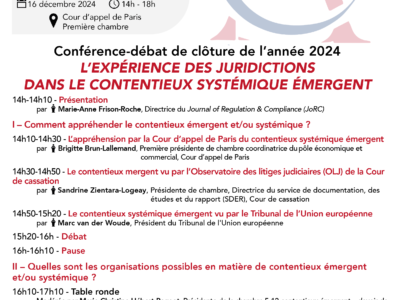
► Full Reference: L’expérience des juridictions dans le Contentieux Systémique Émergent (Courts Experience in Emerging Systemic Litigation), in cycle of conference-debates "Contentieux Systémique Émergent" ("Emerging Systemic Litigation"), organised on the initiative of the Cour d'appel de Paris (Paris Cour of Appeal), with the Cour de cassation (French Court of cassation), the Cour d'appel de Versailles (Versailles Court of Appeal), the École nationale de la magistrature – ENM (French National School for the Judiciary) and the École de formation des barreaux du ressort de la Cour d'appel de Paris – EFB (Paris Bar School), under the scientific direction of Marie-Anne Frison-Roche, 16 December 2024, 2pm.-6pm., Cour d'appel de Paris, Première Chambre (First Chamber) - ► Presentation of the conference:  - 🧮Programme of this event:  Closing conference-debate of 2024 L'EXPÉRIENCE DES JURIDICTIONS DANS LE CONTENTIEUX SYSTÉMIQUE ÉMERGENT  (COURTS EXPERIENCE IN EMERGING SYSTEMIC LITIGATION) Paris Court of Appeal, First Chamber   🕰️2pm.-2.10pm. Présentation (Introduction), by 🕴️Marie-Anne Frison-Roche, Professor of Regulatory Law and  Compliance Law, Director of the Journal of Regulation & Compliance (JoRC), Scientific Director of the Cycle of conferences-debates on the Emerging Systemic Litigation – ESL)   I – Comment appréhender le contentieux émergent et/ou systémique ?  (I – How to deal with Emerging and/or Systemic Litigation?) 🕰️2.10pm.-2.30pm. 🎤L’appréhension par la Cour d’appel de Paris du Contentieux Systémique Émergent (The Paris Court of Appeal's approach to Emerging Systemic Litigation), by 🕴️Brigitte Brun-Lallemand, Première présidente de chambre coordinatrice du pôle économique et commercial, Cour d’appel de Paris (First President of Chamber, Coordinator of the Economic and Commercial Division, Paris Court of Appeal) 🕰️2.30pm.-2.50pm. 🎤Le contentieux émergent vu par l’Observatoire des litiges judiciaires (OLJ) de la Cour de cassation, par 🕴️Sandrine Zientara-Logeay, Présidente de chambre, Directrice du service de documentation, des études et du rapport – SDER, Cour de cassation (President of Chamber, Director of the Department of Documentation, Studies and Reports – SDER, French Court of cassation)  🕰️2.50pm.-3.20pm. 🎤Le contentieux systémique Eémergent vu par le Tribunal de l’Union européenne (Emerging Systemic Litigation as seen by the General Court of the European Union), par 🕴️Marc van der Woude, President of the General Court of the European Union  🕰️3.20pm.-4pm. Debate 🕰️4pm.-4.20pm. Break   II – Quelles sont les organisations possibles en matière de contentieux émergent et/ou systémique ?  (II – How to organise with Emerging and/or Systemic Litigation?) 🕰️4.10pm.-5.10pm. 🎤Table ronde (Round Table) Moderated by 🕴️Marie-Christine Hébert-Pageot, Présidente de la chambre 5-12 contentieux émergent – devoir de vigilance et responsabilité écologique, Cour d‘appel de Paris (President of the 5-12 Chamber emerging litigation – duty of vigilance and ecological liability, Paris Court of Appeal) Speakers: 🕴️Stéphane Noël, Président du Tribunal judiciaire de Paris (President of the Paris First Instance Civil Court) 🕴️Patrick Sayer, Président du Tribunal de commerce de Paris (President of the Paris First Instance Commercial Court) 🕴️Jean-François Beynel, Premier président de la Cour d’appel de Versailles (First President of the Versailles Court of Appeal) and 🕴️Benjamin Deparis, Président du Tribunal judiciaire de Nanterre (President of the Nanterre First Instance Civil Court) 🕰️5.10pm.-5.40pm. Debate   🕰️5.40pm.-6pm. 🎤Conclusion. Le Contentieux Systémique Émergent : dialogues (Conclusion. Emerging Systemic Litigation: Dialogues), by 🕴️Jacques Boulard, Premier Président de la Cour d’appel de Paris (First President of the Paris Court of Appeal) - 🔴Registrations and information requests can be sent to: inscriptionscse@gmail.com 🔴For the attorneys, registrations have to be sent to the following address: https://evenium.events/cycle-de-conferences-contentieux-systemique-emergent/  ⚠️The conference-debates are held in person only, in the Cour d’appel de Paris (Paris Court of Appeal). -

Conferences

Conference

🎤Identifier et anticiper la pratique du Contentieux Systémique Émergent ; Présentation de 🧮L’expérience des juridictions dans le Contentieux Systémique Émergent

► Full Reference: M.-A. Frison-Roche, Identifier et anticiper la pratique du Contentieux Systémique Émergent (Identifying and anticipating the practice of Emerging Systemic Litigation) ; Presentation of L’expérience des juridictions dans le Contentieux Systémique Émergent (Courts Experience in Emerging Systemic Litigation), in cycle of conference-debates "Contentieux Systémique Émergent" ("Emerging Systemic Litigation"), organised on the initiative of the Cour d'appel de Paris (Paris Cour of Appeal), with the Cour de cassation (French Court of cassation), the Cour d'appel de Versailles (Versailles Court of Appeal), the École nationale de la magistrature – ENM (French National School for the Judiciary) and the École de formation des barreaux du ressort de la Cour d'appel de Paris – EFB (Paris Bar School), under the scientific direction of Marie-Anne Frison-Roche, 16 December 2024, 2pm.-6pm., Cour d'appel de Paris, Première Chambre (First Chamber). - 🧮see the full programme of this event - ⚙️This event has been conceived as a part of the cycle of conference-debates "Contentieux Systémique Émergent" ("Emerging Systemic Litigation"), organised on the initiative of the Cour d'appel de Paris (Paris Cour of Appeal), with the Cour de cassation (French Court of cassation), the Cour d'appel de Versailles (Versailles Court of Appeal), the École nationale de la magistrature – ENM (French National School for the Judiciary) and the École de formation des barreaux du ressort de la Cour d'appel de Paris – EFB (Paris Bar School), under the scientific direction of Marie-Anne Frison-Roche - ► English Summary of the conference:  - 🌐follow Marie-Anne Frison-Roche on LinkedIn 🌐follow Marie-Anne Frison-Roche on Instagram 🌐subscribe to the Newsletter MAFR Regulation, Compliance, Law 🌐subscribe to the Newsletter Surplomb, par MAFR

Surplomb - Notion

🎬Regulation and Compliance

Reports

DUCHÂTEL, Mathieu🕴🏻 & WRIGHT, Georgina🕴🏻

📓China’s Extraterritoriality: A New Stage of Lawfare

► Full Reference: M. Duchâtel & G. Wright, China’s Extraterritoriality: A New Stage of Lawfare, Institut Montaigne, Explainer, December 2024, 72 p. - 📓read the Explainer - 📓read the English Summary of the Explainer - 📓read the presentation of this Explainer made on the Institut Montaigne's website - ► English Summary of the Explainer (done by the Authors): "Extraterritoriality – the application of national laws abroad – is gaining traction. In a world characterized by strategic competition and weakened international organizations, many countries are turning to law to secure their interests. This includes China. Extraterritoriality has expanded under Xi Jinping. China no longer sees it as a relic of "the century of humiliation" during which foreign powers imposed consular jurisdiction on Chinese soil. Today, Chinese extraterritoriality has three aims: to defend against foreign interference and sanctions; to legitimize China’s foreign policy actions and strengthen its global influence; and as a way to deploy its public security agenda abroad. China is also exploring a more offensive approach to extraterritoriality in the form of economic sanctions  – though it has yet to use them. A more offensive use will depend on the willingness of the top leadership to employ such tactics during moments of international tension; a stronger international role for the renminbi and lower overall exposure to the dollar; and the countermeasures that third-countries could take to respond to Chinese extraterritorial norms. The EU must act. Europeans need to understand the risks associated with Chinese extraterritoriality and plan accordingly. The EU should continue working with like-minded partners and be ready to deny access to the EU single market in case of abuse. Losing access to the single market would be deeply damaging to China’s interests and constitute a powerful deterrent for the EU. Institut Montaigne’s latest issue paper provides a framework for understanding all dimensions of Chinese extraterritoriality and offers decision-makers and businesses a roadmap for an informed response. Understanding the implications of Chinese extraterritoriality is crucial for governments and businesses, and should be integral to the EU's approach to economic security.". -

Reports

WRIGHT, Georgina🕴🏻 & CHETCUTI, Louise🕴🏻

📓Extraterritorialité américaine : une arme à double tranchant

► Full Reference: G. Wright & L. Chetcuti, US Extraterritoriality: The Trump Card, Institut Montaigne, Explainer, December 2024, 62 p. - 📓read the Explainer - 📓read the English Summary of the Explainer - 📓read the presentation of this Explainer made on the Institut Montaigne's website - ► English Summary of the Explainer (done by the Authors): "Extraterritoriality — the application of national laws abroad — has grown exponentially over the last two decades. In a world characterized by strategic competition and weak international organizations, many countries are turning to law to secure their interests. None more than the United States. There are good and bad uses of US extraterritoriality. It has become a key tool to uphold international law and to safeguard the US’ interests. It has helped to sanction hostile states and combat corruption, money laundering, organized crime and terrorism. It has helped to reduce excessive risk-taking by companies and has been used to manage US-China systemic rivalry. However, the US has also been accused of using it as a way to assert market dominance. Could extraterritoriality be the next Trump Card the United States plays? During his first term, President Trump tightened export controls and expanded US laws to combat human rights abuses. At the same time, he rolled back banking regulations and asked his team to review US laws that created unnecessary red tape. Recently, he warned that he would remove any sanctions that weakened the dollar’s dominant position. The extent to which extraterritoriality is used to exert political pressure on EU countries is unclear. The EU must be better prepared. Companies that fail to comply with US rules risk huge fines, handover of sensitive data and exclusion from the US market. European companies often prefer to comply with US rules, rather than abide by European measures designed to block their application. This poses a direct challenge to the sovereignty of the EU and its member states. Institut Montaigne’s latest issue paper provides a framework for understanding all dimensions of US extraterritoriality and offers decision-makers and businesses a roadmap for an informed response. Understanding the implications of US extraterritoriality is crucial for governments and businesses, and should be integral to the EU's approach to economic security.". -