All news

Marie-Anne Frison-Roche intervenant aux Rencontres de la Haute Autorité de l’Audit (H2A), 2 juillet 2025

Conferences

🎥L’enjeu de la crédibilité des rapports de durabilité. Temps long, Simplicité et Stratégie (The credibility of sustainability reports. Time, Simplicity and Strategy), in 🧮Mise en œuvre de la directive CSRD. Premiers constats et perspectives (Implementation of the CSRD directive. Initial findings and outlook)

► Full Reference: M.-A. Frison-Roche, "L'enjeu de la crédibilité des rapports de durabilité. Temps long, Simplicité et Stratégie" (The credibility of sustainability reports. Time, Simplicity and Strategy), concluding speech, in Rencontres de la Haute Autorité de l'Audit (H2A), 2025,  Mise en œuvre de la directive CSRD. Premiers constats et perspectives (Annual Manifestation of the French Audit Regulatory Body Haute Autorité de l'Audit – H2A, Implementation of the CSRD directive. Initial findings and outlook),, 2 July 2025, La Défense, 1pm-6pm - This manifestation, which takes place face-to-face with simultaneous translation, begins with a presentation by Florence Peybernès, President of the French High Audit Authority ( Haute Autorité de l'Audit -H2A). It is followed by 3 round-table discussions: 🪑🪑🪑 Round table 1: Feedback on the first appointments 🪑🪑🪑 Round table 2: Cross-perspectives between preparers, verifiers and stakeholders 🪑🪑🪑 Round table 3: Perspectives for CSRD   It is following on from this that the more legal, more judicial perspective, in an articulation between Ex Ante and Ex Post, will take shape. - ► English summary of the speech, as prepared : n view of the information available at the time of preparation for this event, the considerable interest aroused by the CSRD, and also its contestation, which led to its modification, is it counter-intuitive in view of the technicality of the remarks, the flood of criticism and the number of pages one reads, the impression of the weight, constraints and uselessness of the thing which would deprive companies of their freedom, but what emerges rather is Simplicity. Why: because the sustainability report is only a tool and it is the goal it serves that needs to be considered (more generally that's how the judge looks at it), a tool that serves a European strategy (Green Deal, sustainable finance). It is this strategy that needs to be identified, and the company has a free hand in it. What we are looking at the company in its contribution to this goal that is simple, a contribution which it can, in information that is admittedly standardised, draw the outlines of Long-term and Strategy: Investors and stakeholders are not hostile to this approach: the key is the credibility of the information made available. Because Long-Term Thinking puts the future at the centre, and we don't know what that future will be. This essential element, which the courts have recalled in relation to Vigilance Obligation, must also be borne in mind, because it is first and foremost a question of providing information about the future. To express the Information they want to give on this subject, companies need to understand the Goal of the European Plan (where Simplicity lies), to adjust their own plan to it (under the more familiar term of "Strategy") the councils and lawyers need to help them with this; to blend their strategies with the European strategy, to rely on the authorities and the auditors so that what they say is credible. Credibility is at the heart of it, which is why auditors are at the heart of it. Because the only obligation they have is to say. Not to do. The CSRD should not be interpreted as imposing obligations on the companies subject to it to do things (such as the obligation of vigilance generates); the CSRD only imposes an obligation on them to say things. The CSRD imposes on them only an obligation to inform. While this may be onerous, standardised and certified, there is no obligation to do or disclose anything. Moreover, that is part of the company's own strategy, a strategy over which the company retains full control. In this respect, although standardised, the information is free and it is the credibility of the information that is crucial, but not participation in a plan whose terms would be written by the Authorities or the stakeholders. Therefore, after learning from each other, it seems that there are three fairly simple things that are sometimes buried under the complication of the details accumulated and the violence of the arguments exchanged around the European Omnibus package. These three points will be developed at the end of the round-tables.   The first is the simplicity of the breadcrumb trail of credible, accessible information imposed by the European Union to put the Green Deal into practice. This breadcrumb trail is held in particular by the various regulators. The second is the existence of a single, simple obligation on the part of the company: to say what it has done, is doing and plans to do, without being obliged to do anything in the European Action Plan (the CRSD does not forcibly enroll companies in the European action plan). This limitation to an obligation to say is essential. Its articulation with obligations to act, arising in particular from texts on Vigilance, or even identical terms, must not lead to confusion in qualifications. The third is the benefit that the company derives from the articulation of a double "singular strategy": that of the European Union, which wants to build its future, a strategy of the Union to which it is free to contribute or not to contribute, and that of its own strategy which is articulated with the first and in which green gives way to many other colours according to the will of the company.   ► English Summary of speech, as made with regard to what effectively was said during the 2 round tables:  During the event itself, I preferred to place myself rather in the direct continuation of what had been said.  In the fifteen minutes allotted, this was the reason for not proceeding in this way, but rather to highlight the fact that what has emerged, all these efforts, uncertainty, trial and error and goodwill to elaborate that went into drawing up the first sustainability reports, runs the risk of being erased because in retrospect, in 2 or 5 years' time, particularly if a lawsuit were be brought, we will have the impression that everything was self-evident, that we knew everything, that everything was clear and decided. And it's that future, which will be the future of the judge who will be called upon by a stakeholder, a regulator, a prosecutor, who always takes the past for granted, that we have to think about. We need to think in terms of evidence. Evidence of uncertainty. And always remember that the sustainability report is also a piece of evidence. Which will fuel liability claims, disputes over information, and so on. Plus encore, parce que le report de durabilité n'est qu'un outil, pour une stratégie, qui est une stratégie d'ensemble, où la CSRD n'est qu'un élément du puzzle, des éléments du rapport de durabilité peuvent être pris pour être utilisés plus tard pour alimenter d'autres documents et rapports, et d'autres litiges. Cela est notamment le cas du plan de vigilance, puisque la cartographie des risques est souvent commune au rapport de durabilité et au plan de vigilance, ce qui est logique puisque la CSRD et la CS3D se font miroir dans le grand plan d'action de l'Union que constitue le Pacte vert. Mais cela est amplifié par les entreprises, qui parfois confondent l'un et l'autre, dans la présentation même au sein du rapport de gestion. Il est pourtant essentielle de distinguer nettement l'obligation de dire (rapport de durabilité) et l'obligation de faire (plan de vigilance). L'ambiguïté des "engagements" accroît cela. Il est essentiel de veiller à un travail ex ante entre expert de la gestion, de la finance, de l'audit et du droit pour éviter que les points de contact ne se transforment en confusions, maintenant et /ou plus tard, confusions qui pourraient être préjudiciables à tous. - 🌐follow Marie-Anne Frison-Roche on LinkedIn 🌐follow Marie-Anne Frison-Roche on Instagram 🌐subscribe to the Newsletter MAFR Regulation, Compliance, Law 🌐subscribe to the Video Newsletter MAFR Surplomb 🌐subscribe to the Newsletter MaFR Droit & Art
Publication director

🏗️ direction of the collection: 📚Cours Dalloz – Série Droit privé

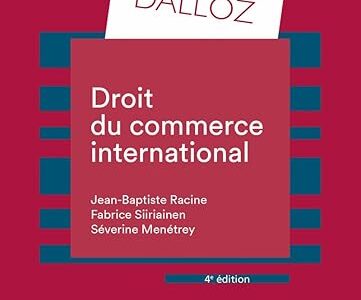
📚Publication of : 🕴️J.-B. RACINE, 🕴️F. SIIRIAINEN, 🕴️S. MENÉTREY, 📕Droit du commerce international (International Trade Law), 4th ed.

► Full Reference : J.-B. Racine, F. Siiriainen, S. Menétrey, Droit du commerce international (International Trade Law), 4th ed., 2025, Dalloz, “Cours Dalloz-Série Droit privé” Series, 410 p. - ► General presentation of this Course (written in French) : This Course sets out all the specific rules of international trade (sale, transport, distribution, etc.). International trade law has become a discipline at the heart of the process of globalisation of the economy. It is therefore expanding rapidly. It is not merely a branch of private international law. International trade law has a definite autonomy through its spirit, its methods and its object. The sources of this law are particular insofar as it gives pride of place to the usages of international trade, more generally referred to as the lex mercatoria. The actors of international trade are varied: companies, of course, but also States. The particularism of international trade law also lies at the level of international trade operations: sale, transport, distribution, etc. obey specific rules, most often substantive rules of international origin. Finally, the importance and originality of international trade law are shown in the use of arbitration. As private justice, arbitration has today become the ordinary means of resolving international trade disputes. The book is intended for students discovering the subject as well as for academics and practitioners. It combines theoretical knowledge and practical guidance. It opens onto a different vision of law, that is to say a law partly dissociated from the State. It also stresses the need to build a law that meets the challenges of globalisation. - 📚See the entire collection in which the book is published. - 📚Books in the collection directly related to this one : 🕴️B. Haftel, 📕Droit international privé (Private International Law) 🕴️D. Mainguy, 📕Contrats spéciaux (Specific Contracts) -

Thesis defence

🪑🪑🪑member of the jury for Annika Bauch’s thesis: 📓Le droit de l’entreprise à l’épreuve de la compliance (Company Law put to the test of Compliance)

► Full Reference: M.-A. Frison-Roche, member of the jury for Annika Bauch's thesis, Le droit de l'entreprise à l'épreuve de la compliance (Company Law put to the test of Compliance), University of Toulouse, 5 June 2025, 2-5pm.  - 🪑🪑🪑Other members of the jury :   🕴🏻Lukas Rass-Masson, Professor at Toulouse-Capitole University, thesis supervisor 🕴🏻Sandrine Tisseyre,  Professor at Toulouse-Capitole University,  🕴🏻Marc-Philippe Weller,  Professor at the University of Heidelberg, Germany 🕴🏻Caroline Coupet, Professor at the Université Panthéon-Assas (Paris II) - ► Presentation of the thesis: The thesis is based on French, American and German research. It is based on two perspectives. The first part of the thesis describes the way in which Business Law  feeds into Compliance, since it is within Business Law (and more particularly Company Law and the legal rules governing corporate bodies) that Compliance, which the author presented  to have originated in the United States, has transformed the way in which companies must be managed, having to take into account the extra-financial dimension of their activity, which modifies the very notion of social interest and leads to the integration of stakeholders into the corporate functioning. The second part of the thesis looks at the way in which Compliance has transformed Corporate Law, bringing with it new requirements, such as consideration of risks, regulatory mechanisms and ethical concerns, with the company itself becoming a vehicle for Compliance. This is achieved in particular by inserting compliance clauses into contracts, which is an appropriate but nevertheless limited tool for this compliance goal. - At the end of her defence, the candidate was awarded the degree of Doctor of Law and was informally congratulated by her jury on the quality of her work. - 📗The thesis was subsequently published by Larcier. - 📝It features a foreword by Marie-Anne Frison-Roche - 🌐follow Marie-Anne Frison-Roche on LinkedIn 🌐follow Marie-Anne Frison-Roche on Instagram 🌐subscribe to the Newsletter MAFR Regulation, Compliance, Law 🌐subscribe to the Video Newsletter MAFR Surplomb 🌐subscribe to the Newsletter MaFR Droit & Art

Articles in a non-legal collective publication

Article in a non-legal collective publication

📝Réguler le numérique, ou Sisyphe heureux (Regulating Digital, or a happy Sisyphus), in 📚Enjeux numérique, 📗Compliance et nouvelles régulations (Compliance and New Regulations)

► Full Reference: P. Bonis & M.-A. Frison-Roche, "Réguler le numérique, ou Sisyphe heureux" (Regulating Digital, or a happy Sisyphus), in P. Bonis & L. Castex (dir.), Compliance et Nouvelles Régulations, Les Annales des Mines, series "Enjeux numériques, June 2025, pp. 5-7. - 📝read the article (in French) - 📗read the table of content of this special issue of Enjeux numérique, Régulation et Compliance (in French), in which this introductory article is published. - ► English Summary of this article: This introduction to the collective publication on Regulation and Compliance, which aims to bring order to the Digital space, takes up the idea expressed by Camus when he referred to 'happy' Sisyphus, and expresses the idea that Regulation and Compliance are applied to this area with difficulty, relentlessness and failure, with texts constantly being adopted, modified and amplified on all sides, while the Digital Space is constantly changing, and the slope is constantly being climbed again. But this should not be seen as a failure, not even a flaw, because it is in the nature of digital regulation to always place the regulatory apparatus on our shoulders. This weight is shared by all, by the Authorities of all countries, because there is something common to all and also because there is something specific for each, because the techniques differ and because the visions of the world that the Politicians print in the texts and project in the Digital will always differ. This weight is also shared by companies, which internalise the rules through Compliance mechanisms, making them necessary agents for the efficiency and sustainability of the digital system, but also players in it, in articulation with Internet users in a permanent and unstable articulation with the local to the finest and this global that the Internet has invented. This presentation opens the series of contributions to the collective publication Régulation et Compliance, which makes up this special issue of Enjeux numériques in Annales des Mines. - 🌐read also the English presentation of:🕴️Marie-Anne Frison-Roche, 📝Le Droit de la compliance, voie royale pour réguler l'espace numérique (Compliance Law as a Royal Road for regulating the Digital Space) - 🌐follow Marie-Anne Frison-Roche on LinkedIn 🌐follow Marie-Anne Frison-Roche on Instagram 🌐subscribe to the Newsletter MAFR Regulation, Compliance, Law 🌐subscribe to the Video Newsletter MAFR Surplomb 🌐subscribe to the Newsletter MaFR Droit & Art

Articles in a non-legal collective publication

article in a non-legal collective publication

📝Le Droit de la compliance, voie royale pour réguler l’espace numérique (Compliance Law as a Royal Road for regulating the Digital Space​), in📚Enjeux numérique,📗Régulation et Compliance

► Full Reference: M.-A. Frison-Roche, "Le Droit de la compliance, voie royale pour réguler l'espace numérique" (Compliance Law as a Royal Road for regulating the Digital Space), in P. Bonis et L. Castex (dir.), Compliance et nouvelles régulation, Annales des Mines, coll. "Enjeux numériques", juin 2025, pp. 69-77. - 📝 read the article (in French)  - 🚧This article is underpinned by a English Working Paper in English, with additional technical developments and hypertext links. : Compliance Law as a Royal Road for regulating the Digital Space - ► English Summary of this article:  In order to describe the role of Compliance Law in regulating the digital space and to conclude that this new branch of Law is the 'royal road' to this end, this study proceeds in 6 stages.  Firstly, at first sight and conceptually, there is a gap between the political idea of Regulating and the ideas (freedom and technology as 'law') on which the digital space has been built and is unfolding.  Secondly, in practice, there is such a huge gap between the ordinary methods of Regulatory Law, which are backed by a State, and the organisation of the Digital Space by these economic operators, that are both American and global.  Thirdly, the political claim to civilise the Digital Space remains and is growing, relying on the very strength of the entities capable of realising this ambition, these entities being the crucial digital operators themselves, seized as Ex Ante.  Fourthly, it corresponds to the conception and practice of a new branch of Law, Compliance Law, which should not be confused with "conformity" and which is normatively anchored in its "Monumental Goals".  Fifthly, Compliance Law internalises Monumental Goals in the digital operators which disseminate them through structures and behaviours in the digital space.  Sixthly, through the interweaving of legislation, court rulings and corporate behaviour, the Monumental Goals are given concrete expression, willingly or by force, in ways that can civilise the digital space without undermining the primacy of freedom. - 🌐follow Marie-Anne Frison-Roche on LinkedIn 🌐follow Marie-Anne Frison-Roche on Instagram 🌐subscribe to the Newsletter MAFR Regulation, Compliance, Law 🌐subscribe to the Video Newsletter MAFR Surplomb 🌐subscribe to the Newsletter MaFR Droit & Art

Working papers

Working Paper for a Newsletter

🚧Pour maîtriser la masse réglementaire de la Compliance, la penser comme un puzzle

► Full Reference : M.-A. Frison-Roche, To master the regulatory mass of Compliance, think of it as a jigsaw puzzle,  Working Paper , May 2025 - 📝 This Working Paper underpins the Newsletter MAFR Law -Compliance – Regulation  of 2 June 2025 :  - ► Summary of this Working Paper:  People are rightly complaining that Europe's regulatory and compliance regulations are too numerous, too complicated and too changeable. As a result, they are said to be unmanageable. Three solutions are proposed: specialise lawyers, regulatory corpus by regulatory corpus; deregulate; entrust everything to algorithms. These are inadequate solutions, because regulations cannot be understood unless they are put into perspective with the rest of the legal rules .; we have entered a new world, and these new regulations reflect the need for a new Law (unless we want to destroy the Law itself, which is what some people are dreaming of doing); algorithms reproduce past solutions and do not produce the new legal conception required. For an appropriate solution, we need to move away from a word-by-word understanding of the regulatory and compliance regulations and understand them as a whole, not only in relation to the purpose that gives them meaning, but also in relation to each other. In the positive sense of the term, they form a European 'jigsaw puzzle'. We need to look at the overall picture in which each regulation fits and makes sense. It finds its simplicity in relation to its purpose. It is always a question of working towards the sustainability of systems by asking companies to contribute so that the systems do not crush human beings but benefit them. Thus, in practice, the Monumental Goals of Compliance Law give clarity to the body of regulations which, when seen as a whole, are manageable and practical. Judges interpret them in this way. - 🔓read the Working Paper below⤵️ - 🌐follow Marie-Anne Frison-Roche on LinkedIn 🌐follow Marie-Anne Frison-Roche on Instagram 🌐subscribe to the Newsletter MAFR Regulation, Compliance, Law 🌐subscribe to the Video Newsletter MAFR Surplomb 🌐subscribe to the Newsletter MaFR Droit & Art

Articles in a legal collective publication

article in a collective legal publication

📝100 fois remettre la Compliance sur le métier de la Stratégie (“100 times put Compliance back on the Strategy agenda”)

► Full Reference: M.-A. Frison-Roche, "100 fois remettre la Compliance sur le métier de la Stratégie" (100 times put Compliance back on the Strategy agenda), in Lettre d'information Compliance. Groupe SNCF, 100ième issue, 28 may 2025. - 📝read the article (in French) - ► English presentation of this article: This anniversary article sets out what Compliance is and should be in a large group. It expresses it in 4 points: 1. Actively master regulations by understanding their spirit 2. Improving risk detection without taking away the entrepreneurial spirit 3. Promoting convergence and managing conflict 4. Strengthen the company's identity by focusing on its strategic ambitions     - 🌐follow Marie-Anne Frison-Roche on LinkedIn 🌐follow Marie-Anne Frison-Roche on Instagram 🌐subscribe to the Newsletter MAFR Regulation, Compliance, Law 🌐subscribe to the Video Newsletter MAFR Surplomb

Publication director

🏗️ direction of the collection: 📚Cours Dalloz – Série Droit privé

📚Publication of : 🕴️Alain PIETRANCOSTA, 📕Droit des marchés financiers (Financial Markets Law), 1st ed.

► Full Reference : A. Pietrancosta, Droit des marchés financiers (Financial Markets Law), 1st ed., 2025, Dalloz, “Cours Dalloz-Série Droit privé” Series, 500 p. - ► Table of contents of the book (written in French) : Introduction Preliminary chapter: Presentation of the subject matter Part 1: General features of financial markets law Title 1: The spirit of financial markets law Chapter 1: The pair deregulation – regulation Chapter 2: The objectives assigned to financial markets law Section 1: The proper technical functioning of markets Section 2: Transparency Section 3: Investor protection Title 2: The sources of financial markets law Chapter 1: General approach Chapter 2: Description of the positive normative framework Section 1: International sources Section 2: European sources Section 3: French sources Part 2: Technical aspects of financial markets law Title 1: Infrastructural components Chapter 1: Legal approach to financial securities markets Section 1: Definition and typologies of financial securities Section 2: Organisation of financial securities markets Chapter 2: The public regulator: the Autorité des marchés financiers Section 1: Legal nature of the AMF Section 2: General missions of the AMF Section 3: Organisation of the AMF Section 4: Powers Title 2: Market transparency Chapter 1: Periodic information Section 1: Accounting information Section 2: Financial information Section 3: Governance information Section 4: Social and environmental information Chapter 2: Occasional information: the prospectus Chapter 3: Permanent or continuous information Section 1: Disclosure by listed issuers of inside information concerning them Section 2: Declarations by investors of threshold crossings and shareholder agreements Title 3: Substantive investor protection Chapter 1: Governance of listed companies Section 1: Rules specifically applicable to listed companies Section 2: Rules with plural sources Chapter 2: Takeover bids and buy-out offers Section 1: Takeover bids Section 2: Public buy-out offers and squeeze-outs Chapter 3: The prohibition of market abuse Section 1: Common European rules Section 2: The prohibition of insider dealing Section 3: The prohibition of market manipulation - 📚See the entire collection in which the book is published. -

Monographs

monograph in a legal publication

📝Le “Grand Arrêt” de la Cour d’Appel de Paris du 7 mai 2025, Dalloz et al. c/ Forseti

► Full Reference : M.-A. Frison-Roche, Le "Grand Arrêt" de la Cour d'appel de Paris du 7 mai 2025, Dalloz et al. c/Forseti, D. 2025, p. - 📝reread the article (in French) - ► Ench presentation of this article: The first part of the article describes the Paris Court of Appeal's ruling against the company that created a Legaltech platform under the trade name 'Doctrine', which offers a large number of court rulings, particularly from lower courts. Sued for unfair competition by a group of publishers offering a similar service, they were not convicted at first instance, but were convicted by the Court of Appeal because it appeared that they had fraudulently obtained thousands of judgments, which, under Civil Law, constitutes unfair competition to the detriment of the plaintiffs. The second part of the article draws 6 lessons from this. The power of general law. On the benefits that the perpetrator has derived from the slowness of justice.  On the importance of Open Data. On the fact that the law is not mastered by accumulating data but by putting it into perspective through the thinking of authors and publishers. On the indifference for this of the financiers who built and resold the "Doctrine" website. On the very nature of a 'Grand Arrêt', such as this one.   -    

Working papers

Working Paper basis for an article in a collective publication

🚧Compliance Law as the Royal Road for regulatinf the Digital Space

► Full Reference: M.-A. Frison-Roche, Compliance law as a Royal Road for regulating the Digital Space, Working Paper, May 2025 - 📝 This Working Paper is the English basis for an article written in French "Le Droit de la compliance, voie royale pour réguler l'espace numérique", in 📕 - ► Summary of this Working Paper: In order to describe the role of Compliance Law in regulating the digital space and to conclude that this new branch of Law is the 'royal road' to this end, this study proceeds in 6 stages. Firstly, at first sight and conceptually, there is a gap between the political idea of Regulating and the ideas (freedom and technology as 'law') on which the digital space has been built and is unfolding. Secondly, in practice, there is such a huge gap between the ordinary methods of Regulatory Law, which are backed by a State, and the organisation of the Digital Space by these economic operators, that are both American and global. Thirdly, the political claim to civilise the Digital Space remains and is growing, relying on the very strength of the entities capable of realising this ambition, these entities being the crucial digital operators themselves, seized as Ex Ante. Fourthly, it corresponds to the conception and practice of a new branch of Law, Compliance Law, which should not be confused with "conformity" and which is normatively anchored in its "Monumental Goals". Fifthly, Compliance Law internalises Monumental Goals in the digital operators which disseminate them through structures and behaviours in the digital space. Sixthly, through the interweaving of legislation, court rulings and corporate behaviour, the Monumental Goals are given concrete expression, willingly or by force, in ways that can civilise the digital space without undermining the primacy of freedom. - 🔓read the Working Paper below⤵️ - 🌐follow Marie-Anne Frison-Roche on LinkedIn 🌐follow Marie-Anne Frison-Roche on Instagram 🌐subscribe to the Newsletter MAFR Regulation, Compliance, Law 🌐subscribe to the Video Newsletter MAFR Overhang 🌐subscribe to the Newsletter MaFR Droit & Art

Conferences

🖥️Traduire dans l’institution judiciaire l’articulation entre l’international et le systémique, in🧮Le contentieux systémique émergent, un contentieux international justifiant la création de juridictions spécialisées ?

  - ► Référence complète : M.-A. Frison-Roche, "Traduire dans l'institution judiciaire l'articulation entre l'international et le systémique" in CREDIP, Faculté de Droit de l'Université Jean Moulin – Lyon 3, Le contentieux systémique émergent, un contentieux international justifiant la création de juridictions spécialisées, cycle de conférences sur Le contentieux international et la spécialisation des juges, Lyon , 18 avril 2025, 10h-12h. - 🪑🪑🪑Participent aussi à cette manifestation : 🪑Jacques Boulard, Premier président de la Cour d'appel de Paris 🪑Brigitte Brun-Lallemand, Première présidente de chambre de la Cour d'appel de Paris (Pôle économique) 🪑Jérémy Heymann, professeur de droit à l'Université Jean Moulin – Lyon 3 🪑Sabine Abravanel-Jolly, Professeure de droit au sein de l'Equipe Louis Josserand 🪑Marylou Françoise, maîtresse de conférences à l'Université Jean Moulin – Lyon 3 - 🧮consulter le programme complet de cette manifestation - ► Résumé de l'intervention : cette intervention ayant eu lieu après les présentations du Premier Président Jacques Boulard et Madame la Première Présidente Brigitte Brun-Lallemand, elle s'articule sur ces deux interventions.   I. Contentieux systémique et Contentieux international. On peut ainsi se demander si la nature d'un "contentieux systémique" se prête à ce qu'est un "contentieux international" ? A première vue, non. L'on pourrait poser que, d'une part, si le "contentieux systémique émergent" était "nécessairement international", alors l'on ne comprendrait pas pourquoi la Chambre spéciale internationale de la Cour d'appel de Paris ne suffisait pas et d'autre part, l'on ne comprendrait pas comment deux jugements ont été rendus sur le Devoir de Vigilance, dont on ne conteste pas qu'il appartient au Contentieux Systémique Emergent, alors qu'ils ne portent pas sur une chaine internationale de valeur : jugement TJ Paris 5 décembre 2023 dit La Poste, cas systémique actuellement devant la chambre spécialisée de la Cour d'appel de Paris ; TJ Paris 13 février 2025, dit SNCF, cas systémique, n'ayant pas fait l'objet d'appel.   II. Deux chambres spécialisées en miroir Dès lors, l'on pourrait dire que le contentieux systémique est de fait international mais pas par nature. Parce que cela n'est pas une subdivision du contentieux international, cela explique certes que la chambre 5-12 soit autonome par rapport à la chambre 5-16 (chambre internationale), mais parce que la perspective est de fait souvent transnationale, ces 2 chambres ont vocation à fonctionner en miroir. Car le système est un fait global. Et c'est plus en terme de fait global qu'il convient de le traiter, ce qui est plus facile dans des systèmes qui ne sont pas construit sur cette summa divisio du fait et du droit, qui convient mal au contentieux systémique.   III. Par nature, un contentieux dans lequel un système est "impliqué". Cela nous amène donc vers la définition du "Contentieux Systémique Emergent". Elle est simple : c'est un Cause dans laquelle un système est impliqué, dans lequel les intérêts de celui-ci sont en jeu, le premier de ses intérêts étant sa survie. C'est pourquoi la durabilité est une notion-clé, que l'on retrouve quelque soit le système impliqué. C'est pourquoi l'avenir est présent dans le contentieux systémique. C'est pourquoi l'office du juge est renouvelé car il s'agit d'un office Ex Ante, renouvellement à la fois procédural et substantiel qui conduit en pratique à un Droit processuel. Le fait systémique mène donc de droit à une dialogue des juges qui se spécialisent sur des faits globaux et les obligent, sauf à méconnaître ceux-ci, à se prendre en considération. Cela donne un nouveau statut au "droit comparé".   IV. Un contentieux émergent par le fait de systèmes nouveaux, globaux, saisis par des opérateurs locaux qui en fixent la stratégie.  Les systèmes ont déjà donné lieu à des contentieux : c'est la juridictionnalisation du Droit de la Régulation. Mais la Régulation a quitté ce prérequis des systèmes pour entrer à l'intérieur des opérateurs économiques dont le pouvoir de stratégie est situé localement. Le Droit de la Compliance internalise les besoins systémiques. Le Droit de la Compliance dont on affirma, parce qu'Ex Ante, qu'il allait dispenser du Juge, s'est lui-même juridictionnalisé. L'obligation de vigilance étant elle-même la pointe avancée de la Compliance, ne pouvait que donner une large place au Juge. Tandis que le système est l'enjeu du procès et de sa bonne solution, la partie au litige est l'opérateur cruciale : non seulement les entreprises régulées (comme les banques) mais encore les entreprises maîtresses des chaines de valeur (ce qui fait sortir le Droit de la Régulation des secteurs régulés). Or, les chaines de valeur sont un espace global contractuellement structuré transnational rattachées à un juge local qui est confronté à un office renouvelé avec le DIP.    V. Une culture juridictionnelle propre à des zones distinctes. Le Droit de la Vigilance, de la Compliance et de la Régulation tel qu'on le voit manier par les juges dépasse nos distinctions entre droit public et droit privé, entre les systèmes juridique, mais les décisions que l'on lit expriment trois cultures, procédurales et substantielles, différentes : l'Asie, les Etats-Unis et l'Europe. Cette culture de place porteuse d'une identité européenne de Vigilance, de Compliance et de Régulation repose notamment sur une culture juridictionnelle propre à cette zone-là. - 🌐suivre Marie-Anne Frison-Roche sur LinkedIn 🌐suivre Marie-Anne Frison-Roche sur Instagram 🌐s'abonner à la Newsletter MAFR Regulation, Compliance, Law 🌐s'abonner à la Newsletter en vidéo MAFR Surplomb 🌐s'abonner à la Newsletter MaFR Droit & Art