All news

Reports

Rapport d’information sur l’évaluation de la loi du 27 mars 2017 relative au devoir de vigilance des sociétés mères et des entreprises donneuses d’ordre

► Full reference: C. Dubost and D. Potier, Commission des lois constitutionnelles, de la législation et de l’administration générale de la République, Rapport d'information sur l’évaluation de la loi du 27 mars 2017 relative au devoir de vigilance des sociétés mères et des entreprises donneuses d’ordre, 24th February 2022, 100 p. - ► Read the report (in french)  -

Lessons

Leçon n°4

Articles in The Journal of Regulation & Compliance « JoRC »

SEGONDS, Marc

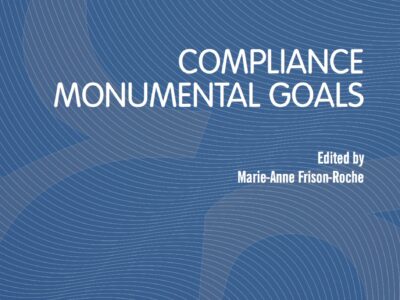
📝Compliance, Proportionality and Sanction. The example of the sanctions taken by the French Anticorruption Agency, in 📘Frison-Roche, M.-A. (ed.), “Compliance Monumental Goals”

► Full Reference: Segonds, M., Compliance, Proportionality and Sanction. The example of the sanctions taken by the French Anticorruption Agency, in Frison-Roche, M.-A. (ed.),Compliance Monumental Goals, series "Compliance & Regulation", Journal of Regulation & Compliance (JoRC) and Bruylant, to be published. - ► Article Summary:  Before devoting the developments of his article to the sole perspective of sanctions imposed under "Anti-corruption Compliance", the author recalls in a more general way that, as is the sanction, Compliance is in essence proportional: Proportionality is inherent to Compliance as it conditions any sanction, including a sanction imposed under Compliance. This link between Proportionality and Compliance has been underlined by the French Anti-Corruption Agency (Agence française anticorruption – AFA) with regard to risk mapping, which must measure risks to arrive at effective and proportional measures. This same spirit of proportionality animates the recommendations of the AFA which are intended to apply according to the size of the company and its concrete organisation. It governs sanctions even more, in that punitive sanctions refer on one hand to Criminal Law, centered on the requirement of proportionality. Punitive sanctions It governs sanctions even more, in that punitive sanctions refer on the other hand to the disciplinary power of the manager who, from other sources of law, must integrate the legal requirement of proportionality when he/she applies external and internal compliance norms. -     📘see the general presentation of the book, Compliance Monumental Goals, in which this article is published   -

Articles

La loi sur le devoir de vigilance des sociétés multinationales : parcours d’une loi improbable

►Full Reference: Delalieu, G., La loi sur le devoir de vigilance des sociétés multinationales : parcours d’une loi improbable, Droit et Société, 2020/3, n°106, pp. 649-665. - ►English Summary of the Article (done by the Author): (Corporate Duty of Vigilance in France: The Path of an Improbable Statute). This article offers an analysis of the resistance encountered by defenders (NGOs and trade unions) of the French Law on Corporate Duty of Vigilance. These actors sought to behave as institutional entrepreneurs deploying intense advocacy and lobbying efforts to successfully have this bill tabled, examined, and ultimately passed by the French government. Considering this case, the concept of “institutional entrepreneurship” is discussed and then relativized using Machiavelli’s notion of “Fortuna,” to describe the “improbable” adoption of this statute. The results tend to put into perspective the importance that individual actors, including collective ones, can have in the explanation of institutional change, in favor of a multilevel analysis of change (micro, meso, macro). -  

Organisation of events

⚙️scienfica organisation of a public manifestation

🧱Scientific Organisation of the Conference 🧮L’office du juge et les causes systémiques (“The office of the judge and systemic causes”)

► Full Reference: Frison-Roche, M.-A., coordination and moderation of the conference L'office du juge et les causes systémiques (""The Office of the Judge and systemic causes"), in Cycle of Conferences, Penser l'office du juge ("Thinking the Office of the Judge"), Grand Chamber of the Cour de cassation, Paris, May 9, 2021, 17h-19h. The conference is held in French. - ► General presentation of the conference: the conference is based on the intervention of three judges, Christophe Soulard, Fabien Raynaud, and François Ancel, who think and debate among themselves on a hypothesis: the existence of "systemic causes". The hypothesis is that beyond and through the diversity of disputes and cases that are submitted to the most diverse judges, there is a category of cases that are systemic, which means containing in what is submitted to the judge for resolution a system.  If such a category exists, which also raises the question of the diversity of systems and the difficulty arising from their submission to rules that are not legal (for example economic, biological, financial "laws", etc.) , then the judge should take this into account, both in the procedure and in the judgment they make on the case and in the way they formulate et restitute this judgment. - 📝read the presentation of this conference by the Cour de cassation (in French) 📝read the program of the cycle of conferences 2022 (in French) -  🎥see the conference video (in French)  🎥 see the synthesis video of the conference, made in situ by Marie-Anne Frison-Roche (in French)   - ​✏️read the notes taken during the conference to make the synthesis (in French) 📝read the article of Marie-Anne Frison-Roche restituting this conference, published in the Recueil Dalloz (in French) - ►read the works, basis of the two interventions of Marie-Anne Frison-Roche 🚧 L'hypothèse de la "cause systémique (made before the conference to prepare it), available en English 📝Synthese of the conference (made during the conference) -

Working papers

🚧Compliance Law and Climate. Prevent Climate Risk and build Climate Balance

  🌐follow Marie-Anne Frison-Roche on LinkedIn 🌐subscribe to the Newsletter MAFR Regulation, Compliance, Law  - ► Full Reference: M.-A. Frison-Roche, Compliance Law and Climate. To prevent Climate Risk and build Climate Balance, January 2022. - 🎤 In its French version, this Working Paper had been written for a speech  for  the colloquium held under the scientific direction of Marta Torre-Schaub, Béatrice Lormeteau, & Anne Stevignon, Les risques climatiques à l’épreuve du droit Comment le droit fait-il face aux nouveaux risques engendrés par la crise climatique ? , at the University Panthéon-Sorbonne (Paris I), Amphithéâtre Liard, on March 17, 2022. - 📝it is also the basis of an article : "Droit de la compliance et climat. Pour prévenir le risque et construire l'équilibre climatiques" ("Compliance Law and climate. Prevent the climate risk and build the climate balance") - ► Summary of this Working Paper: Compliance Law is beginning to emerge in climate topic, through the expression  "Climate Compliance Law", but the climate issue itself is the most perfect example of why General Compliance Law is made for.  It is indeed a new branch of Law, a global Law claiming to provide Ex Ante solutions here and now for global issues, so that in the future systemic catastrophies will not occur, will not happen: it is these "Monumental Goals" that give meaning, coherence, and simplicity to Compliance Law. Compliance Law, linked to the Rule of Law principle, makes it possible to go beyond the choice often presented between the effectiveness of the protection of the planet and the renunciation of freedoms, in particular the freedom to do business and the freedom of individuals, especially the protection of their data. Climate is thus exemplary of the object of Monumental Goals of Compliance Law (I). The systemic risk that it now constitutes is analogous to Banking or Digital Systemic Risks and therefore calls for the application of identical legal Compliance Tools, formerly put in place for Banking Regulatory and Compliance Law, recently invented for Digital. Compliance Law, extending Regulation Law, itself from the precondition of the Sector and the Territory, is therefore the branch which makes it possible to put in place new legal solutions, either by force (judicial agreements, compliance programs, etc.), or by will (commitments, global charters, etc.). Therefore, an alliance can exist between political and public authorities, and crucial economic operators (II), that the rise in power of the "raison d'être" is the sight and whose technical challenge is the collection of information that must be put in correlation. Scientists pooling Information, this public good, provided by public and private entities. The courts are at the center of this articulation between Compliance Law and Climate, which object is the Future. -   🔓read the developments below⤵️ -